
Data report · Updated October 2026
Asian men's hairstyle trends: the two-block, the perm and a growing salon habit
Survey, market and medical data on how men in South Korea, Japan, China and the US Asian community style and care for their hair.
In a 2019 survey of 430 Korean men aged 20 to 49, 54.7% had worn a two-block cut[1]. In Japan, 14.3% of men who used a beauty salon in the past year got a perm in 2025, up from 11.9% in 2021[2]. About 26.8 million Asian Americans lived in the US in 2024[3].

54.7%
Korean men aged 20 to 49 in a 2019 regional survey who had worn a two-block cut[1]
14.3%
Japanese men using beauty salons who got a perm in 2025 (11.9% in 2021)[2]
¥4,879
Average spend per beauty salon visit by Japanese men, 2025[2]
14.1%
Korean men with pattern hair loss (Norwood III or above), all ages[4]
26.8 million
Asian alone-or-in-combination US residents, 2024[3]
By Jessica Hamilton, Editor · Published · Updated · Free to reuse with credit (CC BY 4.0)
Key findings
- In a 2019 survey of 430 men aged 20 to 49 in South Jeolla Province, Korea, 61.2% said they were interested in a two-block haircut, 54.7% had worn one, and 92.3% of those who had tried it were satisfied[1].
- Perm use among Japanese men who visit beauty salons rose from 11.9% in 2021 to 15.3% in 2024 before easing to 14.3% in 2025, making the perm the fourth most used salon service for men[2].
- Japanese men spent an average of 4,879 yen per beauty salon visit in 2025, up from 4,441 yen in 2021, compared with 2,751 yen per visit at a traditional barber[2][5].
- Younger Japanese men lean toward beauty salons and older men toward barbers: 54.2% of men in their 20s used a beauty salon in the past year in 2025, against 31.3% who used a barber[2][5].
- Pattern hair loss is less common in East Asian men than in white men at the same age: 14.1% of 5,531 Korean men in a hospital health-check study had Norwood III or above, and 21.3% of men in a six-city Chinese study had androgenetic alopecia[4][6].
- South Korea's men's cosmetics market was estimated at about 1.1 trillion won ($821.6 million) in 2023, up nearly 4% from 2022, according to Euromonitor figures reported by The Korea Times[7].
- The US Asian population reached about 26.8 million (alone or in combination) in 2024, led by people of Chinese, Asian Indian and Filipino descent[3].
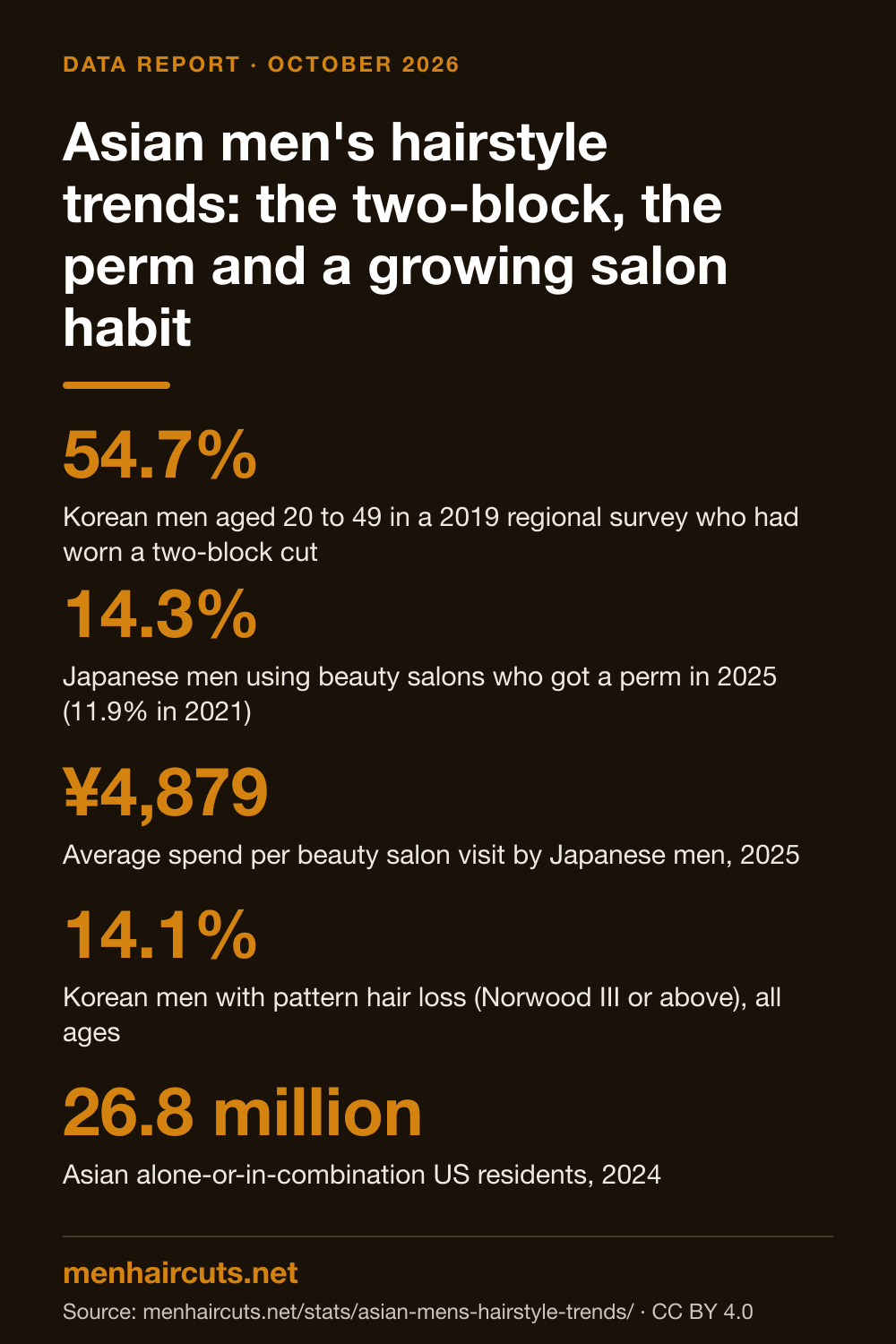
Download the infographic
The headline numbers from this report as one tall image (1000 x 1500 PNG), sized for Pinterest, slides and posts. Free to reuse with credit.
What are the most popular hairstyles for Asian men in 2026?
No government agency counts haircuts by style, so popularity has to be pieced together from surveys, salon data and retail figures. The clearest style-level number comes from South Korea, where the two-block cut (short or clipped sides under a longer top that falls over them) has been the default young men's cut for most of the past decade.
A 2019 survey of 430 men aged 20 to 49 in South Jeolla Province, published in the Journal of Industrial Convergence in 2020, found that 61.2% were interested in a two-block haircut and 54.7% had already worn one[1]. Among the men who had tried it, 92.3% said they were satisfied, and 58.4% of all respondents said they chose their haircut on their own rather than on a friend's suggestion[1]. The sample is regional and small, so treat it as a strong signal rather than a national figure.
In Japan the data is about services rather than named cuts. Men who use beauty salons there are adding perms, color and eyebrow trims to the basic cut, which lines up with the softer, textured fringe and down-perm looks seen across East Asian pop culture[2]. The sections below break those numbers down by year and age.
- Two-block cut: 54.7% of surveyed Korean men aged 20 to 49 had worn one (2019 survey)[1].
- Perm: 14.3% of Japanese men using beauty salons got one in 2025[2].
- Hair color: 18.9% of Japanese men using beauty salons had color done in 2025[2].
- Eyebrow cut: 15.1% of Japanese men using beauty salons had one in 2025, the third most used service[2].
How many Japanese men get perms and other salon services?
Recruit's Hot Pepper Beauty Academy runs the Beauty Census, an online survey of 13,200 people aged 15 to 69 living in Japanese cities of 200,000 or more[8]. Its 2025 data shows that nearly every male salon customer still gets a cut (97.3%), but a growing slice adds something else[2].
Perm use among men rose four years in a row, from 11.9% in 2021 to 15.3% in 2024, then dipped to 14.3% in 2025[2]. Over the same years, women's perm use fell from 11.7% to 7.3%, so by 2025 men who visit salons were roughly twice as likely as women to get a perm[2]. In its 2024 release the academy noted that men use perms not only for style but to deal with flat hair or hair that will not sit right[9].
Hair straightening is the other service on the rise for men, moving from 6.6% in 2021 to 9.2% in 2025[2]. Straightening and perms solve opposite problems, and both point to men paying for texture control rather than just length.
| Service | 2021 | 2022 | 2023 | 2024 | 2025 |
|---|---|---|---|---|---|
| Cut | 98.4 | 97.5 | 97.8 | 97.0 | 97.3 |
| Color | 17.7 | 19.0 | 17.4 | 19.6 | 18.9 |
| Eyebrow cut | 14.9 | 14.3 | 13.3 | 14.7 | 15.1 |
| Perm | 11.9 | 12.3 | 13.2 | 15.3 | 14.3 |
| Treatment | 13.9 | 12.9 | 12.1 | 15.1 | 14.1 |
| Straightening | 6.6 | 6.2 | 6.7 | 8.8 | 9.2 |
How much do Japanese men spend on a haircut?
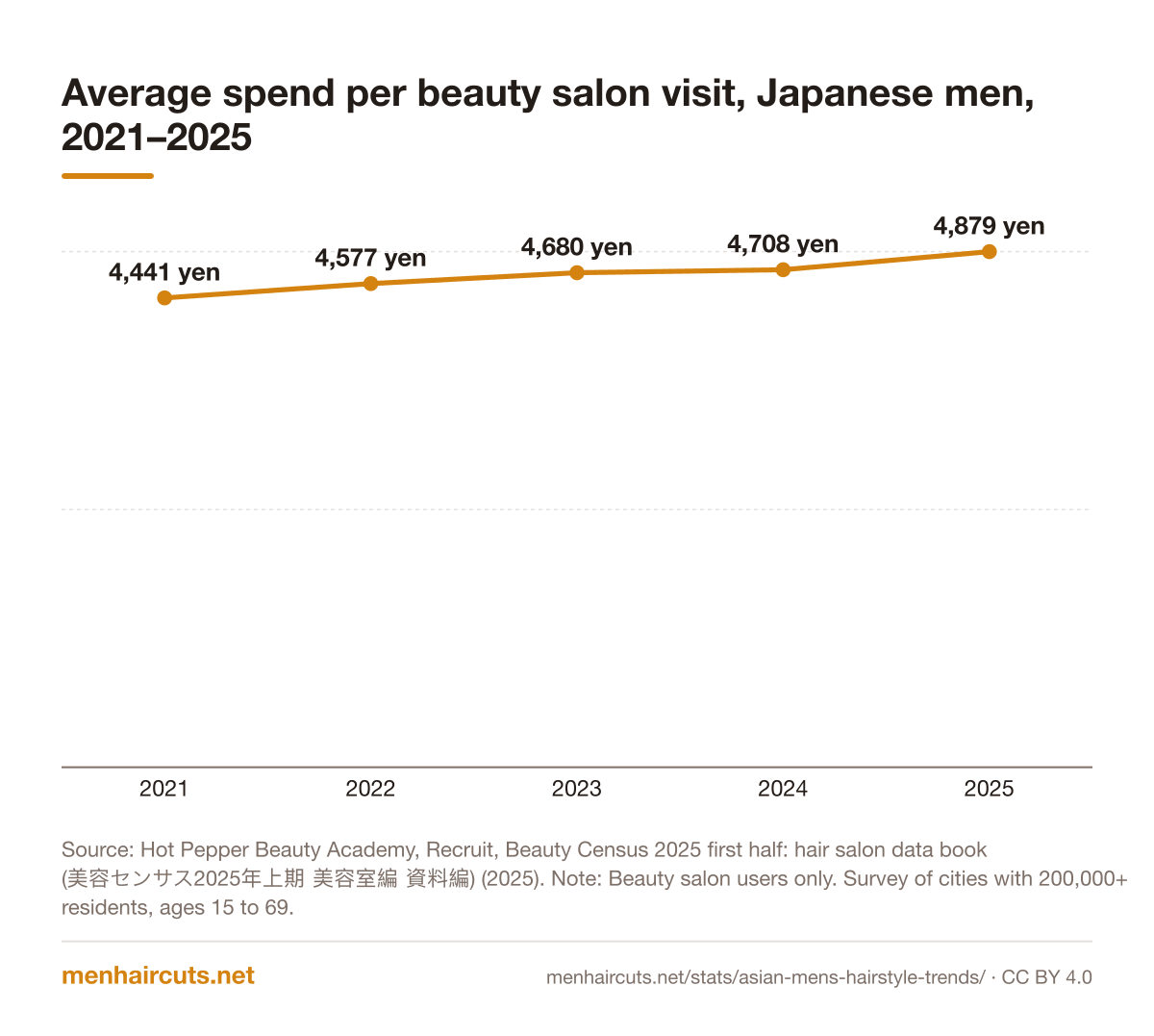
The average Japanese man who used a beauty salon spent 4,879 yen per visit in 2025, the highest in the five years the academy compares[2]. That is up from 4,441 yen in 2021, an increase of about 9.9% (menhaircuts.net calculation: (4,879 − 4,441) ÷ 4,441). Men in their 20s spent the most, at 5,064 yen per visit[2].
In its 2024 release, the academy said the main reason customers gave for higher bills was menu price increases, such as higher cut prices, with men also citing more spending on color, treatments and perms[9].
Traditional barbers (rihatsu-ten) remain much cheaper. Men spent an average of 2,751 yen per barber visit in 2025, and 53.4% paid 2,000 yen or less[5]. Male beauty salon customers also went more often than once a season, averaging 5.24 visits a year in 2025[2].
Show the numbers
| Category | Value |
|---|---|
| 2021 | 4,441 yen |
| 2022 | 4,577 yen |
| 2023 | 4,680 yen |
| 2024 | 4,708 yen |
| 2025 | 4,879 yen |
Do young Asian men prefer barbers or hair salons?
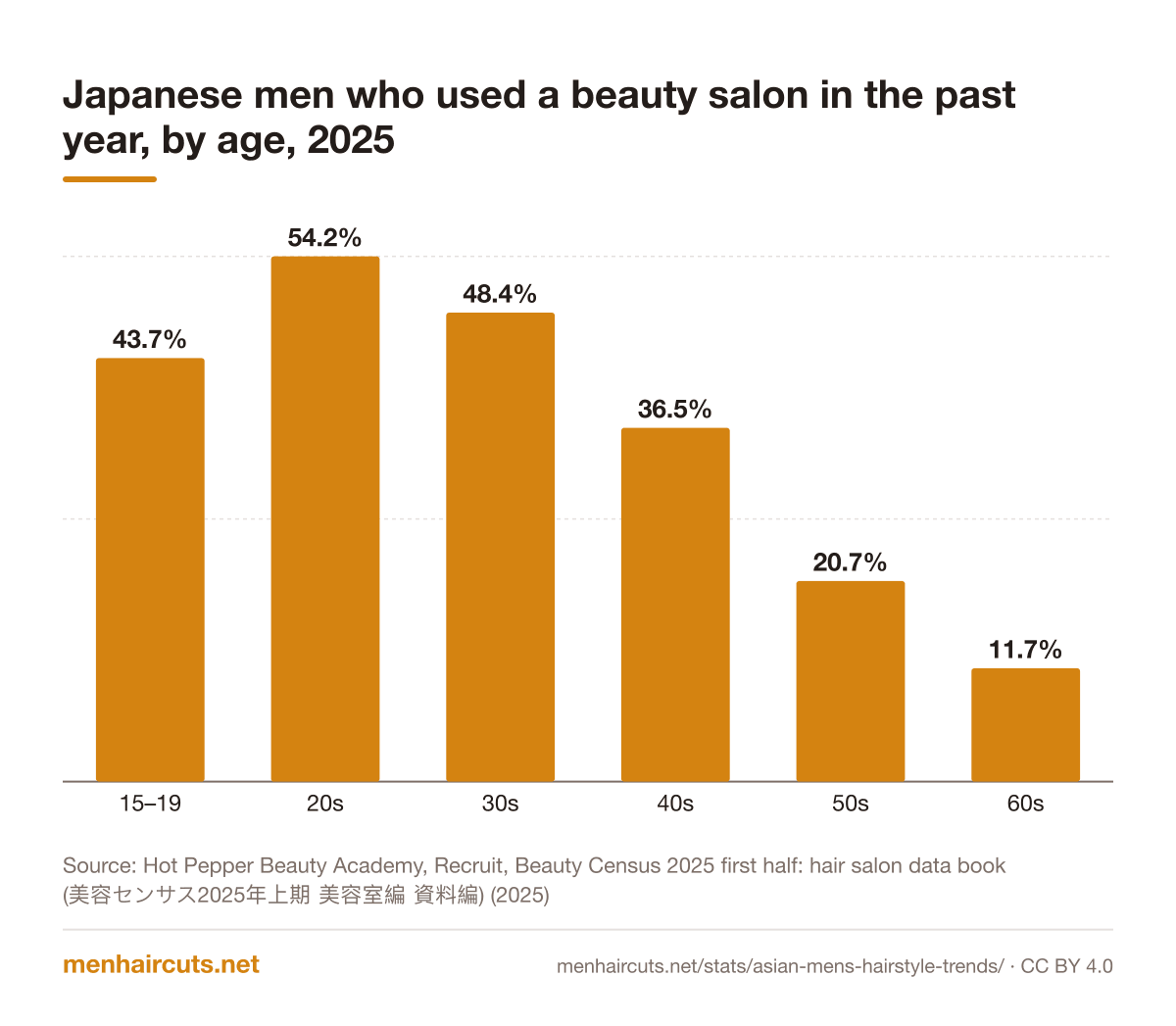
In Japan the answer depends on age. In 2025, 34.5% of men aged 15 to 69 had used a beauty salon in the past year and 44.2% had used a barber[2][5]. The split by age is sharp: beauty salons win among men under 40, and barbers win from the 40s up[2][5].
Men in their 20s were the heaviest salon users, at 54.2%, while only 11.7% of men in their 60s went to a beauty salon[2]. Barber use runs the other way, from 28.3% of teens to 63.3% of men in their 60s[5].
South Korea has a similar split between the traditional barber, called an ibalso, which mostly serves older men, and newer shops that use the English word "barbershop" and focus on stylish short cuts for younger men[10]. Korea also has far more hair salons per person than the US: KB Financial Group's research institute counted more than 110,000 salons, including barbers, as of September 2020, or 21.3 per 10,000 people, compared with about 2 per 10,000 in the US[10].
Show the numbers
| Category | Value |
|---|---|
| 15–19 | 43.7% |
| 20s | 54.2% |
| 30s | 48.4% |
| 40s | 36.5% |
| 50s | 20.7% |
| 60s | 11.7% |
| Age | Beauty salon | Barber |
|---|---|---|
| 15–19 | 43.7 | 28.3 |
| 20s | 54.2 | 31.3 |
| 30s | 48.4 | 35.6 |
| 40s | 36.5 | 40.3 |
| 50s | 20.7 | 55.1 |
| 60s | 11.7 | 63.3 |
How common is hair loss in Asian men?
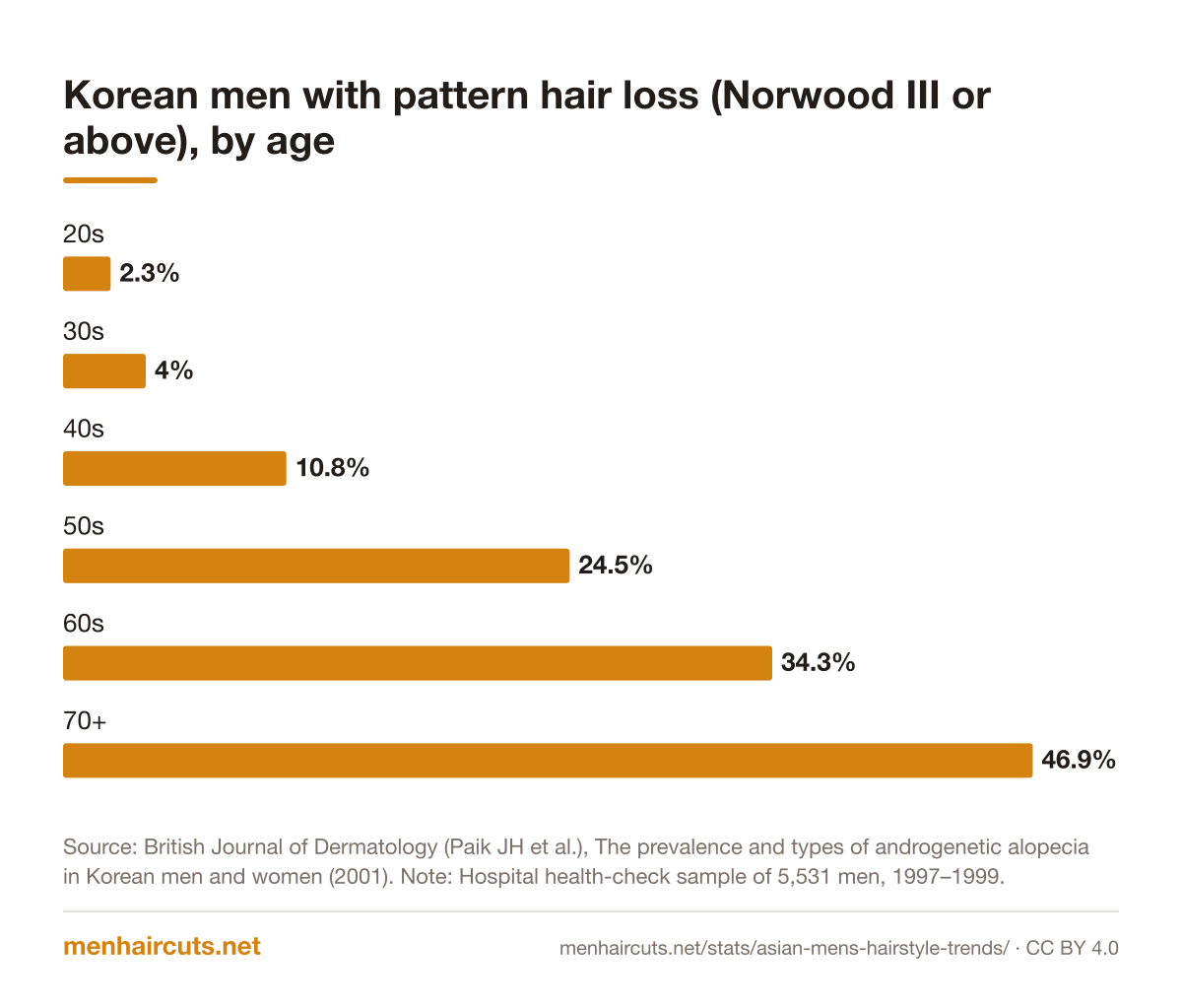
Hair loss shapes hairstyle choice more than any trend, and the data shows East Asian men keep their hair longer on average than white men. A study of 5,531 Korean men examined at Kyung Hee University Hospital between 1997 and 1999 found that 14.1% had pattern hair loss at Norwood III or above[4]. Prevalence climbed with age, from 2.3% of men in their 20s to 46.9% of men over 70[4].
The same study reported that Korean men tend to keep more of their frontal hairline and more often show a diffuse "female pattern" of thinning (11.1% of cases) than white men[4]. That matters for styling: a preserved hairline makes fringe-forward cuts like the two-block and comma hair workable for longer, while thinning at the crown pushes men toward volume-adding perms or shorter tops.
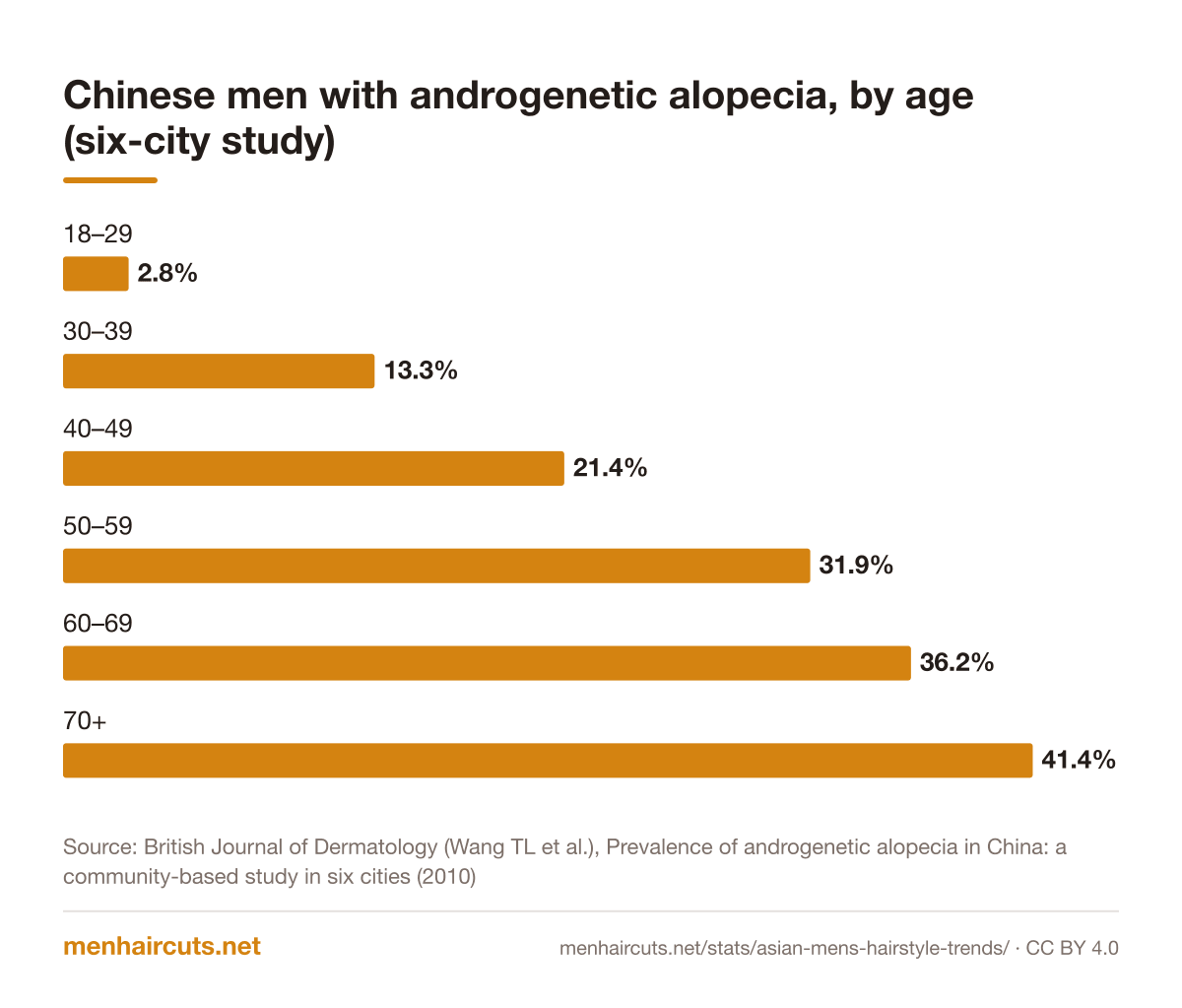
In China, a community study of 15,257 people in six cities found androgenetic alopecia in 21.3% of men overall, from 2.8% at ages 18 to 29 to 41.4% at 70 and over[6]. A separate Shanghai study of 3,519 men put prevalence at 19.9%, with crown thinning (type III vertex) the most common pattern[11].
Show the numbers
| Category | Value |
|---|---|
| 20s | 2.3% |
| 30s | 4% |
| 40s | 10.8% |
| 50s | 24.5% |
| 60s | 34.3% |
| 70+ | 46.9% |
Are more young Korean and Chinese men worried about hair loss?
Concern is rising faster than prevalence. Korea's National Health Insurance Service data showed 233,194 people visited hospitals for hair loss in 2020, and around 43% were in their 20s or 30s[12]. Patients in their 20s numbered 48,257, up 15.4% from 2016[12]. These counts include women.
In a survey of 400 Koreans aged 20 to 60 by Amway Korea and Opensurvey, 62.3% said they worried about hair loss, and 28.7% said their hair loss began in their 20s[12].
The Chinese data shows the same age curve. In the six-city study, prevalence among men jumped from 2.8% at ages 18 to 29 to 13.3% at ages 30 to 39[6]. For men picking a style in their 30s, that is often when a heavy fringe or a perm starts to do double duty as cover.
Show the numbers
| Category | Value |
|---|---|
| 18–29 | 2.8% |
| 30–39 | 13.3% |
| 40–49 | 21.4% |
| 50–59 | 31.9% |
| 60–69 | 36.2% |
| 70+ | 41.4% |
How much do Korean men spend on grooming?
South Korea is one of the most active men's grooming markets in the world. Euromonitor estimated the domestic men's cosmetics market at about 1.1 trillion won ($821.6 million) in 2023, up nearly 4% from 2022, with a forecast of 1.16 trillion won by 2025, as reported by The Korea Times[7].
Retail data points the same way. At CJ Olive Young, Korea's largest health and beauty chain, the share of first-time buyers who were men rose from 20% in 2021 to 30% in 2023, and men's purchases of men's cosmetics and beauty items rose nearly 40% in the first half of 2023[13]. A 2024 Olive Young survey of 1,000 men found that nine in 10 said personal grooming was necessary, with average spending of 70,000 won a month on beauty products[14].
Convenience and discount stores have joined in. A GS25 representative said men made up 45% of the chain's cosmetics sales in 2024, and Daiso reported a 154% rise in men's cosmetics sales from January to July 2024[14][15]. Olive Young's men's beauty pop-up drew more than 12,000 visitors in 10 days (Aug. 30 to Sept. 8, 2024), and the company said 80% were men[15].
What about men's grooming in China and India?
China's figures are older but show fast growth. A September 2018 white paper from Tmall Innovation Center and L'Oréal China reported that sales of male-beauty products in China grew 59% in fiscal 2017 and 54% in fiscal 2018[16]. The same paper found that male-only purchases of hair products on Tmall rose 47%[17]. The South China Morning Post described the market at the time as nearly $2 billion[16].
In India, a 2018 Mintel survey of 1,500 men found that the average man spent 42 minutes a day grooming, including 14 minutes on his hair[18]. Men in metro areas spent 21 minutes a day on their hair, and 20% of all respondents were concerned about baldness or thinning hair[18]. Our separate guide covers cuts for South Asian men in more detail.
How many Asian American men are there in the US?
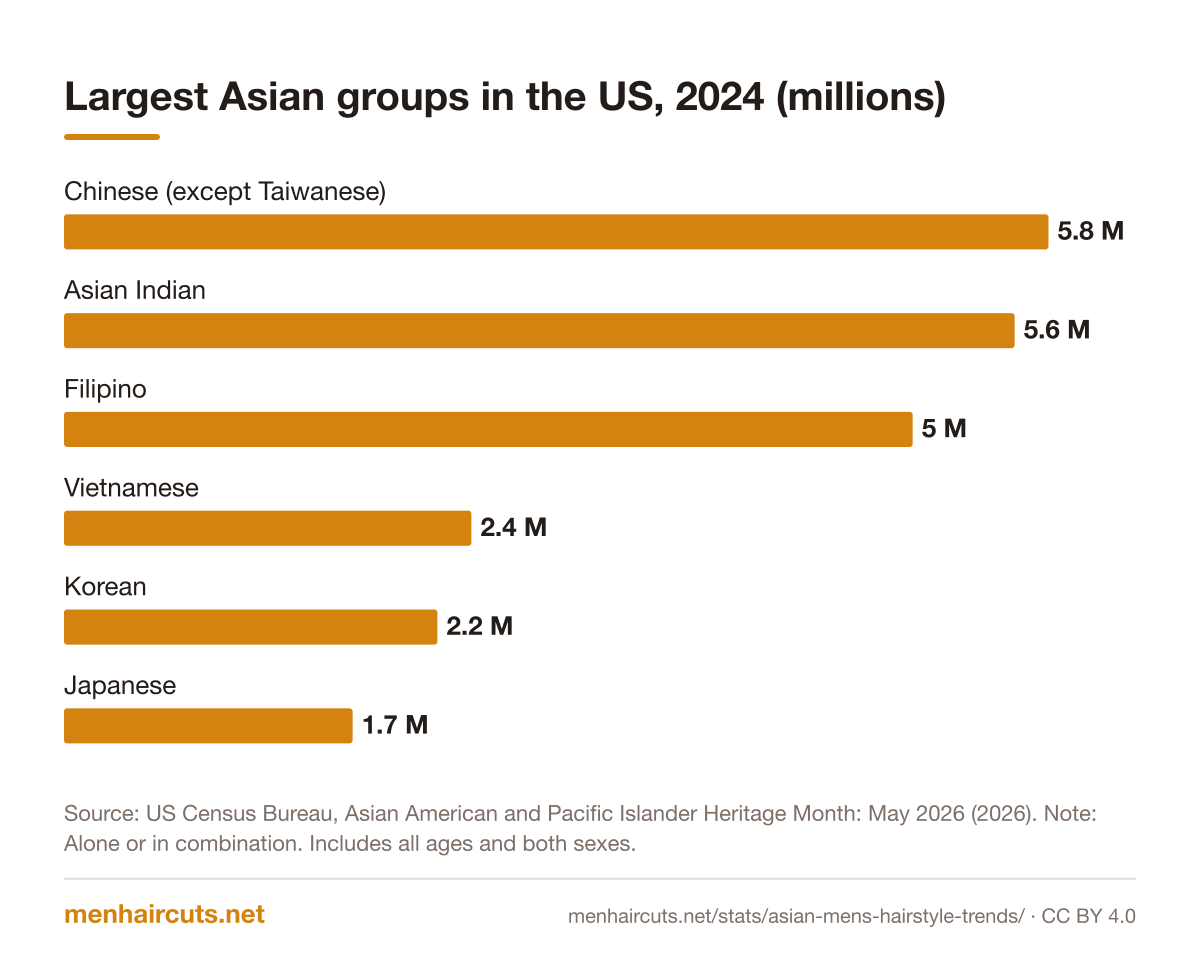
The US Census Bureau estimates that about 26.8 million people who identify as Asian alone or in combination with another race lived in the United States in 2024[3]. The group most often counted as Asian in hair-trend coverage, East Asians, is only part of it: people of Asian Indian and Filipino descent are the second and third largest groups[3].
Pew Research Center found that the Asian population grew 81% from 2000 to 2019, from about 10.5 million to 18.9 million, the fastest growth of any major racial or ethnic group, and projected it to reach 35.8 million by 2060[19]. Census does not publish haircut data by race, so the style trends above come from Asian countries rather than from Asian American men directly.
Show the numbers
| Category | Value |
|---|---|
| Chinese (except Taiwanese) | 5.8 M |
| Asian Indian | 5.6 M |
| Filipino | 5 M |
| Vietnamese | 2.4 M |
| Korean | 2.2 M |
| Japanese | 1.7 M |
Frequently asked questions
What is the most popular haircut for Korean men?
How many Japanese men get perms?
How much does a men's haircut cost in Japan?
Do Asian men go bald less often?
At what age do Korean men start losing hair?
How big is the men's cosmetics market in South Korea?
How many Asian Americans are there?
Methodology and limitations
This page was compiled in October 2026 from the sources listed below, each opened and checked for the exact figures quoted. Japanese salon data comes from the Hot Pepper Beauty Academy Beauty Census 2025 (first half) data books for hair salons and barbers, fielded online in February 2025. Hair loss prevalence comes from peer-reviewed studies indexed on PubMed. Korean and Chinese market figures come from news outlets quoting named sources (Euromonitor, CJ Olive Young, GS25, Daiso, the Tmall and L'Oréal white paper and Korea's National Health Insurance Service). US population figures come from the Census Bureau and Pew Research Center. The one calculation (the 9.9% rise in Japanese men's salon spending) is labeled menhaircuts.net calculation and uses only figures from the cited source.
Limitations
No country publishes official counts of haircuts by style, so style popularity rests on one regional Korean survey of 430 men and on Japanese service-level data. The Japanese survey covers only cities of 200,000 or more and people aged 15 to 69. The Korean and Chinese hair loss studies were published between 2001 and 2010 and used hospital or community samples, so current rates may differ. Korean hospital visit counts include women. Chinese market data is from 2018 and Indian data from 2018. Company figures from Olive Young, GS25 and Daiso describe their own customers, not the whole market. US Census figures cover all Asian Americans, not men alone, and there is no national US data on haircut choices by race.
Every figure on this page links to its source. Numbers are reported as published; any menhaircuts.net calculation is labelled and shows its inputs. Spotted an error? Tell us and we will check it.
Sources
- Current 2-Block Haircut Styles and Preferences in Men, Journal of Industrial Convergence (Sim E-H, Lim S-N) (2020). Accessed October 15, 2026.
- Beauty Census 2025 first half: hair salon data book (美容センサス2025年上期 美容室編 資料編), Hot Pepper Beauty Academy, Recruit (2025). Accessed October 15, 2026.
- Asian American and Pacific Islander Heritage Month: May 2026, US Census Bureau (2026). Accessed October 15, 2026.
- The prevalence and types of androgenetic alopecia in Korean men and women, British Journal of Dermatology (Paik JH et al.) (2001). Accessed October 15, 2026.
- Beauty Census 2025 first half: barber data book (美容センサス2025年上期 理容室編 資料編), Hot Pepper Beauty Academy, Recruit (2025). Accessed October 15, 2026.
- Prevalence of androgenetic alopecia in China: a community-based study in six cities, British Journal of Dermatology (Wang TL et al.) (2010). Accessed October 15, 2026.
- Beauty firms turn to men's cosmetics, The Korea Times (citing Euromonitor and CJ Olive Young) (2023). Accessed October 15, 2026.
- Beauty Census 2025 first half press letter, Hot Pepper Beauty Academy, Recruit (2025). Accessed October 15, 2026.
- Beauty Census 2024 first half: hair salon and barber press release, Hot Pepper Beauty Academy, Recruit (2024). Accessed October 15, 2026.
- Like my hair? Get yours done at a Korean hair salon, if you know how, The Korea Herald (citing KB Financial Group Management Research Institute) (2024). Accessed October 15, 2026.
- Prevalence and types of androgenetic alopecia in Shanghai, China: a community-based study, British Journal of Dermatology (Xu F et al.) (2009). Accessed October 15, 2026.
- Young Koreans losing hair, tonics, pills and tinctures fly off shelves, Korea JoongAng Daily (citing National Health Insurance Service; Amway Korea and Opensurvey) (2021). Accessed October 15, 2026.
- CJ Olive Young to expand men's product line, KED Global (2023). Accessed October 15, 2026.
- As male beauty market gets hot, retailers look to capitalize, Korea JoongAng Daily (2025). Accessed October 15, 2026.
- Men's makeup market begins to heat up in Korea, The Korea Times (2024). Accessed October 15, 2026.
- Beautify like Beckham: Chinese men splash the cash to keep up appearances, South China Morning Post (citing Tmall Innovation Center and L'Oréal China) (2018). Accessed October 15, 2026.
- L'Oréal China, Tmall partner to tap male beauty market, Alizila (Alibaba Group news), citing Tmall Innovation Center and L'Oréal China (2018). Accessed October 15, 2026.
- India's dapper men: average Indian man spends 42 minutes grooming per day, Mintel (2019). Accessed October 15, 2026.
- Asian Americans are the fastest-growing racial or ethnic group in the U.S., Pew Research Center (2021). Accessed October 15, 2026.
Cite, embed and download
This report, its charts and its infographic are free to reuse under a Creative Commons Attribution 4.0 license. Credit menhaircuts.net with a link to this page.
Cite this report (APA)
Hamilton, J. (2026, October 15). Asian Men's Hairstyle Trends 2026: Data and Statistics. menhaircuts.net. https://menhaircuts.net/stats/asian-mens-hairstyle-trends/
Link to this report
<a href="https://menhaircuts.net/stats/asian-mens-hairstyle-trends/">Asian Men's Hairstyle Trends 2026: Data and Statistics</a> (menhaircuts.net, CC BY 4.0)Share the headline number
54.7%: Korean men aged 20 to 49 in a 2019 regional survey who had worn a two-block cut (Journal of Industrial Convergence (Sim E-H, Lim S-N), via menhaircuts.net/stats/asian-mens-hairstyle-trends/)
Download the charts and infographic
- Average spend per beauty salon visit, Japanese men, 2021–2025 (PNG)
- Japanese men who used a beauty salon in the past year, by age, 2025 (PNG)
- Korean men with pattern hair loss (Norwood III or above), by age (PNG)
- Chinese men with androgenetic alopecia, by age (six-city study) (PNG)
- Largest Asian groups in the US, 2024 (millions) (PNG)
- Infographic: Asian Men's Hairstyle Trends 2026 (PNG, 1000 x 1500)
Related data
- 50 millionUS men with androgenetic alopecia (male pattern hair loss)Male Hair Loss Statistics 2026
- 16%of UK men wear a buzz cut, the most common style (2025)Most Popular Men's Haircuts by Country
- $298.9BGlobal men's grooming products market, 2025 (Grand View Research)Men's Grooming Market Size 2026
- 39%of US men say they have a consistent skincare routine (women: 60%), 2024Men's Skincare Statistics 2026
Related guides
Make us a Preferred Source on Google
See our latest articles first in your Google Search & AI Overviews.