
Data report · Updated October 2026
Male hair loss statistics: 50 million US men have pattern hair loss
How common male pattern baldness is, who gets it, how early it starts and what the research says about genes and treatment.
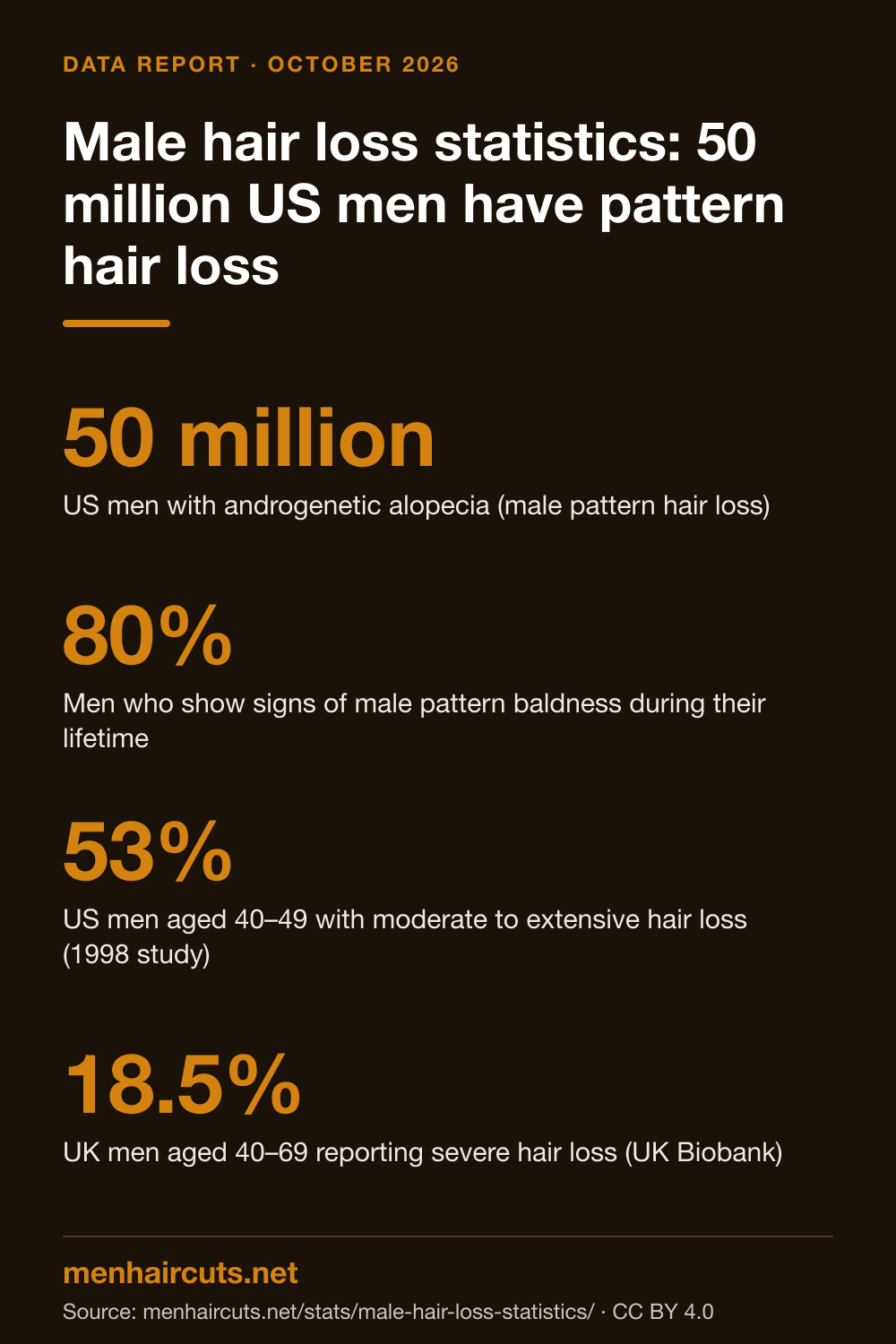
Male pattern hair loss affects an estimated 50 million men in the United States[1], and about 80% of men show signs of it during their lifetime[2]. In a US community study, 53% of men aged 40–49 had moderate to extensive hair loss[3]. Genes explain most of the risk.

50 million
US men with androgenetic alopecia (male pattern hair loss)[1]
80%
Men who show signs of male pattern baldness during their lifetime[2]
53%
US men aged 40–49 with moderate to extensive hair loss (1998 study)[3]
18.5%
UK men aged 40–69 reporting severe hair loss (UK Biobank)[4]
By Jessica Hamilton, Editor · Published · Updated · Free to reuse with credit (CC BY 4.0)
Key findings
- Androgenetic alopecia affects an estimated 80 million Americans: 50 million men and 30 million women[5].
- More than 50 percent of men over age 50 have some degree of hair loss, and the condition can start in the teens[1].
- In a community sample of US men aged 18–49, 42% had moderate to extensive hair loss (Norwood type III or greater), rising from 16% at ages 18–29 to 53% at ages 40–49[3].
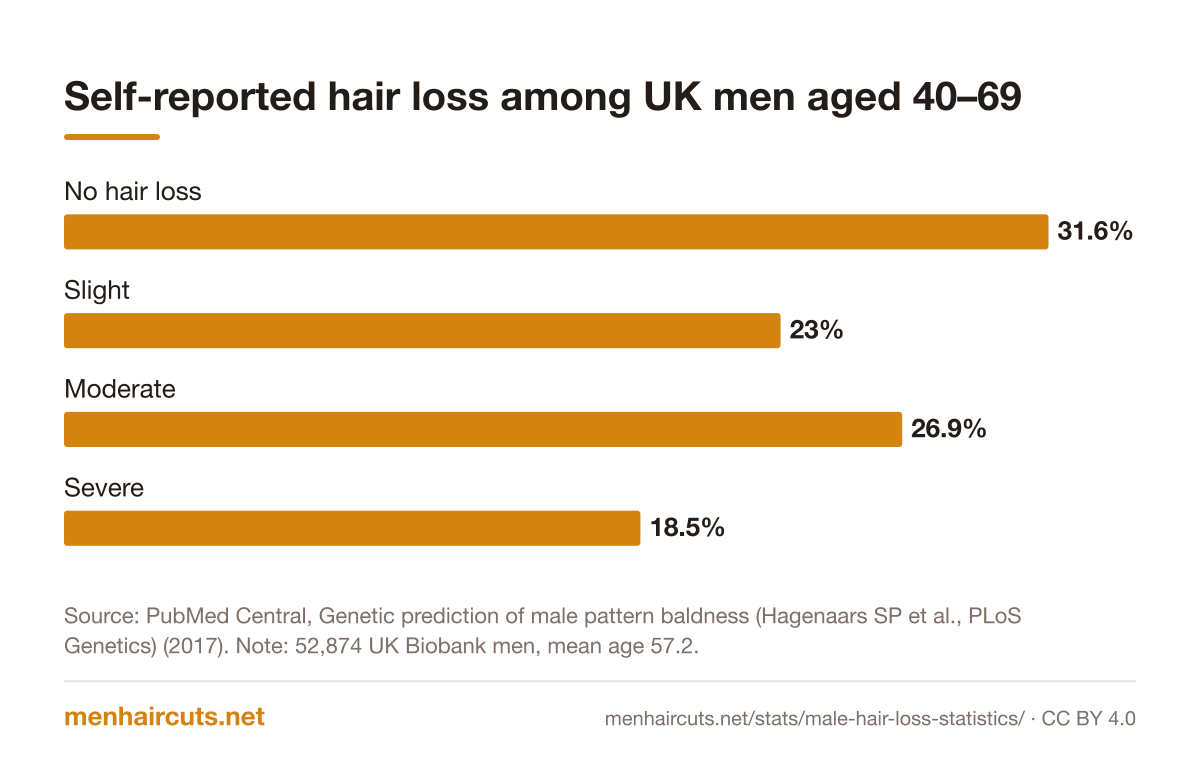
- Among 52,874 UK Biobank men (mean age 57.2), 31.6% reported no hair loss, 23.0% slight, 26.9% moderate and 18.5% severe hair loss[4].
- Hair loss is less common in East Asian men: 14.1% of Korean men[6] and 19.9% of men in a Shanghai community study had androgenetic alopecia[7].
- Twin studies put the heritability of male pattern baldness at about 80%[4], and 63 known gene regions explain about 39% of the variation in it[8].
- In a meta-analysis of studies covering 36,990 people, men with severe baldness in cohort studies had a higher adjusted risk of coronary heart disease (relative risk 1.32), driven by crown (vertex) baldness rather than a receding front[9].
Download the infographic
The headline numbers from this report as one tall image (1000 x 1500 PNG), sized for Pinterest, slides and posts. Free to reuse with credit.
How many men have male pattern hair loss?
Male pattern hair loss, known medically as androgenetic alopecia, is the most common cause of hair loss. The American Academy of Dermatology (AAD) estimates it affects 80 million Americans, made up of 50 million men and 30 million women[5]. The AAD figure comes from the National Library of Medicine's MedlinePlus Genetics summary, which gives the same 50 million men and 30 million women split[1].
On a lifetime basis the number is higher still. MedlinePlus, the US government's consumer health encyclopedia, says about 80% of men show signs of male pattern baldness during their lifetime and that it can start at any time after puberty[2]. A large UK genetics paper makes the same point from the other direction: it notes that male pattern baldness affects around 80% of men by age 80[4].
These are estimates, not a census. No national survey in the US physically examines a representative sample of men for hair loss each year, so the 50 million figure is best read as an order of magnitude: tens of millions of American men, and a clear majority by old age.
What percentage of men lose their hair by age 30, 40 and 50?
Age is the strongest single predictor after genes. MedlinePlus says more than 50 percent of men over age 50 have some degree of hair loss[1], and that men may start showing signs of baldness by the time they are 30, with many men nearly bald by age 60[10].
The most cited US community study, published in Dermatologic Surgery in 1998, examined healthy men aged 18–49 rather than patients at a clinic. A trained observer graded each man on the Norwood scale. Overall, 42% had moderate to extensive hair loss (type III or greater). That share rose from 16% of men aged 18–29 to 53% of men aged 40–49[3].
An Australian study of 1,390 randomly selected men aged 40–69, published in the British Journal of Dermatology in 2003, found that crown (vertex) or full balding rose from 31% at ages 40–55 to 53% at ages 65–69. A receding front alone stayed steady at 31–33% across all those age groups[11].
How severe is hair loss in middle-aged men?
The UK Biobank gives one of the largest single snapshots. Men aged 40–69 picked the picture that best matched their hair pattern. Of 52,874 men with a mean age of 57.2, 31.6% reported no hair loss, 23.0% slight, 26.9% moderate and 18.5% severe hair loss[4].
Put another way, about two in three of these men reported at least some hair loss. That figure is a menhaircuts.net calculation: 23.0% + 26.9% + 18.5% = 68.4%[4]. Because it is self-reported, it may differ from what a dermatologist would grade in person.
Show the numbers
| Category | Value |
|---|---|
| No hair loss | 31.6% |
| Slight | 23% |
| Moderate | 26.9% |
| Severe | 18.5% |
Does male hair loss differ by ethnicity?
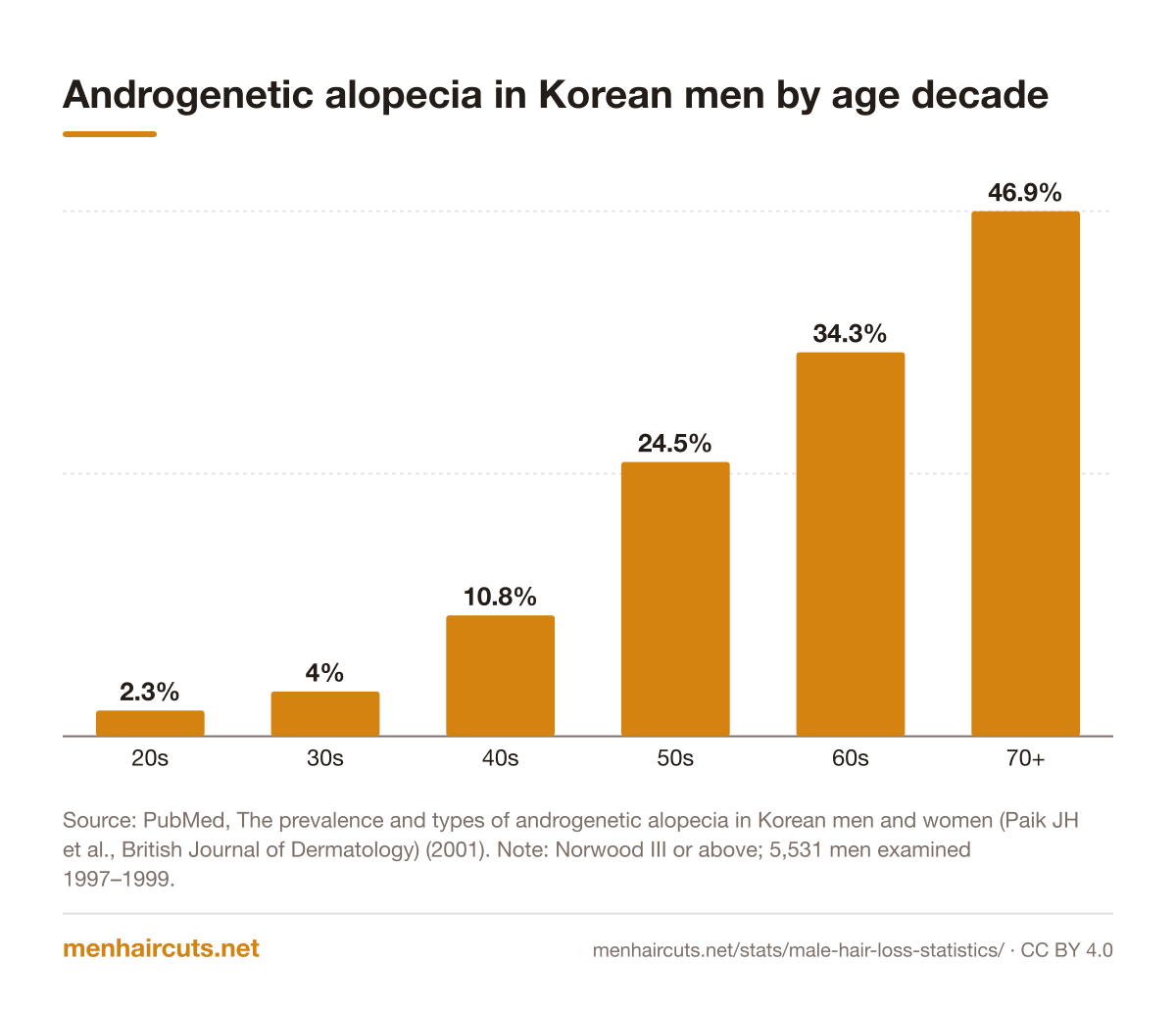
Yes. Studies in East Asia consistently find lower rates than studies of white men. A study of 5,531 Korean men examined at a hospital health check centre between 1997 and 1999 found a 14.1% prevalence of androgenetic alopecia (Norwood III or above) across all ages. It rose with each decade, from 2.3% in men in their 20s to 46.9% in men over 70[6]. Korean men also kept their frontal hairline more often than white men in earlier studies[6].
A community study of 3,519 men in Shanghai in 2006 found a 19.9% prevalence, similar to the Korean figure. Over age 60, though, Chinese rates approached those of white men[7].
Treatment response also varied by group in the finasteride trials. In the FDA label's combined analysis, mean hair count change over the trial was +91 hairs with finasteride versus -19 with placebo in white men, and +49 versus -27 in Black men[12]. The non-white groups were small, so those numbers are less certain.
Show the numbers
| Category | Value |
|---|---|
| 20s | 2.3% |
| 30s | 4% |
| 40s | 10.8% |
| 50s | 24.5% |
| 60s | 34.3% |
| 70+ | 46.9% |
Is male pattern baldness genetic?
Mostly, yes. Twin studies estimate that about 80% of the variation in male pattern baldness comes from genetic factors, for both early and late onset hair loss[4]. The largest early-onset genetic meta-analysis, published in Nature Communications in 2017, compared 10,846 cases with 11,672 controls and found 63 gene regions linked to baldness. Together they explain about 39% of the variation in the trait[8].
A separate UK Biobank analysis found more than 250 independent gene regions tied to severe hair loss[4]. Men in the top 10% of the genetic risk score were far more likely to report moderate to severe hair loss (58%) than men below the median, of whom 14% reported severe hair loss and 39% reported none[4].
Family history shows up in clinical studies too. A family history of baldness was present in 48.5% of Korean men with androgenetic alopecia[6] and 55.8% of affected men in the Shanghai study[7]. A genetic test cannot yet tell any one man whether he will go bald; the UK study described individual predictions as still relatively crude[4].
How young does male hair loss start?
Androgenetic alopecia can start as early as the teens[1]. In the US community study, 16% of men aged 18–29 already had moderate to extensive hair loss[3]. A 2021 study of 1,507 male university students aged 18–30 in Turkey found early-onset androgenetic alopecia in 19.2% of them[13].
The age at which men seek surgery tells a similar story. In the 2025 practice census of the International Society of Hair Restoration Surgery (ISHRS), covering 2024, members reported that 57.6% of first-time surgery patients were aged 26–35 and 37.3% were aged 20–25[14].
Is baldness linked to heart disease or other health risks?
Some studies link crown balding to heart disease. A 2013 BMJ Open meta-analysis of six observational studies covering 36,990 people found that, in its cohort studies, men with severe baldness had a higher adjusted risk of coronary heart disease (relative risk 1.32) than men without baldness[9]. The link held for crown baldness and grew with its severity. A receding front alone was not associated with heart disease (relative risk 1.11, not statistically significant)[9].
These are associations, not proof that hair loss causes heart problems. Baldness and heart disease share some biology, so the safest reading is that men with significant crown loss have one more reason to keep up with routine checkups.
What do men do about male pattern hair loss?
Only a few treatments have FDA backing. A 2017 meta-analysis in the Journal of the American Academy of Dermatology noted that minoxidil and finasteride are FDA-approved for androgenetic alopecia and that the HairMax LaserComb is FDA-cleared, and found all three better than placebo[15]. The UK's NHS also lists finasteride and minoxidil as the main treatments for male pattern baldness[16].
Among hair restoration surgeons in the ISHRS 2025 census, 72.3% said they always or often prescribed oral finasteride 1 mg to patients in 2024, and 64.7% said the same of oral minoxidil[14]. Men made up 84.7% of surgical hair restoration patients that year[14]. Many men skip treatment entirely and change their haircut instead, which is a perfectly healthy choice.
| Treatment | Always or often prescribed |
|---|---|
| Finasteride 1 mg (oral) | 72.3% |
| Minoxidil (oral) | 64.7% |
| Minoxidil 2% or 5% solution (topical) | 55.3% |
| Minoxidil 5% foam (topical) | 52.0% |
| Platelet-rich plasma (PRP) | 49.8% |
| Ketoconazole 2% shampoo | 37.3% |
| Dutasteride (oral) | 36.7% |
- Finasteride 1 mg: at 2 years, 17% of men taking it had lost hair (any drop in hair count from baseline) compared with 72% of men on placebo[12].
- Topical minoxidil 5%: produced 45% more regrowth than the 2% strength at 48 weeks in a trial of 393 men[17].
- Hair transplant: a UK hair transplant can cost between £1,000 and £30,000 and is not available on the NHS[18].
How much daily hair shedding is normal?
Losing some hair every day is not the same as balding. The NHS says people can lose between 50 and 100 hairs a day, often without noticing[16]. MedlinePlus gives a range of roughly 50 to 200 hairs a day from a scalp that holds about 100,000 hairs[2].
Pattern hair loss works differently from shedding. Follicles shrink over years, so the hair that grows back comes in finer and shorter until some follicles stop producing visible hair. That is why a gradual change at the temples or crown matters more than the number of hairs in the shower drain.
Frequently asked questions
What percentage of men go bald?
How many men in the US have male pattern baldness?
What percentage of men are balding at 30?
Is male pattern baldness inherited from your mother's side?
Are Asian men less likely to go bald?
How many hairs a day is normal to lose?
Is baldness a sign of heart disease?
Methodology and limitations
This report compiles prevalence and risk data on male pattern hair loss from US government health sources (MedlinePlus, part of the National Library of Medicine), the American Academy of Dermatology, the NHS, the FDA label for finasteride (Propecia), the ISHRS 2025 Practice Census, and peer-reviewed studies indexed in PubMed, including papers in the British Journal of Dermatology, Dermatologic Surgery, PLoS Genetics, Nature Communications and BMJ Open. Every figure was checked against the source page, abstract or full text in October 2026. Study years are given in the text. The 68.4% share of UK men with any hair loss is a menhaircuts.net calculation that adds the slight, moderate and severe categories reported by Hagenaars et al. This is general information, not medical advice; see a board-certified dermatologist about hair loss, especially if it is sudden, patchy or comes with other symptoms.
Limitations
Studies use different scales (Norwood grading by an observer versus self-reported pictures), different age bands and different decades, so their numbers should not be merged into one trend line. The most cited US prevalence study is from 1998 and covered men aged 18–49 only. The 50 million US estimate is a summary figure, not a measured national survey. Ethnic comparisons rely on separate studies in Korea, China and white populations rather than a single study using one method. Associations with heart disease come from observational studies and do not show cause. Nothing here replaces a diagnosis; this is general information, not medical advice.
Every figure on this page links to its source. Numbers are reported as published; any menhaircuts.net calculation is labelled and shows its inputs. Spotted an error? Tell us and we will check it.
Sources
- Androgenetic alopecia, MedlinePlus Genetics, National Library of Medicine (NIH) (2023). Accessed October 15, 2026.
- Hair loss (Medical Encyclopedia), MedlinePlus, National Library of Medicine (NIH) (2025). Accessed October 15, 2026.
- Prevalence of male pattern hair loss in 18-49 year old men (Rhodes T et al., Dermatologic Surgery), PubMed (1998). Accessed October 15, 2026.
- Genetic prediction of male pattern baldness (Hagenaars SP et al., PLoS Genetics), PubMed Central (2017). Accessed October 15, 2026.
- Skin conditions by the numbers, American Academy of Dermatology (2025). Accessed October 15, 2026.
- The prevalence and types of androgenetic alopecia in Korean men and women (Paik JH et al., British Journal of Dermatology), PubMed (2001). Accessed October 15, 2026.
- Prevalence and types of androgenetic alopecia in Shanghai, China: a community-based study (Xu F et al., British Journal of Dermatology), PubMed (2009). Accessed October 15, 2026.
- Meta-analysis identifies novel risk loci and yields systematic insights into the biology of male-pattern baldness (Heilmann-Heimbach S et al., Nature Communications), PubMed (2017). Accessed October 15, 2026.
- Male pattern baldness and its association with coronary heart disease: a meta-analysis (Yamada T et al., BMJ Open), PubMed (2013). Accessed October 15, 2026.
- Aging changes in hair and nails, MedlinePlus, National Library of Medicine (NIH) (2024). Accessed October 15, 2026.
- Androgenetic alopecia in men aged 40-69 years: prevalence and risk factors (Severi G et al., British Journal of Dermatology), PubMed (2003). Accessed October 15, 2026.
- PROPECIA (finasteride) tablets prescribing information, revised 07/2022, US Food and Drug Administration (2022). Accessed October 15, 2026.
- Prevalence of early-onset androgenetic alopecia and its relationship with lifestyle and dietary habits (Agaoglu E et al., Italian Journal of Dermatology and Venereology), PubMed (2021). Accessed October 15, 2026.
- 2025 Practice Census Results (2024 data), International Society of Hair Restoration Surgery (2025). Accessed October 15, 2026.
- The effectiveness of treatments for androgenetic alopecia: a systematic review and meta-analysis (Adil A, Godwin M, Journal of the American Academy of Dermatology), PubMed (2017). Accessed October 15, 2026.
- Hair loss, NHS (2024). Accessed October 15, 2026.
- A randomized clinical trial of 5% topical minoxidil versus 2% topical minoxidil and placebo in men (Olsen EA et al., Journal of the American Academy of Dermatology), PubMed (2002). Accessed October 15, 2026.
- Hair transplant, NHS (2023). Accessed October 15, 2026.
Cite, embed and download
This report, its charts and its infographic are free to reuse under a Creative Commons Attribution 4.0 license. Credit menhaircuts.net with a link to this page.
Cite this report (APA)
Hamilton, J. (2026, October 15). Male Hair Loss Statistics 2026: Facts and Figures. menhaircuts.net. https://menhaircuts.net/stats/male-hair-loss-statistics/
Link to this report
<a href="https://menhaircuts.net/stats/male-hair-loss-statistics/">Male Hair Loss Statistics 2026: Facts and Figures</a> (menhaircuts.net, CC BY 4.0)Share the headline number
50 million: US men with androgenetic alopecia (male pattern hair loss) (MedlinePlus Genetics, National Library of Medicine (NIH), via menhaircuts.net/stats/male-hair-loss-statistics/)
Download the charts and infographic
Related data
- 31–33%Men aged 40–69 with frontal-only hair loss (Australia)Receding Hairline Statistics 2026
- 35% vs 100%Men with hair loss after 5 years: finasteride vs placeboHair Loss Treatment Statistics 2026
- 84.7%Hair transplant patients who were men (ISHRS members, 2024)Hair Transplant Statistics 2026
- 62%of European men with hair loss agreed it could affect self-esteemHair and Confidence Statistics 2026
Related guides
Make us a Preferred Source on Google
See our latest articles first in your Google Search & AI Overviews.