
Data report · Updated October 2026
Hair transplant statistics: 85% of men's procedures now use FUE
Who gets hair transplants, which techniques surgeons use, how many grafts a session takes and what drives patients, from the ISHRS Practice Census.
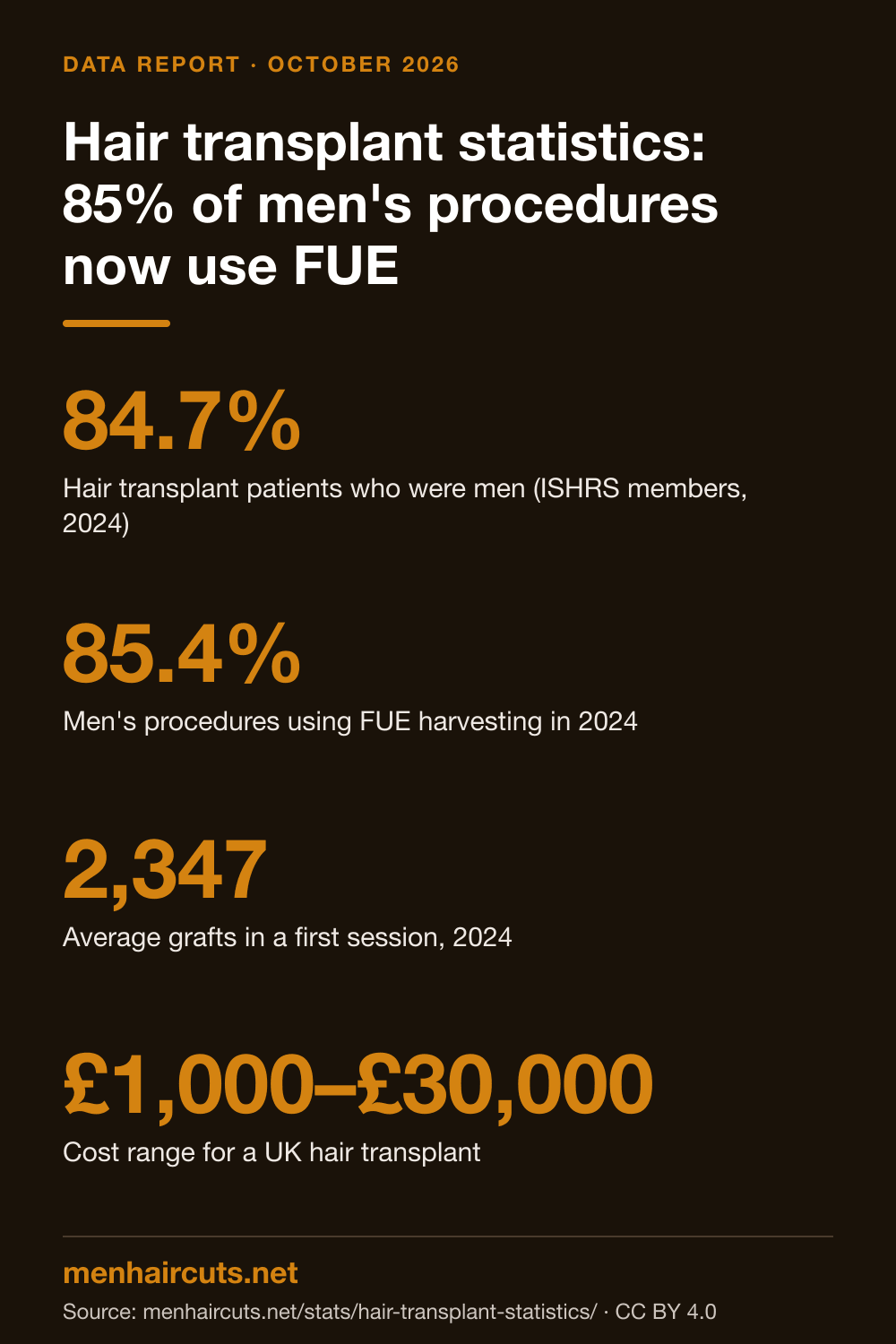
Men made up 84.7% of hair transplant patients treated by ISHRS surgeons in 2024, and 85.4% of men's procedures used follicular unit excision (FUE)[1]. A first session averaged 2,347 grafts, and most patients needed one procedure[1]. In the UK a transplant costs £1,000 to £30,000[2].

84.7%
Hair transplant patients who were men (ISHRS members, 2024)[1]
85.4%
Men's procedures using FUE harvesting in 2024[1]
2,347
Average grafts in a first session, 2024[1]
£1,000–£30,000
Cost range for a UK hair transplant[2]
By Jessica Hamilton, Editor · Published · Updated · Free to reuse with credit (CC BY 4.0)
Key findings
- Men made up 84.7% of surgical hair restoration patients treated by ISHRS members in 2024, and women 15.3%[1].
- FUE harvesting was used in 85.4% of men's procedures, strip harvesting in 12.5% and a combination in 2.1%[1].
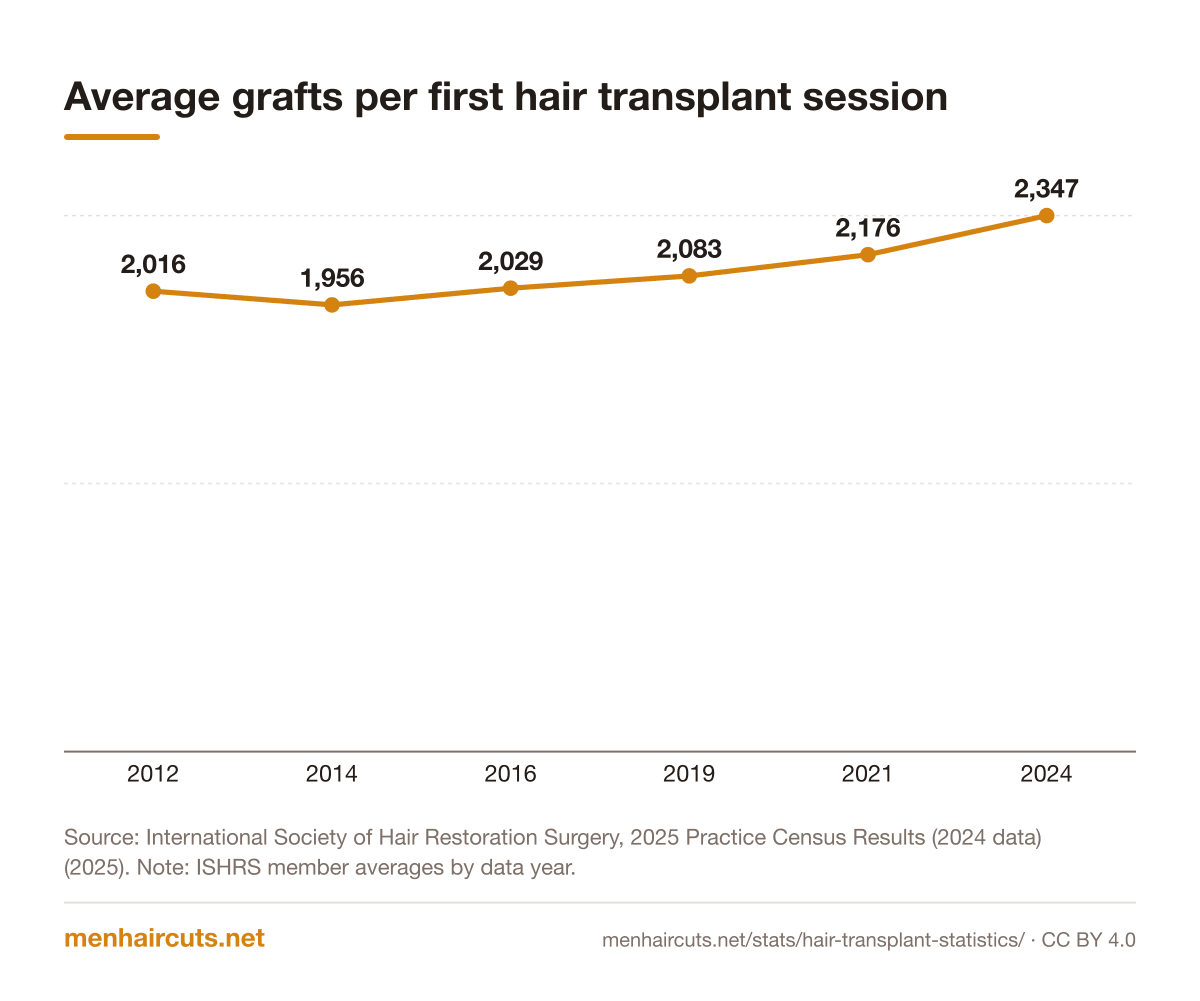
- The average first session grew from 2,016 grafts in 2012 to 2,347 grafts in 2024[1].
- Two-thirds of surgeons (67.3%) said patients usually needed only one procedure; the average was 1.5 in 2024, down from 5 in 2016[1].
- 57.6% of first-time patients were aged 26–35 and 37.3% were aged 20–25[1].
- 90.0% of surgeons said patients wanted to look or feel more attractive, and 62.7% cited looking younger to compete at work[1].
- 59.4% of ISHRS surgeons reported black market hair transplant clinics in their city in 2024, up from 51% in 2021[1][3].
Download the infographic
The headline numbers from this report as one tall image (1000 x 1500 PNG), sized for Pinterest, slides and posts. Free to reuse with credit.
How many hair transplants are performed each year?
There is no official worldwide count. The best data come from the International Society of Hair Restoration Surgery (ISHRS), which surveys its physician members. In its 2025 Practice Census, covering 2024, the average member performed 178 hair restoration procedures in the year, or 15 a month, and treated 156 surgical patients[1]. Members in the US and Canada averaged 200 procedures a year[1].
The society's previous census reported that ISHRS members treated 628,604 surgical patients in 2021, alongside 1,592,588 non-surgical patients, and put the hair restoration surgery market at $4.5 billion that year[3]. The ISHRS has more than 1,200 members across 80 countries[1], and many transplants are performed outside its membership, so treat these as specialist-practice figures rather than a global total.
Who gets hair transplants?
Mostly men, mostly young. Men accounted for 84.7% of surgical patients in 2024, down from 87.3% in 2021, as the female share rose to 15.3%[1]. More than half of male surgical patients (58.7%) were aged 30–49[1].
First procedures skew younger still. Members reported that 57.6% of patients having surgery for the first time were aged 26–35 and 37.3% were aged 20–25[1]. Most surgeons set a floor: 73.0% have a minimum age for surgery, with an average cut-off of 22 and a median of 23[1]. At the other end, 80.0% have no maximum age, and 66.1% require medical clearance for older patients[1].
Genetic hair loss is the main reason people come in, cited for 70.9% of hair restoration patients[1]. The NHS notes that transplants suit permanent, inherited baldness and are not usually suitable for patchy loss such as alopecia areata[2]. The pool of potential patients is large: androgenetic alopecia affects an estimated 50 million men in the United States[4].
Surgeons have long graded candidates with the Norwood scale. O'Tar Norwood published it in 1975 from a study of 1,000 white adult men, noting that transplant success depends largely on choosing the right patients[5].
FUE or FUT: which hair transplant method is most common?
Follicular unit excision (FUE), which removes grafts one by one, now dominates. In 2024, 85.4% of men's procedures used FUE harvesting, 12.5% used strip (linear) harvesting, known as FUT, and 2.1% combined the two in one session[1]. Women were more likely to have strip harvesting (30.0%)[1].
Within FUE, most surgeons use a hand-held motorized tool without suction (75.1% of FUE cases), followed by motorized with suction (19.8%), manual punches (3.8%) and robotic-assisted FUE (1.3%)[1]. The NHS describes the trade-off: FUT leaves a single scar at the back of the head that is usually hidden unless hair is cut very short, while FUE leaves many tiny scars that are not very noticeable[2].
| Method | Men | Women |
|---|---|---|
| FUE harvesting | 85.4% | 68.2% |
| Strip (linear) harvesting, FUT | 12.5% | 30.0% |
| Strip and FUE in the same session | 2.1% | 1.9% |
How many grafts does a hair transplant need?
Sessions have grown larger over the past decade. The average first procedure used 2,347 grafts in 2024, up from 2,016 in 2012, while a follow-up procedure averaged 1,637 grafts[1]. By method, the average typical case used 2,262 grafts for FUE and 2,100 for FUT[1].
Bigger sessions have cut the number of surgeries. Surgeons reported an average of 1.5 procedures per patient to reach the desired result in 2024, compared with 3.4 in 2019 and 5 in 2016; two-thirds (67.3%) said one procedure was typical[1]. Grafts usually come from the scalp (91.7% of FUE donor sites), with beard hair second at 6.1%[1].
Show the numbers
| Category | Value |
|---|---|
| 2012 | 2,016 |
| 2014 | 1,956 |
| 2016 | 2,029 |
| 2019 | 2,083 |
| 2021 | 2,176 |
| 2024 | 2,347 |
Why do men get hair transplants?
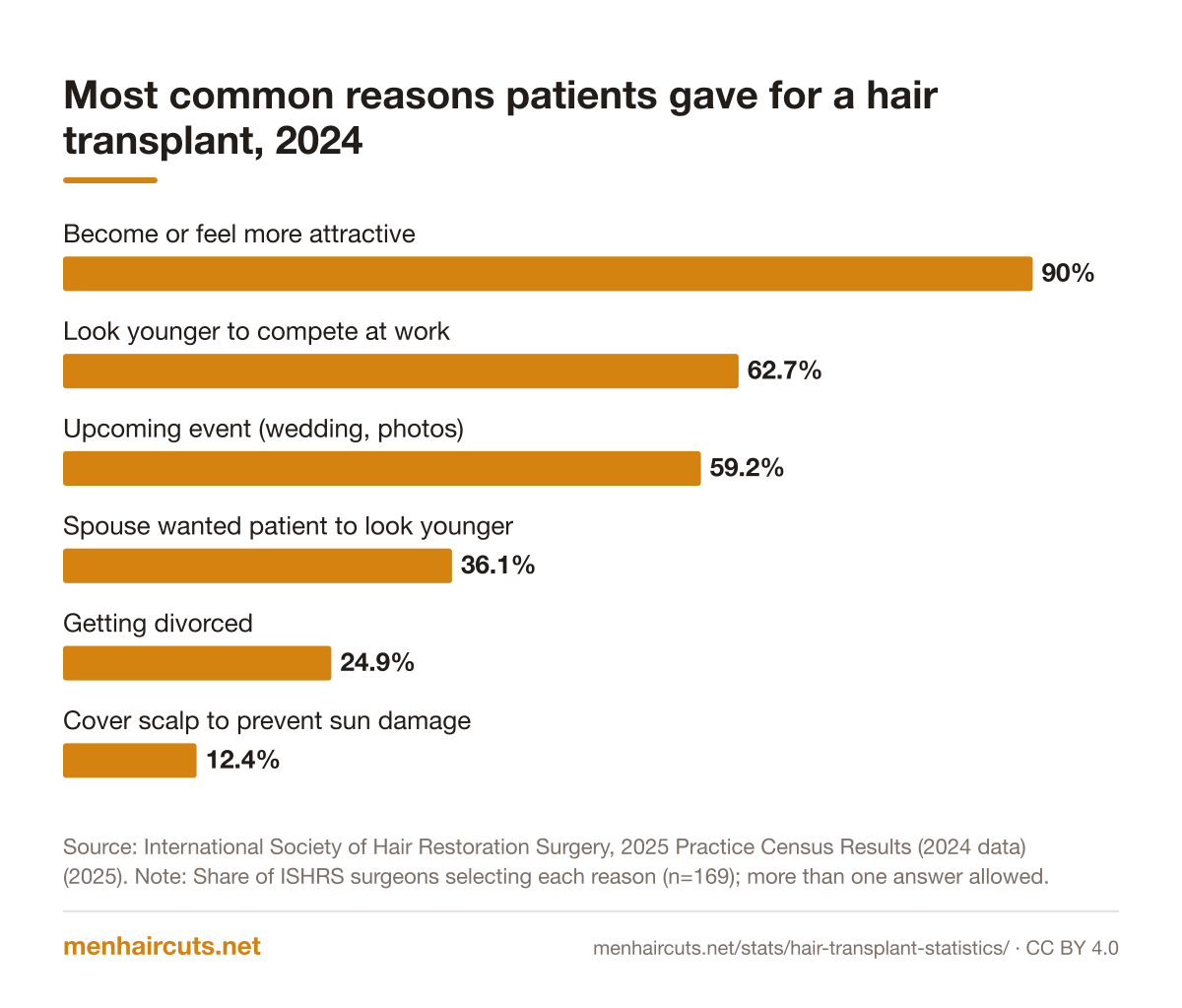
Appearance and career both matter. Asked for the most common reasons patients gave in 2024, 90.0% of surgeons said to become or feel more attractive, 62.7% said to look younger to compete in the workplace, and 59.2% said to look better for an upcoming event such as a wedding or graduation photos[1].
Results seem to help how people feel. A small 2024 study of 48 FUE patients in Aesthetic Plastic Surgery found significant improvements in quality of life scores and life satisfaction after surgery, with lower stress and anxiety scores[6]. Openness is mixed: surgeons said the majority of patients planned to tell friends, family and co-workers in 44.1% of cases, were unsure in 31.8% and did not plan to in 24.1%[1].
Show the numbers
| Category | Value |
|---|---|
| Become or feel more attractive | 90% |
| Look younger to compete at work | 62.7% |
| Upcoming event (wedding, photos) | 59.2% |
| Spouse wanted patient to look younger | 36.1% |
| Getting divorced | 24.9% |
| Cover scalp to prevent sun damage | 12.4% |
How much does a hair transplant cost?
Prices vary widely by clinic, country and the size of the job. The NHS says a hair transplant in the UK can cost anywhere between £1,000 and £30,000, depending on how much hair has been lost, the type of procedure and the quality of the clinic and its team. It is not available on the NHS because it is cosmetic surgery[2].
The ISHRS 2025 census did not publish average US fees, so we do not quote one here. Cost pressure is visible in other ways: 24.6% of ISHRS surgeons said they were changing their pricing structure in response to black market clinics, up from 16% who said so for 2021[1][3].
How common are black market hair transplants?
Increasingly common, according to surgeons. In 2024, 59.4% of ISHRS members said there were black market hair transplant clinics in their city, up from 51% in 2021[1][3]. Repair of a previous black market transplant made up an average of 10% of members' cases (median 5%)[1], and such repairs accounted for about 4% of male procedures[1].
The NHS advises checking that any clinic in England is registered with the Care Quality Commission and warns that some clinics pay to advertise in search listings[2]. Asking how many transplants a surgeon has performed and how many had complications is on the NHS's list of questions[2].
How long does hair transplant recovery take?
Expect a long wait for the final result. The NHS timeline runs like this[2]:
- 1 to 2 weeks off work may be needed[2].
- After 2 to 5 days: bandages can usually come off, but the grafts should not be touched[2].
- Day 6: hair can usually be washed gently by hand[2].
- After 10 to 14 days: non-dissolvable stitches can usually be removed[2].
- After a few weeks: transplanted hair often falls out before growing back[2].
- After 4 months: new hair usually starts to appear[2].
- After 10 to 18 months: full results should be visible[2].
Do hair transplant patients also use medication?
Usually. A transplant moves hair but does not stop the underlying pattern loss, and the NHS notes hair can keep thinning around the transplanted area[2]. That is why most hair restoration surgeons also prescribe medicine: in 2024, 72.3% always or often prescribed oral finasteride 1 mg and 64.7% oral minoxidil[1]. Minoxidil and finasteride are the FDA-approved drug options for male pattern hair loss[7]. In finasteride's 5-year trials, 35% of treated men lost hair compared with 100% of men on placebo[8], which is why surgeons often pair the drug with surgery to protect the hair that was not moved.
On what comes next, surgeons were split. The most common pick for the next big advance was lab-grown hair follicles, or hair cloning (27.9%), followed by stem cell therapy (26.7%) and a breakthrough drug (17.4%)[1].
Frequently asked questions
How many grafts does a hair transplant need?
Is FUE or FUT more common?
How much does a hair transplant cost in the UK?
What is the average age for a hair transplant?
How many procedures does a hair transplant take?
When will I see results from a hair transplant?
What percentage of hair transplant patients are women?
Methodology and limitations
Most figures come from the ISHRS 2025 Practice Census, which covers 2024 and was prepared by Relevant Research Consulting. Of 946 ISHRS physician members with valid email addresses, 247 responded (26%), with a stated margin of error of plus or minus 5.4% at the 95% confidence level; results were weighted by region[1]. Earlier-year comparisons come from the same report and from the ISHRS 2022 Practice Census news release. Patient-facing guidance on cost, methods and recovery comes from the NHS, drug data from the FDA label for finasteride and a 2017 meta-analysis, background prevalence from MedlinePlus, and quality of life data from a 2024 study in Aesthetic Plastic Surgery found on PubMed. All figures were checked against the source documents in October 2026. This is general information, not medical advice; talk to a board-certified dermatologist or a qualified hair restoration surgeon before deciding on surgery.
Limitations
The ISHRS census describes the practices of responding members only, not every clinic in the world, and members' answers were not independently verified[1]. Many questions report the average percentage that members estimated for their own practice, not a count of procedures. The 2021 worldwide totals and the $4.5 billion market size were extrapolations published by the ISHRS for that year and were not repeated in the 2025 report. No reliable average US price was available from an authoritative source, so US costs are not quoted. This is general information, not medical advice.
Every figure on this page links to its source. Numbers are reported as published; any menhaircuts.net calculation is labelled and shows its inputs. Spotted an error? Tell us and we will check it.
Sources
- 2025 Practice Census Results (2024 data), International Society of Hair Restoration Surgery (2025). Accessed October 15, 2026.
- Hair transplant, NHS (2023). Accessed October 15, 2026.
- ISHRS 2022 Practice Census Results (news release, 2021 data), International Society of Hair Restoration Surgery (2022). Accessed October 15, 2026.
- Androgenetic alopecia, MedlinePlus Genetics, National Library of Medicine (NIH) (2023). Accessed October 15, 2026.
- Male pattern baldness: classification and incidence (Norwood OT, Southern Medical Journal), PubMed (1975). Accessed October 15, 2026.
- Impact of hair transplantation on quality of life (Maletic A et al., Aesthetic Plastic Surgery), PubMed (2024). Accessed October 15, 2026.
- The effectiveness of treatments for androgenetic alopecia: a systematic review and meta-analysis (Adil A, Godwin M, Journal of the American Academy of Dermatology), PubMed (2017). Accessed October 15, 2026.
- PROPECIA (finasteride) tablets prescribing information, revised 07/2022, US Food and Drug Administration (2022). Accessed October 15, 2026.
Cite, embed and download
This report, its charts and its infographic are free to reuse under a Creative Commons Attribution 4.0 license. Credit menhaircuts.net with a link to this page.
Cite this report (APA)
Hamilton, J. (2026, October 15). Hair Transplant Statistics 2026: Patients, Grafts, Costs. menhaircuts.net. https://menhaircuts.net/stats/hair-transplant-statistics/
Link to this report
<a href="https://menhaircuts.net/stats/hair-transplant-statistics/">Hair Transplant Statistics 2026: Patients, Grafts, Costs</a> (menhaircuts.net, CC BY 4.0)Share the headline number
84.7%: Hair transplant patients who were men (ISHRS members, 2024) (International Society of Hair Restoration Surgery, via menhaircuts.net/stats/hair-transplant-statistics/)
Download the charts and infographic
Related data
- 50 millionUS men with androgenetic alopecia (male pattern hair loss)Male Hair Loss Statistics 2026
- 35% vs 100%Men with hair loss after 5 years: finasteride vs placeboHair Loss Treatment Statistics 2026
- 31–33%Men aged 40–69 with frontal-only hair loss (Australia)Receding Hairline Statistics 2026
- 62%of European men with hair loss agreed it could affect self-esteemHair and Confidence Statistics 2026
Related guides
Make us a Preferred Source on Google
See our latest articles first in your Google Search & AI Overviews.