
Best Haircuts for a
Balding Crown
Thinning at the crown is the hardest spot to see and the easiest to style badly. Here are the cuts that handle a bald spot at the back with zero fuss.
By Jessica Hamilton — Master Stylist & Creative Director
📚 Part of our Thinning & Balding guide hub: explore every related guide in one place.
The crown (the swirl at the back where a bald spot often starts) is uniquely tricky because you can't see it, everyone else can, and length makes it worse, not better. Longer hair on top parts and exposes the thinning underneath; shorter, even hair blends the density difference. The whole strategy is reducing the contrast between the thin crown and the fuller hair around it.
Why Length Betrays the Crown
When hair is long, it separates and lies flat, so any thin patch at the crown shows through as scalp. When hair is short and even, there's no parting and less contrast, so the eye reads one uniform texture. That's why nearly every crown-friendly cut is short.
The Best Cuts
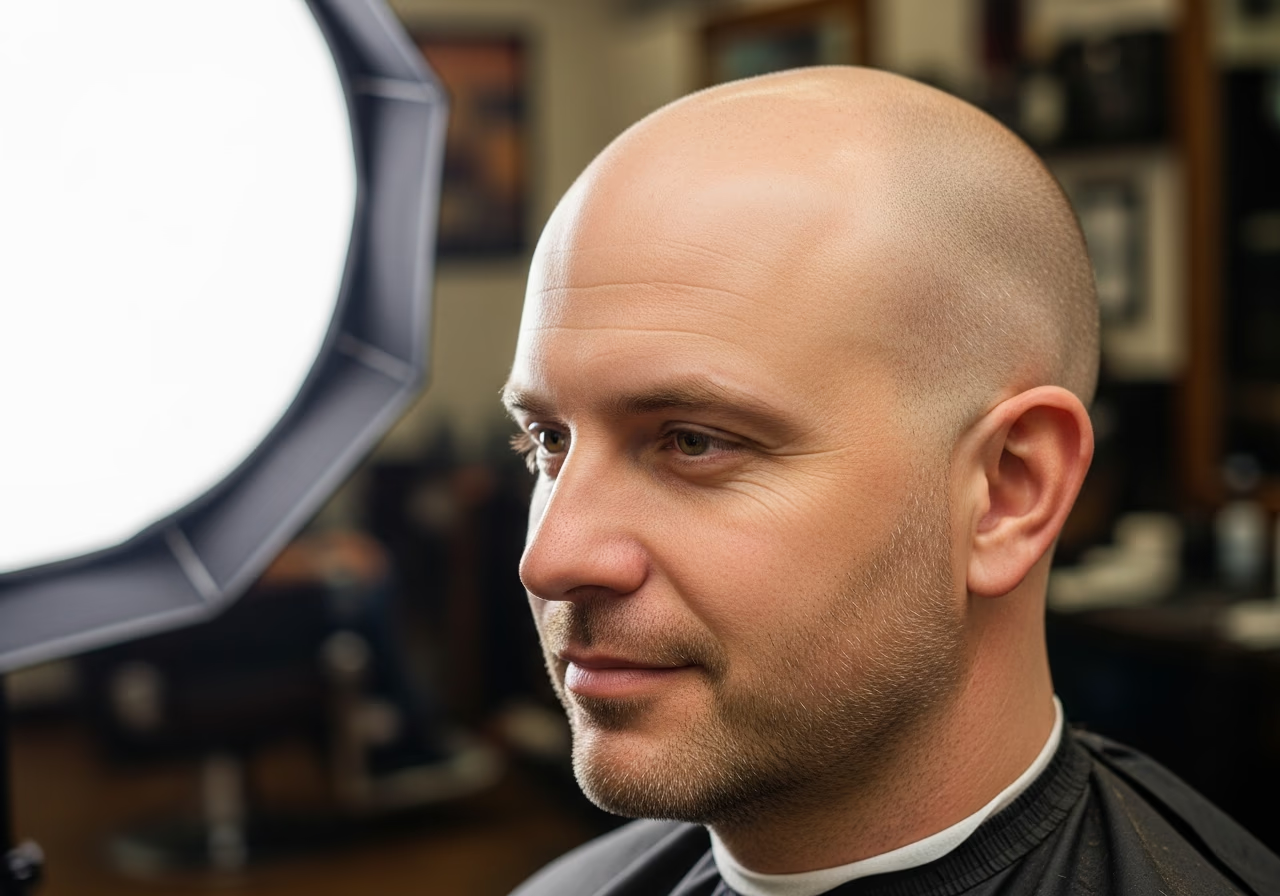
- Buzz cut: the most reliable: one short length across the whole head erases the crown contrast completely.
- Crew cut: a little more length up front than the crown, keeping it short enough to blend the back.
- Short crop with a skin fade: keeps attention on the top and sides; keep the crown length modest.
- A textured, matte finish anywhere with length breaks up the light so the scalp shows less.
What Makes It Worse
- Length on top that parts and exposes the crown swirl.
- Shiny product that reflects light off the scalp: go matte.
- Slicked or combed styles that flatten hair against the head.
- Growing the back long to 'cover' the crown. It exposes it instead.
How to Ask Your Barber
- Point out the crown directly. Barbers see it clearly; telling them it is the area you want handled means they can plan the lengths around it.
- Ask for the crown to be kept close to the length of the sides, or only slightly longer, so there is no obvious step between thick and thin areas.
- Request texture on top rather than a heavy, blunt length. Point cutting or a textured scissor finish breaks the hair into small pieces that do not separate at the crown.
- Ask them to check the crown with a hand mirror at the end, from the angle other people see it.
- Discuss the growth pattern. The crown whorl often points hair in several directions; cutting slightly longer against the whorl can help it lie flat instead of splitting open.
Styling at Home
Even the right cut can be undone by the wrong routine. The goal is a light, matte finish that does not clump.
- Towel dry gently, then let the crown air dry or dry it on a cool setting. Rubbing hard makes thin hair separate.
- Use a small amount of matte clay or powder, worked in with fingertips. Heavy product weighs hair together into strands that show scalp.
- Brush the crown in the direction it naturally falls while it is damp, rather than against it.
- Check the back with two mirrors once in a while, because the crown is the one area you do not see day to day.
When to Go Shorter
If the crown is visible even with a short, textured cut, the next step is usually to take everything down together, not to grow the top to cover it. A short crew cut or buzz makes the density difference far less obvious, and it can be kept tidy with a trim every two to four weeks. A dermatologist is the right person to see if thinning is recent or spreading quickly; a haircut manages appearance but does not change the underlying cause.
Frequently Asked Questions
Q1: What is the best haircut for a balding crown?+
Q2: Does short hair hide a bald spot on the crown?+
Q3: What should I avoid if I'm thinning at the crown?+
Q4: Should I use matte or shiny product for a thinning crown?+
Q5: Can a fade help with a balding crown?+
Related Haircut Guides
Make us a Preferred Source on Google
See our latest articles first in your Google Search & AI Overviews.