
How to Hide an
Uneven or Asymmetrical Hairline
Almost nobody has a perfectly symmetrical hairline. Here's how to style around one, and why you shouldn't let a barber "fix" it with a razor.
By Jessica Hamilton, Editor · Updated
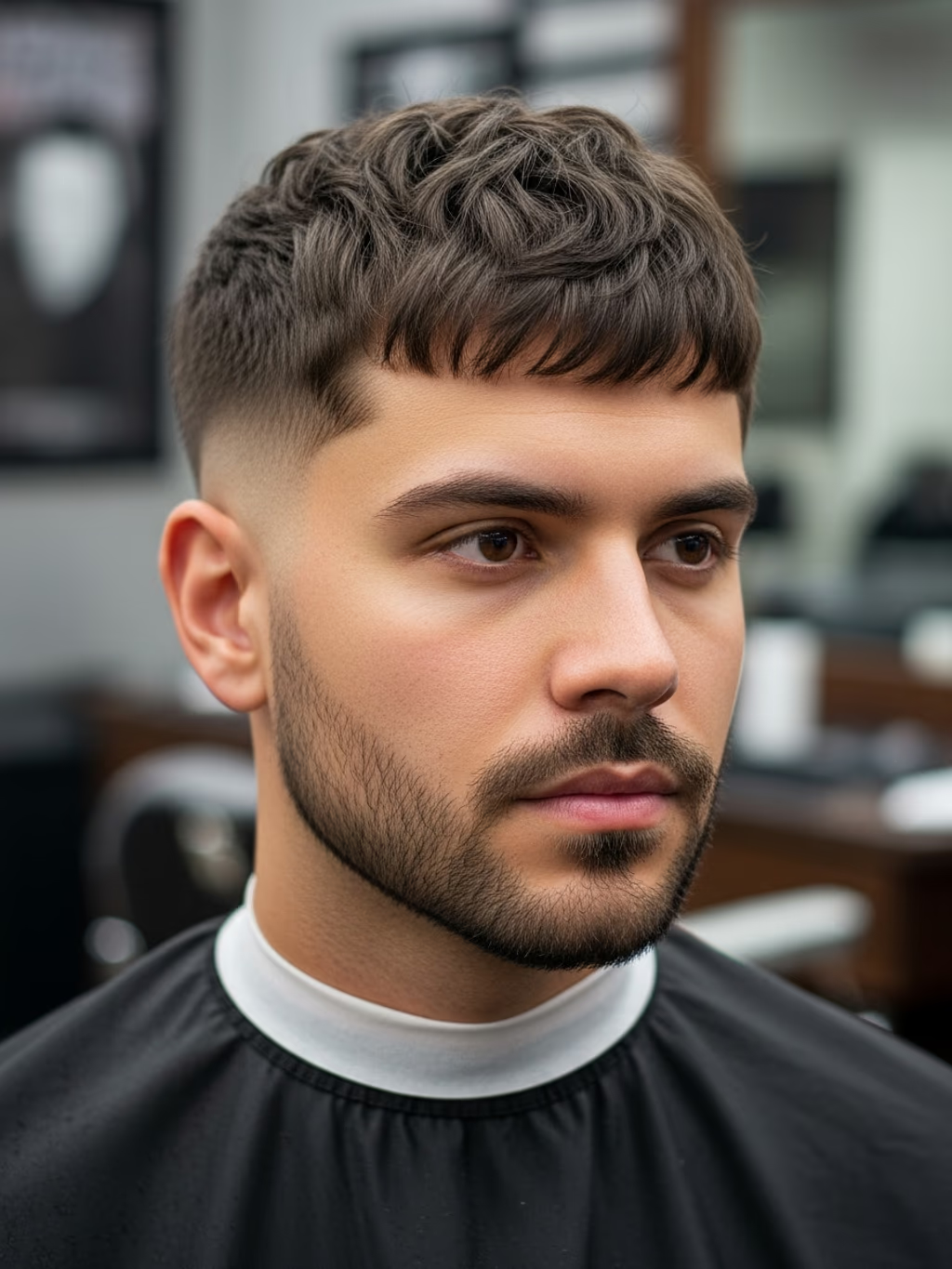
Quick answer: Almost nobody has a perfectly symmetrical hairline. To hide an uneven one, wear a textured fringe forward, part on the fuller side and keep the styling slightly messy. Ask for a natural line-up that follows your real hairline. Never have it razored 'even,' which permanently raises the fuller side to match the higher one.
Style images are AI-generated illustrations.
📚 Part of our Thinning & Balding guide hub, with the rest of the related guides in one list.
Men's hairlines are rarely symmetrical: one side usually sits slightly higher, or there's a dip or a cowlick pulling it off-line. It's normal, and almost nobody notices but you. The important thing to know: trying to razor it "even" is the worst option, because evening up means cutting the lower side up to match the higher one, permanently raising your hairline.
Should You Razor an Uneven Hairline Straight?
To make an uneven hairline symmetrical, a barber has to remove hair from the fuller side, which raises your hairline on that side to match the sparser one. Do that a few times and you've traded a slight asymmetry for a noticeably higher hairline everywhere. This is the same trap as a line-up that's too high. Style around it instead.
Which Kind of Uneven Hairline Do You Have?
"Uneven" covers a few different shapes. Find yours first, because the best cut depends on it.
| What you see | Usual cause | Best approach |
|---|---|---|
| One temple sits higher than the other | Normal growth pattern | Part on the fuller side and sweep hair across |
| A V-shaped point in the middle | Widow's peak | Textured fringe or a pushed-back style with some height |
| A tuft that splits the front | Front cowlick | Cut with the growth direction; dry it into place |
| Both corners moving back slowly | Early recession | Shorter textured crop; ask about it at each visit |
| A notch after a line-up | Line taken too high | Let it grow back; no more edging for a few weeks |
More than one can apply. A slightly higher temple plus a front cowlick is common, and the fixes stack: part on the fuller side, cut with the cowlick, and keep the front textured.
How Do You Style Around an Uneven Hairline?
- Wear a textured fringe forward (textured fringe, French crop), since irregular texture hides asymmetry far better than a blunt line.
- Avoid hard straight lines. Straight lines across the forehead make any asymmetry obvious by comparison.
- Part on the fuller side so hair sweeps across toward the sparser side.
- Messy beats precise. Deliberately tousled styling makes asymmetry read as intentional.
- Ask for a natural line-up that follows your hairline's real shape.
What If a Cowlick Is the Cause?
Sometimes an "uneven" hairline is really a cowlick or whorl at the front pushing hair in an odd direction. That's a styling problem, not a hairline problem: a barber can cut with the growth direction so the hair falls naturally, and blow-drying against the cowlick while it's damp trains it. Cutting the hairline won't help a cowlick.
How Do You Explain It to Your Barber?
Point directly at the part of the hairline that bothers you rather than describing it in general terms, since "uneven" can mean a widow's peak, a receded corner, or a naturally asymmetrical growth pattern, and each is handled differently. Ask the barber to leave a bit more length right at the hairline itself rather than cutting it to a hard, uniform edge, since length gives you more to work with when styling around the irregular spot.
If you have tried razoring or shaving the hairline straight before and it looked worse, mention that clearly so the barber avoids repeating the same approach and instead builds texture around the natural line.
What to say in the chair
"My hairline is higher on the left than the right. Please don't line it up straight. Follow my natural edge, leave some length at the front, and cut the fringe so it falls toward the left side."
This is a normal cut, not an extra service, so expect regular pricing of about $25 to $45 at a neighborhood shop. Our haircut cost guide has prices by shop type.
What Mistakes Make It More Obvious?
- Combing hair straight back off the face: this exposes the full hairline in one continuous line, which highlights any asymmetry instead of softening it.
- Using a hard side part near the uneven section: a defined part close to the irregular area draws the eye directly to it.
- Cutting the hairline completely straight with a razor: a razor-straight edge looks artificial next to naturally irregular growth and often makes the mismatch more visible, not less.
- Slicking hair down with heavy product: flattened hair reveals the scalp and hairline shape more clearly than textured, lifted styles do.
Does an Uneven Hairline Change Over Time?
A naturally asymmetrical hairline you have had since your teens or twenties typically stays fairly stable and is simply part of your growth pattern, not a sign of hair loss. If unevenness has developed more recently, particularly alongside gradual recession at one or both temples, it is more likely connected to normal age-related thinning, which is worth discussing with a barber or dermatologist so your cut can be adjusted as it progresses rather than reacted to after the fact.
An easy way to tell is to take a photo of your hairline from the front every few months, in the same light, with your hair pushed back. If the shape stays the same, it is just how your hair grows. If one or both temples keep moving, bring the photos to your next cut.
Which Products Help Hide an Uneven Hairline?
The goal is soft, broken-up texture at the front, not a stiff shape. These product types help (more detail in pomade vs clay vs wax):
- Matte paste or clay: separates the fringe into pieces so the edge underneath is hard to trace.
- Sea salt spray: adds grit to fine hair so a forward fringe holds without looking flat.
- Light cream: for curly or wavy hair, defines the curls at the front so they cover the edge.
- Hairline fibers: a color-matched powder can fill a small gap at one temple for a photo or an event.
Leave out gel and shiny pomade near the front. Both clump hair into lines that show the scalp between them.
How Long Does It Take to Grow Out a Hairline That Was Cut Even?
If a barber already razored your hairline straight, the edge hairs grow back at about half an inch a month, the same as the rest of your hair.
| Time | What changes |
|---|---|
| Week 1 | Stubble shows where the old edge was |
| Week 2 to 3 | The bare strip fills in; the hard line softens |
| Week 4 | Your natural uneven edge is back and can be styled around again |
| Week 6 | Enough front length for a textured fringe to cover it |
Frequently Asked Questions
Q1: How do I hide an uneven hairline?+
Q2: Should I get my uneven hairline razored even?+
Q3: Is an uneven hairline normal?+
Q4: Can a cowlick make my hairline look uneven?+
Q5: What haircut suits an uneven hairline?+
Q6: Can a beard help balance an uneven hairline?+
Medical & Dermatology Sources
Haircuts change how thinning hair looks, not how much of it you keep. For what causes hair loss and how it is diagnosed and treated, read these medical sources and ask a dermatologist about your own case.
- How male pattern hair loss is treated, American Academy of Dermatology
- Androgenetic alopecia, MedlinePlus (U.S. National Library of Medicine)
Related Haircut Guides
Make us a Preferred Source on Google
See our latest articles first in your Google Search & AI Overviews.