
How to Style Hair with a
Low Hairline or Small Forehead
The opposite problem to a high forehead, and the fix is the opposite too. Here's how to open up your face.
By Jessica Hamilton, Editor · Updated
Quick answer: A low hairline sits close to the eyebrows and leaves a small forehead, so the fix is to lift hair up and back rather than cover it. A quiff, pompadour, slick back or side part reveals more forehead and lengthens the face. Fringes, Caesars and French crops push the visual hairline even lower, so avoid them.
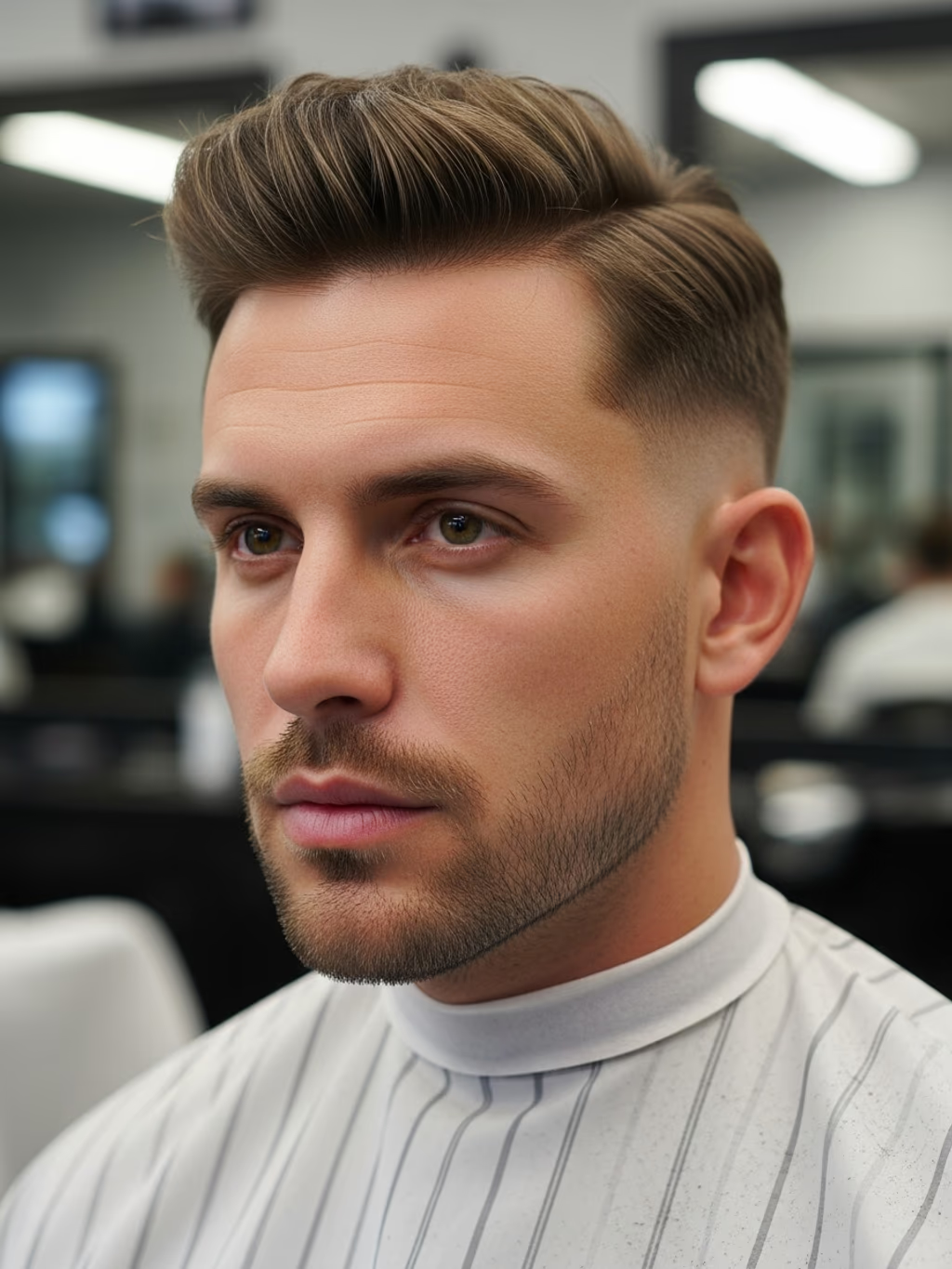
Style images are AI-generated illustrations.
On men, a low hairline sits close to the eyebrows, leaving a small forehead. It's often seen as lucky (plenty of hair!) but it can make the face look compressed if you wear hair forward. The fix is the exact opposite of the high-forehead playbook: lift and sweep hair up and back to open the face.
Should You Wear Hair Up or Forward With a Low Hairline?
With a low hairline, wear your hair up and back, not forward. A quiff, pompadour, slick back or side part shows more forehead and lengthens the face, while a fringe, caesar or forward French crop lowers the visual hairline further. Keep about 2 to 4 inches on top for lift and the sides short.
Anything worn forward, whether a fringe, a caesar, or a French crop, drops the visual hairline even lower and shrinks the forehead further. Styles with height and backward direction do the reverse: they reveal forehead and lengthen the face. This is one of the clearest style rules there is.
How Do the Best Low Hairline Haircuts Compare?
| Cut | Top length | Sides | Effect on the forehead |
|---|---|---|---|
| Quiff | 2 to 4 inches | Mid taper, #2 | Lifts the front, shows the most forehead |
| Pompadour | 3 to 5 inches | Mid or high fade | Maximum height, swept back |
| Slick back | 3 to 5 inches | #2 to #3 or undercut | Clears the whole forehead |
| Side part | 2 to 3 inches | #2 to #3 taper | Opens one side, adds structure |
| Textured crop pushed up | 1.5 to 2 inches | Low or mid fade | Works for fine hair if styled up, not forward |
Guard numbers are explained in our clipper guard numbers chart. For what most men are asking for this year, see the most popular men's haircuts of 2026.
What Are the Best Haircuts for a Low Hairline?
- Quiff: lift at the front opens the face (the top pick).
- Pompadour: maximum height and backward sweep.
- Slick back: takes everything off the face cleanly.
- Side part: opens one side and adds structure.
- A higher fade to keep the sides tight and emphasise the vertical.
Which Haircuts Should You Avoid With a Low Hairline?
- Blunt forward fringes: they cover an already-small forehead entirely.
- Caesar and French crop styles worn forward.
- Heavy, low-sitting texture across the brow.
- Very long hair worn down over the face: compresses the features.
How Do You Ask Your Barber for a Low Hairline Haircut?
With a low hairline the barber's main job is creating height and keeping the front off the face, so explain that goal rather than only naming a style.
- Say you want to show more forehead. That tells the barber to leave length on top for lift and not to add a forward fringe.
- Ask for weight at the front, not the back. Longer hair at the front gives you something to push up and back; a heavy crown just sits flat.
- Keep sides tight and tidy. A taper is a cut where the sides get gradually shorter toward the ears and neck. A mid or high taper exaggerates height on top and makes the face look longer.
- Discuss the line-up carefully. A slight clean-up of stray hairs at the temples can sharpen a low hairline, but ask the barber to follow your natural line rather than move it. Hair shaved back will grow in again and look patchy until it does.
What to say in the chair
“I have a low hairline and want to show more forehead. Leave about three inches at the front so I can push it up and back, keep a mid taper on the sides, and follow my natural hairline at the temples.”
Which Low Hairline Haircut Suits Your Face Shape and Hair Type?
A low hairline on a round or square face benefits most from height, because the extra vertical line balances the width. On an already long face, keep the lift moderate; a soft side part or a gently pushed-back textured top opens the forehead without making the face look even longer.
Thick, straight hair holds a quiff or pompadour easily with a blow-dryer and a medium-hold product. Fine hair struggles to stay up, so a shorter textured top styled up and back with a matte clay is more reliable. Curly hair naturally gains height, and a taper with curls sitting slightly back from the brow works well without heavy styling.
How Do You Style Hair Up and Back With a Low Hairline?
Most styles for a low hairline depend on direction set while the hair is drying. Towel-dry, then blow-dry the front upward and back with your fingers or a brush, aiming the airflow from the roots. Once the hair is dry and set, work a small amount of matte product through from back to front and lift the front into place.
If the fringe keeps falling forward by midday, the hair was usually styled while still damp or the front is cut too short to hold the height. Asking for a little more length at the front on the next visit often solves it.
Which Products Hold Hair Up With a Low Hairline?
- Matte clay: strong hold with no shine for quiffs and textured tops.
- Pomade: smooth hold and some shine for a slick back or side part.
- Sea salt spray: a pre-styler on damp hair that adds grip before blow-drying.
- Mousse: light lift for fine hair that collapses under heavier products.
Our pomade vs clay vs wax guide compares hold and finish in more detail.
How Often Do Low Hairline Haircuts Need a Trim?
Lifted styles depend on tight sides. Once the sides bulk out, the top looks lower and flatter again. Plan on a trim every 3 to 5 weeks for a quiff or side part, as our guide to how often you should get a haircut explains. A standard cut costs about $25 to $45 at most barbershops; see our haircut cost guide. For more on phrasing, read how to talk to your barber.
Frequently Asked Questions
Q1: What haircut is best for a low hairline?+
Q2: Should I have a fringe with a low hairline?+
Q3: Is a low hairline good or bad?+
Q4: How do I make my forehead look bigger?+
Q5: What's the difference in styling a low vs high hairline?+
Q6: Does a buzz cut work with a low hairline?+
Make us a Preferred Source on Google
See our latest articles first in your Google Search & AI Overviews.