
Best Haircuts for
M-Shaped Hairlines
The M-shape (deeper temples with a center peak) is extremely common. Here's how to cut around it instead of fighting it.
By Jessica Hamilton, Editor · Updated
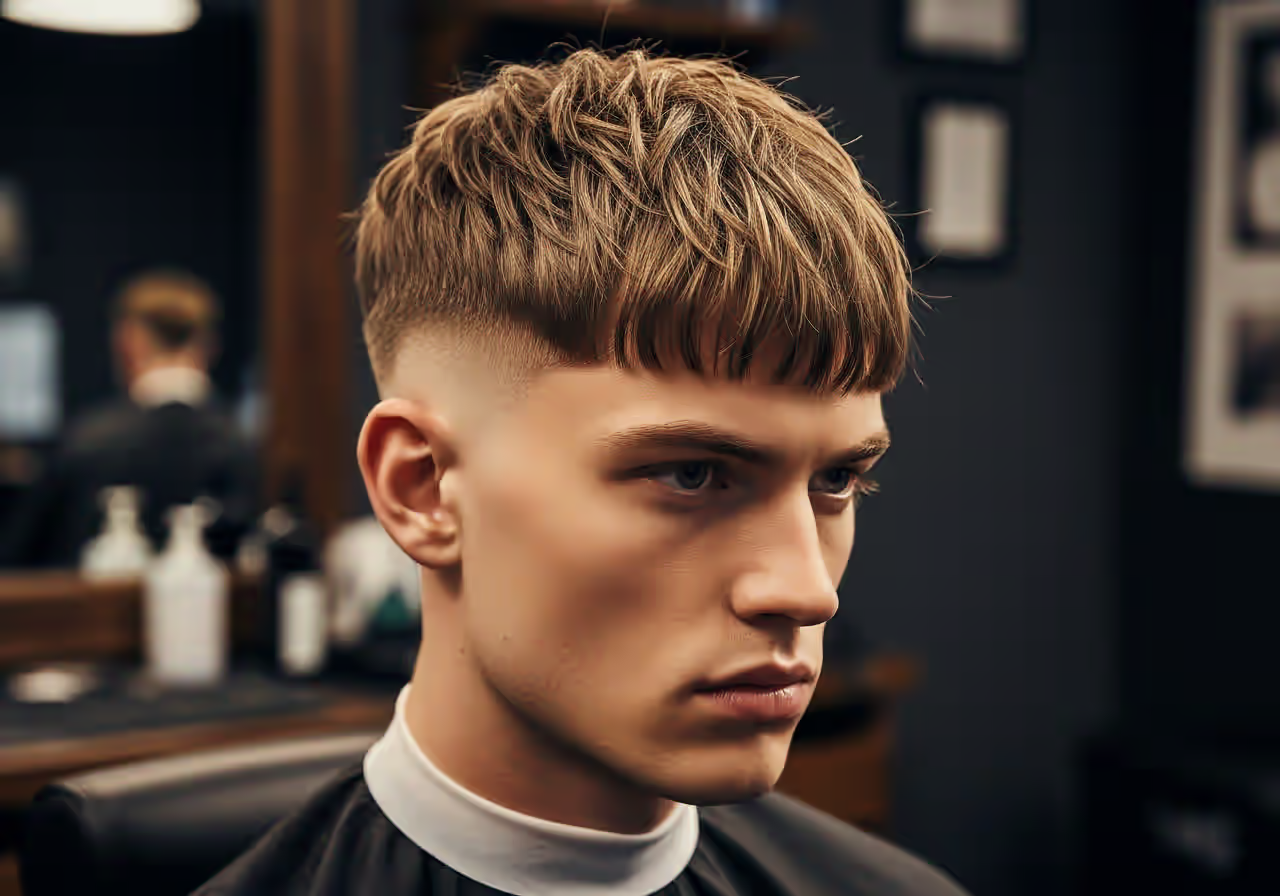
Quick answer: The best haircuts for M-shaped hairlines bring hair forward over the temple gaps: a French crop, a textured crop with a fringe, or a Caesar. An M-shaped hairline is one where the temples recede further than the center, leaving a peak in the middle. It is common and does not necessarily mean balding. A buzz removes the contrast entirely.
Style images are AI-generated illustrations.
📚 Part of our Thinning & Balding guide hub, which links the full set of related guides.
The best haircuts for M-shaped hairlines work with one of the most common maturing patterns: the temples recede further than the center, leaving a peak in the middle. It's not necessarily balding; many men hold an M-shape for decades. The styling answer is the same either way: bring hair forward to fill the temple gaps, and avoid anything that pulls hair back and frames them.
How Do You Style an M-Shaped Hairline?
Style an M-shaped hairline by bringing hair forward over the temples. Keep about 1 1/2 to 3 inches on top, cut a textured fringe rather than a blunt line, and keep the sides short with a low or mid taper. Skip slick backs and hard line-ups, and trim every 3 to 4 weeks so the fringe keeps its shape.
The temples are the recessed part, so hair worn forward covers exactly where the gap is. A French crop or textured crop with a forward fringe is the most direct fix: the fringe sits over the M and the shape disappears into the cut. Textured, irregular fringes work better than blunt ones because they don't draw a straight line across the recession.
What Are the Best Haircuts for an M-Shaped Hairline?
- French crop: forward fringe covers the temple gaps. The top choice.
- Textured crop: choppy forward texture disguises the M-shape naturally.
- Caesar cut: short and forward, very forgiving.
- Buzz cut: removes the contrast entirely. The confident option.
- Keep sides shorter (taper) so the top reads as the fullest area.
| Cut | Top | Sides | Trim every |
|---|---|---|---|
| French crop | 1 1/2 to 2 inches, textured fringe | Low or mid fade | 3 weeks |
| Textured crop | 2 to 3 inches, choppy and forward | #1 to #3 taper | 3 to 4 weeks |
| Caesar | About 1 inch, forward | #2 to #3 | 2 to 3 weeks |
| Buzz cut | #1 to #3 all over | Same as top | 2 to 3 weeks |
A taper is a cut where hair gets shorter only around the ears and neckline; a fade carries that shortening higher, sometimes to skin. Keeping the sides shorter than the top makes the front look fuller. See the French crop gallery for fringe shapes.
Which Hairstyles Make an M-Shaped Hairline More Obvious?
- Slicked-back styles: pull everything off the temples and spotlight them.
- High pompadours and quiffs that lift hair away from the front.
- Hard, high line-ups that draw a sharp border right at the recession: ask for a natural line instead.
- Hard side parts that expose one temple completely.
A line-up is the trimmer or razor edge a barber cuts along the forehead and temples. Repeated hard line-ups can push the edge back over time; if that has happened, read how to fix a line-up that's too high and line-up vs edge-up.
Is an M-Shaped Hairline Different From a Receding Hairline?
A straight receding hairline moves back evenly across the whole forehead, so a short forward style disguises it from edge to edge. An M-shape recedes at the temples first while a central point of hair often stays put, which means a single blunt fringe can end up framing that central point like an island. Cuts for an M-shape need to soften both temple corners individually rather than relying on one fringe length to cover the entire front.
How Does Hair Type Change the Cut for an M-Shaped Hairline?
Fine, straight hair shows scalp at the temples more readily under indoor light, so keep a little extra length there rather than fading all the way to skin right at the corners. Thicker or wavy hair has more natural cover and can handle a tighter fade into the temple points since the surrounding density hides the transition.
Curly hair adds volume at the temples on its own, which can actually work in your favor by softening the M-shape without any extra styling effort, as long as the curl pattern is kept even in length across the front.
How Do You Ask Your Barber for an M-Shaped Hairline Haircut?
Point out both temple corners rather than just saying "receding hairline," since that phrase alone often gets treated as a straight-line recession. Ask for the fringe to be left a touch longer directly above each temple point and shorter through the center, so the two corners get individual coverage instead of a single flat line across the front.
If you are getting a fade, ask the barber to bring the fade line up higher at the temples than at the center, which follows the natural shape of an M instead of cutting straight across it. Mention how you style day to day, since a wet-look or slick style pulls hair straight back and exposes both corners at once, while a textured, forward finish naturally rests over each temple point and needs less aggressive tapering to look full.
What to say in the chair
"My temples are further back than the middle, so I want a textured French crop that covers both corners. Leave the fringe longer over each temple, low taper from a #1 to a #3, and no line-up at the front."
A guard is the clip-on comb that sets clipper length; a #3 leaves about 10 mm. See the clipper guard numbers chart and how to talk to your barber. A standard cut costs $25 to $45 at most neighborhood shops, per our 2026 haircut cost guide, and how often you should get a haircut covers schedules.
Which products help the fringe cover the temples?
- Matte clay: holds a textured fringe forward with no shine.
- Sea salt spray: adds grip on damp hair so the fringe does not split.
- Texture powder: lifts fine hair at the root without weighing the fringe down.
Pomade vs clay vs wax explains why shiny products show more scalp. The receding hairline statistics report shows how common temple recession is by age, and our receding hairline haircut guide covers even recession.
Frequently Asked Questions
Q1: What is an M-shaped hairline?+
Q2: What haircut is best for an M-shaped hairline?+
Q3: What hairstyles make an M-shaped hairline more obvious?+
Q4: Is an M-shaped hairline the same as balding?+
Q5: Should I get a line-up with an M-shaped hairline?+
Q6: How long should a fringe be to cover an M-shaped hairline?+
Medical & Dermatology Sources
No haircut treats hair loss; it only changes how thinning reads. For causes and treatment options, start with the medical sources below, and see a dermatologist for advice specific to you.
- Male pattern hair loss treatment options, American Academy of Dermatology
- Androgenetic alopecia, MedlinePlus (U.S. National Library of Medicine)
Make us a Preferred Source on Google
See our latest articles first in your Google Search & AI Overviews.