
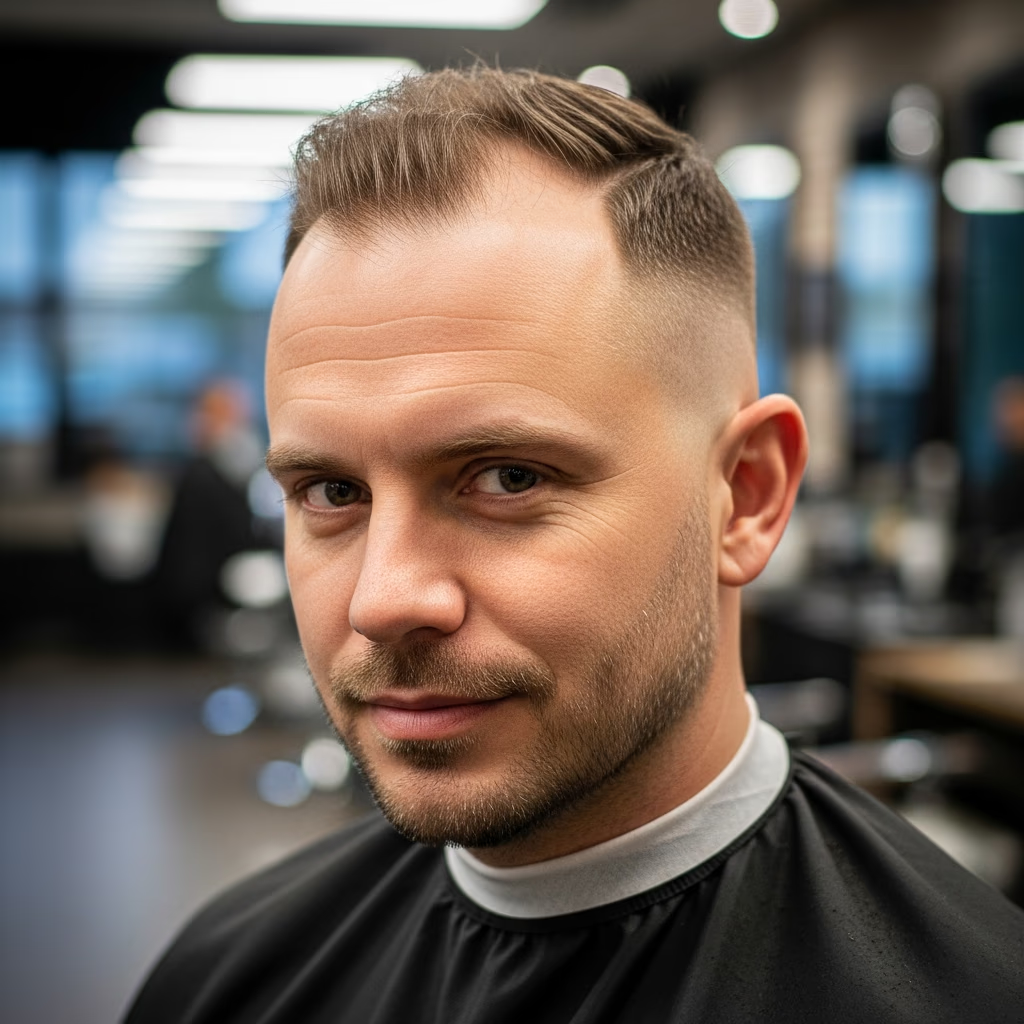
Best Haircuts for a
Receding Hairline
A receding hairline isn't a styling problem. It's a styling opportunity. The right cut works with the hairline instead of hiding from it.
By Jessica Hamilton — Master Stylist & Creative Director
📚 Part of our Thinning & Balding guide hub: explore every related guide in one place.
A receding or maturing hairline is one of the most common things that happens to men's hair, and one of the easiest to style well. The mistake almost everyone makes is trying to cover it with length swept forward, which draws attention to exactly what you're hiding. The cuts that actually work do the opposite: they keep things short and structured, so the hairline reads as a deliberate feature, not a flaw.
The Golden Rule: Go Shorter, Not Longer
Long hair swept forward or a comb-over across a receding hairline is the classic trap: it looks like concealment and moves with the wind. Short, textured cuts remove the contrast between hair and forehead, so the eye stops tracking the hairline. Confidence and a sharp short cut beat any cover-up.
The Best Cuts to Try
- The French Crop: short textured top with a blunt fringe: the fringe sits forward and disguises a receding front naturally. Arguably the #1 receding-hairline cut.
- The Caesar: similar idea, short and worn forward, very low-maintenance.
- The Buzz Cut: the ultimate equaliser: one length everywhere removes the hairline contrast entirely.
- A short cut with a skin fade: keeps focus on the textured top and the sharp fade, not the hairline.
What to Avoid
- Long fringes swept sideways or forward to 'cover' the temples. They emphasise the recession.
- Slicked-back styles that pull all the hair off the face and spotlight the hairline.
- Hard, high line-ups that draw a sharp border right where the hairline is thinning.
- Excess length on top with thin sides: the imbalance ages the look.
How to Ask Your Barber
Keep it simple and specific: "I've got a receding hairline — I want something short and textured that works with it, not a comb-over. Maybe a French crop or a crop with a fade." A good barber will immediately know the playbook and may suggest the exact fringe length that best disguises your particular hairline.
Does Your Hair Type Change the Approach?
Straight hair shows a receding hairline the most clearly, since there is no natural texture to soften the line where hair meets skin. It usually looks best kept very short on top, with a defined fringe cut close enough that it cannot be swept back into a comb-over. Wavy hair has an easier time of it: the slight movement in a French crop or textured fringe breaks up the hairline naturally, so the front doesn't need to be cut quite as short to disguise it. Curly and coily hair can often carry more length on top than either of the other two, because the volume and shrinkage push the visual weight upward and away from the hairline rather than forward across it, though the front edge should still be kept tight rather than picked out loose. Coarse or thick hair holds a textured crop's shape especially well and rarely needs daily restyling, while fine hair benefits from a slightly shorter overall length so it doesn't go limp and fall forward, undoing the disguise a short cut is meant to provide.
Maintenance That Keeps the Cut Working
A receding-hairline cut only keeps doing its job if it stays fresh. Most of the styles above need a trim every two to three weeks, since the whole effect depends on a short, defined fringe and clean sides rather than length that can be brushed into place as it grows. Letting a cut go a week or two past its trim date is usually fine, but pushing it much further lets the fringe grow heavy enough to fall forward, drifting back toward the sweep-over this approach is meant to avoid. A small amount of matte clay or a light textured paste worked through damp hair is usually all the daily styling this look needs; heavy pomades or anything with shine tend to draw more attention to the hairline rather than less.
What to Do if a Cut Isn't Working
If a fresh cut still feels like it's drawing attention to the hairline rather than away from it, the fix is usually to go shorter still rather than to add length back in. A fringe that looked right in the mirror at home can read differently under different lighting or once it has settled over a few days, and a slightly shorter second pass at the front often resolves it. If the sides feel too sharp against the softer top, ask for the fade blended a shade lower or higher rather than abandoning the fade altogether: it is the contrast, not the fade itself, that usually needs adjusting. And if a particular style genuinely isn't suiting the shape of the recession, a buzz cut is always a reliable reset: taking everything to one length removes the decision entirely and gives hair a clean point to grow from before trying a more shaped cut again.
Frequently Asked Questions
Q1: What is the best haircut for a receding hairline?+
Q2: Should I grow my hair long to hide a receding hairline?+
Q3: What haircuts should I avoid with a receding hairline?+
Q4: Does a fade look good with a receding hairline?+
Q5: How do I ask my barber for a receding-hairline haircut?+
Related Haircut Guides
Make us a Preferred Source on Google
See our latest articles first in your Google Search & AI Overviews.