
Data report · Updated October 2026
Receding hairline statistics: about 1 in 3 men in midlife have frontal-only loss
How often hair loss starts at the temples, how early it shows up, and what the evidence says about treating the front of the scalp.
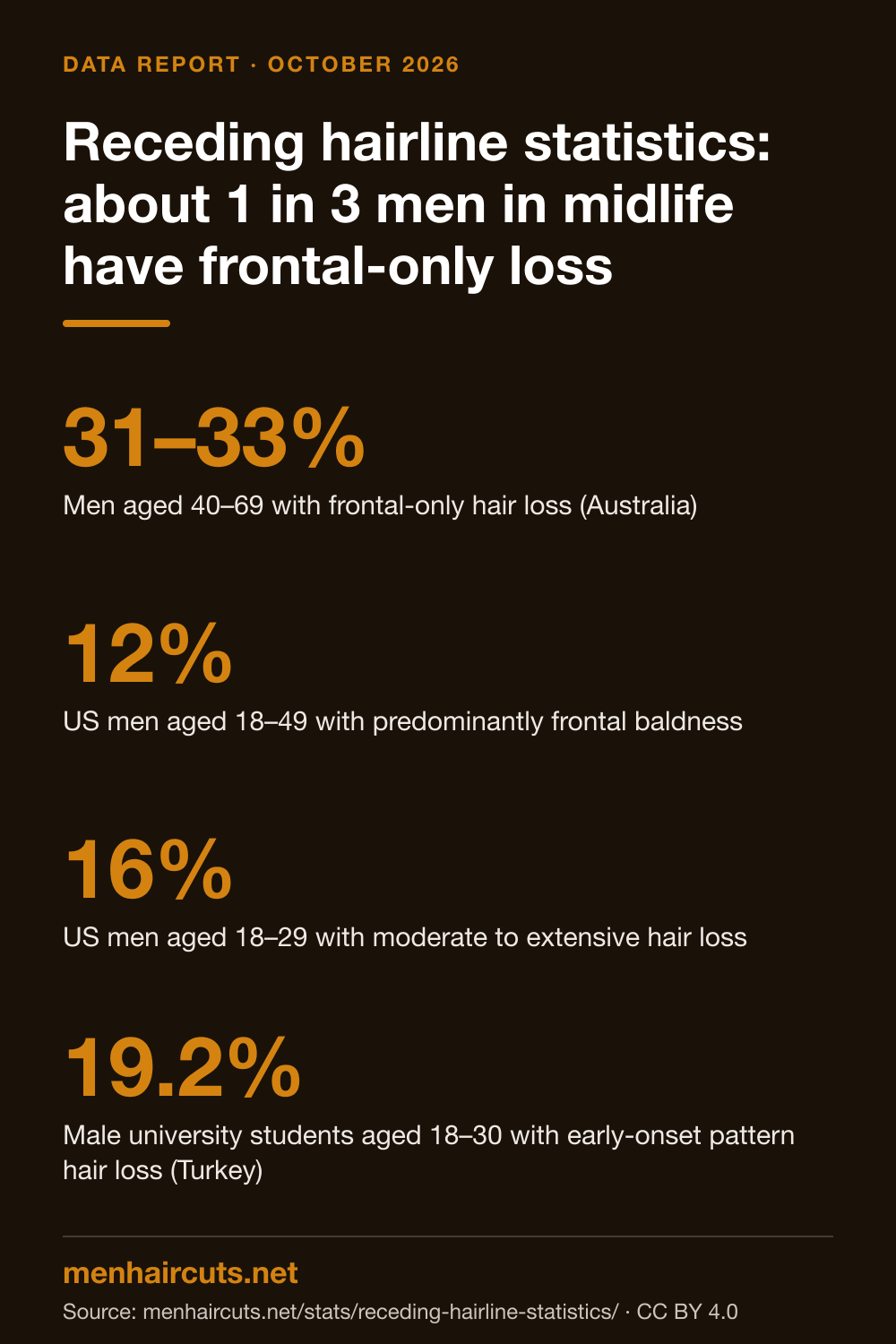
In an Australian study of men aged 40–69, 31–33% had hair loss only at the front, and that share barely changed with age[1]. In a US study, 16% of men aged 18–29 already had moderate hair loss[2]. A receding front alone was not tied to heart disease risk[3].

31–33%
Men aged 40–69 with frontal-only hair loss (Australia)[1]
12%
US men aged 18–49 with predominantly frontal baldness[2]
16%
US men aged 18–29 with moderate to extensive hair loss[2]
19.2%
Male university students aged 18–30 with early-onset pattern hair loss (Turkey)[4]
By Jessica Hamilton, Editor · Published · Updated · Free to reuse with credit (CC BY 4.0)
Key findings
- Among 1,390 randomly selected Australian men aged 40–69, 31–33% had frontal-only hair loss in every age group, while crown or full balding rose from 31% to 53% with age[1].
- In a US community study of men aged 18–49, 12% had predominantly frontal baldness (Norwood type A variants)[2].
- Moderate to extensive hair loss was already present in 16% of US men aged 18–29[2] and early-onset pattern hair loss in 19.2% of Turkish male students aged 18–30[4].
- Korean men tend to keep their frontal hairline more often than white men, and crown-type loss (type III vertex) was the most common pattern from their 20s to their 60s[5].
- Men's Rogaine 5% foam is labeled for the top of the scalp only and its label says it is not intended for frontal baldness or a receding hairline[6].
- In the finasteride trial of men with front-of-scalp loss, hair counts did not include the area of bitemporal recession or the anterior hairline[7].
- Frontal baldness alone was not significantly associated with coronary heart disease (relative risk 1.11), unlike crown baldness[3].
Download the infographic
The headline numbers from this report as one tall image (1000 x 1500 PNG), sized for Pinterest, slides and posts. Free to reuse with credit.
How common is a receding hairline in men?
Hair loss at the temples is one of the two classic starting points of male pattern hair loss. A German medical review describes androgenetic alopecia in men as receding temporal hairlines plus loss at the whorl on the back of the head[8]. MedlinePlus says age-related hair loss in men may be at the temples or at the top of the head[9].
How many men have a receding front without crown loss? The best population figure comes from an Australian study of 1,390 men aged 40–69 picked at random from electoral rolls and examined in person. In every age group, 31–33% had frontal-only hair loss[1].
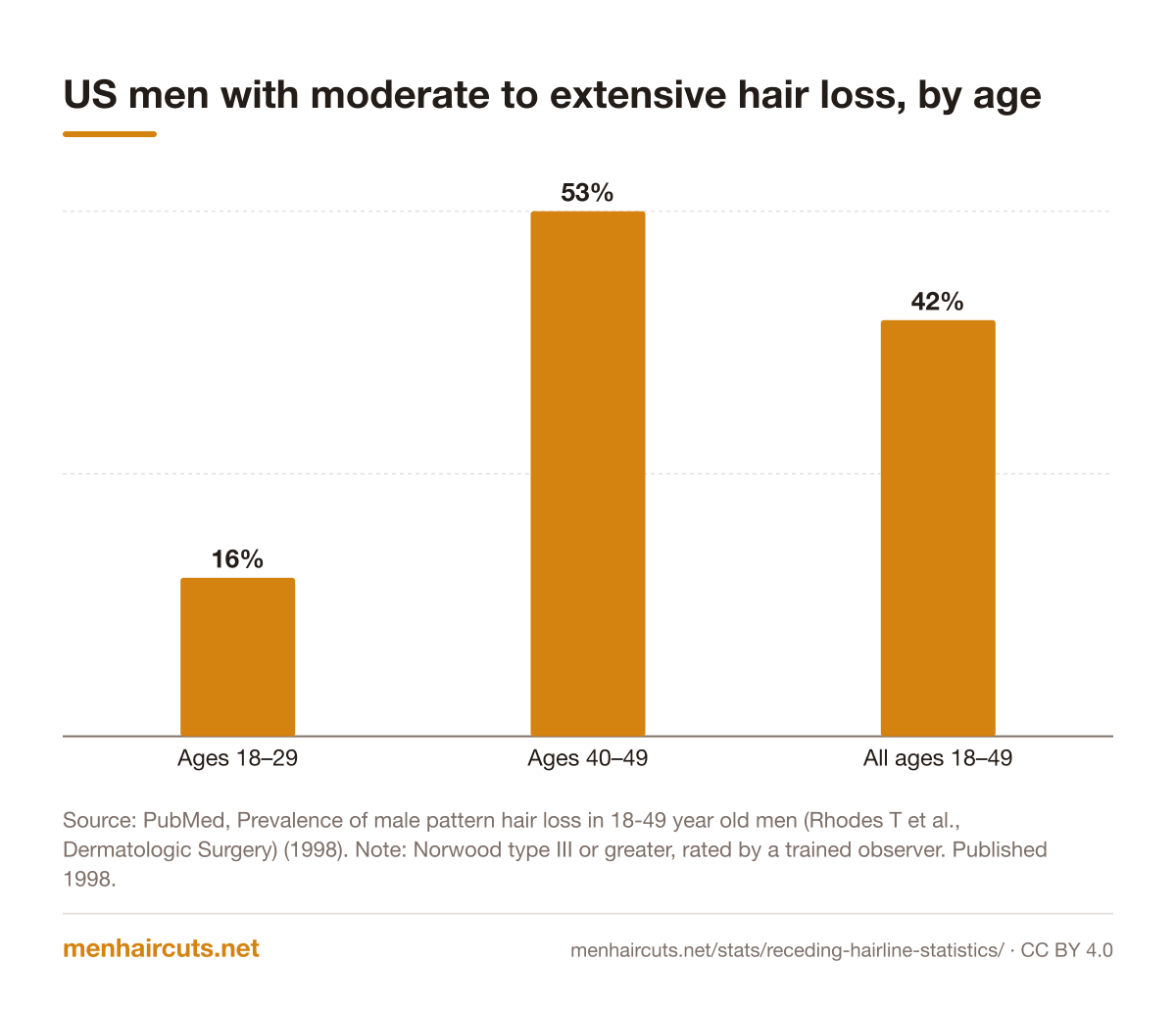
A US community study of men aged 18–49, published in 1998, found that 12% had predominantly frontal baldness, the Norwood type A pattern where the hairline moves back as a whole rather than at the temples first[2]. The same study found 42% of all men in that age range had moderate to extensive hair loss[2].
At what age does a hairline start to recede?
Earlier than many men expect. MedlinePlus says men may start showing signs of baldness by the time they are 30[9], and that androgenetic alopecia can start as early as the teens[10].
In the US study, 16% of men aged 18–29 already had moderate to extensive hair loss. By ages 40–49 the share was 53%[2]. A 2021 study of 1,507 male university students aged 18–30 in Turkey found early-onset androgenetic alopecia in 19.2%. Older age, family history, smoking and some dietary habits were linked to higher risk[4].
Some hairline change in the late teens and twenties is a normal maturing of the hairline rather than balding, and only a dermatologist can tell the two apart with confidence. The studies above count pattern hair loss graded on a standard scale, not every small shift at the temples.
Show the numbers
| Category | Value |
|---|---|
| Ages 18–29 | 16% |
| Ages 40–49 | 53% |
| All ages 18–49 | 42% |
Is a receding hairline or a thinning crown more common?
It depends on age. In the Australian study the share of men with frontal-only loss stayed flat at 31–33% from 40 to 69, while crown (vertex) or full balding climbed from 31% at ages 40–55 to 53% at ages 65–69[1]. In other words, older age groups had more crown loss, while the share with frontal-only loss stayed about the same.
In East Asian studies, the crown leads. Type III vertex, a pattern with loss at the crown, was the most common type in Korean men from their 20s through their 60s[5] and the most common type in Chinese men in Shanghai (3.5% of all men)[11].
| Pattern | Ages 40–55 | Ages 65–69 |
|---|---|---|
| Frontal only | 31–33% (similar across all age groups) | 31–33% (similar across all age groups) |
| Vertex or full (front and crown) | 31% | 53% |
Do receding hairlines differ by ethnicity?
Yes, in both how often and how hair loss shows up. A study of 5,531 Korean men found that they tend to keep their frontal hairline more than white men do, and that 11.1% of cases showed a diffuse 'female pattern' of thinning rather than the usual male pattern[5]. The overall rate of pattern hair loss in Korean men was 14.1%[5], and in Chinese men in Shanghai it was 19.9%[11], both lower than in studies of white men.
The finasteride label adds a detail from its clinical trials. Patient self-assessment improved across racial groups, with one exception: satisfaction with the frontal hairline and vertex in Black men, who were satisfied overall[7]. Those subgroups were small, so it is a signal rather than a firm finding.
Can minoxidil or finasteride regrow a receding hairline?
The evidence for the front of the scalp is thinner than for the crown. The Drug Facts label for Men's Rogaine 5% foam says it is for regrowing hair on the top of the scalp (vertex only) and states it is not intended for frontal baldness or receding hairline[6]. The label also says results may occur at 2 months with twice-daily use, that some men need at least 4 months, and that it will not work for all men[6].
Finasteride was tested in men with hair loss in the anterior mid-scalp, the area just behind the front. That 12-month study showed significant increases in hair count versus placebo, but hair counts there did not include the area of bitemporal recession or the anterior hairline[7]. The label says daily use for three months or more is generally needed before benefit is seen[7].
None of this means treatment never helps at the temples. It means the official labels and trials were not designed to prove it, which is worth knowing before you spend money. A dermatologist can explain what is realistic for your pattern.
Is a receding hairline a sign of health problems?
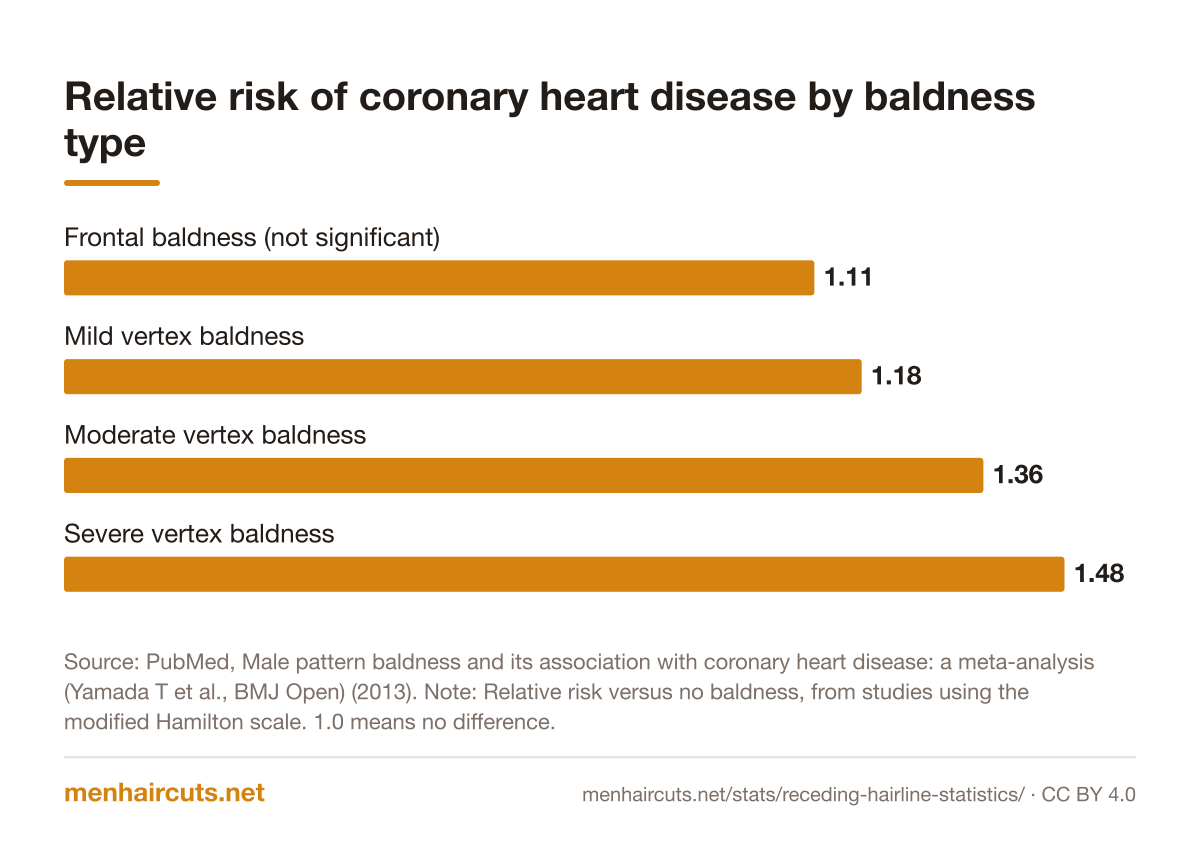
For the common pattern, the research is reassuring. A 2013 BMJ Open meta-analysis of studies covering 36,990 people found that crown baldness was linked to higher risk of coronary heart disease, rising with severity, but frontal baldness was not significantly associated (relative risk 1.11)[3].
A receding hairline can occasionally signal something other than pattern hair loss. Frontal fibrosing alopecia, a scarring condition, is characterized by a receding hairline together with loss of the eyebrows[8]. Sudden loss, redness, itching or eyebrow thinning are reasons to see a dermatologist rather than wait.
Show the numbers
| Category | Value |
|---|---|
| Frontal baldness (not significant) | 1.11 |
| Mild vertex baldness | 1.18 |
| Moderate vertex baldness | 1.36 |
| Severe vertex baldness | 1.48 |
How is a receding hairline measured?
Most studies use the Norwood scale, often called Hamilton-Norwood. O'Tar Norwood published it in 1975 after classifying hair loss in 1,000 white adult men, partly to help hair transplant surgeons choose suitable patients[12]. Lower grades describe recession at the temples; higher grades add crown loss until the two areas join.
Because the scale grades the front and the crown together, a man with a deep but stable hairline and no crown loss can score the same grade as a man whose loss is spreading. That is one reason studies differ, and why the Australian study split frontal-only loss out on its own[1].
How many men get a hair transplant for their hairline?
Hair restoration surgery data do not separate hairline work from crown work, but they show how the procedure is used. In the ISHRS 2025 Practice Census, covering 2024, 81.6% of procedures in men targeted the scalp, and men made up 84.7% of surgical patients[13]. Members reported an average of 2,347 grafts per session for a first procedure, and two-thirds (67.3%) said patients usually needed only one procedure[13].
Most first-time patients were young: 57.6% were aged 26–35 and 37.3% were aged 20–25[13]. In the UK, the NHS says a hair transplant can cost between £1,000 and £30,000, that new hair usually starts to appear after 4 months, and that full results take 10 to 18 months[14].
Frequently asked questions
What percentage of men have a receding hairline?
At what age does a hairline start receding?
Does minoxidil work on a receding hairline?
Does finasteride regrow the front hairline?
Does a receding hairline always lead to baldness?
Is a receding hairline linked to heart disease?
Methodology and limitations
This report draws on population studies of male pattern hair loss (Dermatologic Surgery 1998, British Journal of Dermatology 2001, 2003 and 2009, Italian Journal of Dermatology and Venereology 2021), a BMJ Open meta-analysis, a Deutsches Ärzteblatt review, the FDA prescribing information for finasteride (Propecia), the DailyMed Drug Facts label for Men's Rogaine 5% foam, MedlinePlus, the NHS and the ISHRS 2025 Practice Census. Each figure was checked against the original abstract, label or report in October 2026. No calculations were made for this page. This is general information, not medical advice; see a board-certified dermatologist if your hairline is changing quickly or you have other symptoms.
Limitations
Few studies report frontal-only hair loss separately; most give a single Norwood grade that mixes front and crown. The US and Australian studies were published in 1998 and 2003, and the Asian studies used hospital or community samples with their own methods. A normal maturing hairline and early pattern loss can look alike and are not always separated in survey data. Transplant data come from ISHRS member surgeons only and do not separate hairline from crown procedures. This is general information, not medical advice.
Every figure on this page links to its source. Numbers are reported as published; any menhaircuts.net calculation is labelled and shows its inputs. Spotted an error? Tell us and we will check it.
Sources
- Androgenetic alopecia in men aged 40-69 years: prevalence and risk factors (Severi G et al., British Journal of Dermatology), PubMed (2003). Accessed October 15, 2026.
- Prevalence of male pattern hair loss in 18-49 year old men (Rhodes T et al., Dermatologic Surgery), PubMed (1998). Accessed October 15, 2026.
- Male pattern baldness and its association with coronary heart disease: a meta-analysis (Yamada T et al., BMJ Open), PubMed (2013). Accessed October 15, 2026.
- Prevalence of early-onset androgenetic alopecia and its relationship with lifestyle and dietary habits (Agaoglu E et al., Italian Journal of Dermatology and Venereology), PubMed (2021). Accessed October 15, 2026.
- The prevalence and types of androgenetic alopecia in Korean men and women (Paik JH et al., British Journal of Dermatology), PubMed (2001). Accessed October 15, 2026.
- Men's Rogaine (minoxidil 5%) unscented foam, Drug Facts label, DailyMed, National Library of Medicine (NIH) (2024). Accessed October 15, 2026.
- PROPECIA (finasteride) tablets prescribing information, revised 07/2022, US Food and Drug Administration (2022). Accessed October 15, 2026.
- The diagnosis and treatment of hair and scalp diseases (Wolff H et al., Deutsches Ärzteblatt International), PubMed (2016). Accessed October 15, 2026.
- Aging changes in hair and nails, MedlinePlus, National Library of Medicine (NIH) (2024). Accessed October 15, 2026.
- Androgenetic alopecia, MedlinePlus Genetics, National Library of Medicine (NIH) (2023). Accessed October 15, 2026.
- Prevalence and types of androgenetic alopecia in Shanghai, China: a community-based study (Xu F et al., British Journal of Dermatology), PubMed (2009). Accessed October 15, 2026.
- Male pattern baldness: classification and incidence (Norwood OT, Southern Medical Journal), PubMed (1975). Accessed October 15, 2026.
- 2025 Practice Census Results (2024 data), International Society of Hair Restoration Surgery (2025). Accessed October 15, 2026.
- Hair transplant, NHS (2023). Accessed October 15, 2026.
Cite, embed and download
This report, its charts and its infographic are free to reuse under a Creative Commons Attribution 4.0 license. Credit menhaircuts.net with a link to this page.
Cite this report (APA)
Hamilton, J. (2026, October 15). Receding Hairline Statistics 2026: How Common Is It?. menhaircuts.net. https://menhaircuts.net/stats/receding-hairline-statistics/
Link to this report
<a href="https://menhaircuts.net/stats/receding-hairline-statistics/">Receding Hairline Statistics 2026: How Common Is It?</a> (menhaircuts.net, CC BY 4.0)Share the headline number
31–33%: Men aged 40–69 with frontal-only hair loss (Australia) (PubMed, via menhaircuts.net/stats/receding-hairline-statistics/)
Download the charts and infographic
Related data
- 50 millionUS men with androgenetic alopecia (male pattern hair loss)Male Hair Loss Statistics 2026
- 35% vs 100%Men with hair loss after 5 years: finasteride vs placeboHair Loss Treatment Statistics 2026
- 84.7%Hair transplant patients who were men (ISHRS members, 2024)Hair Transplant Statistics 2026
Related guides
Make us a Preferred Source on Google
See our latest articles first in your Google Search & AI Overviews.