
Data report · Updated October 2026
Hair loss treatment statistics: finasteride cut 5-year hair loss to 35% of men
Trial results, side effect rates, time to results and prescribing patterns for the main male hair loss treatments.
Minoxidil and finasteride are the two FDA-approved drugs for male pattern hair loss[1]. In finasteride's 5-year trials, 35% of treated men lost hair compared with 100% on placebo[2]. Topical 5% minoxidil produced 45% more regrowth than the 2% strength[3]. Both need months of daily use.
35% vs 100%
Men with hair loss after 5 years: finasteride vs placebo[2]
45%
More regrowth with 5% vs 2% topical minoxidil at 48 weeks[3]
3.8% vs 2.1%
Men reporting a sexual side effect in year 1: finasteride vs placebo[2]
72.3%
Hair restoration doctors who always or often prescribed finasteride 1 mg in 2024[4]
By Jessica Hamilton, Editor · Published · Updated · Free to reuse with credit (CC BY 4.0)
Key findings
- Minoxidil and finasteride are FDA-approved for androgenetic alopecia, and a 2017 meta-analysis found both, along with low-level laser therapy, better than placebo[1].
- At 5 years, 100% of men on placebo in the finasteride trials showed hair loss, compared with 35% of men taking finasteride 1 mg[2].
- Finasteride produced a 107-hair difference from placebo at 1 year and 138 hairs at 2 years in a 1-inch circle of balding crown[5].
- In year 1, 3.8% of men on finasteride reported a sexual side effect versus 2.1% on placebo, and the rate of each fell to 0.3% or less by year 5[2].
- Topical 5% minoxidil produced 45% more hair regrowth than 2% minoxidil at 48 weeks in a trial of 393 men[3].
- In a 2025 meta-analysis, low-dose oral minoxidil did not significantly change blood pressure; 5.0% of patients reported low blood pressure symptoms[6].
- Among ISHRS hair restoration doctors, 72.3% always or often prescribed oral finasteride and 64.7% oral minoxidil in 2024[4].
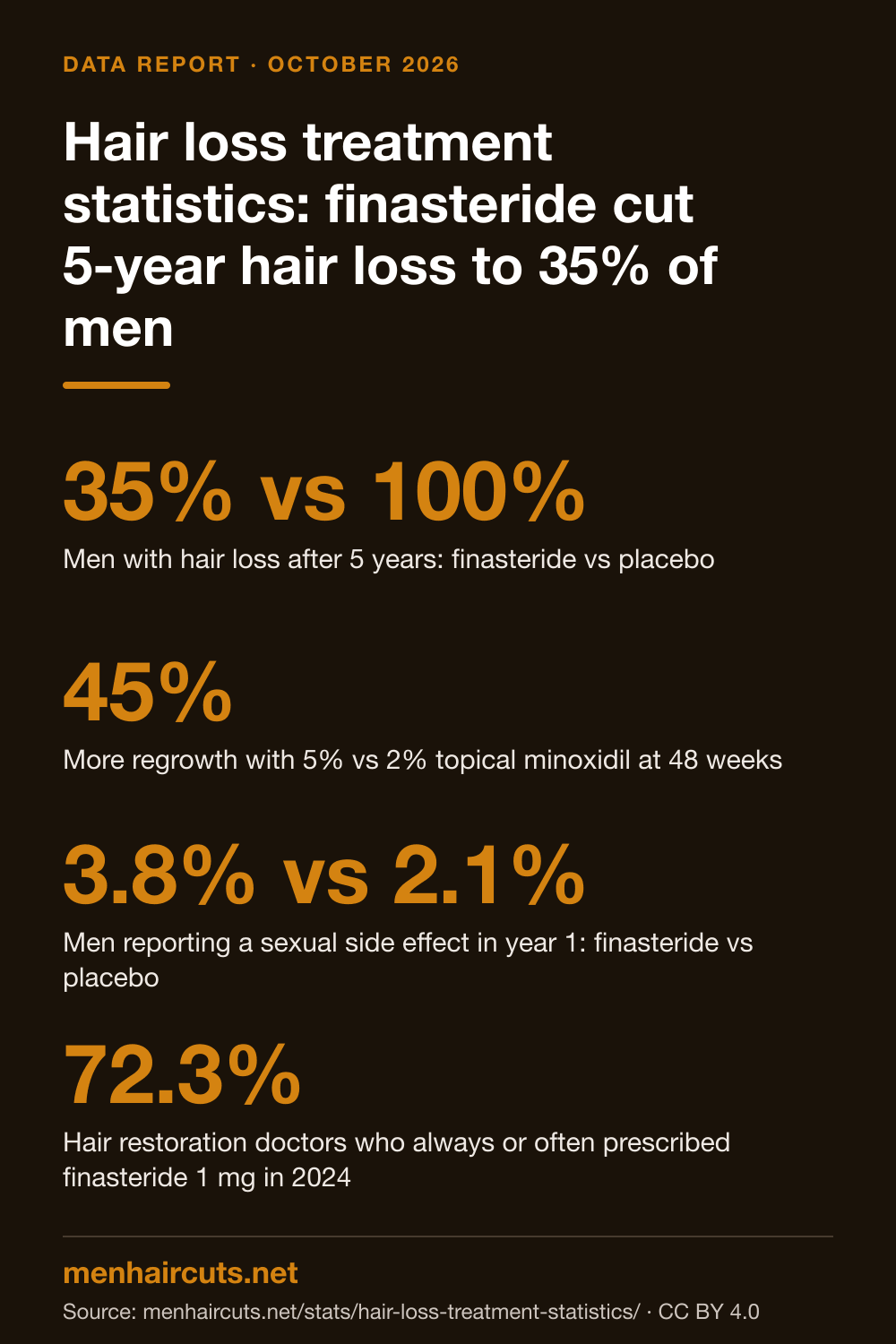
Download the infographic
The headline numbers from this report as one tall image (1000 x 1500 PNG), sized for Pinterest, slides and posts. Free to reuse with credit.
Which hair loss treatments are FDA approved for men?
Two drugs: topical minoxidil, sold over the counter as Rogaine and many store brands, and oral finasteride 1 mg, sold by prescription as Propecia and generics. A 2017 systematic review in the Journal of the American Academy of Dermatology listed minoxidil and finasteride as FDA-approved and the HairMax LaserComb as FDA-cleared, and found that all were better than placebo in men[1].
UK guidance matches. The NHS lists finasteride and minoxidil as the main treatments for male pattern baldness, and notes they are not all available on the NHS, so many men pay privately[7].
Everything else, from oral minoxidil to dutasteride to platelet-rich plasma, is used off label or without FDA approval for hair loss. Some have reasonable evidence; some have very little. The sections below separate the two.
How effective is finasteride for hair loss?
Finasteride has the longest track record of any hair loss pill. Its key trials were two 1-year studies of 1,553 men aged 18–41, with 1,215 continuing for a second year[5]. In a 1-inch circle of balding crown that started with an average of 876 hairs, men on finasteride had 107 more hairs than the placebo group at 1 year and 138 more at 2 years[5].
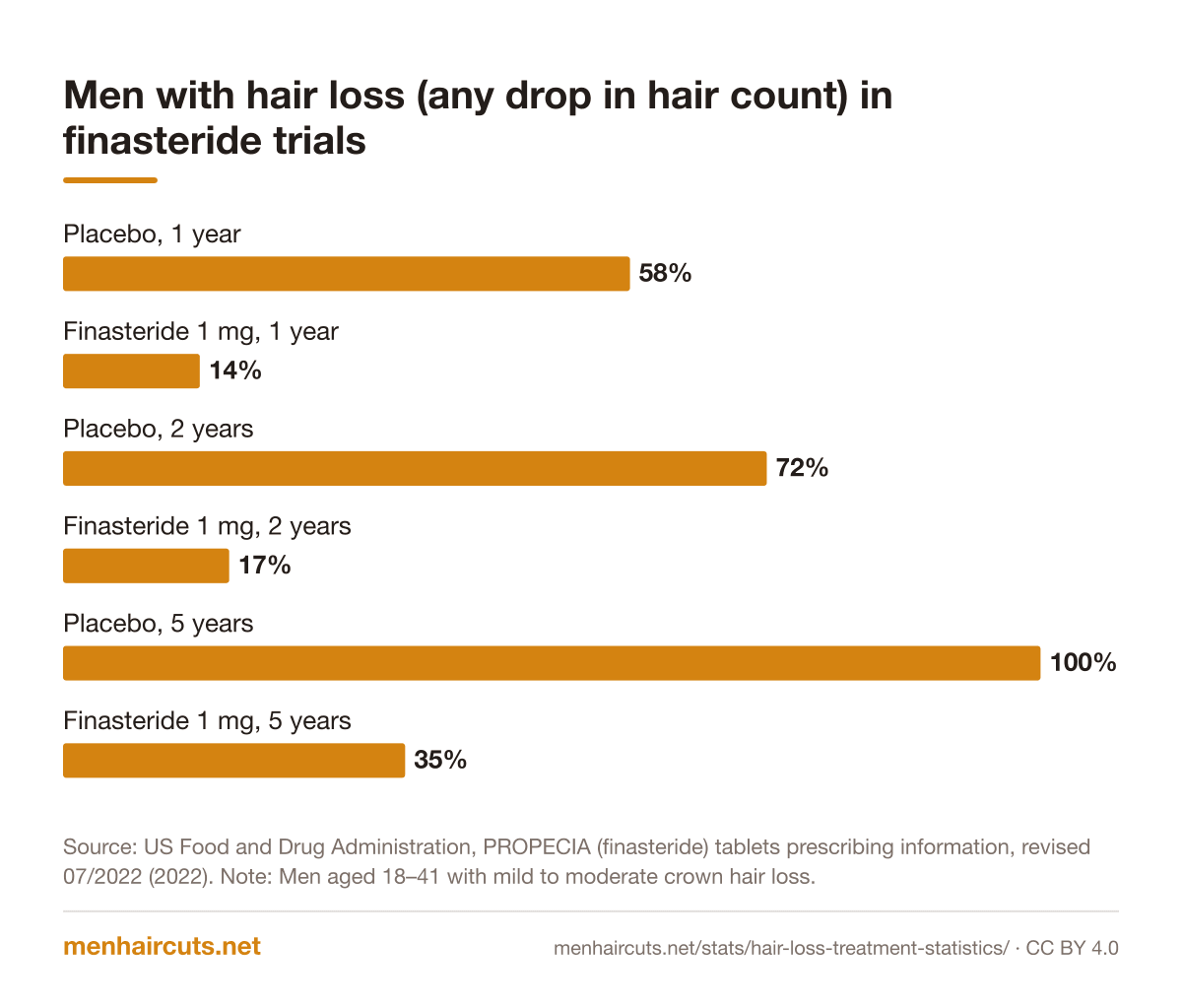
The FDA label adds 5-year results. Using any drop in hair count as the definition of hair loss, 58% of men on placebo lost hair by 12 months versus 14% on finasteride. By 2 years it was 72% versus 17%, and by 5 years 100% versus 35%[2]. A blinded photo panel rated 48% of finasteride users as having more hair at 5 years, 42% unchanged and 10% with less, compared with 6%, 19% and 75% in the placebo group[2].
Results depend on staying on it. When men switched from finasteride to placebo after 12 months, the gain in hair count reversed within the next 12 months[2].
Show the numbers
| Category | Value |
|---|---|
| Placebo, 1 year | 58% |
| Finasteride 1 mg, 1 year | 14% |
| Placebo, 2 years | 72% |
| Finasteride 1 mg, 2 years | 17% |
| Placebo, 5 years | 100% |
| Finasteride 1 mg, 5 years | 35% |
How common are finasteride side effects?
In three 12-month trials, sexual side effects were uncommon but more frequent than with placebo. Overall, 3.8% of 945 men on finasteride reported at least one, compared with 2.1% of 934 men on placebo[2]. Those effects resolved in men who stopped the drug and in most who kept taking it, and the rate of each fell to 0.3% or less by the fifth year[2]. About 1.4% of men stopped finasteride because of a drug-related side effect, compared with 1.6% on placebo[2].
The label also lists reports collected after approval, where frequency cannot be measured: sexual dysfunction that continued after stopping the drug, male infertility or poor semen quality, depression, and suicidal ideation and behavior[2]. Anyone who notices mood changes on finasteride should talk to a doctor promptly. Finasteride is not for women; in a 12-month study of 137 postmenopausal women it did not work[2].
| Side effect | Finasteride 1 mg (n=945) | Placebo (n=934) |
|---|---|---|
| Decreased libido | 1.8% | 1.3% |
| Erectile dysfunction | 1.3% | 0.7% |
| Ejaculation disorder | 1.2% | 0.7% |
| Stopped due to a sexual side effect | 1.2% | 0.9% |
How well does minoxidil work for men?
Topical minoxidil is the main over-the-counter option. In a 48-week trial of 393 men aged 18–49, published in the Journal of the American Academy of Dermatology in 2002, the 5% solution beat both the 2% solution and placebo on hair counts and on patient and investigator ratings. It produced 45% more regrowth than 2% at week 48 and worked sooner, though it caused more itching and scalp irritation[3].
Expect a slow start. The Men's Rogaine 5% foam label says results may occur at 2 months with twice-daily use, that some men need at least 4 months, and that it will not work for all men. It also warns that continued use is needed or hair loss will begin again[8]. The American Academy of Dermatology says results usually take about 6 to 12 months to see, and that minoxidil tends to work better combined with another hair loss treatment[9].
Is oral minoxidil or dutasteride better than the standard drugs?
A 2022 network meta-analysis in JAMA Dermatology pooled 23 studies of men using single treatments. At 24 weeks, dutasteride 0.5 mg a day produced the largest gain in total hair count, 7.1 hairs per square centimeter more than finasteride 1 mg. Oral minoxidil 5 mg a day produced the largest gain in thick terminal hairs at 24 weeks. At 48 weeks, finasteride 1 mg led on terminal hair count[10]. The authors note that more head-to-head trials are needed before ranking these firmly[10].
Low-dose oral minoxidil has become common practice. A 2025 meta-analysis of doses up to 5 mg a day found no significant change in systolic or diastolic blood pressure, a small rise in heart rate, and low blood pressure symptoms in 119 patients (5.0%). Unwanted hair growth on the body or face was the most common side effect and accounted for 34.6% of people who stopped[6]. Oral minoxidil for hair loss is off label and needs a prescription.
Which hair loss treatments do doctors prescribe most?
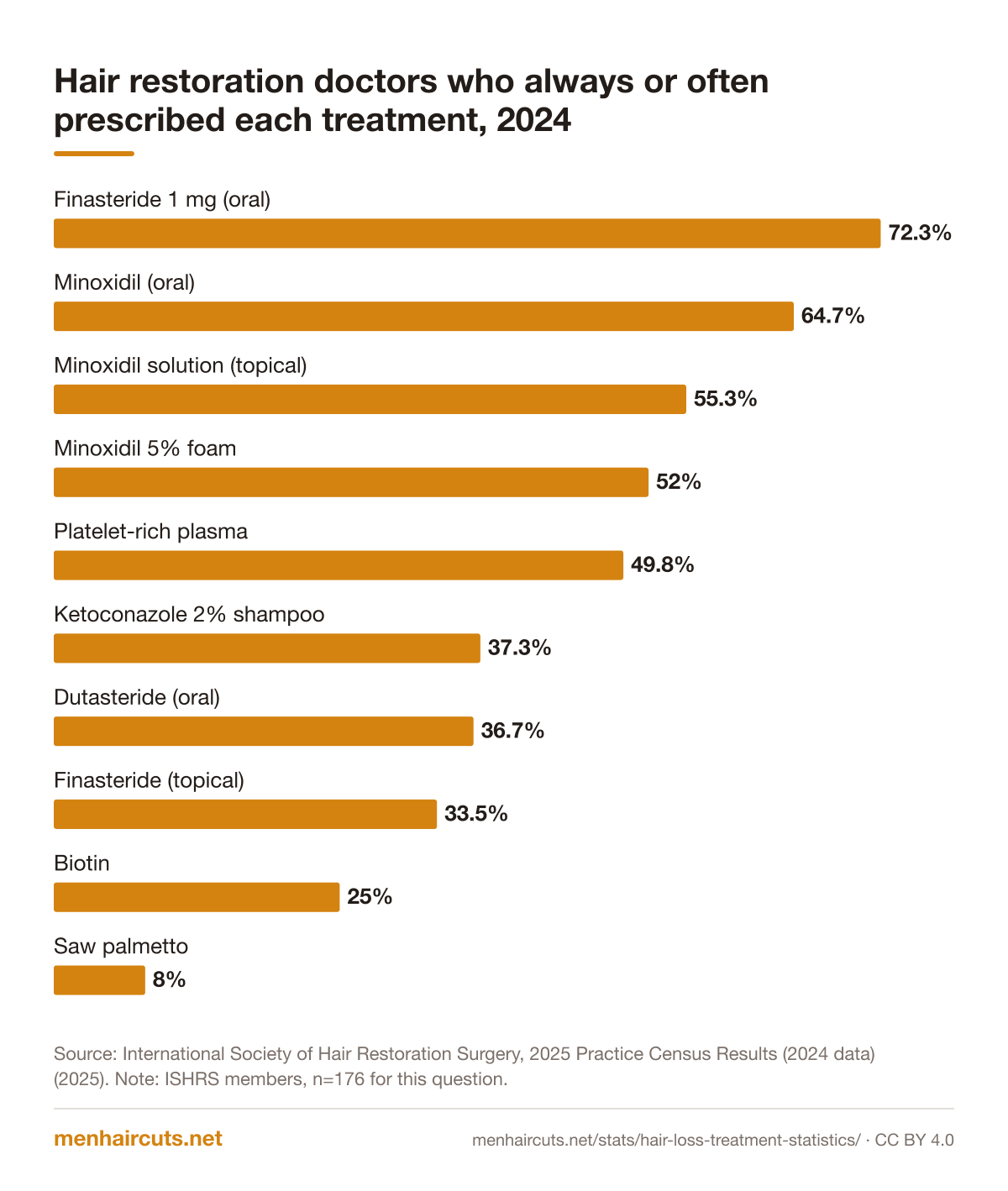
The ISHRS 2025 Practice Census asked hair restoration physicians worldwide how often they prescribed each treatment in 2024. Oral finasteride 1 mg led, with 72.3% prescribing it always or often, followed by oral minoxidil (64.7%), topical minoxidil solution (55.3%) and minoxidil foam (52.0%). Platelet-rich plasma came next at 49.8%[4].
Supplements ranked lower. Biotin was always or often prescribed by 25.0% and saw palmetto by 8.0%, while 50.6% rarely or never prescribed biotin[4]. The survey reflects 247 physicians who answered out of 946 invited, so it shows what specialists do, not what every doctor does[4].
Show the numbers
| Category | Value |
|---|---|
| Finasteride 1 mg (oral) | 72.3% |
| Minoxidil (oral) | 64.7% |
| Minoxidil solution (topical) | 55.3% |
| Minoxidil 5% foam | 52% |
| Platelet-rich plasma | 49.8% |
| Ketoconazole 2% shampoo | 37.3% |
| Dutasteride (oral) | 36.7% |
| Finasteride (topical) | 33.5% |
| Biotin | 25% |
| Saw palmetto | 8% |
How long does hair loss treatment take to work?
Every option is slow, which is the main reason people quit early. Here is what the labels and medical bodies say:
- Finasteride: daily use for three months or more is generally needed before benefit is seen[2].
- Topical minoxidil 5% foam: results may occur at 2 months with twice-daily use; some men need at least 4 months[8].
- Minoxidil in general: about 6 to 12 months to see results, according to the AAD[9].
- Hair transplant: new hair usually starts to appear after 4 months, with full results after 10 to 18 months[11].
Do lasers, PRP and microneedling work?
The evidence is more mixed. Low-level laser therapy was better than placebo in men in the 2017 meta-analysis, though the studies varied widely[1]. The AAD describes a trial in which more than 200 men and women with hereditary hair loss used a laser comb or a sham device 3 times a week for 26 weeks[9].
For microneedling, the AAD cites a 12-week study of men aged 20–35 in which 5% minoxidil twice daily plus weekly microneedling produced significantly more hair growth than minoxidil alone[9]. For platelet-rich plasma, the AAD notes that most patients return once a month for 3 months and then every 3 to 6 months[9], so costs add up. About half of ISHRS doctors (49.8%) prescribed PRP always or often in 2024[4].
How many people seek hair loss treatment?
Non-surgical patients far outnumber surgical ones. In 2024 the average ISHRS member treated 498 non-surgical hair restoration patients and 156 surgical patients[4]. The society's earlier census reported that 1,592,588 non-surgical patients sought treatment from ISHRS members in 2021, against 628,604 surgical patients[12].
Men made up 61.7% of non-surgical patients and 84.7% of surgical patients in 2024[4]. These figures cover specialist practices only. Men who buy minoxidil off the shelf or get finasteride through a telehealth service are not counted.
Frequently asked questions
What is the most effective hair loss treatment for men?
What percentage of men respond to finasteride?
How common are sexual side effects from finasteride?
How long does minoxidil take to work?
Is 5% minoxidil better than 2%?
Does oral minoxidil raise blood pressure?
What happens if you stop finasteride?
Methodology and limitations
Figures come from the FDA prescribing information for Propecia (finasteride 1 mg, revised July 2022), the DailyMed Drug Facts label for Men's Rogaine 5% foam, randomized trials and meta-analyses indexed in PubMed (Journal of the American Academy of Dermatology 1998, 2002, 2017 and 2025; JAMA Dermatology 2022), the American Academy of Dermatology, the NHS, and the ISHRS 2022 and 2025 Practice Census reports. Each number was checked against the source in October 2026. The 65% figure in the FAQ is a menhaircuts.net calculation: 100% minus the 35% of finasteride users who showed hair loss at 5 years. This is general information, not medical advice; see a board-certified dermatologist before starting, stopping or combining any hair loss treatment.
Limitations
Most of the main trials enrolled men aged 18–49 with mild to moderate loss, mostly white, and focused on the crown, so results may differ for older men, other groups and the hairline. Trial outcomes like hair counts in a small circle do not map neatly to how full hair looks. Off-label treatments such as oral minoxidil and dutasteride have shorter and smaller studies. The ISHRS census reflects specialists who answered the survey (a 26% response rate) and not general practice. Prices and access vary by country and are not covered here. This is general information, not medical advice.
Every figure on this page links to its source. Numbers are reported as published; any menhaircuts.net calculation is labelled and shows its inputs. Spotted an error? Tell us and we will check it.
Sources
- The effectiveness of treatments for androgenetic alopecia: a systematic review and meta-analysis (Adil A, Godwin M, Journal of the American Academy of Dermatology), PubMed (2017). Accessed October 15, 2026.
- PROPECIA (finasteride) tablets prescribing information, revised 07/2022, US Food and Drug Administration (2022). Accessed October 15, 2026.
- A randomized clinical trial of 5% topical minoxidil versus 2% topical minoxidil and placebo in men (Olsen EA et al., Journal of the American Academy of Dermatology), PubMed (2002). Accessed October 15, 2026.
- 2025 Practice Census Results (2024 data), International Society of Hair Restoration Surgery (2025). Accessed October 15, 2026.
- Finasteride in the treatment of men with androgenetic alopecia (Kaufman KD et al., Journal of the American Academy of Dermatology), PubMed (1998). Accessed October 15, 2026.
- Low-dose oral minoxidil does not significantly affect blood pressure: a systematic review and meta-analysis (Chen M et al., Journal of the American Academy of Dermatology), PubMed (2025). Accessed October 15, 2026.
- Hair loss, NHS (2024). Accessed October 15, 2026.
- Men's Rogaine (minoxidil 5%) unscented foam, Drug Facts label, DailyMed, National Library of Medicine (NIH) (2024). Accessed October 15, 2026.
- Hair loss: Diagnosis and treatment, American Academy of Dermatology (2022). Accessed October 15, 2026.
- Relative efficacy of minoxidil and the 5-alpha reductase inhibitors in androgenetic alopecia treatment of male patients: a network meta-analysis (Gupta AK et al., JAMA Dermatology), PubMed (2022). Accessed October 15, 2026.
- Hair transplant, NHS (2023). Accessed October 15, 2026.
- ISHRS 2022 Practice Census Results (news release, 2021 data), International Society of Hair Restoration Surgery (2022). Accessed October 15, 2026.
Cite, embed and download
This report, its charts and its infographic are free to reuse under a Creative Commons Attribution 4.0 license. Credit menhaircuts.net with a link to this page.
Cite this report (APA)
Hamilton, J. (2026, October 15). Hair Loss Treatment Statistics 2026: What Works. menhaircuts.net. https://menhaircuts.net/stats/hair-loss-treatment-statistics/
Link to this report
<a href="https://menhaircuts.net/stats/hair-loss-treatment-statistics/">Hair Loss Treatment Statistics 2026: What Works</a> (menhaircuts.net, CC BY 4.0)Share the headline number
35% vs 100%: Men with hair loss after 5 years: finasteride vs placebo (US Food and Drug Administration, via menhaircuts.net/stats/hair-loss-treatment-statistics/)
Download the charts and infographic
Related data
- 50 millionUS men with androgenetic alopecia (male pattern hair loss)Male Hair Loss Statistics 2026
- 84.7%Hair transplant patients who were men (ISHRS members, 2024)Hair Transplant Statistics 2026
- 31–33%Men aged 40–69 with frontal-only hair loss (Australia)Receding Hairline Statistics 2026
- 79%of US men use shampoo or conditioner (93% of women), 2025Men's Hair Product Statistics 2026
Related guides
Make us a Preferred Source on Google
See our latest articles first in your Google Search & AI Overviews.