
Data report · Updated October 2026
Men's hair product statistics: 79% of US men use shampoo or conditioner, far fewer go further
What men put on their hair, how often, and why, from polls, a peer-reviewed study and market research.
In an August 2025 YouGov poll, 79% of US men said they use shampoo or conditioner, against 93% of women[1]. A 2023 Morning Consult survey for EWG found men use 11 personal care products a day, two of them for hair[2]. Scalp health is a top hair concern for 47% of US men[3].
79%
of US men use shampoo or conditioner (93% of women), 2025[1]
11
personal care products the average US man uses daily, 2 of them for hair (2023)[2]
31%
of men's sample days included hairspray or hair gel in the prior 24 hours (EARTH study)[4]
47%
of US men list scalp health among their top hair concerns, vs 22% of women[3]
By Jessica Hamilton, Editor · Published · Updated · Free to reuse with credit (CC BY 4.0)
Key findings
- 79% of US men use shampoo or conditioner, compared with 93% of women, and 8% of men say they do nothing for their hair at all[1].
- Only 4% of US men use serums, masks or leave-in products and 7% oil their hair, against 31% and 25% of women[1].
- Men's daily personal care product count almost doubled from 6 in 2004 to 11 in 2023, and 2 of those 11 are hair care products, including beard products[2].
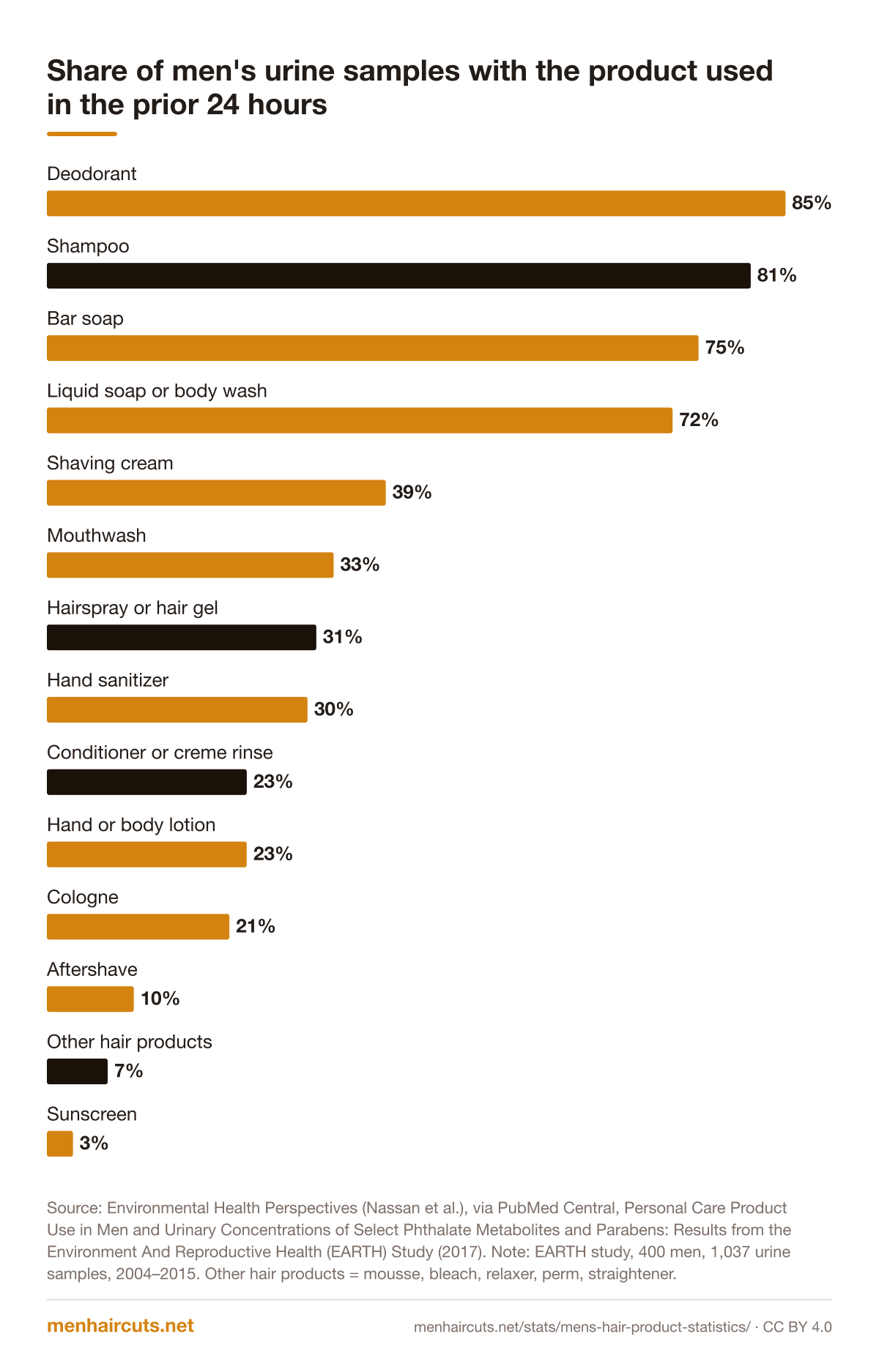
- In a Harvard study of 400 men, shampoo was reported within 24 hours of 81% of urine samples, hairspray or gel in 31% and conditioner in 23%[4].
- 47% of US men named scalp health as a top-three hair concern, more than twice the 22% of women who did[3].
- Among men whose hair is changing, 28% use serums or oils and 15% take supplements such as biotin, compared with 52% and 37% of women[1].
- 15% of US men say they would spend nothing on hair care in a month, compared with 4% of women[1].
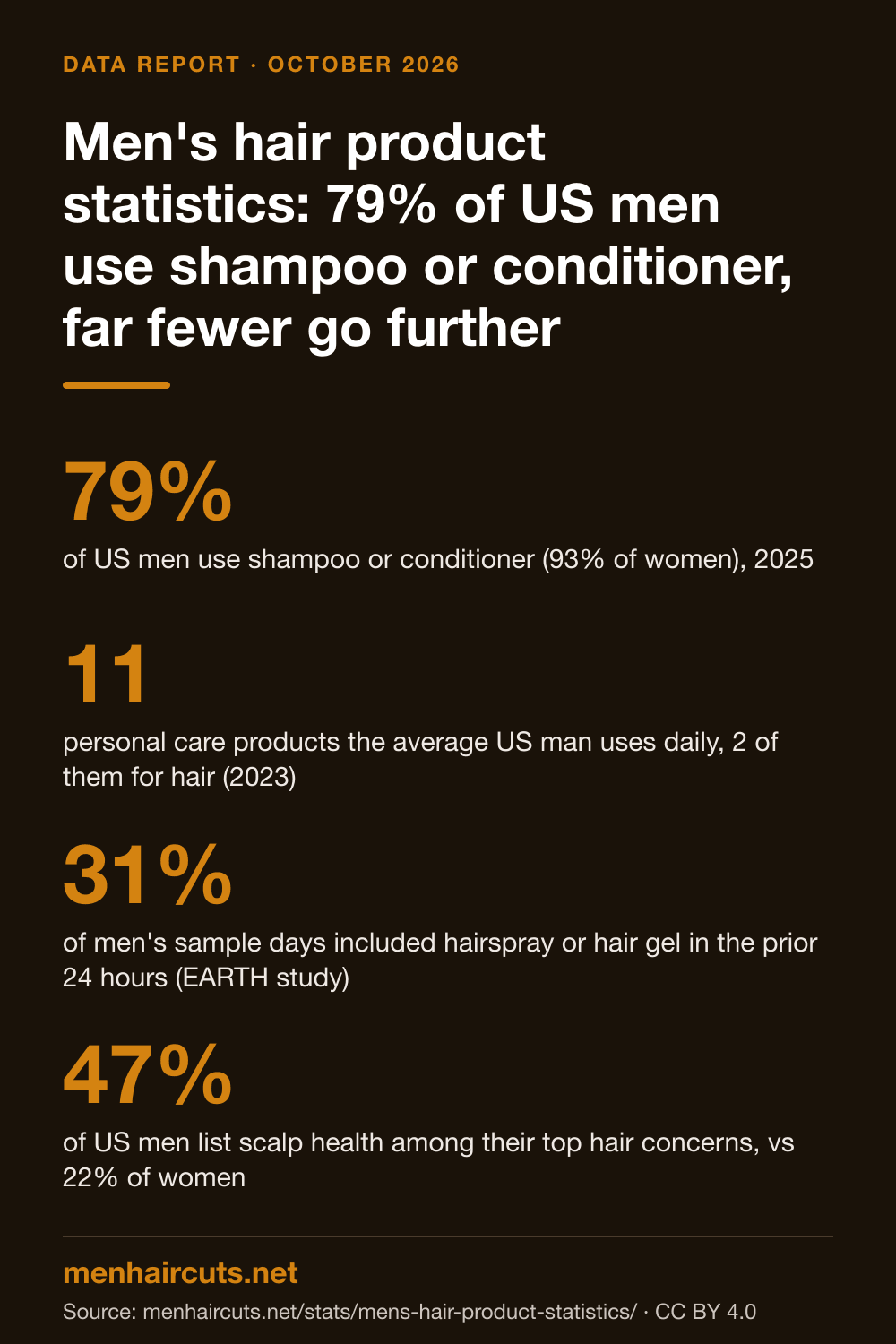
Download the infographic
The headline numbers from this report as one tall image (1000 x 1500 PNG), sized for Pinterest, slides and posts. Free to reuse with credit.
What percentage of men use hair products?
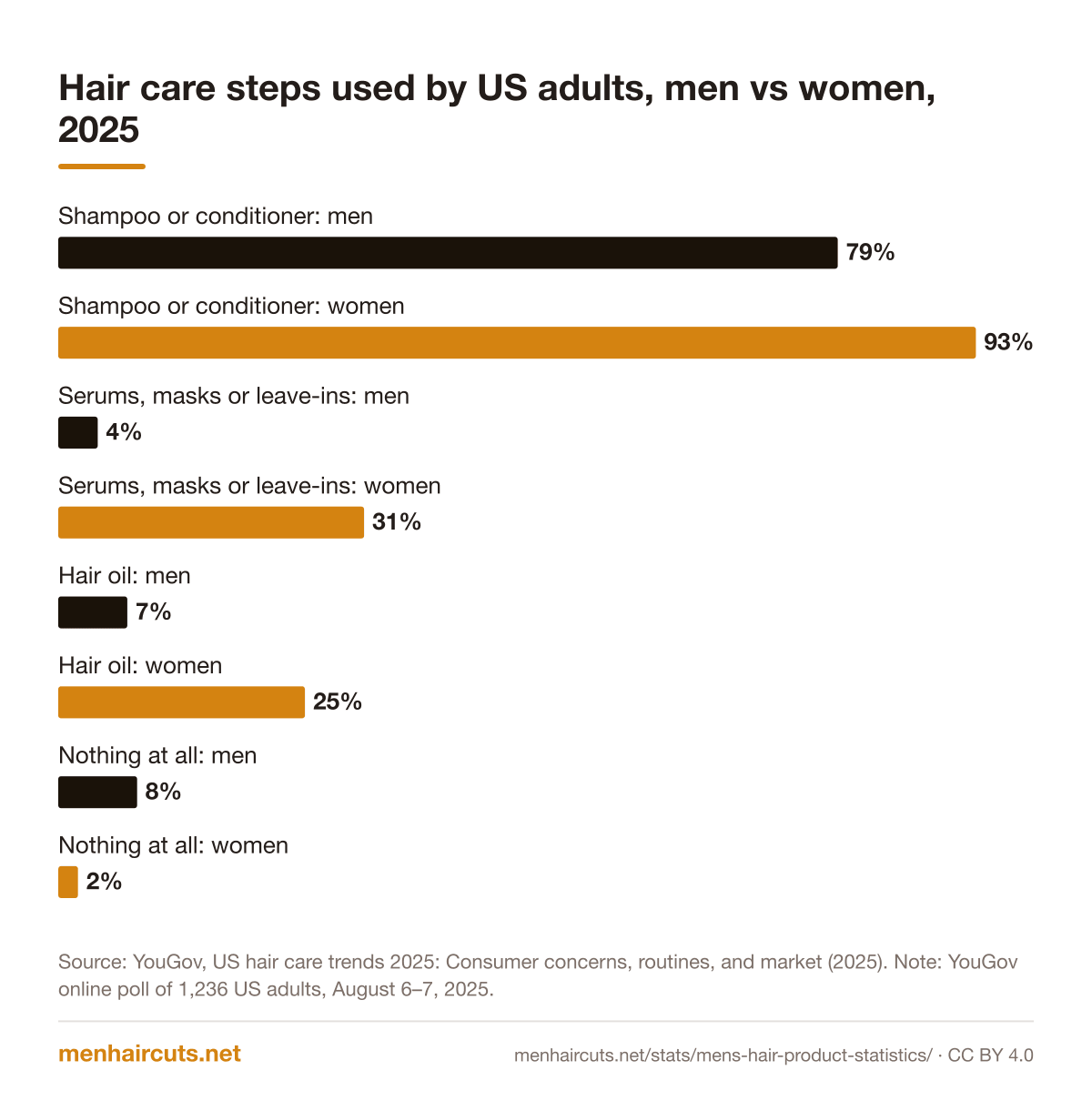
Basic hair care is close to universal for men, but the routine usually stops at the shower. In a nationally representative YouGov poll of 1,236 US adults run on August 6–7, 2025, 79% of men said they use shampoo or conditioner, compared with 93% of women[1].
The gap widens for anything beyond washing. Women were far more likely than men to oil their hair (25% vs 7%) or use serums and leave-ins (31% vs 4%)[1]. Men were more than three times as likely as women to say they do nothing at all for their hair (8% vs 2%), and another 8% of men said they don't have hair[1].
That last group matters for any product statistic. A share of men who skip shampoo are bald or shave their heads, so a low usage figure is not only about indifference. If you shave or keep a very short cut, our guide to scalp care basics for men covers what is still worth doing.
Show the numbers
| Category | Value |
|---|---|
| Shampoo or conditioner: men | 79% |
| Shampoo or conditioner: women | 93% |
| Serums, masks or leave-ins: men | 4% |
| Serums, masks or leave-ins: women | 31% |
| Hair oil: men | 7% |
| Hair oil: women | 25% |
| Nothing at all: men | 8% |
| Nothing at all: women | 2% |
How many grooming products does the average man use a day?
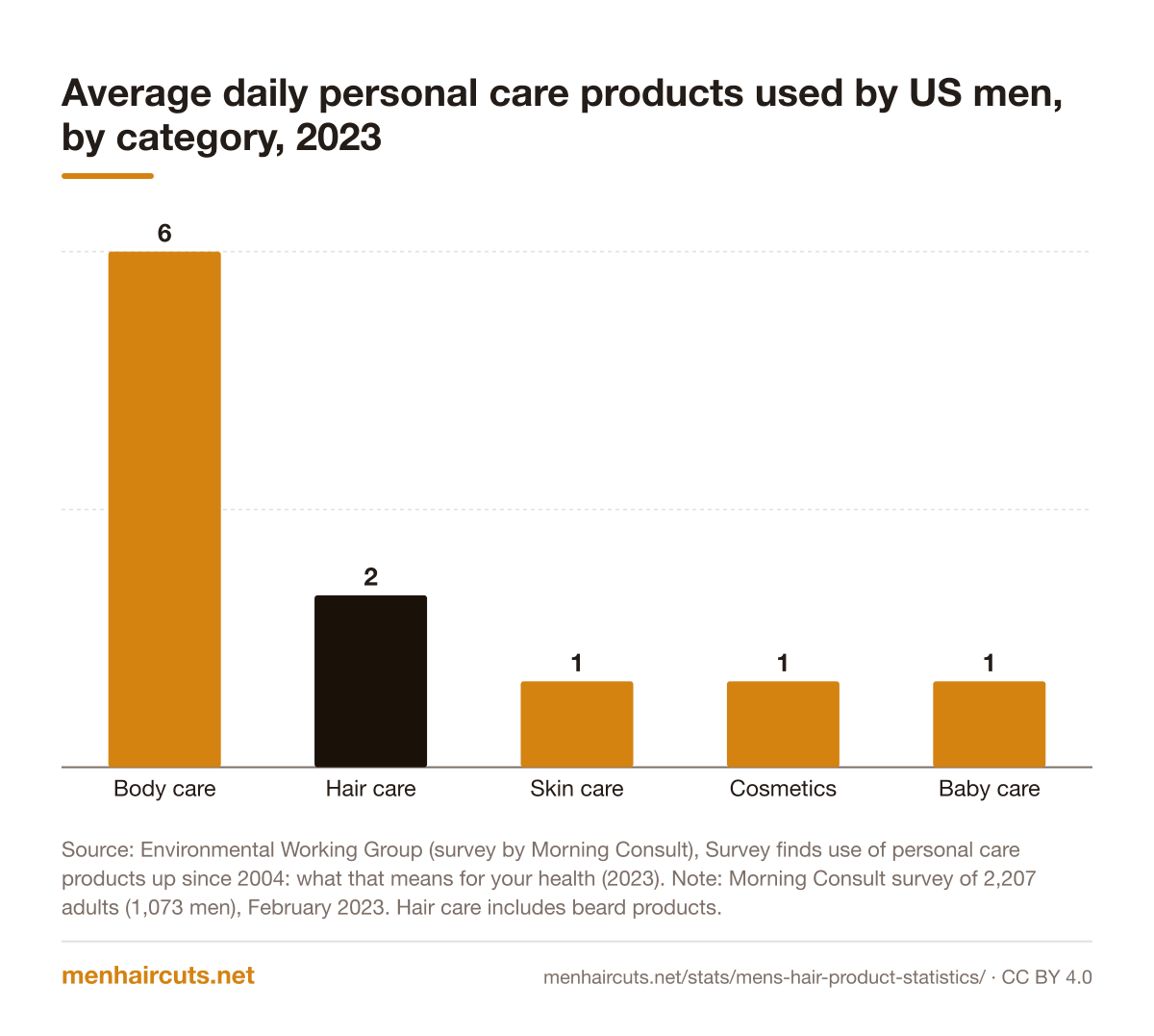
It depends on how you count. When Morning Consult asked about 66 specific product types for the Environmental Working Group in February 2023, the average man used 11 personal care products a day, up from 6 in EWG's 2004 survey[2]. Women averaged 13, and the average adult 12[2].
Of a man's 11 daily products, EWG's breakdown puts 6 in body care, 1 in skin care, 1 cosmetic, 2 in hair care (including beard products) and 1 baby care product[2]. Women's hair care count was 1, so on this measure men report more daily hair products than women do[2].
A broader 2022 Attest survey of 2,000 US consumers found a much lower number: the majority of men said they use no more than 3 products, while women use between 4 and 6[5]. The likely reason for the gap is the question itself. A checklist of 66 product types captures items such as deodorant, soap and lotion that people may not count as grooming products when asked in general terms.
Show the numbers
| Category | Value |
|---|---|
| Body care | 6 |
| Hair care | 2 |
| Skin care | 1 |
| Cosmetics | 1 |
| Baby care | 1 |
| Category | Men | Women |
|---|---|---|
| Body care | 6 | 6 |
| Skin care | 1 | 3 |
| Cosmetics | 1 | 2 |
| Hair care | 2 | 1 |
| Baby care | 1 | 1 |
| Total products per day | 11 | 13 |
Which hair products do men actually use day to day?
Self-reported surveys can drift toward what people think they should do. A peer-reviewed study from the Harvard T.H. Chan School of Public Health gives a closer look because it asked men about specific products tied to specific days. In the EARTH study, 400 men gave 1,037 urine samples between 2004 and 2015 and reported which of 14 personal care products they had used in the 24 hours before each sample[4].
Shampoo was reported before 81% of samples, second only to deodorant at 85%[4]. Hairspray or hair gel came up for 31%, conditioner for 23%, and other hair products such as mousse, bleach, relaxer, perms and straighteners for just 7%[4]. Shaving cream (39%) was used more often than any styling product[4].
The men in this study were mostly white (86%), college educated (84%) and had a median age of 36, so the figures describe one group of men rather than all US men[4]. Even so, the ranking matches the polls: washing is routine, while styling and conditioning are something closer to a third of men do on a given day. For how to choose between styling products, see pomade vs clay vs wax.
How many men use styling products like gel, pomade or wax?
There is no recent, free, nationally representative US figure for styling product use alone. The most cited US number comes from the Dove Men+Care 2017 Men's Hair Census, a brand survey of men in all 50 states: gel, pomade and hair spray were the tools of choice for 60% of respondents, and more than 60% said they style their hair every day[6]. The same survey found 90% of men check or fix their hair in a mirror at least once a day[6]. Dove's published coverage does not give a sample size, so treat these as indicative.
UK data from Mintel, published in April 2016 and based on men who use hair care products, shows how styling habits split by age. 23% of these men take time to style their hair in the morning, rising to 33% of 16–24 year olds[7]. 20% carry styling products for on-the-go fixes and 20% use styling products throughout the day[7]. Heated tools are still a minority habit: 12% of male hair care users use them, rising to 22% of 16–24 year olds[7].
Shine level is part of the choice too. In Attest's 2025 US haircare research, 28% of men picked shine and smoothness as a concern, slightly above 27% of women[3]. Our guide to matte vs shine hair products explains which finish suits which cut.
| Habit | All male users | Men aged 16–24 |
|---|---|---|
| Take time to style hair in the morning | 23% | 33% |
| Use heated styling appliances | 12% | 22% |
| Carry styling products for on-the-go fixes | 20% | Not reported |
| Use styling products throughout the day | 20% | Not reported |
| Prefer a barber or hairdresser to style hair for special occasions | 30% | Not reported |
Do men use conditioner, hair oils and leave-in products?
Conditioner is the clearest dividing line between a basic and a fuller hair routine. In the EARTH study, conditioner was reported before 23% of men's samples, against 81% for shampoo[4]. In YouGov's 2025 poll, only 4% of men used serums, masks or leave-ins and 7% used hair oil[1].
Some men get their conditioner secondhand. In a 2023 OnePoll survey of 2,000 Gen Z and millennial men commissioned by CeraVe, 76% of men in relationships said they are gradually using more of their partner's personal care products, and shampoo or conditioner (43%) was the item named most often[8].
Race and hair texture shape these habits for both sexes. YouGov found 47% of Black respondents oil their hair, compared with 10% of white and 17% of Hispanic respondents; these figures are not split by gender[1].
What hair concerns drive men's product choices?
Men's hair worries center on the scalp and on keeping the hair they have. In Attest's 2025 research, 47% of US men listed scalp health among their top three hair concerns, compared with 22% of women; in the UK the split was 46% of men against 28% of women[3]. Across all US adults, preventing hair loss or thinning was the top concern at 37%[3].
YouGov's 2025 poll asked why people care for their hair. Hygiene and upkeep led overall at 66%[1]. Men were less likely than women to say they want healthier or better-looking hair (42% vs 72%), to link hair care with stress relief (21% vs 33%) or to cite preventing hair loss (35% vs 44%)[1].
Older UK data from Mintel points the same way. Among men who use hair care products, 27% were concerned about thinning hair, 24% about hair loss and 17% about hair that is difficult to style[9]. A quarter (24%) wanted to try products that stimulate hair growth and 21% were interested in thickening products[9]. In 2016, 22% of male users worried that styling products cause hair loss[7]. If heavy products are leaving residue, see how to deep clean hair product buildup.
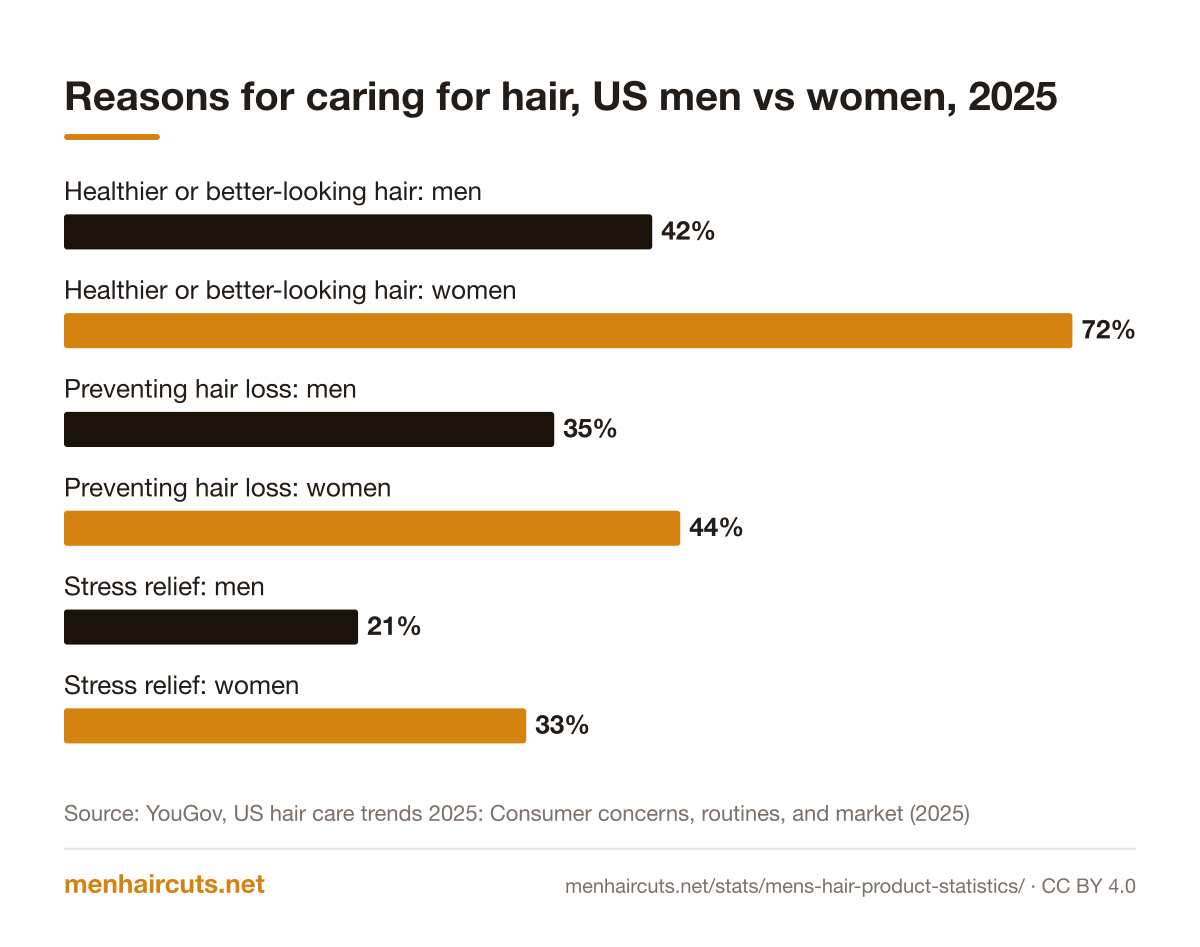
Show the numbers
| Category | Value |
|---|---|
| Healthier or better-looking hair: men | 42% |
| Healthier or better-looking hair: women | 72% |
| Preventing hair loss: men | 35% |
| Preventing hair loss: women | 44% |
| Stress relief: men | 21% |
| Stress relief: women | 33% |
What do men do when their hair starts changing?
Concern does not always turn into action. Among Americans noticing changes in their hair, 41% use serums, oils or similar products, but the split is 52% of women against 28% of men[1]. More than a third of men said they have not tried anything at all, compared with 28% of all adults[1].
Supplements such as biotin or collagen were used by 37% of women but 15% of men[1]. Clinical routes stay rare for everyone: 7% had seen a dermatologist and 2% had a medical procedure[1]. For treatment data, see our hair loss statistics pages linked below.
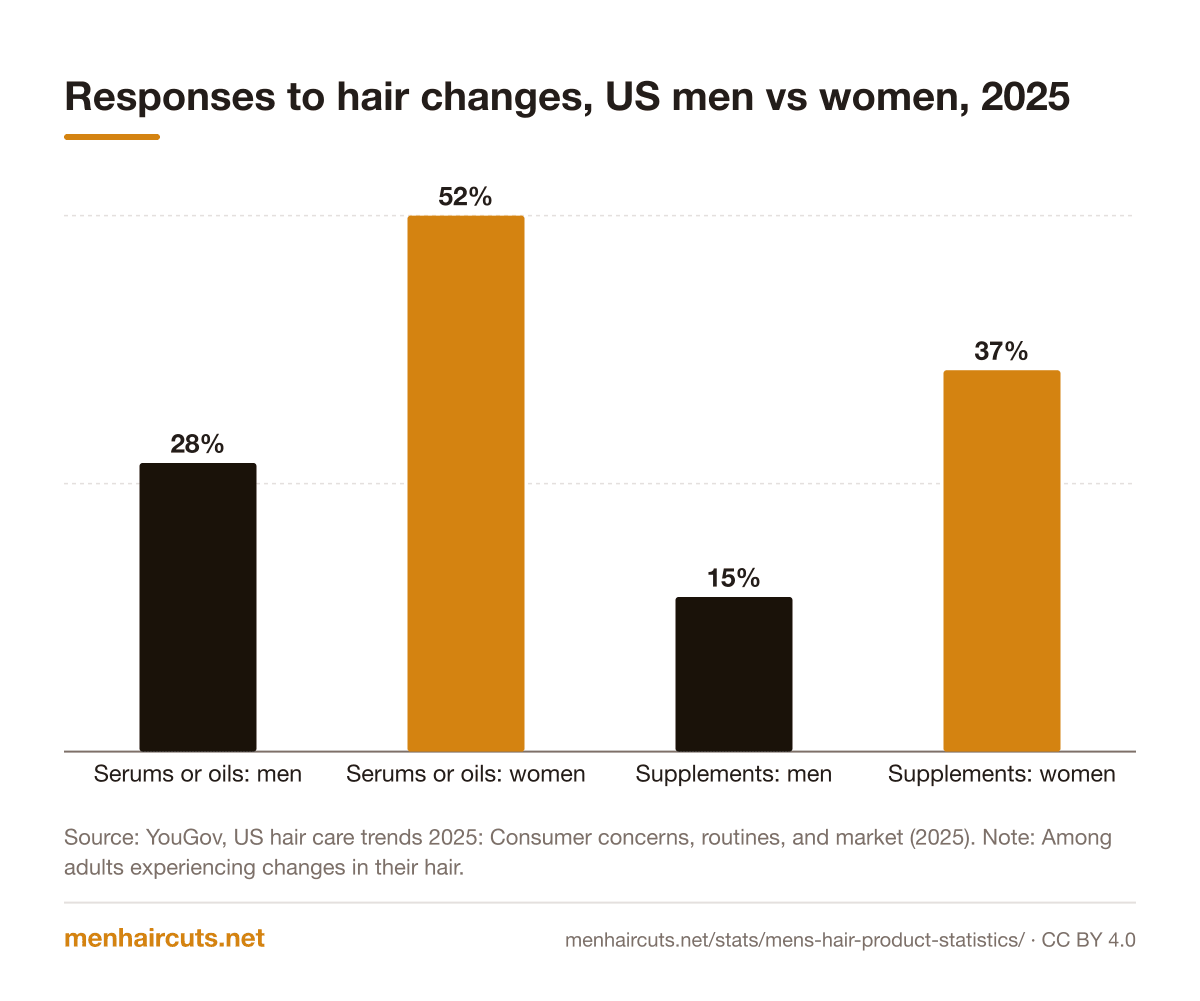
Show the numbers
| Category | Value |
|---|---|
| Serums or oils: men | 28% |
| Serums or oils: women | 52% |
| Supplements: men | 15% |
| Supplements: women | 37% |
How much do men want to spend on hair care each month?
Men are more likely to want to spend nothing. In the 2025 YouGov poll, 15% of men said they would spend nothing a month on hair care, compared with 4% of women[1]. 37% of men chose the $1–$50 range, against 46% of women[1]. Across all adults only 5% said they would go as high as $100[1].
Price sensitivity fits the short routines above: a shampoo, perhaps a styling product, and little else. For a full breakdown of what men spend on grooming overall, see our men's grooming spending statistics.
Where do men learn how to use hair products?
The barber chair is a common classroom. In a July 2025 Talker Research poll of 2,000 US men commissioned by Sport Clips, 31% said their stylist taught them how to style and maintain their haircut at home, and 41% learned which styles fit their hair type[10]. Mintel's UK data shows 30% of male hair care users prefer a barber or hairdresser to style their hair for special occasions[7].
For step-by-step help choosing and applying products at home, our styling products and DIY guide walks through each product type.
Frequently asked questions
What percentage of men use hair products?
How many grooming products does the average man use per day?
How many men use hair gel or pomade?
Do men use conditioner?
What is the biggest hair concern for men?
How much do men spend on hair care a month?
Methodology and limitations
This page combines five kinds of data: a 2025 YouGov US poll on hair care routines (1,236 adults); a February 2023 Morning Consult survey commissioned by EWG on personal care product counts (2,207 adults); a peer-reviewed 2017 Environmental Health Perspectives paper from the EARTH study (400 men, 1,037 urine samples, 2004–2015); Attest consumer surveys from 2022 and 2025; and UK Mintel press releases from 2015 and 2016. Brand-commissioned surveys (Dove Men+Care 2017, CeraVe 2023 via OnePoll, Sport Clips 2025 via Talker Research) are named as such. Every figure was checked on the source page on October 15, 2026. No numbers were estimated or adjusted.
Limitations
There is no recent, free, nationally representative US measure of how many men use styling products such as gel, pomade, clay or wax, so the styling figures here come from a 2017 brand survey without a published sample size, a clinical study of 400 mostly white, college-educated men, and UK data from 2015–2016. The EARTH study percentages are shares of urine-sample visits, not of men. Product counts differ sharply by question wording (11 a day in a 66-item checklist vs 3 or fewer in a general question). YouGov and Attest figures are self-reported online panel results. Attest's 2025 blog does not state its sample size. Several figures come from brand-commissioned polls and may reflect the sponsor's interests.
Every figure on this page links to its source. Numbers are reported as published; any menhaircuts.net calculation is labelled and shows its inputs. Spotted an error? Tell us and we will check it.
Sources
- US hair care trends 2025: Consumer concerns, routines, and market, YouGov (2025). Accessed October 15, 2026.
- Survey finds use of personal care products up since 2004: what that means for your health, Environmental Working Group (survey by Morning Consult) (2023). Accessed October 15, 2026.
- Split ends and shifting trends: the state of haircare in 2025, Attest (2025). Accessed October 15, 2026.
- Personal Care Product Use in Men and Urinary Concentrations of Select Phthalate Metabolites and Parabens: Results from the Environment And Reproductive Health (EARTH) Study, Environmental Health Perspectives (Nassan et al.), via PubMed Central (2017). Accessed October 15, 2026.
- Just the numbers: US beauty and grooming 2022 (Attest survey of 2,000 US consumers), BeautyMatter (2022). Accessed October 15, 2026.
- Haircare is a serious business for men (Dove Men+Care 2017 Men's Hair Census), Premium Beauty News (2017). Accessed October 15, 2026.
- Because he's worth it: Men's haircare market in the UK to grow 11% by 2020, Mintel (2016). Accessed October 15, 2026.
- Survey: Gen Z and millennial men fall short on face washing, skin care (CeraVe survey by OnePoll), Practical Dermatology (2023). Accessed October 15, 2026.
- Healthy growth in men's haircare sales despite a receding number of product launches, Mintel (2015). Accessed October 15, 2026.
- How men can overcome their haircut anxiety (poll of 2,000 US men for Sport Clips), Talker Research (2025). Accessed October 15, 2026.
Cite, embed and download
This report, its charts and its infographic are free to reuse under a Creative Commons Attribution 4.0 license. Credit menhaircuts.net with a link to this page.
Cite this report (APA)
Hamilton, J. (2026, October 15). Men's Hair Product Statistics 2026: Use and Habits. menhaircuts.net. https://menhaircuts.net/stats/mens-hair-product-statistics/
Link to this report
<a href="https://menhaircuts.net/stats/mens-hair-product-statistics/">Men's Hair Product Statistics 2026: Use and Habits</a> (menhaircuts.net, CC BY 4.0)Share the headline number
79%: of US men use shampoo or conditioner (93% of women), 2025 (YouGov, via menhaircuts.net/stats/mens-hair-product-statistics/)
Download the charts and infographic
- Hair care steps used by US adults, men vs women, 2025 (PNG)
- Average daily personal care products used by US men, by category, 2023 (PNG)
- Share of men's urine samples with the product used in the prior 24 hours (PNG)
- Reasons for caring for hair, US men vs women, 2025 (PNG)
- Responses to hair changes, US men vs women, 2025 (PNG)
- Infographic: Men's Hair Product Statistics 2026 (PNG, 1000 x 1500)
Related data
- 34.8 minaverage daily grooming time for US men in 2025 (0.58 hours; women 0.77 hours)Men's Grooming Routine Statistics 2026
- $978Average household spending on personal care products and services, 2024Men's Grooming Spending Statistics 2026
- 39%of US men say they have a consistent skincare routine (women: 60%), 2024Men's Skincare Statistics 2026
- 50 millionUS men with androgenetic alopecia (male pattern hair loss)Male Hair Loss Statistics 2026
- 50%Adults worldwide affected by dandruffDandruff Statistics 2026
Related guides
Make us a Preferred Source on Google
See our latest articles first in your Google Search & AI Overviews.