
Data report · Updated October 2026
Dandruff statistics: about half of all adults have dandruff
How common dandruff and seborrheic dermatitis are, why men get more of both, what treatment costs and which shampoo ingredients have evidence.
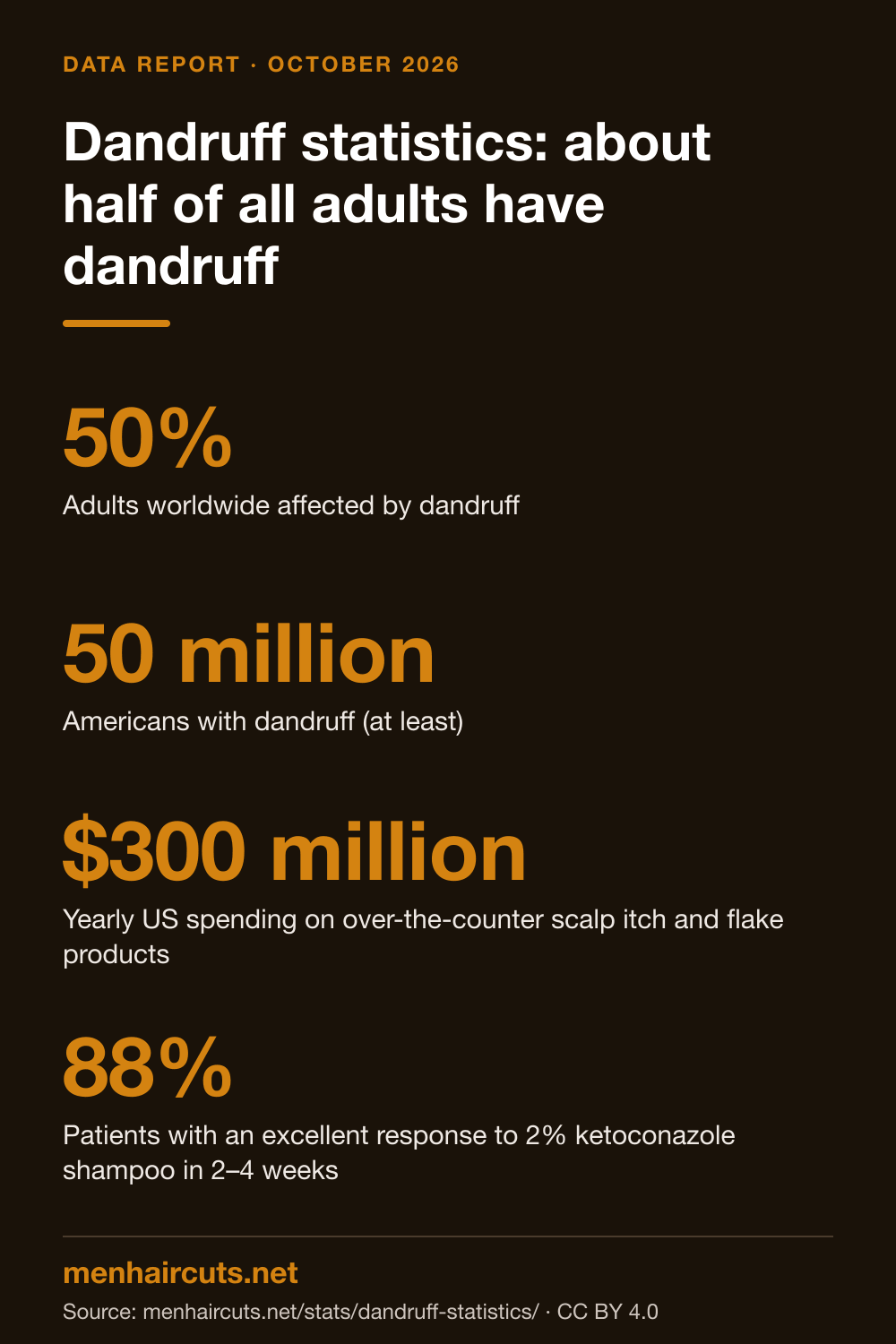
Dandruff affects about 50% of adults worldwide and is more common in men than women[1]. At least 50 million Americans have it and spend about $300 million a year on over-the-counter products[1]. Its more severe form, seborrheic dermatitis, affects 1–3% of adults[1].

50%
Adults worldwide affected by dandruff[1]
50 million
Americans with dandruff (at least)[1]
$300 million
Yearly US spending on over-the-counter scalp itch and flake products[1]
88%
Patients with an excellent response to 2% ketoconazole shampoo in 2–4 weeks[2]
By Jessica Hamilton, Editor · Published · Updated · Free to reuse with credit (CC BY 4.0)
Key findings
- Dandruff affects approximately 50% of the adult population worldwide and is more common in men than women[1].
- At least 50 million Americans have dandruff and spend about $300 million a year on over-the-counter products for scalp itching and flaking[1].
- Dandruff starts at puberty, peaks in severity around age 20 and becomes less common after 50[1].
- In a US and China study, dandruff prevalence was 81–95% in African Americans, 66–82% in white Americans and 30–42% in Chinese participants[1].
- Seborrheic dermatitis was diagnosed in 14.3% of 5,498 middle-aged and older Dutch adults, and men had about twice the odds of women (odds ratio 2.09)[3].
- In a trial of 575 patients, 2% ketoconazole shampoo twice weekly gave an excellent response in 88%, and weekly use cut relapse to 19% versus 47% on placebo[2].
- The NHS says dandruff is not caused by poor hygiene and suggests using an anti-dandruff shampoo for up to 4 weeks before seeing a GP[4].
Download the infographic
The headline numbers from this report as one tall image (1000 x 1500 PNG), sized for Pinterest, slides and posts. Free to reuse with credit.
How common is dandruff?
Very. A comprehensive review published in 2015 in the Journal of Clinical and Investigative Dermatology, by researchers at the University of Miami, puts dandruff at approximately 50% of the general adult population worldwide[1]. The same review estimates that at least 50 million Americans have dandruff[1].
The American Academy of Dermatology describes dandruff as a common scalp condition in which small pieces of dry skin flake off the scalp, sometimes with itching[5]. The NHS calls it a common skin condition that is not harmful and cannot be caught from someone else[4].
Those figures are global estimates gathered from earlier studies, not a fresh national survey. No US government survey tracks dandruff each year, and the AAD notes that for most people dandruff does not require medical attention[5], so many cases never reach a doctor's records.
Do men get dandruff more than women?
Yes. Dandruff is more prevalent in males than females, according to the 2015 review[1]. The pattern holds for its more severe form too: seborrheic dermatitis affects men more often than women (3.0% versus 2.6%)[1], and in the Rotterdam Study men had about twice the odds of having it (odds ratio 2.09)[3].
A 2025 study in the British Journal of Dermatology, run by researchers employed by Unilever, looked at the scalp microbes behind dandruff. It found that men's scalps, even with milder dandruff, showed a microbial profile that resembled more severe dandruff, and suggested men and women might need different treatment approaches[6].
Age matters as well. Dandruff typically starts at puberty, reaches its peak incidence and severity at about age 20, and becomes less common in people over 50[1]. That makes teenagers and men in their twenties the classic dandruff group.
Does dandruff differ by ethnicity?
Large differences have been reported. The 2015 review cites a study in the US and China that found dandruff in 81–95% of African American participants, 66–82% of white participants and 30–42% of Chinese participants[1]. The review reports ranges rather than single figures, so they are best read as relative differences, not exact rates.
Hair type also changes how dandruff is treated. The AAD notes that people with coarse, curly or coily hair often wash less frequently and may use dandruff shampoo about once a week, applied only to the scalp because the active ingredients can dry the hair[5]. Flakes are also more visible on dark hair and dark clothing[5].
| Group | Dandruff prevalence |
|---|---|
| African American | 81–95% |
| White (Caucasian) | 66–82% |
| Chinese | 30–42% |
How common is seborrheic dermatitis compared with dandruff?
Dandruff and seborrheic dermatitis sit on the same spectrum. Dandruff is limited to the scalp and involves itchy flaking without visible inflammation, while seborrheic dermatitis adds redness and inflammation and can spread beyond the scalp[1]. Seborrheic dermatitis is far less common, affecting about 1–3% of the general adult population[1].
Rates climb in older adults. The Rotterdam Study, a population study in the Netherlands, had physicians examine the skin of 5,498 middle-aged and older people and diagnosed seborrheic dermatitis in 788 of them (14.3%). Men, people with lighter skin, people with dry skin and people examined in winter were more likely to have it[3].
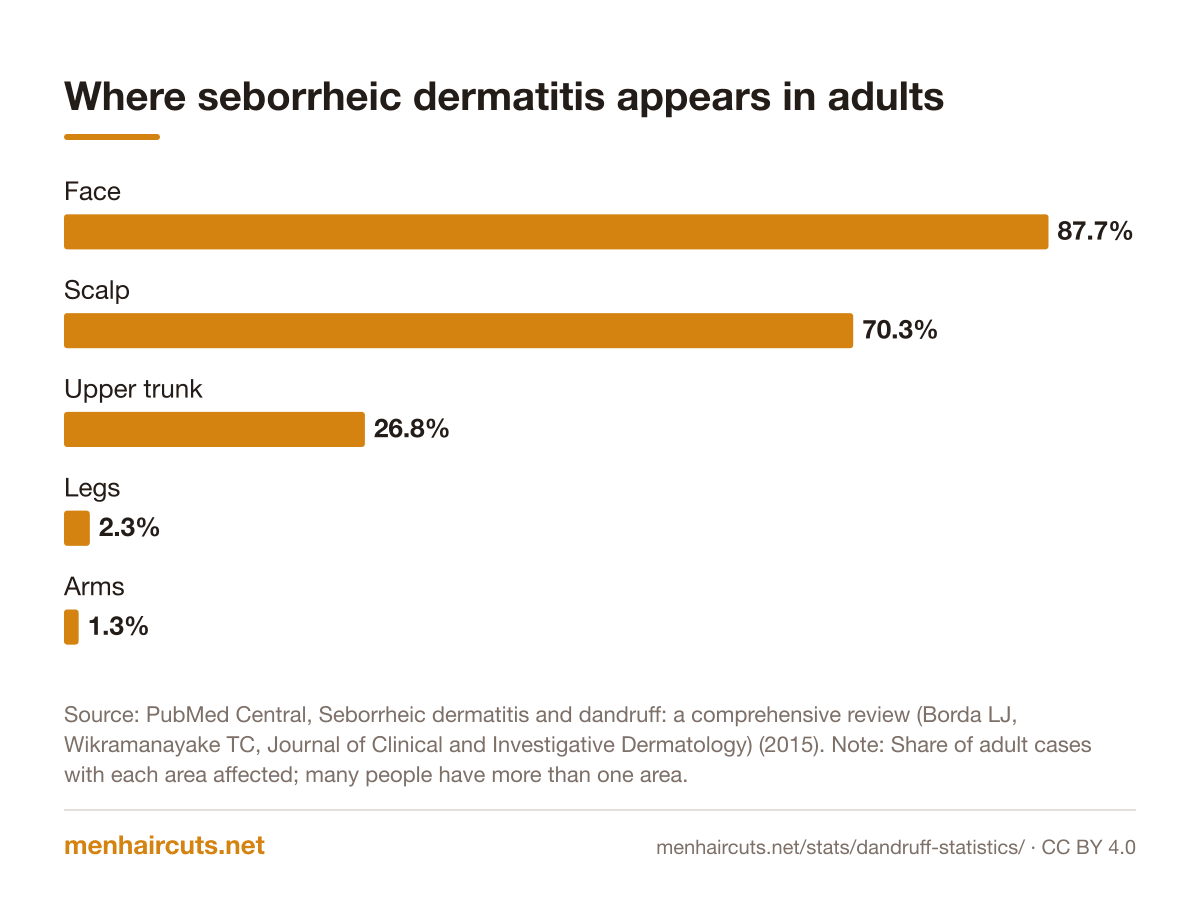
In adults with seborrheic dermatitis, the face is involved most often (87.7% of cases), followed by the scalp (70.3%) and upper trunk (26.8%)[1]. Flaky, itchy patches on the face or body are one of the NHS's reasons to see a GP rather than keep trying shampoos[4].
Show the numbers
| Category | Value |
|---|---|
| Face | 87.7% |
| Scalp | 70.3% |
| Upper trunk | 26.8% |
| Legs | 2.3% |
| Arms | 1.3% |
How much do Americans spend on dandruff?
The 2015 review estimates that Americans with dandruff spend $300 million a year on over-the-counter products to treat scalp itching and flaking[1].
Seborrheic dermatitis costs more per person. The review cites US estimates that outpatient office visits alone cost $58 million in 2004, with $109 million spent on prescription drugs. Total direct costs, including over-the-counter products and hospital services, came to an estimated $179 million, plus $51 million in indirect costs from lost work days. People said they would be willing to pay $1.2 billion for relief of symptoms[1].
These figures are old and have not been updated by a federal source, so the current market is almost certainly different. They are still the most specific published US cost numbers for this condition.
Which dandruff shampoo ingredients work best?
The AAD lists six active ingredients to look for: zinc pyrithione, salicylic acid, sulfur, selenium sulfide, ketoconazole and coal tar, and suggests alternating between shampoos with different actives if one stops working[5]. The NHS recommends shampoos with ketoconazole, coal tar or salicylic acid[4].
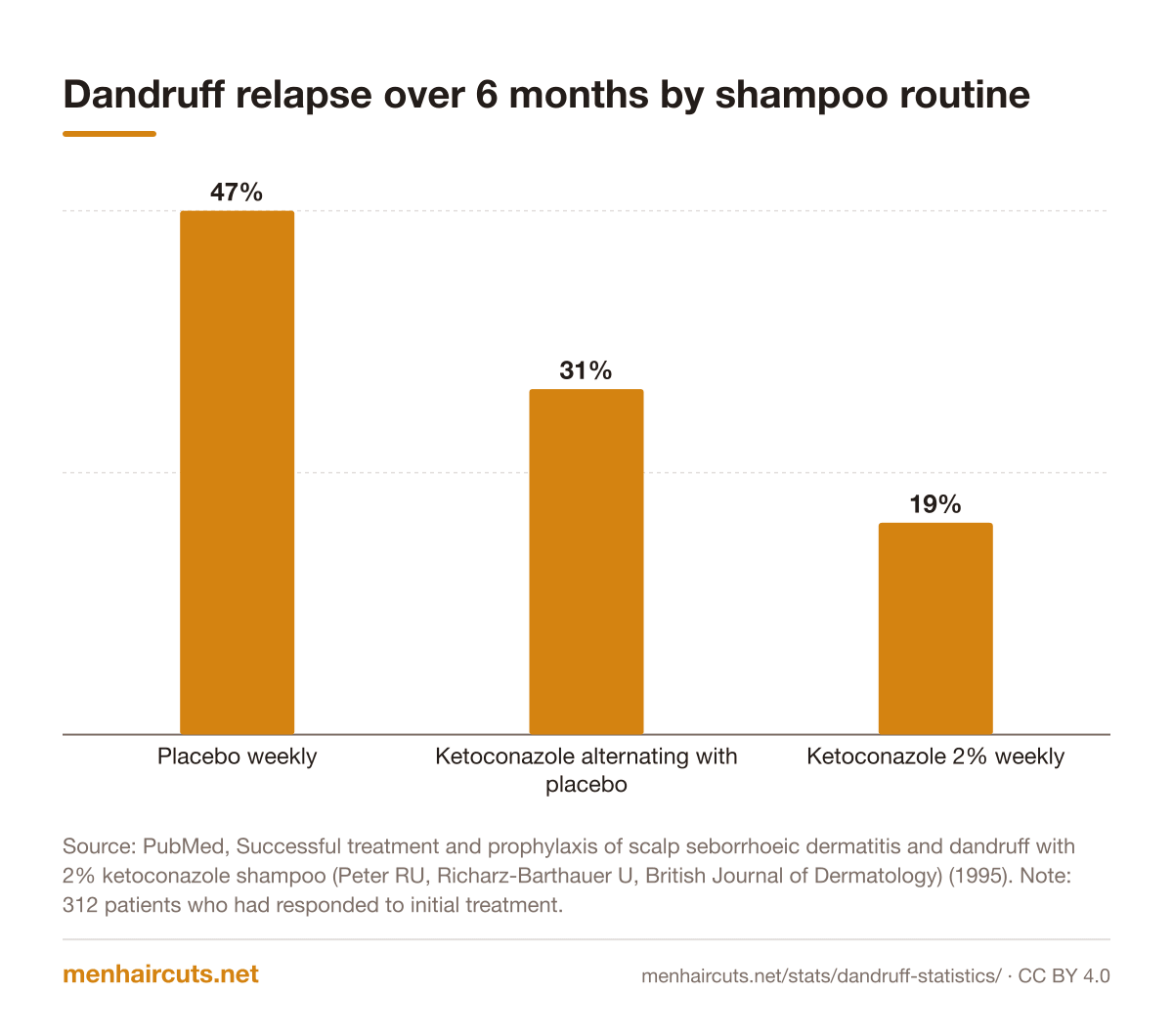
Ketoconazole has some of the strongest trial data. In a multicenter, double-blind trial published in the British Journal of Dermatology in 1995, 575 patients with moderate to severe seborrheic dermatitis and dandruff used 2% ketoconazole shampoo twice a week for 2–4 weeks, and 88% had an excellent response[2]. In the 6-month follow-up, 47% of patients on a placebo shampoo relapsed, compared with 19% using ketoconazole once a week and 31% alternating it with placebo[2].
Hair loss specialists use these shampoos too. In 2024, 37.3% of ISHRS hair restoration physicians always or often prescribed ketoconazole 2% shampoo, and 19.9% prescribed 2% zinc pyrithione shampoo that often[7].
Show the numbers
| Category | Value |
|---|---|
| Placebo weekly | 47% |
| Ketoconazole alternating with placebo | 31% |
| Ketoconazole 2% weekly | 19% |
How long does dandruff treatment take to work?
Give a shampoo a few weeks. The NHS suggests using an anti-dandruff shampoo for up to 4 weeks to see if it helps, and trying more than one type if needed[4]. The AAD notes that some dandruff shampoos need to sit on the scalp for 5–10 minutes before rinsing[5].
For ketoconazole, the 2015 review describes a typical regimen of twice a week for 4 weeks, then once a week for maintenance[1]. Coal tar shampoos can make the scalp more sensitive to sunlight, so the AAD advises sun protection, including SPF 30 or higher on a thinning scalp[5].
Is dandruff caused by not washing your hair?
No. The NHS says dandruff is not caused by poor hygiene, although it can be more obvious if you do not wash your hair regularly. Likely causes include a yeast that naturally lives on the skin and skin conditions such as eczema, and stress and cold weather can make it worse[4].
The seasonal effect shows up in the data. In the Rotterdam Study, people examined in summer had lower odds of seborrheic dermatitis than those examined in winter (odds ratio 0.63)[3]. The AAD adds that how often you wash matters by hair type: people with fine, straight hair or an oily scalp may need to shampoo daily and use a dandruff shampoo twice a week[5].
Can dandruff cause hair loss?
The link between dandruff and hair loss is not well studied, but scalp inflammation can get in the way of judging hair loss treatment. In the finasteride trials, every man was asked to use a tar-based shampoo for the first 2 years to prevent seborrheic dermatitis from confusing the hair growth results[8]. A 2010 review in the Indian Journal of Dermatology notes that some anti-dandruff compounds, especially ketoconazole, may limit the progression of androgenetic alopecia[9], but that evidence is limited.
If flaking comes with patchy hair loss or a red or silver rash, the NHS lists scalp ringworm and psoriasis among the possible causes, which need different treatment[4].
Frequently asked questions
What percentage of people have dandruff?
How many Americans have dandruff?
Is dandruff more common in men?
At what age is dandruff worst?
What is the best shampoo ingredient for dandruff?
How long should I use dandruff shampoo before seeing a doctor?
Is dandruff contagious?
Methodology and limitations
This report combines patient guidance from the American Academy of Dermatology and the NHS with peer-reviewed research found on PubMed and PubMed Central: a 2015 review in the Journal of Clinical and Investigative Dermatology, a 2010 review in the Indian Journal of Dermatology, the Rotterdam Study in the British Journal of Dermatology (2018), a 1995 ketoconazole trial in the British Journal of Dermatology, and a 2025 microbiome study in the British Journal of Dermatology. Prescribing data come from the ISHRS 2025 Practice Census and trial details from the FDA label for finasteride. Several prevalence and cost figures are taken from the 2015 review, which cites earlier primary studies; they are attributed to the review. All figures were checked in October 2026. This is general information, not medical advice; see a board-certified dermatologist if flaking is severe, spreads beyond the scalp or does not improve with treatment.
Limitations
There is no recent national US survey of dandruff, so the 50% and 50 million figures are review-level estimates drawn from older studies. Cost figures date from around 2004. The ethnicity ranges come from one cited study, and the Rotterdam figures describe middle-aged and older Dutch adults, not young men. The 2025 microbiome study was run by employees of a shampoo maker, and the 1995 ketoconazole trial is decades old. This is general information, not medical advice.
Every figure on this page links to its source. Numbers are reported as published; any menhaircuts.net calculation is labelled and shows its inputs. Spotted an error? Tell us and we will check it.
Sources
- Seborrheic dermatitis and dandruff: a comprehensive review (Borda LJ, Wikramanayake TC, Journal of Clinical and Investigative Dermatology), PubMed Central (2015). Accessed October 15, 2026.
- Successful treatment and prophylaxis of scalp seborrhoeic dermatitis and dandruff with 2% ketoconazole shampoo (Peter RU, Richarz-Barthauer U, British Journal of Dermatology), PubMed (1995). Accessed October 15, 2026.
- Prevalence and determinants of seborrhoeic dermatitis in a middle-aged and elderly population: the Rotterdam Study (Sanders MGH et al., British Journal of Dermatology), PubMed (2018). Accessed October 15, 2026.
- Dandruff, NHS (2026). Accessed October 15, 2026.
- How to treat dandruff, American Academy of Dermatology (2023). Accessed October 15, 2026.
- Dandruff scalp microbiome exhibits flake severity and sex-related differences (Liang B et al., British Journal of Dermatology), PubMed (2025). Accessed October 15, 2026.
- 2025 Practice Census Results (2024 data), International Society of Hair Restoration Surgery (2025). Accessed October 15, 2026.
- PROPECIA (finasteride) tablets prescribing information, revised 07/2022, US Food and Drug Administration (2022). Accessed October 15, 2026.
- Dandruff: the most commercially exploited skin disease (Ranganathan S, Mukhopadhyay T, Indian Journal of Dermatology), PubMed Central (2010). Accessed October 15, 2026.
Cite, embed and download
This report, its charts and its infographic are free to reuse under a Creative Commons Attribution 4.0 license. Credit menhaircuts.net with a link to this page.
Cite this report (APA)
Hamilton, J. (2026, October 15). Dandruff Statistics 2026: How Common Is It in Men?. menhaircuts.net. https://menhaircuts.net/stats/dandruff-statistics/
Link to this report
<a href="https://menhaircuts.net/stats/dandruff-statistics/">Dandruff Statistics 2026: How Common Is It in Men?</a> (menhaircuts.net, CC BY 4.0)Share the headline number
50%: Adults worldwide affected by dandruff (PubMed Central, via menhaircuts.net/stats/dandruff-statistics/)
Download the charts and infographic
Related data
- 50 millionUS men with androgenetic alopecia (male pattern hair loss)Male Hair Loss Statistics 2026
- 79%of US men use shampoo or conditioner (93% of women), 2025Men's Hair Product Statistics 2026
- 34.8 minaverage daily grooming time for US men in 2025 (0.58 hours; women 0.77 hours)Men's Grooming Routine Statistics 2026
Related guides
Make us a Preferred Source on Google
See our latest articles first in your Google Search & AI Overviews.