
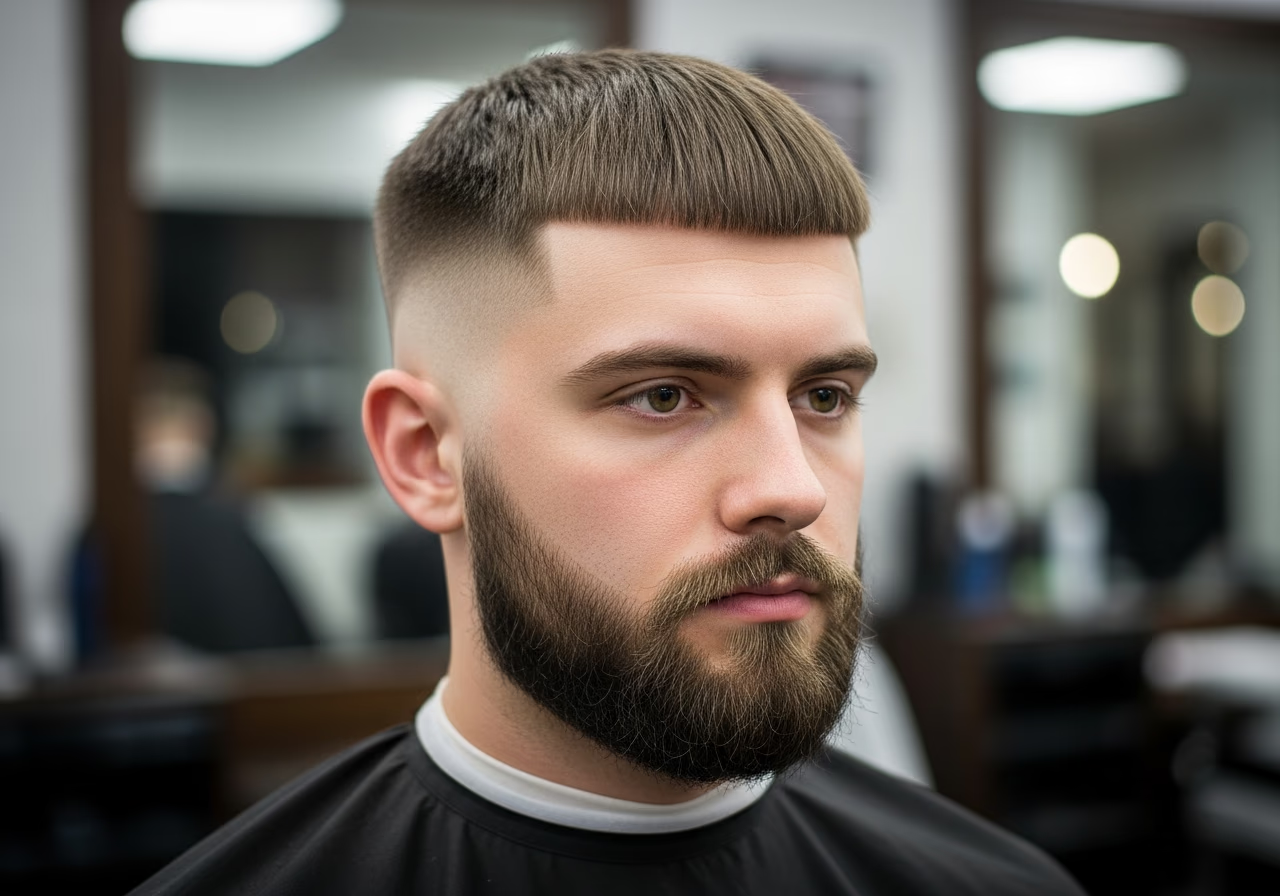
Best Hairstyles to
Hide a Widow's Peak
A widow's peak can be a feature or a frustration, depending entirely on how you cut around it. Here's how to soften it or own it.
By Jessica Hamilton, Editor · Updated
Quick answer: A widow's peak is the natural V-shaped point at the center of the hairline. To soften it, wear your hair forward and textured. A French crop's blunt fringe covers the peak best, and a textured crop, textured fringe or Caesar works the same way. Slick-backs and hard side parts spotlight it. Hiding it is optional.
Style images are AI-generated illustrations.
📚 Part of our Thinning & Balding guide hub. Explore every related guide in one place.
A widow's peak is the V-shaped point in the center of your hairline. It's completely natural (and on some men, a genuinely striking feature), but if you'd rather downplay it, the trick is bringing hair forward and adding texture so the sharp point softens into the overall shape. Fighting it with slicked-back styles does the opposite.
How Do You Hide a Widow's Peak With a Hairstyle?
Hide a widow's peak with a hairstyle that brings hair forward with texture. A French crop, textured crop or Caesar with 1 to 2 1/2 inches on top lets a short fringe fall over the V. Keep the corners a little longer, skip a hard line-up at the front, and use matte product rather than shiny pomade.
A widow's peak shows most when hair is pulled back and away from it, spotlighting the point. Bring hair forward with a fringe and the peak disappears into the front of the cut; add texture and the hard V softens into something irregular and natural.
What Are the Best Hairstyles to Hide a Widow's Peak?
- French crop: the blunt forward fringe covers the peak entirely: the top pick.
- Textured crop or textured fringe: forward and choppy, hides the point.
- Caesar: short and forward, minimal peak visibility.
- A fuller, tousled medium style worn forward, if you prefer length.
| Style | Top | Fringe | Trim every |
|---|---|---|---|
| French crop | 1 to 1 1/2 inches | Blunt but point-cut, forward | 3 weeks |
| Textured crop | 1 1/2 to 2 1/2 inches | Choppy, forward | 3 to 4 weeks |
| Textured fringe | 2 to 3 inches | Messy, forward | 4 weeks |
| Caesar | About 1 inch | Short, straight forward | 2 to 3 weeks |
Browse the French crop gallery to choose a fringe length.
Should You Hide a Widow's Peak or Show It Off?
Worth saying: a widow's peak is a classic leading-man feature (think plenty of famous faces). If yours is symmetrical and your hairline is otherwise strong, a style that shows it, a quiff or a swept-back look, can read as sharp and distinctive rather than something to hide. The 'problem' is entirely optional.
What Should You Tell Your Barber About a Widow's Peak?
A widow's peak changes how the front of the cut behaves, so point it out at the start rather than hoping the barber notices.
- Ask them to leave the corners longer. The recessed areas either side of the peak need extra length to be covered by the fringe.
- Request a textured, point-cut front rather than a straight line, so the fringe breaks up the V shape instead of framing it.
- Avoid a sharp line-up at the front. Pushing the hairline back with a trimmer exaggerates the point and is slow to grow back.
- Mention which way your hair wants to fall. The peak often creates a split or swirl at the center, and cutting with that direction makes forward styling far easier.
A line-up is the sharp edge a barber cuts along the forehead and temples with a trimmer or razor. On a widow's peak it makes the V more obvious, so ask for the front left natural.
What to say in the chair
"I have a widow's peak and want it softened. Textured French crop with the fringe forward, a bit longer at the corners on each side of the point, no line-up at the front, and a low taper with a #2 on the sides."
A guard is the clip-on comb that sets clipper length; a #2 leaves about 6 mm. See the clipper guard numbers chart and how to talk to your barber. A standard cut costs $25 to $45 at most neighborhood shops, per the 2026 haircut cost guide.
Which Styling Mistakes Reveal a Widow's Peak?
- Combing the fringe straight down while wet. The hair tends to part at the peak as it dries. Rough-dry it forward with fingers instead.
- Using a shiny, heavy product. Wet-look pomade clumps the fringe into strands and shows the skin between them. A matte paste or clay gives separation without gaps.
- Growing the fringe too long. A long fringe gets pushed aside and exposes the peak anyway. A short-to-medium forward fringe stays put.
- Parting right at the peak. If you wear a part, start it slightly off the point so the peak falls inside the swept side.
Which products keep the fringe in place?
- Matte paste: soft hold and separation without gaps.
- Matte clay: firmer hold for thick hair that wants to lift at the peak.
- Sea salt spray: grip on damp hair so the fringe stays forward as it dries.
What Is the Difference Between a Widow's Peak and a Receding Hairline?
A widow's peak is a V-shaped point at the center of the hairline that many men have from their teens, and on its own it is a normal hairline shape. It can become more pronounced if the temples recede around it, which leaves the center point isolated on its own.
If the corners are moving back over time, keep the whole cut a little shorter, since a short textured crop hides recession better than a heavier fringe that separates. A widow's peak that has been stable for years needs no special treatment beyond the styling choices above.
Hair grows about half an inch a month, so growing a fringe long enough to cover the peak from a short cut takes time. Roughly: about 1/2 inch after a month, 1 inch after two, and 1 1/2 inches after three, which is enough for a French crop. Keep the sides trimmed every 3 to 4 weeks while the top grows; see how often you should get a haircut.
If the corners are moving, our M-shaped hairline guide covers temple recession, and the receding hairline statistics report shows how common it is by age.
Frequently Asked Questions
Q1: How do I hide a widow's peak?+
Q2: What is the best haircut for a widow's peak?+
Q3: What hairstyles make a widow's peak more obvious?+
Q4: Should I hide my widow's peak or embrace it?+
Q5: Can a widow's peak mean I'm balding?+
Q6: How long does a fringe need to be to cover a widow's peak?+
Medical & Dermatology Sources
A cut can make thinning less noticeable, but it won't stop or reverse hair loss. The sources below cover causes, diagnosis and treatment, and a dermatologist can advise on your own hair.
- Treating male pattern hair loss, American Academy of Dermatology
- Androgenetic alopecia, MedlinePlus (U.S. National Library of Medicine)
- Hair loss, NHS
Related Haircut Guides
Make us a Preferred Source on Google
See our latest articles first in your Google Search & AI Overviews.