
Best Haircuts for
Men with High Foreheads
A high forehead is easily balanced with the right front, mostly, it comes down to one word: fringe.
By Jessica Hamilton, Editor · Updated
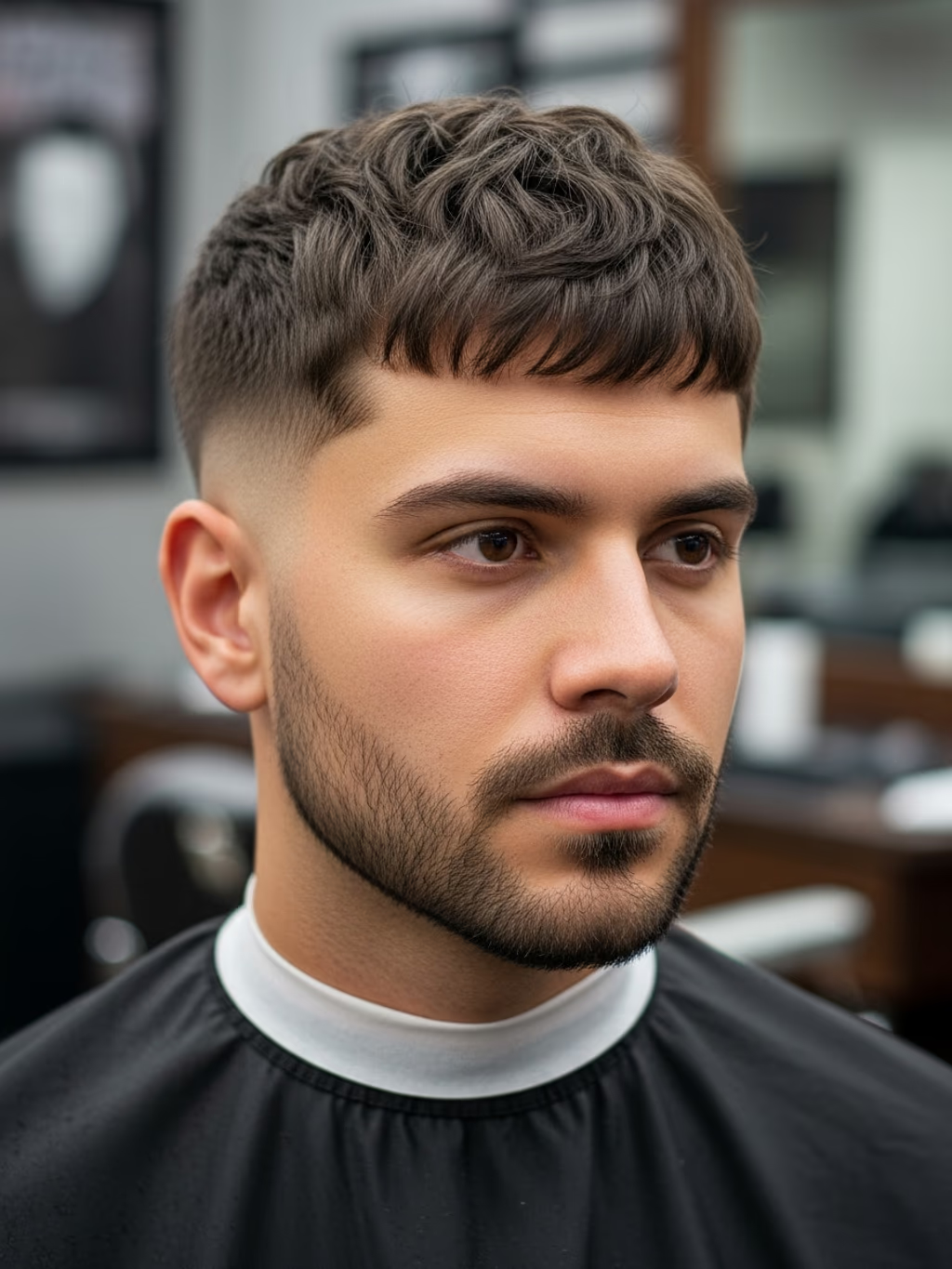
Quick answer: The best haircuts for men with high foreheads use a fringe, because wearing hair forward covers part of the forehead and shortens its apparent height. The French crop, with its blunt forward fringe, is the most reliable choice, followed by a textured fringe or a Caesar. Pompadours, quiffs, slick-backs and hard side parts make a high forehead look bigger.
Style images are AI-generated illustrations.
📚 Part of our Haircuts by Face Shape guide hub, which links the full set of related guides.
The best haircuts for men with high foreheads share a direct fix, because a high or large forehead is one of the most straightforward features to balance: bring hair forward. A fringe visually shortens the forehead, while anything that pulls hair up and back exposes and emphasises it. If you know one rule here, it's "fringe forward."
How Do You Make a High Forehead Look Smaller With a Haircut?
To make a high forehead look smaller with a haircut, wear a fringe forward. Keep about 1 1/2 to 3 inches on top so the fringe lands at mid-forehead or just above the brows, and keep the sides at a low or mid taper. A French crop, textured fringe or Caesar all work; trim every 3 to 4 weeks.
Styles worn forward with a fringe cover part of the forehead and cut its apparent height. The French crop (short, textured, with a blunt forward fringe) is almost purpose-built for a high forehead. The caesar does the same job. Both are low-maintenance and reliably flattering.
What Are the Best Haircuts for Men With High Foreheads?
- French crop: the go-to. Blunt forward fringe, minimal forehead on show.
- Textured fringe: a softer, choppier forward fringe with movement.
- Caesar cut: short and forward, very forgiving.
- Curtains or a longer fringe: if you prefer length, worn down over the forehead.
| Cut | Fringe lands | Sides | Trim every |
|---|---|---|---|
| French crop | Upper to mid forehead, blunt | Low or mid fade | 3 weeks |
| Textured fringe | Mid forehead, choppy | Low taper | 3 to 4 weeks |
| Caesar | Upper forehead, short | #2 to #3 | 2 to 3 weeks |
| Curtains | Brow level, split in the middle | Scissors or long taper | 6 weeks |
A taper is a cut where hair gets shorter only near the ears and neckline; a fade continues that shortening higher, often to skin. For a high forehead, a lower one keeps the top from looking taller. The French crop gallery shows fringe lengths side by side.
Which Hairstyles Make a High Forehead Look Bigger?
- Pompadours and quiffs that lift hair up and off the forehead.
- Slicked-back styles that pull everything away from the face.
- Hard side parts with no front coverage.
- Buzz cuts (they expose the whole forehead), though a buzz can still work if you own it.
How Do You Ask Your Barber for a Fringe That Covers Your Forehead?
The key detail to give your barber is how far down you want the fringe to sit when it is dry and styled, because hair shortens as it dries and curly or wavy hair can shrink noticeably.
- Name the landing point. Tell them whether the fringe should sit at mid-forehead or just above the brows.
- Ask for texture, not a heavy block. Point-cutting the fringe keeps it forward without looking like a helmet.
- Keep the sides moderate. A very high, tight fade makes the top look taller and draws the eye upward to the forehead. A low or mid taper keeps things balanced.
- Mention the temples. If the hairline is higher at the corners, ask for a bit more length there so the fringe can cover the gaps.
What to say in the chair
"I have a high forehead, so I want a textured fringe that lands mid-forehead once it's dry. Point-cut it so it's not a heavy block, low taper on the sides with a #2, and leave the temples a bit longer."
A guard is the clip-on comb that sets clipper length, and a #2 leaves about 6 mm; see clipper guard numbers explained. A standard cut costs $25 to $45 at most neighborhood shops, per the 2026 haircut cost guide.
Does Face Shape or Hair Type Change the Best Fringe for a High Forehead?
Face shape changes which fringe works best. A long or oblong face benefits most from a fuller fringe and sides that are not cut too tight, because both reduce the vertical line. A round face can handle a shorter, choppier fringe with a bit of height behind it, as long as the forehead is partly covered.
Hair type matters too. Fine, straight hair tends to separate and show the forehead through the fringe, so it needs to be cut a bit blunter and styled with a light matte product. Thick or wavy hair holds a forward fringe on its own and can be left more textured.
How long does it take to grow a fringe?
Hair grows about half an inch a month. Starting from a short buzz, a forward fringe takes a few months:
| Time | Top length | What you can wear |
|---|---|---|
| Month 1 | About 1/2 inch | Buzz or Caesar pushed forward |
| Month 2 | About 1 inch | Short Caesar fringe |
| Month 3 | About 1 1/2 inches | French crop |
| Month 5 to 6 | 2 1/2 to 3 inches | Textured fringe or short curtains |
Keep the sides trimmed while the top grows; how often you should get a haircut explains spacing. A light matte clay or texture paste keeps a fringe forward without clumping; pomade vs clay vs wax compares them.
Is It a High Forehead or a Receding Hairline?
A naturally high forehead is even across, while a receding hairline usually pulls back further at the temples and can change over time. Comparing photos from a few years apart is the easiest way to tell.
If the hairline is moving, the same forward, textured styles still help, but it is wise to keep the top shorter. Long fringes over a thinning front separate and draw attention to the gaps, while a short crop hides them. If the change is recent or rapid, it is worth discussing with a doctor or dermatologist rather than relying on the haircut alone.
Our receding hairline haircut guide covers the short-crop approach, and the receding hairline statistics report shows how common recession is by age.
Frequently Asked Questions
Q1: What haircut is best for a high forehead?+
Q2: How do I make my forehead look smaller with a haircut?+
Q3: What hairstyles make a high forehead look bigger?+
Q4: Is a fringe good for a big forehead?+
Q5: Can I have a high forehead and still get a buzz cut?+
Q6: Which product keeps a fringe forward all day?+
Related Haircut Guides
Make us a Preferred Source on Google
See our latest articles first in your Google Search & AI Overviews.