
Best Haircuts for
Men with Prominent Noses
The counterintuitive truth: bigger hair, not smaller, balances a strong nose. Here's how to use volume to your advantage.
By Jessica Hamilton, Editor · Updated
Quick answer: The best haircuts for men with prominent noses add hair rather than remove it, which sounds backwards but works. Structured volume on top, as in a pompadour, a quiff or a medium-length cut, creates a second focal point so the profile looks proportioned. Very flat, tight or slicked-down cuts leave the nose as the only feature that projects.
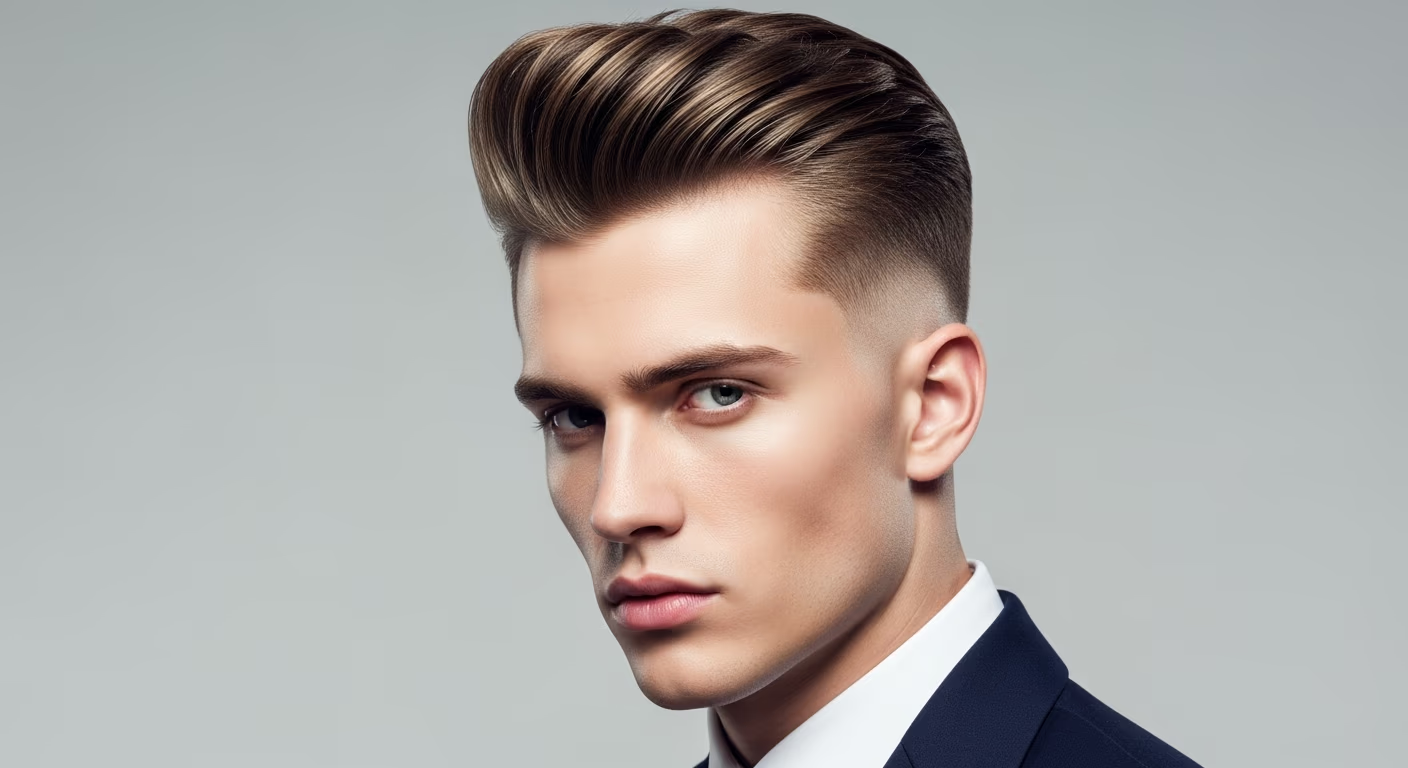
Style images are AI-generated illustrations.
📚 Part of our Haircuts by Face Shape guide hub; start there for more on this topic.
It seems backwards, but the best haircuts for men with prominent noses use more hair, not less. A strong nose looks most prominent next to flat, minimal hair, because there's nothing to balance its projection. Structured volume (height and shape on top) gives the face proportion and takes the nose out of the spotlight.
What Are the Best Haircuts for Men With Prominent Noses?
The best haircuts for men with prominent noses add structured volume on top: a pompadour, a quiff or a textured medium-length cut. Keep 3 to 4 inches of lift on top and shorter sides, around a #2 to #3 taper. Flat buzz cuts and tight slick backs leave the nose as the only projecting feature.
- Pompadour: classic height and structure. The textbook balance for a strong nose.
- Quiff: volume and lift at the front, slightly more casual.
- Styles with fuller shape or a bit of length that adds dimension.
- Medium-length textured cuts with body, rather than flat or severe short styles.
| Cut | Top | Sides | Trim every |
|---|---|---|---|
| Pompadour | 4 inches or more, swept up and back | Low or mid fade | 3 to 4 weeks |
| Quiff | 3 to 4 inches, lifted at the front | #2 to #3 taper | 3 to 4 weeks |
| Textured medium cut | 3 inches or more with body | Scissors or long taper | 5 to 6 weeks |
| Textured fringe | 2 to 3 inches, forward | Low taper | 4 weeks |
A taper is a cut where hair gets shorter only near the ears and neckline; a fade runs that shortening higher, often to skin. A guard is the clip-on comb that sets clipper length; see the clipper guard numbers chart for millimeters.
Why Does Volume on Top Balance a Prominent Nose?
A prominent nose projects forward; flat, tight hair leaves it as the face's single strongest feature. Adding height and structure on top creates a second focal point and balances the profile, so the nose reads as part of a proportioned whole. Styles with volume are your friend here.
Which Haircuts Make a Big Nose More Noticeable?
- Very flat, tight cuts with no volume to balance the profile.
- Severe slicked-back styles that flatten everything against the head.
- Extremely short all-over cuts that leave the nose as the only projecting feature.
- That said, a strong nose is a distinguished feature. Balancing is optional, not mandatory.
Can a Beard Help Balance a Prominent Nose?
A haircut is not the only lever available. A short beard, especially one with a bit of fullness along the jaw, adds structure to the lower half of the face and works alongside volume on top to balance a strong profile. Keeping the moustache area trimmed close, rather than letting it sit heavy under the nose, avoids drawing more attention to it from below.
Men who prefer to stay clean shaven can lean more on the haircut itself, since there is no facial hair sharing the balancing work. Either way, treat the nose, the hairline, and any facial hair as parts of the same composition rather than deciding on each in isolation, since a great haircut paired with a beard that fights it will still look disjointed.
Our beard shapes for jawlines guide helps you pick a beard outline that adds weight at the jaw.
How Do You Ask Your Barber for More Volume on Top?
You do not need to mention your nose directly if that feels awkward. Instead, describe the result you want in terms of shape: ask for more height and structure through the crown and front, with the sides kept shorter so the top reads as the focal point. Bring a reference photo of a pompadour or quiff with visible volume, and tell your barber you want the silhouette from the front to have real lift rather than lying flat.
If you already have some natural wave or thickness on top, mention that too, since it changes how much product and blow-drying technique the barber will recommend to hold the shape through the day. A good barber will also flag whether your hair density can support the height you are asking for, or whether a slightly shorter version of the same shape will hold up better between washes.
What to say in the chair
"I want real height on top, like a textured quiff. Leave about four inches at the front, take some weight out so it lifts, and keep the sides to a #2 taper. Can you show me how to blow-dry it up?"
A standard cut runs $25 to $45 at most neighborhood shops, per the 2026 haircut cost guide, and volume styles need a trim every 3 to 4 weeks; see how often you should get a haircut.
Which products hold the height?
- Sea salt spray or pre-styler: blow-dried in for lift at the root.
- Matte clay: strong hold with a natural finish for a quiff.
- Pomade: shine and hold for a classic pompadour.
Pomade vs clay vs wax explains hold and shine levels, and the quiff gallery shows heights that work.
Does a Fringe or Side Part Help With a Prominent Nose?
A fringe that falls forward with some texture draws the eye across the forehead horizontally, which softens how much attention lands on a strong nose in profile. A deep side part does something similar by shifting the visual line of the hairstyle to one side rather than straight down the center.
Both work well paired with volume elsewhere on top, since the goal is overall proportion rather than any single trick. Avoid pushing all the hair straight back off the face with heavy product, since that removes the horizontal line a fringe or part provides and puts the nose back at the center of the composition.
Frequently Asked Questions
Q1: What haircut is best for a big nose?+
Q2: Does a big nose look worse with short hair?+
Q3: Why does volume balance a prominent nose?+
Q4: What hairstyles should I avoid with a big nose?+
Q5: Is a pompadour good for a prominent nose?+
Q6: How much length on top do you need for a pompadour?+
Make us a Preferred Source on Google
See our latest articles first in your Google Search & AI Overviews.