
Data report · Updated October 2026
Hair and confidence statistics: 62% of men losing hair say it can hurt self-esteem
What surveys, population studies and meta-analyses say about how hair and hair loss affect men's confidence.
In a Gallup survey of men in five European countries, 62% of those losing hair agreed it could affect self-esteem and 43% worried about losing attractiveness[1]. Yet a Finnish population study of 892 men aged 46 found no link between hair loss and depression or self-esteem[2]. The evidence is mixed.
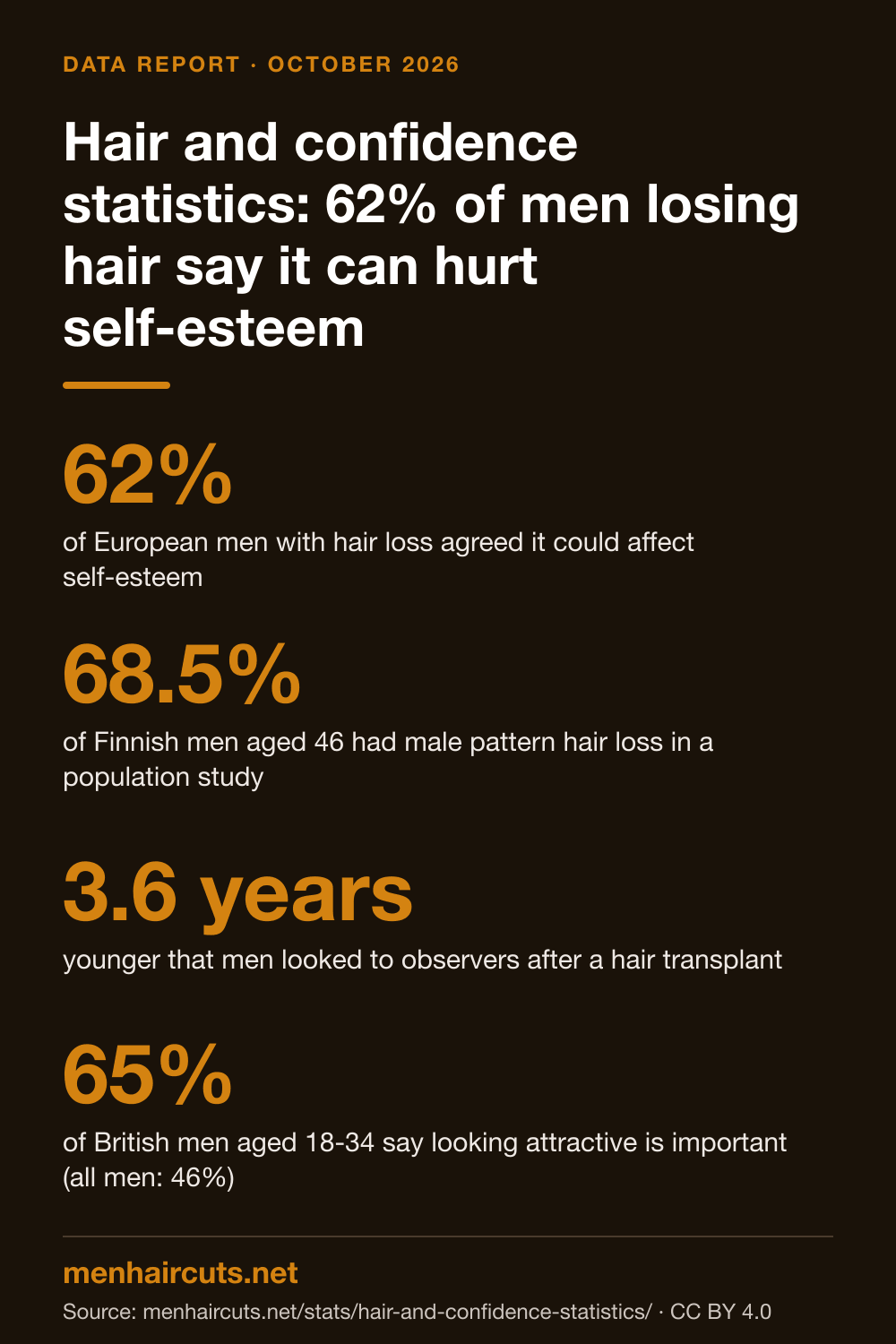
62%
of European men with hair loss agreed it could affect self-esteem[1]
68.5%
of Finnish men aged 46 had male pattern hair loss in a population study[2]
3.6 years
younger that men looked to observers after a hair transplant[3]
65%
of British men aged 18-34 say looking attractive is important (all men: 46%)[4]
By Jessica Hamilton, Editor · Published · Updated · Free to reuse with credit (CC BY 4.0)
Key findings
- Among 729 European men aged 18 to 45 with hair loss, over 70% said hair is an important feature of their image and 62% agreed hair loss could affect self-esteem[1].
- When they noticed hair loss, 43% of those men worried about losing attractiveness, 42% feared going bald and 21% reported feelings of depression[1].
- Fewer than 10% of men with hair loss in that survey were being treated, and three in four had never sought treatment[1].
- A population study of 892 Finnish men aged 46 found male pattern hair loss in 68.5% but no significant association with depression, anxiety, quality of life or self-esteem[2].
- A 2023 meta-analysis of 37 studies found no overall effect of male pattern hair loss on depression and a moderate effect on quality of life, and flagged likely conflicts of interest in 78% of studies[5].
- A 2025 meta-analysis of 13 studies with 2,737 patients found higher anxiety, depression and stress symptoms in people with androgenetic alopecia than in controls[6].
- In a randomized photo experiment, observers rated men 3.6 years younger after a hair transplant and also rated them more attractive and successful[3].
Download the infographic
The headline numbers from this report as one tall image (1000 x 1500 PNG), sized for Pinterest, slides and posts. Free to reuse with credit.
How much does hair matter to men's self-image?
For men who are losing it, a lot. A Gallup telephone survey of 1,536 men aged 18 to 45 in Germany, France, Italy, Spain and the UK found that 729 of them (47%) reported hair loss[1]. Over 70% of those men said hair is an important feature of their image, and 62% agreed that hair loss could affect self-esteem[1].
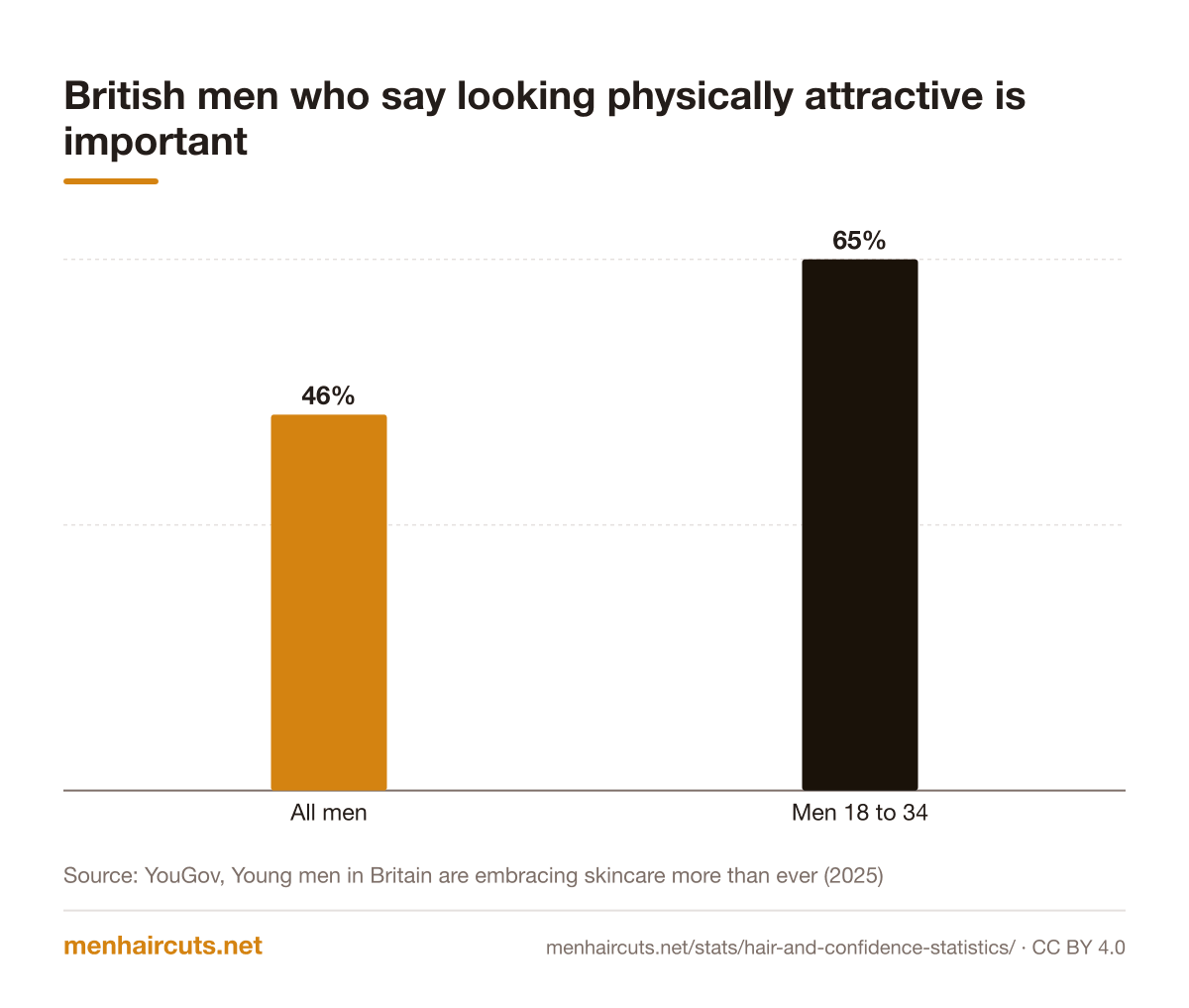
Younger men put more weight on looks in general. In YouGov Profiles data from Britain, 65% of men aged 18 to 34 said looking physically attractive is important to them, compared with 46% of all men[4].
A 2026 qualitative study of 21 UK adults found people with a positive relationship to their hair described accepting it, learning to work with it, and using it to express identity[7].
Show the numbers
| Category | Value |
|---|---|
| All men | 46% |
| Men 18 to 34 | 65% |
How does hair loss make men feel?
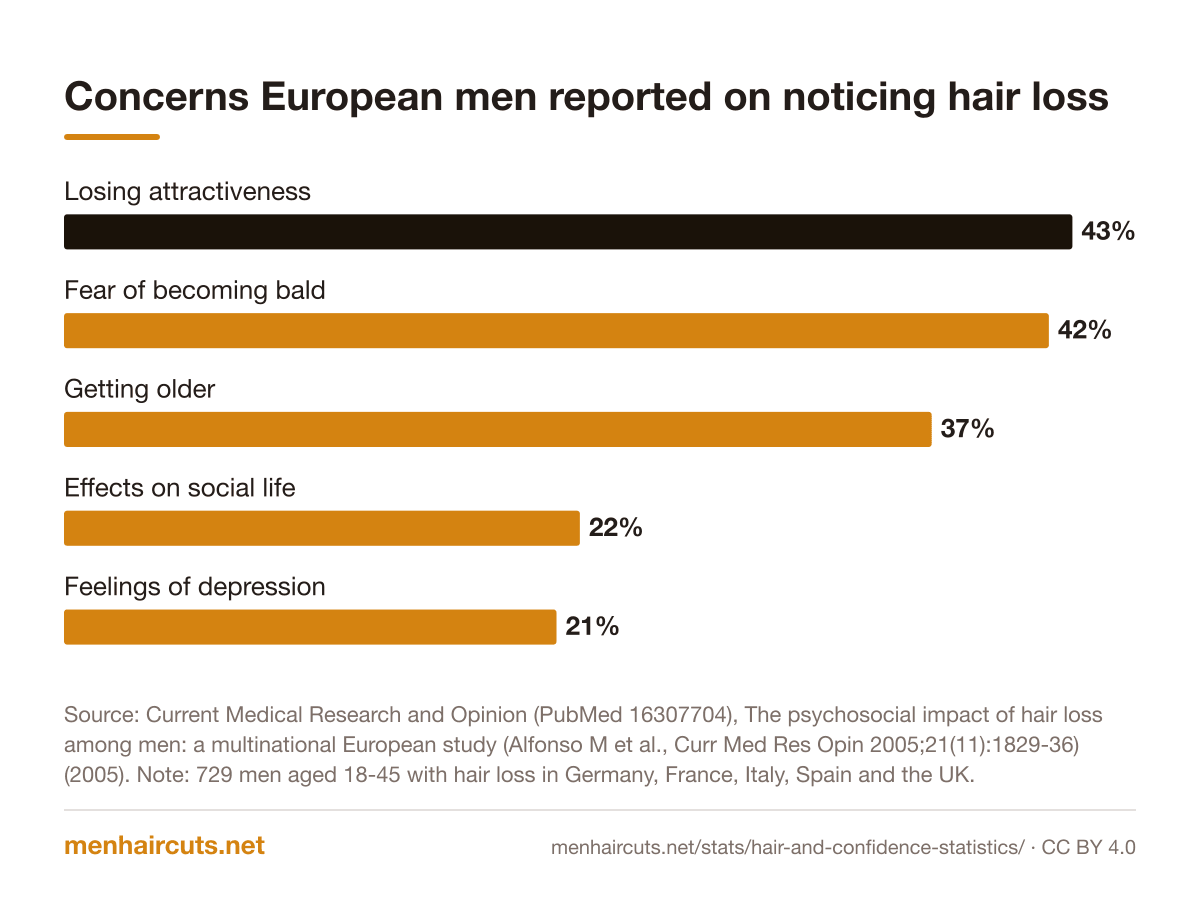
In the European survey, noticing hair loss triggered several worries. 43% of men were concerned about losing an important part of their attractiveness, 42% feared becoming bald and 37% worried about getting older[1]. Smaller shares reported negative effects on social life (22%) and feelings of depression (21%)[1].
Relationship status mattered: 38% of men who were not in a stable relationship reported reduced self-confidence about their attractiveness[1].
An earlier US study by psychologist Thomas Cash compared 63 men with modest balding, 40 with more extensive balding and 42 men without balding[8]. Balding men reported preoccupation, moderate stress and active coping, and had lower body-image satisfaction than controls, but their wider personality functioning was similar[8]. The effects were strongest in younger men, single men, men with extensive balding and those whose hair loss started early[8].
Show the numbers
| Category | Value |
|---|---|
| Losing attractiveness | 43% |
| Fear of becoming bald | 42% |
| Getting older | 37% |
| Effects on social life | 22% |
| Feelings of depression | 21% |
Does hair loss cause depression or low self-esteem?
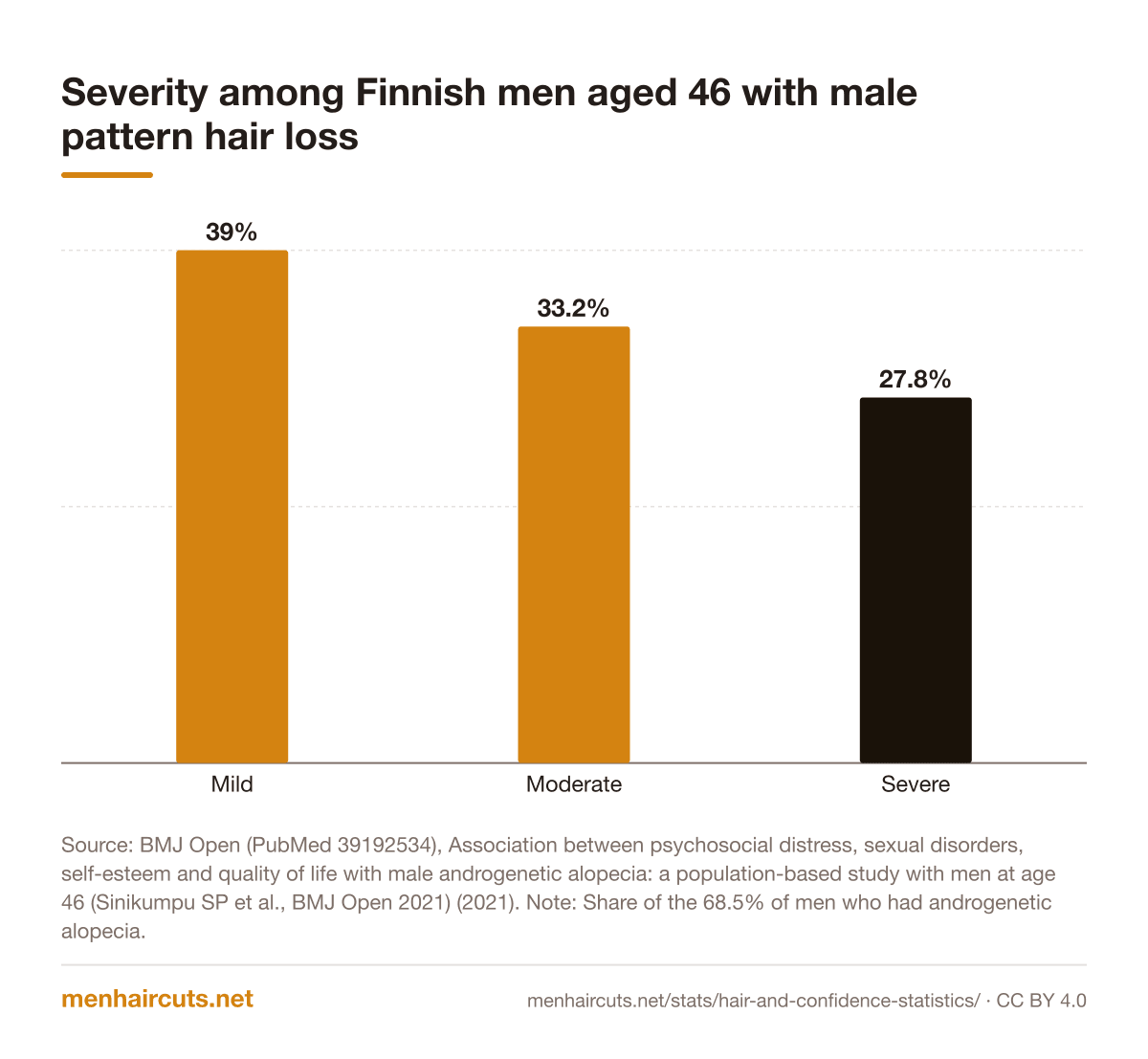
Population studies suggest the average effect is small. The Northern Finland Birth Cohort study examined 892 men at age 46, with dermatologists grading hair loss on the Norwood scale[2]. Hair loss was found in 68.5% of the men, but neither its presence nor its severity was significantly linked to depression, anxiety, quality of life, self-esteem or sexual symptoms[2].
A Jordanian study of 522 men from the general population found a mean Dermatology Life Quality Index score of 1.5, a minor impact, with embarrassment as the main burden[9]. Younger men reported more impact, and men who had lived with hair loss for more than 10 years reported milder effects[9].
The Jordanian authors caution that studies of men seeking treatment may show larger effects than studies of the general population[9].
Show the numbers
| Category | Value |
|---|---|
| Mild | 39% |
| Moderate | 33.2% |
| Severe | 27.8% |
What do meta-analyses say about hair loss and mental health?
Two recent reviews reach different conclusions. A 2023 systematic review and meta-analysis screened 607 articles and included 37 (6%)[5]. It found no overall impact of male pattern hair loss on depression and a moderate impact on quality of life, and men with hair loss had average or better mental health than men without it[5]. The authors cautioned that 78% of studies had probable conflicts of interest and 68% had biased samples[5].
A 2025 meta-analysis pooled 13 studies covering 2,737 patients with androgenetic alopecia and 17,382 controls[6]. It found significantly higher symptoms of generalized anxiety, social anxiety and depression, and the largest difference for perceived stress, but no significant difference in general distress[6]. That review included both men and women.
Taken together, the research suggests hair loss bothers many men and is linked to more stress and anxiety in some studies, while the evidence for a consistent link to depression is weaker.
| Study | Sample | Main finding |
|---|---|---|
| Cash, 1992 (US) | 63 + 40 balding men, 42 controls | Balding men had lower body-image satisfaction |
| Alfonso et al., 2005 (5 EU countries) | 729 men with hair loss | 62% said hair loss could affect self-esteem |
| Sinikumpu et al., 2021 (Finland) | 892 men aged 46 | No link to depression, anxiety or self-esteem |
| Frith and Jankowski, 2023 (meta-analysis) | 37 studies | No effect on depression; moderate effect on quality of life |
| Muhaidat et al., 2025 (Jordan) | 522 men | Mean DLQI 1.5, minor impact |
| Kong et al., 2025 (meta-analysis) | 13 studies, 2,737 patients | Higher anxiety, depression and stress symptoms |
Each row comes from the study named; see sources.
Does fixing hair loss improve confidence?
Among men who treated hair loss successfully, many said it helped. In the European survey, 73 men reported successful treatment, and 43% to 59% of them reported improvements in self-esteem and perceived attractiveness[1].
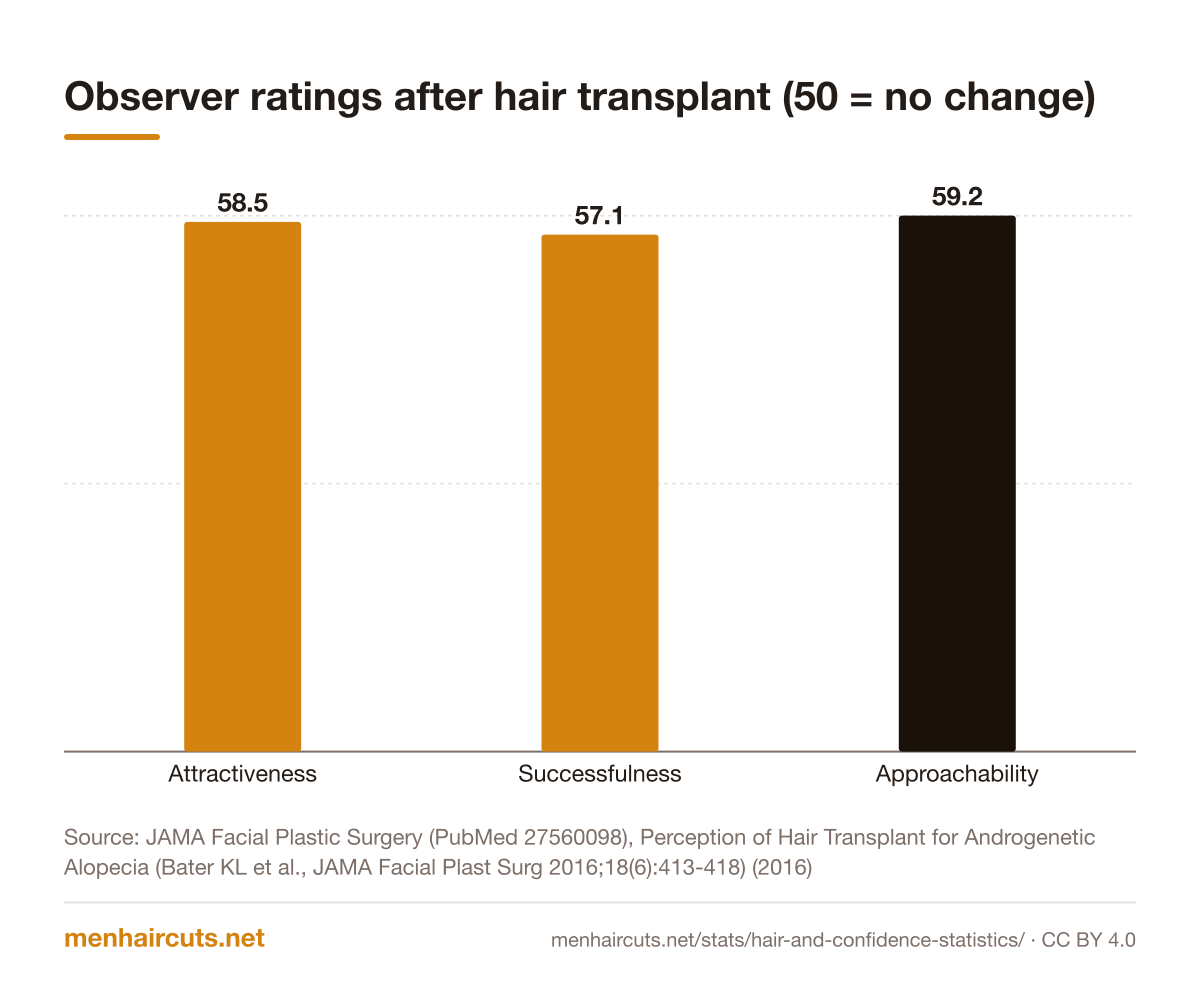
Outside observers notice the change too. In a randomized experiment, 122 observers compared before and after photos of men who had hair transplants with control pairs[3]. After a transplant, men were judged 3.6 years younger on average, and scored 58.5 for attractiveness, 57.1 for successfulness and 59.2 for approachability on a 0 to 100 scale where scores above 50 mean a positive change[3].
Treatment is the exception, not the rule. Fewer than 10% of European men with hair loss were in treatment, and three in four had never tried any[1]. For men who would rather work with their hair than treat it, our guide to styling thinning hair and the shave-it-or-not guide are good places to start.
Show the numbers
| Category | Value |
|---|---|
| Attractiveness | 58.5 |
| Successfulness | 57.1 |
| Approachability | 59.2 |
Does hair loss affect men's sex lives?
The link appears to run through how much the hair loss bothers a man, not the hair loss itself. A web-based study of 190 men aged 18 to 40 with mild male pattern hair loss found that those with moderate to severe psychosocial impairment had about twice the odds of sexual dysfunction (adjusted odds ratio 2.1) compared with men with mild or no impairment[10].
In the Finnish population study, men with severe hair loss reported lower sexual activity than men without it, but the difference was not statistically significant[2].
Which men are most affected?
Across studies, the same groups come up. Cash found the strongest effects in younger men, single men, those with more extensive balding and those whose hair loss began early[8]. The European survey found reduced confidence about attractiveness in 38% of men not in a stable relationship[1].
The Jordanian study also found more impact in younger age groups and less among men who had lived with hair loss for over a decade[9].
A cut that suits the hairline, such as those in our receding hairline guide, can help a younger man feel more in control while he decides whether to treat, style around or shave.
Frequently asked questions
Does hair loss affect self-esteem?
Can hair loss cause depression?
What percentage of men with hair loss seek treatment?
Do hair transplants make men look younger?
Who is most bothered by hair loss?
How common is hair loss by age 46?
Methodology and limitations
This report summarizes peer-reviewed research found through PubMed, read at the abstract level: a 1992 US psychology study, a 2005 multinational Gallup survey published in Current Medical Research and Opinion, population studies from Finland (2021) and Jordan (2025), a 2016 randomized perception experiment, a 2016 web-based study on sexual function, and two meta-analyses (2023 and 2025). Attitude data on attractiveness come from YouGov Profiles (UK, reported February 2025). No numbers were estimated or combined across studies. Sources accessed October 15, 2026.
Limitations
Most studies here measure self-reported feelings, use different questionnaires and cover different countries and ages, so their numbers cannot be combined. The 2005 European survey used non-validated instruments, and its authors note that reliance on self-reported hair loss is a limitation. Population studies (Finland, Jordan) include men who are not seeking help, while clinic-based studies may overstate distress. The 2025 meta-analysis included women as well as men. The hair transplant perception study used 122 online observers recruited through social media. No large recent US national survey on hair and confidence was available to verify, so this report relies mainly on European and other international research.
Every figure on this page links to its source. Numbers are reported as published; any menhaircuts.net calculation is labelled and shows its inputs. Spotted an error? Tell us and we will check it.
Sources
- The psychosocial impact of hair loss among men: a multinational European study (Alfonso M et al., Curr Med Res Opin 2005;21(11):1829-36), Current Medical Research and Opinion (PubMed 16307704) (2005). Accessed October 15, 2026.
- Association between psychosocial distress, sexual disorders, self-esteem and quality of life with male androgenetic alopecia: a population-based study with men at age 46 (Sinikumpu SP et al., BMJ Open 2021), BMJ Open (PubMed 39192534) (2021). Accessed October 15, 2026.
- Perception of Hair Transplant for Androgenetic Alopecia (Bater KL et al., JAMA Facial Plast Surg 2016;18(6):413-418), JAMA Facial Plastic Surgery (PubMed 27560098) (2016). Accessed October 15, 2026.
- Young men in Britain are embracing skincare more than ever, YouGov (2025). Accessed October 15, 2026.
- Psychosocial impact of androgenetic alopecia on men: A systematic review and meta-analysis (Frith H, Jankowski GS. Psychol Health Med 2024;29(4):822-842), Psychology, Health and Medicine (PubMed 37605428) (2023). Accessed October 15, 2026.
- Association between androgenetic alopecia and psychological well-being: a systematic review and meta-analysis (Kong Y et al., Front Psychiatry 2025), Frontiers in Psychiatry (PubMed 41383986) (2025). Accessed October 15, 2026.
- A qualitative study of hair-related positive body image (Anastasiades E et al., Body Image 2026;58:102136), Body Image (PubMed 42250462) (2026). Accessed October 15, 2026.
- The psychological effects of androgenetic alopecia in men (Cash TF. J Am Acad Dermatol 1992;26(6):926-31), Journal of the American Academy of Dermatology (PubMed 1607410) (1992). Accessed October 15, 2026.
- Impact of male androgenetic alopecia on a Jordanian cohort measured using the Dermatology Life Quality Index (Muhaidat J et al., J Int Med Res 2025), Journal of International Medical Research (PubMed 40302666) (2025). Accessed October 15, 2026.
- Psychosocial Impairment as a Possible Cause of Sexual Dysfunction among Young Men with Mild Androgenetic Alopecia (Molina-Leyva A et al., Acta Dermatovenerol Croat 2016;24(1):42-8), Acta Dermatovenerologica Croatica (PubMed 27149130) (2016). Accessed October 15, 2026.
Cite, embed and download
This report, its charts and its infographic are free to reuse under a Creative Commons Attribution 4.0 license. Credit menhaircuts.net with a link to this page.
Cite this report (APA)
Hamilton, J. (2026, October 15). Hair and Confidence Statistics 2026: Hair Loss Data. menhaircuts.net. https://menhaircuts.net/stats/hair-and-confidence-statistics/
Link to this report
<a href="https://menhaircuts.net/stats/hair-and-confidence-statistics/">Hair and Confidence Statistics 2026: Hair Loss Data</a> (menhaircuts.net, CC BY 4.0)Share the headline number
62%: of European men with hair loss agreed it could affect self-esteem (Current Medical Research and Opinion (PubMed 16307704), via menhaircuts.net/stats/hair-and-confidence-statistics/)
Download the charts and infographic
- British men who say looking physically attractive is important (PNG)
- Concerns European men reported on noticing hair loss (PNG)
- Severity among Finnish men aged 46 with male pattern hair loss (PNG)
- Observer ratings after hair transplant (50 = no change) (PNG)
- Infographic: Hair and Confidence Statistics 2026 (PNG, 1000 x 1500)
Related data
- 50 millionUS men with androgenetic alopecia (male pattern hair loss)Male Hair Loss Statistics 2026
- 31–33%Men aged 40–69 with frontal-only hair loss (Australia)Receding Hairline Statistics 2026
- 84.7%Hair transplant patients who were men (ISHRS members, 2024)Hair Transplant Statistics 2026
- 100 msExposure time enough for people to judge a face's trustworthiness or competence (2006 study)Grooming and First Impressions Statistics 2026
Related guides
Make us a Preferred Source on Google
See our latest articles first in your Google Search & AI Overviews.