
Data report · Updated October 2026
Grooming and first impressions: faces are judged in a tenth of a second, and grooming explains half the looks premium for men
What peer-reviewed studies and named polls show about hair, beards and grooming at work and in dating.
People form trait judgments of a face after seeing it for just 100 milliseconds[1]. At work, attractive people earn roughly 20% more than average-looking people, and grooming accounts for about half of that premium for men[2]. Hair choices shift impressions too: shaved heads read as more dominant[3].
100 ms
Exposure time enough for people to judge a face's trustworthiness or competence (2006 study)[1]
~20%
Pay premium for attractive people over average-looking people (US Add Health data, 2016 study)[2]
Half
Share of the men's attractiveness pay premium explained by grooming[2]
13%
How much stronger men looked in photos with their hair digitally shaved off[3]
62%
US women who said they find bearded men attractive (YouGov, 2014)[4]
By Jessica Hamilton, Editor · Published · Updated · Free to reuse with credit (CC BY 4.0)
Key findings
- Trait judgments made after seeing a face for 100 milliseconds correlated highly with judgments made with no time limit, across attractiveness, likeability, trustworthiness, competence and aggressiveness[1].
- Competence judgments based only on candidates' faces, made within a 1-second exposure, predicted the winner in 68.8% of the 2004 US Senate races[5].
- Attractive people earn roughly 20% more than people of average looks in US survey data, and grooming accounts for the entire premium for women but only half of it for men[2].
- In a 2009 Gillette survey run by Harris Interactive, 84% of more than 500 HR professionals agreed that well-groomed employees climb the corporate ladder faster[6].
- Men whose hair was digitally removed in a photo were rated as more dominant, nearly an inch taller and 13% stronger, but less attractive, than the same men with hair[3].
- In a 2023 YouGov poll, 19% of British women said they prefer the look of a man with a beard, up from 6% in 2011, while the share preferring no beard fell from 66% to 36%[7].
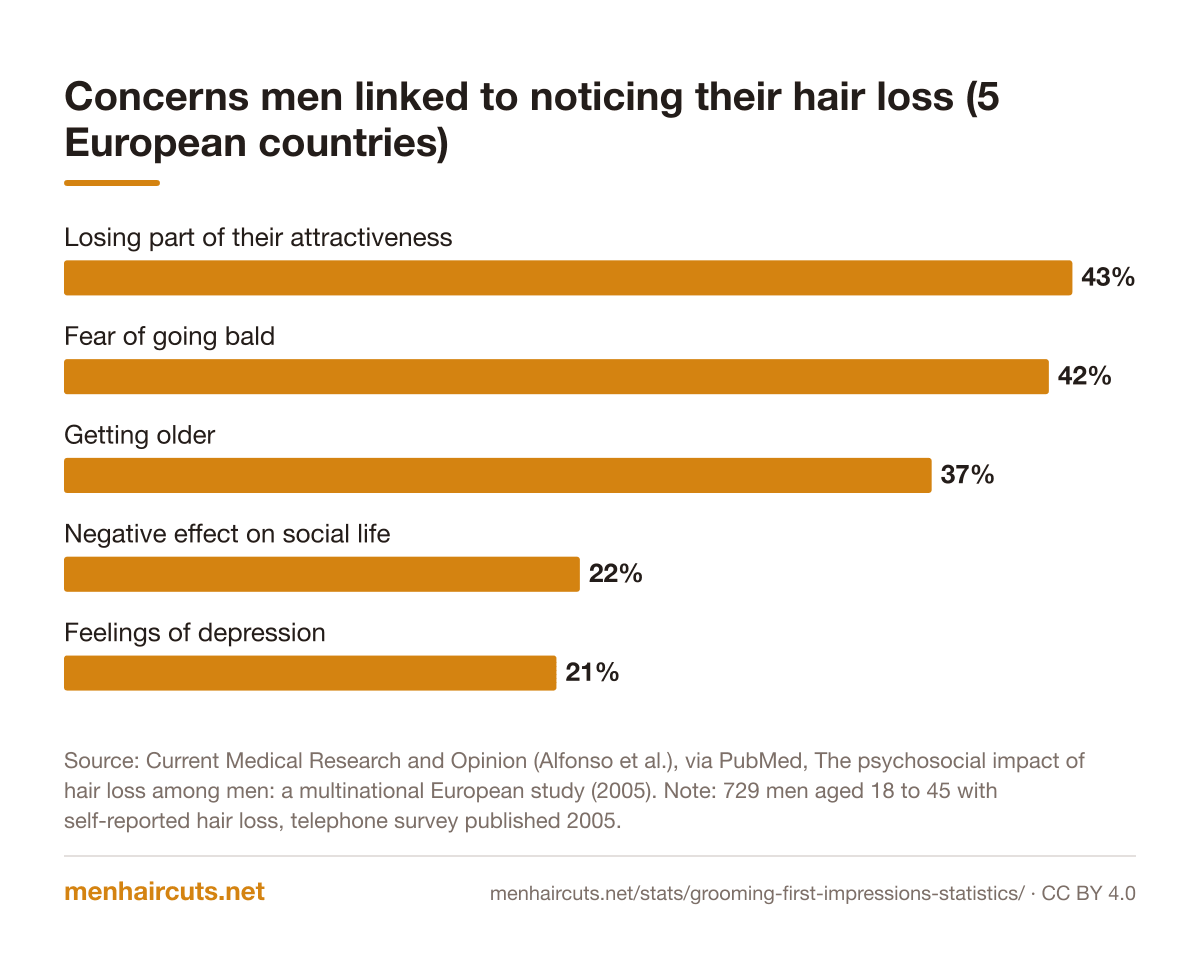
- Among 729 European men aged 18 to 45 who reported hair loss, 62% agreed it could affect self-esteem and 43% worried about losing part of their attractiveness[8].
- In a 2015 experiment with 122 observers, men were judged an average of 3.6 years younger in photos taken after a hair transplant than before[9].
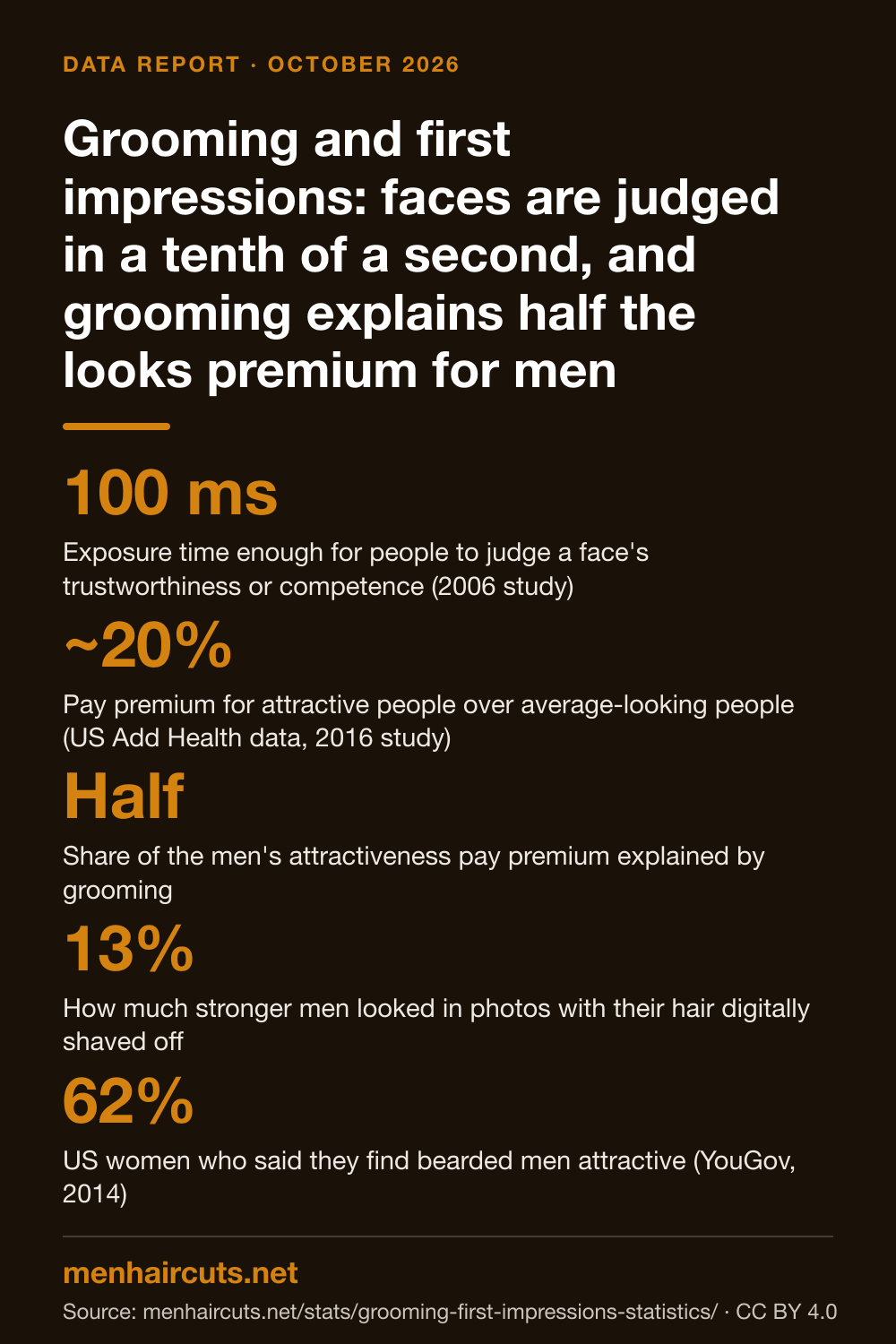
Download the infographic
The headline numbers from this report as one tall image (1000 x 1500 PNG), sized for Pinterest, slides and posts. Free to reuse with credit.
How fast do people form a first impression from someone's face?
Very fast. In a set of five experiments at Princeton, Janine Willis and Alexander Todorov showed people unfamiliar faces for different lengths of time. Judgments made after a 100-millisecond look correlated highly with judgments made with no time limit[1]. That held for all five traits tested: attractiveness, likeability, trustworthiness, competence and aggressiveness. Giving people more time did not significantly raise those correlations[1].
Extra time mostly changed how sure people felt. When exposure went from 100 to 500 milliseconds, judgments became more negative and confidence rose. Between 500 and 1,000 milliseconds, the judgments themselves barely moved, but confidence kept climbing for some traits[1].
These snap reads can carry real weight. In a 2005 study in Science, competence ratings based only on candidates' faces, made within a 1-second exposure, predicted the winner of 68.8% of the 2004 US Senate races and were linearly related to the margin of victory[5]. That study looked at faces, not grooming, but it shows how much a quick visual read can matter. Hair and facial hair are among the parts of a face a man can actually change.
Do better-looking or better-groomed men earn more money?
Looks and pay are linked in several large data sets. Daniel Hamermesh and Jeff Biddle found that, holding demographic and labor-market factors constant, plain people earn less than people of average looks, who earn less than the good-looking. They put the penalty for plainness at 5 to 10%, slightly larger than the premium for beauty[10]. Their paper first appeared as an NBER working paper in 1993 and was published in the American Economic Review in 1994.
Grooming is the part of that gap a man can control. Jaclyn Wong and Andrew Penner used the US National Longitudinal Study of Adolescent to Adult Health (Add Health), where interviewers rated both attractiveness and grooming. They found that attractive people earn roughly 20% more than people of average attractiveness, and that the gap shrinks once grooming is taken into account[11]. Grooming explained the entire attractiveness premium for women, and only half of the premium for men[2].
The UC Irvine summary of the study notes that men are still rewarded for grooming but are also judged on traits they were born with[12]. In plain terms: for men, a good haircut and a tidy beard can close part of the looks gap, not all of it. These are observational results, so they show an association between grooming ratings and income, not proof that a haircut raises pay.
| Study | Data | Finding |
|---|---|---|
| Hamermesh and Biddle (NBER 1993, AER 1994) | Earnings data, controlling for demographic and labor-market characteristics | Plainness penalty of 5 to 10%, slightly larger than the beauty premium |
| Wong and Penner (2016) | US Add Health survey with interviewer attractiveness and grooming ratings | Attractive people earn roughly 20% more; grooming explains all of the premium for women and half for men |
Row 1 from Hamermesh and Biddle[10]; row 2 from Wong and Penner.
Does grooming matter in a job interview?
Hiring professionals say it does, though the strongest numbers come from a brand-funded poll. In a 2009 survey commissioned by Gillette and conducted by Harris Interactive, 84% of more than 500 human resources professionals agreed that well-groomed employees climb the corporate ladder faster than those who are not well groomed[6]. The same survey found 90% placed more importance on being well groomed than on a firm handshake when it comes to first impressions[6]. Gillette sells shaving products, so treat the framing with some caution.
Controlled experiments give a more mixed picture on beards. In a Brazilian study published in 2003, 50 personnel managers who made hiring decisions in Sao Paulo clearly preferred clean-shaven men over bearded, mustached or goateed versions of the same man as job candidates[13]. In the same paper, 106 undergraduates linked beards with older age, greater responsibility and left-leaning politics[13].
A Dutch experiment pointed the other way on one measure. Among 216 participants who viewed LinkedIn-style profile photos, bearded candidates were seen as having more expertise than clean-shaven ones, and perceived expertise predicted the intention to invite a candidate to interview[14]. The study tested three job types (architect, back-office cashier and sales representative) to see whether the effect depended on the role[14].
| Study | Who rated | Result |
|---|---|---|
| de Souza et al. (2003), Brazil | 50 personnel managers | Clean-shaven candidates clearly preferred over bearded, mustached or goateed |
| de Souza et al. (2003), Brazil | 106 undergraduates | Beards linked with older age, more responsibility, leftist politics |
| van der Land and Muntinga (2014), Netherlands | 216 participants, LinkedIn-style photos | Bearded candidates seen as having more expertise |
Rows 1 and 2 from de Souza et al. 2003; row 3 from van der Land and Muntinga 2014[14].
Do beards make men look older, more dominant or more trustworthy?
Beards consistently make men look older and higher in status. In a study run in New Zealand and Samoa, Barnaby Dixson and Paul Vasey found that men and women in both cultures rated the same men as older and of higher social status when bearded. Bearded men making an aggressive expression were also rated as more aggressive. Women in both countries did not rate bearded faces as more attractive than clean-shaven ones[15].
Context matters. In a 2023 study of 509 men, more facial hair was judged more appropriate in informal situations, especially with another man, and men preferred more facial hair for themselves than for other men[16]. The authors suggest that formal settings limit how much a beard helps a man's image[16]. That lines up with the hiring results above: a beard can signal maturity and expertise but may read as less conventional in a conservative workplace[13].
None of these studies shows that a beard makes a man more or less capable. They measure how strangers rate photos, usually in a single sitting.
Do women prefer beards, stubble or a clean shave?
Lab studies point to some facial hair over none, with heavy stubble often on top. In Dixson and Brooks's 2013 study, 10 men were photographed clean-shaven, with light stubble, heavy stubble and a full beard, then rated by 351 women and 177 men[17]. Women rated heavy (10-day) stubble as most attractive, and masculinity ratings rose as facial hair increased[17].
Relationship type changes the answer. In a 2016 study of 8,520 women, facial hair raised ratings of attractiveness for a long-term relationship but not for a short-term one[18]. A smaller 2018 study of 52 women found an overall preference for bearded over clean-shaven faces that did not shift across the menstrual cycle[19].
Fashion cycles matter too. When beards were rare in a set of faces, women and men judged heavy stubble and full beards more attractive than when beards were common, and clean-shaven faces were least attractive when they were most common[20]. In other words, part of a beard's appeal may come from being a little different from everyone else.
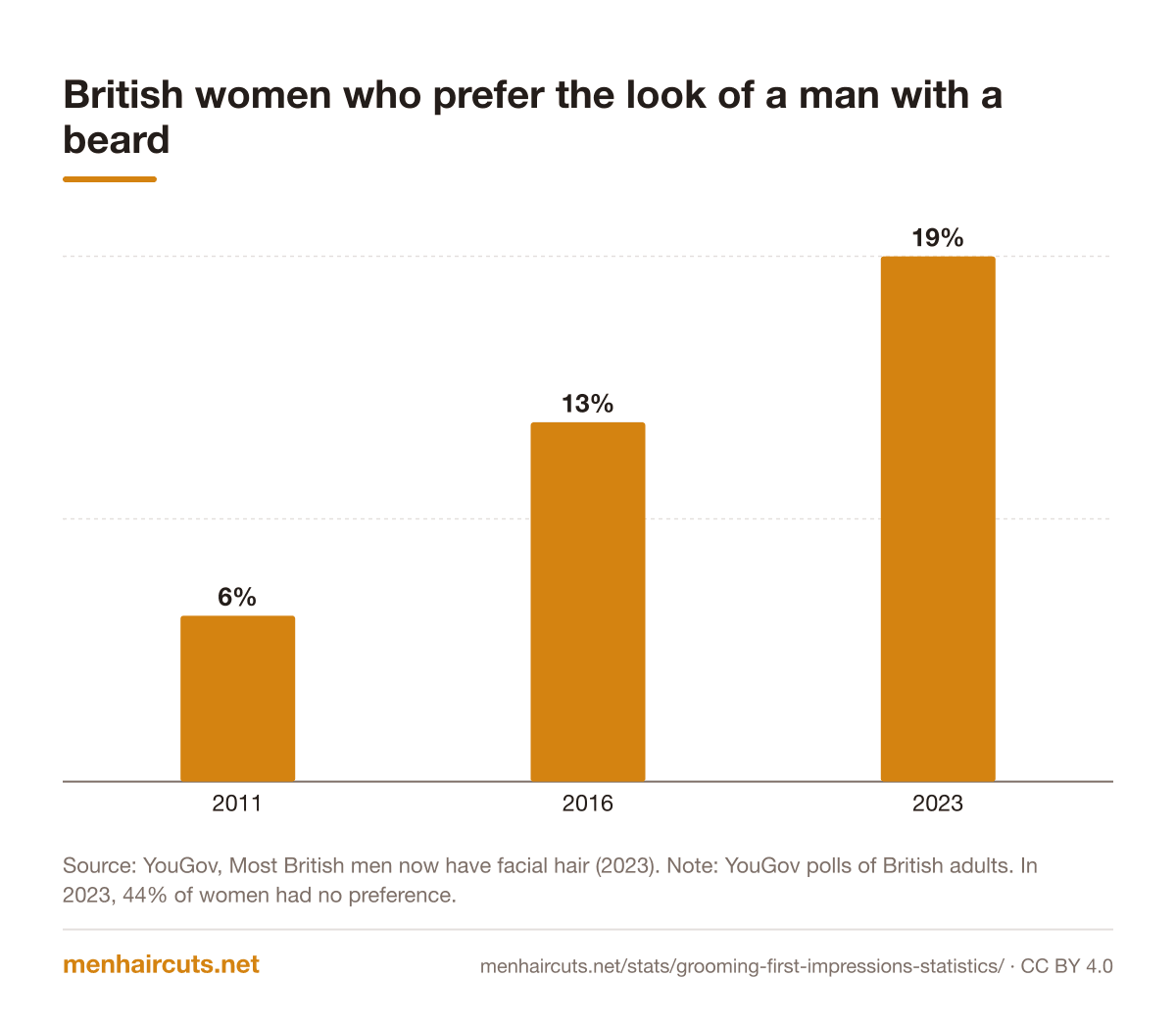
Show the numbers
| Category | Value |
|---|---|
| 2011 | 6% |
| 2016 | 13% |
| 2023 | 19% |
What do polls say about beards and attractiveness?
In the US, a 2014 YouGov poll found 47% of Americans said they find men with well-kept beards attractive. Among women, 62% said they find bearded men attractive and 30% said unattractive[4]. Asked about the number of beards, 42% of women were happy with things as they were, 35% wished a few men would shave, and only 10% wanted to see more bearded men[4].
In Britain, YouGov's 2023 poll found 54% of men had some form of facial hair, up from 42% in 2016 and 37% in 2011[7]. Women's tastes moved in the same direction. The share of women who prefer a man without a beard fell from 66% in 2011 to 36% in 2023, and the share with no preference rose from 27% to 44%[7]. Among women aged 18 to 39, 34% now prefer a man with a beard[7].
| Preference | 2011 | 2023 |
|---|---|---|
| Prefer a man with a beard | 6% | 19% |
| Prefer a man without a beard | 66% | 36% |
| No preference | 27% | 44% |
Does shaving your head make you look more dominant?
Yes, according to three studies by Albert Mannes at the Wharton School. In Study 1, men with shaved heads were rated more dominant than similar men with full heads of hair[3]. In Study 2, 344 US adults from an online panel each rated one photo of a man, either the real photo or a version with his hair digitally removed. The shaved versions were rated more dominant, more confident and more masculine, and were estimated to be older, taller and stronger. They were also rated less attractive[3]. In the author's words, the men were viewed as nearly an inch taller and 13% stronger[3].
Study 3 used a written description of a 35-year-old man named John, with only his hair changed, rated by 552 adults. Described with thinning hair, John was viewed least favorably on every trait except norm violation. With a shaved head, he scored highest on dominance, masculinity, leadership potential and strength. With thick hair, he scored highest on attractiveness and confidence[3]. The author concludes that men with natural hair loss may improve how others see them by shaving[3].
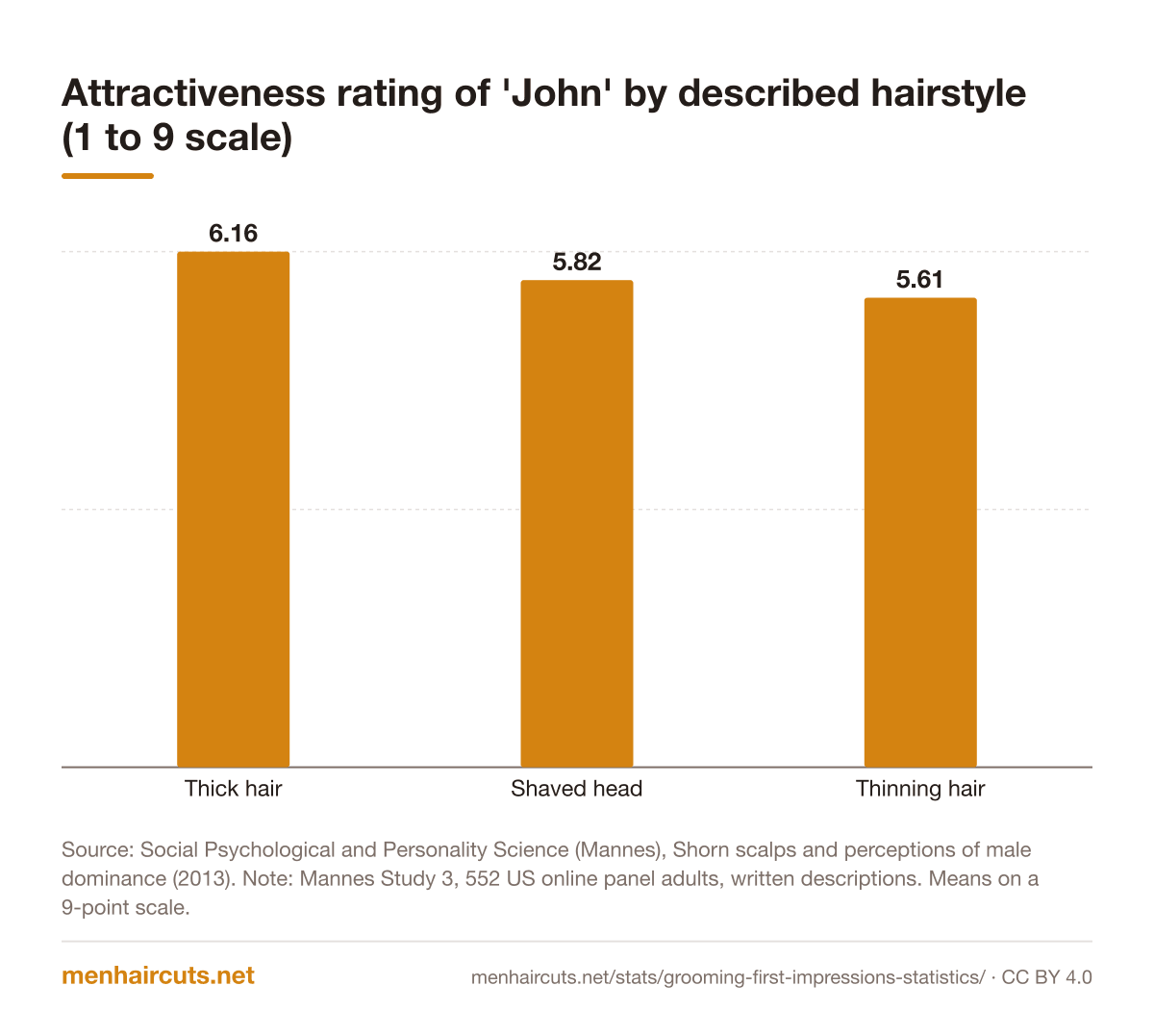
Show the numbers
| Category | Value |
|---|---|
| Thick hair | 6.16 |
| Shaved head | 5.82 |
| Thinning hair | 5.61 |
| Rating | With hair | Shaved |
|---|---|---|
| Dominance (1 to 9) | 4.93 | 5.55 |
| Masculinity (1 to 9) | 5.64 | 6.19 |
| Attractiveness (1 to 9) | 5.92 | 5.41 |
| Estimated age (years) | 33.71 | 37.48 |
| Estimated height (inches) | 69.88 | 70.72 |
| Estimated bench press (lbs) | 175.97 | 198.26 |
| Leadership potential (1 to 7, no significant difference) | 4.80 | 4.87 |
How does hair loss change how men are seen and how they feel?
Bald men can be judged less favorably when people know nothing else about them. In experiments by researchers at the Universities of Trier and Mannheim in Germany, women of the same age rated bald men lower on social attractiveness only when no individuating information was given, while implicit tests still showed the bias even when information was available[21].
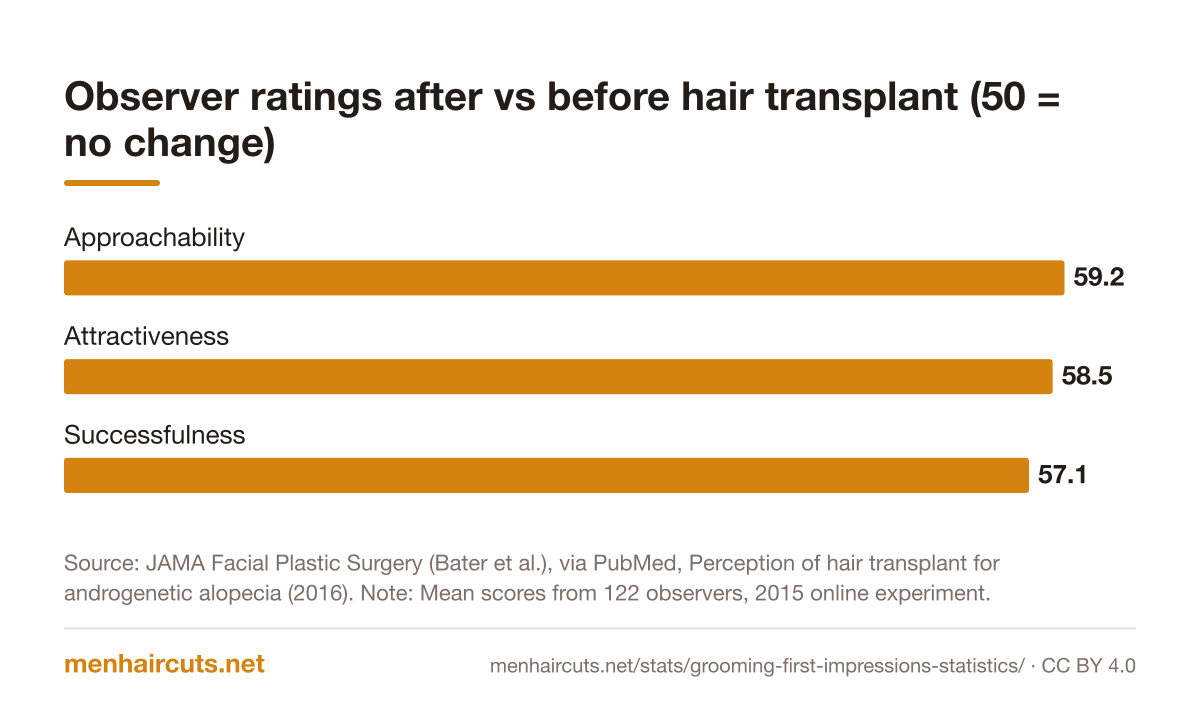
Restoring hair shifts outside ratings. In a randomized online experiment run in late 2015, 122 observers compared before-and-after photos of 7 men who had hair transplants against 6 controls. After the transplant, men were judged an average of 3.6 years younger, and scored above the no-change midpoint of 50 for attractiveness, successfulness and approachability[9].
Men feel the effect too. In a telephone survey of 1,536 men aged 18 to 45 in Germany, France, Italy, Spain and the UK, 729 (47%) reported hair loss. Over 70% of them called hair an important part of their image and 62% agreed hair loss could affect self-esteem, yet fewer than 10% were being treated[8]. A 2022 clinic study of 75 Polish men with androgenetic alopecia found 66.7% reported a rather large negative effect on self-esteem and 60% often or sometimes felt embarrassed by their baldness[22].
Show the numbers
| Category | Value |
|---|---|
| Losing part of their attractiveness | 43% |
| Fear of going bald | 42% |
| Getting older | 37% |
| Negative effect on social life | 22% |
| Feelings of depression | 21% |
Does a hair transplant change first impressions?
The Johns Hopkins team behind the 2016 study scored each domain on a 0 to 100 scale, where anything above 50 means observers saw a positive change after the procedure[9]. All three social ratings came in above 50, and the age effect averaged 3.6 years younger[9]. The sample was small (13 pairs of photos), and observers were recruited through social media, so the numbers describe one group of raters rather than the general public.
Show the numbers
| Category | Value |
|---|---|
| Approachability | 59.2 |
| Attractiveness | 58.5 |
| Successfulness | 57.1 |
Frequently asked questions
How long does it take to form a first impression of someone's face?
Do attractive or well-groomed people earn more?
Is it better to shave your beard for a job interview?
Do women prefer beards or clean-shaven men?
What facial hair length do women find most attractive?
Does shaving your head make you look tougher?
Methodology and limitations
This report gathers peer-reviewed studies on face perception, grooming, facial hair and hair loss, plus named polls (YouGov) and one brand-commissioned survey (Gillette, run by Harris Interactive). We read each PubMed abstract directly, read the full text of Mannes (2013) for its tables, and confirmed Wong and Penner's figures from the paper's abstract as quoted by Marginal Revolution and the UC Irvine news release. Dixson and Brooks (2013) findings come from The Register's report on the paper, because the journal page could not be opened. All figures were checked on 15 October 2026. No figures were calculated or adjusted by menhaircuts.net.
Limitations
Most studies here ask strangers to rate photos or written descriptions in one sitting, which is not the same as a real interview or date. Many samples are small, drawn from students or online panels, and from one country (US, Brazil, Netherlands, New Zealand, Samoa, Poland or Western Europe). Pay studies are observational and cannot show that grooming causes higher income. The Gillette survey was commissioned by a shaving brand. Several studies are a decade or more old, and beard fashion has changed since, which itself affects how beards are judged.
Every figure on this page links to its source. Numbers are reported as published; any menhaircuts.net calculation is labelled and shows its inputs. Spotted an error? Tell us and we will check it.
Sources
- First impressions: making up your mind after a 100-ms exposure to a face, Psychological Science (Willis and Todorov), via PubMed (2006). Accessed October 15, 2026.
- Gender and the returns to attractiveness, Research in Social Stratification and Mobility, vol. 44 (Wong and Penner) (2016). Accessed October 15, 2026.
- Shorn scalps and perceptions of male dominance, Social Psychological and Personality Science (Mannes) (2013). Accessed October 15, 2026.
- Have no fear, 'peak beard' is not here, YouGov (2014). Accessed October 15, 2026.
- Inferences of competence from faces predict election outcomes, Science (Todorov et al.), via PubMed (2005). Accessed October 15, 2026.
- Job seekers: update your look before you update your resume (Gillette survey conducted by Harris Interactive), Banker & Tradesman (2009). Accessed October 15, 2026.
- Most British men now have facial hair, YouGov (2023). Accessed October 15, 2026.
- The psychosocial impact of hair loss among men: a multinational European study, Current Medical Research and Opinion (Alfonso et al.), via PubMed (2005). Accessed October 15, 2026.
- Perception of hair transplant for androgenetic alopecia, JAMA Facial Plastic Surgery (Bater et al.), via PubMed (2016). Accessed October 15, 2026.
- Beauty and the Labor Market (NBER Working Paper 4518; published in the American Economic Review, 1994), National Bureau of Economic Research (Hamermesh and Biddle) (1993). Accessed October 15, 2026.
- How much of the attractiveness premium is really about grooming? (quotes the Wong and Penner abstract), Marginal Revolution (2016). Accessed October 15, 2026.
- UCI researchers find that personal grooming habits can affect women's salaries more than men's, University of California, Irvine, School of Social Sciences (2016). Accessed October 15, 2026.
- Perception of men's personal qualities and prospect of employment as a function of facial hair, Psychological Reports (de Souza, Baiao and Otta), via PubMed (2003). Accessed October 15, 2026.
- To shave or not to shave? How beardedness in a LinkedIn profile picture influences perceived expertise and job interview prospects, HCI in Business, Springer (van der Land and Muntinga), Erasmus University repository (2014). Accessed October 15, 2026.
- Beards augment perceptions of men's age, social status, and aggressiveness, but not attractiveness, Behavioral Ecology (Dixson and Vasey) (2012). Accessed October 15, 2026.
- Men's facial hair preferences reflect facial hair impression management functions across contexts and men know it, Archives of Sexual Behavior (Jach, Moron and Jonason), via PubMed (2023). Accessed October 15, 2026.
- 10-day stubble: men's 'socio-sexual attributes' at their best (report on Dixson and Brooks 2013), The Register (2013). Accessed October 15, 2026.
- The masculinity paradox: facial masculinity and beardedness interact to determine women's ratings of men's facial attractiveness, Journal of Evolutionary Biology (Dixson et al.), via PubMed (2016). Accessed October 15, 2026.
- Women's preferences for men's beards show no relation to their ovarian cycle phase and sex hormone levels, Hormones and Behavior (Dixson et al.), via PubMed (2018). Accessed October 15, 2026.
- Negative frequency-dependent preferences and variation in male facial hair, Biology Letters (Janif, Brooks and Dixson), via PubMed (2014). Accessed October 15, 2026.
- Bald and bad?, Experimental Psychology (Kranz, Nadarevic and Erdfelder), via PubMed (2019). Accessed October 15, 2026.
- Association between androgenetic alopecia and psychosocial disease burden: a cross-sectional survey among Polish men, Dermatology Research and Practice (Adamowicz et al.), via PubMed (2022). Accessed October 15, 2026.
Cite, embed and download
This report, its charts and its infographic are free to reuse under a Creative Commons Attribution 4.0 license. Credit menhaircuts.net with a link to this page.
Cite this report (APA)
Hamilton, J. (2026, October 15). Grooming and First Impressions Statistics 2026. menhaircuts.net. https://menhaircuts.net/stats/grooming-first-impressions-statistics/
Link to this report
<a href="https://menhaircuts.net/stats/grooming-first-impressions-statistics/">Grooming and First Impressions Statistics 2026</a> (menhaircuts.net, CC BY 4.0)Share the headline number
100 ms: Exposure time enough for people to judge a face's trustworthiness or competence (2006 study) (Psychological Science (Willis and Todorov), via PubMed, via menhaircuts.net/stats/grooming-first-impressions-statistics/)
Download the charts and infographic
- British women who prefer the look of a man with a beard (PNG)
- Attractiveness rating of 'John' by described hairstyle (1 to 9 scale) (PNG)
- Concerns men linked to noticing their hair loss (5 European countries) (PNG)
- Observer ratings after vs before hair transplant (50 = no change) (PNG)
- Infographic: Grooming and First Impressions Statistics 2026 (PNG, 1000 x 1500)
Related data
- 54%of British men had some facial hair in 2023 (37% in 2011)Beard Statistics 2026
- 64.18%of US Air Force shaving waiver holders in a 2021 study were Black (12.85% of the sample)Facial Hair Dress Code Statistics 2026
- 62%of European men with hair loss agreed it could affect self-esteemHair and Confidence Statistics 2026
- 50 millionUS men with androgenetic alopecia (male pattern hair loss)Male Hair Loss Statistics 2026
Related guides
Make us a Preferred Source on Google
See our latest articles first in your Google Search & AI Overviews.