
Data report · Updated October 2026
Beard statistics: 54% of UK men now have facial hair, up from 37% in 2011
Survey data on how many men wear beards, how attitudes have shifted, what beards cost and how the military treats them.
In 2023, 54% of British men said they had some form of facial hair, up from 37% in 2011, and 34% wore a beard with a moustache[1]. In the US, seven in ten men say they have had facial hair at some point[2]. Men with facial hair also report spending $49 a month on grooming[3].
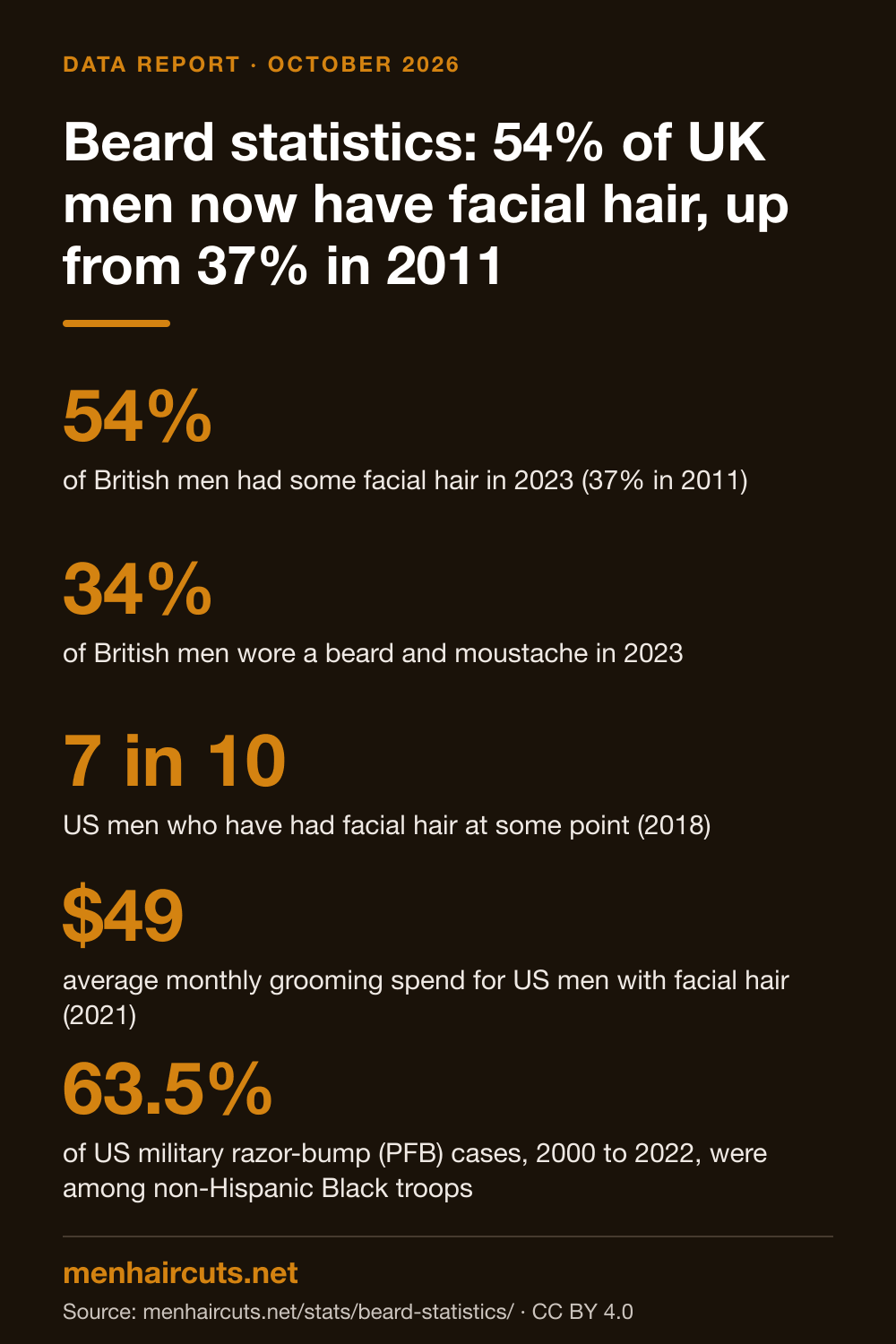
54%
of British men had some facial hair in 2023 (37% in 2011)[1]
34%
of British men wore a beard and moustache in 2023[1]
7 in 10
US men who have had facial hair at some point (2018)[2]
$49
average monthly grooming spend for US men with facial hair (2021)[3]
63.5%
of US military razor-bump (PFB) cases, 2000 to 2022, were among non-Hispanic Black troops[4]
By Jessica Hamilton, Editor · Published · Updated · Free to reuse with credit (CC BY 4.0)
Key findings
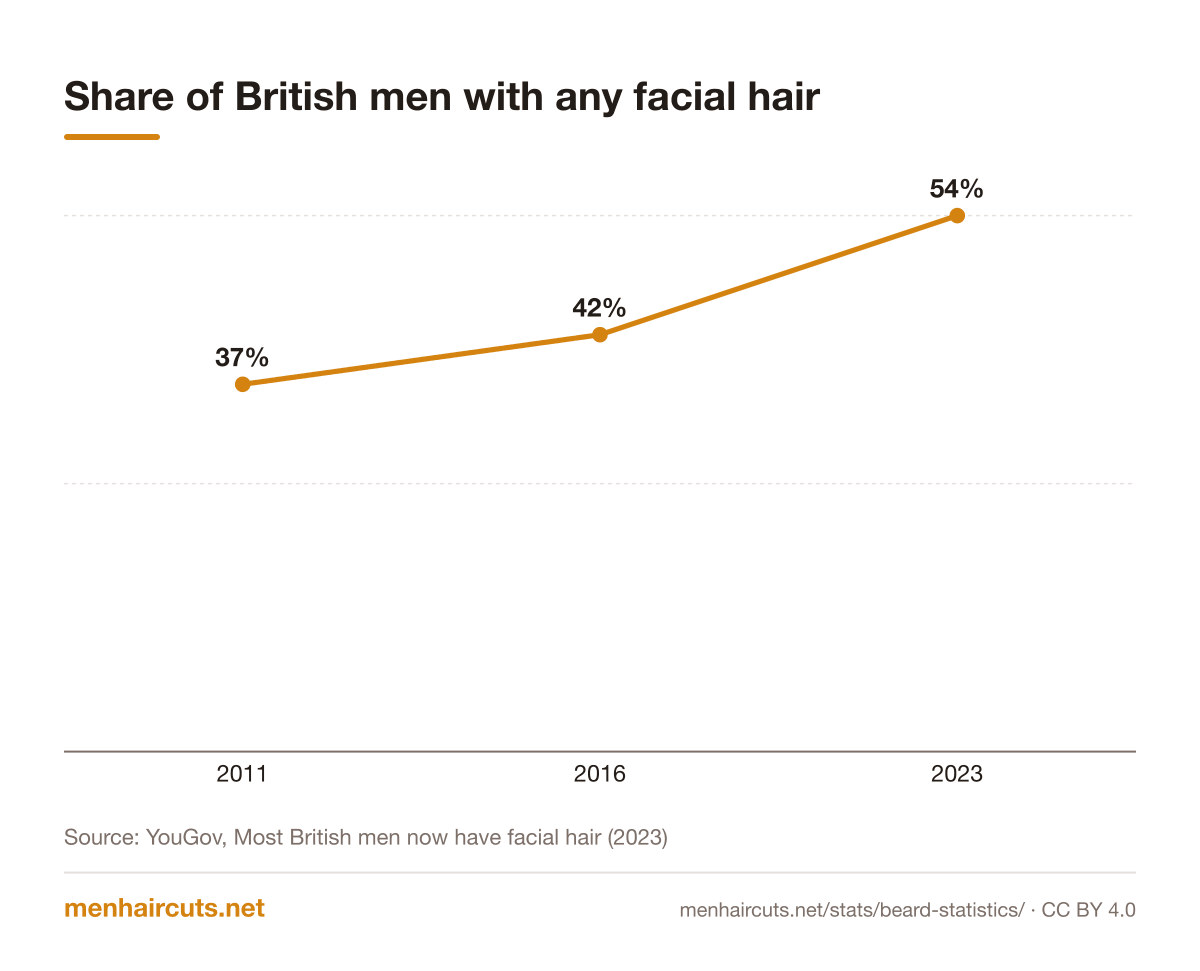
- The share of British men with facial hair rose from 37% in 2011 to 42% in 2016 and 54% in 2023, according to YouGov[1].
- Among British men aged 18 to 39, 69% had facial hair in 2023 and 42% wore a beard and moustache together[1].
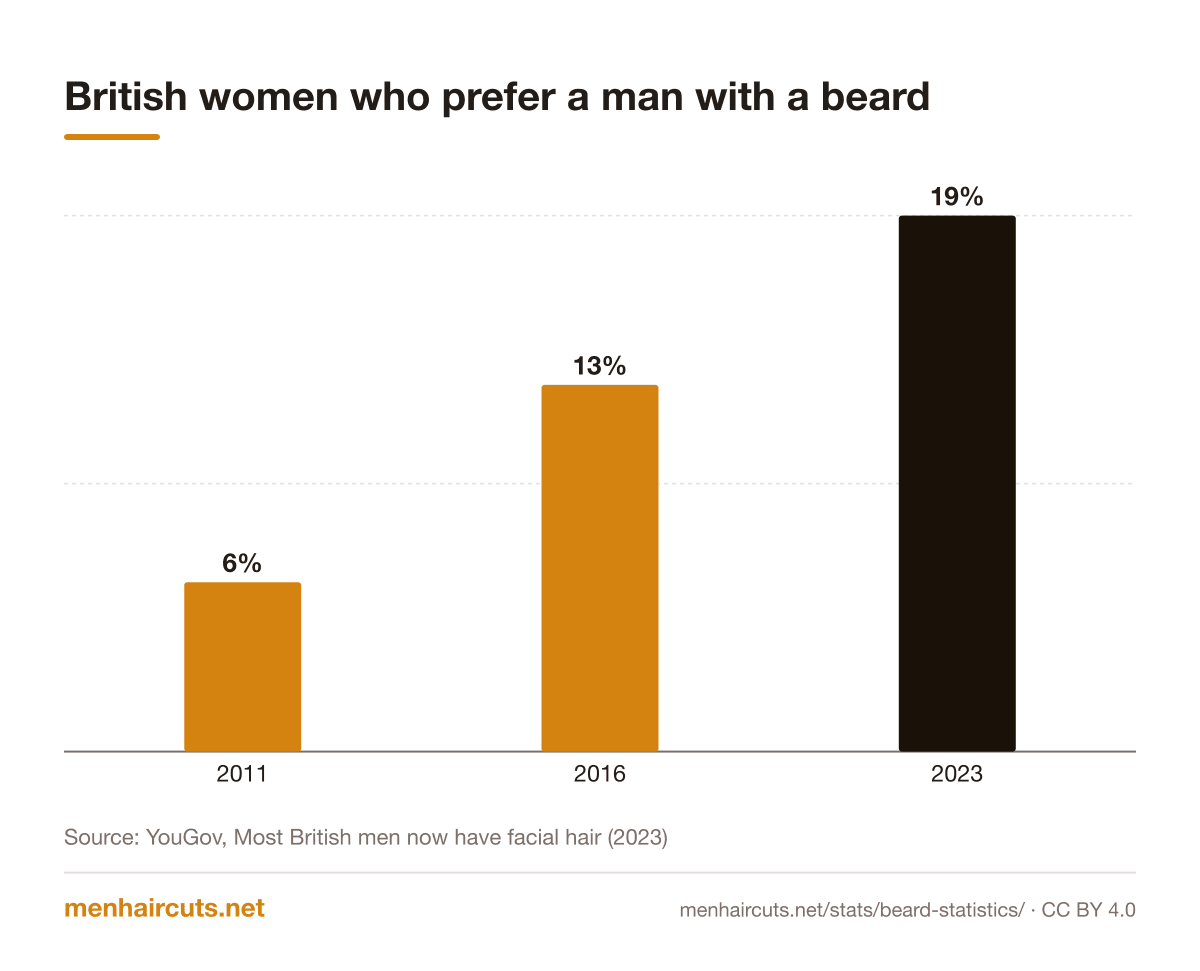
- Women's views shifted too: 19% of British women preferred a man with a beard in 2023, up from 6% in 2011, while the share preferring clean-shaven men fell from 66% to 36%[1].
- An Economist/YouGov poll found that seven in ten American men have had facial hair, most of them a beard and moustache together[2].
- In a 2021 LendingTree survey, US men with facial hair spent $49 a month on shaving and grooming products versus $35 for clean-shaven men[3].
- Mintel found in 2015 that 41% of US men who use shaving products do not shave every day[5].
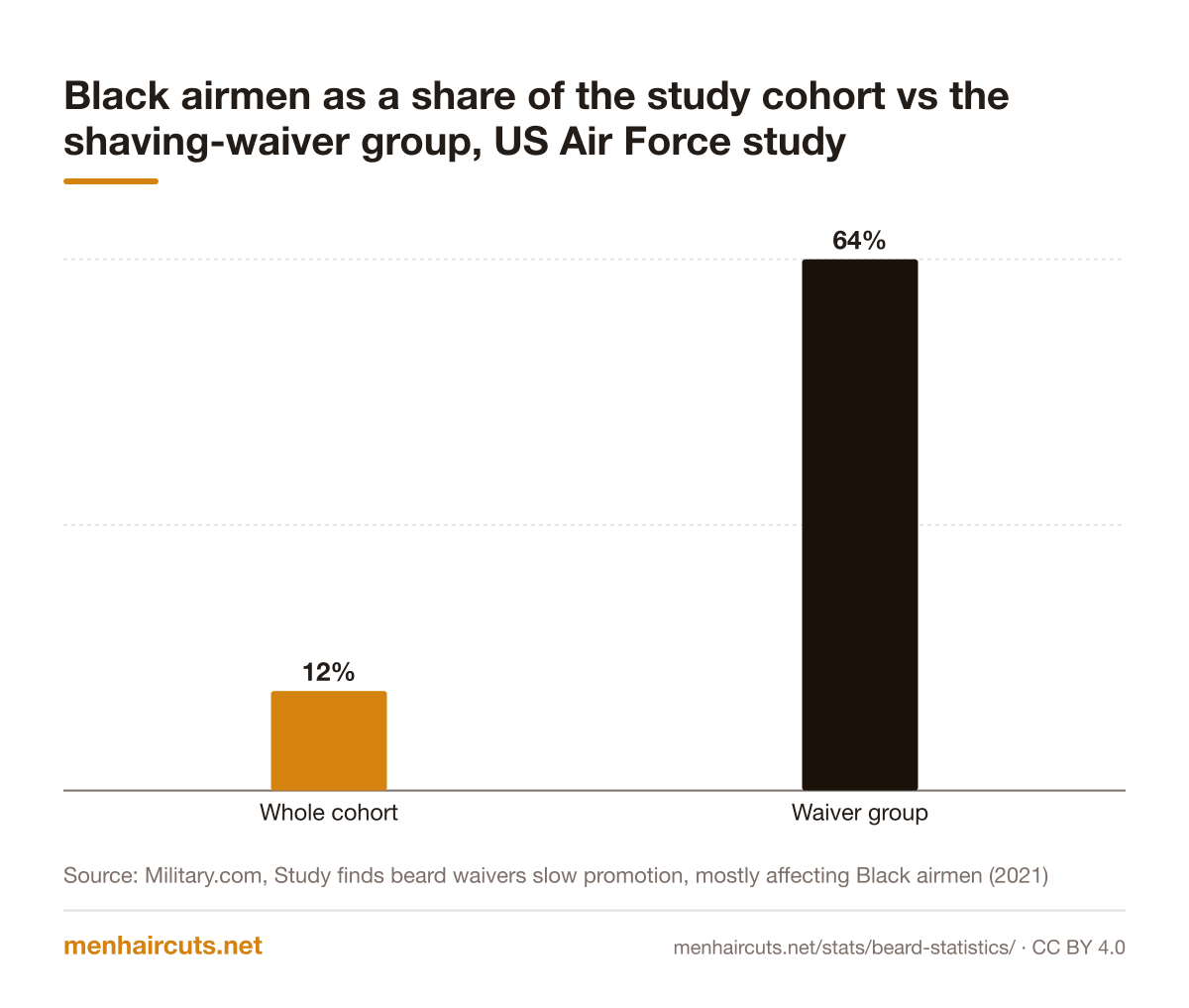
- In the US Air Force, 64% of airmen with shaving waivers in a survey of more than 9,000 were Black, though Black airmen were 12% of the cohort[6].
- Pentagon rules issued on September 30, 2025 end permanent medical shaving waivers and cap treatment-based exemptions at 12 months[7].
Download the infographic
The headline numbers from this report as one tall image (1000 x 1500 PNG), sized for Pinterest, slides and posts. Free to reuse with credit.
How many men have beards?
The longest-running national tracker of facial hair comes from YouGov in Britain. Its poll, published in September 2023, found that 54% of men had some form of facial hair, up from 42% in 2016 and 37% in 2011[1]. That means facial hair went from a minority look to the majority in about twelve years.
The US has no equally recent national count of men who currently wear beards. The closest figure is from an Economist/YouGov poll reported in April 2018: seven in ten American men said they had sported facial hair themselves at some point, and most of those had worn both a beard and a moustache[2]. That measures men who have ever had facial hair, not the share who have it today, so it should not be read as a prevalence rate.
The pandemic gave beards another push. A Wahl survey of US men aged 18 to 64, reported in October 2020, found that 40% had grown a beard since Covid-19 hit, and more than half said they planned to keep it[8].
What beard styles are most common?
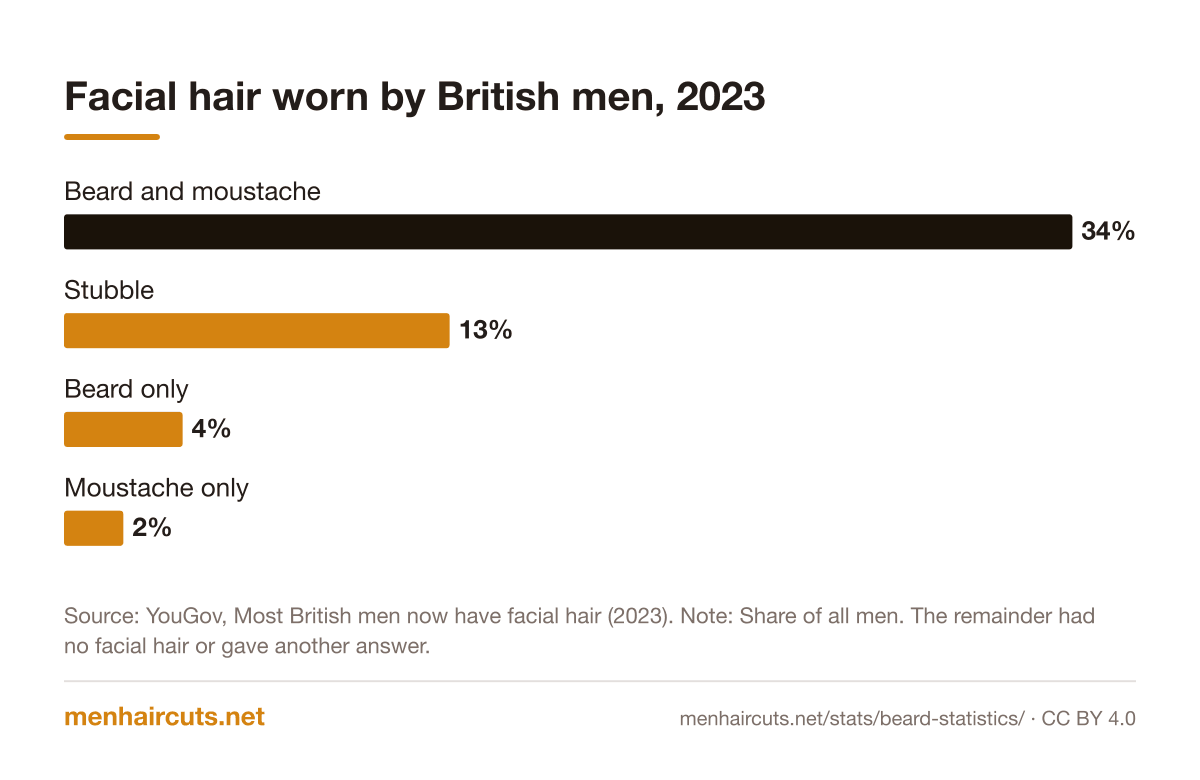
In YouGov's 2023 data, the most common look among British men was a beard and moustache together, worn by 34%[1]. Stubble came next at 13%, with 4% wearing a beard without a moustache and 2% a moustache alone[1].
That is a big change in style mix. In 2011, stubble was the leader at 19% and only 11% of men had a beard and moustache; by 2016 the two were roughly level at 18% and 17%[1]. Put another way, among men with facial hair in late 2016, 44% had full beards, up from 29% five years earlier[9].
A Remington poll of 2,000 UK men, published in September 2025, found full beards on 20% of men in London, while stubble was most popular in the West Midlands and goatees in the North West and Wales[10]. For style ideas by face shape, see our guide to beard shapes for your jawline.
Show the numbers
| Category | Value |
|---|---|
| Beard and moustache | 34% |
| Stubble | 13% |
| Beard only | 4% |
| Moustache only | 2% |
| Measure | 2011 | 2016 | 2023 |
|---|---|---|---|
| Any facial hair | 37% | 42% | 54% |
| Beard and moustache | 11% | 18% | 34% |
| Stubble | 19% | 17% | 13% |
Are beards more popular with younger men?
Yes, by a wide margin. Among British men aged 18 to 39, 69% had some facial hair in 2023, and 42% wore a beard and moustache[1]. Back in 2011, only 43% of men in that age group had any facial hair, and 72% of those with facial hair kept it as stubble[9].
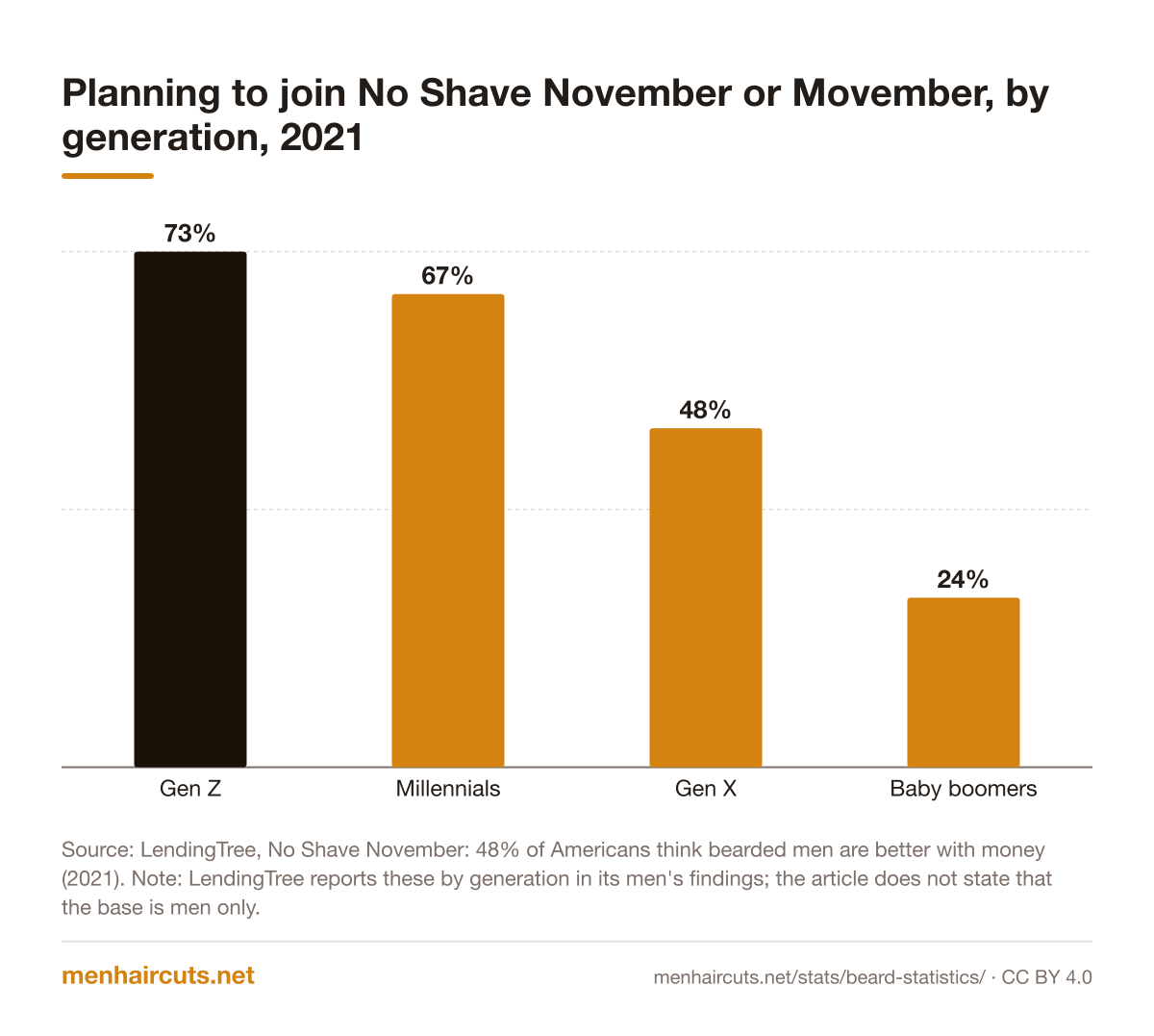
US survey data points the same way for interest in beard-growing events. In LendingTree's October 2021 survey, 73% of Gen Z and 67% of millennial respondents planned to join No Shave November or Movember, compared with 48% of Gen X and 24% of baby boomers[3].
Show the numbers
| Category | Value |
|---|---|
| Gen Z | 73% |
| Millennials | 67% |
| Gen X | 48% |
| Baby boomers | 24% |
Which beard styles do Americans search for most?
Search data shows what men are curious about. Google's November 2019 Movember analysis found search interest in faded and square beard styles doubled over the previous year, retro sideburns gained 190% and the soul patch 110%[11]. The handlebar moustache was the uniquely popular style in six states and the goatee in four[11].
Some state picks were unusual: the braided beard in Colorado, the chinstrap in Delaware and the circle beard in Arizona[11]. A separate StyleSeat analysis of Google searches across more than 35 facial hair styles, controlled for population, named goatees, full beards, mutton chops and chin straps as the most popular beard styles, with California the most beard-focused state[12].
| State | Style |
|---|---|
| Arizona | Circle beard |
| Colorado | Braided beard |
| Delaware | Chinstrap beard |
| Idaho | Monkey tail beard |
| New Jersey | Huge beard |
| Virginia | Beard dreads |
| Washington | 70's mustache |
| Washington, D.C. | Chevron mustache |
Do women prefer men with beards?
Opinion has moved toward beards, but most people do not mind either way. In YouGov's 2023 British poll, 19% of women preferred a man with a beard, up from 13% in 2016 and 6% in 2011[1]. The share preferring clean-shaven men fell from 66% in 2011 to 36% in 2023, and 44% now have no preference[1]. Among women aged 18 to 39, 34% prefer a beard and 24% prefer clean-shaven men[1].
Men are mostly neutral: 62% have no strong feelings, 19% prefer no beard and 15% say beards look better[1].
In the US, a 2014 YouGov study found that 47% of Americans said they find men with well-kept beards attractive[13]. More than a decade old, it remains the most cited US measure of beard appeal.
Show the numbers
| Category | Value |
|---|---|
| 2011 | 6% |
| 2016 | 13% |
| 2023 | 19% |
How much do men with beards spend on grooming?
LendingTree's survey of 2,051 US consumers, fielded October 15 to 20, 2021, found that men spend an average of $42 a month on shaving and grooming products[3]. Men with facial hair spent more, $49 a month, against $35 for clean-shaven men[3]. Over a year that gap is $168 (menhaircuts.net calculation: ($49 - $35) × 12).
Product use backs this up. In the 2025 Remington poll of UK men, 16% used a beard oil, 13% a beard shampoo and 12% a beard balm, and 40% of men with facial hair used an electric trimmer[10]. Three in five men with facial hair said they prefer to style it themselves, and of those who do go to a barber for a trim, 32% go weekly[10]. Our beard oil vs beard balm comparison covers which product suits which beard.
The same LendingTree survey turned up a quirkier result: 48% of Americans think bearded men are better with money than clean-shaven men, a view held by 75% of men with facial hair and 17% of clean-shaven men[3].
How many men skip shaving every day?
Daily shaving is no longer the default. Mintel reported in 2015 that 41% of US men who use shaving products do not shave daily, rising to 50% of men aged 18 to 24 and 51% of men aged 45 to 54[5]. In the same research, 22% of men agreed that facial hair, including beards, is fashionable[5].
Seasonal campaigns push the numbers higher each autumn. In 2021, 46% of US men told LendingTree they would skip shaving or grow a moustache for No Shave November or Movember, split between 25% for No Shave November and 21% for Movember[3].
Why do so many Black men in the military need shaving waivers?
Pseudofolliculitis barbae (PFB), or razor bumps, happens when shaved hair curls back into the skin, and troops with it have been able to get medical shaving exemptions[7]. A 2021 US Air Force study surveyed more than 9,000 male airmen: 8,200 had never had a shaving waiver and 1,139 had held one for at least a year[6]. Black airmen made up 64% of the waiver group but only 12% of the whole cohort[6].
The study linked waivers with slower careers. Staff and technical sergeants who had held a waiver for more than eight years saw promotions delayed by about six months to a year, and the waiver group had a disciplinary rate of roughly 19% against 11.5% for the no-waiver group[6].
Across the services, non-Hispanic Black troops, historically 16% to 18% of the force, accounted for 63.5% of all PFB cases from 2000 to 2022, according to figures cited in a letter from 39 House members reported in October 2025[4]. Our guide to preventing razor bumps on the neckline covers the same skin problem for civilians.
What are the military's beard rules in 2025?
On September 30, 2025, Defense Secretary Pete Hegseth issued a memo ending permanent medical shaving exemptions[7]. Troops with PFB who already hold profiles can get exemptions for up to 12 months, but only with a treatment plan, and those with permanent conditions will be considered for administrative separation[7].
Most religious exemptions also end as the policy returns to pre-2010 standards, with existing exemptions facing individual reviews[7]. The services had 60 days to write implementation plans and about 90 days to enforce them[7]. Moustaches are still allowed if neatly trimmed and kept within the corners of the mouth, and some special operations units may keep beards for mission needs[7].
An earlier memo, dated August 20, 2025, directed commanders to begin separating troops who still need shaving waivers after more than a year of medical treatment[4]. Our military haircut standards guide covers the hair rules that go with these beard rules.
Frequently asked questions
What percentage of men have a beard?
Are beards still popular in 2026?
Do women like beards?
How much do bearded men spend on grooming?
How many men grew a beard during the pandemic?
Can you have a beard in the US military?
What share of men shave every day?
Methodology and limitations
Figures come from published polls and reports opened and read on October 15, 2026: YouGov UK facial hair tracking (2011, 2016, 2023), an Economist/YouGov poll reported in 2018, a 2014 YouGov US study, Mintel (2015), Wahl via Cosmetics Business (2020), LendingTree (2021), Remington/OnePoll via Yorkshire Post (2025), a US Air Force study reported by Military.com (2021), Stars and Stripes on the 2025 Pentagon memo, Straight Arrow News on a 2025 congressional letter, Google's 2019 Movember search analysis and StyleSeat's Google search analysis of beard styles. The annual spending gap ($168) is a menhaircuts.net calculation from LendingTree's monthly figures.
Limitations
The best prevalence data is British; the US lacks a recent national count of men who currently wear beards, and the 2018 US figure covers men who have ever had facial hair. YouGov's 2023 article does not state its sample size or fieldwork dates. The Wahl, Remington and LendingTree studies were commissioned by companies that sell grooming products or services, and Wahl's sample size was not published. Mintel and YouGov US attitude data are from 2014 and 2015. Military figures describe service members, not the general population, and the 63.5% PFB figure is reported secondhand from a congressional letter. Google's 2019 Movember analysis and StyleSeat's beard analysis report search interest, not how many men wear each style; the StyleSeat page is undated and does not state its time frame.
Every figure on this page links to its source. Numbers are reported as published; any menhaircuts.net calculation is labelled and shows its inputs. Spotted an error? Tell us and we will check it.
Sources
- Most British men now have facial hair, YouGov (2023). Accessed October 15, 2026.
- Americans aren't sure about John Bolton and his mustache, YouGov (Economist/YouGov poll) (2018). Accessed October 15, 2026.
- No Shave November: 48% of Americans think bearded men are better with money, LendingTree (2021). Accessed October 15, 2026.
- Lawmakers press Hegseth to reverse beard policy after Korea event ban, Straight Arrow News (2025). Accessed October 15, 2026.
- Razors down: 41% of US men don't shave daily, with one quarter agreeing beards are fashionable, Mintel (2015). Accessed October 15, 2026.
- Study finds beard waivers slow promotion, mostly affecting Black airmen, Military.com (2021). Accessed October 15, 2026.
- 'No more beardos': Hegseth gives military branches 60 days to end shaving waivers for almost all US troops, Stars and Stripes (2025). Accessed October 15, 2026.
- Men embrace hairiness during pandemic, Cosmetics Business (Wahl survey) (2020). Accessed October 15, 2026.
- Beards are growing on the British public, YouGov (2017). Accessed October 15, 2026.
- Leicester is the moustache capital of the UK, where most men boast their hair, Yorkshire Post (Remington / OnePoll data) (2025). Accessed October 15, 2026.
- Here's a 'stache of Movember trends from Google Search, Google (The Keyword blog) (2019). Accessed October 15, 2026.
- The Most Popular Beard Styles in Every State, StyleSeat (2022). Accessed October 15, 2026.
- Peak beard, YouGov (2014). Accessed October 15, 2026.
Cite, embed and download
This report, its charts and its infographic are free to reuse under a Creative Commons Attribution 4.0 license. Credit menhaircuts.net with a link to this page.
Cite this report (APA)
Hamilton, J. (2026, October 15). Beard Statistics 2026: How Many Men Have Beards?. menhaircuts.net. https://menhaircuts.net/stats/beard-statistics/
Link to this report
<a href="https://menhaircuts.net/stats/beard-statistics/">Beard Statistics 2026: How Many Men Have Beards?</a> (menhaircuts.net, CC BY 4.0)Share the headline number
54%: of British men had some facial hair in 2023 (37% in 2011) (YouGov, via menhaircuts.net/stats/beard-statistics/)
Download the charts and infographic
- Share of British men with any facial hair (PNG)
- Facial hair worn by British men, 2023 (PNG)
- Planning to join No Shave November or Movember, by generation, 2021 (PNG)
- British women who prefer a man with a beard (PNG)
- Black airmen as a share of the study cohort vs the shaving-waiver group, US Air Force study (PNG)
- Infographic: Beard Statistics 2026 (PNG, 1000 x 1500)
Related data
- 64.18%of US Air Force shaving waiver holders in a 2021 study were Black (12.85% of the sample)Facial Hair Dress Code Statistics 2026
- $978Average household spending on personal care products and services, 2024Men's Grooming Spending Statistics 2026
- 34.8 minaverage daily grooming time for US men in 2025 (0.58 hours; women 0.77 hours)Men's Grooming Routine Statistics 2026
- 29.0%Share of US barbers who are Black (2025 annual average)Black Men's Haircut Statistics 2026
Related guides
Make us a Preferred Source on Google
See our latest articles first in your Google Search & AI Overviews.