
Data report · Updated October 2026
Black men's haircut statistics: 29% of US barbers are Black, and the barbershop is a proven health venue
Sourced data on Black barbers, barbershop visits, barbershop health trials, razor bumps and hair discrimination law.
Black workers held 29.0% of US barber jobs in 2025, more than twice their 12.7% share of all employment[1]. Black barbershop patrons in a Los Angeles trial visited every 2 weeks on average, and a barber-plus-pharmacist program there cut systolic blood pressure by 27.0 mm Hg in six months[2].
29.0%
Share of US barbers who are Black (2025 annual average)[1]
Every 2 weeks
Average visit frequency of Black barbershop patrons in the Los Angeles trial[2]
27.0 mm Hg
Drop in systolic blood pressure in six months with barbers plus pharmacists[2]
45%–83%
Razor bump (PFB) prevalence reported among Black US Army recruits and soldiers in earlier studies[3]
28 states
States with a CROWN Act after Pennsylvania signed in November 2025[4]
By Jessica Hamilton, Editor · Published · Updated · Free to reuse with credit (CC BY 4.0)
Key findings
- Black workers made up 29.0% of the 141,000 people employed as barbers in the US in 2025, compared with 12.7% of all employed people[1].
- In a Los Angeles trial of 52 Black-owned barbershops, participants had been going to the same shop for about 10 to 11 years and got a cut about every 2 weeks[2].
- Barbers who sent hypertensive patrons to in-shop pharmacists helped cut systolic blood pressure by 27.0 mm Hg in six months, versus 9.3 mm Hg in the control group[2].
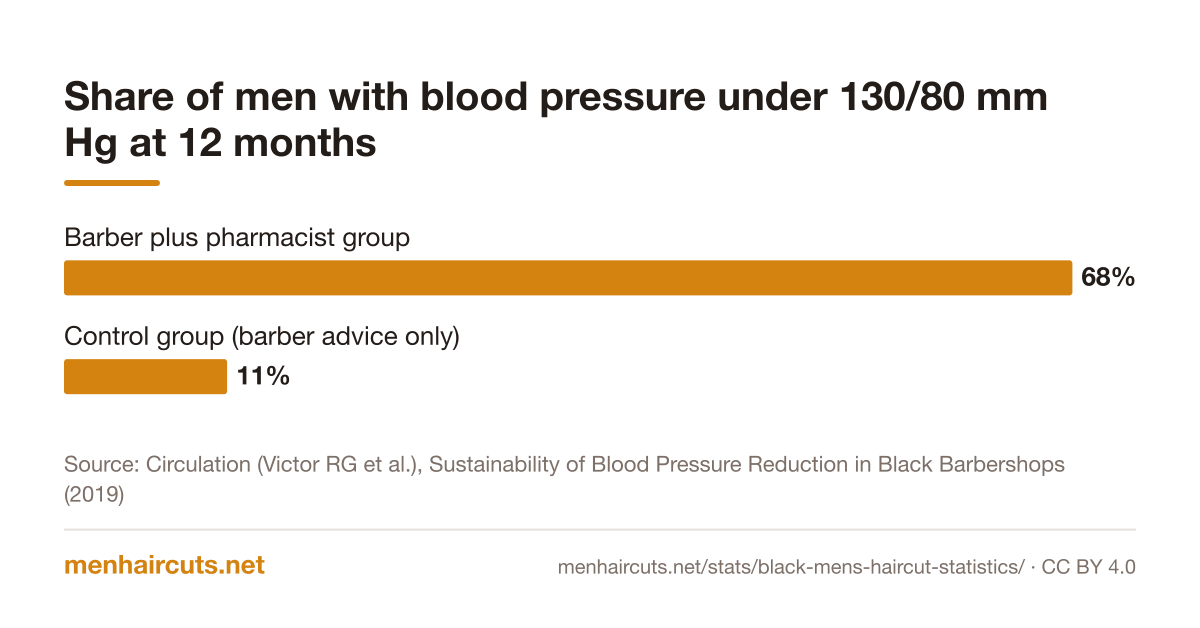
- At 12 months, 68.0% of men in the barber-plus-pharmacist group had blood pressure under 130/80 mm Hg, compared with 11.0% of the control group[5].
- Earlier military reports put razor bump (pseudofolliculitis barbae) prevalence at 45%–83% among Black US Army recruits and soldiers, though the current incidence is unknown[3].
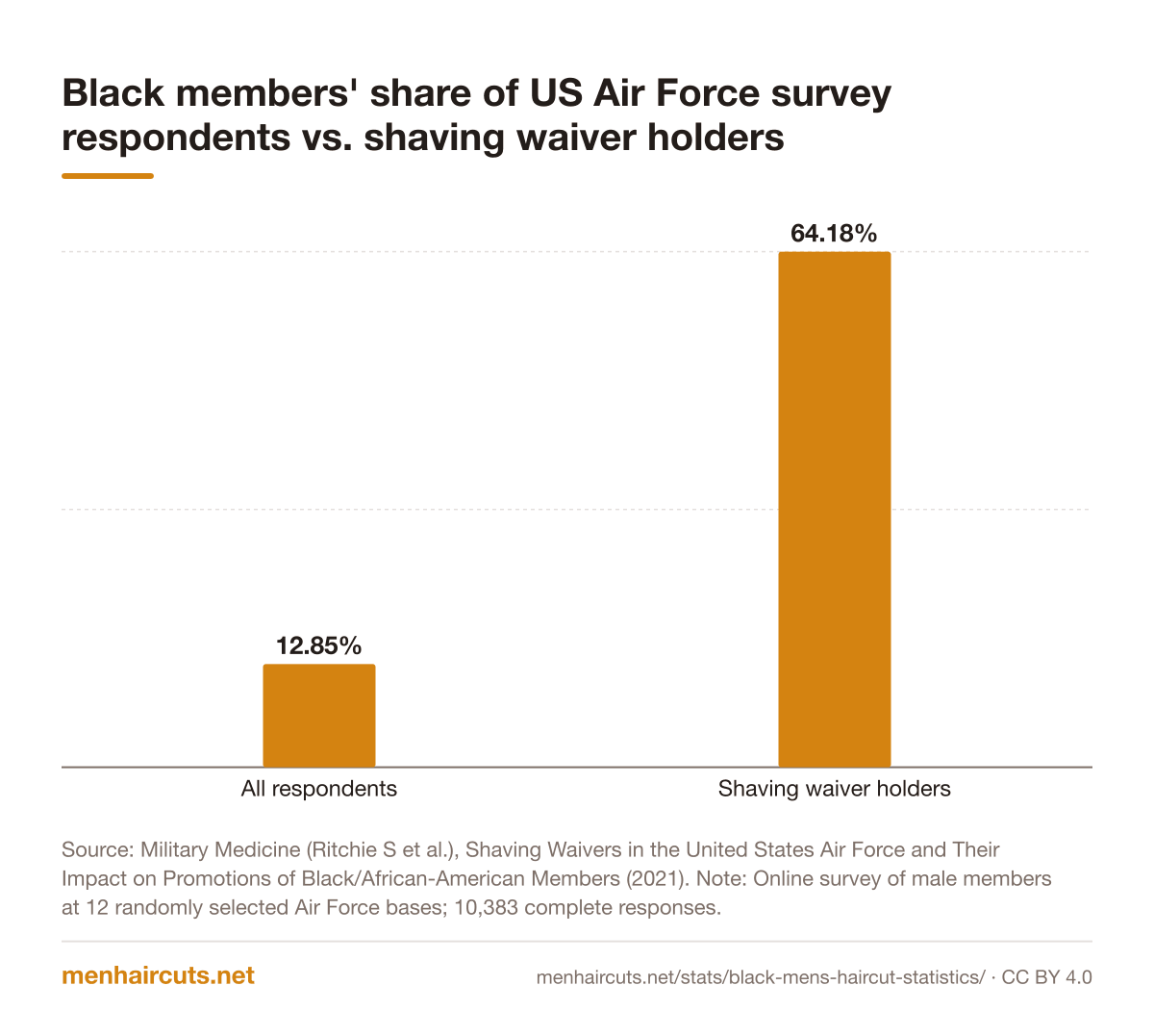
- In a survey of 10,383 US Air Force men, 64.18% of those with shaving waivers were Black, although Black members were only 12.85% of the study group[6].
- Pennsylvania became the 28th state with a CROWN Act in November 2025, while the federal CROWN Act passed the House in 2020 and 2022 but never cleared the Senate[4][7].
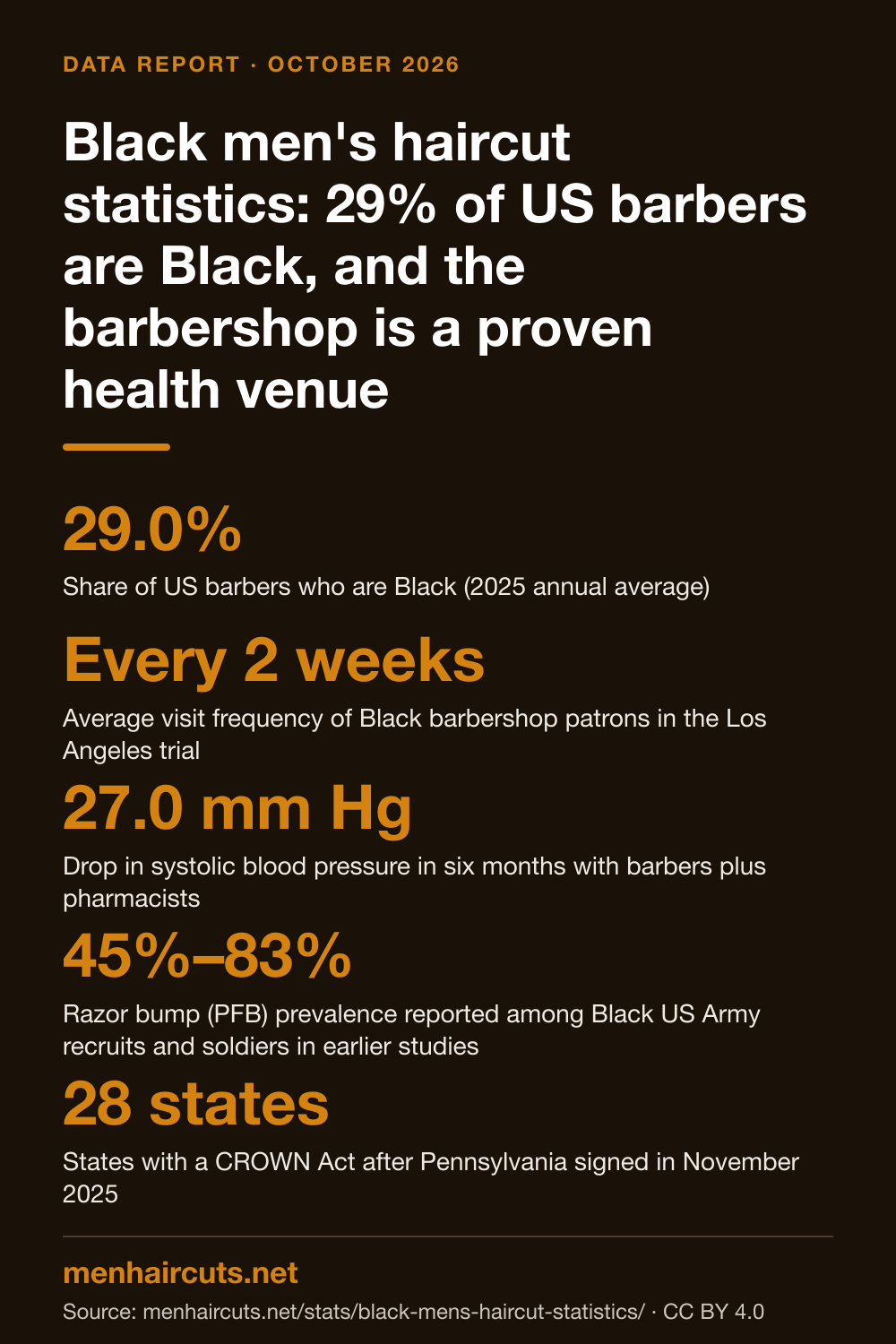
Download the infographic
The headline numbers from this report as one tall image (1000 x 1500 PNG), sized for Pinterest, slides and posts. Free to reuse with credit.
How many US barbers are Black?
The Bureau of Labor Statistics publishes a yearly breakdown of employed people by occupation, sex, race and Hispanic ethnicity, based on the Current Population Survey. In the 2025 table, 141,000 people worked as barbers, and 29.0% of them were Black or African American[1]. Across all occupations, Black workers were 12.7% of employed people that year[1]. That makes the Black share of barbering about 2.3 times the Black share of the overall workforce (29.0 ÷ 12.7, menhaircuts.net calculation).
In headcount terms, 29.0% of 141,000 barbers is roughly 40,900 Black barbers (141,000 × 0.290, menhaircuts.net calculation). Treat that as a rough figure. Barbering is a small occupation for a household survey, and the BLS estimates for it move around from year to year.
The contrast with hairdressers, hairstylists and cosmetologists is sharp. That occupation is far larger at 747,000 workers, and 12.2% of them were Black in 2025, close to the all-jobs average[1]. Barbering is also mostly male: women were 17.7% of barbers, compared with 92.0% of hairdressers and cosmetologists[1].
| Occupation | Employed (thousands) | Women | Black or African American | White | Hispanic or Latino |
|---|---|---|---|---|---|
| All employed, 16 and over | 163,493 | 47.1% | 12.7% | 75.7% | 20.0% |
| Barbers | 141 | 17.7% | 29.0% | 65.1% | 43.4% |
| Hairdressers, hairstylists and cosmetologists | 747 | 92.0% | 12.2% | 78.8% | 17.9% |
Has the share of Black barbers changed since 2019?
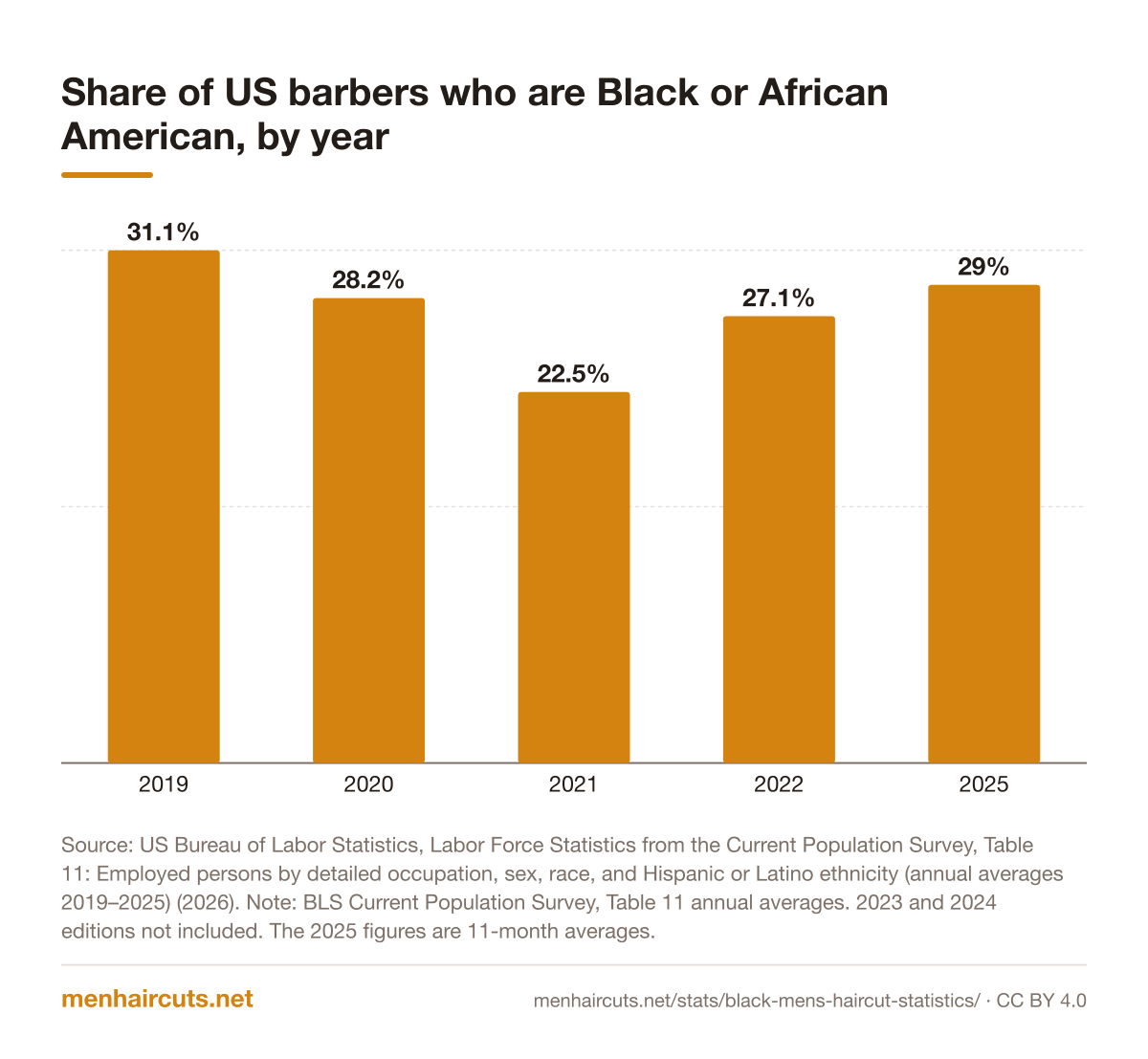
Looking across the BLS annual tables, the Black share of barbers has stayed far above the national average every year, but it moves around. It was 31.1% in 2019, 28.2% in 2020, 22.5% in 2021, 27.1% in 2022 and 29.0% in 2025[1]. The 2021 dip came during a year when the number of employed barbers was also low, at 103,000, compared with 137,000 in 2019[1].
Because barbering is a small occupation in a household survey, a single-year change should not be read as a trend. What holds steady is the gap: in every year shown, the Black share of barbers was at least 10 percentage points above the Black share of all workers, which ranged from 12.1% to 12.7% over the same years[1].
How often do Black men go to the barbershop?
There is no national survey that tracks haircut frequency for Black men specifically. The best detailed data comes from the barbershop blood-pressure trial led by Ronald Victor at Cedars-Sinai, published in the New England Journal of Medicine in 2018. To join, men had to be self-identified regular patrons, defined as at least one haircut every 6 weeks for at least 6 months[2].
Among the men who enrolled, visits averaged every 2.0 weeks in one group and every 2.1 weeks in the other[2]. They had been patrons of their shop for 10.2 and 11.5 years on average. The shops themselves had been open about 17 to 18 years and had about 4 barbers each[2].
These numbers describe men aged 35 to 79 with high blood pressure who were loyal customers of Black-owned shops in Los Angeles County, so they are not a national average. They do show why public health researchers keep coming back to the barbershop: few other places see the same men every couple of weeks for a decade.
| Measure | Pharmacist group | Control group |
|---|---|---|
| Barbershops | 28 | 24 |
| Participants analyzed at baseline | 132 | 171 |
| Average age (years) | 54.4 | 54.6 |
| Years as a patron of the shop | 10.2 | 11.5 |
| Weeks between barbershop visits | 2.0 | 2.1 |
| Years the shop had been in business | 17.3 | 18.1 |
| Barbers per shop | 4 | 4 |
Can a barbershop lower blood pressure?
Yes, according to the largest trial so far. The study enrolled 319 Black male patrons with systolic blood pressure of 140 mm Hg or higher from 52 Black-owned barbershops in Los Angeles County[2]. Shops were randomly assigned to one of two approaches. In the intervention shops, barbers encouraged patrons to meet in the shop with specialty-trained pharmacists, who prescribed blood-pressure medicine under an agreement with the men's doctors. In the control shops, barbers encouraged lifestyle changes and doctor visits[2].
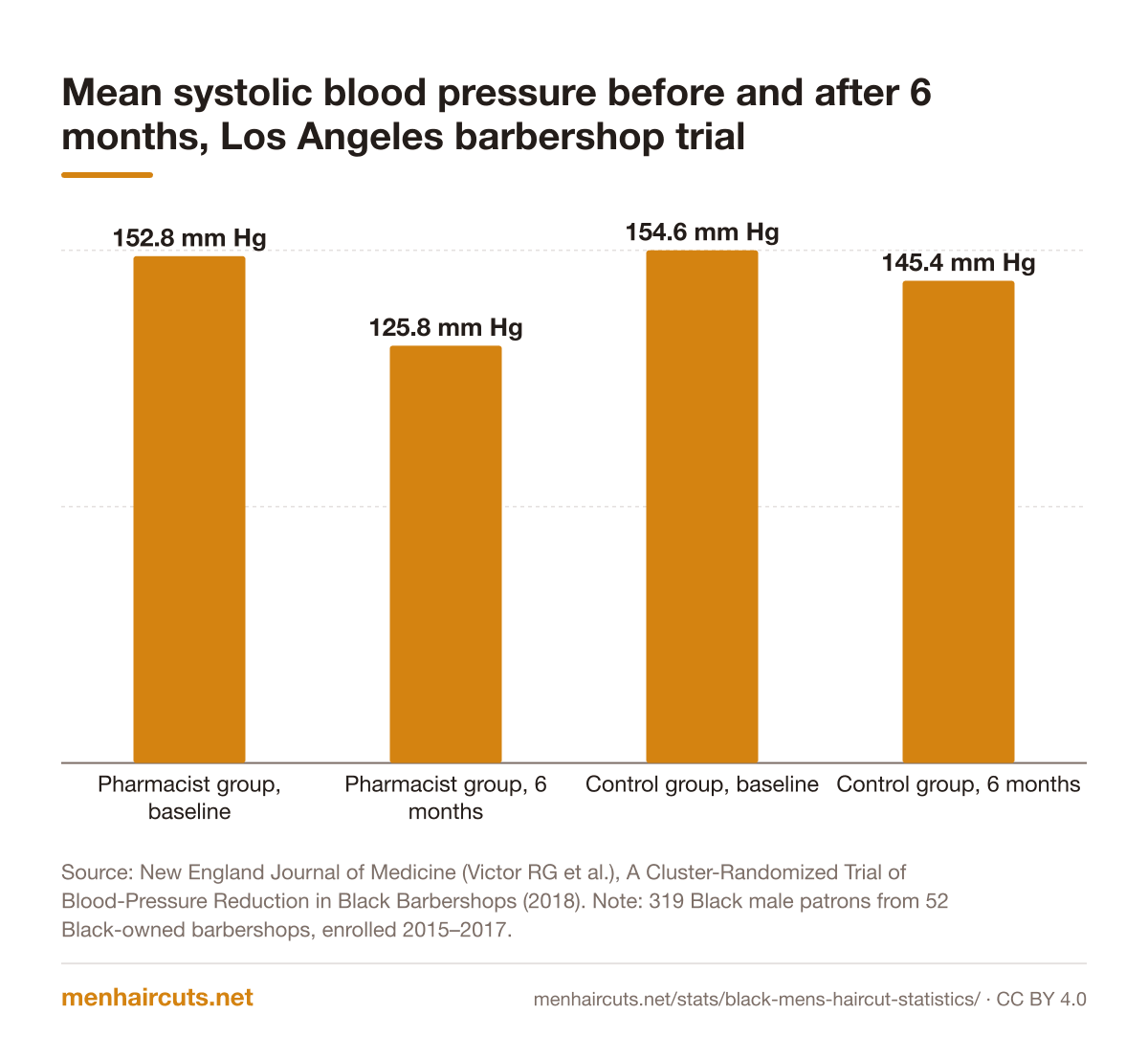
After six months, mean systolic blood pressure fell by 27.0 mm Hg in the pharmacist group, from 152.8 to 125.8 mm Hg, and by 9.3 mm Hg in the control group, from 154.6 to 145.4 mm Hg[2]. A blood pressure under 130/80 mm Hg was reached by 63.6% of the intervention group versus 11.7% of the control group, and 95% of the intervention group stayed in the study[2].
The paper notes that non-Hispanic Black men have the highest rate of hypertension-related death of any racial, ethnic or sex group in the United States, which is the reason the team went to barbershops in the first place[2].
Show the numbers
| Category | Value |
|---|---|
| Pharmacist group, baseline | 152.8 mm Hg |
| Pharmacist group, 6 months | 125.8 mm Hg |
| Control group, baseline | 154.6 mm Hg |
| Control group, 6 months | 145.4 mm Hg |
Did the barbershop blood pressure results last?
The team kept the trial running to 12 months, with fewer in-person pharmacist visits after month six, and published the results in Circulation in 2019[5]. At 12 months, mean systolic blood pressure had fallen by 28.6 mm Hg in the pharmacist group, to 123.8 mm Hg, compared with a 7.2 mm Hg drop in the control group, to 147.4 mm Hg[5].
Blood pressure under 130/80 mm Hg was reached by 68.0% of the intervention group versus 11.0% of the control group. Cohort retention was 90% in both groups, and no treatment-related serious adverse events occurred in either group over the year[5]. The authors concluded that the 12-month results were statistically indistinguishable from the six-month results.
What other health programs run through Black barbershops?
Blood pressure is the best-known example, but not the only one. A 2021 systematic review in BMC Public Health found 14 experimental or quasi-experimental studies of health programs for African American adults delivered in barbershops and hair salons; 10 of them took place in barbershops[8]. Cancer was the most common focus, in 7 studies (50%), followed by hypertension in 5 (35.7%). Only four studies reported clinical outcomes; the rest measured behavior change[8].
Newer work has moved into sexual health. In Cutting Out Stigma, a pilot in Tennessee published in 2026, 67 barbers completed HIV stigma and health training, and 50 barbers in 26 shops took part in a six-month trial from September 2024 to March 2025[9]. The researchers estimated 4,464 barbershop client encounters and 3,096 referrals, mostly for HIV testing and PrEP[9].
Patron preferences are not uniform. In a small 2023 survey of 17 non-Hispanic Black men at one San Francisco Bay Area barbershop, 81% preferred getting care in a traditional clinic, and 47% agreed they would prefer barbershops[10]. With so few respondents, that result is a prompt for larger studies, not a firm figure.
How common are razor bumps and scarring hair loss in Black men?
Pseudofolliculitis barbae (PFB), often called razor bumps, happens when tightly curled hairs cut close to the skin grow back into it. It matters for haircuts as well as shaves, since a sharp line-up or skin fade at the neckline can set it off. A 2019 review in Clinical, Cosmetic and Investigational Dermatology states that earlier military reports, under clean-shaven rules, gave a prevalence of 45%–83% among Black recruits and soldiers in the US Army[3]. The same review says the current incidence of PFB is unknown[3].
Military shaving rules show how unevenly the condition falls. A survey of US Air Force men received 10,383 complete responses. Of those with a shaving waiver, 64.18% were Black, even though Black members made up 12.85% of the study group[6]. Waivers were also linked with a longer time to promotion for members of every race[6].
The rules keep changing. In August 2025, the Department of Defense revised grooming standards across all branches, with shaving waivers that now have shorter durations and require more frequent medical evaluations[11].
Treatment data are limited. A military study of 50 service members treated with laser hair removal for PFB, 74% of whom identified as Black, found 88% were satisfied and 96% could resume shaving, but PFB came back in 84% of them[12].
Central centrifugal cicatricial alopecia (CCCA) is a scarring hair loss that starts at the crown. It is seen mainly in women of African descent and is rarely reported in men[13]. A 2023 case series from the University of Pennsylvania found 17 men with biopsy-confirmed CCCA seen between 2012 and 2022. Their average age was 43, 88.2% were Black, and 47.1% had a family history of hair loss[13].
Scalp itch was the most common symptom, and few of the men reported high-risk hair care practices[13]. The authors' takeaway is practical: CCCA should be on the list when an adult Black man has hair loss at the crown, rather than assuming it is always male pattern baldness. A barber who notices a shiny, smooth patch at the crown can suggest a dermatologist visit.
What does research say about hair discrimination?
The best-known numbers come from the CROWN research studies commissioned by Dove, and they focus on women and girls, not men. The 2023 CROWN Workplace Research Study, co-commissioned by Dove and LinkedIn, found that Black women's hair is 2.5 times more likely to be perceived as unprofessional, and that about two in three Black women (66%) change their hair for a job interview[14]. The 2019 study found Black women were 1.5 times more likely to be sent home from work because of their hair[14].
Dove has also run a 2021 CROWN research study for girls, which looked at hair discrimination in schools[14].
No comparable large survey of Black men's experiences with hair bias at work was found for this report. The laws that grew out of this research, however, protect everyone, so hairstyles common among Black men, such as locs, twists, braids and Afros, are covered where a CROWN Act is in force.
How many states have passed the CROWN Act?
California passed the first CROWN Act, signed into law on July 3, 2019[15]. When Pennsylvania's governor signed its version on November 25, 2025, the state joined 27 others, and the law took effect on January 24, 2026[4]. The CROWN Coalition's own site now displays "30 States Down, 20 To Go"[15]. Counts differ by source mainly because some states passed narrower laws that cover only schools or only some employers.
At the federal level, the CROWN Act has passed the House twice. H.R. 5309 passed by voice vote on September 21, 2020[16], and H.R. 2116 passed 235 to 189 on March 18, 2022[7]. Neither bill got a Senate vote. The CROWN Act of 2025 was introduced in both chambers on February 26, 2025, as H.R. 1638 and S. 751, and both were still in committee at the last recorded action[17][18].
| Bill | Congress | Key action | Date |
|---|---|---|---|
| H.R. 5309 | 116th | Passed House by voice vote | Sept. 21, 2020 |
| H.R. 2116 | 117th | Passed House, 235 to 189 | Mar. 18, 2022 |
| H.R. 1638 | 119th | Introduced, referred to committee | Feb. 26, 2025 |
| S. 751 | 119th | Introduced, referred to Judiciary Committee | Feb. 26, 2025 |
How many businesses do Black Americans own?
Many Black barbershops are small, owner-run businesses, and the Census Bureau does not publish an easy count of Black-owned barbershops alone. The broader picture: in reference year 2023, Black or African American owners held 3.4% (201,000) of US employer businesses, with $249.0 billion in receipts[19].
Pew Research Center's analysis of the prior year's data found that about seven in ten Black-owned firms (71%) had one to nine employees in 2022, and 90% were in urban areas[20]. Those patterns fit the typical neighborhood barbershop, though the data do not separate barbershops from other service businesses.
Frequently asked questions
What percentage of barbers in the US are Black?
How often do Black men get haircuts?
Did the barbershop blood pressure study work?
What percentage of Black men get razor bumps?
How many states have the CROWN Act?
Is the CROWN Act a federal law?
Does the CROWN Act protect men's hairstyles?
Methodology and limitations
This report was compiled in October 2026. Occupational data come from the Bureau of Labor Statistics Current Population Survey, Table 11 (employed persons by detailed occupation, sex, race and Hispanic or Latino ethnicity), using the current 2025 table and the archived 2019, 2020, 2021 and 2022 editions (bls.gov/cps/aaYYYY/cpsaat11.htm). Barbershop visit and health data come from peer-reviewed papers read through their PubMed abstracts and, for the 2018 NEJM trial, the full text and baseline table on PubMed Central. Legal status comes from Congress.gov bill records, the CROWN Coalition site and news reports of Pennsylvania's signing. Business ownership data come from the Census Bureau Annual Business Survey release and a Pew Research Center analysis. menhaircuts.net calculations are labeled and show their formulas: the Black share of barbers relative to all workers (29.0 ÷ 12.7) and an approximate count of Black barbers (141,000 × 0.290).
Limitations
There is no national data set on Black men's haircut frequency, spending or style choices; the visit figures here come from one Los Angeles trial of men aged 35 to 79 with high blood pressure, so they describe loyal patrons, not all Black men. BLS race shares for barbers rest on a small Current Population Survey sample and swing between years; the 2025 table uses 11-month averages, and the 2023 and 2024 editions were not included. Razor bump prevalence figures come from older military reports cited in a 2019 review, and the review notes current incidence is unknown. The CROWN surveys were commissioned by Dove (with LinkedIn in 2023) and measured women and girls, not men. State CROWN Act counts differ by source depending on whether narrower laws are included. Census business data cover all industries and do not isolate barbershops.
Every figure on this page links to its source. Numbers are reported as published; any menhaircuts.net calculation is labelled and shows its inputs. Spotted an error? Tell us and we will check it.
Sources
- Labor Force Statistics from the Current Population Survey, Table 11: Employed persons by detailed occupation, sex, race, and Hispanic or Latino ethnicity (annual averages 2019–2025), US Bureau of Labor Statistics (2026). Accessed October 15, 2026.
- A Cluster-Randomized Trial of Blood-Pressure Reduction in Black Barbershops, New England Journal of Medicine (Victor RG et al.) (2018). Accessed October 15, 2026.
- Pseudofolliculitis barbae: current treatment options, Clinical, Cosmetic and Investigational Dermatology (Ogunbiyi A) (2019). Accessed October 15, 2026.
- Shapiro signs 'Crown Act' banning hair-based discrimination in Pennsylvania, WITF (2025). Accessed October 15, 2026.
- Sustainability of Blood Pressure Reduction in Black Barbershops, Circulation (Victor RG et al.) (2019). Accessed October 15, 2026.
- Shaving Waivers in the United States Air Force and Their Impact on Promotions of Black/African-American Members, Military Medicine (Ritchie S et al.) (2021). Accessed October 15, 2026.
- H.R. 2116, CROWN Act of 2022: All actions, Congress.gov (2022). Accessed October 15, 2026.
- Health promotion interventions for African Americans delivered in U.S. barbershops and hair salons: a systematic review, BMC Public Health (Palmer KNB et al.) (2021). Accessed October 15, 2026.
- Cutting Out Stigma: Findings From a Pilot Implementation Trial of a Barbershop-Based HIV Stigma Reduction and Health Promotion Intervention in the Southern United States, Journal of the International AIDS Society (Perkins JM et al.) (2026). Accessed October 15, 2026.
- Preferences and Perspectives of Black Male Barbershop Patrons on Receiving Health Care in Nontraditional Settings, Health Equity (Chong S et al.) (2023). Accessed October 15, 2026.
- Military Grooming Policy Changes Affecting Service Members With Pseudofolliculitis Barbae, Cutis (Devine M, Cho S, Norton SA) (2026). Accessed October 15, 2026.
- Evaluating the Short- and Long-Term Outcomes of Laser Hair Removal for the Management of Pseudofolliculitis Barbae in a Military Population, Military Medicine (2026). Accessed October 15, 2026.
- Central centrifugal cicatricial alopecia in males, Journal of the American Academy of Dermatology (Jackson TK et al.) (2023). Accessed October 15, 2026.
- CROWN Act Research Studies (2019, 2021 and 2023), The CROWN Coalition / Dove (2023). Accessed October 15, 2026.
- About The CROWN Act, The CROWN Coalition (2026). Accessed October 15, 2026.
- H.R. 5309, CROWN Act of 2020: All actions, Congress.gov (2020). Accessed October 15, 2026.
- H.R. 1638, CROWN Act of 2025, Congress.gov (2025). Accessed October 15, 2026.
- S. 751, CROWN Act of 2025, Congress.gov (2025). Accessed October 15, 2026.
- Census Bureau Releases New Data About Characteristics of Employer and Nonemployer Business Owners, US Census Bureau (2025). Accessed October 15, 2026.
- A look at Black-owned businesses in the U.S., Pew Research Center (2025). Accessed October 15, 2026.
Cite, embed and download
This report, its charts and its infographic are free to reuse under a Creative Commons Attribution 4.0 license. Credit menhaircuts.net with a link to this page.
Cite this report (APA)
Hamilton, J. (2026, October 15). Black Men's Haircut Statistics 2026: Barbers, Health, Law. menhaircuts.net. https://menhaircuts.net/stats/black-mens-haircut-statistics/
Link to this report
<a href="https://menhaircuts.net/stats/black-mens-haircut-statistics/">Black Men's Haircut Statistics 2026: Barbers, Health, Law</a> (menhaircuts.net, CC BY 4.0)Share the headline number
29.0%: Share of US barbers who are Black (2025 annual average) (US Bureau of Labor Statistics, via menhaircuts.net/stats/black-mens-haircut-statistics/)
Download the charts and infographic
- Share of US barbers who are Black or African American, by year (PNG)
- Mean systolic blood pressure before and after 6 months, Los Angeles barbershop trial (PNG)
- Share of men with blood pressure under 130/80 mm Hg at 12 months (PNG)
- Black members' share of US Air Force survey respondents vs. shaving waiver holders (PNG)
- Infographic: Black Men's Haircut Statistics 2026 (PNG, 1000 x 1500)
Related data
- 75,800Barber jobs in the US, 2025 (including self-employed)Barber Industry Statistics 2026
- 10Haircuts per year for the average US man (2025 poll)How Often Men Get Haircuts
- 54%of British men had some facial hair in 2023 (37% in 2011)Beard Statistics 2026
- 64.18%of US Air Force shaving waiver holders in a 2021 study were Black (12.85% of the sample)Facial Hair Dress Code Statistics 2026
Related guides
Make us a Preferred Source on Google
See our latest articles first in your Google Search & AI Overviews.