
Data report · Updated October 2026
How often men get haircuts: about 10 times a year, or every 5 to 7 weeks
Survey and booking data on haircut frequency, barber loyalty and yearly spend.
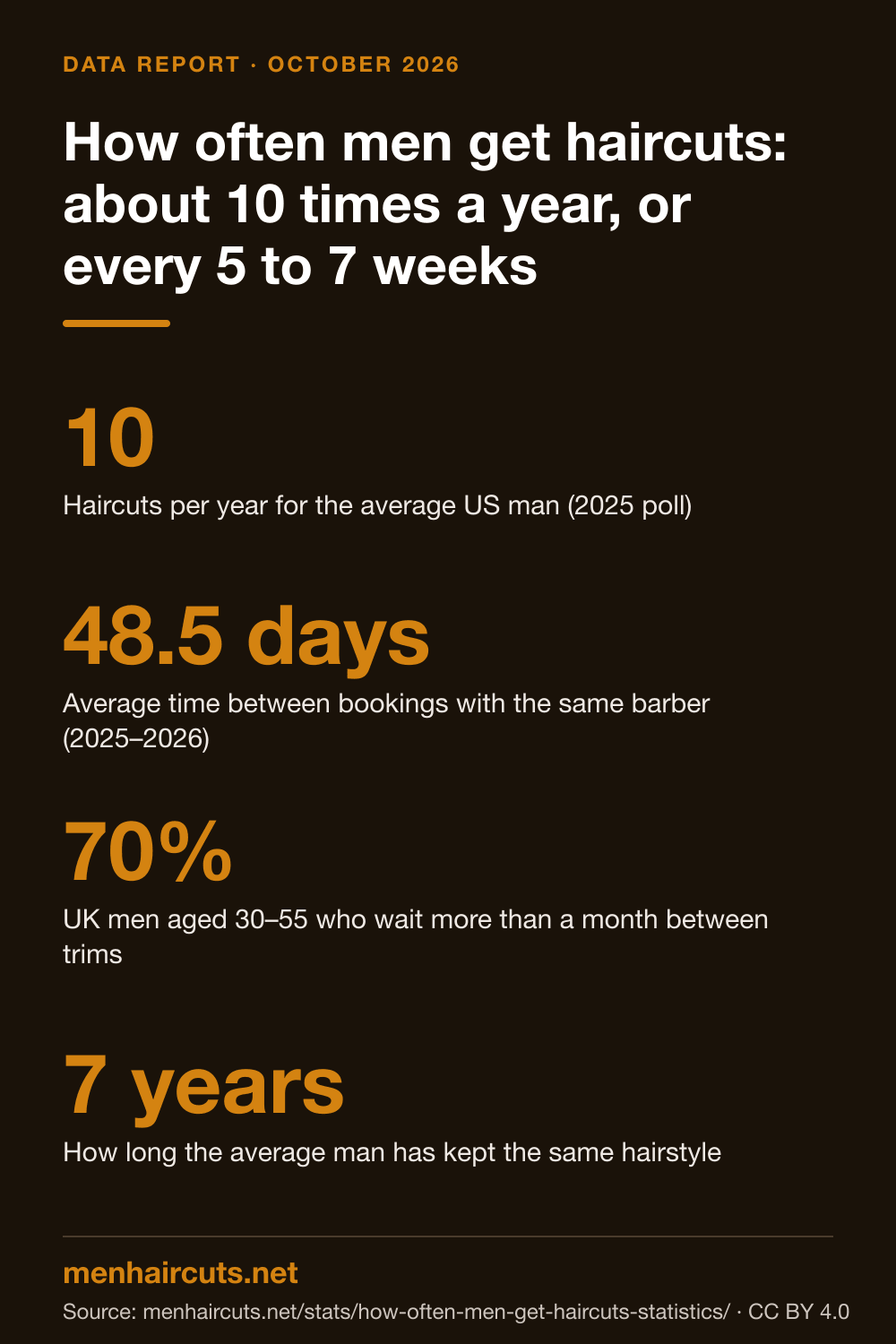
The average American man gets his hair cut 10 times a year, according to a 2025 Talker Research poll of 2,000 men for Sport Clips[1]. Booking data tells a similar story: across more than 7,000 SQUIRE barbershops, clients book with their barber every 48.5 days on average[2].

10
Haircuts per year for the average US man (2025 poll)[1]
48.5 days
Average time between bookings with the same barber (2025–2026)[2]
70%
UK men aged 30–55 who wait more than a month between trims[3]
7 years
How long the average man has kept the same hairstyle[1]
By Jessica Hamilton, Editor · Published · Updated · Free to reuse with credit (CC BY 4.0)
Key findings
- The average US man gets his hair cut 10 times a year, based on a July 2025 online poll of 2,000 men[1].
- SQUIRE's 2026 report, built on more than 13.9 million appointments at over 7,000 US barbershops, found that clients book with their barber every 48.5 days on average[2].
- Returning clients made up 44.6% of all barbershop visits on SQUIRE's platform, and the average barbershop haircut cost $43[2].
- In a YouGov poll of 2,100 UK men aged 30 to 55, 81% said they feel most confident in the two weeks after a haircut or beard trim, yet 70% leave more than a month between trims[3].
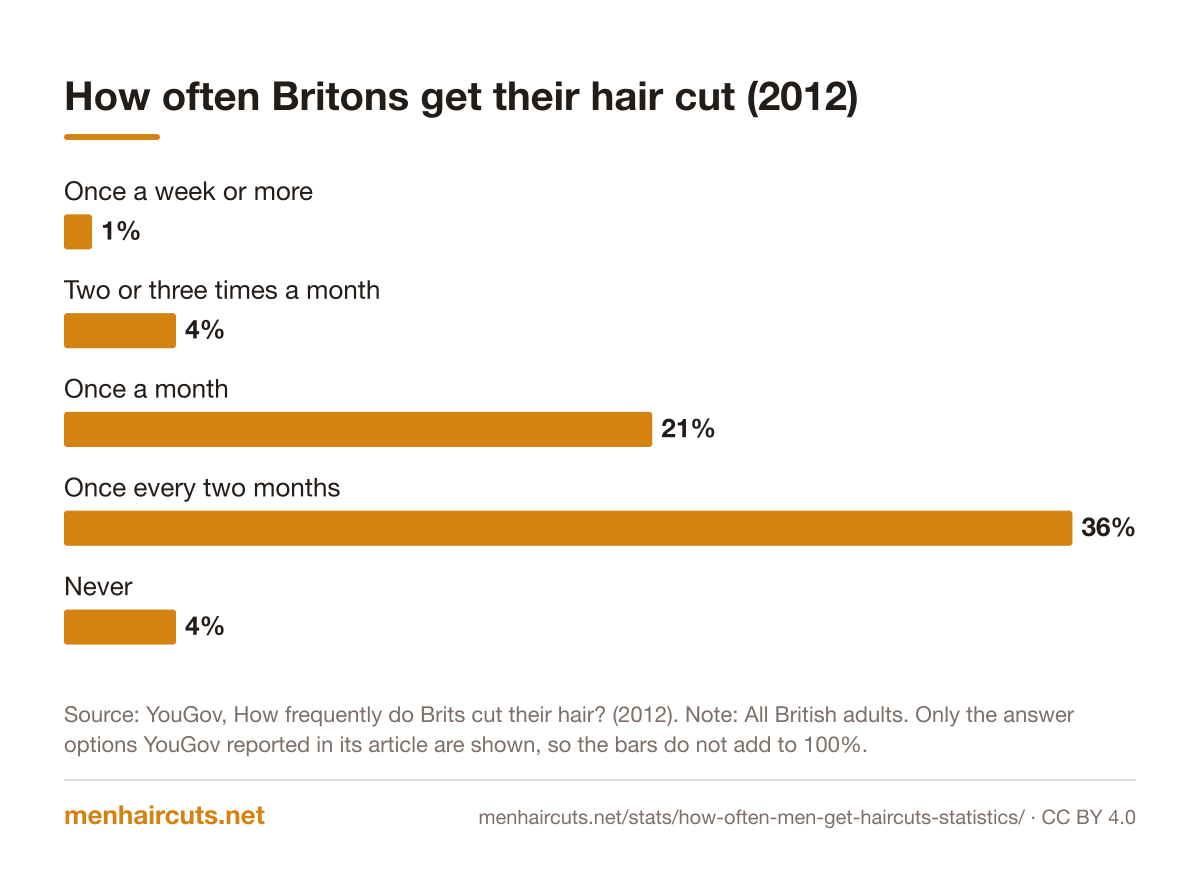
- In a 2012 YouGov poll, the most common UK answer was a haircut once every two months (36%), while 21% went once a month[4].
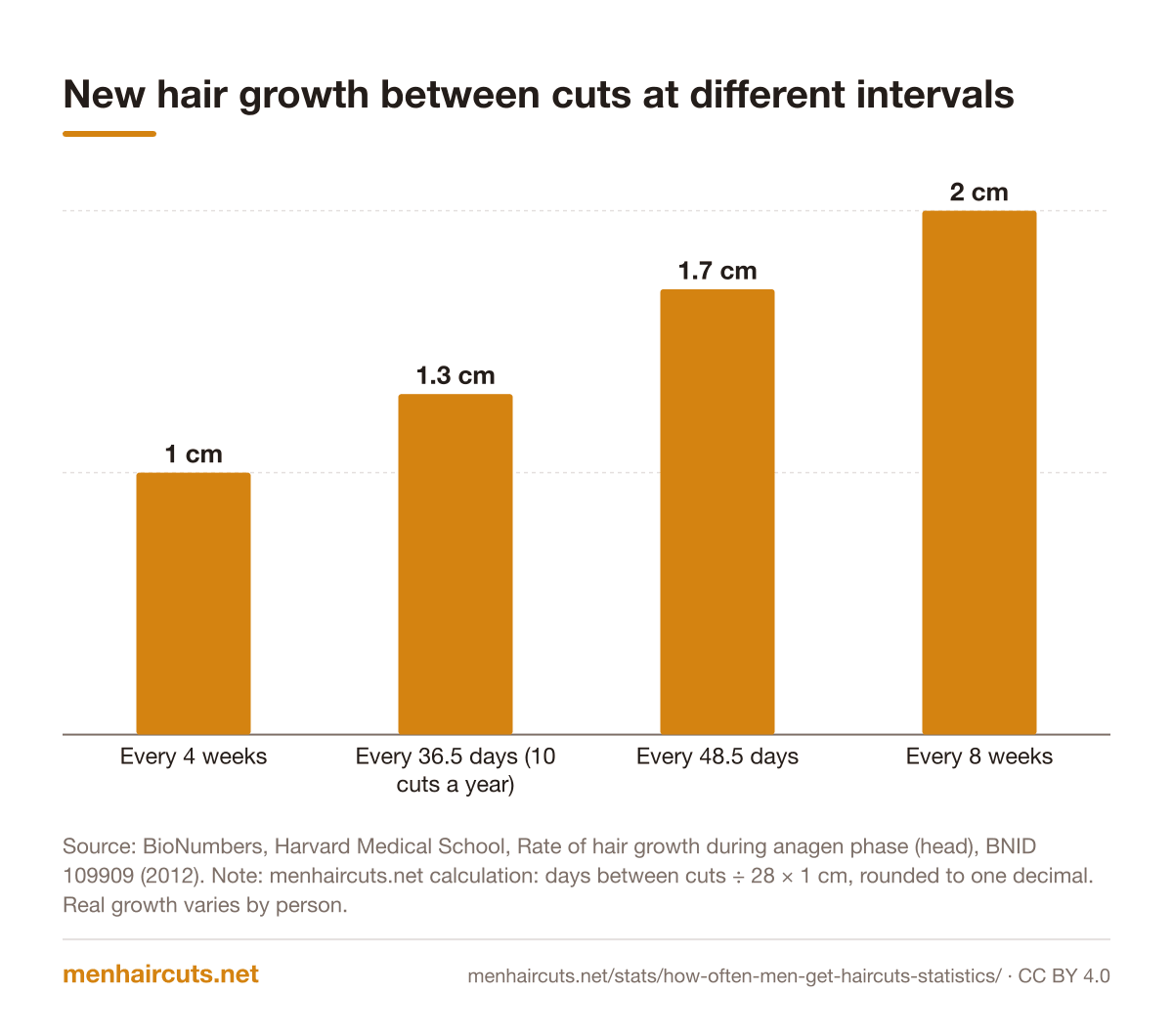
- Scalp hair grows about 1 cm every 28 days, so a man on a 48.5-day cycle sits down with roughly 1.7 cm of new growth (menhaircuts.net calculation)[5].
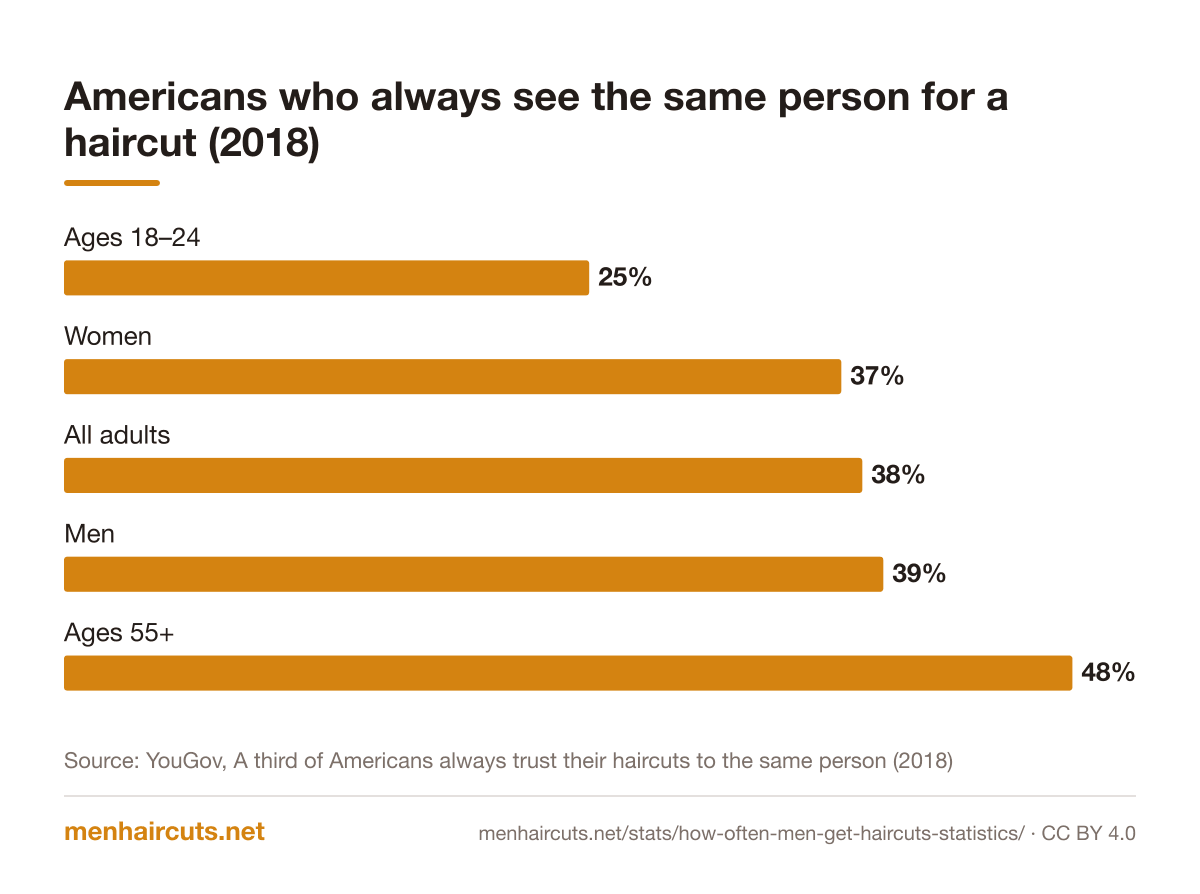
- 39% of American men "always" see the same person for a haircut, compared with 37% of women, in a 2018 YouGov Omnibus survey[6].
Download the infographic
The headline numbers from this report as one tall image (1000 x 1500 PNG), sized for Pinterest, slides and posts. Free to reuse with credit.
How often does the average man get a haircut?
The most recent direct answer comes from a Talker Research poll of 2,000 American men, commissioned by Sport Clips and conducted online from July 23 to July 28, 2025. It found that the average man gets his hair cut 10 times per year[1]. Spread evenly, that works out to one cut about every 5.2 weeks (52 weeks ÷ 10 cuts, menhaircuts.net calculation).
Booking data points to a slightly longer gap. SQUIRE, a barbershop booking and management platform, analyzed more than 13.9 million appointments at more than 7,000 US barbershops for its 2026 report and found that clients book with their barber every 48.5 days on average[2]. That is about 6.9 weeks, or roughly 7.5 bookings a year (365 ÷ 48.5, menhaircuts.net calculation).
The two numbers measure different things. The poll is self-reported and counts every haircut a man gets, wherever he gets it. The SQUIRE figure only sees repeat bookings at shops that use its software, so a man who splits visits between two shops, or who trims at home between appointments, looks less frequent in that data. Taken together, a reasonable reading is that a typical man gets a professional cut somewhere between every five and seven weeks.
In the table below, the gaps between cuts are menhaircuts.net calculations, and the SQUIRE row comes from the SQUIRE report as summarized by American Salon[2].
| Measure | Source and year | Result | Implied gap between cuts |
|---|---|---|---|
| Self-reported haircuts per year | Talker Research for Sport Clips, 2025 | 10 per year | About 5.2 weeks |
| Average time between bookings with a barber | SQUIRE State of Barbershops, 2025–2026 | 48.5 days | About 6.9 weeks |
How many days between barber visits is normal?
SQUIRE's report is the largest public data set on barbershop visit timing. It covers more than 7,000 shops in the US between 2025 and 2026, and its 48.5-day rebooking figure is an average across that platform[2]. The same report found that returning clients account for 44.6% of all barbershop visits, which means a little more than half of visits on the platform come from people who are not yet regulars at that shop[2].
The report treats rebooking speed as a sign of a healthy shop. Its summary says repeat behavior, not new customer acquisition, separates the top quartile of shops from the rest, and it names "faster rebook cycles" as one of the habits of those shops[2].
There is no single correct interval. Short, sharp styles such as skin fades lose their shape fastest, while longer cuts can go longer between visits. Barbers often teach this directly: in the 2025 Sport Clips poll, 37% of men said a stylist or barber had taught them how often to come in for a haircut[1].
How often do men in the UK get their hair cut?
UK polling shows a similar rhythm. In a 2012 YouGov survey of the British public, the most common answer was a haircut once every two months (36%). Another 21% said once a month, 4% said two or three times a month, 1% said once a week or more, and 4% said they never get their hair cut[4]. That poll covered all adults, not only men.
A more recent YouGov study, run for the clipper maker Wahl and published in January 2023, focused on 2,100 UK men aged 30 to 55. It found that 81% feel most confident in the two-week period after a haircut or beard trim, but 70% leave it for more than a month between trims[3]. In other words, most men in that age group spend a large share of each haircut cycle past the point where they feel their best.
Show the numbers
| Category | Value |
|---|---|
| Once a week or more | 1% |
| Two or three times a month | 4% |
| Once a month | 21% |
| Once every two months | 36% |
| Never | 4% |
Why do men need a haircut every few weeks?
Hair growth sets the clock. Scalp hair in its active growth phase grows about 1 cm every 28 days, and stays in that phase for 2 to 6 years, according to a pediatrics textbook entry collected in Harvard's BioNumbers database[5]. At any time, about 90% of scalp hairs are in that growth phase, based on a 2003 review in the Journal of the American Academy of Dermatology[7].
At that rate, a man who books every 48.5 days returns with roughly 1.7 cm of new growth (48.5 ÷ 28 × 1 cm), and a man on the poll average of 10 cuts a year returns with about 1.3 cm (36.5 days ÷ 28 × 1 cm). Both are menhaircuts.net calculations from the cited growth rate. On a clipper cut with a #1 or #2 guard, a centimeter or more of growth changes the outline noticeably, which is why short fades tend to need the most frequent visits.
Show the numbers
| Category | Value |
|---|---|
| Every 4 weeks | 1 cm |
| Every 36.5 days (10 cuts a year) | 1.3 cm |
| Every 48.5 days | 1.7 cm |
| Every 8 weeks | 2 cm |
Do men always go to the same barber?
Many do. In a 2018 YouGov Omnibus survey, 39% of American men and 37% of women said they "always" see the same person for a haircut. Men were more likely than women to say they "often" see the same stylist (25% vs 20%)[6].
Age matters more than gender. Nearly half of Americans over 55 (48%) said they always see the same barber, compared with a quarter of 18 to 24 year olds (25%)[6]. The 2025 Sport Clips poll found that 57% of men have a specific person they go to, and 74% said trust in their stylist or barber has a big impact on the haircut they end up with[1].
In the UK, a 2012 YouGov poll found that 69% of the public always get their hair cut by the same person and 29% use different hairdressers[4].
Show the numbers
| Category | Value |
|---|---|
| Ages 18–24 | 25% |
| Women | 37% |
| All adults | 38% |
| Men | 39% |
| Ages 55+ | 48% |
How much do men spend on haircuts in a year?
Frequency drives yearly cost. SQUIRE put the average US barbershop haircut at $43 in its 2026 report, ranging from $35 in the Midwest to $45 in the West[2]. Combining that price with the poll average of 10 cuts a year gives about $430 a year before tips ($43 × 10, menhaircuts.net calculation). The two inputs come from different sources and samples, so treat the result as a rough guide rather than a measured average.
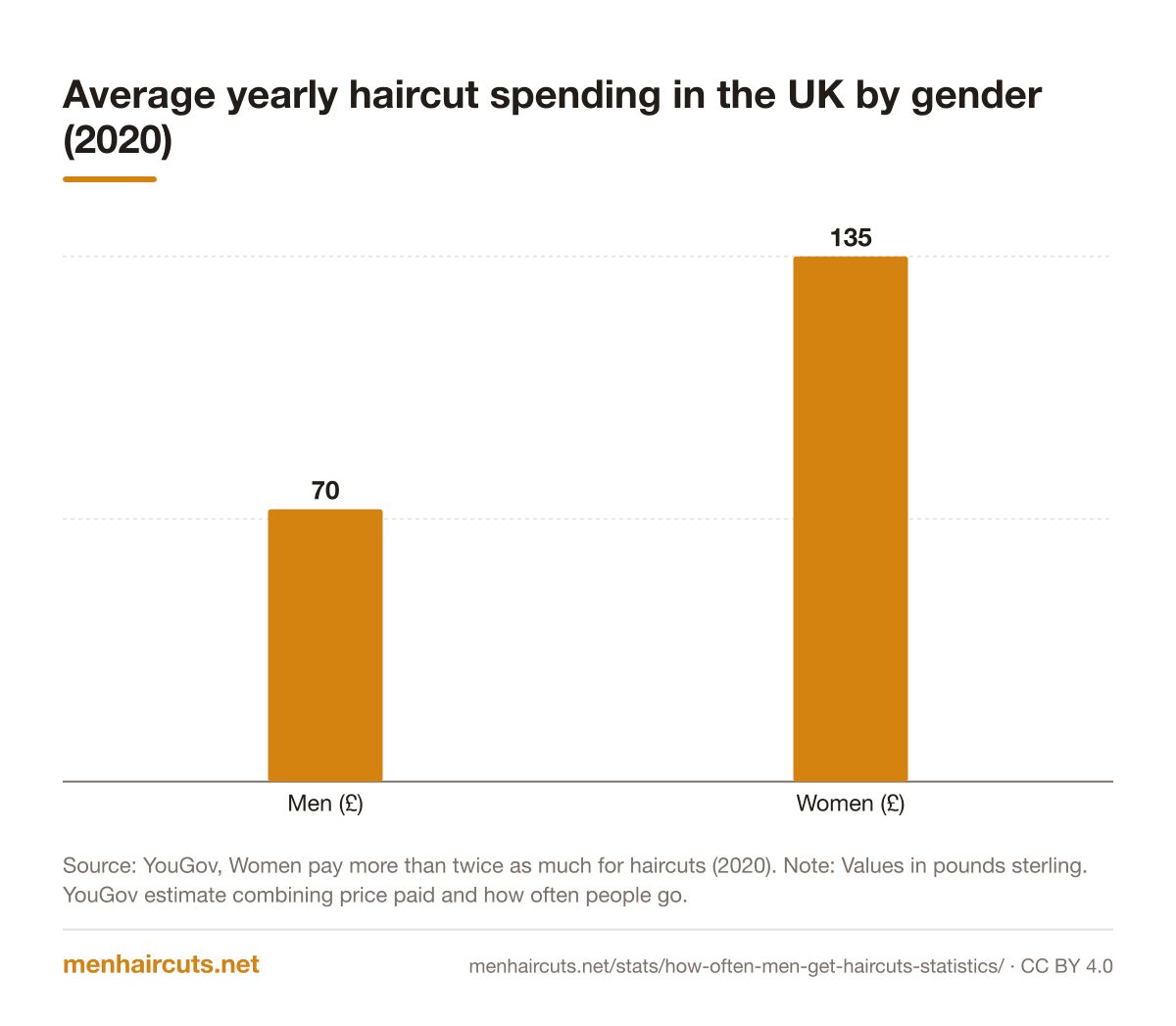
In the UK, YouGov estimated in July 2020 that men pay an average of £12.17 per haircut and about £70 a year once frequency is taken into account, compared with £135 a year for women[8]. Women in that analysis got their hair cut less often but paid far more per visit (£31.99 on average)[8].
Show the numbers
| Category | Value |
|---|---|
| Men (£) | 70 |
| Women (£) | 135 |
How did the pandemic change how often men got haircuts?
Lockdowns broke the usual cycle. A May 2021 OnePoll survey of 2,000 men for Sport Clips found that 75% went without professional hair maintenance during lockdowns and quarantines. One in four cut their own hair, 27% had a friend or family member do it, and 23% let it grow out[9]. About half had visited a barber since the pandemic began when they were surveyed[9].
YouGov polling in late May 2020 found that 38% of American men had their hair cut at home since lockdown began, compared with 18% of women[10]. Across eight countries in April 2020, Kantar found Americans the least willing to wait: only 44% of US respondents said they would hold off until they could see their own hairdresser[11]. Our separate report on DIY haircuts covers home cutting in more detail.
How long do men keep the same hairstyle?
Men change their haircut far less often than they get one. The 2025 Sport Clips poll found that the average man has kept the same hairstyle for seven years, 84% feel confident with their current style, and 55% have never considered changing it[1].
Nerves play a part. In the same poll, 21% said they feel nervous asking a barber for a new style, 23% had been afraid to ask for a specific cut, and 17% had asked for a watered-down version of what they wanted[1]. Bringing a photo helps: 36% said showing a reference picture had worked, and 88% of those said the barber matched it[1].
Frequently asked questions
How often does the average man get a haircut?
How many days between haircuts is average?
How often should men with a fade get a haircut?
What percentage of men always use the same barber?
How much does a man spend on haircuts per year?
Methodology and limitations
We compiled this page from published survey and booking data and opened each source to confirm the figures. The headline frequency comes from a July 2025 Talker Research online poll of 2,000 US men commissioned by Sport Clips. Visit-timing data comes from SQUIRE's 2026 State of Barbershops report (more than 13.9 million appointments at more than 7,000 US shops, 2025–2026) as summarized by American Salon, because the report page itself could not be opened. UK figures come from YouGov polls published in 2012, 2020 and 2023. Hair growth rates come from Harvard's BioNumbers database, which quotes the original textbook and journal sources. Calculations labeled "menhaircuts.net calculation" use only the cited inputs and show the formula.
Limitations
There is no recent government survey of haircut frequency in the US, so the headline figures come from a commissioned poll and from one booking platform's customers. The poll is self-reported and was paid for by a haircut chain. SQUIRE's data only covers shops that use its software and only counts bookings made through it. The UK frequency question dates from 2012 and covered all adults, not only men. Spending estimates that combine sources are approximate. We left out a widely quoted 2015 trade study on weeks between haircuts because its original page is no longer available to check.
Every figure on this page links to its source. Numbers are reported as published; any menhaircuts.net calculation is labelled and shows its inputs. Spotted an error? Tell us and we will check it.
Sources
- How men can overcome their haircut anxiety, Talker Research (commissioned by Sport Clips) (2025). Accessed October 15, 2026.
- The Top 3 Takeaways from SQUIRE's New Barbershop Data, American Salon (reporting SQUIRE's 2026 State of the Barbershop Industry Report) (2026). Accessed October 15, 2026.
- 70% of men have a lack of confidence in everyday life because of their hair, Modern Barber (reporting YouGov research for Wahl) (2023). Accessed October 15, 2026.
- How frequently do Brits cut their hair?, YouGov (2012). Accessed October 15, 2026.
- Rate of hair growth during anagen phase (head), BNID 109909, BioNumbers, Harvard Medical School (2012). Accessed October 15, 2026.
- A third of Americans always trust their haircuts to the same person, YouGov (2018). Accessed October 15, 2026.
- Fraction of scalp hairs in anagen, catagen and telogen phases, BNID 114256 (citing Wolfram, J Am Acad Dermatol 2003), BioNumbers, Harvard Medical School (2003). Accessed October 15, 2026.
- Women pay more than twice as much for haircuts, YouGov (2020). Accessed October 15, 2026.
- Return of the mullet? 1 in 5 men want to bring back the hairdo, StudyFinds (reporting a OnePoll survey for Sport Clips) (2021). Accessed October 15, 2026.
- Many Americans are cutting their hair at home during the pandemic, YouGov (2020). Accessed October 15, 2026.
- How is COVID-19 affecting our hair?, Kantar (2020). Accessed October 15, 2026.
Cite, embed and download
This report, its charts and its infographic are free to reuse under a Creative Commons Attribution 4.0 license. Credit menhaircuts.net with a link to this page.
Cite this report (APA)
Hamilton, J. (2026, October 15). How Often Men Get Haircuts: 2026 Statistics. menhaircuts.net. https://menhaircuts.net/stats/how-often-men-get-haircuts-statistics/
Link to this report
<a href="https://menhaircuts.net/stats/how-often-men-get-haircuts-statistics/">How Often Men Get Haircuts: 2026 Statistics</a> (menhaircuts.net, CC BY 4.0)Share the headline number
10: Haircuts per year for the average US man (2025 poll) (Talker Research (commissioned by Sport Clips), via menhaircuts.net/stats/how-often-men-get-haircuts-statistics/)
Download the charts and infographic
Related data
- 36%US men who always or usually get their hair cut at home (2024)DIY Haircut Statistics 2026
- $21,130Lifetime haircut cost at $43 a cut, 7 cuts a year and a 20% tip (menhaircuts.net calculation)Lifetime Cost of Men's Haircuts 2026
- ~2 in 3Barbershop bookings made by clients through self-serviceBarbershop Booking Statistics 2026
- $29Average men's haircut in the US, StyleSeat stylist data (page updated 2026)Men's Haircut Prices by State 2026
Related guides
Make us a Preferred Source on Google
See our latest articles first in your Google Search & AI Overviews.