
Data report · Updated October 2026
Facial hair dress code statistics: 64% of Air Force shaving waivers held by Black airmen
Beard and mustache rules in the US and UK military, pro sports and the workplace, with the numbers behind them.
In a US Air Force study of 10,383 male airmen, 64.18% of those with shaving waivers were Black, though Black airmen were 12.85% of the sample, and waivers were linked to slower promotion[1]. In 2025 the Pentagon set a one-year limit on medical shaving waivers before separation[2]. Thirty states have passed CROWN Act hair laws[3].
64.18%
of US Air Force shaving waiver holders in a 2021 study were Black (12.85% of the sample)[1]
1 year
limit on medical shaving waivers before separation, under an August 2025 Pentagon memo[2]
30
US states that have passed a version of the CROWN Act[3]
54%
of British men say they have some form of facial hair, 2023 (37% in 2011)[4]
By Jessica Hamilton, Editor · Published · Updated · Free to reuse with credit (CC BY 4.0)
Key findings
- An August 20, 2025 memo from Defense Secretary Pete Hegseth set a clean-shaven standard and said troops who still need a shaving waiver after more than a year of medical treatment will face separation[2].
- Army regulation AR 670-1 requires male soldiers to be clean-shaven in uniform, allows trimmed mustaches, and caps sideburn hairs at 1/8 inch[5].
- In a study of 10,383 male US airmen, shaving waivers were linked to a longer time to promotion, and 64.18% of the waiver group was Black against 12.85% of the cohort[1].
- The British Army lifted its beard ban in March 2024, allowing beards between 2.5 mm and 25.5 mm; the RAF had allowed beards since 2019[6].
- The New York Yankees amended their 1970s-era facial hair policy on February 21, 2025 to allow well-groomed beards[7].
- Thirty states have passed a version of the CROWN Act banning discrimination based on hair texture and protective styles[3].
- 54% of British men say they have some form of facial hair, up from 42% in 2016 and 37% in 2011[4].
- Seven in ten American men have had facial hair at some point, according to an Economist/YouGov poll[8].
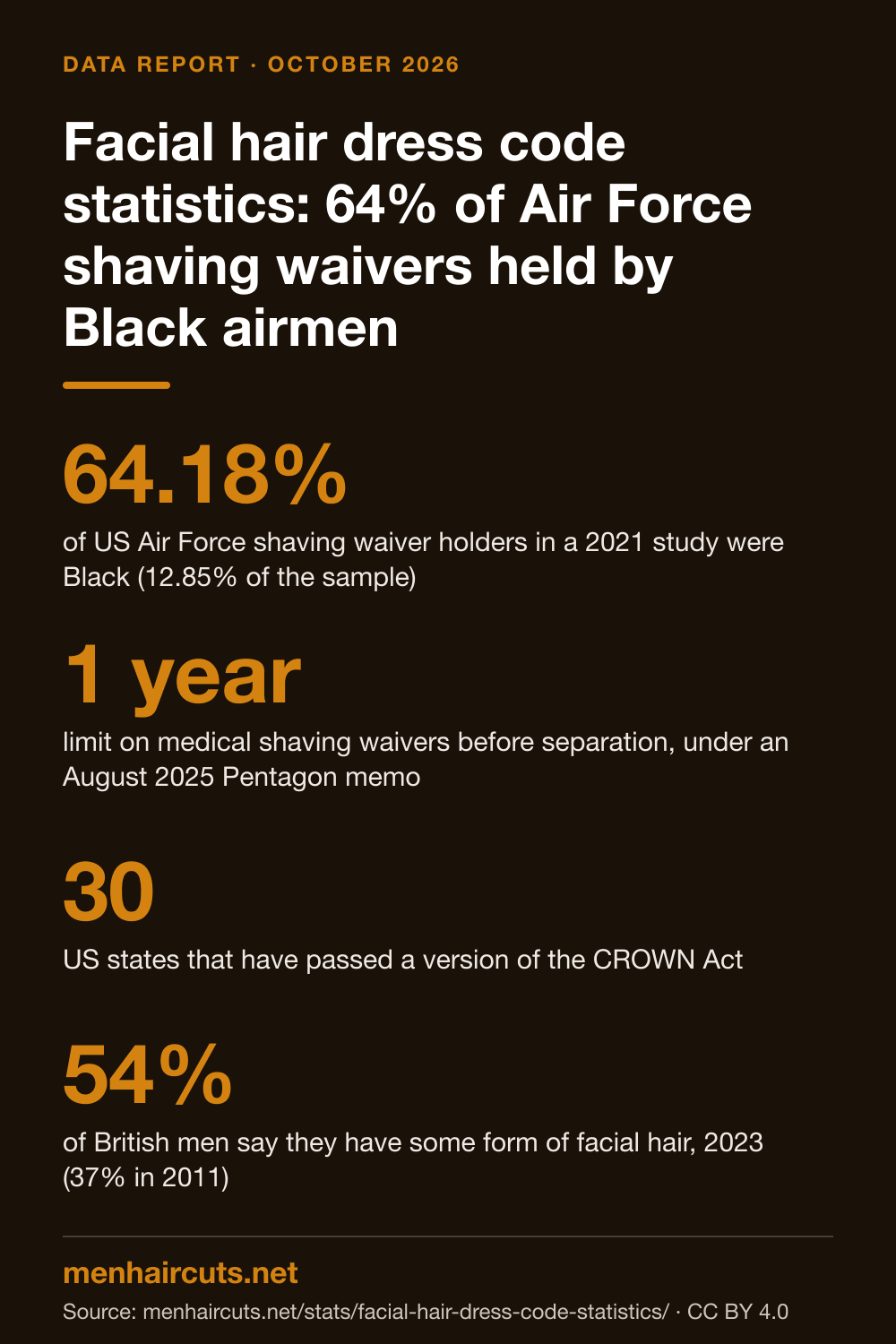
Download the infographic
The headline numbers from this report as one tall image (1000 x 1500 PNG), sized for Pinterest, slides and posts. Free to reuse with credit.
Can you have a beard in the US military in 2026?
In most cases, no. A memo from Defense Secretary Pete Hegseth dated August 20, 2025 and made public in September states that the grooming standard set by the US military is to be clean shaven and neat in presentation[2].
Commanders can still approve medical shaving waivers, but each now has to come with a medical treatment plan, and troops who still need a waiver after more than a year of treatment will be separated from service[2]. Military.com reported that it was unclear whether broad shaving exemptions for special forces in operational settings, or for soldiers in Alaska's Arctic climate, would be affected[9].
Most shaving waivers are for pseudofolliculitis barbae (PFB), a condition in which shaved hairs curl back into the skin, and which disproportionately affects Black men[2]. A January 2026 review in the journal Cutis noted that the revised policies bring shorter waiver durations and more frequent medical evaluations[10].
For the haircut side of the rules, see our military haircut grooming standards guide.
What does Army regulation AR 670-1 say about facial hair?
The Army's appearance regulation, AR 670-1 (26 January 2021 edition), requires male soldiers to keep the face clean-shaven when in uniform or in civilian clothes on duty[5]. Mustaches are allowed if neatly trimmed and tapered, but they may not cover the upper lip line or extend sideways past the corners of the mouth[5].
Handlebar mustaches, goatees and beards are not authorized[5]. Sideburns may not extend below the bottom of the ear opening, and individual sideburn hairs may not exceed 1/8 inch when fully extended[5].
When a medical authority allows beard growth, the length must be specified, with the regulation giving 1/4 inch as an example[5]. Soldiers with an approved religious accommodation may wear a beard up to 2 inches long measured from the bottom of the chin, rolled or tied if longer[5].
| Rule | Limit |
|---|---|
| Default standard | Clean-shaven in uniform or on duty |
| Mustache | Allowed; may not cover upper lip line or pass mouth corners |
| Goatees, handlebar mustaches, beards | Not authorized |
| Sideburn length | No lower than bottom of ear opening; hairs max 1/8 inch |
| Medical beard | Length set by medical authority (example: 1/4 inch) |
| Religious accommodation beard | Max 2 inches from bottom of chin |
Do shaving waivers hurt military careers?
A US Air Force study suggests they can. Researchers emailed 51,703 male airmen at 12 randomly selected bases and received 10,383 complete responses, a 20.08% response rate[1].
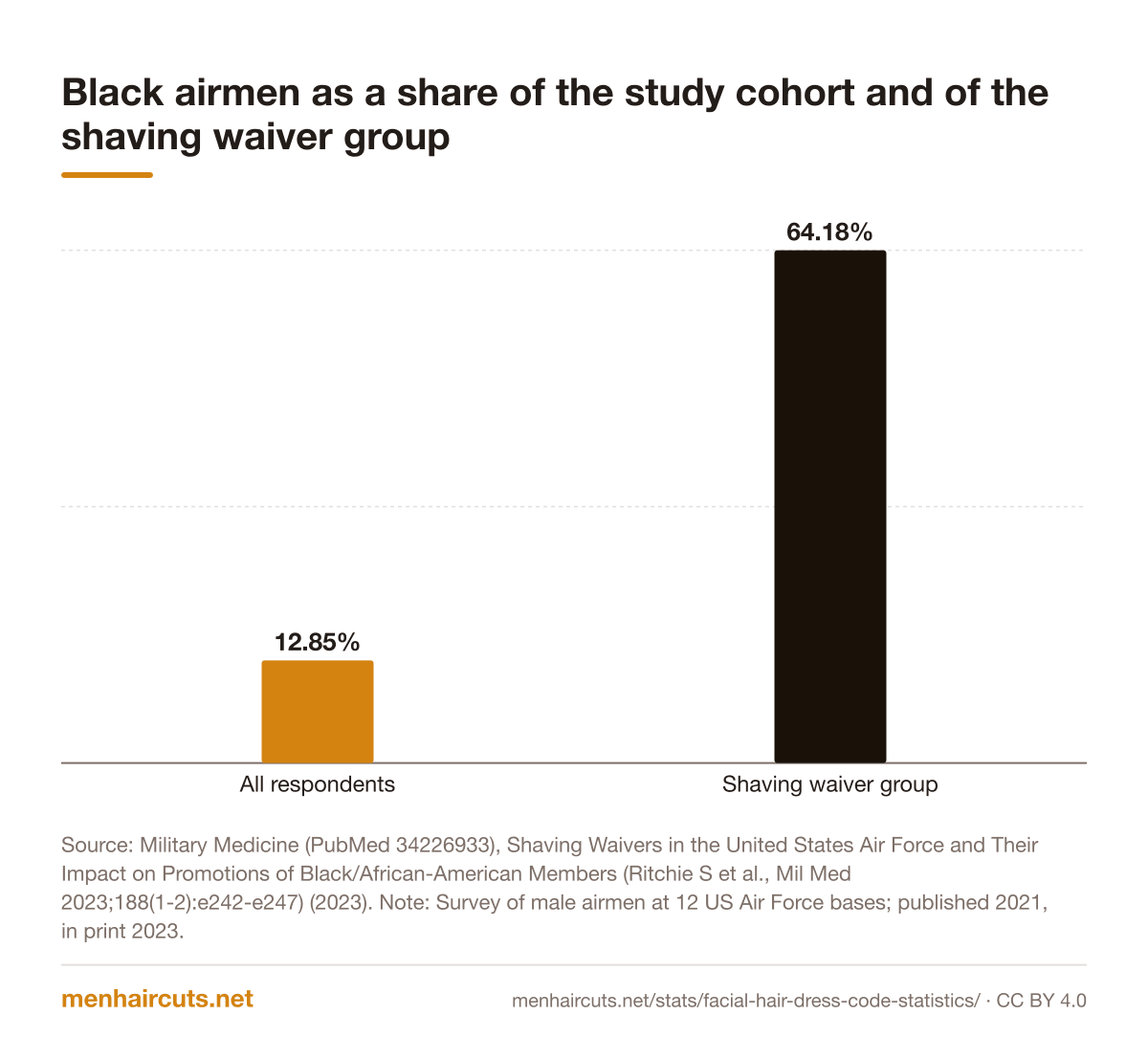
After controlling for rank, race, education, professional military education and disciplinary action, shaving waivers were associated with a longer time to promotion[1]. The effect was similar across races, but the waiver group was heavily skewed: 64.18% of airmen with waivers were Black, while Black airmen made up 12.85% of the study cohort[1].
That means Black airmen were about five times as common in the waiver group as in the sample overall (menhaircuts.net calculation: 64.18 / 12.85 = 5.0). The authors concluded this may produce a racially discriminatory effect of the grooming standards[1].
Why does the military require men to shave?
The main stated reason is protective equipment. A 2023 review of military PFB policy explains that a beard can prevent a proper seal on breathing protection such as gas masks or N95 respirators[11].
The rule is old. A 2021 review in Military Medicine traces enforced shaving back to World War I, when it was meant to support hygiene and discipline and to make sure gas masks would seal in a chemical attack[12]. The same review notes that the Navy had discontinued permanent shaving restrictions because of concerns about gas mask fit[12].
Shaving is hard on men with PFB. If you deal with razor bumps on the neck and jaw, our razor bump prevention guide covers practical steps.
Which UK armed forces allow beards?
All three now do. The British Army lifted its long-standing beard ban in March 2024, ending a rule that had lasted about a century[6]. Before that, only a few roles, such as Pioneer Sergeant and Bugle Major, could wear beards[6].
Under the new rules, an Army beard must be between Grade 1 (2.5 mm) and Grade 8 (25.5 mm) in length and must look neat within two weeks of a soldier announcing the intent to grow one[6].
The Royal Air Force allowed beards in 2019, and the Royal Navy has allowed full beards and mustaches for many years[6].
| Service | Beards allowed since | Notes |
|---|---|---|
| Royal Navy | Many years | Full beard with mustache |
| Royal Air Force | 2019 | |
| British Army | March 2024 | Length 2.5 mm to 25.5 mm |
Do pro sports teams ban beards?
The best-known example ended in 2025. On February 21, 2025, the New York Yankees amended their facial hair policy to allow players and uniformed staff to have well-groomed beards[7].
The old rule dated to the 1970s under owner George Steinbrenner and allowed only mustaches, with an exception for religious reasons; scalp hair also could not grow below the collar[7]. Owner Hal Steinbrenner said it was 'the appropriate time to move beyond the familiar comfort of our former policy'[7].
For cuts that work under helmets and caps, see our guide to the best haircuts for athletes.
Can employers ban certain hairstyles or beards?
Hair texture and protective styles are protected in a growing number of states. The CROWN Act campaign reports that 30 states have passed a version of the law[3]. The laws target discrimination based on hair texture and protective hairstyles.
A federal CROWN Act was reintroduced on February 26, 2025 as H.R. 1638 in the House and S. 751 in the Senate[3]. An earlier version passed the House by a vote of 235 to 189 but did not become law[3].
The CROWN Act deals with scalp hair texture and styles rather than beards. Requests to keep a beard at work are more often framed as religious or medical accommodations, the same two grounds the military recognizes in its own exceptions.
How many men have facial hair?
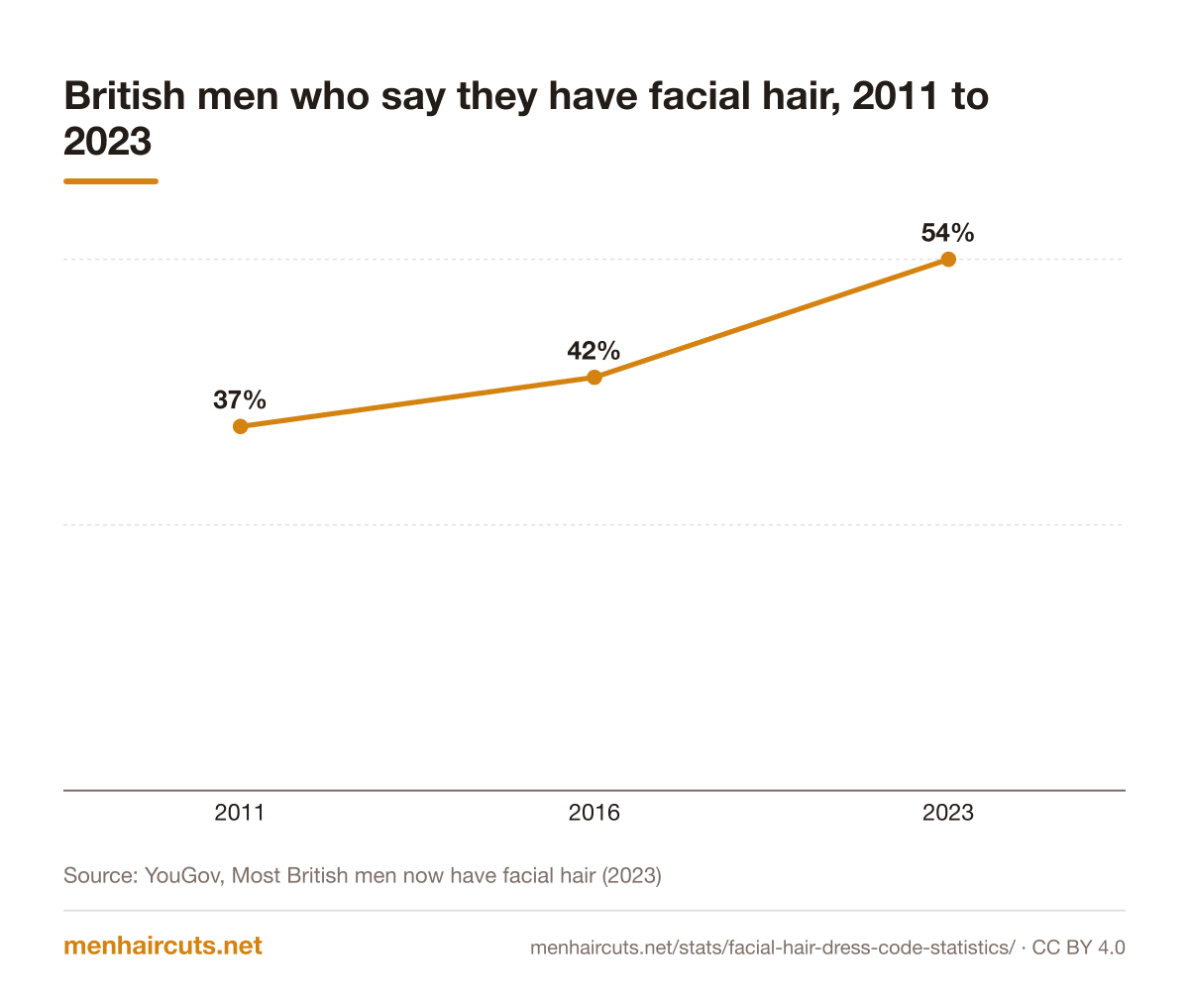
In Britain, 54% of men told YouGov in 2023 that they have some form of facial hair, up from 42% in 2016 and 37% in 2011[4]. Among men aged 18 to 39, the figure was 69%[4]. A beard with a mustache was the most common style at 34%, followed by stubble at 13%[4].
Attitudes shifted too. In 2011, 66% of British women preferred men without beards; by 2023 that was 36%, while 19% preferred a beard and 44% had no preference[4].
US data are older. An Economist/YouGov poll found that seven in ten American men have sported facial hair at some point[8], and a 2014 YouGov poll found 47% of Americans find men with well-kept beards attractive, including 62% of women[13]. Our beard grooming guide covers keeping a beard within workplace standards.
Show the numbers
| Category | Value |
|---|---|
| 2011 | 37% |
| 2016 | 42% |
| 2023 | 54% |
| Style | Share of men |
|---|---|
| Beard and mustache | 34% |
| Stubble | 13% |
| Beard only | 4% |
| Mustache only | 2% |
| Any facial hair | 54% |
Frequently asked questions
Can you have a beard in the US Army?
How long can a military shaving waiver last?
Are mustaches allowed in the Army?
When did the British Army allow beards?
Do the Yankees still ban beards?
How many states have a CROWN Act?
What percentage of men have beards?
Methodology and limitations
This report combines official rules, peer-reviewed research and published polls. Military rules come from Army Regulation 670-1 (26 January 2021 edition) and from Associated Press and Military.com reporting on the Defense Secretary's August 20, 2025 grooming memo. Shaving waiver data come from a peer-reviewed survey of male US Air Force members (Military Medicine). UK military rules come from Forces News (March 29, 2024). Sports policy comes from MLB.com. State law counts come from the CROWN Act campaign website. Facial hair prevalence comes from YouGov (UK 2023; US 2014 and 2018). Ratios are menhaircuts.net calculations. Sources accessed October 15, 2026.
Limitations
Military grooming rules change by memo and service directive; this report reflects the AR 670-1 edition dated 26 January 2021 and press reporting on the August 2025 memo, and service-level updates since then may add detail. The Air Force waiver study is a survey with a 20.08% response rate and shows an association, not proof that waivers cause slower promotion. Sports policies are set team by team and are rarely published in full. CROWN Act counts differ between trackers depending on whether limited laws (for example, school-only laws) are included. Facial hair prevalence data are from Britain (2023) and older US polls; no recent national US survey of current beard wearing was available to verify.
Every figure on this page links to its source. Numbers are reported as published; any menhaircuts.net calculation is labelled and shows its inputs. Spotted an error? Tell us and we will check it.
Sources
- Shaving Waivers in the United States Air Force and Their Impact on Promotions of Black/African-American Members (Ritchie S et al., Mil Med 2023;188(1-2):e242-e247), Military Medicine (PubMed 34226933) (2023). Accessed October 15, 2026.
- Pentagon says troops can only be exempt from shaving their facial hair for a year (Associated Press), KWTX / Associated Press (2025). Accessed October 15, 2026.
- About the CROWN Act, The CROWN Act / CROWN Coalition (2026). Accessed October 15, 2026.
- Most British men now have facial hair, YouGov (2023). Accessed October 15, 2026.
- Army Regulation 670-1: Wear and Appearance of Army Uniforms and Insignia (26 January 2021), Headquarters, Department of the Army (2021). Accessed October 15, 2026.
- Army lifts 100-year ban on serving soldiers having beards after royal appointment, Forces News (2024). Accessed October 15, 2026.
- Yanks amend longstanding facial hair policy, to allow 'well-groomed beards', MLB.com (2025). Accessed October 15, 2026.
- Americans aren't sure about John Bolton and his mustache (Economist/YouGov poll), YouGov (2018). Accessed October 15, 2026.
- Pentagon Says Troops Can Only Be Exempt from Shaving Their Facial Hair for a Year, Military.com (2025). Accessed October 15, 2026.
- Military Grooming Policy Changes Affecting Service Members With Pseudofolliculitis Barbae (Devine M et al., Cutis 2026;117(1):6-9), Cutis (PubMed 41839013) (2026). Accessed October 15, 2026.
- Treatment and Current Policies on Pseudofolliculitis Barbae in the US Military (Jung I et al., Cutis 2023;112(6):299-302), Cutis (PubMed 38290080) (2023). Accessed October 15, 2026.
- Pseudofolliculitis Barbae in the U.S. Military, a Review (Tshudy MT, Cho S. Mil Med 2021;186(1-2):e52-e57), Military Medicine (PubMed 33128565) (2021). Accessed October 15, 2026.
- Peak beard, YouGov (2014). Accessed October 15, 2026.
Cite, embed and download
This report, its charts and its infographic are free to reuse under a Creative Commons Attribution 4.0 license. Credit menhaircuts.net with a link to this page.
Cite this report (APA)
Hamilton, J. (2026, October 15). Facial Hair Dress Code Statistics 2026: Beard Rules. menhaircuts.net. https://menhaircuts.net/stats/facial-hair-dress-code-statistics/
Link to this report
<a href="https://menhaircuts.net/stats/facial-hair-dress-code-statistics/">Facial Hair Dress Code Statistics 2026: Beard Rules</a> (menhaircuts.net, CC BY 4.0)Share the headline number
64.18%: of US Air Force shaving waiver holders in a 2021 study were Black (12.85% of the sample) (Military Medicine (PubMed 34226933), via menhaircuts.net/stats/facial-hair-dress-code-statistics/)
Download the charts and infographic
Related data
- 54%of British men had some facial hair in 2023 (37% in 2011)Beard Statistics 2026
- 29.0%Share of US barbers who are Black (2025 annual average)Black Men's Haircut Statistics 2026
- 100 msExposure time enough for people to judge a face's trustworthiness or competence (2006 study)Grooming and First Impressions Statistics 2026
- 34.8 minaverage daily grooming time for US men in 2025 (0.58 hours; women 0.77 hours)Men's Grooming Routine Statistics 2026
Related guides
Make us a Preferred Source on Google
See our latest articles first in your Google Search & AI Overviews.