
Data report · Updated October 2026
Gray hair statistics: 74% of adults aged 45–65 have some gray hair
When graying starts, how fast it spreads, why men gray earlier than women, and what research says about genes, smoking and stress.
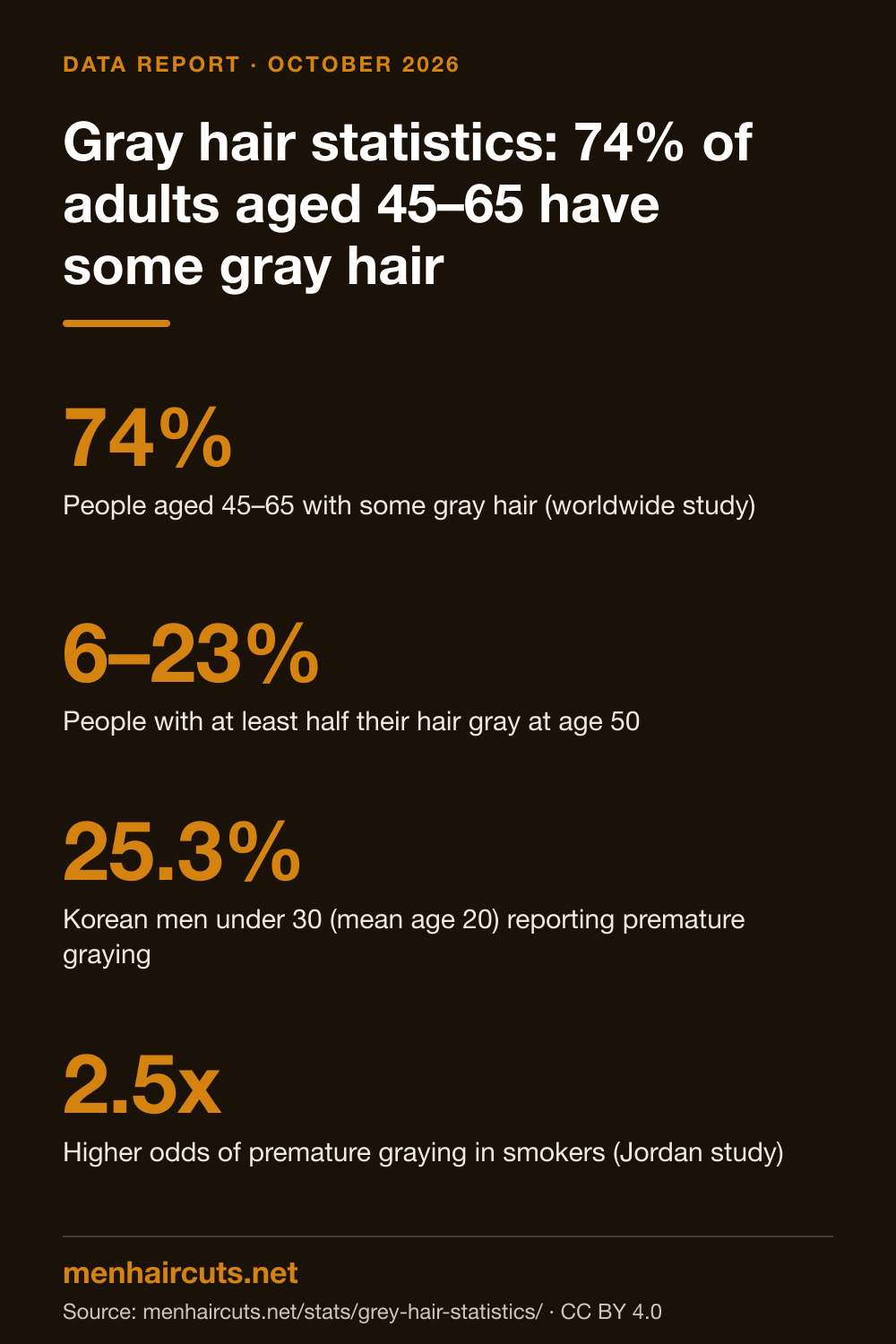
In a worldwide study of 4,192 adults, 74% of people aged 45–65 had gray hair, covering 27% of the head on average, and men had more than women[1]. Graying often begins in the 30s[2]. In a survey of 6,390 young Korean men, 25.3% reported premature graying[3].
74%
People aged 45–65 with some gray hair (worldwide study)[1]
6–23%
People with at least half their hair gray at age 50[1]
25.3%
Korean men under 30 (mean age 20) reporting premature graying[3]
2.5x
Higher odds of premature graying in smokers (Jordan study)[4]
By Jessica Hamilton, Editor · Published · Updated · Free to reuse with credit (CC BY 4.0)
Key findings
- Between ages 45 and 65, 74% of people had gray hair, with gray covering 27% of the hair on average, in a study of 4,192 volunteers worldwide[1].
- The '50/50/50' rule is a myth: only 6–23% of people have at least 50% gray hair at age 50, depending on ethnic origin and natural hair color[1].
- Men had significantly more gray hair than women of the same age[1].
- Of 6,390 Korean men with a mean age of 20.2, 25.3% reported premature graying; family history raised the odds about 12.8 times and obesity 2.6 times[3].
- In a Jordanian study, smokers were 2.5 times more likely to go gray before 30, and their graying began at an average age of 31 versus 34 for non-smokers[4].
- IRF4 was the first gene shown to be associated with hair graying, in a 2016 study of more than 6,000 Latin Americans[5].
- Some gray hairs can regain color: a 2021 study tracked hairs that grayed and then darkened again in step with changes in reported stress[6].
Download the infographic
The headline numbers from this report as one tall image (1000 x 1500 PNG), sized for Pinterest, slides and posts. Free to reuse with credit.
At what age do men start going gray?
For most people, the first gray hairs (spelled grey in the UK) appear in early middle age. MedlinePlus, the US National Library of Medicine's health encyclopedia, says graying often begins in the 30s, usually starting at the temples and spreading to the top of the scalp[2]. Body and facial hair tend to gray later than scalp hair[2].
The biggest worldwide study of graying, published in the British Journal of Dermatology in 2012, assessed the natural hair color of 4,192 healthy men and women against standard color swatches. Between ages 45 and 65, 74% of people had gray hair, and the average share of gray on the head was 27%[1].
Graying happens because hair follicles make less of the pigment melanin with age[2]. The hair shaft itself does not change color once it has grown; new hairs simply come in with less pigment.
Is the 50/50/50 rule about gray hair true?
No. The old rule of thumb says that by age 50, 50% of people have at least 50% gray hair. The 2012 worldwide study tested it directly and found that the share of people with at least half their hair gray at 50 ranges from only 6% to 23%, depending on ethnic or geographic origin and natural hair color[1].
So most 50-year-olds have some gray, but only a minority are mostly gray. That matches what barbers see: salt and pepper is far more common at 50 than a full head of silver.
Do men go gray faster than women?
Yes, on average. In the worldwide study, men had significantly more gray hair than women at comparable ages[1].
Facial hair follows its own schedule. MedlinePlus notes that body and facial hair also turn gray, but most often later than scalp hair[2]. Many men see a few gray beard hairs before their scalp changes much, but there is no large study measuring that order, so treat it as observation rather than data.
Does ethnicity affect when hair turns gray?
It does. Both the age at which graying starts and how fast it spreads were clearly linked to ethnic and geographic origin in the 2012 study. People of Asian and African descent had less gray hair than people of white European origin at the same ages[1]. MedlinePlus says the same: gray hair tends to appear earlier in white people and later in Asians[2].
Natural hair color plays a part in how visible graying is. The 6–23% range for being half gray at 50 varied with both ethnic origin and natural color[1], and a few gray hairs are far easier to spot in dark hair than in light brown or blond hair.
How common is premature gray hair in young men?
More common than many men assume. Definitions vary: some studies count graying that starts before 20, others before 30. In a 2015 study in the Journal of the American Academy of Dermatology, 6,390 Korean men under 30, with a mean age of 20.2, answered questions about gray hair. Of these, 1,618 (25.3%) reported premature graying[3].
A 2026 study of 239 medical students in Saudi Arabia, mean age 22.9, found premature graying in 37.2%. It was associated with smoking, ketogenic diets, hair coloring and a family history of early graying[7]. In an Indian clinic study of 52 patients whose graying began before age 20, the average age of onset was 11.6 years[8].
| Measure | Result |
|---|---|
| Average age when graying began | 11.6 years |
| Front of the scalp affected first | 48.1% |
| Family history of premature graying | 75% |
| A parent, sibling or child also affected | 55.8% |
Does smoking cause gray hair?
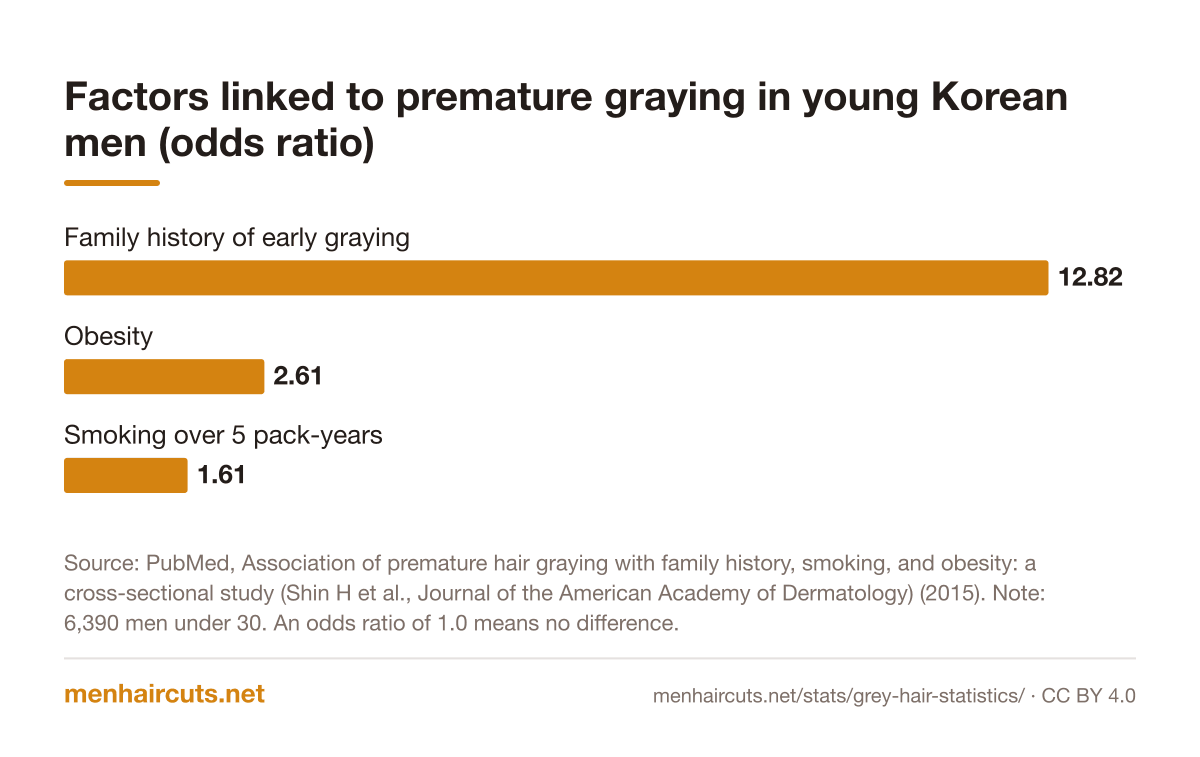
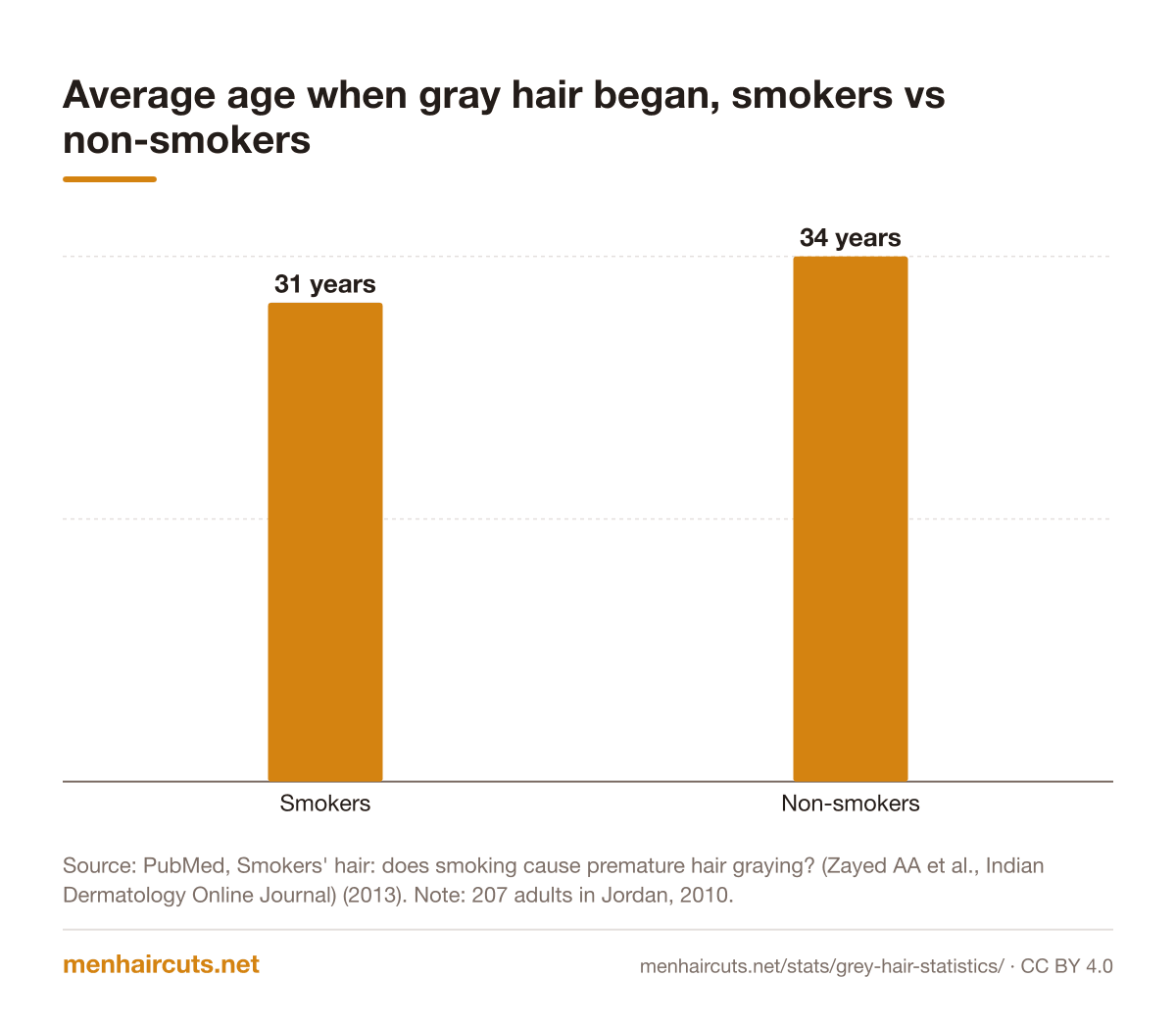
Smoking is linked to earlier graying in several studies, though they show association rather than proof. In the Korean study, more than 5 pack-years of smoking raised the odds of premature graying by 1.61 times[3]. A 2013 study of 207 adults in Jordan defined premature graying as gray hair appearing before 30 and found smokers were 2.5 times more likely to have it. Smokers' graying began at an average age of 31, compared with 34 in non-smokers[4].
Obesity also stood out. Korean men who were obese had 2.61 times the odds of premature graying, and obesity was linked with more severe graying[3].
Show the numbers
| Category | Value |
|---|---|
| Family history of early graying | 12.82 |
| Obesity | 2.61 |
| Smoking over 5 pack-years | 1.61 |
Is gray hair genetic?
Largely. MedlinePlus says graying is largely determined by your genes[2]. In the Korean study, family history was the strongest factor, with an odds ratio of 12.82 for premature graying[3], and 75% of the Indian patients with very early graying had a family history of it[8].
A 2016 genome-wide study in Nature Communications of more than 6,000 Latin Americans reported the first gene region linked to graying, near the IRF4 gene, which also affects hair color[5]. That does not make a genetic test for graying practical yet, but it confirms that timing runs in families for biological reasons.
Can stress turn your hair gray?
There is now lab evidence that it can, at least in mice. A 2020 study in Nature found that acute stress turned mouse hair gray by activating sympathetic nerves that release noradrenaline, which made the pigment stem cells in hair follicles multiply rapidly and then run out for good[9].
In people, the picture is less clear but interesting. A 2021 eLife study measured color along single hairs, using a scalp growth rate of about 1.0–1.3 cm per month to date each segment. It found gray hairs that naturally regained color, and in some cases graying and reversal lined up with periods of higher and lower reported stress[6]. A computer model in the same study suggested that a stressful event might trigger graying earlier in hairs that were already close to going gray[6].
Show the numbers
| Category | Value |
|---|---|
| Smokers | 31 years |
| Non-smokers | 34 years |
Can gray hair be reversed or prevented?
Not reliably. MedlinePlus says nutritional supplements, vitamins and other products will not stop or slow graying[2]. The documented reversals in the 2021 study were natural, occurred in individual hairs, and were not caused by any product[6].
What men can control is limited to the risk factors that showed up in studies, such as smoking and weight[3], and to how they wear the gray. A short taper or a textured crop often makes salt-and-pepper hair look deliberate, which is why the silver fox look has become a style choice rather than something to hide.
Frequently asked questions
At what age do men get gray hair?
What percentage of people are gray by 50?
Do men go gray earlier than women?
Is gray hair in your 20s normal?
Does smoking make your hair go gray?
Can stress cause gray hair?
Can vitamins stop gray hair?
Methodology and limitations
This report uses MedlinePlus (US National Library of Medicine) for background and peer-reviewed studies found on PubMed: the British Journal of Dermatology (2012), Journal of the American Academy of Dermatology (2015), Indian Dermatology Online Journal (2013), Indian Journal of Dermatology, Venereology and Leprology (2016), Medicina (2026), Nature (2020), eLife (2021) and Nature Communications (2016). Each figure was checked against the study abstract or full text in October 2026. No calculations were made. Several studies were funded or run by companies (the 2012 worldwide study was run by L'Oréal researchers). This is general information, not medical advice; see a board-certified dermatologist if graying is sudden, patchy or comes with other symptoms.
Limitations
Studies define premature graying differently (before 20, before 30) and many rely on self-report, so prevalence figures are not directly comparable. The large premature graying study included only young Korean men, and the smoking studies were small and cross-sectional, showing association rather than cause. The stress evidence for permanent graying comes from mice; the human study was small and descriptive. No authoritative US survey of gray hair prevalence by age was available. This is general information, not medical advice.
Every figure on this page links to its source. Numbers are reported as published; any menhaircuts.net calculation is labelled and shows its inputs. Spotted an error? Tell us and we will check it.
Sources
- Greying of the human hair: a worldwide survey, revisiting the '50' rule of thumb (Panhard S et al., British Journal of Dermatology), PubMed (2012). Accessed October 15, 2026.
- Aging changes in hair and nails, MedlinePlus, National Library of Medicine (NIH) (2024). Accessed October 15, 2026.
- Association of premature hair graying with family history, smoking, and obesity: a cross-sectional study (Shin H et al., Journal of the American Academy of Dermatology), PubMed (2015). Accessed October 15, 2026.
- Smokers' hair: does smoking cause premature hair graying? (Zayed AA et al., Indian Dermatology Online Journal), PubMed (2013). Accessed October 15, 2026.
- A genome-wide association scan in admixed Latin Americans identifies loci influencing facial and scalp hair features (Adhikari K et al., Nature Communications), PubMed (2016). Accessed October 15, 2026.
- Quantitative mapping of human hair greying and reversal in relation to life stress (Rosenberg AM et al., eLife), PubMed Central (2021). Accessed October 15, 2026.
- A cross-sectional study on the prevalence of premature canities among university students in the Eastern Province, Saudi Arabia (Alojail HY et al., Medicina), PubMed (2026). Accessed October 15, 2026.
- Profile of Indian patients with premature canities (Daulatabad D et al., Indian Journal of Dermatology, Venereology and Leprology), PubMed (2016). Accessed October 15, 2026.
- Hyperactivation of sympathetic nerves drives depletion of melanocyte stem cells (Zhang B et al., Nature), PubMed (2020). Accessed October 15, 2026.
Cite, embed and download
This report, its charts and its infographic are free to reuse under a Creative Commons Attribution 4.0 license. Credit menhaircuts.net with a link to this page.
Cite this report (APA)
Hamilton, J. (2026, October 15). Gray Hair Statistics 2026: When Men Go Gray and Why. menhaircuts.net. https://menhaircuts.net/stats/grey-hair-statistics/
Link to this report
<a href="https://menhaircuts.net/stats/grey-hair-statistics/">Gray Hair Statistics 2026: When Men Go Gray and Why</a> (menhaircuts.net, CC BY 4.0)Share the headline number
74%: People aged 45–65 with some gray hair (worldwide study) (PubMed, via menhaircuts.net/stats/grey-hair-statistics/)
Download the charts and infographic
Related data
- 50 millionUS men with androgenetic alopecia (male pattern hair loss)Male Hair Loss Statistics 2026
- 1.0–1.3 cmTypical scalp hair growth per monthHair Growth Statistics 2026
- 79%of US men use shampoo or conditioner (93% of women), 2025Men's Hair Product Statistics 2026
Related guides
Make us a Preferred Source on Google
See our latest articles first in your Google Search & AI Overviews.