
Data report · Updated October 2026
Hair growth statistics: scalp hair grows about 1 cm a month
How fast men's hair grows, how long each hair lasts, how much shedding is normal and how long it takes to grow out a haircut.
Scalp hair grows about 1.0–1.3 cm (roughly half an inch) a month[1] from about 100,000 follicles[2]. Each strand normally grows for 2 to 6 years before resting and falling out[3]. At any moment, 80–90% of scalp follicles are in the growth phase[2].

1.0–1.3 cm
Typical scalp hair growth per month[1]
100,000
Approximate number of hair follicles on the scalp[2]
2–6 years
How long a scalp hair normally keeps growing[3]
50–100
Hairs most people shed a day[4]
By Jessica Hamilton, Editor · Published · Updated · Free to reuse with credit (CC BY 4.0)
Key findings
- Scalp hair grows about 1.0–1.3 cm per month, the rate researchers use to date segments of a hair[1].
- In a British Journal of Dermatology study, white European participants' hair grew 396 micrometers a day on average and African participants' hair 256 micrometers a day[5].
- The scalp holds about 100,000 terminal hair follicles; 80–90% are growing, 10–20% resting and 1–5% in transition at any time[2].
- Each scalp hair normally grows for 2 to 6 years, rests for several months and then falls out[3].
- Shedding 50 to 100 hairs a day is normal, according to the NHS[4].
- In a study of 2,249 young adults from 24 ethnic groups, Asian hair grew fastest and was thickest, while African hair grew more slowly and had lower density[6].
- At 1.0–1.3 cm a month, growing a buzzed head out to 3 inches takes roughly 6 to 8 months (menhaircuts.net calculation)[1].
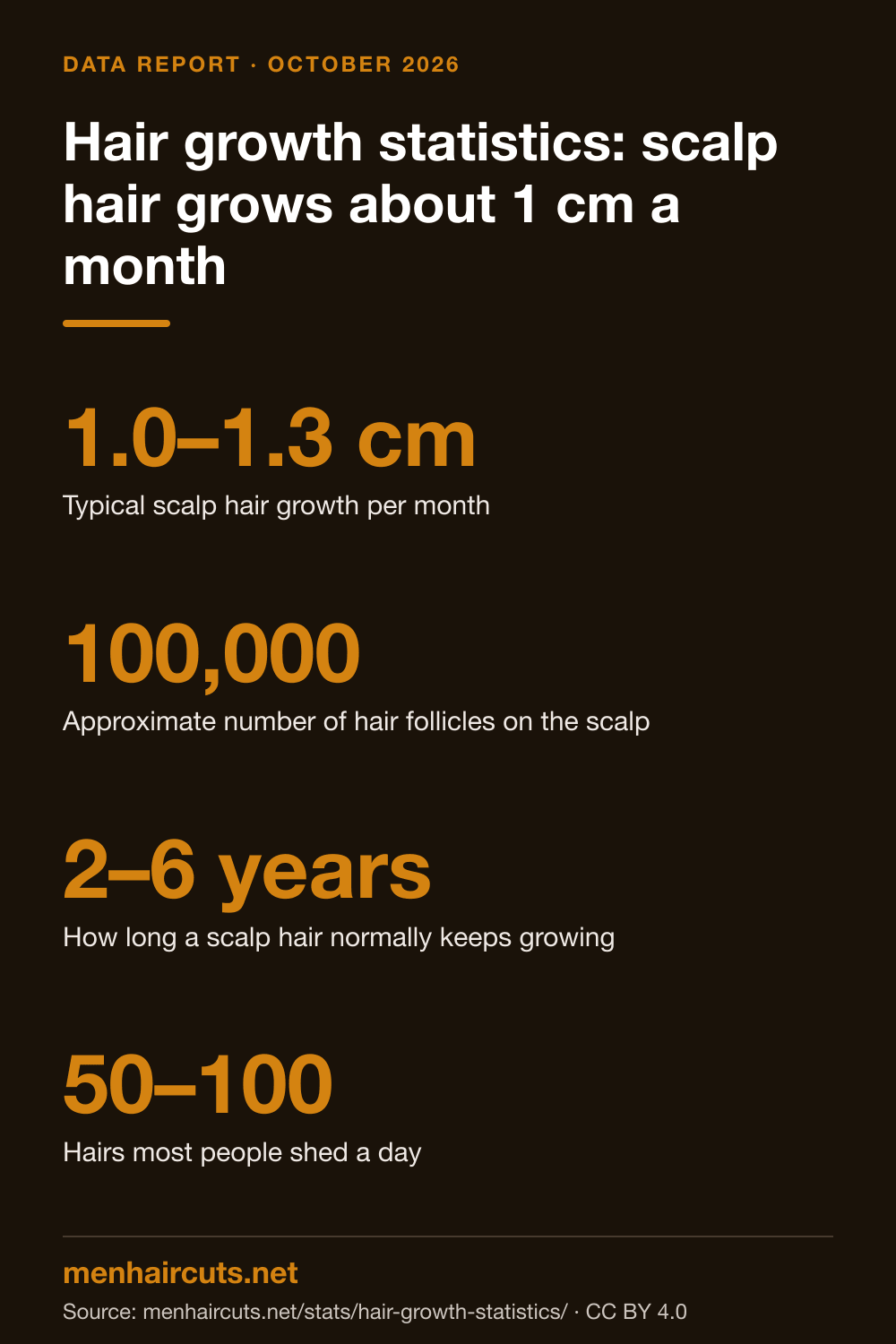
Download the infographic
The headline numbers from this report as one tall image (1000 x 1500 PNG), sized for Pinterest, slides and posts. Free to reuse with credit.
How fast does men's hair grow?
About a centimeter a month. Researchers who read stress histories from single hairs date each segment using a known scalp growth rate of about 1.0–1.3 cm per month[1]. A 2025 review of hair as a medical test material uses the same working figure of about 1 cm a month[7]. In US units that is a little under half an inch.
Direct measurements give similar numbers. A study published in the British Journal of Dermatology in 2001 used close-up photographs of the scalp over time to measure growth. White European volunteers averaged 396 micrometers (0.396 mm) a day, while volunteers from central and western Africa averaged 256 micrometers a day[5].
Converted to monthly figures, 396 micrometers a day is about 12.0 mm (0.47 inch) a month and 256 micrometers a day is about 7.8 mm (0.31 inch) a month. That is a menhaircuts.net calculation: daily rate × 30.4 days, divided by 25.4 mm per inch[5]. Over a full year, the same rates work out to about 5.7 inches and 3.7 inches (daily rate × 365)[5].
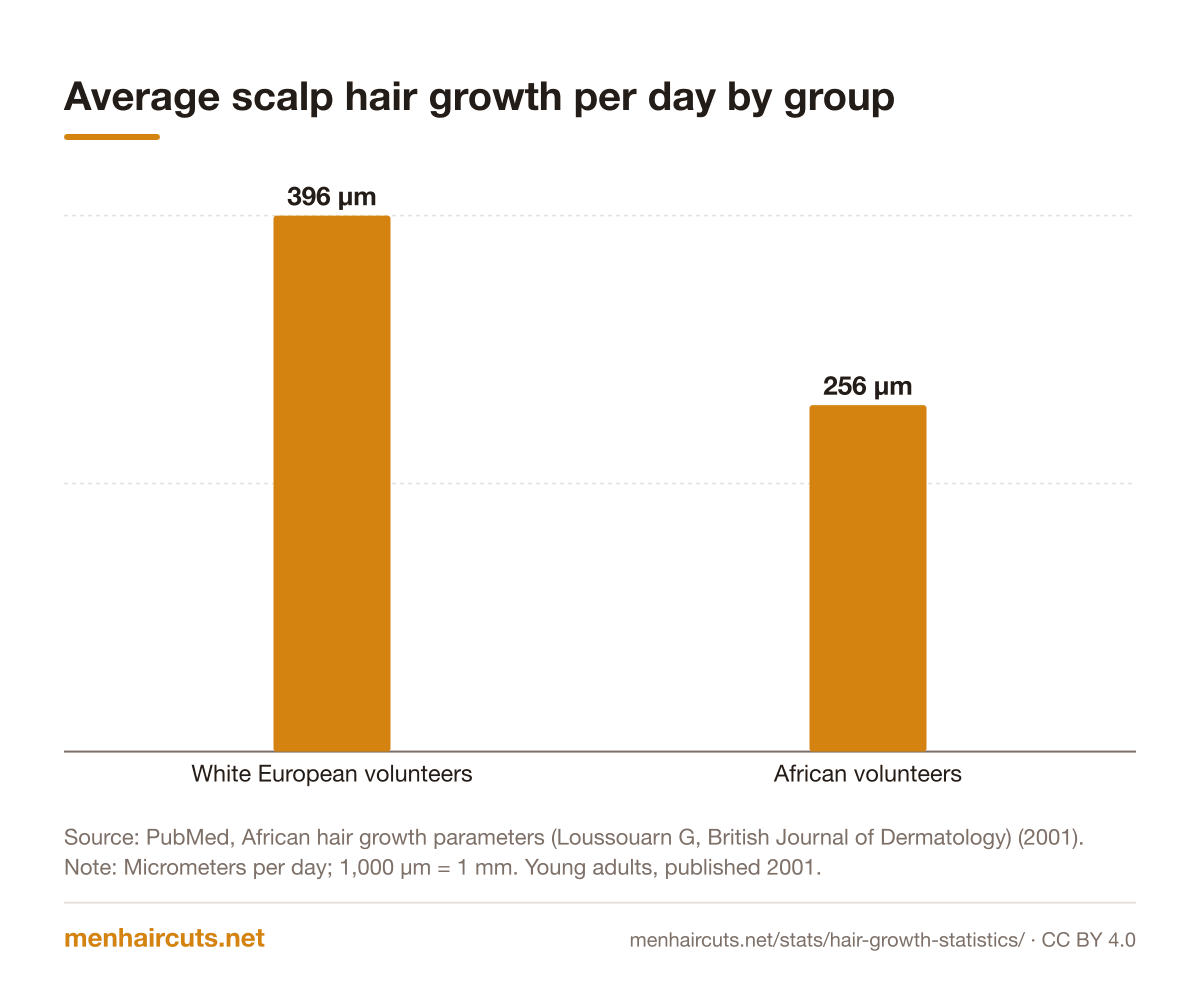
Show the numbers
| Category | Value |
|---|---|
| White European volunteers | 396 µm |
| African volunteers | 256 µm |
Does hair grow at different speeds for different people?
Yes, and by a wide margin. In the 2001 study, individual growth rates among African volunteers ranged from 150 to 363 micrometers a day, with no difference between men and women or between scalp areas[5].
A much larger study, published in the European Journal of Dermatology in 2016, measured 2,249 young adults aged 18–35 without hair loss from 24 ethnic groups on five continents. It found that African hair had lower density and grew more slowly, Asian hair was thicker and grew faster, and white European hair had high total density[6].
Age matters too. MedlinePlus says the rate of hair growth slows as people get older, and that hair strands become smaller and carry less pigment[8]. Body hair varies by site: growth rates measured on the armpit, cheek, chin, leg and upper lip ranged from 180 to 485 micrometers a day[9].
How many hairs are on a man's head?
Roughly 100,000. A 2016 guide to studying the human hair cycle in the Journal of Investigative Dermatology says scalp skin holds about 100,000 terminal hair follicles[2], and MedlinePlus gives the same figure for scalp hairs[10].
Density varies. In the 2001 study, white European volunteers averaged 227 hairs per square centimeter and African volunteers 190, with individual counts ranging from 90 to 290 per square centimeter among the African group[5].
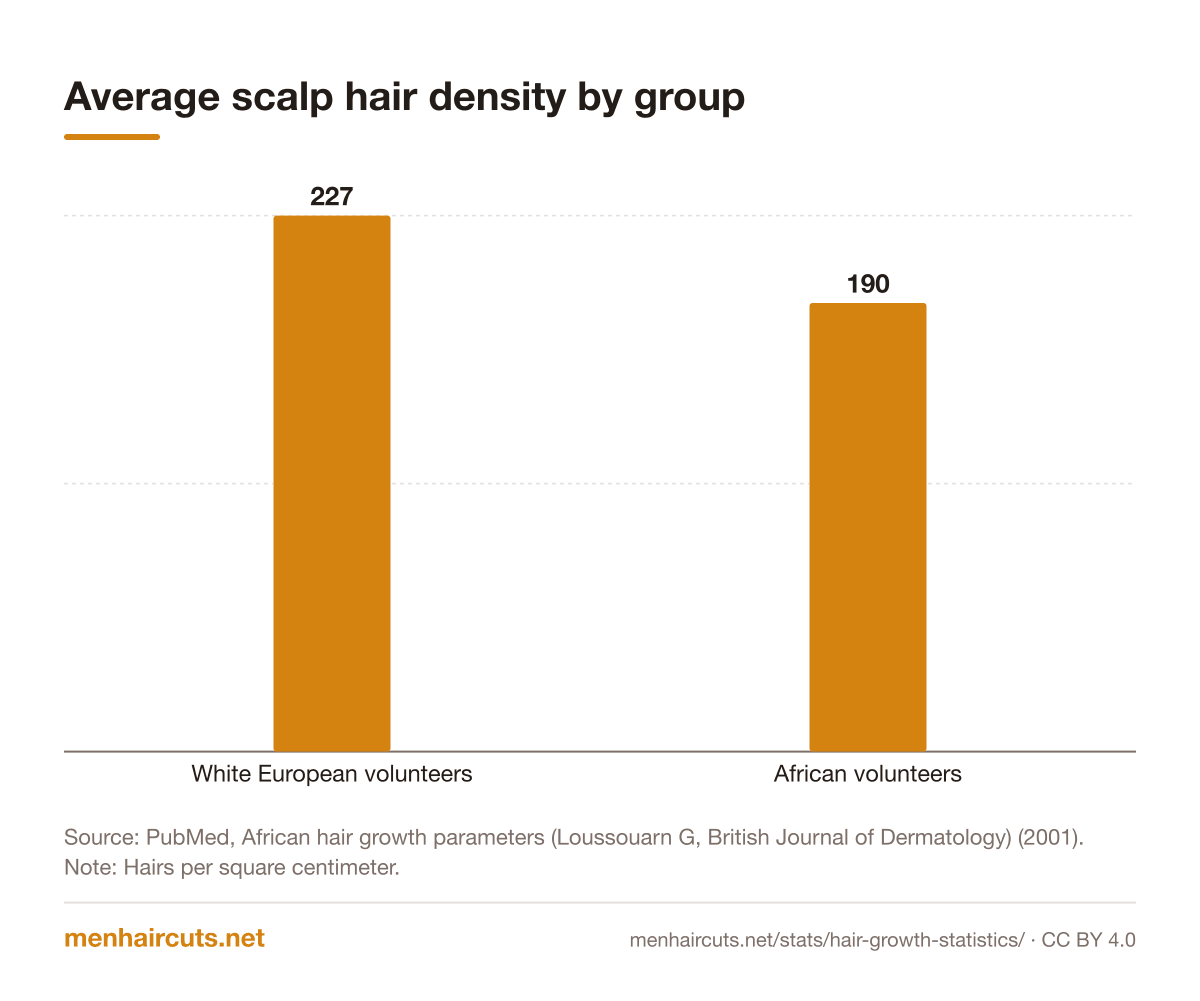
Show the numbers
| Category | Value |
|---|---|
| White European volunteers | 227 |
| African volunteers | 190 |
How long does a single hair keep growing?
Several years. MedlinePlus Genetics says each strand normally grows for 2 to 6 years, rests for several months and then falls out[3]. The MedlinePlus encyclopedia describes a normal life of 2 to 7 years for a single hair[8], and a 2023 review in the Journal of Clinical Medicine gives a growth phase (anagen) of about two to eight years for scalp hair[11]. The ranges differ slightly because they come from different reference texts.
That long growth phase is why scalp hair can grow far longer than eyebrows. Eyebrow follicles stay in the growth phase for only two to three months[11].
| Phase | What happens | Typical length |
|---|---|---|
| Anagen | Active growth | About 2 to 8 years |
| Catagen | Transition as growth stops | About 2 weeks |
| Telogen | Rest, then the hair is shed | About 2 to 3 months |
What share of hair is growing at any one time?
Most of it. Scalp follicles cycle out of sync with each other, so at any given time about 80–90% are growing, 10–20% are resting and only 1–5% are in the short transition phase[2]. Because the scalp holds around 100,000 follicles, even small shifts in that balance can make a visible difference[2].
Resting rates differ between groups. In the 2001 study, the share of resting (telogen) hairs averaged 14% in white European volunteers and 18% in African volunteers, and was higher on the temples and in men[5].
How much hair shedding per day is normal?
Shedding is part of the cycle, not a sign of balding by itself. The NHS says people can lose between 50 and 100 hairs a day, often without noticing[4]. MedlinePlus gives a range of roughly 50 to 200[10], and the 2023 review cites 100 to 150 resting hairs a day[11].
Sudden heavy shedding is different. MedlinePlus says physical or emotional stress, such as major surgery, illness or crash diets, can cause one half to three quarters of scalp hair to shed, often weeks to months after the event. This condition, telogen effluvium, usually eases over 6 to 8 months[10].
How long does it take to grow out a haircut?
Using the 1.0–1.3 cm a month rate[1], we calculated how long it takes for hair to add each length. The formula is the target length in centimeters divided by the monthly rate, which makes this a menhaircuts.net calculation. Real results will vary with your own growth rate, and visible length also depends on curl, since curly and coily hair looks shorter than its true length.
| Length to add | In centimeters | Months at 1.3 cm/month | Months at 1.0 cm/month |
|---|---|---|---|
| 1 inch | 2.54 cm | 2.0 | 2.5 |
| 3 inches | 7.62 cm | 5.9 | 7.6 |
| 6 inches | 15.24 cm | 11.7 | 15.2 |
Does cutting hair or taking supplements make it grow faster?
No on cutting. The American Academy of Dermatology calls faster growth from frequent haircuts a popular but false myth: hair grows below the skin and is not affected by cutting, though regular trims remove hair that would split[12]. On supplements, MedlinePlus states plainly that nutritional supplements, vitamins and other products will not stop or slow graying[8], and hair loss specialists are cautious about them: half of ISHRS hair restoration physicians (50.6%) rarely or never prescribed biotin in 2024[13].
Treatments for pattern hair loss work on thinning follicles, not on a healthy growth rate, and they are slow. The Men's Rogaine 5% foam label says results may occur at 2 months, with some men needing at least 4 months[14]. After a hair transplant, the NHS says new hair usually starts to appear after about 4 months, with full results in 10 to 18 months[15].
Frequently asked questions
How fast does hair grow in a month?
How much does hair grow in a year?
How long does a hair grow before it falls out?
How many hairs a day is it normal to lose?
How long does it take to grow hair out from a buzz cut?
Does hair grow slower as you age?
Does cutting your hair make it grow faster?
Methodology and limitations
This report draws on MedlinePlus and MedlinePlus Genetics (US National Library of Medicine), the American Academy of Dermatology, the NHS, the DailyMed label for Men's Rogaine, the ISHRS 2025 Practice Census, and peer-reviewed studies and reviews found on PubMed and PubMed Central: the British Journal of Dermatology (2001), European Journal of Dermatology (2016), International Journal of Cosmetic Science (2019), Journal of Investigative Dermatology (2016), Journal of Clinical Medicine (2023), eLife (2021) and Biochemistry and Biophysics Reports (2025). Each figure was checked in October 2026. Our calculations are labeled: monthly growth = daily rate × 30.4 days; yearly growth = daily rate × 365; inches = millimeters ÷ 25.4; months to add a length = length in cm ÷ monthly rate. This is general information, not medical advice; see a board-certified dermatologist if your hair is shedding heavily, thinning or not growing back.
Limitations
Growth rates come from small study groups of young adults and vary widely between individuals. The 1.0–1.3 cm per month range is a working figure used in research, not a measurement of any one person. Several studies on hair growth by ethnic group were run by researchers at L'Oréal. Reference ranges for the length of the growth phase differ slightly between sources (2 to 6, 2 to 7 and 2 to 8 years). Calculated grow-out times ignore curl, breakage and trims. This is general information, not medical advice.
Every figure on this page links to its source. Numbers are reported as published; any menhaircuts.net calculation is labelled and shows its inputs. Spotted an error? Tell us and we will check it.
Sources
- Quantitative mapping of human hair greying and reversal in relation to life stress (Rosenberg AM et al., eLife), PubMed Central (2021). Accessed October 15, 2026.
- A guide to studying human hair follicle cycling in vivo (Oh JW et al., Journal of Investigative Dermatology), PubMed Central (2016). Accessed October 15, 2026.
- Androgenetic alopecia, MedlinePlus Genetics, National Library of Medicine (NIH) (2023). Accessed October 15, 2026.
- Hair loss, NHS (2024). Accessed October 15, 2026.
- African hair growth parameters (Loussouarn G, British Journal of Dermatology), PubMed (2001). Accessed October 15, 2026.
- Diversity in human hair growth, diameter, colour and shape: an in vivo study on young adults from 24 different ethnic groups (Loussouarn G et al., European Journal of Dermatology), PubMed (2016). Accessed October 15, 2026.
- Human hair as a diagnostic tool in medicine (Florou VA et al., Biochemistry and Biophysics Reports), PubMed Central (2025). Accessed October 15, 2026.
- Aging changes in hair and nails, MedlinePlus, National Library of Medicine (NIH) (2024). Accessed October 15, 2026.
- Exploring some characteristics (density, anagen ratio, growth rate) of human body hairs (Bouabbache S et al., International Journal of Cosmetic Science), PubMed (2019). Accessed October 15, 2026.
- Hair loss (Medical Encyclopedia), MedlinePlus, National Library of Medicine (NIH) (2025). Accessed October 15, 2026.
- Integrative and mechanistic approach to the hair growth cycle and hair loss (Natarelli N et al., Journal of Clinical Medicine), PubMed Central (2023). Accessed October 15, 2026.
- National Healthy Skin Month: dermatologists provide tips on caring for your skin, hair, and nails, American Academy of Dermatology (2022). Accessed October 15, 2026.
- 2025 Practice Census Results (2024 data), International Society of Hair Restoration Surgery (2025). Accessed October 15, 2026.
- Men's Rogaine (minoxidil 5%) unscented foam, Drug Facts label, DailyMed, National Library of Medicine (NIH) (2024). Accessed October 15, 2026.
- Hair transplant, NHS (2023). Accessed October 15, 2026.
Cite, embed and download
This report, its charts and its infographic are free to reuse under a Creative Commons Attribution 4.0 license. Credit menhaircuts.net with a link to this page.
Cite this report (APA)
Hamilton, J. (2026, October 15). Hair Growth Statistics 2026: How Fast Does Hair Grow?. menhaircuts.net. https://menhaircuts.net/stats/hair-growth-statistics/
Link to this report
<a href="https://menhaircuts.net/stats/hair-growth-statistics/">Hair Growth Statistics 2026: How Fast Does Hair Grow?</a> (menhaircuts.net, CC BY 4.0)Share the headline number
1.0–1.3 cm: Typical scalp hair growth per month (PubMed Central, via menhaircuts.net/stats/hair-growth-statistics/)
Download the charts and infographic
- Average scalp hair growth per day by group (PNG)
- Average scalp hair density by group (PNG)
- Infographic: Hair Growth Statistics 2026 (PNG, 1000 x 1500)
Related data
- 50 millionUS men with androgenetic alopecia (male pattern hair loss)Male Hair Loss Statistics 2026
- 74%People aged 45–65 with some gray hair (worldwide study)Gray Hair Statistics 2026
- 10Haircuts per year for the average US man (2025 poll)How Often Men Get Haircuts
- 51%of US adults say short hair looks better on menLong vs Short Hair on Men
Related guides
Make us a Preferred Source on Google
See our latest articles first in your Google Search & AI Overviews.