
Data report · Updated October 2026
Gen Z vs millennial haircut statistics: 90% of Gen Z men rank their hair as a top asset, ahead of millennials at 83%
What age-split surveys actually show about how younger and older men cut, style, buy for and worry about their hair.
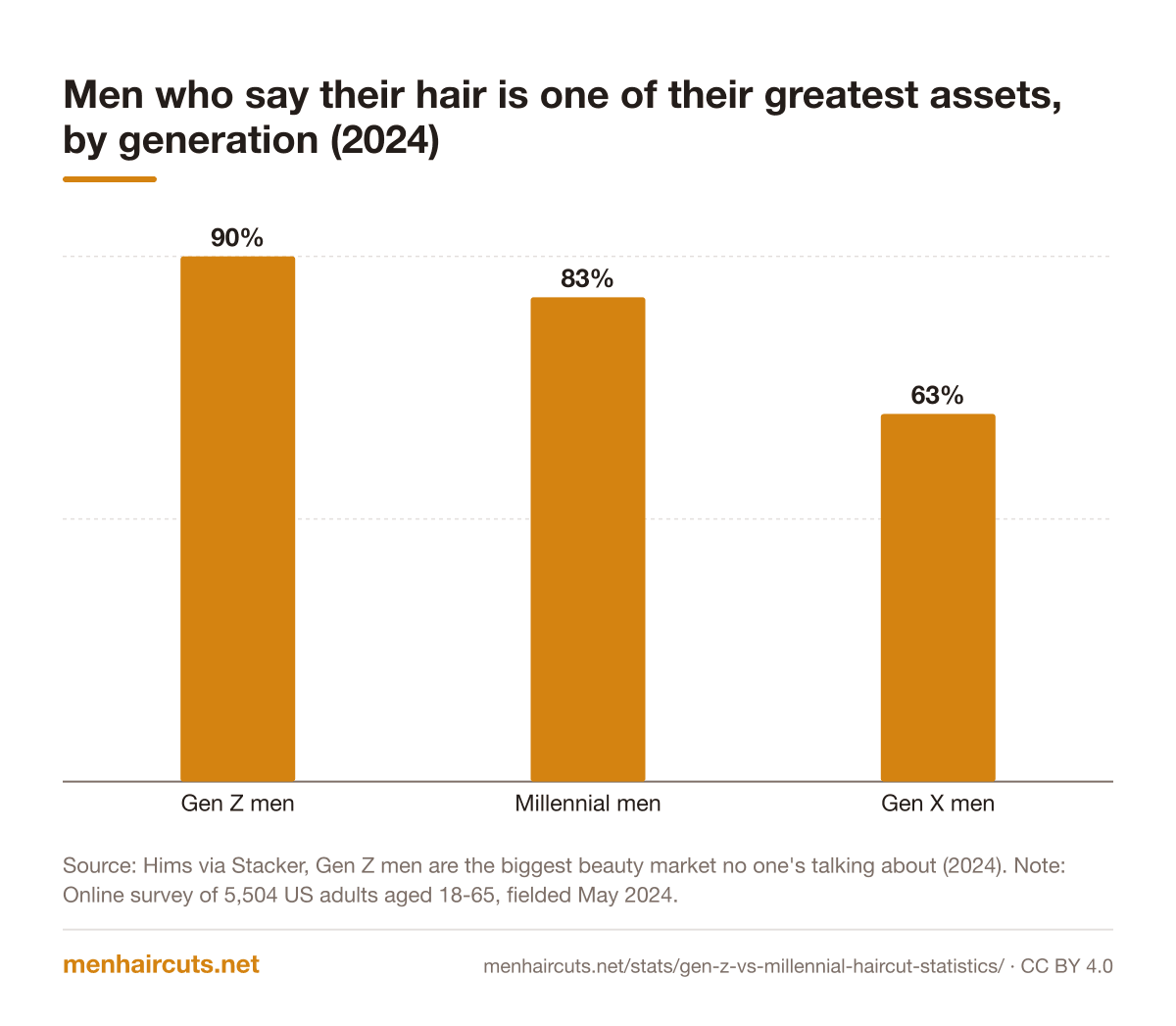
In a 2024 Hims survey, 90% of Gen Z men said their hair is one of their greatest assets, compared with 83% of millennial men and 63% of Gen X men[1]. Younger adults also switch barbers more: only 25% of 18 to 24 year olds always see the same person, against 48% of over-55s[2].
90% vs 83%
Gen Z vs millennial men who call their hair one of their greatest assets (2024)[1]
59%
US men aged 18-24 who agree "going bald terrifies me" (2019-2020)[3]
25% vs 48%
Adults 18-24 vs over-55s who always see the same barber or stylist (2018)[2]
$593
Average yearly hair care spend reported by Gen Z men (2024)[1]
39% vs 28%
Millennial vs boomer men who know how to cut their own hair (2016)[4]
By Jessica Hamilton, Editor · Published · Updated · Free to reuse with credit (CC BY 4.0)
Key findings
- In a May 2024 survey of 5,504 US adults, 90% of Gen Z men said their hair is one of their greatest assets, compared with 83% of millennial men and 63% of Gen X men[1].
- Asked to pick between good hair and good food, 38% of Gen Z men chose hair, compared with 30% of millennial men and 21% of Gen X men[1].
- Gen Z men reported spending an average of $593 a year on hair care, 34% more than the $425 reported by Gen Z women[1].
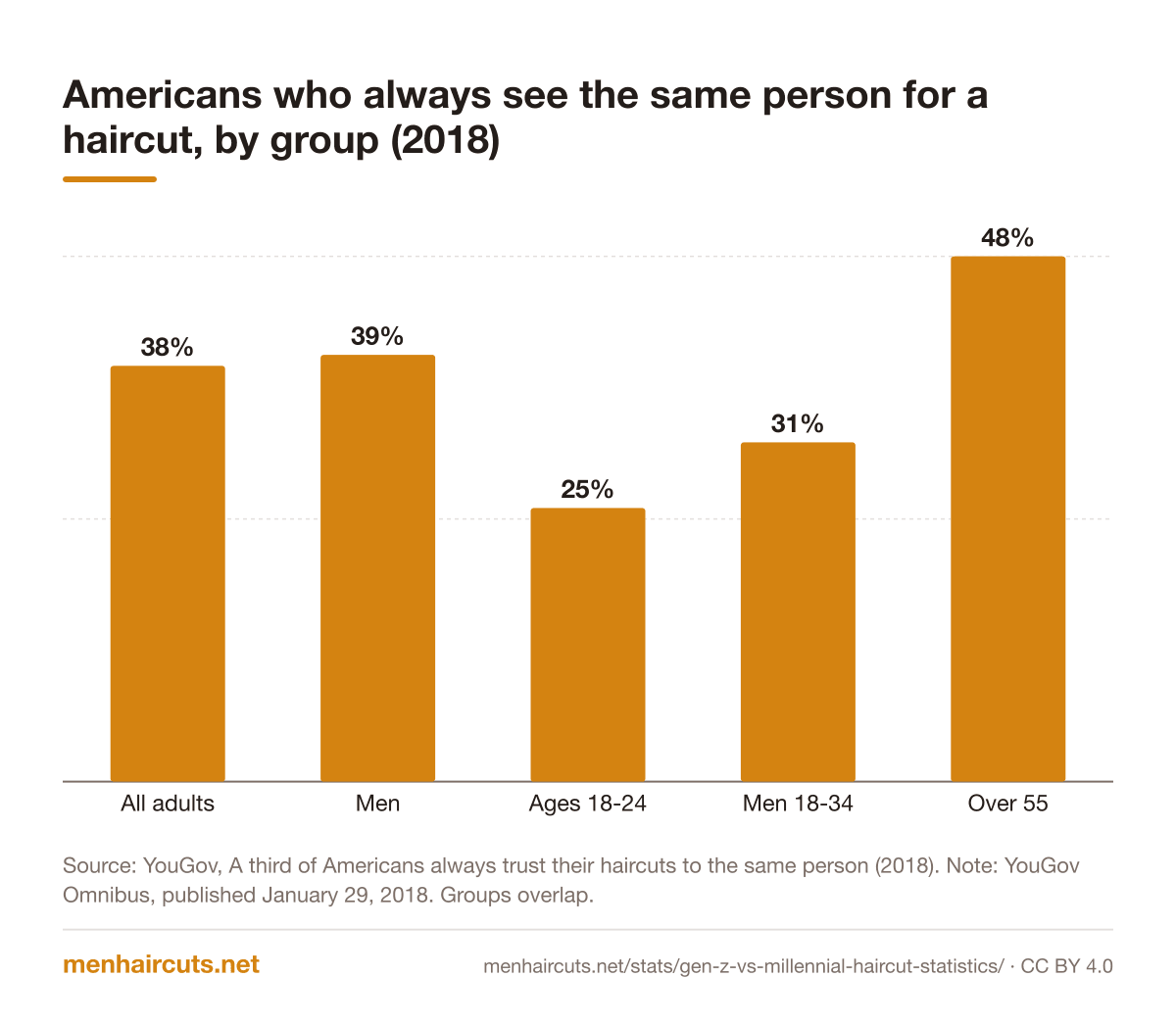
- Only 25% of Americans aged 18 to 24 always see the same barber or stylist, compared with 48% of those over 55[2].
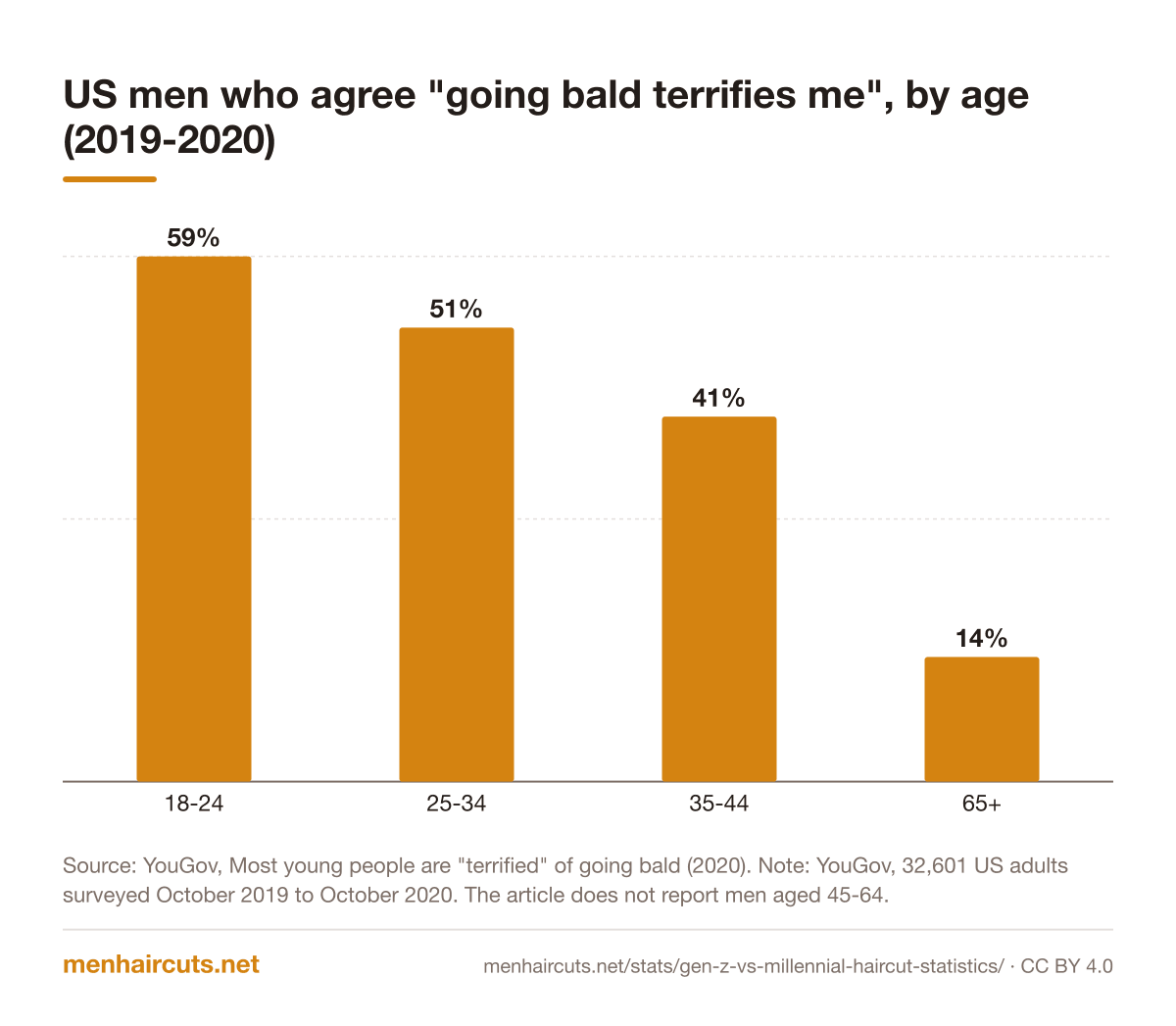
- Fear of baldness falls with age: 59% of men aged 18-24 agree that going bald terrifies them, compared with 51% at 25-34, 41% at 35-44 and 14% at 65 and older[3].
- In a January 2025 survey, Gen Z men were less likely than Gen X men to name a buzz cut as their favorite men's style (12% vs 19%) and five times as likely to pick a quiff[5].
- In a 2016 survey of 1,000 men, 39% of millennials (then aged 18-35) said they know how to cut their own hair, compared with 28% of baby boomers[4].
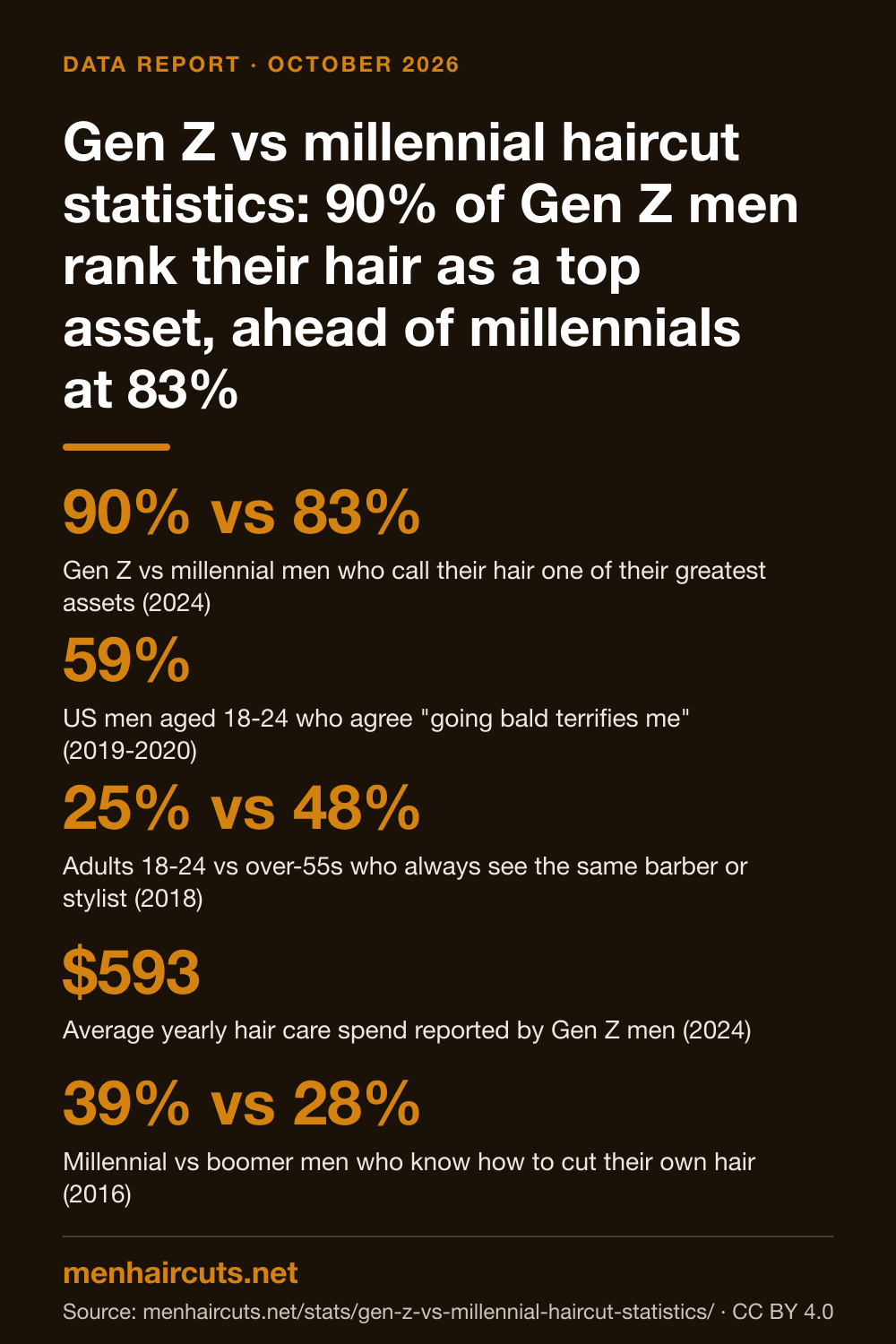
Download the infographic
The headline numbers from this report as one tall image (1000 x 1500 PNG), sized for Pinterest, slides and posts. Free to reuse with credit.
How are Gen Z and millennials defined in haircut surveys?
Pew Research Center treats anyone born from 1981 to 1996 as a millennial and anyone born from 1997 onward as part of the next generation, Gen Z[6]. Pew set 1996 as the last millennial birth year in 2018, and Gen X covers births from 1965 to 1980[6].
Surveys about hair rarely use those exact birth years. Most report by age band, and the bands shift with the year the survey ran. A 2018 YouGov poll called 18 to 24 year olds "younger millennials"[2], yet by Pew's cutoffs most people in that band in 2018 were born in 1994 or later, so it mixes late millennials and early Gen Z. Wahl's 2016 survey counted millennials as men aged 18 to 35[4], and Attest's 2022 report defined Gen Z as 18 to 25[7].
This page keeps each source's own label and age range. It never assigns a generation to a figure that was reported only for all adults. Where a survey compares Gen Z with Gen X but not with millennials, the page says so rather than filling in a millennial number.
- Hims, May 2024: online survey of 5,504 US adults aged 18-65, reported for Gen Z, millennial and Gen X men[1]
- Hims, January 2025: 7,100-person online survey of US adults aged 18-65, reported for Gen Z and Gen X men[5]
- YouGov Omnibus, January 2018: US adults, reported for ages 18-24, men and women 18-34, and over 55[2]
- YouGov, October 2019 to October 2020: 32,601 US adults, reported by gender and age band[3]
- Wahl, August 2016: 1,000 US men; millennials 18-35, Gen X 36-51, boomers 52-70[4]
- Attest, 2022: 2,000 US consumers; Gen Z 18-25, men 26-40, boomers 56-66[7]
Do Gen Z men care more about their hair than millennial men?
On the one survey that splits men into Gen Z, millennial and Gen X groups, the answer is yes, though the gap between Gen Z and millennials is smaller than the gap between millennials and Gen X. In a May 2024 online survey of 5,504 US adults aged 18 to 65, 90% of Gen Z men said their hair is one of their greatest assets, compared with 83% of millennial men and 63% of Gen X men[1].
The same pattern shows up in a blunter question. Asked whether they would rather have good hair or good food, 38% of Gen Z men picked hair, compared with 30% of millennial men and 21% of Gen X men[1]. Most Gen Z men (62%) still chose food[1].
Other answers from Gen Z men in that study: 84% said they would do almost anything to have better hair, compared with 78% of Gen Z women[1]. Some 84% of Gen Z men agreed that the first thing they notice about someone is their hair, against 74% of all Americans surveyed, and 65% said their hair is impactful or extremely impactful on their day, against 54% overall[1].
Keep the sponsor in mind. Hims sells hair loss treatments, the survey drew 5,000 of its respondents from the 50 largest metro areas, and the published summary does not give margins of error[1].
Show the numbers
| Category | Value |
|---|---|
| Gen Z men | 90% |
| Millennial men | 83% |
| Gen X men | 63% |
How much do Gen Z men spend on hair care?
Gen Z men in the 2024 Hims survey reported spending an average of $593 a year on hair care, which Hims put at 34% more than the $425 reported by Gen Z women[1]. The published summary says Gen Z men spend more than millennial men as well, but it does not give a dollar figure for millennials[1], so no millennial average appears on this page.
Time spent follows the same direction. Gen Z men reported an average of 44.26 minutes a day on their hair, compared with 32.68 minutes among women[1]. These are self-reported figures, and most people are not precise about minutes spent in front of a mirror.
Spending intent also leans young. In a January 2025 Hims survey, 24% of Gen Z men planned to spend more on their hair that year than the year before, compared with 14% of Gen X men[5]. That survey did not publish a millennial figure.
Which haircuts do Gen Z men prefer compared with older men?
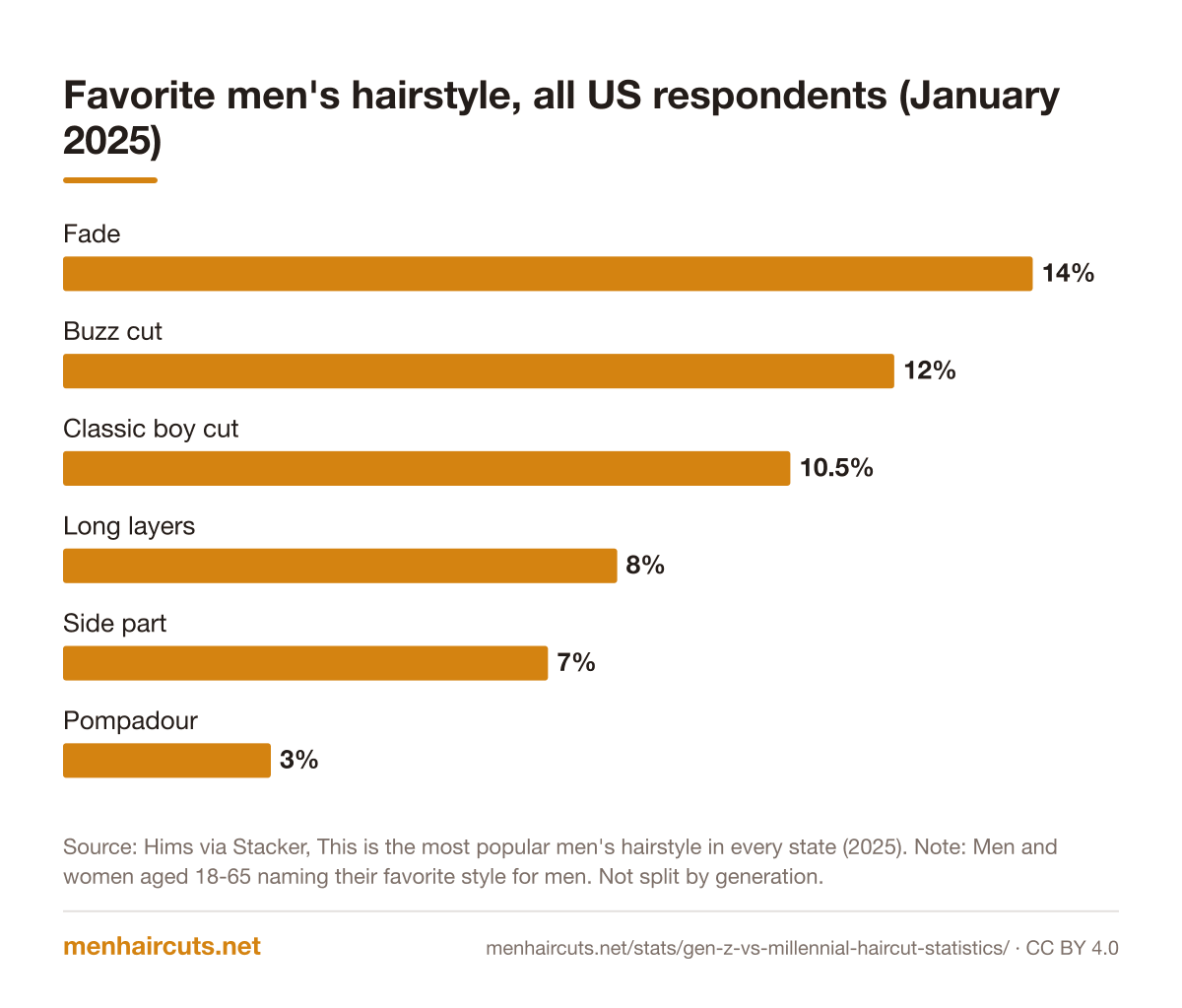
Hard numbers on haircut choice by generation are scarce. The best published split comes from the January 2025 Hims survey, which asked people to name their favorite hairstyle for men. Across all respondents, the fade (14%) and the buzz cut (12%) led, followed by the classic boy cut (10.5%), long layers (8%) and the side part (7%)[5]. The pompadour came last at 3%[5].
Gen Z men answered differently from their fathers' generation. They were less likely than Gen X men to pick a buzz cut (12% vs 19%), about twice as likely to prefer an undercut, Caesar cut or fringe, and five times as likely to pick a quiff[5]. The survey compared Gen Z with Gen X only, so it cannot say how millennial men voted.
The 2024 Hims survey asked Gen Z men a related question about the hair they find attractive on other people: 37% picked mid-length styles, 35% long and 29% short[1]. That is a preference about others, not the cut they wear themselves.
Styles such as the wolf cut, modern mullet and curtains are widely described as Gen Z looks, but none of the sources reviewed for this page measured them by age. We have left them out of the numbers rather than guess.
Show the numbers
| Category | Value |
|---|---|
| Fade | 14% |
| Buzz cut | 12% |
| Classic boy cut | 10.5% |
| Long layers | 8% |
| Side part | 7% |
| Pompadour | 3% |
| Style | Gen Z men vs Gen X men |
|---|---|
| Buzz cut | 12% vs 19% |
| Undercut, Caesar cut or fringe | About 2 times as likely |
| Quiff | About 5 times as likely |
Are younger men less loyal to one barber?
Yes, at least in the most recent age-split poll we could find. In a January 2018 YouGov Omnibus survey, 38% of Americans said they always see the same person for a haircut, and men (39%) and women (37%) answered almost the same[2]. Age made the bigger difference: 48% of Americans over 55 always see the same barber, compared with 25% of 18 to 24 year olds[2].
Among 18 to 24 year olds, 32% said they sometimes get their hair cut by someone other than their usual barber or stylist, ten points above the national figure of 22%[2]. Young men were steadier than young women: among male 18 to 34 year olds, the most common answer was always visiting the same person (31%)[2], while female 18 to 34 year olds were as likely to see a different stylist every time (26%) as to always see the same one (26%)[2].
A 2025 Attest survey points to one reason younger customers move around. Adults aged 18 to 24 were more likely than other age groups to say faster services and easier appointment booking would get them to book more salon services[8]. Price was the top lever across all ages, cited by 47%[8].
Show the numbers
| Category | Value |
|---|---|
| All adults | 38% |
| Men | 39% |
| Ages 18-24 | 25% |
| Men 18-34 | 31% |
| Over 55 | 48% |
Do younger men cut their own hair at home?
Home haircutting is one of the few grooming skills where younger men are ahead. In an August 2016 Wahl survey of 1,000 US men, 39% of millennials (defined as men aged 18 to 35) said they know how to cut their own hair, compared with 28% of baby boomers[4]. Boomers led on most of the other traditional skills in the survey[4].
Among millennials who could cut their own hair, 63% taught themselves, and seven in ten had done it in the past month[4]. Wahl makes clippers, so it has a stake in the result, and the survey asked about ability, not how often men skip the barber.
Newer data on home cutting is not split by generation. Attest's 2022 survey of 2,000 US consumers found 45% of men cut their hair at home, compared with 21% of women[7], but the published summary does not break that figure down by age.
How worried are young men about losing their hair?
Worry is highest at the ages when hair loss is least common. In YouGov data from October 2019 to October 2020, covering 32,601 US adults, 59% of men aged 18 to 24 agreed that "going bald terrifies me"[3]. The share was 51% among men aged 25 to 34, 41% at 35 to 44 and 14% among men 65 and older[3].
YouGov noted that male pattern hair loss is not common for most men under 30, which may explain the fear at younger ages[3]. In the same data, women's fear declined more slowly with age than men's[3].
Younger men also report more use of hair loss products. In the January 2025 Hims survey, 35% of Gen Z men had tried hair growth medications, compared with 24% of Gen X men, and 38% had tried hair supplements, compared with 27%[5]. In the 2024 survey, 39% of Gen Z men took vitamins or supplements to improve their hair, against 30% of all respondents[1].
Show the numbers
| Category | Value |
|---|---|
| 18-24 | 59% |
| 25-34 | 51% |
| 35-44 | 41% |
| 65+ | 14% |
| Measure | Gen Z men | Gen X men |
|---|---|---|
| Have tried hair growth medications | 35% | 24% |
| Have tried hair supplements | 38% | 27% |
| Working with a telehealth company for hair care | 14.5% | 11.5% |
Are younger men more open to hair color, styling and makeup?
Younger men are more likely to dye, blow-dry and grow facial hair, based on the age-split data available. In the UK, Mintel found the share of men aged 16 to 24 using at-home hair colorants rose from 38% in 2018 to 46% in 2019[9]. Among male at-home color users, 19% said social media personalities inspired their latest color[9].
In the US, Mintel's 2022 report on shampoo, conditioner and styling products said nearly 60% of men aged 18 to 34 blow-dry their hair as part of a regular routine[10].
Makeup shows a less tidy split. Attest's 2022 survey found 39% of Gen Z men (18 to 25) shop for makeup and 21% do so regularly, while 35% of men aged 26 to 40 shop for it at least once a month[7]. Gen X men were close to Gen Z, with 36% buying makeup, and 78% of boomers (56 to 66) never buy cosmetics[7].
Facial hair is also more common among younger men in the UK. A September 2023 YouGov poll found 69% of men aged 18 to 39 have some form of facial hair, compared with 54% of all British men, and 42% of the younger group wear a beard and moustache, against 34% of all men[11].
Where do Gen Z and millennials get hair advice, and what do they buy?
Social video matters most to the youngest buyers. Mintel reported that more than half of US men aged 18 to 24 learn about beauty from TikTok[12].
Attest's 2025 haircare research shows millennials as the more experimental shoppers. People aged 35 to 44 were the most likely to try new haircare brands, with 38% saying they regularly do so against a US average of 26.5%, and 19.5% of that group buy what they see recommended online, compared with 13% of all adults[8]. Adults aged 18 to 24 were the least likely to try unfamiliar brands (18%) and less likely to choose products based on claims (19.5% vs 27% overall)[8].
Concerns differ by age too. Growth or length was a top-three hair goal for 45% of Americans aged 25 to 34, well above other ages[8]. Across all ages, men were far more likely than women to list scalp health as a top concern (47% vs 22%)[8].
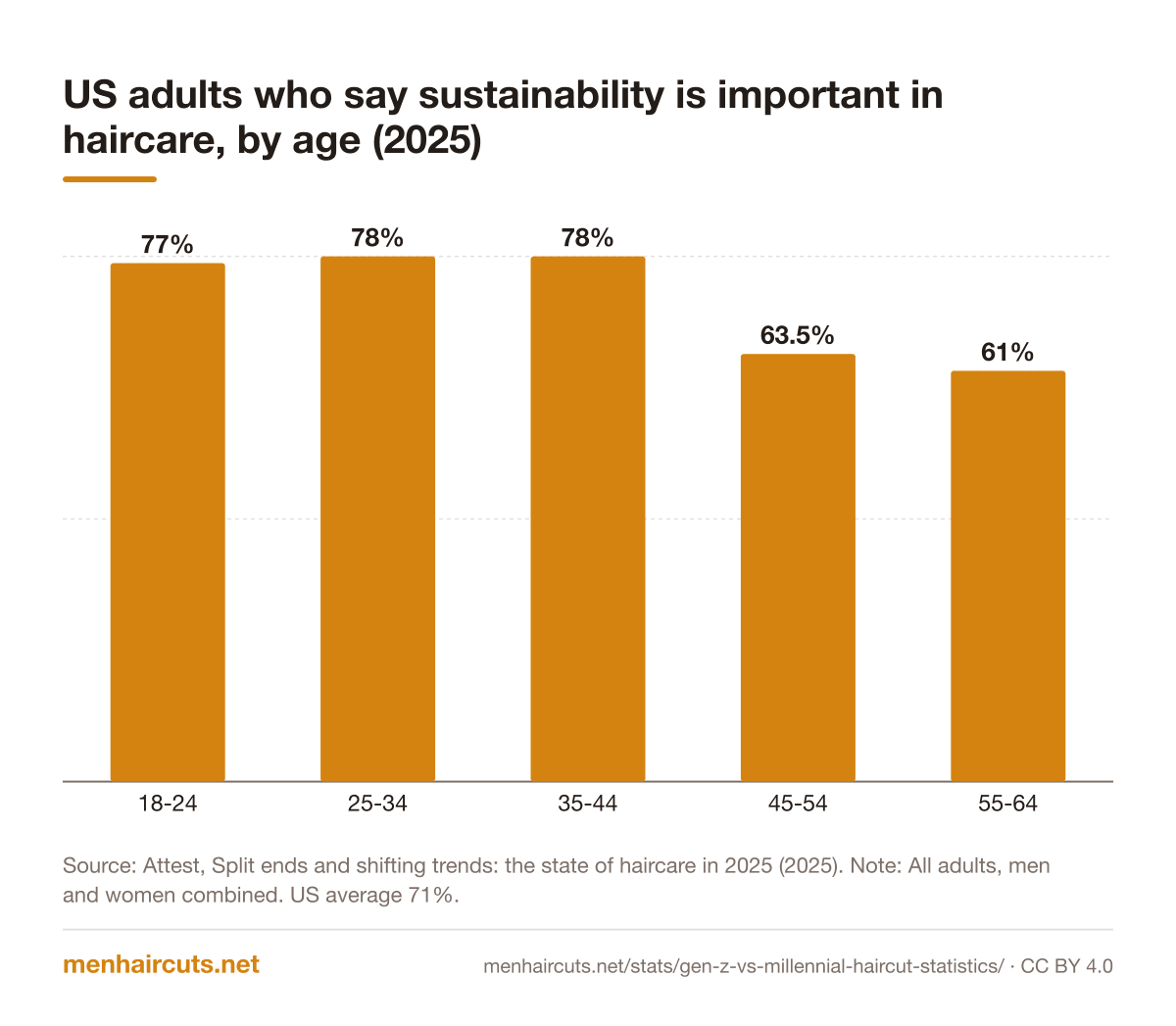
Sustainability counts more for adults under 45. In the same survey, 77% of 18 to 24 year olds and 78% of 25 to 34 year olds said sustainability is important to them when buying haircare, compared with 61% of 55 to 64 year olds[8]. These Attest figures cover all adults, not men alone.
Show the numbers
| Category | Value |
|---|---|
| 18-24 | 77% |
| 25-34 | 78% |
| 35-44 | 78% |
| 45-54 | 63.5% |
| 55-64 | 61% |
Frequently asked questions
Do Gen Z men care more about their hair than millennial men?
How much do Gen Z men spend on hair care a year?
What haircut do Gen Z men like most?
Are young people loyal to one barber?
Are young men afraid of going bald?
Do millennial men cut their own hair?
What years are Gen Z and millennials born?
Methodology and limitations
Compiled by Jessica Hamilton, Editor, in October 2026. We searched for published surveys that report hair or grooming results by generation or by age band, then opened each source and recorded only figures shown on the page. Generation labels follow each source; Pew Research Center's birth-year cutoffs are used for context only. Hims survey results were read from the Hims-produced articles distributed by Stacker, because the Hims site blocked automated access. The Mintel 2022 figure comes from the public brochure for its Shampoo, Conditioner and Hairstyling Products US 2022 report. No figures were estimated, and no calculations were added.
Limitations
Few surveys report the same question for both Gen Z and millennial men, so most comparisons here are Gen Z vs Gen X, or by age band. Age bands do not line up neatly with generations, and the same band (for example 18-24) captured late millennials in 2018 and Gen Z later. Several sources are commissioned by companies that sell hair products or treatments (Hims, Wahl) and publish summaries without margins of error. The YouGov barber poll is from 2018 and the Wahl survey from 2016. The Mintel colorant and YouGov facial hair figures are UK data. Attest's haircare figures cover all adults, not men only. No source reviewed measured specific Gen Z styles such as the wolf cut or mullet by age.
Every figure on this page links to its source. Numbers are reported as published; any menhaircuts.net calculation is labelled and shows its inputs. Spotted an error? Tell us and we will check it.
Sources
- Gen Z men are the biggest beauty market no one's talking about, Hims via Stacker (2024). Accessed October 15, 2026.
- A third of Americans always trust their haircuts to the same person, YouGov (2018). Accessed October 15, 2026.
- Most young people are "terrified" of going bald, YouGov (2020). Accessed October 15, 2026.
- Which skills may be going by the wayside for men?, Wahl Clipper Corporation (2016). Accessed October 15, 2026.
- This is the most popular men's hairstyle in every state, Hims via Stacker (2025). Accessed October 15, 2026.
- Defining generations: Where Millennials end and Generation Z begins, Pew Research Center (2019). Accessed October 15, 2026.
- Just the numbers: US beauty and grooming 2022 (Attest US Beauty & Grooming Report 2022), BeautyMatter (2022). Accessed October 15, 2026.
- Split ends and shifting trends: the state of haircare in 2025, Attest (2025). Accessed October 15, 2026.
- Reach for the bleach: four in ten UK 16-24-year-old men use in-home hair colourants, Mintel (2019). Accessed October 15, 2026.
- Shampoo, Conditioner and Hairstyling Products - US - 2022 (report brochure), Mintel (2022). Accessed October 15, 2026.
- Most British men now have facial hair, YouGov (2023). Accessed October 15, 2026.
- Gen Z is defining a new approach to men's grooming, Mintel (2024). Accessed October 15, 2026.
Cite, embed and download
This report, its charts and its infographic are free to reuse under a Creative Commons Attribution 4.0 license. Credit menhaircuts.net with a link to this page.
Cite this report (APA)
Hamilton, J. (2026, October 15). Gen Z vs Millennial Haircut Statistics 2026. menhaircuts.net. https://menhaircuts.net/stats/gen-z-vs-millennial-haircut-statistics/
Link to this report
<a href="https://menhaircuts.net/stats/gen-z-vs-millennial-haircut-statistics/">Gen Z vs Millennial Haircut Statistics 2026</a> (menhaircuts.net, CC BY 4.0)Share the headline number
90% vs 83%: Gen Z vs millennial men who call their hair one of their greatest assets (2024) (Hims via Stacker, via menhaircuts.net/stats/gen-z-vs-millennial-haircut-statistics/)
Download the charts and infographic
- Men who say their hair is one of their greatest assets, by generation (2024) (PNG)
- Favorite men's hairstyle, all US respondents (January 2025) (PNG)
- Americans who always see the same person for a haircut, by group (2018) (PNG)
- US men who agree "going bald terrifies me", by age (2019-2020) (PNG)
- US adults who say sustainability is important in haircare, by age (2025) (PNG)
- Infographic: Gen Z vs Millennial Haircut Statistics 2026 (PNG, 1000 x 1500)
Related data
- #2most-searched haircut on Google since 2004, after the bobMullet Statistics 2026
- 51%of US adults say short hair looks better on menLong vs Short Hair on Men
- 36%US men who always or usually get their hair cut at home (2024)DIY Haircut Statistics 2026
- 50 millionUS men with androgenetic alopecia (male pattern hair loss)Male Hair Loss Statistics 2026
Related guides
Make us a Preferred Source on Google
See our latest articles first in your Google Search & AI Overviews.