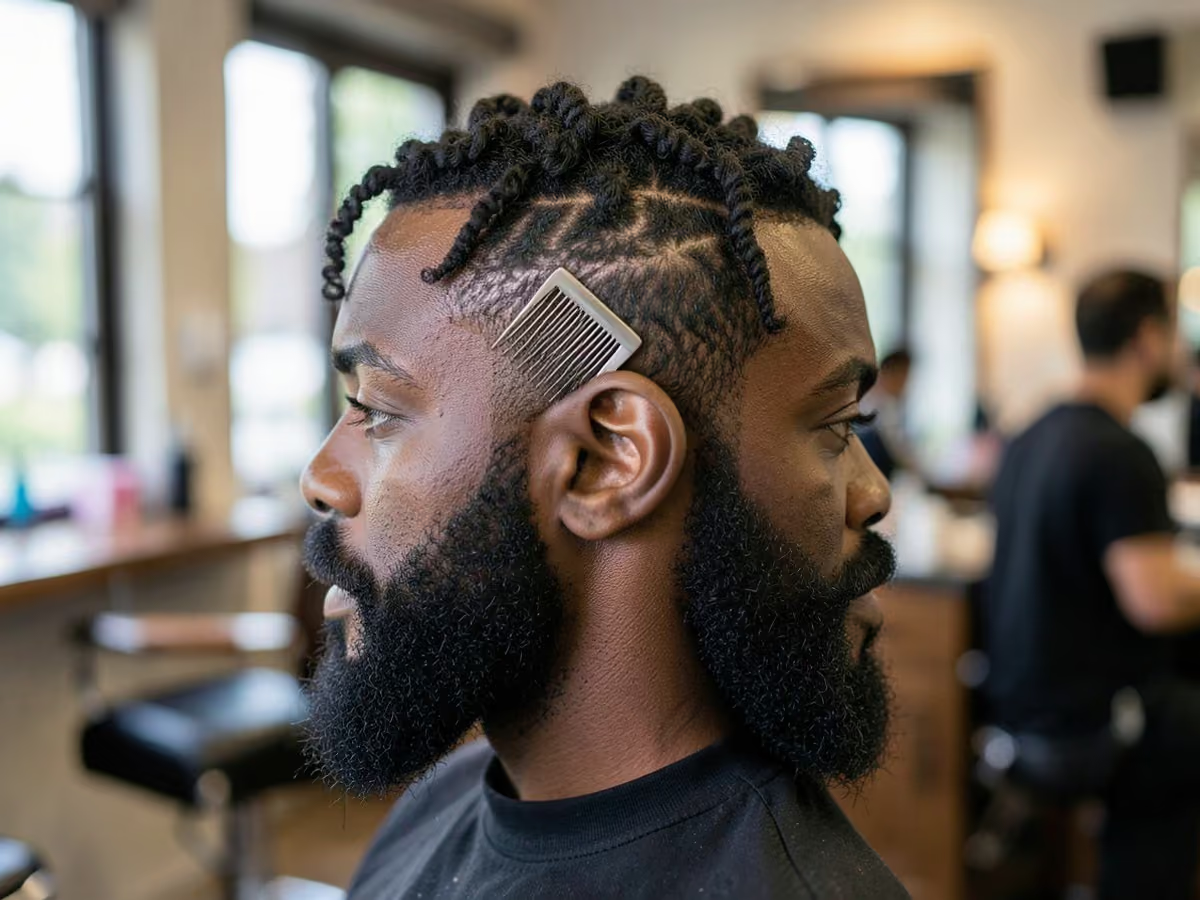
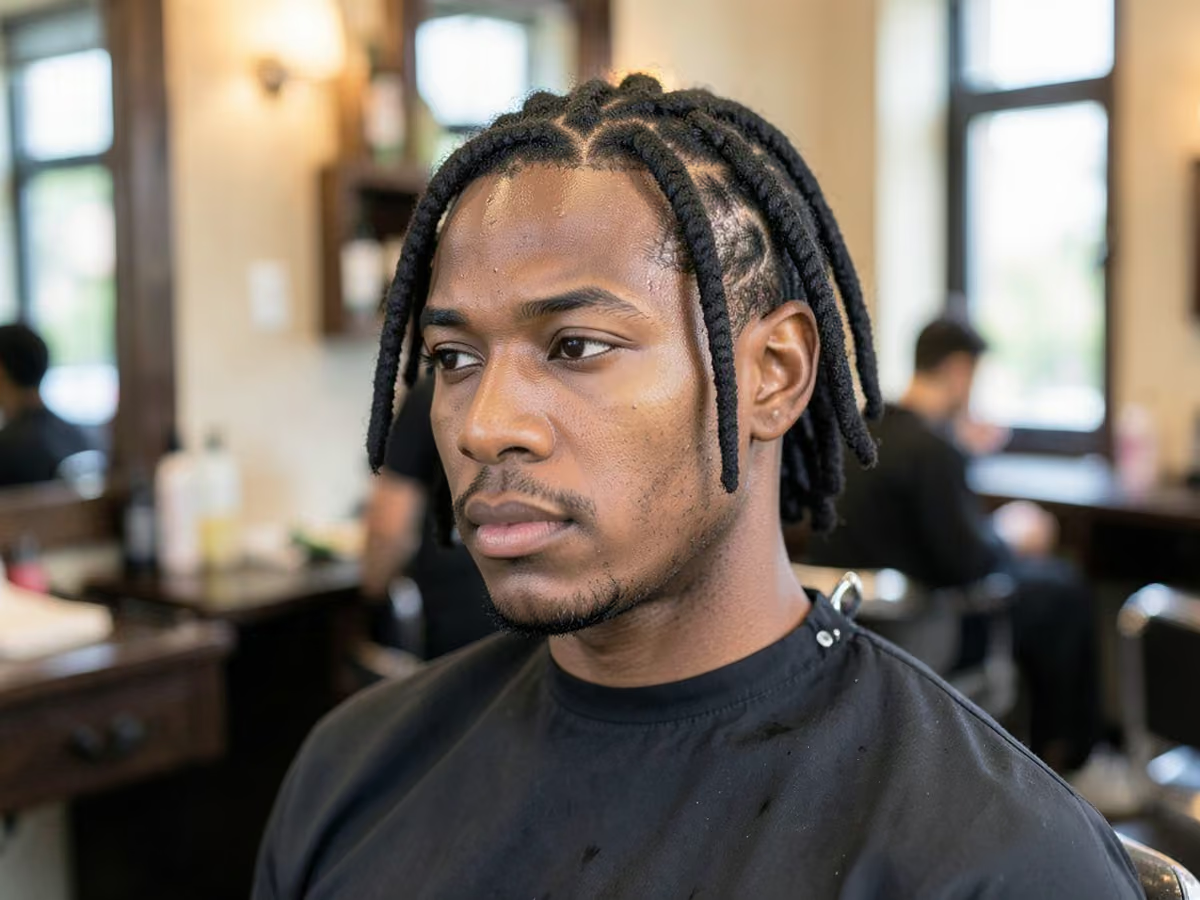
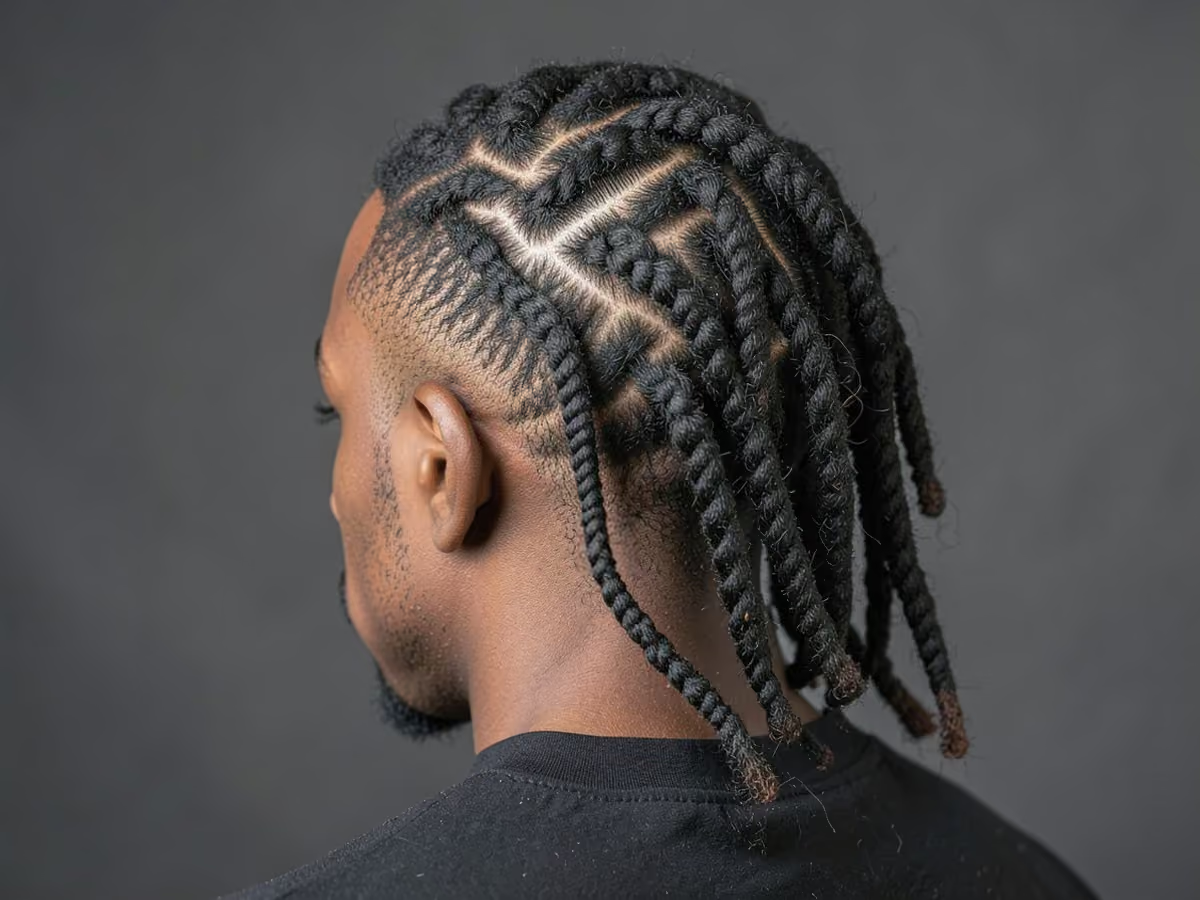
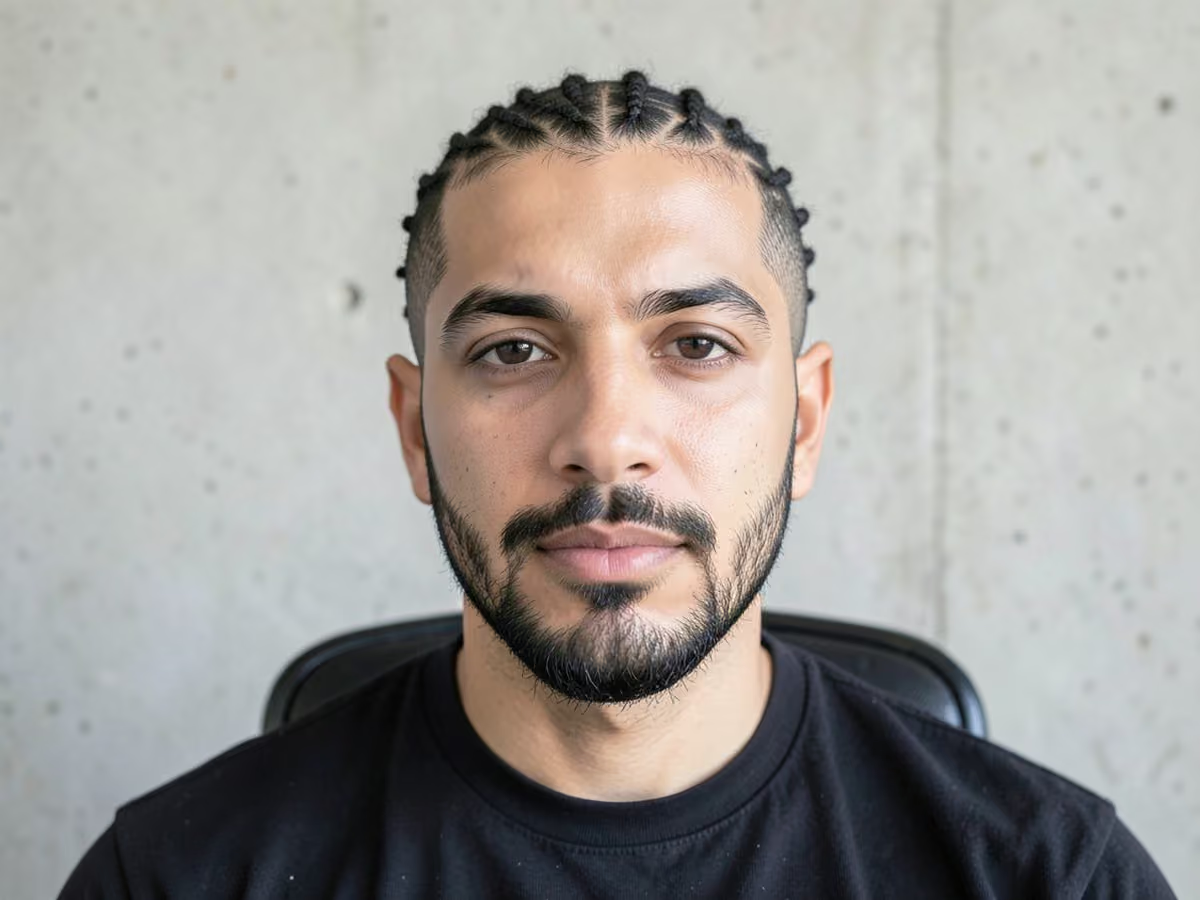
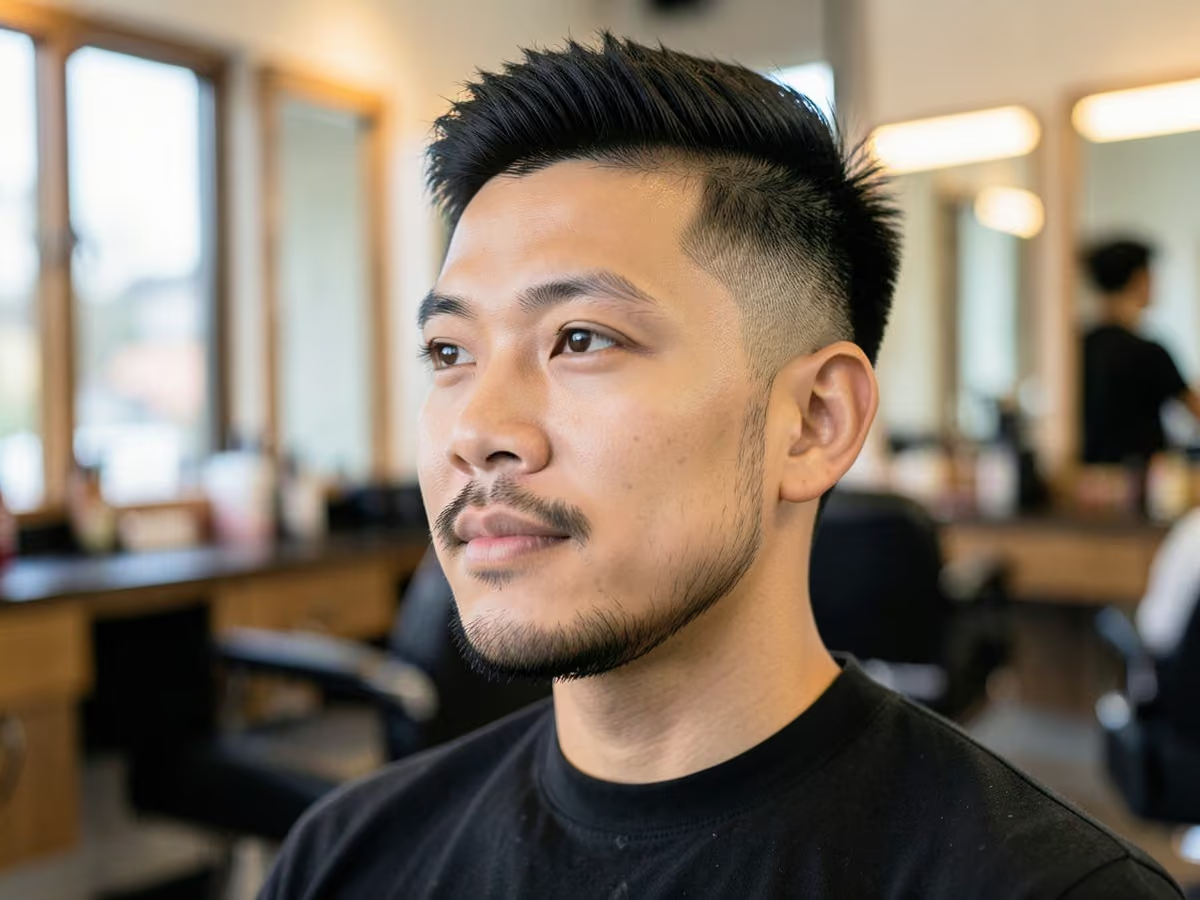
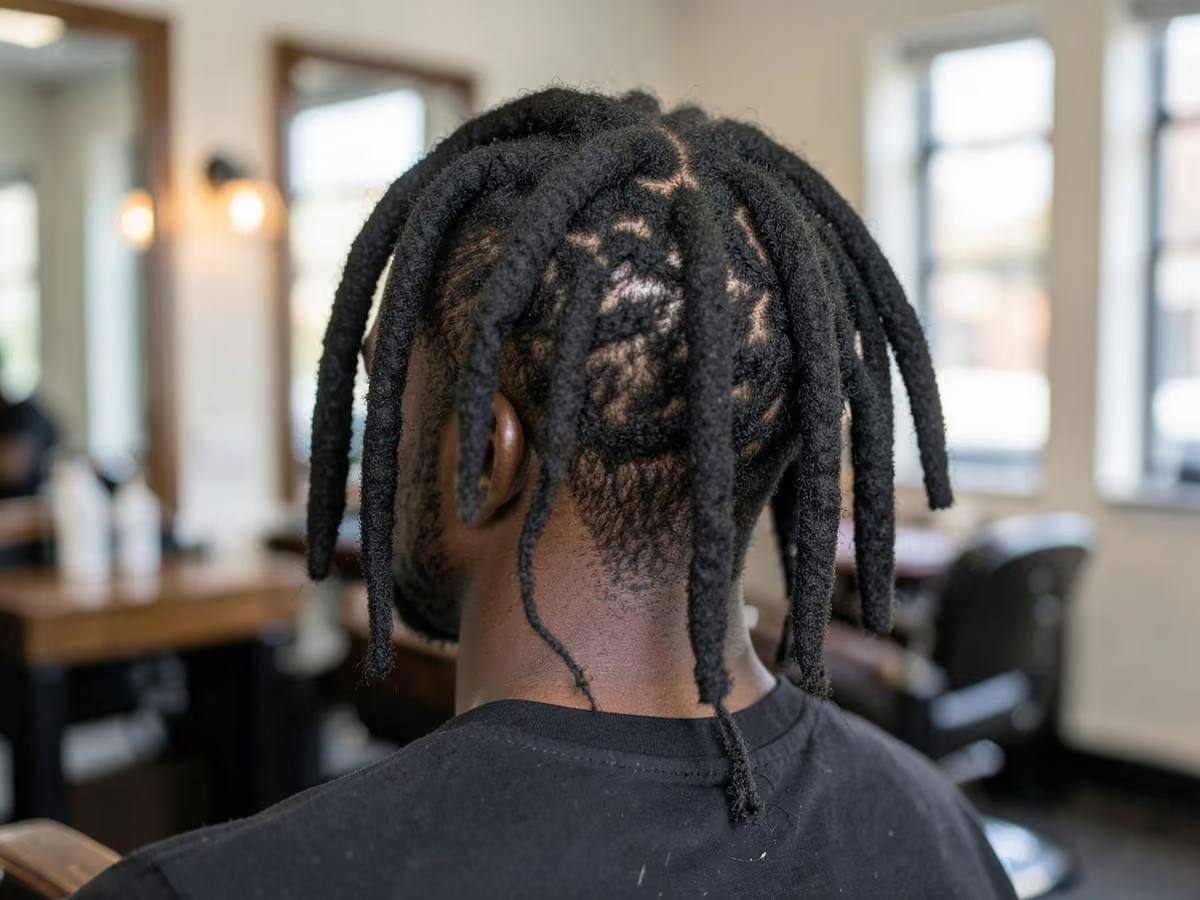
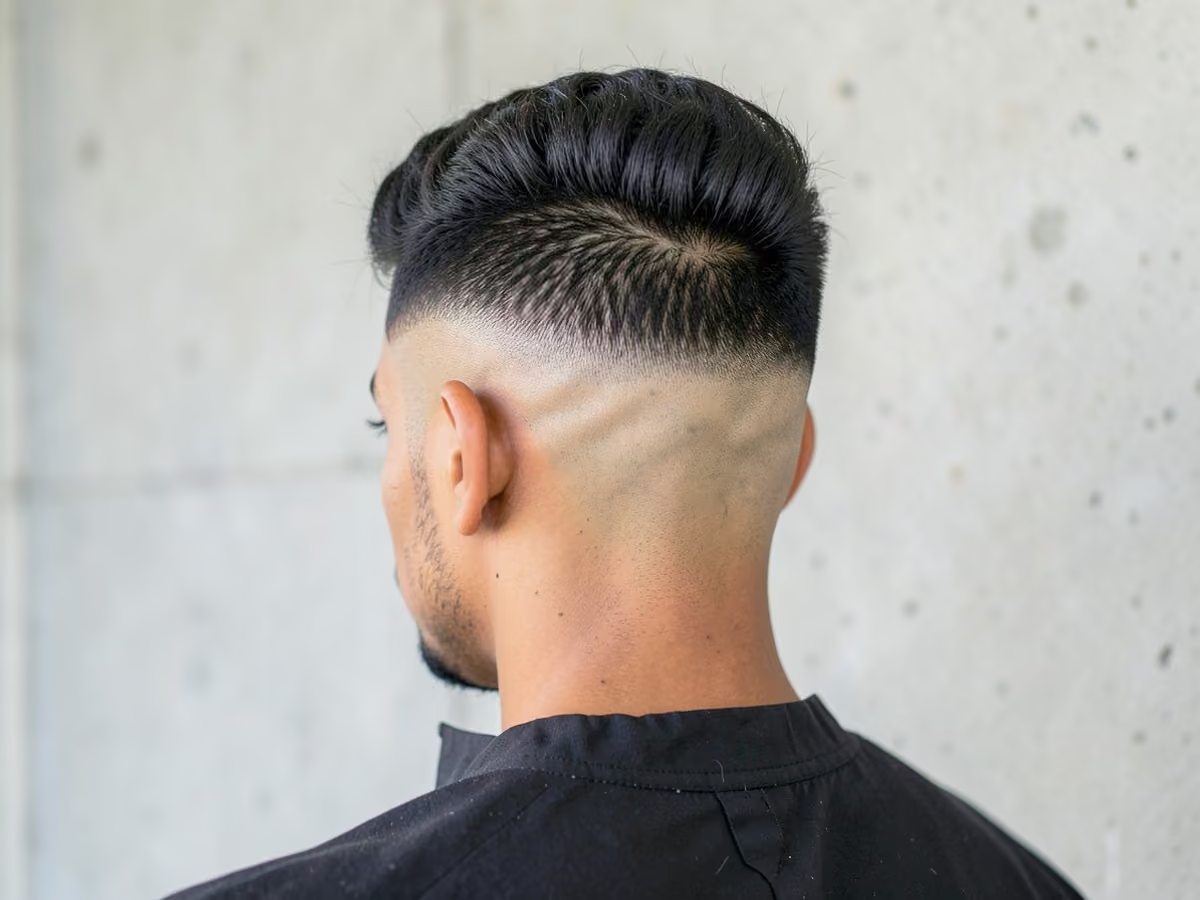
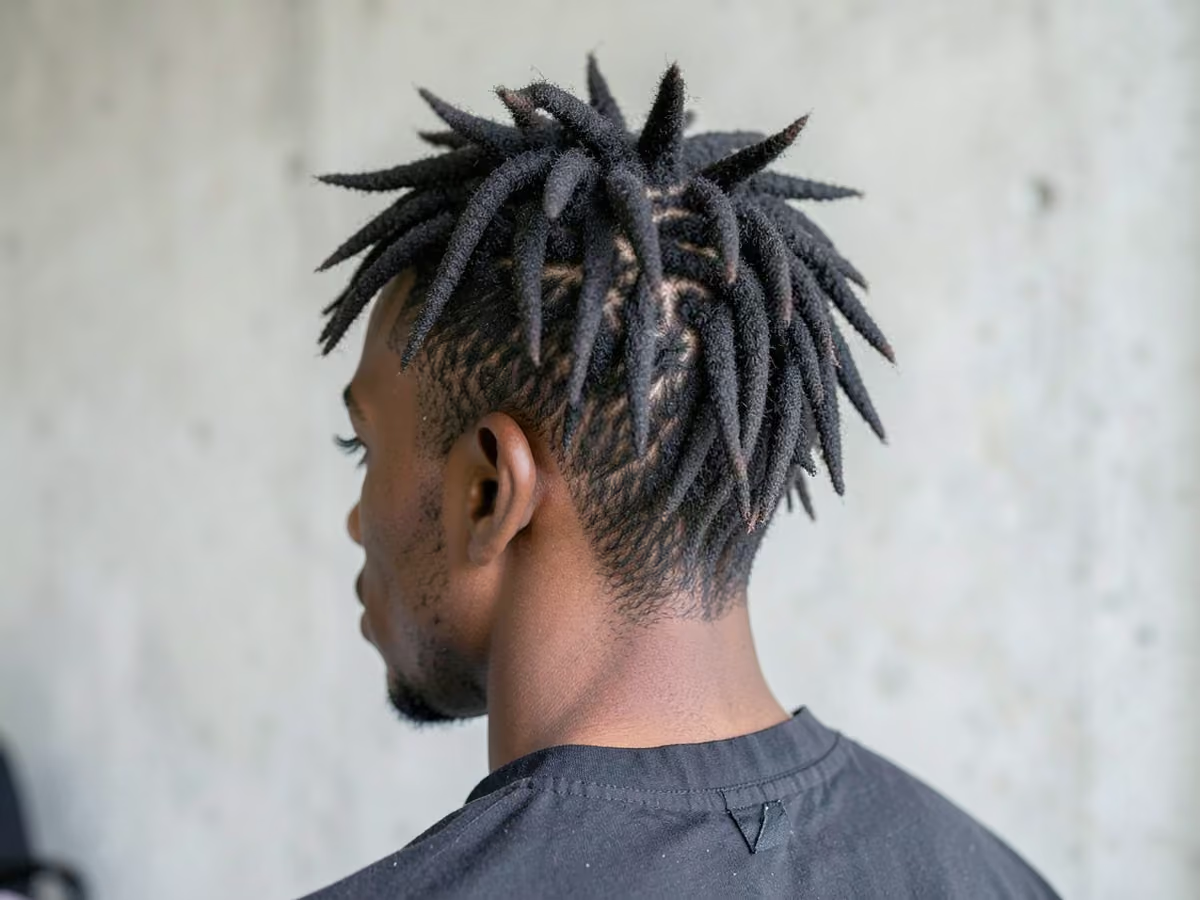
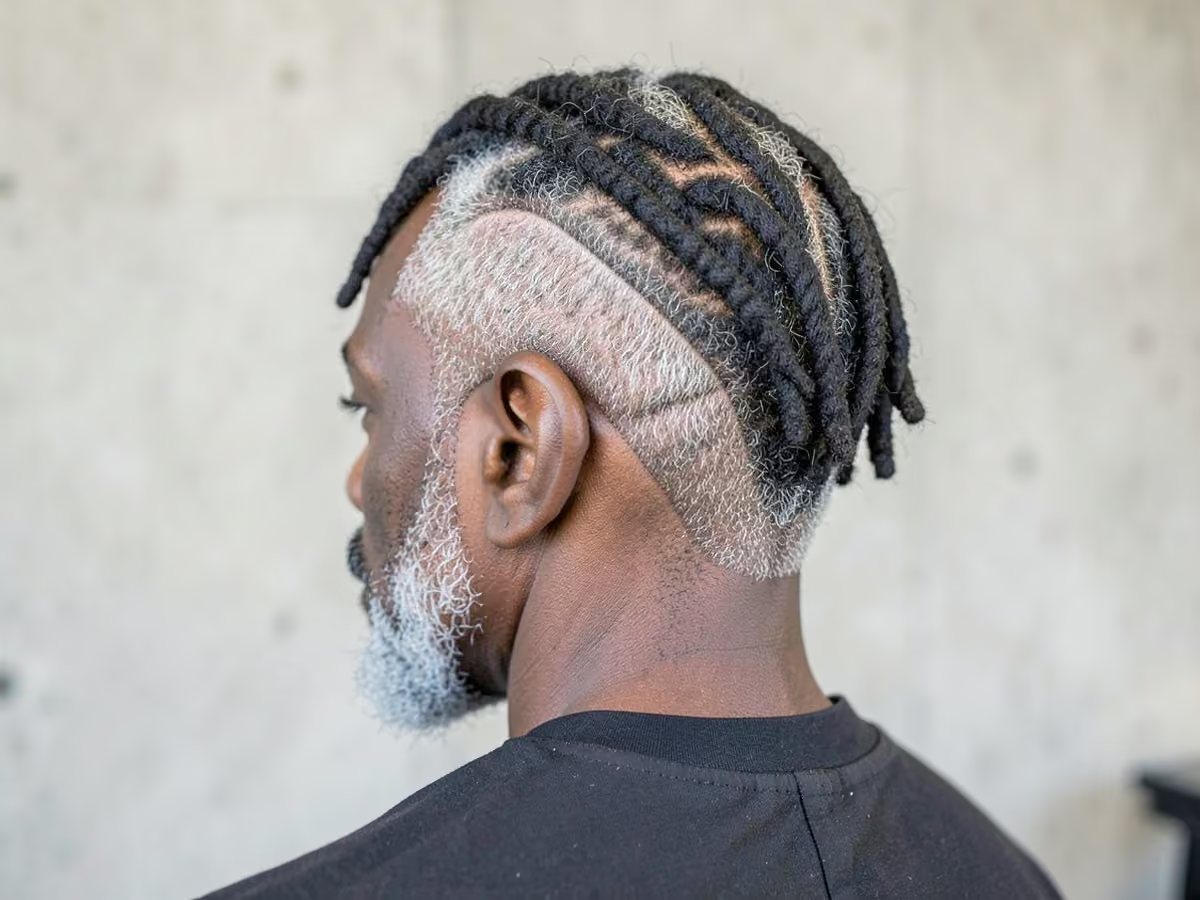
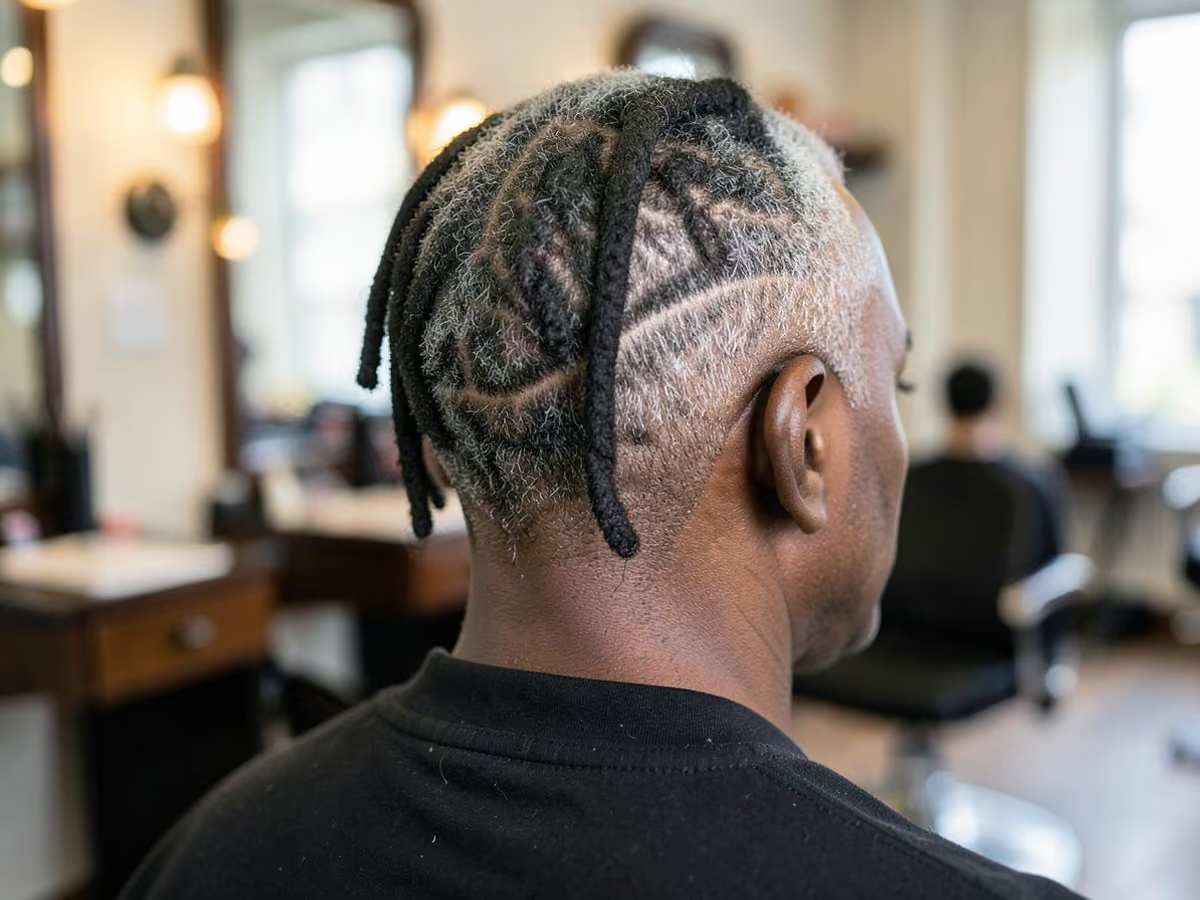
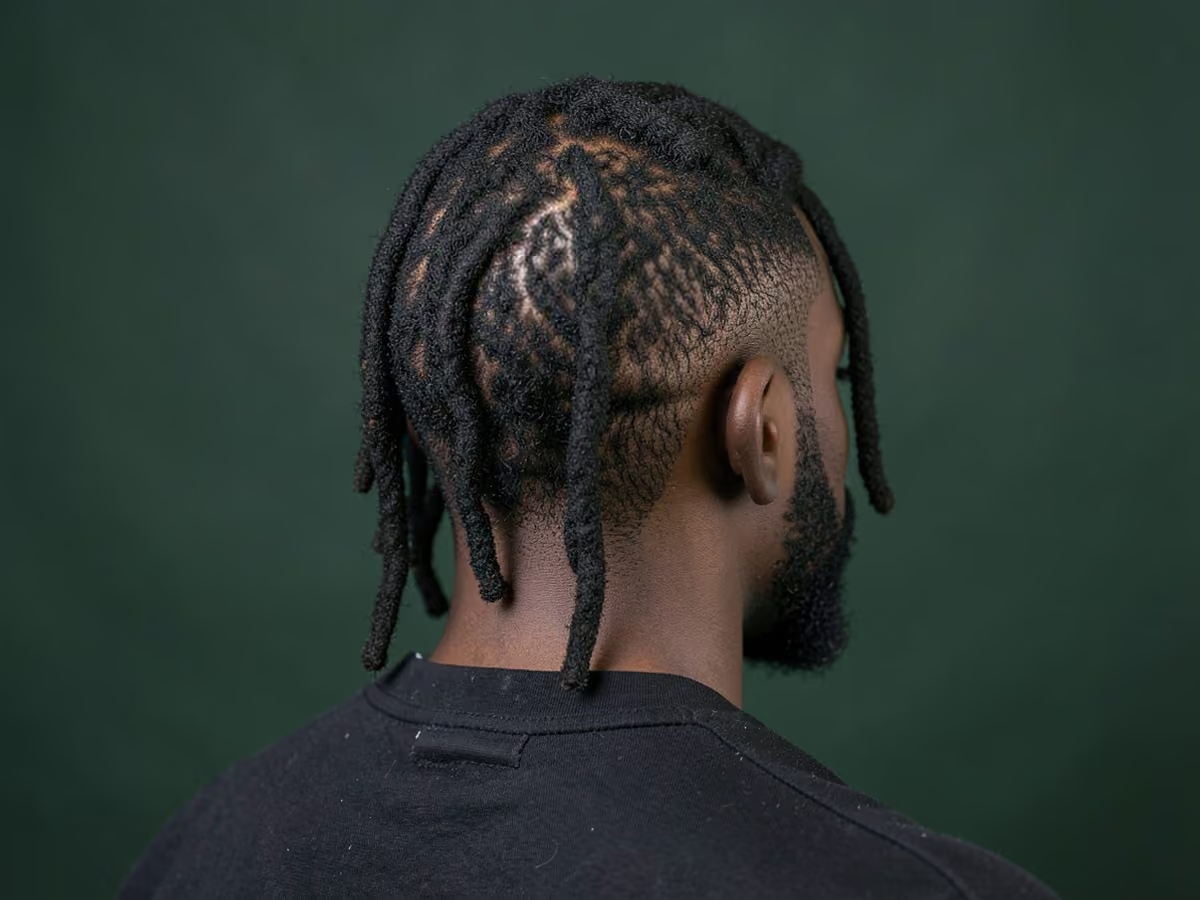
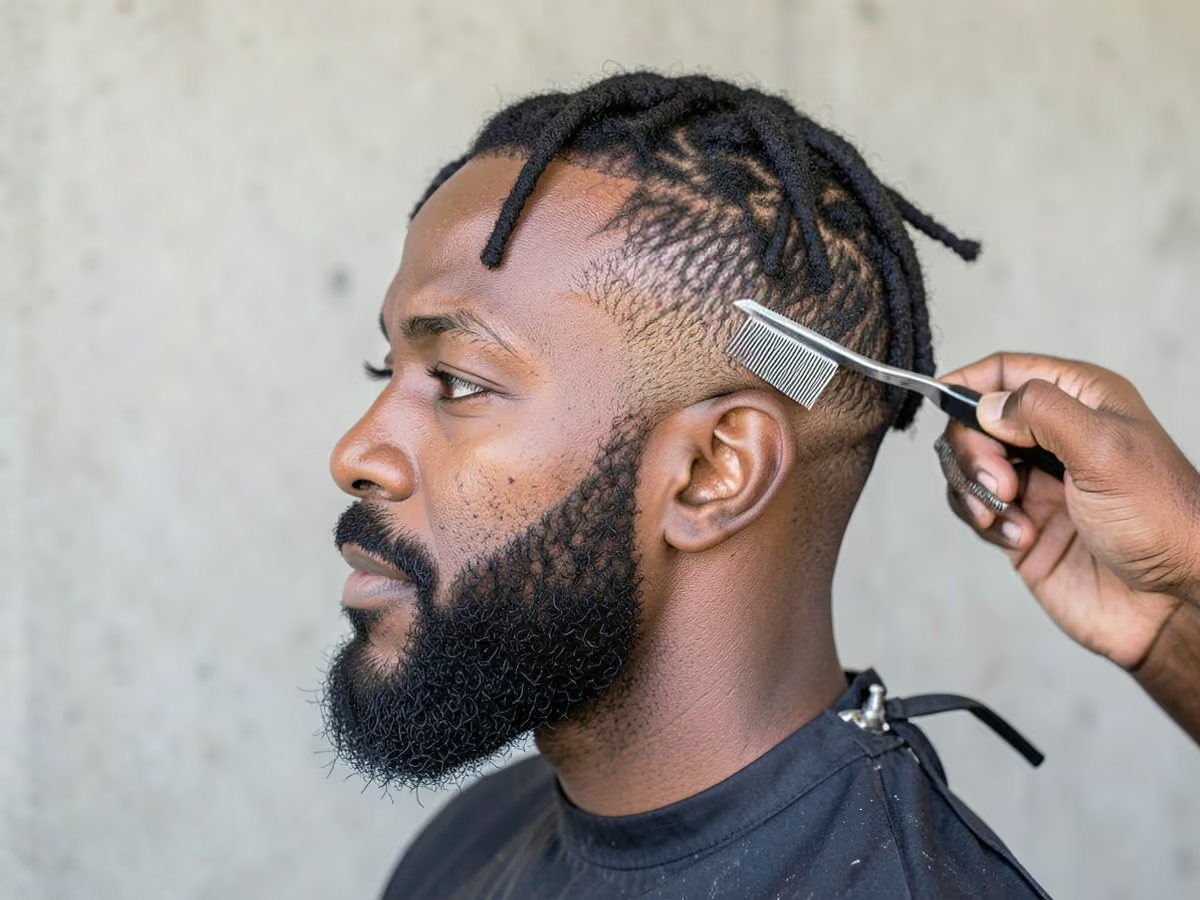
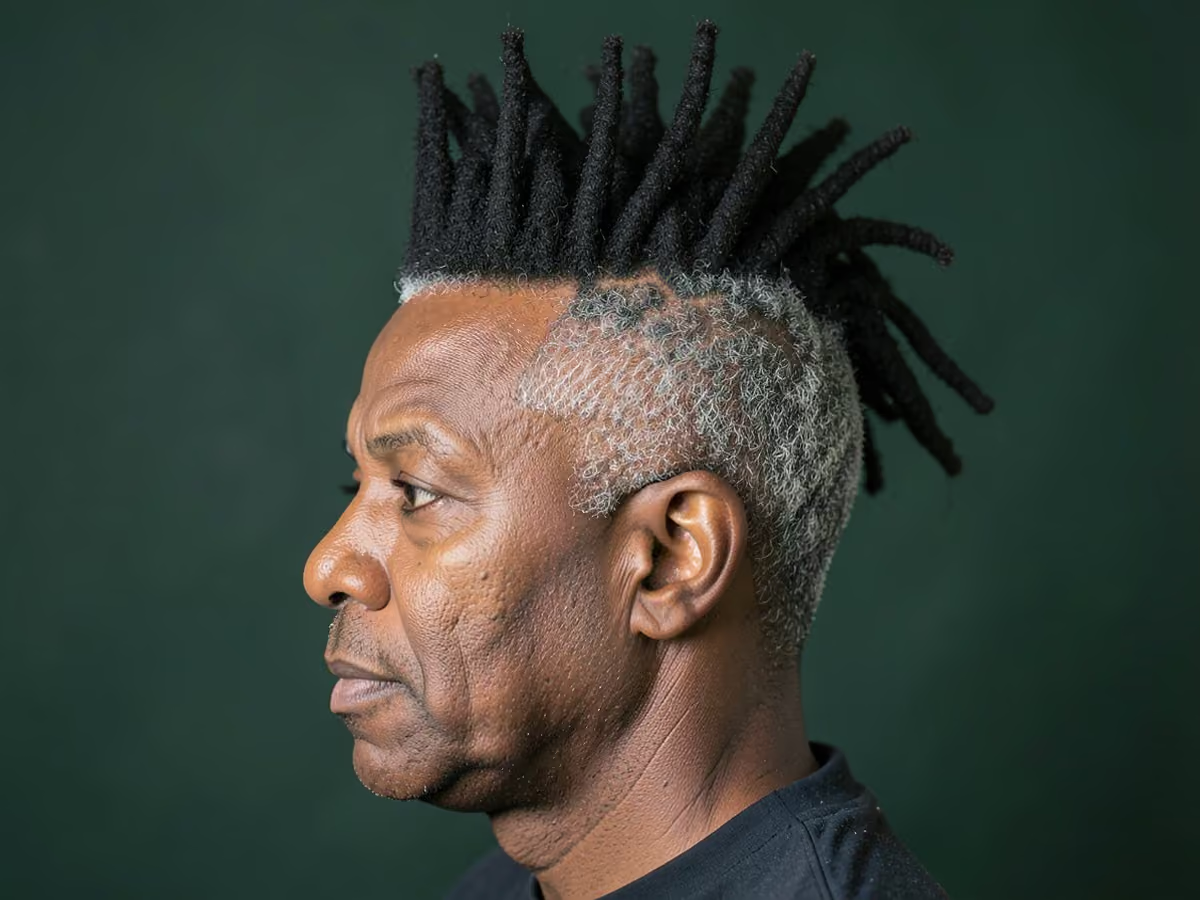
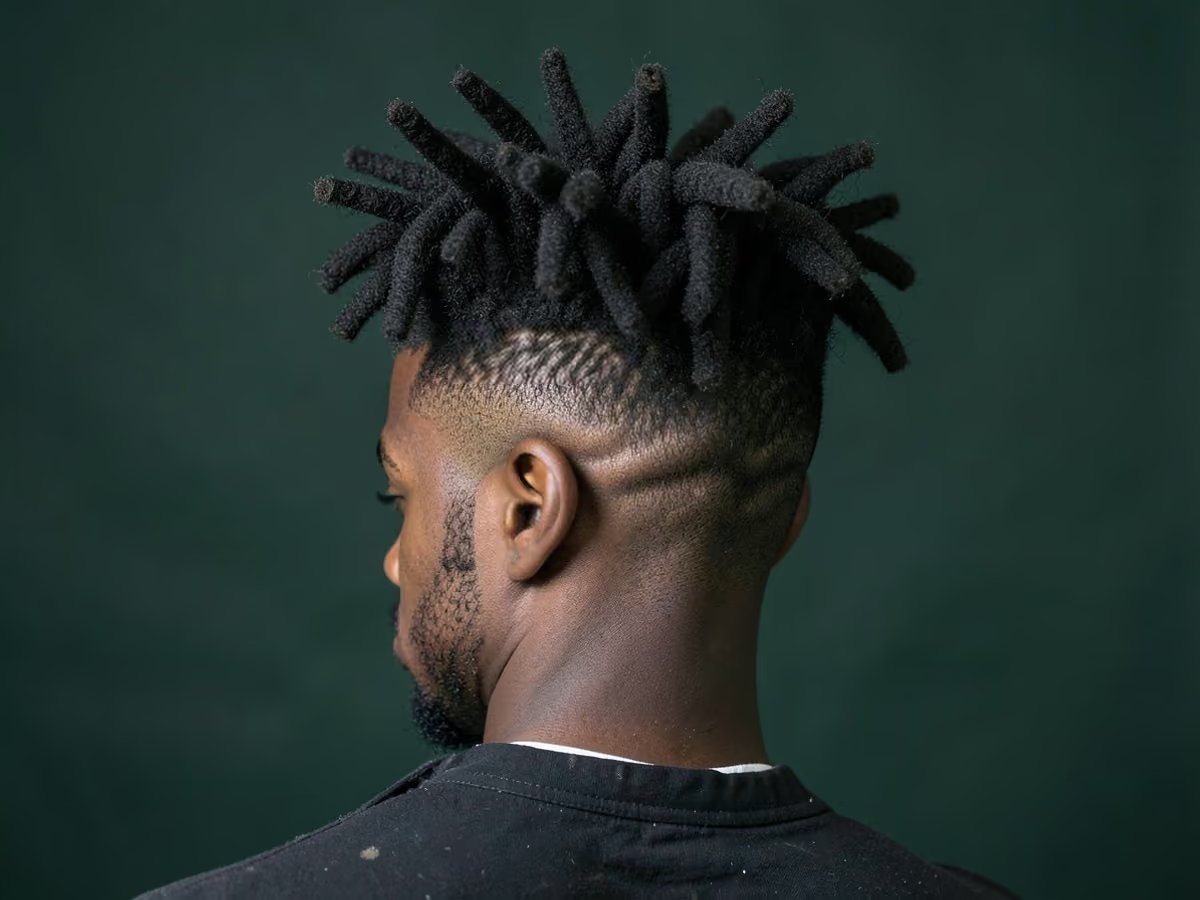
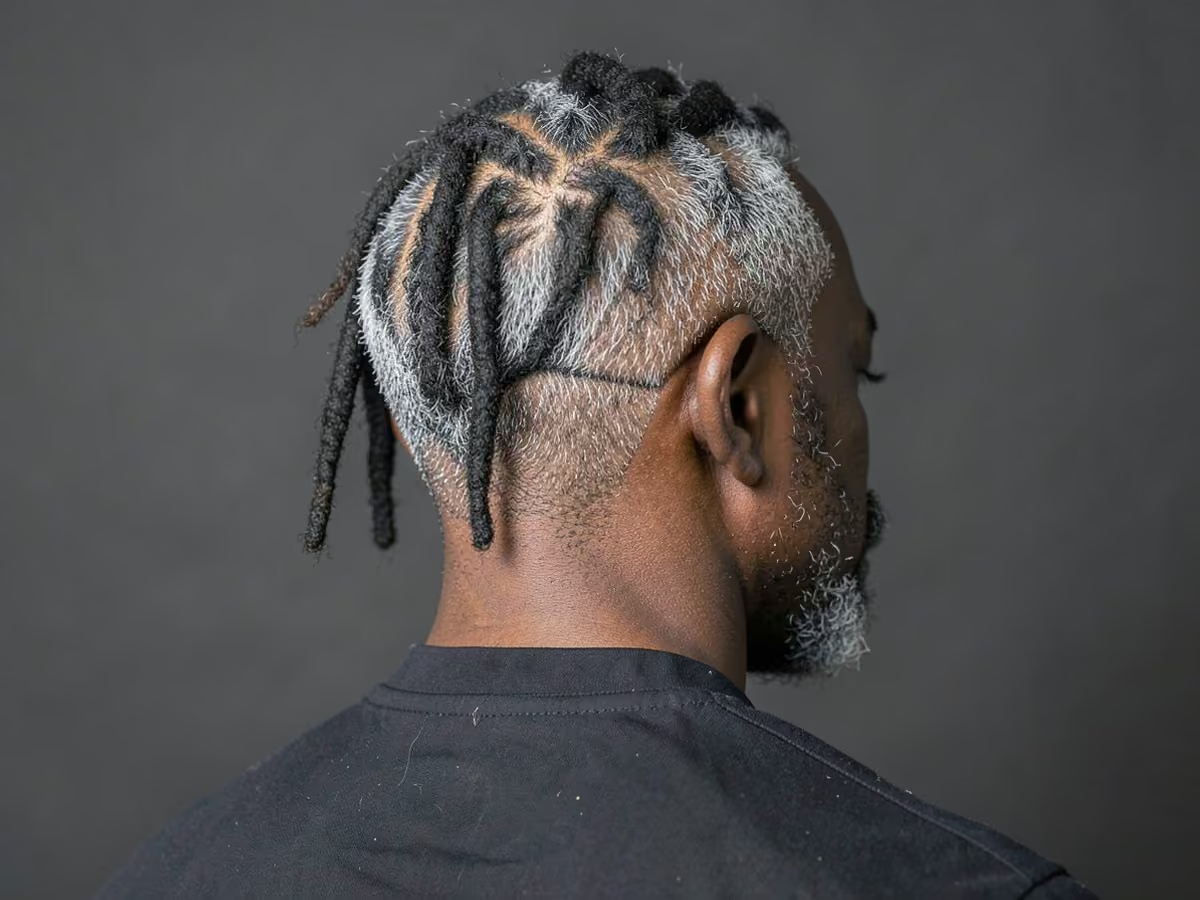
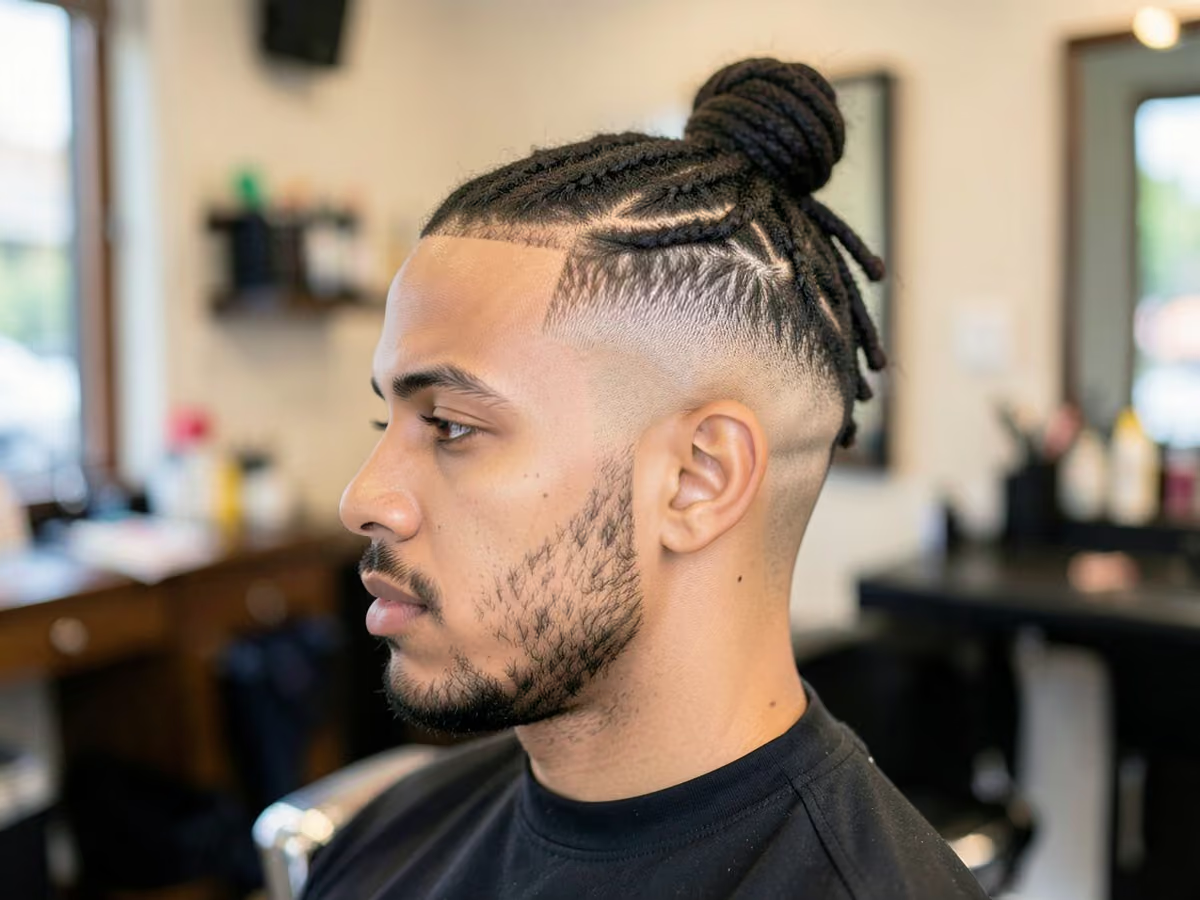
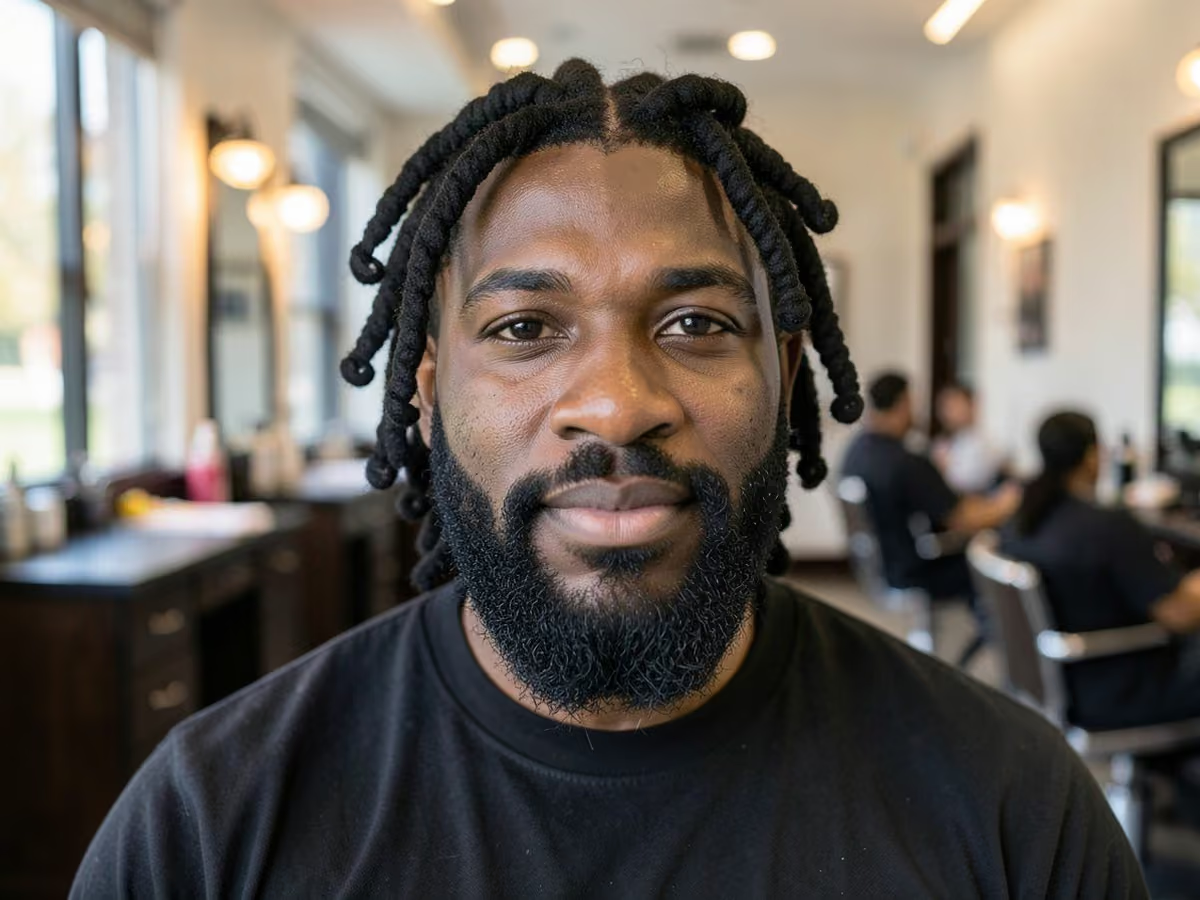
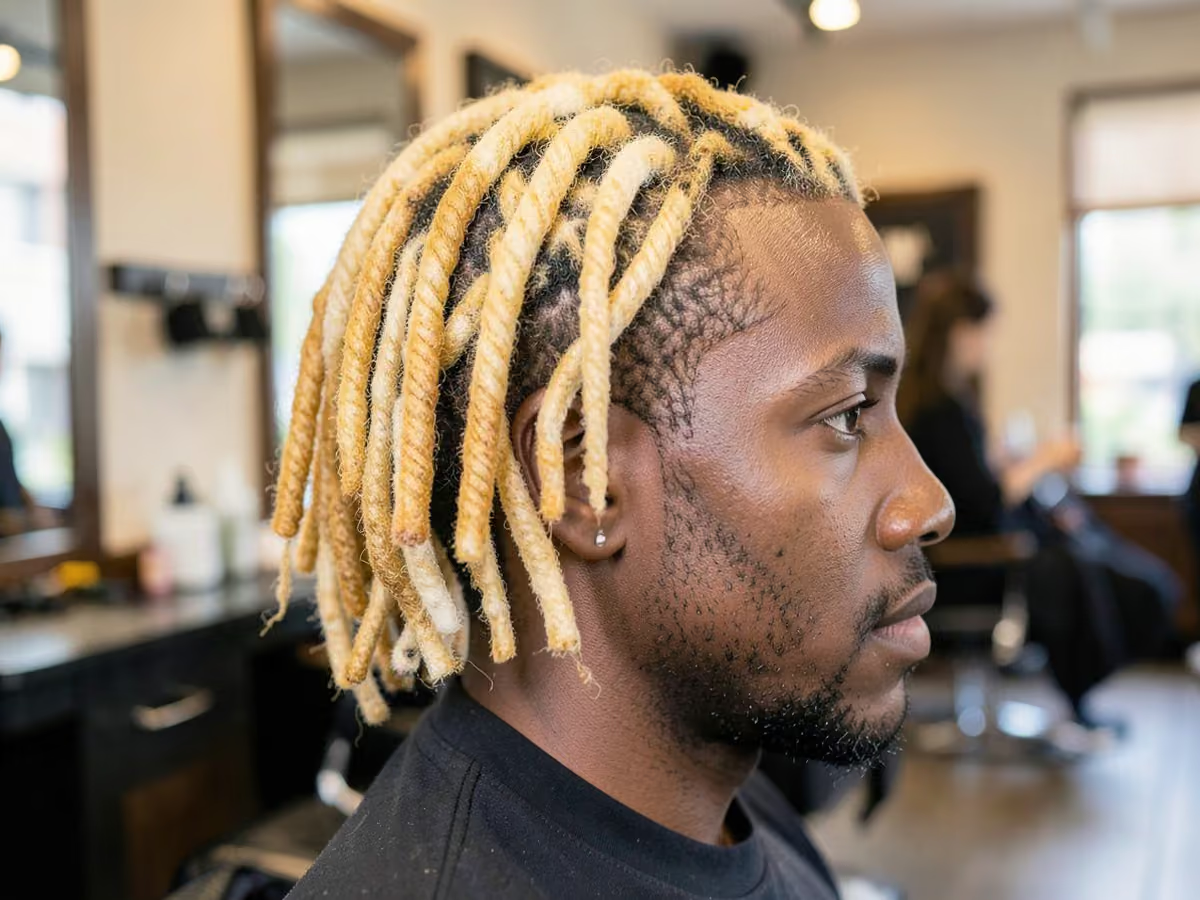
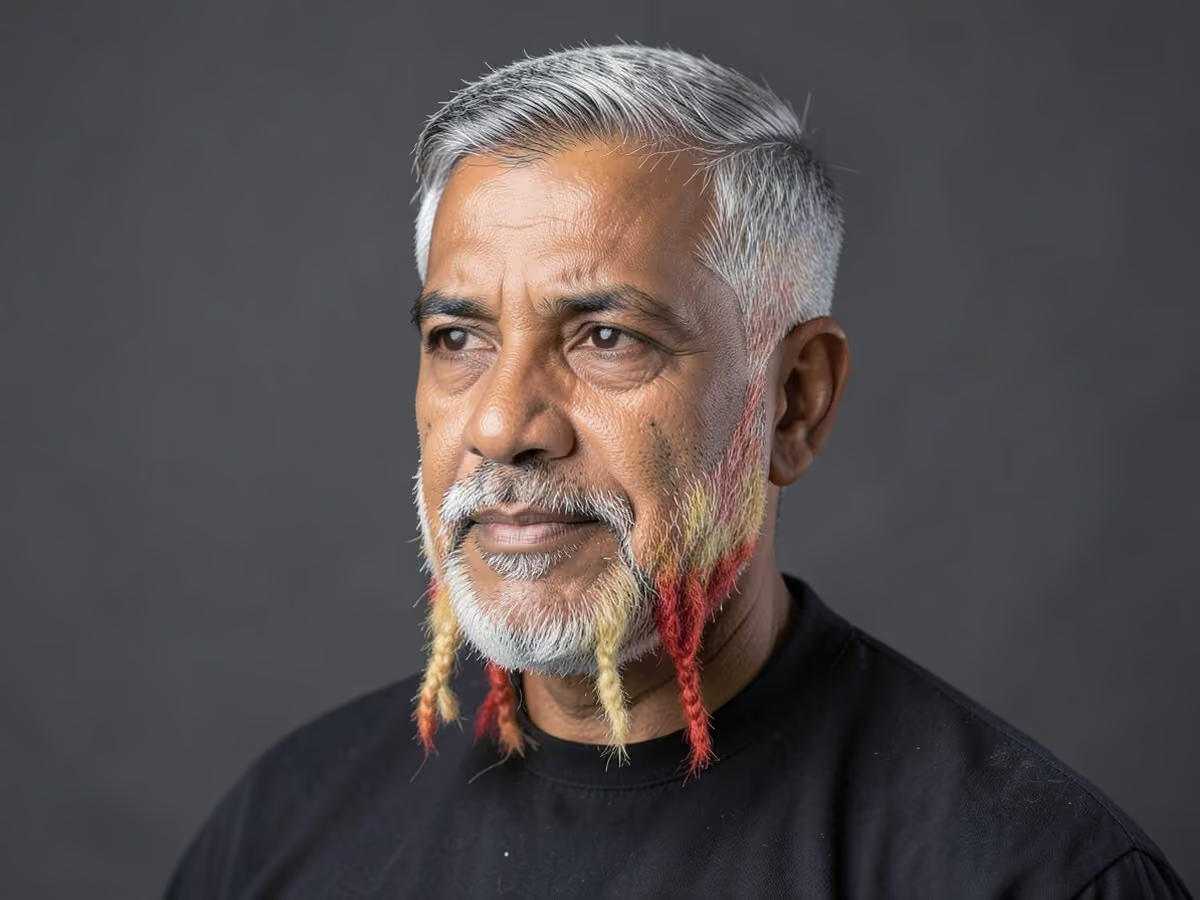
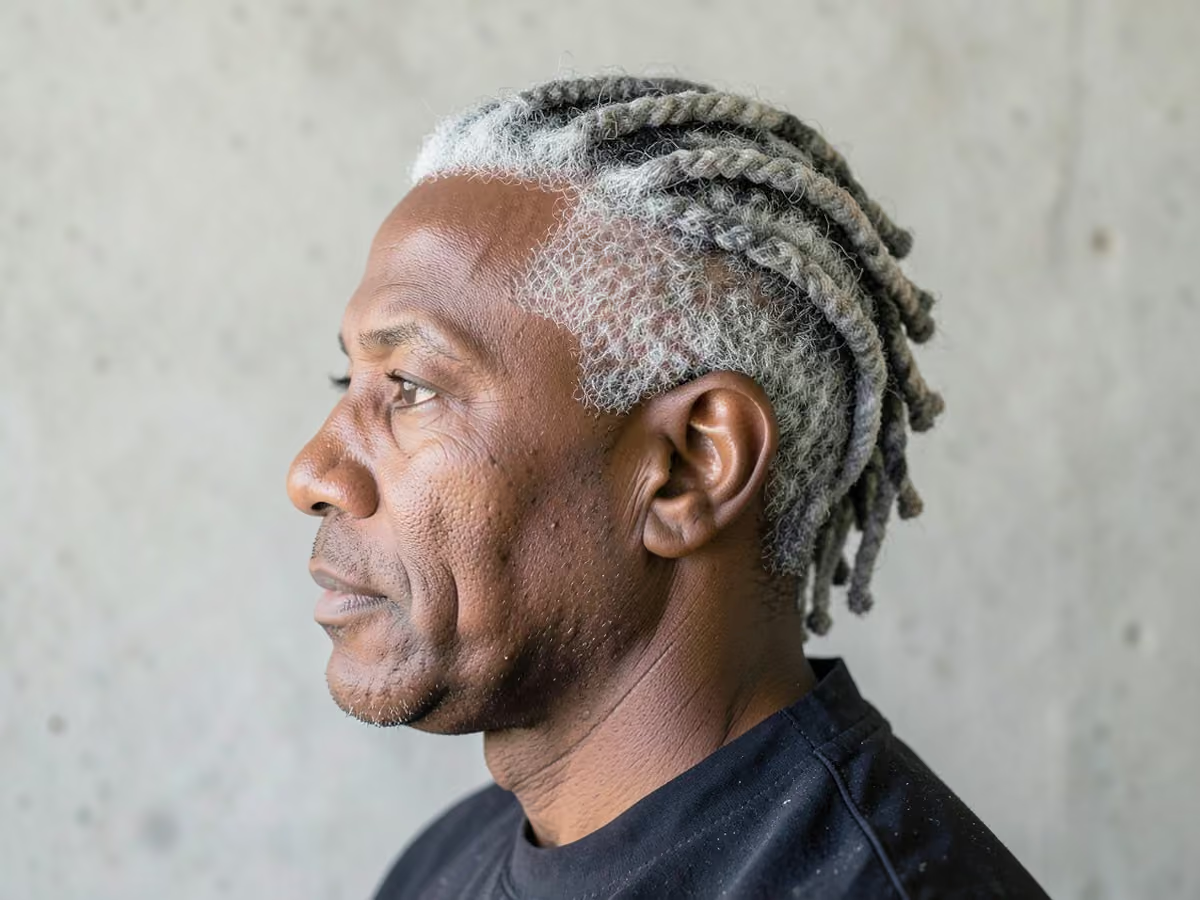
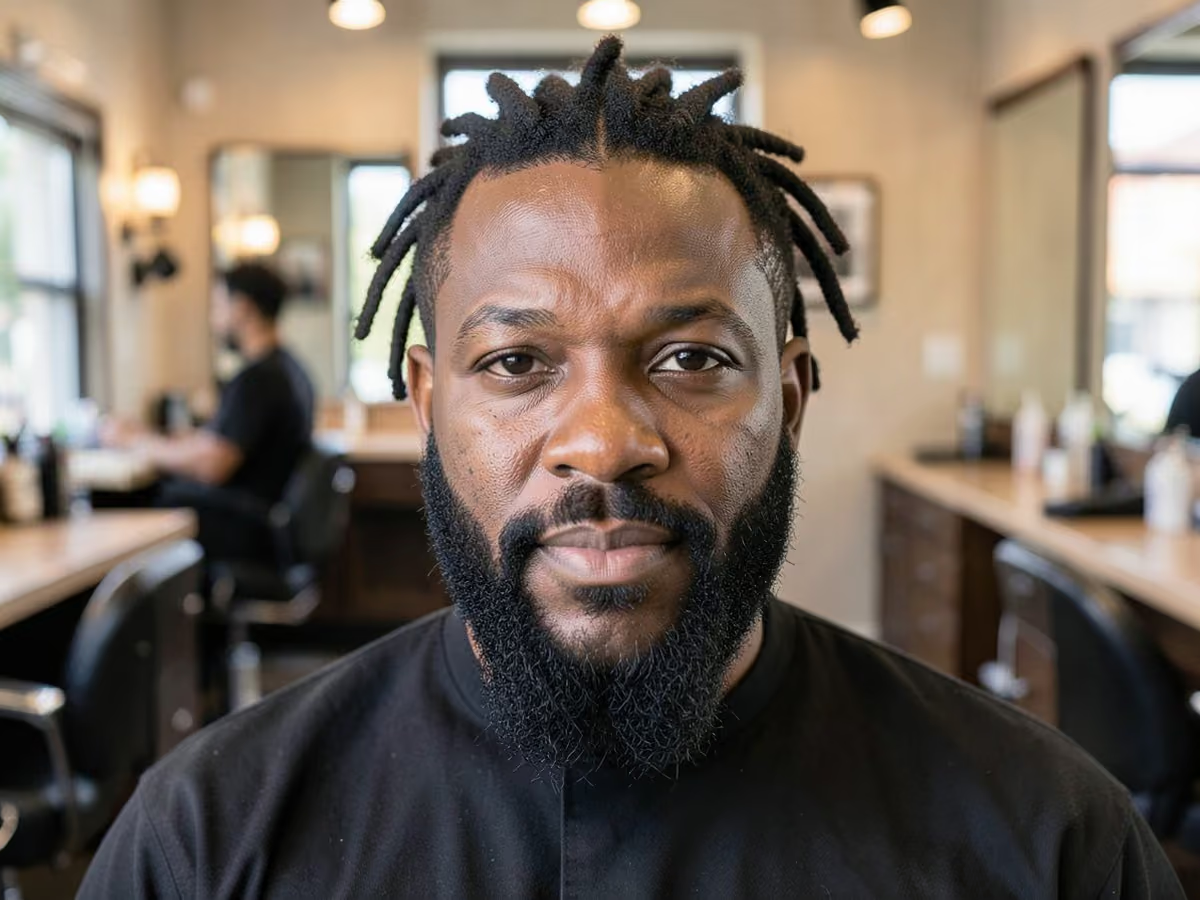
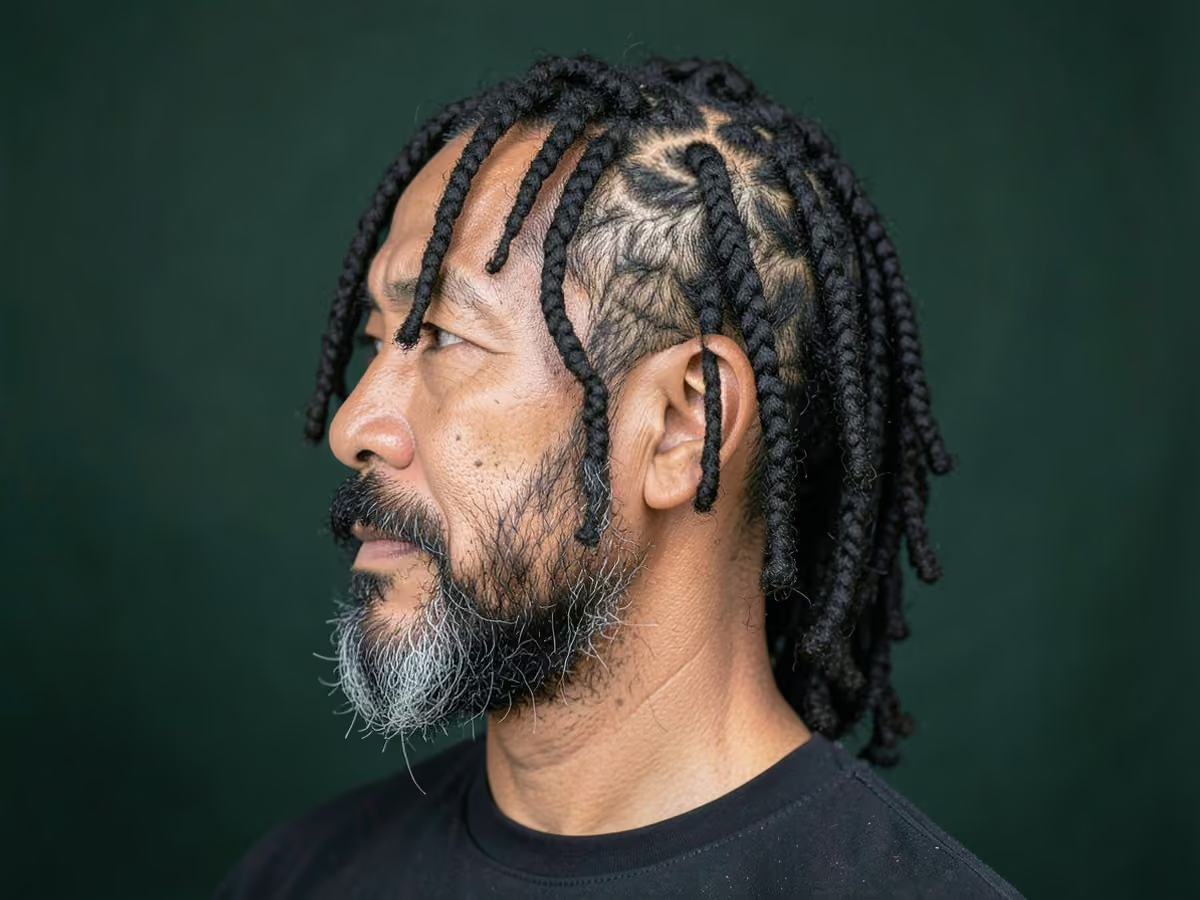
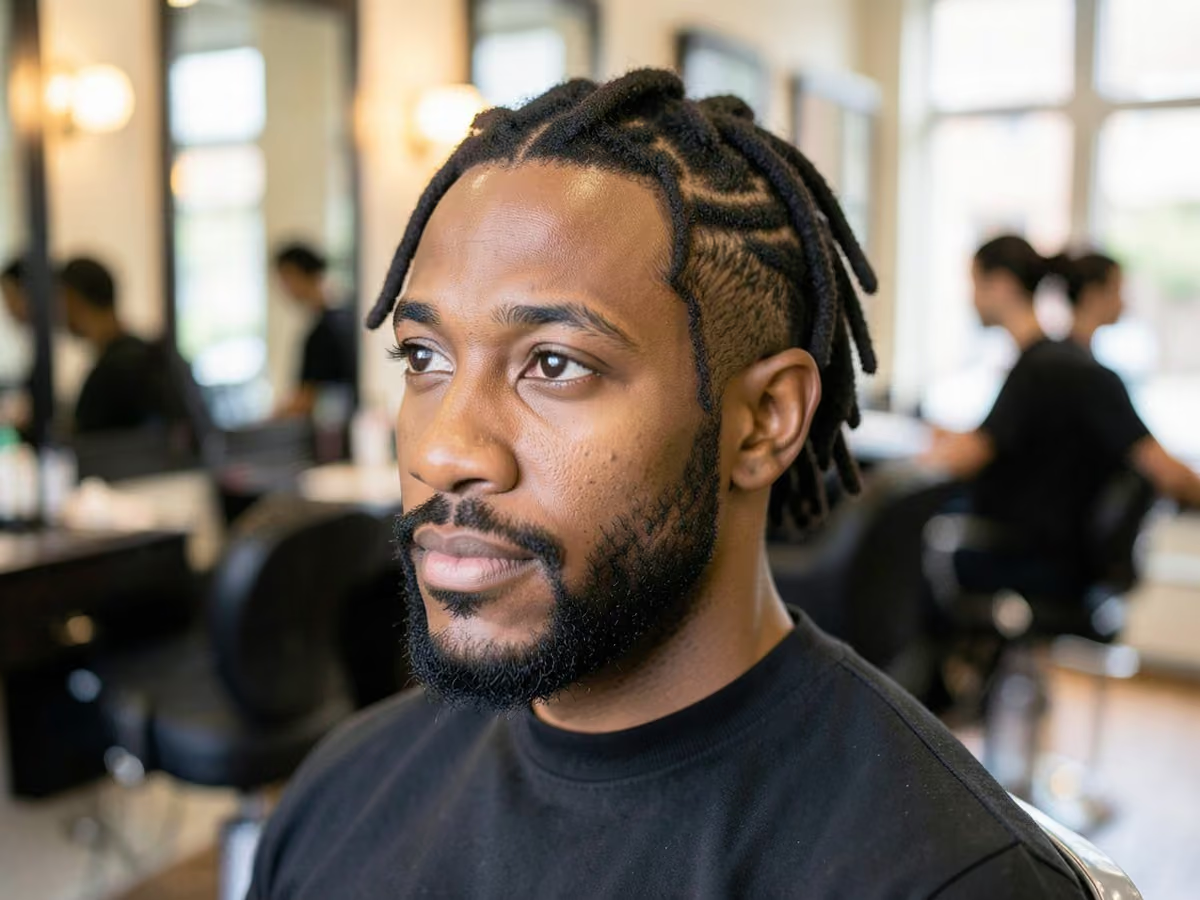
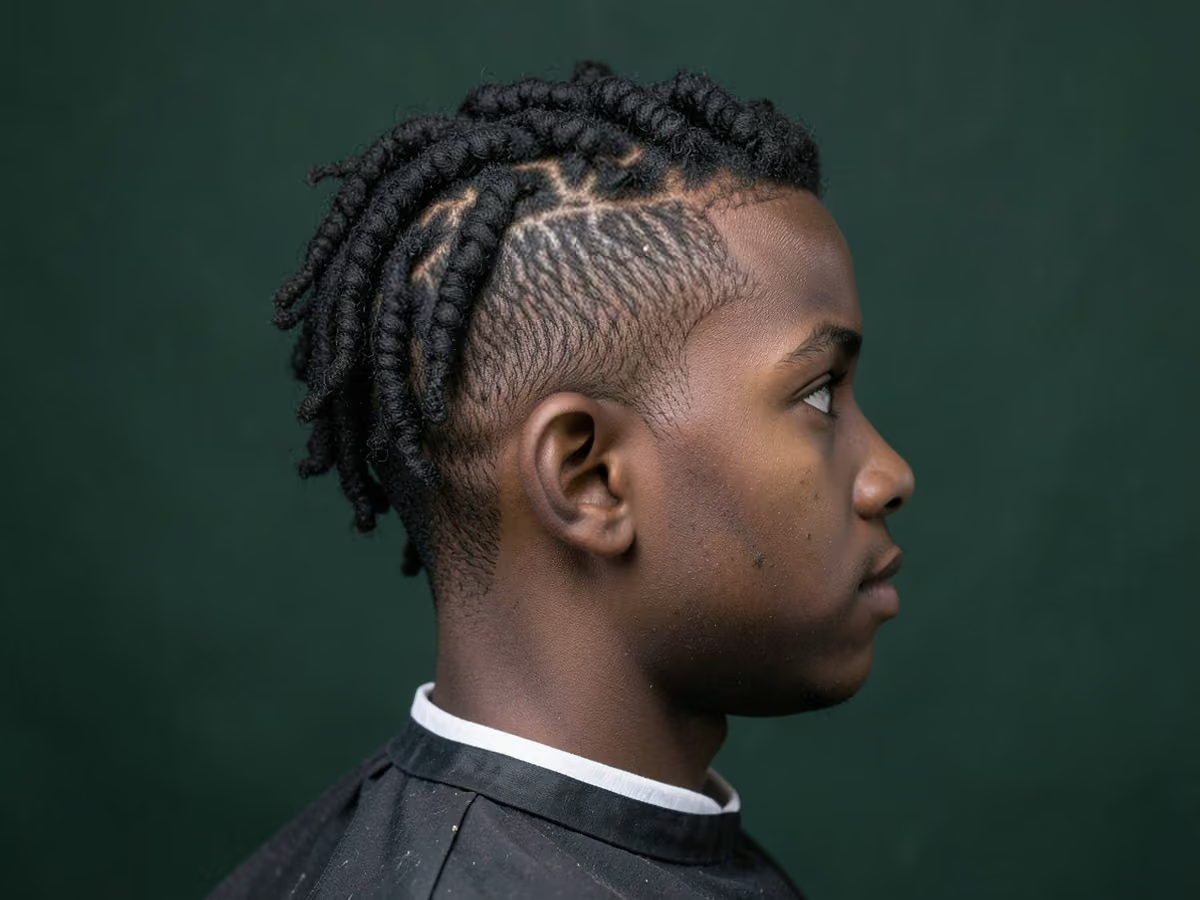
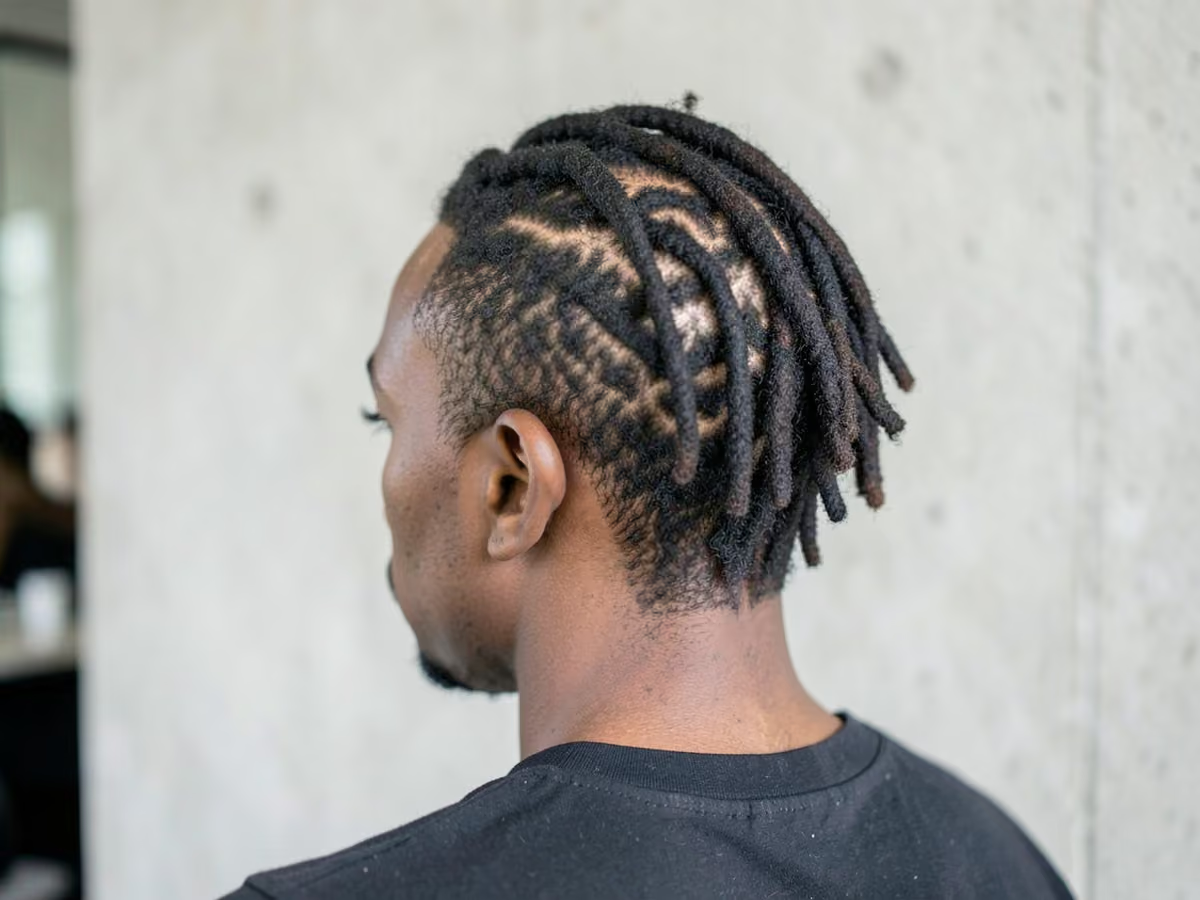
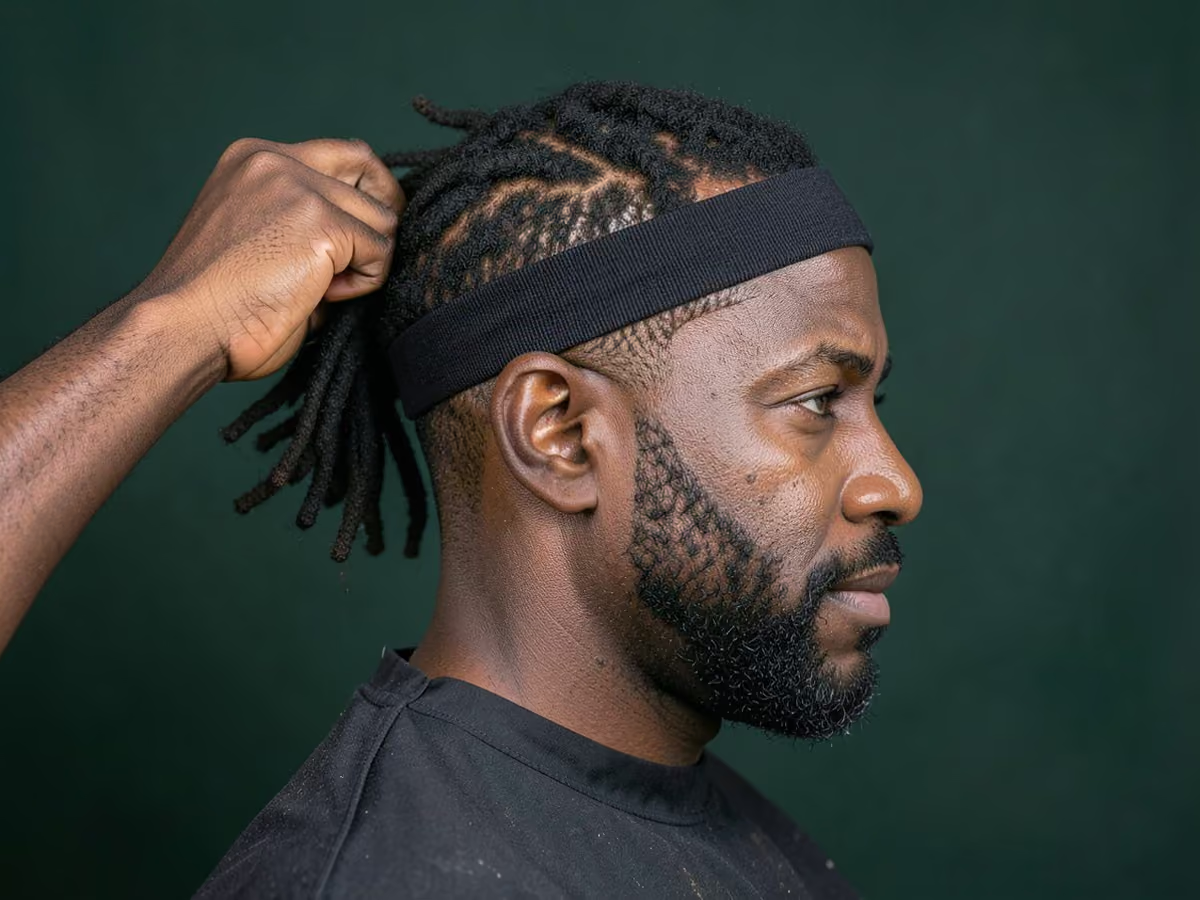
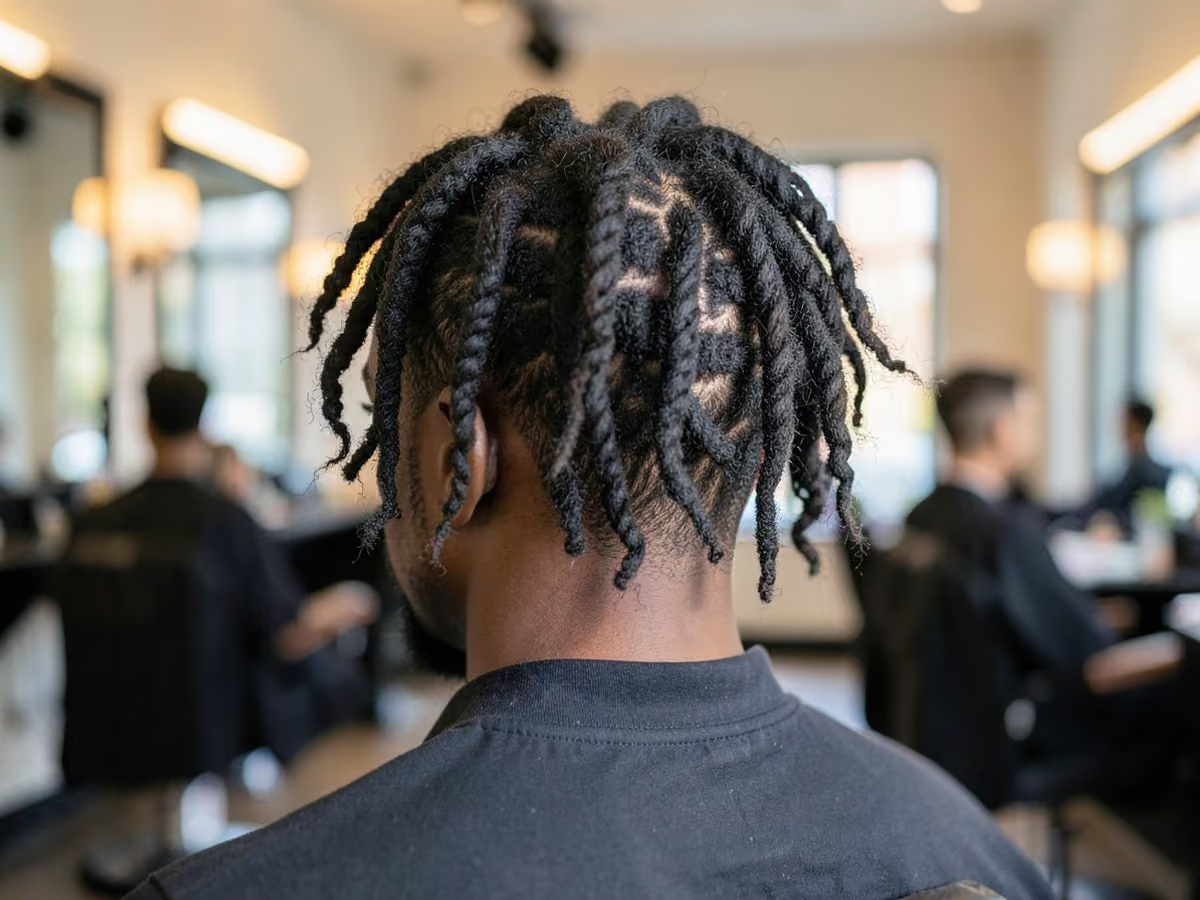
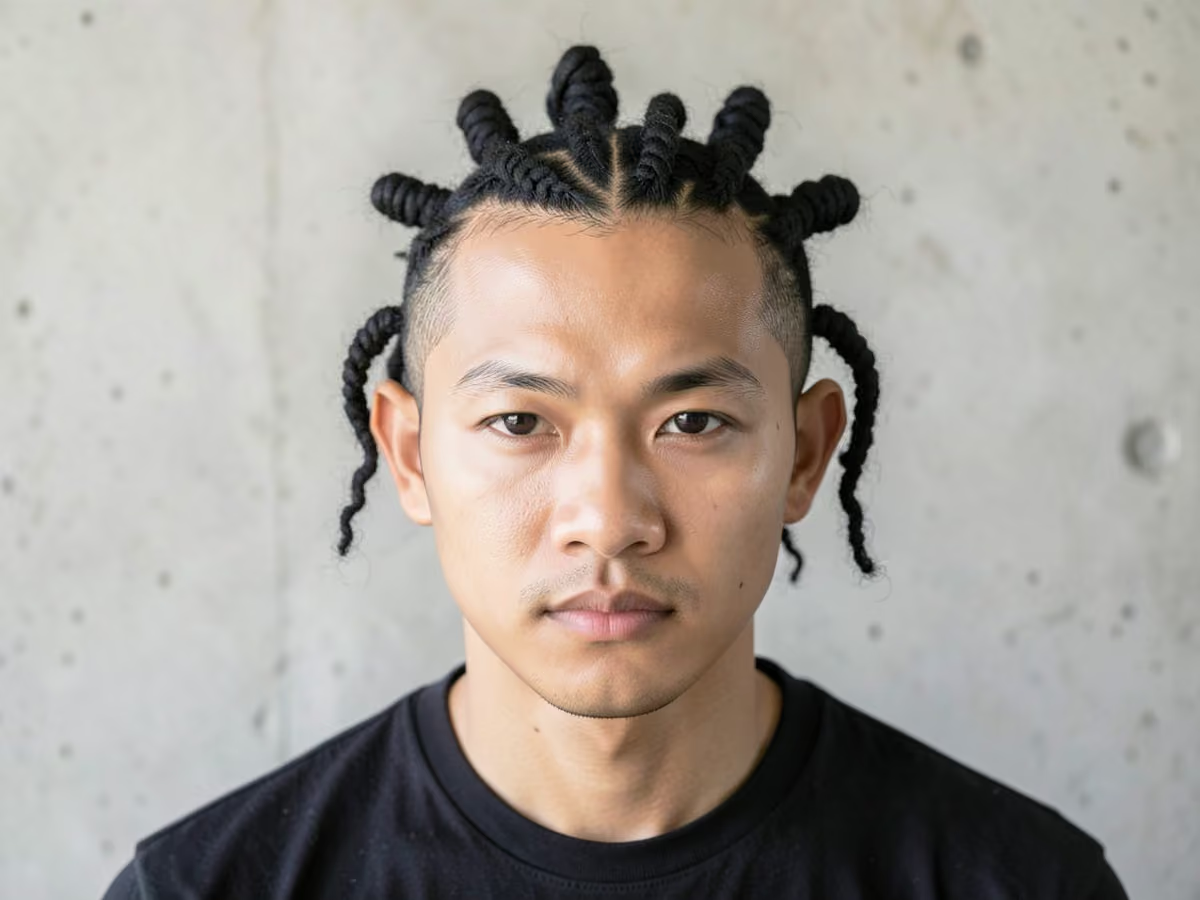
Quick answer: Dreadlocks for men are ropes of hair that mat and lock together over months. They are started with comb coils, two-strand twists, interlocking, backcombing or crochet, or left to form freeform. Most locs take six months to two years to mature, and cultivated locs need retwisting or interlocking every four to ten weeks.
Dreadlocks for Men Styles at a Glance
Every style on this page with its clipper guard, top length and trim interval. Tap a name to jump to that card.
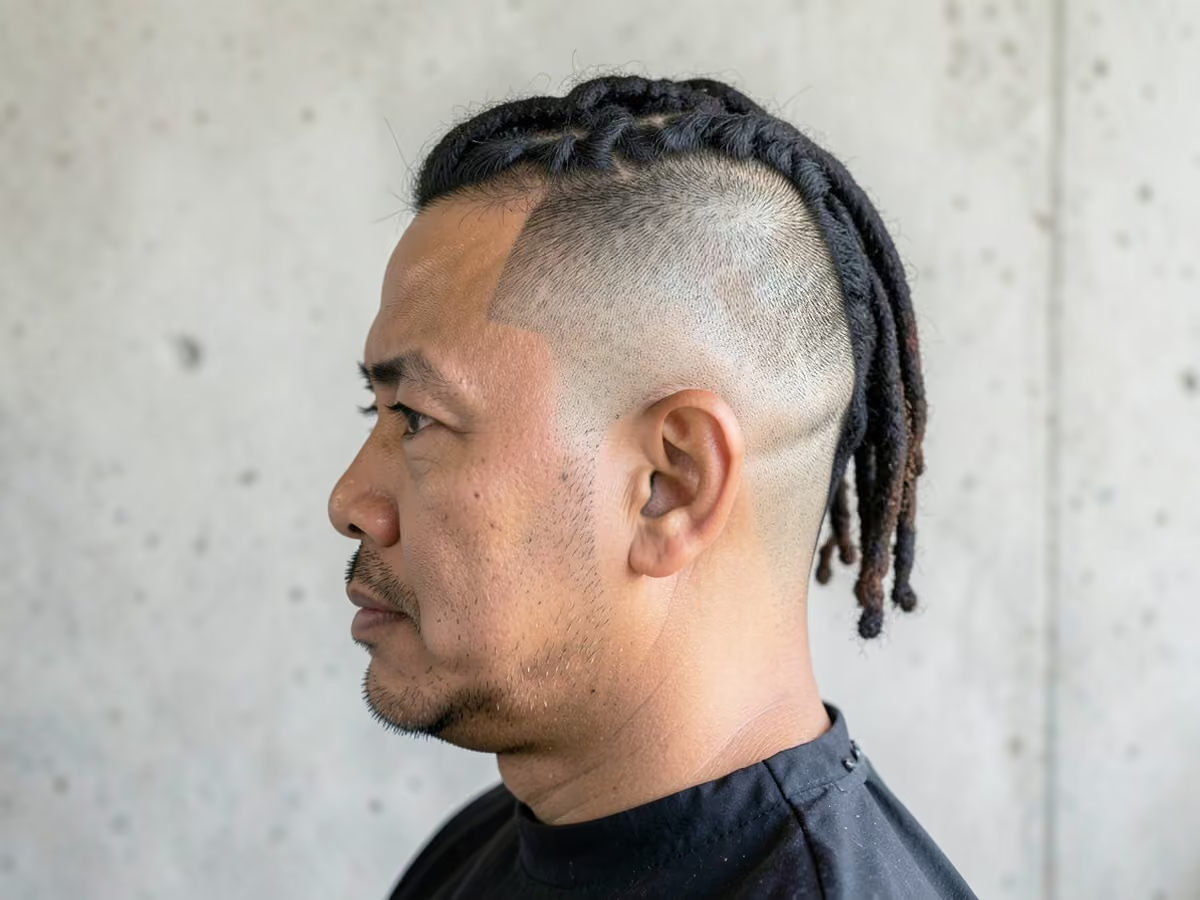
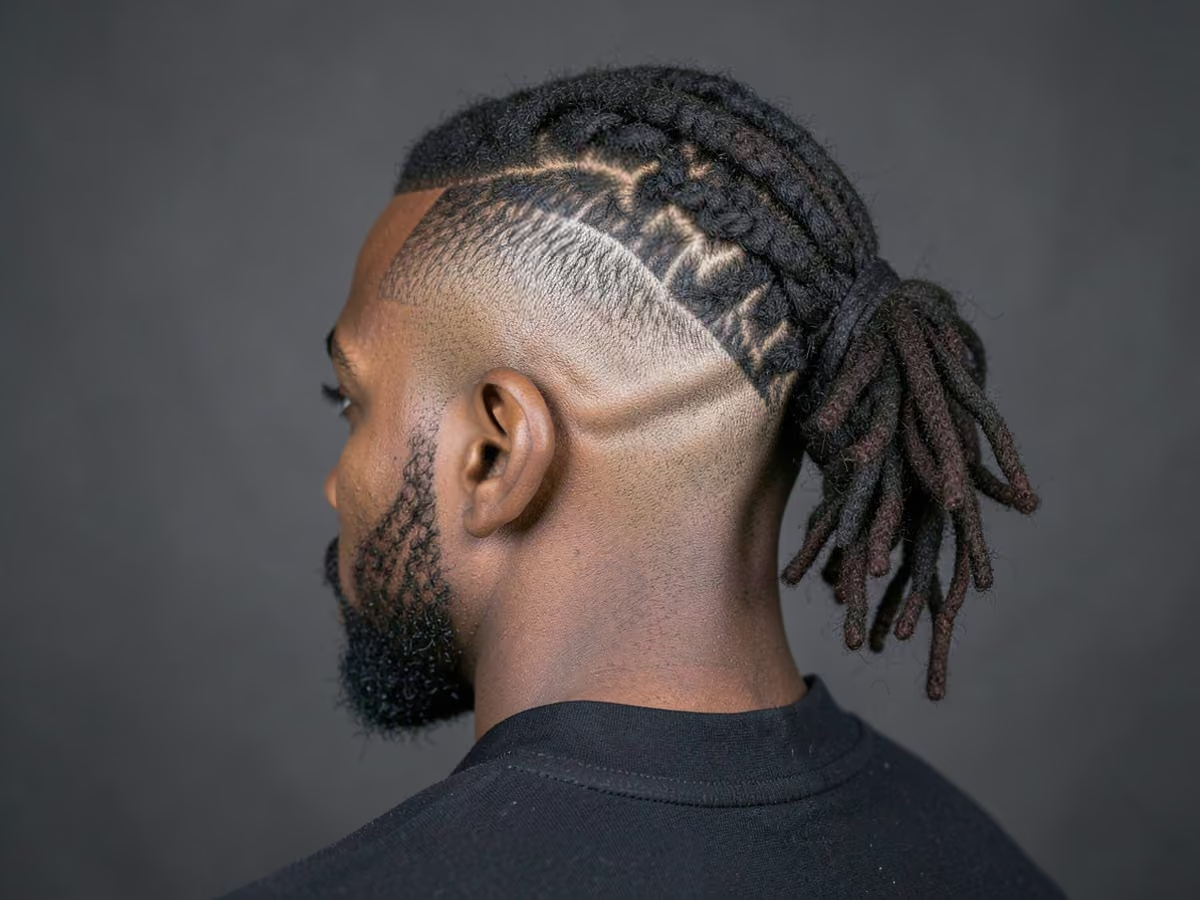
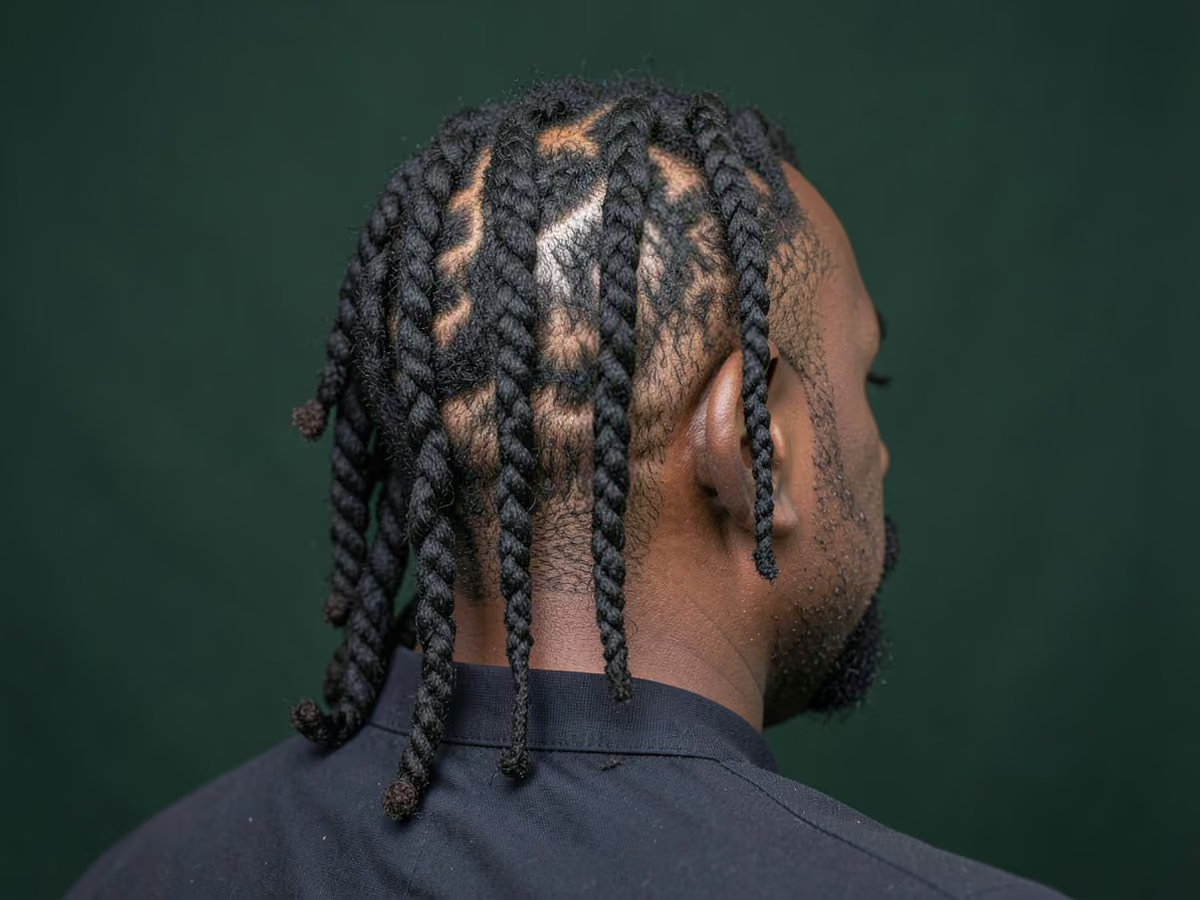
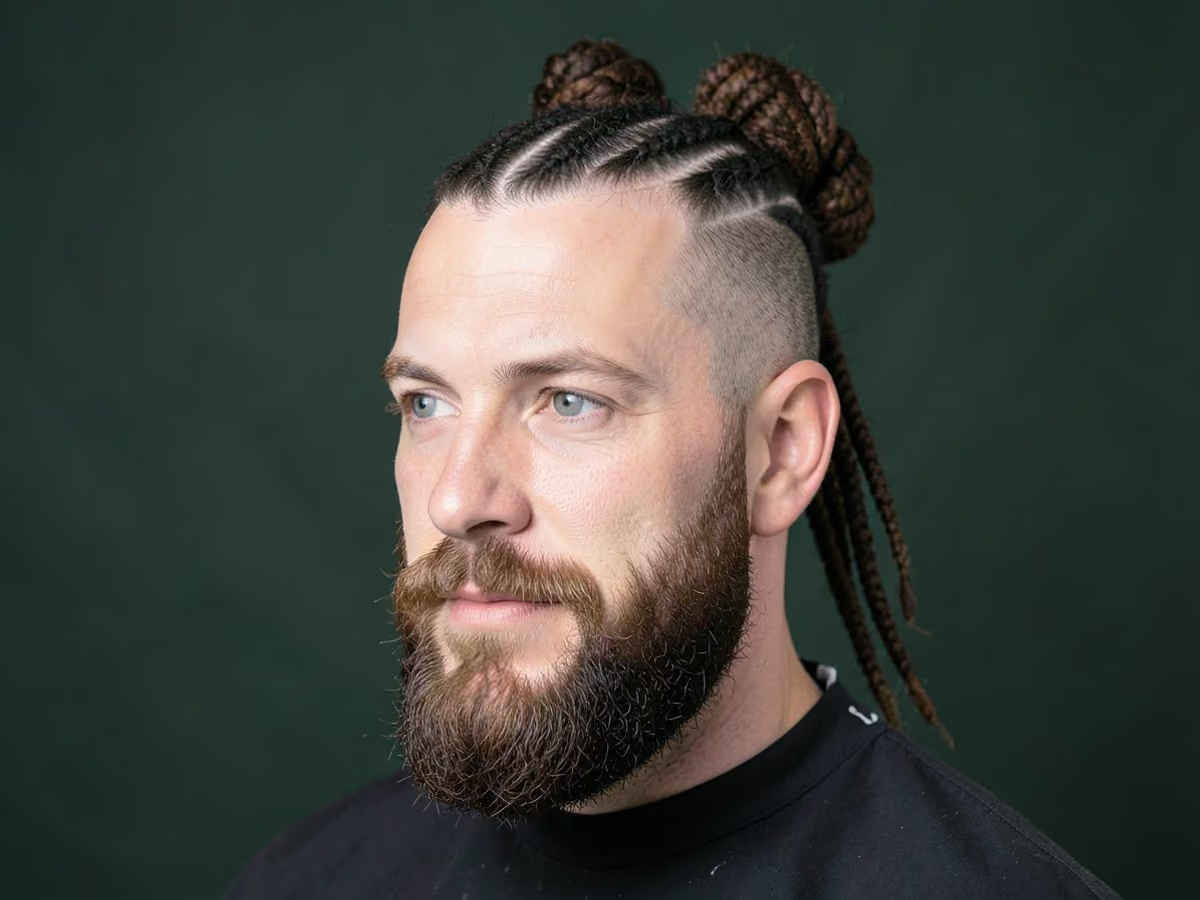
Dreadlocks for men are sections of hair that lock into ropes over months, worn anywhere from short starter coils to long locs. Below are 66 styles grouped by starting method, freeform and wicks, short dreads, high tops and faded sides, long locs, and color and beard pairings, each with upkeep, products and words for your loctician or barber.
What Are Dreadlocks?
Dreadlocks, often just called locs, are sections of hair that have matted into permanent ropes. Shed hair that would normally fall out stays trapped inside each section, and over time the strands knot together from the root to the tip. Coily and kinky hair locks most readily because the strands already coil around each other. Straighter textures can lock too, but usually need backcombing or crochet work and more upkeep to hold.
Locs have a long history across many cultures, and today the words dreads and locs are both used. Many wearers prefer locs, so a shop or loctician may use that term. A loctician is a stylist who specializes in starting and maintaining locs. For a first install, a loctician is worth the cost, because the size and parting set at the start decide how the locs look for years.
How Do You Start Dreadlocks?
There are five common starting methods, plus freeform, which skips any method and lets hair lock on its own. The right one depends on your hair length, texture and how soon you want the locs to look mature. Comb coils suit short coily hair, two-strand twists need around three inches, and interlocking can start on most lengths. Backcombing and crochet suit straighter textures that will not lock by twisting alone.
Whatever the method, expect a starter or baby stage where locs look like coils or twists, a budding stage where they swell and frizz, a teen stage where they start to hang, and a mature stage where they are solid ropes. On coily hair this commonly takes six months to two years, and longer on straighter textures. The table compares the methods side by side.
How Do You Start Dreadlocks?
Method
Best hair
Minimum length
Upkeep
Comb coils
4B to 4C coily hair
About 1 to 3 inches
Retwist every 4 to 6 weeks
Two-strand twists
3C to 4C hair
About 3 inches
Retwist every 4 to 6 weeks
Interlocking
Most textures
About 2 to 3 inches
Re-interlock every 6 to 10 weeks
Backcombing
Straight, wavy or loose curly hair
About 4 to 6 inches
Palm roll and crochet loose hairs
Crochet (instant locs)
Most textures
About 4 inches
Crochet new growth every 6 to 10 weeks
Freeform
Coily and kinky hair
Any length
Separate roots to stop locs merging
Who Suits Dreadlocks?
Locs suit any face shape, because the size, length and how you wear them can be adjusted. Small or medium locs pulled back or worn in a high top lengthen a round face. Long locs with a middle part soften a square jaw. Thick wicks or freeform locs add width, which balances a long, narrow face. Heart-shaped faces do well with locs that hang to the chin or below, adding weight near the jaw.
The bigger question is commitment. Locs are hard to undo; young locs can sometimes be combed out with conditioner and patience, but mature locs usually have to be cut. You also need to be comfortable with an awkward budding phase that can last months. Coily hair locks the fastest and holds the shape with the least upkeep. If your hair is fine or straight, expect more maintenance, and ask a barber or loctician with experience in your texture before starting.
Filter the styles
Showing all 66 styles
Fade
Hair
Length
Starter Locs by Method
Each of these eight looks comes from a different way of starting locs. The method decides how the locs look in the first months and how much upkeep they need; read the method table above first.
Trim:Every 4–6 weeks. New growth at the roots needs recoiling.
Best For:Oval, round faces + 4B to 4C short coily hair.
About This Style
A fine-tooth comb is placed at the root of a small square section and turned until the hair winds into a tight spiral. Coils are usually pencil width and work on as little as an inch of coily hair. They look like neat springs for the first months, then swell and frizz as they bud. Washing too early can unravel them, so many locticians suggest a stocking cap for the first few washes.
How to Style at Home
Wear a satin durag at night so the coils keep their shape.
Mist the coils with water and a light leave-in instead of full washing early on.
Pat a small amount of loc gel on loose roots between appointments.
Ask Your Barber
"Comb coil starter locs on my natural hair, pencil-width coils in a brick-lay grid, and a low taper at the sides and nape to keep them tidy."
Trim:Every 4–6 weeks. Roots need retwisting as twists mature.
Best For:Oval, square faces + 3C to 4C hair at least 3 in long.
About This Style
Here each section is split into two strands and wrapped around each other to the ends, then left to lock. The twists hold better through washing than coils and show some length from day one. In the budding stage the two strands fuse and the zigzag pattern softens into a single rope. A visible seam can remain for months, so some wearers palm roll during retwists to round each loc.
How to Style at Home
Wash every two weeks and squeeze, not rub, the twists dry.
Palm roll each loc between your hands with a small amount of loc gel.
Tie the hair under a satin bonnet or durag before sleeping.
Ask Your Barber
"Two-strand twist starter locs, finger-width sections in a square grid, twisted from the root to the ends, with clean edges and a taper at the nape."
Trim:Every 6–10 weeks. New growth is pulled through the root again.
Best For:Oval, long faces + most textures, including fine hair.
About This Style
With a latch hook or interlocking tool, the end of each loc is pulled through its own base in a set pattern, knotting new growth tightly at the root. Because no product or twisting holds it, interlocked locs can be washed right away and hold up to sweat and swimming. They suit active men. Done too tight or too often, interlocking can leave holes or weak points, so a trained loctician matters.
How to Style at Home
Wash as often as weekly with a residue-free shampoo.
Squeeze locs dry in a microfiber towel and finish under a hooded dryer.
Oil the scalp lightly between the parts after drying.
Ask Your Barber
"Interlocked locs about finger width, square parts, interlocked every eight weeks, and no product at the roots so I can wash and swim freely."
Trim:Every 6–8 weeks. Loose hairs and roots need crochet work.
Best For:Oval, square faces + straight, wavy or loose curly hair.
About This Style
Starting from the ends, a fine comb pushes each section of hair backward toward the scalp until it forms a dense, tangled rope. This is the usual way to lock straight, wavy and loose curly hair, which will not knot from twisting alone. The dreads look fuzzy at first and need regular palm rolling and crochet work to tuck in loose hairs. Expect them to shrink in length as they tighten.
How to Style at Home
Palm roll each dread for a few seconds every day for the first months.
Use a small crochet hook to pull loose hairs back into the dread.
Wash weekly with a residue-free shampoo and dry fully.
Ask Your Barber
"Backcombed dreads on straight hair, about thumb-width sections in a staggered grid, crochet the loose ends in, and keep the edges neat."
Trim:Every 6–10 weeks. New growth is crocheted into the base.
Best For:Round, oval faces + most textures at least 4 in long.
About This Style
Using a tiny crochet hook, a loctician knots each section of your own hair into a firm, finished loc in one sitting. This is a different thing from crochet extension braids, which add hair. The result looks like mature locs immediately, skipping the budding phase, though the inside still tightens over the first year. Installation can take many hours for a full head, and the tension must stay gentle to avoid thinning.
How to Style at Home
Wash after the first week with a residue-free shampoo.
Dry the locs fully under a hooded dryer or in the sun.
Smooth any frizz at the roots with a little loc gel.
Ask Your Barber
"Instant locs crocheted from my own hair, medium finger-width sections, brick-lay parts, and a light touch on tension at the hairline."
Trim:Every 6–8 weeks. Hundreds of small roots need re-tightening.
Best For:Oval, heart-shaped faces + coily or kinky hair of any density.
About This Style
These are very small locs, often several hundred on one head, started with interlocking, tiny comb coils or two-strand twists. Sisterlocks is one trademarked system for them, done by certified consultants using a set grid and tool. Small locs move like loose hair and can be parted, curled or worn in updos. The install can take a full day or longer, and maintenance sessions are long too.
How to Style at Home
Wash with a light, residue-free shampoo and rinse thoroughly.
Air dry or use a hooded dryer so the centers do not stay damp.
Set the locs on rods or pipe cleaners overnight for a curled look.
Ask Your Barber
"Microlocs on a tight grid, interlocked rather than twisted, with tension kept light at the edges so my hairline stays full."
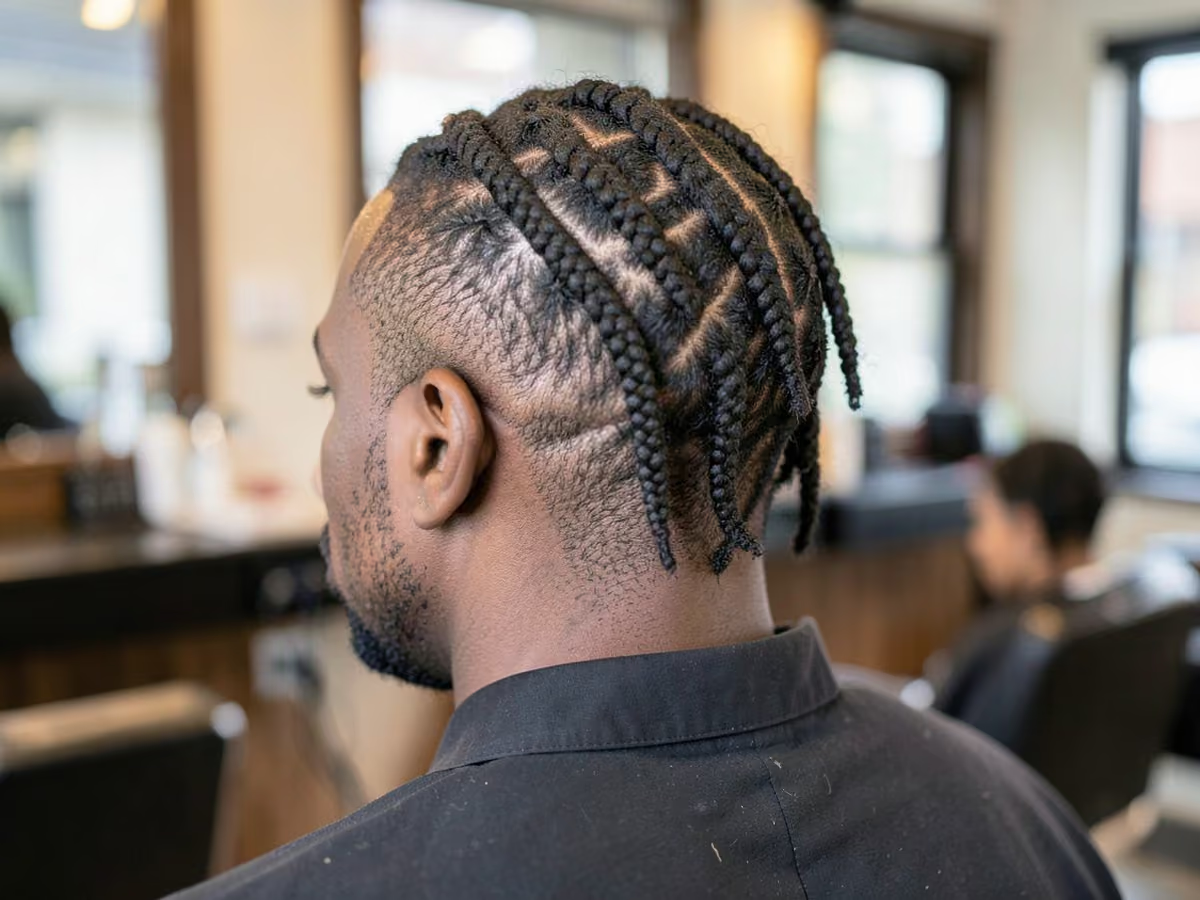
Trim:Every 6–8 weeks. Roots are rebraided or interlocked as they grow.
Best For:Oval, long faces + 4A to 4C hair at least 4 in long.
About This Style
Braided starter locs, often called braidlocs, start as individual three-strand plaits, usually box-parted, that are left in until the hair inside them mats. The braid pattern stays visible for several months, so the locs look flatter and more uniform early on than coil or twist starters. Plaits hold up well to washing, which suits men who work out often. Expect the ends to stay braided for a year or more before they round off.
How to Style at Home
Wash with a residue-free shampoo and squeeze the braids dry with a microfiber towel.
Rub a little scalp oil along the parts, not down the braids.
Pinch any loose hair at the root back into the nearest plait.
Ask Your Barber
"Can we start braidlocs with box parts about one inch square, plaited from root to tip, and clean up my edges and nape with a soft taper."
Trim:Every 3–4 weeks. The sides and line-up need cleaning more than the coils.
Best For:Round, oval faces + 4B to 4C hair of 1 to 3 in.
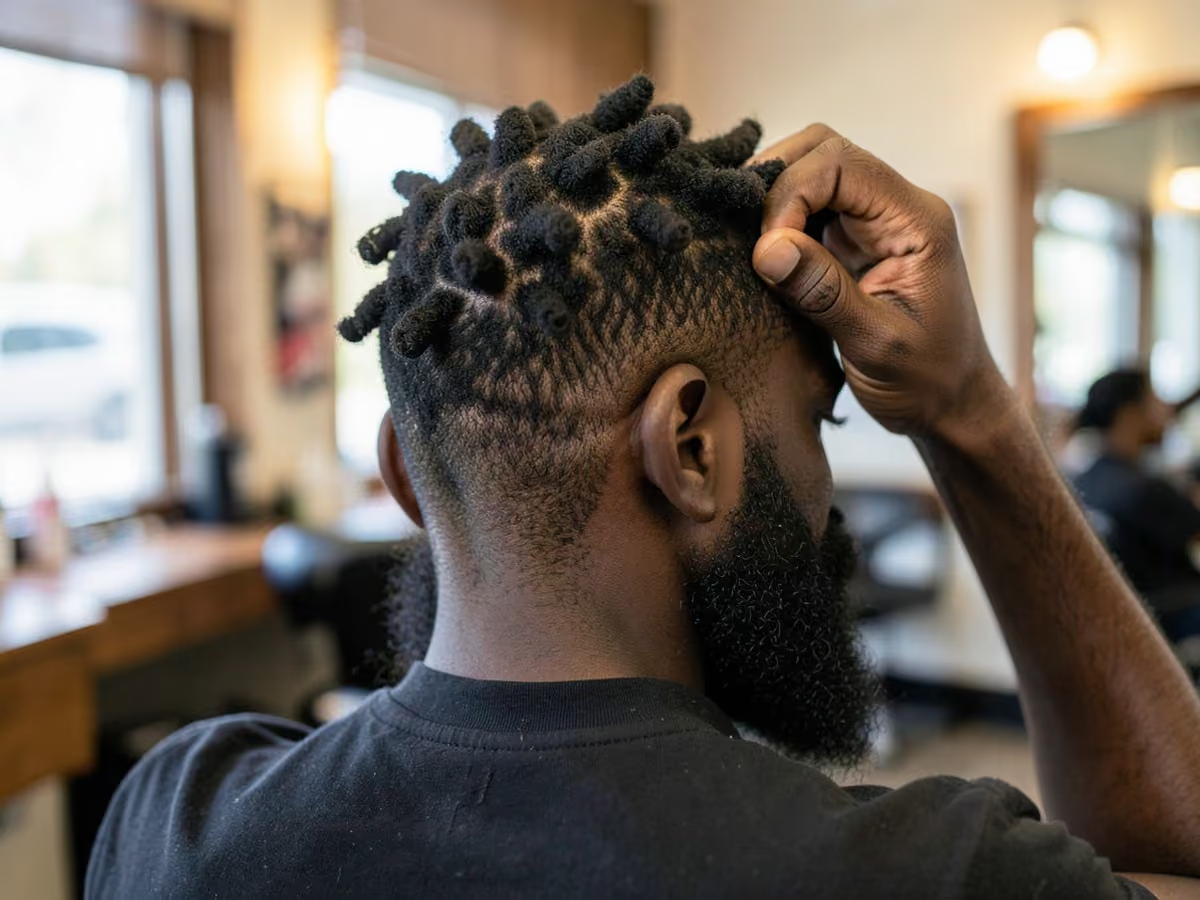
About This Style
Rubbing a twist sponge in small circles over short coily hair rolls it into nubs, and those nubs can be left to lock. It is the cheapest way to start locs because there is no salon parting session, but the sizes come out uneven and some nubs merge. Men often pair it with a low taper so the head looks deliberate while the coils settle over the first few months.
How to Style at Home
Mist the hair with water and leave-in so the coils grab the sponge.
Rub the sponge in small circles from front to back for about two minutes.
Separate any nubs that have joined at the root with your fingertips.
Ask Your Barber
"Leave about two inches on top for sponge locs, give me a low taper with a #1 at the bottom and line the front up soft so it does not recede."
Recommended Products
Curl Sponge
Leave-In
Freeform Dreads and Wicks
Freeform locs and wicks skip the retwist routine and form with little direction. These eight styles range from loose freeform to the thick, chunky wick look; see afro styles for how hair looks before it starts locking.
Trim:Every 4–6 weeks. Only the edges and fade need a barber.
Best For:Oval, long faces + 4A to 4C coily hair.
About This Style
Rather than parting the hair into sections, you simply stop combing it, wash it regularly and let it clump into locs of whatever size forms. At a few inches the result is a mix of thick and thin dreads, often with a fuzzy, organic texture. Pairing them with a taper keeps the shape intentional. Pulling apart merging roots now and then stops them fusing into giant locs.
How to Style at Home
Wash weekly with a residue-free shampoo and let the hair dry naturally.
Pull apart any roots that are fusing into one large loc.
Keep the edges tidy with a quick taper at the barbershop.
Ask Your Barber
"No retwist, I am growing freeform dreads. Low taper at the sides and nape with a soft line-up, and do not touch the top."
Best For:Square, oval faces + coily or tight curly hair.
About This Style
Somewhere between freeform and cultivated, this approach lets locs form on their own but guides them with occasional palm rolling or separation every couple of months. Sizes stay varied without merging into very large ones. It suits men who want a natural texture but a slightly more uniform look at work. The roots stay soft and fuzzy rather than tightly twisted.
How to Style at Home
Separate the roots by hand every few weeks after washing.
Palm roll the most uneven locs between your hands with a little loc gel.
Moisturize the scalp with light oil once a week.
Ask Your Barber
"Semi-freeform locs, just separate any merging roots and palm roll the uneven ones, then a low taper on the sides and back."
Trim:Every 8–12 weeks. Wicks need little more than washing.
Best For:Long, oval faces + thick coily hair.
About This Style
Wicks are very thick, chunky locs, often only a dozen or so across the whole head, with a rough, matted surface. They are usually started from large sections by backcombing, rubbing with a towel or sponge, or left to form freeform. Because each wick holds so much hair, they are heavy once long and take a long time to dry. Most men wear them short to medium.
How to Style at Home
Wash every week or two and squeeze each wick firmly to rinse.
Dry under a hooded dryer, since thick wicks hold water for hours.
Rub a towel in circles over the roots to encourage new growth to lock.
Ask Your Barber
"Wick dreads from large sections, about a dozen across the head, rough texture left alone, and clean the edges with a light taper."
Trim:Every 4–6 weeks. Only the line-up and nape need cleaning.
Best For:Round, square faces + 4B to 4C dense hair.
About This Style
Kept at two to four inches, short wicks stand up and out from the scalp in thick, blunt clumps. The look is chunky and compact, and it stays light enough to dry quickly. They are often started on an afro by rubbing sections with a towel, then left alone. Short wicks are one of the lowest-effort loc styles, as there is no retwisting at all.
How to Style at Home
Rinse and shampoo weekly, squeezing each wick to clean the center.
Let them dry standing up, without flattening them under a hat.
Brush the edges down with an edge brush after the line-up.
Ask Your Barber
"Short wicks on top at about three inches, a line-up at the front, and a taper at the sides and nape down to a #1."
Trim:Every 2–3 weeks. Only the taper needs work; wicks need no retwist.
Best For:Oval, long faces + coily hair of medium to high density.
About This Style
Thick wicks on top meet sideburns and a nape tapered from a #1 to a #3, with the hair above the ears left full. The taper makes the wicks look deliberate and keeps the neckline clean in an office or on camera. Because the sides are not faded high, the wicks can fall forward and sideways without exposing bare scalp.
How to Style at Home
Wash the wicks weekly and dry them fully before tying them back.
Rub scalp oil along the tapered area after each barber visit.
Shake the wicks loose with your fingers after drying.
Ask Your Barber
"Keep the wicks as they are, low taper at the sideburns and nape from a #1 up to a #3, with a soft line-up at the temples."
Trim:Every 6–8 weeks. Only the neckline and edges get tidied.
Best For:Square, long faces + 4A to 4C coily hair.
About This Style
Around the two-year mark, freeform locs usually reach the jaw and settle into their own sizes, some thin, some flat, a few joined into wide mats. Nobody parts or palm-rolls them, so no two heads match. This middle length is heavy enough to hang rather than stick up, but still short enough to dry within a few hours after washing, which keeps mildew odor away.
How to Style at Home
Wash every one to two weeks and squeeze, rather than rub, the water out.
Pull apart any locs that start to fuse at the root if you want separate pieces.
Let the hair air-dry fully before covering it or lying down.
Ask Your Barber
"Freeform dreads at jaw length, please do not twist or part anything. Just clean the neckline with a #2 and soften the edges at the temples."
Trim:Every 8–12 weeks. Large mats need only washing and drying time.
Best For:Oval, long faces + thick, dense 4B to 4C hair.
About This Style
Congo locs are very wide, flat locs that form when freeform hair is left to merge into a few big sections. Each one can be two inches across or more. They carry a lot of weight once they pass the shoulders, so the scalp needs to be healthy and the hair dense. Drying is the main chore, since thick mats hold water for hours and can smell if covered damp.
How to Style at Home
Wash in the morning so the locs have the whole day to dry.
Squeeze each section in a towel, then finish with a cool hair dryer.
Massage scalp oil into the parts between sections once a week.
Ask Your Barber
"I wear congo locs, so leave the length and shape alone. Clean the nape with a #1 and trim any thin, broken ends."
Trim:Every 2 weeks. The high fade shows regrowth well before the wicks do.
Best For:Round, oval faces + dense coily hair on top.
About This Style
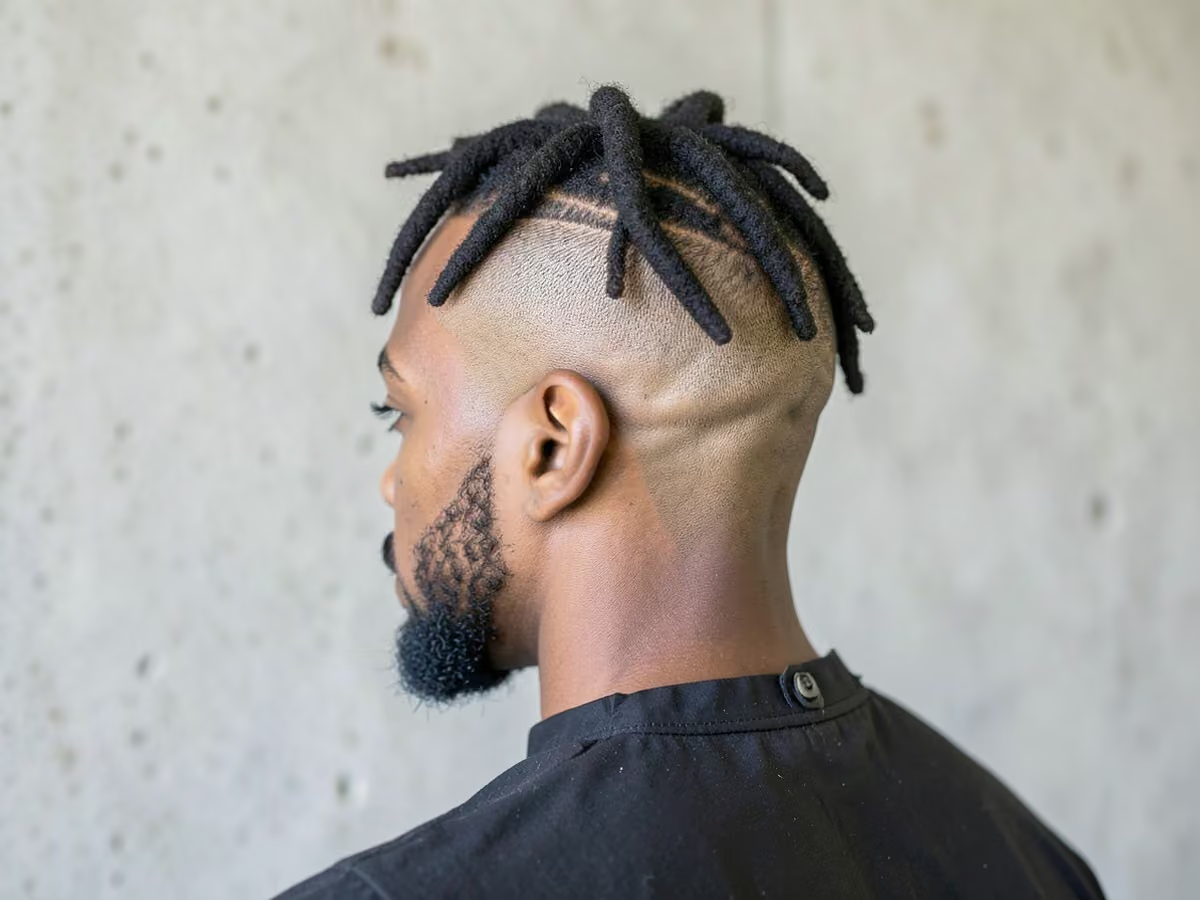
Taking the sides up to the parietal ridge leaves only a thick cluster of wicks on the crown, so they read as a short, chunky high top. Most barbers take it from bare skin through a #1 and #2 into the wicks. With less hair around the ears, the wicks dry faster and feel lighter in hot weather, and the barber visits are about the fade, not the locs.
How to Style at Home
Rinse the wicks and blot them with a towel instead of rubbing.
Rub scalp oil over the faded sides to keep the skin from flaking.
Brush the faded hair downward with a soft edge brush.
Ask Your Barber
"High fade from skin up to the top of my head, blended with a #1 and #2 into the wicks. Leave the wicks as they are and line up the front."
Recommended Products
Scalp Oil
Edge Brush
Short Dreads and Fades
Short dreads run from one to six inches and suit men in the first year of locs or anyone who wants less weight. These eight pair them with fades, tapers and line-ups; the burst fade guide covers that curve.
Trim:Every 4–6 weeks. Roots and edges both need attention.
Best For:Round, oval faces + 4A to 4C coily hair.
About This Style
Short dreads are locs of roughly two to five inches, all the same length around the head, with no faded sides. They sit on the scalp and point in different directions, which gives a full, rounded shape. Many men stay at this length in the teen stage before deciding whether to grow them long. Even sizes and a clean line-up keep them looking tidy.
How to Style at Home
Retwist the roots with a small amount of loc gel every four to six weeks.
Shape the edges with a soft line-up between retwists.
Sleep in a durag or satin cap to keep lint out.
Ask Your Barber
"Short dreads all one length, retwist the roots, and give me a soft line-up at the front with the nape cleaned up."
Trim:Every 4–6 weeks. Retwisted tips lose their point over time.
Best For:Oval, square faces + 4B to 4C hair at 2–4 inches.
About This Style
Twisted firmly from root to tip so each short dread stands upright, this style ends in narrow points. Thinner sections of pencil to finger width hold the spikes best. The look is lively and works with a fade at any height. As the locs grow past four inches their weight pulls them down, so it is a short-lived style unless you trim the tips.
How to Style at Home
Twist each loc to the tip with loc gel after washing.
Let the gel dry fully before touching or wearing a hat.
Refresh flat pieces by twisting them upright with damp fingers.
Ask Your Barber
"Short spiky dreads at about three inches, twisted to the tips, with a mid fade blended from a #0 on the sides."
Trim:Every 2–3 weeks. The curved fade around the ear grows out fast.
Best For:Oval, round faces + 4A to 4C coily hair.
About This Style
A burst fade curves around the ear in a half circle and leaves the hair at the nape longer, so the short dreads on top sweep down into a fuller back. The cut shows skin only around the ears. It works well when the nape locs have grown enough to hang slightly, giving a gentle mohawk shape without shaving the back.
How to Style at Home
Retwist the dreads monthly and keep the nape locs slightly longer.
Brush the edges and temples after each burst fade touch-up.
Massage scalp oil into the faded curve around each ear.
Ask Your Barber
"Burst fade curving around the ears down to skin, leave the dreads on top and at the nape untouched, with a sharp line-up."
Trim:Every 2–3 weeks. The dip behind the ear needs regular reshaping.
Best For:Square, oval faces + coily hair at medium density.
About This Style
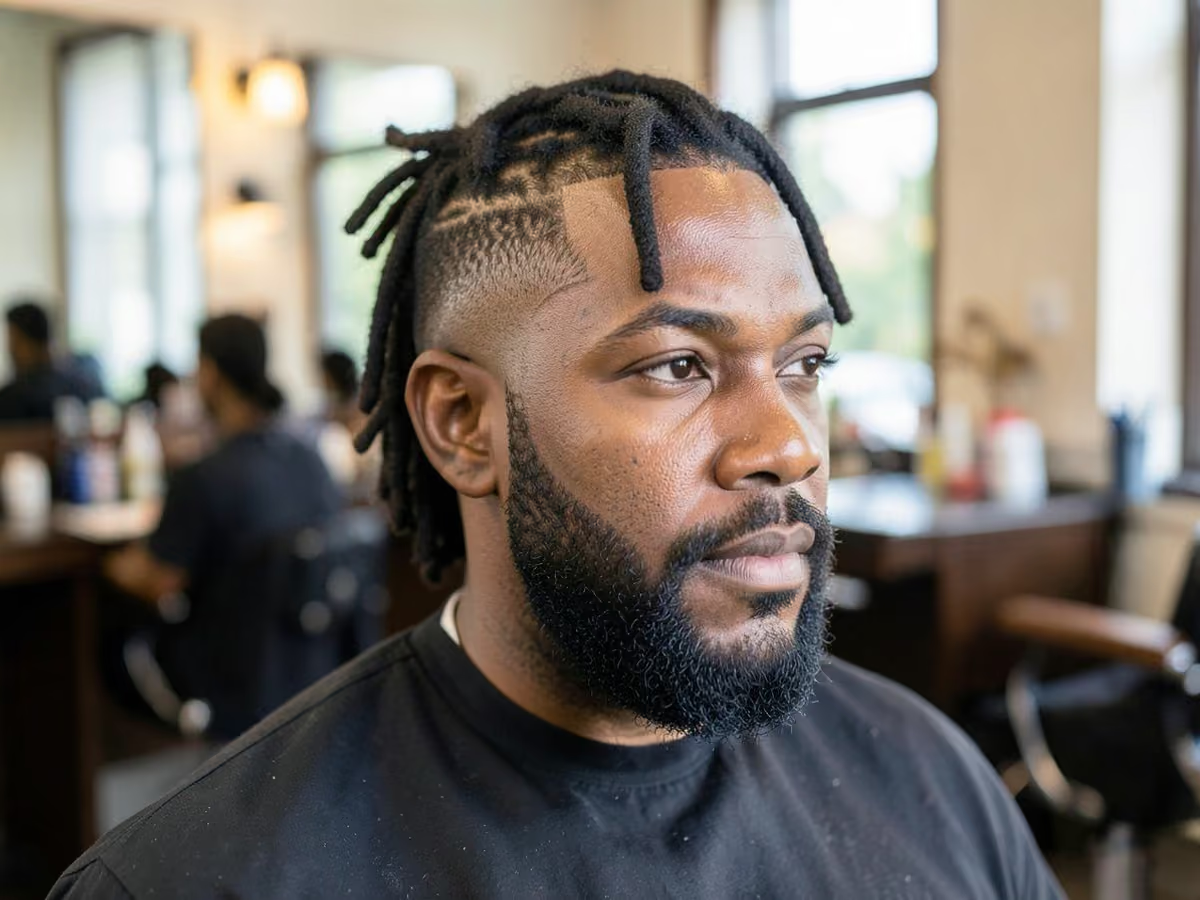
The fade line here starts at the temple and dips down behind the ear toward the nape, framing short dreads in a curved outline. The dip gives more depth at the back than a straight fade. Skin or a #0 at the bottom contrasts sharply with dark locs. Pairing it with a line-up and a beard connection gives a finished barbershop look.
How to Style at Home
Twist the roots with loc gel every four to six weeks.
Keep the dreads pushed forward and up so the fade line shows.
Apply scalp oil on the faded area to stop dryness.
Ask Your Barber
"Drop fade from skin, starting at the temple and dipping behind the ear, keep the short dreads on top, and line up the front."
Trim:Every 4–6 weeks. Roots need retwisting as locs gain weight.
Best For:Square, long faces + 4A to 4C hair.
About This Style
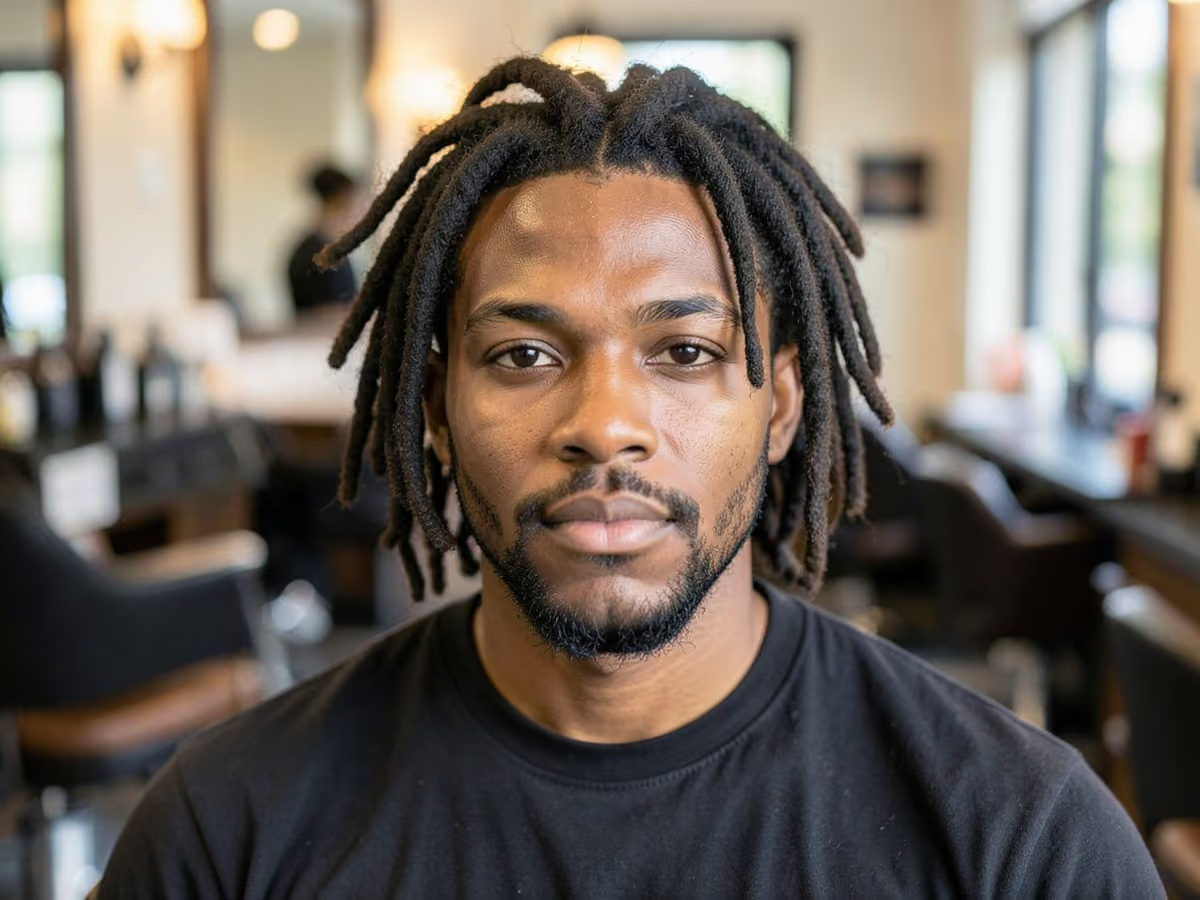
Locs that hang just to the chin mark the point where they start to fall rather than stand up. It is a common teen-stage length, usually reached about a year to a year and a half after starting on short hair. The weight lets you part them and push them back. A middle or side part at this stage helps frame the face.
How to Style at Home
Part the locs in the center or to one side with your fingers.
Retwist the roots with loc gel and clip them flat to dry.
Tie the front locs back loosely if they fall into your eyes.
Ask Your Barber
"Retwist only, locs kept at chin length, a soft taper at the sideburns and nape, and leave the length alone."
Trim:Every 3 weeks. The taper softens above the ear by week three.
Best For:Round, heart-shaped faces + 4B to 4C coily hair.
About This Style
A mid taper reaches up to the temple at the sideburns and nape but leaves the sides above the ears longer than a full fade would. Under short dreads it narrows the head slightly and keeps the edges tidy. Blending runs from a #0.5 to a #3. It is a middle option between untouched sides and a skin fade, and it grows out softly.
How to Style at Home
Retwist the dreads every four to six weeks with loc gel.
Brush the tapered sideburns down with an edge brush.
Oil the scalp between the locs once a week.
Ask Your Barber
"Mid taper at the sideburns and nape, from a #0.5 up to a #3, short dreads untouched on top, and a soft line-up."
Trim:Every 2–3 weeks. The low fade grows over the ear tops first.
Best For:Oval, long faces + 4A to 4C coily hair.
About This Style
Starting the fade just above the ear keeps most of the side hair, so the locs on top still cover the temples and the head stays fairly round. The fade moves from a #0.5 or #1 over the ear to the loc line within an inch or two. This low version suits men who need a tidy look for work without taking much off, and it hides early thin spots near the temples.
How to Style at Home
Retwist roots with a pea-size dab of loc gel per section every month.
Tie the locs down with a durag for an hour so roots set flat.
Brush the faded hair downward to keep the blend smooth.
Ask Your Barber
"Low fade just above the ear, #1 to #2, blended into the locs. Keep my dreads at about four inches and give me a clean neckline."
Trim:Every 1–2 weeks. The shaved part line fills in quickly.
Best For:Square, oval faces + short locs of 2 to 4 in.
About This Style
Here the barber razors a thin line on one side, usually above the outer corner of the eye, and the short locs on top fall away from it. The part gives the hair a direction without any styling, which helps when locs are too short to tie. It is usually paired with a taper or low fade so the line has clean skin around it.
How to Style at Home
Brush the short locs away from the part after washing.
Set the direction with a little light gel at the roots near the line.
Book a quick part touch-up between full cuts.
Ask Your Barber
"Shave a side part on my left above the eyebrow arch, with a low taper on the sides at a #1. Leave the dreads at three inches and retwist the roots."
Recommended Products
Light Gel
Loc Gel
High-Top Dreads, Undercuts and Top Knots
Keeping locs on top and taking the sides short gives height and makes locs easier to wear in heat. These eight cover high-top dreads, a dreadhawk, undercuts, top knots and designs; see the high top fade guide for the base shape.
Trim:Every 2–3 weeks. The faded sides lose their contrast quickly.
Best For:Round, oval faces + 4A to 4C dense coily hair.
About This Style
Locs grown only on the top of the head stand up in a tall, narrow shape, while the sides are faded high, often to skin. It takes the classic 1990s high top and swaps the sponged afro for dreads. Short to medium locs of two to six inches hold the upright shape best. Round faces gain height and look longer.
How to Style at Home
Retwist the dreads upright with loc gel so they dry standing tall.
Keep the sides moisturized with scalp oil after each fade.
Wear a durag at night to stop the locs flattening.
Ask Your Barber
"High top dreads, fade the sides high from skin up to the loc line, keep the locs on top untouched and line up the front."
Trim:Every 1–2 weeks. Bare skin shows stubble within days.
Best For:Oval, long faces + thick 4B to 4C hair.
About This Style
Foil-shaved skin on the lower sides blends up through a #0.5 and #1 to meet a flat-sided block of dreads on top. Squaring the corners of the loc block gives a sharp, geometric outline. The contrast is the strongest of any loc style, and it shows the shape of your head, so scars or bumps on the sides will be visible.
How to Style at Home
Shape the loc block square with your hands while the gel is wet.
Rub a light scalp oil on the shaved sides every evening.
Protect the skin fade from the sun with a hat outdoors.
Ask Your Barber
"Skin fade up to the loc line, foil shaved at the bottom, blended through a #0.5 and #1, with the dreads on top squared off at the corners."
Trim:Every 2–3 weeks. Only the faded sides need a barber.
Best For:Square, oval faces + 4B to 4C coily hair.
About This Style
Freeform locs on top, of uneven size and fuzzy texture, rise above faded or tapered sides. The top gets no retwisting, so the locs grow organically into varied clumps, while the barber keeps the sides and outline sharp. The contrast between the wild top and clean sides is the point. A high top shape keeps the freeform locs from looking shapeless.
How to Style at Home
Wash weekly and pull apart any roots that start merging.
Shake the top loose after drying and avoid twisting it.
Brush the faded sides and temples with an edge brush.
Ask Your Barber
"Freeform dreads on top, do not twist them, fade the sides to a #0 up to the top with a sharp line-up at the front."
Trim:Every 3 weeks. The clipped band shows growth before the locs do.
Best For:Oval, long faces + any loc-ready hair.
About This Style
The sides and back are clipped to one length, usually a #1 or #2, with no fade, and the locs on top are long enough to hang over the undercut or be tied up. Unlike a fade, the line between short and long is abrupt. It removes weight and heat while keeping full length on top, and the undercut disappears when the locs are worn down.
How to Style at Home
Tie the locs up to keep them off the clipped sides while drying.
Apply scalp oil along the undercut after barber visits.
Wear the locs down to hide the undercut or up to show it.
Ask Your Barber
"Undercut on a #1 around the sides and back with no fade, keep all the locs on top at full length, and clean the neckline."
Trim:Every 2–3 weeks. The fade blurs first; retwist locs every 4–6 weeks.
Best For:Round, square faces + locs at least shoulder length.
About This Style
Medium to long locs on top are twisted into a knot at the crown, and the sides are faded from a #0 to a #2. The knot adds height that slims a round face and keeps locs off the neck in hot weather. Locs need to reach at least the shoulders when hanging to wrap into a knot. A wide fabric tie avoids pulling at the hairline.
How to Style at Home
Gather the locs at the crown and twist them into a loose coil.
Wrap the coil around itself and fix it with a fabric tie or one loc.
Smooth the edges with an edge brush and a little light gel.
Ask Your Barber
"Mid fade from a #0 to a #2 on the sides, keep the locs on top long enough for a top knot, and line up the hairline."
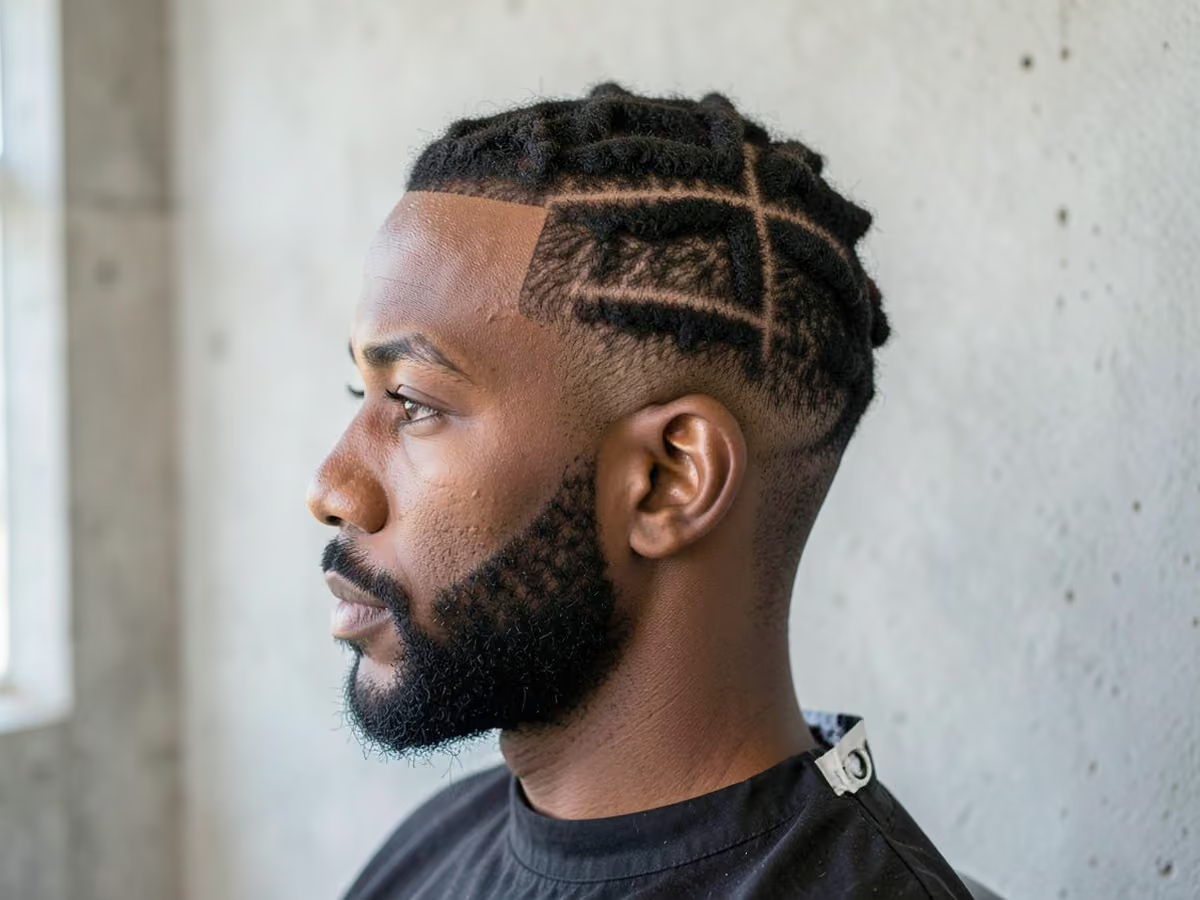
Trim:Every 1–2 weeks. Designs blur within about ten days.
Best For:Oval, square faces + short to medium locs.
About This Style
A shaved pattern, such as straight lines, zigzags or a curved part, is cut into the faded sides under short or medium locs. The design is shaved with a trimmer or razor after the fade is blended. It is a way to add detail without dyeing the locs. Simple lines last longer between visits than detailed patterns. See hair designs for ideas.
How to Style at Home
Keep the locs tied up when you want the design to show.
Apply scalp oil to the design area to keep the skin calm.
Book a quick touch-up when the lines start to fill in.
Ask Your Barber
"Low fade on the sides with two curved lines shaved above the left ear, locs kept as they are on top, and a sharp line-up."
Trim:Every 1–2 weeks. Shaved sides show stubble within days.
Best For:Oval, long faces + locs at least 4 in on top.
About This Style
A dreadhawk is a strip of locs about three to four inches wide running from the hairline to the nape, with both sides shaved close. Unlike a high-top, the strip continues down the back. Longer locs in the strip can fall to one side or be tied back. Shaving the sides of existing locs is permanent, so many men try the shape with an undercut first.
How to Style at Home
Retwist the strip every four to six weeks with a little loc gel.
Apply scalp oil to the shaved sides after each wash.
Tie longer locs at the crown if they flop onto the shaved skin.
Ask Your Barber
"Shave both sides with a #0, leave a strip of dreads about three fingers wide down the middle to the nape, and keep a clean line where they meet."
Trim:Every 3–4 weeks. The hidden shaved patch shows when hair is tied.
Best For:Oval, heart-shaped faces + long, heavy locs.
About This Style
Only the lowest inch or two at the back is clipped, hidden under the locs when they hang loose. Tie them into a bun or ponytail and the shaved nape shows, sometimes with a simple design. Removing that bottom layer takes some weight off long locs and keeps the neck cooler. The patch is easy to hide while it grows back if you change your mind.
How to Style at Home
Lift the locs and check the nape line in a hand mirror weekly.
Oil the clipped patch lightly so it does not itch under the locs.
Tie the locs high to show the undercut, or leave them down to hide it.
Ask Your Barber
"Undercut just the nape, about two inches up from the neckline, with a #1 and a straight top line. Leave all my locs at full length."
Recommended Products
Scalp Oil
Edge Brush
Long Loc Styles: Parts, Barrels and Updos
Once locs pass the chin, the styling options open up. These eight cover how to wear longer locs day to day, from middle parts and barrels to half-up styles and updos.
Trim:Every 4–6 weeks. Roots need retwisting as weight increases.
Best For:Square, oval faces + mature locs of any size.
About This Style
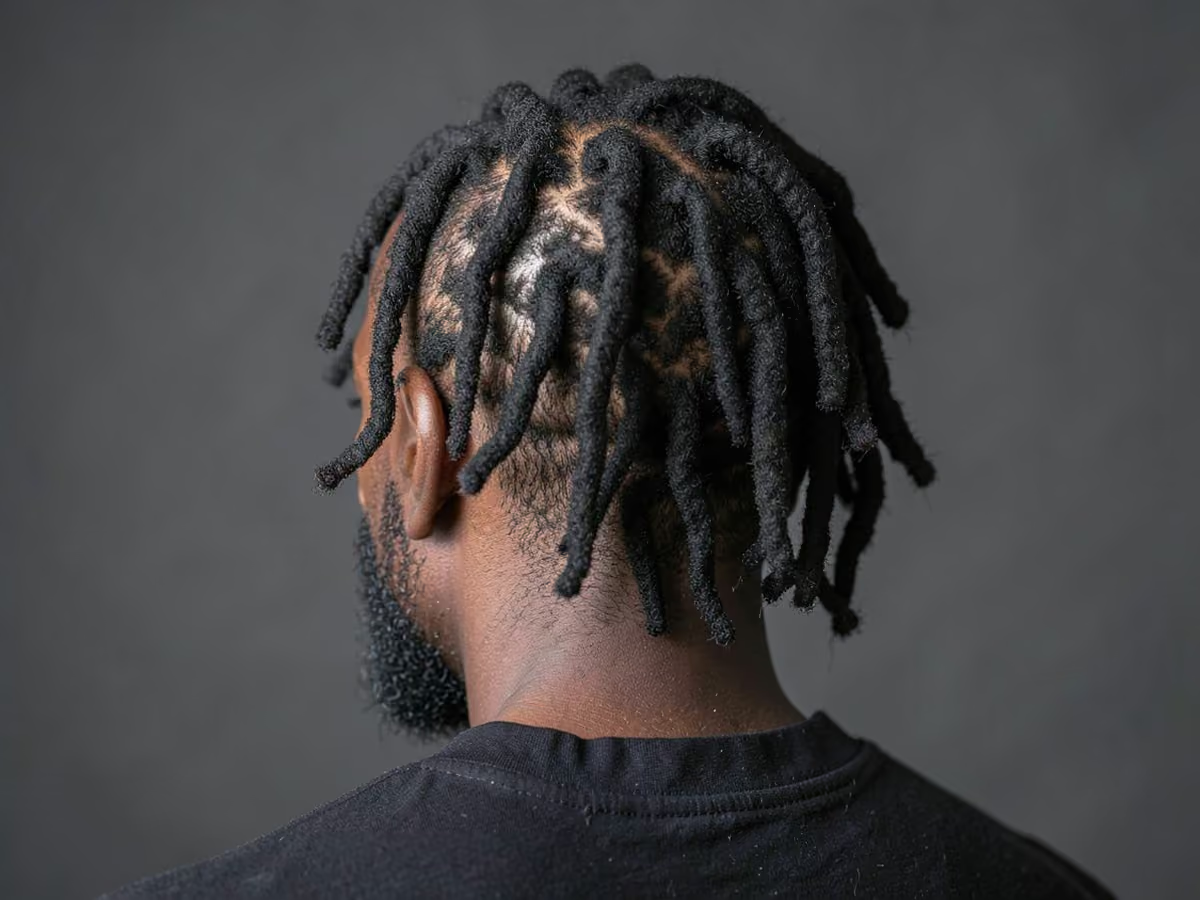
Reaching the shoulders usually takes two to three years from a short start, and at this point the locs hang freely and swing with movement. They are heavy enough to tie back but short enough to dry in an afternoon. Even sizing from the start shows most at this length, so locs that merged early will look thicker than their neighbors.
How to Style at Home
Wash every one to two weeks and squeeze out water firmly.
Air dry fully before tying, or use a hooded dryer.
Rotate how you tie them back so the same roots are not pulled daily.
Ask Your Barber
"Retwist only, locs at shoulder length, trim any frayed tips, and a low taper at the nape to keep the neckline clean."
Trim:Every 6 weeks. The center part shows new growth first.
Best For:Round, square faces + locs at least chin length.
About This Style
Split evenly down the center, medium or long locs fall on both sides of the face like curtains. The vertical line lengthens a round face, and the locs soften a square jaw. A clean center part needs the locs to have been started on a grid with a central row, so plan for it at the install if you know you will want this style.
How to Style at Home
Split the locs down the center with your fingers after washing.
Retwist the roots along the part so it stays clean.
Tuck the front locs behind your ears for a neater shape.
Ask Your Barber
"Retwist with a clean middle part, locs falling evenly on both sides, and a light taper at the nape only."
Trim:Every 2–3 weeks. Barrel style loosens as roots grow.
Best For:Oval, long faces + medium locs, 4 to 10 inches.
About This Style
Barrel twists on locs take groups of two or three locs and twist them around each other in rows from the front to the back, forming thick ropes close to the scalp. This styling method sits on top of existing locs and lasts two to three weeks. It looks neat for work, keeps locs off the face, and is often paired with a fade or taper.
How to Style at Home
Retwist the roots first so the barrel rows lie flat.
Twist pairs of locs around each other along each row.
Secure the ends with a small elastic or let the weight hold them.
Ask Your Barber
"Retwist and barrel style my locs in four rows from front to back, and fade the sides from a #1 with a sharp line-up."
Trim:Every 2–3 weeks. Rope twists unravel slowly after washing.
Best For:Square, oval faces + medium to long locs.
About This Style
Pairs of hanging locs are twisted around each other from root to tip, producing thicker ropes that hang down rather than lying along the scalp in rows. The result looks like fewer, chunkier locs. It is a temporary style, often redone every two to three weeks, and gives long locs a different shape without changing them permanently.
How to Style at Home
Pick two neighboring locs and twist each one in the same direction.
Wrap them around each other in the opposite direction down to the tips.
Dab loc gel at the ends so the rope stays twisted.
Ask Your Barber
"Rope twist my locs in pairs from root to tip, keep the length, and give me a low taper at the sides and nape."
Best For:Round, heart-shaped faces + locs past the chin.
About This Style
For this style, the top locs from temple to temple are gathered into a small knot or tie at the crown, while the lower locs hang loose. It clears the face for work or sport and keeps the length on show. The lifted crown adds height for round faces. Use a soft tie, since locs are heavy and thin elastics can snap them at the base.
How to Style at Home
Gather the locs above the ears and twist them once at the crown.
Secure them with a fabric tie or wrap one loc around the group.
Leave the lower locs down and smooth the edges.
Ask Your Barber
"Retwist and keep my locs past my chin so the top section reaches a half-up knot, and clean up the edges."
Trim:Every 6–8 weeks. The updo hides root regrowth.
Best For:Oval, long faces + long locs past the shoulders.
About This Style
Long locs pinned up into a rolled bun, a crown wrap or a pair of looped knots work for weddings, interviews and hot weather. Unlike a simple top knot, an updo is arranged and pinned, often with the locs wrapped around the head. It shows off the hairline and neck, so a fresh line-up and nape taper make it look finished.
How to Style at Home
Gather the locs at the back and fold them up toward the crown.
Wrap the ends around the base and fix them with loc pins.
Smooth the edges with an edge brush and a little light gel.
Ask Your Barber
"Retwist and tidy my hairline and nape for an updo, a soft line-up at the front and a low taper at the neck."
Trim:Every 6–8 weeks. A low bun hides root growth well.
Best For:Long, oval faces + locs past the shoulders.
About This Style
Gathering the locs at the nape and wrapping them into a bun puts the weight low, where it pulls less on the hairline than a crown bun. It looks neat under a suit collar and suits jobs where long hair has to be tied. Rotate the spot slightly each day, since a tight bun in one place can thin the edges over time.
How to Style at Home
Gather the locs at the nape without pulling the front tight.
Wrap them into a coil and secure with a loc band or one loose loc.
Smooth the hairline with a soft brush and a dab of gel.
Ask Your Barber
"Keep my full length and just retwist the roots. Clean up the edges and nape so a low bun looks neat at the collar."
Trim:Every 2–3 weeks. The curled ends drop as the set relaxes.
Best For:Round, heart-shaped faces + medium to long locs.
About This Style
Each loc is folded and pinned into a loop or set on pipe cleaners so the ends curl into a petal shape. Taken down, the locs keep a bouncy, curled pattern for one to three weeks. It is a styling set, not a cut, so it can be redone or brushed out at any time. The set is easier on locs past the chin, since short ones will not hold the fold.
How to Style at Home
Dampen the locs slightly and apply a thin coat of loc gel.
Fold each loc into a loop and pin it, or wrap it on a pipe cleaner.
Let the set dry overnight before taking the pins out gently.
Ask Your Barber
"Set my locs in petals after the retwist, folded at mid-length and pinned overnight. Line up my temples and nape too."
Recommended Products
Loc Gel
Dreads by Color, Beard and Hair Type
These eight cover dyed and burgundy locs, beard and stubble pairings, gray locs and dreads on straight hair. Color should be done by a colorist who works with locs, because bleach inside a loc is hard to rinse out.
Trim:Every 4–6 weeks. Dark roots show as the locs grow.
Best For:Oval, square faces + healthy, mature locs.
About This Style
Bleaching locs to honey, golden or platinum blonde lifts the color right through each rope. Because bleach soaks into the center of a loc and is hard to rinse, a colorist who works with locs is important, and deep conditioning afterward helps prevent brittleness. Dark roots grow in quickly, so many men leave them as part of the look instead of rebleaching monthly.
How to Style at Home
Rinse locs for several minutes after every wash to clear residue.
Apply a leave-in to the lengths to soften bleached hair.
Wear a hat in strong sun to stop the color turning brassy.
Ask Your Barber
"Retwist only, my locs are bleached so keep tension light, and give me a low taper at the sides with a soft line-up."
Trim:Every 6–8 weeks. Colored ends grow away from the roots.
Best For:Round, oval faces + medium to long locs.
About This Style
Only the bottom few inches of each loc are bleached or dyed, often to blonde, copper or red, leaving natural color at the roots. Since the roots stay untouched, there is no regrowth line, and the color moves further down as the locs grow. It is a lower-commitment option than full color. The dyed ends can be trimmed off later.
How to Style at Home
Keep the colored ends moisturized with leave-in after washing.
Squeeze the tips extra well, since bleached ends hold more water.
Trim frayed colored tips with sharp scissors if they split.
Ask Your Barber
"Retwist my roots, the tips are dyed copper so do not touch the ends, and taper the nape and sideburns."
Trim:Every 4–6 weeks. Beard shaping every 2–3 weeks.
Best For:Round, oval faces + medium locs and a dense beard.
About This Style
Worn down or tied back, medium or long locs pair with a full beard of one to three inches, connected at the sideburns with a short taper. The beard adds weight at the jaw that balances long locs at the back. Shaping the beard narrower at the chin keeps the face from looking too wide. Beard oil keeps the beard as soft as the locs.
How to Style at Home
Wash the beard separately with a gentle cleanser.
Work beard oil into the beard and shape it with a beard brush.
Tie the locs back so the beard shape shows clearly.
Ask Your Barber
"Retwist my locs, taper the sideburns into the beard, keep the beard at about two inches and shape the cheek line and neckline."
Trim:Every 3–4 weeks. Goatee edges need weekly tidying.
Best For:Round, square faces + short coily locs.
About This Style
A goatee or circle beard on a clean-shaven face pairs with short dreads and tapered sides. The pointed beard draws the eye down and lengthens round faces, while the short locs keep the top full without hanging over the forehead. Keep the goatee under an inch so the two shapes stay in proportion. A line-up connects the look at the front.
How to Style at Home
Shave the cheeks and neck, keeping the goatee shape intact.
Comb beard balm through the goatee to hold its edges.
Retwist the short dreads every four to six weeks.
Ask Your Barber
"Short dreads retwisted, low taper on the sides and nape, line up the front, and shape my goatee short with clean cheeks."
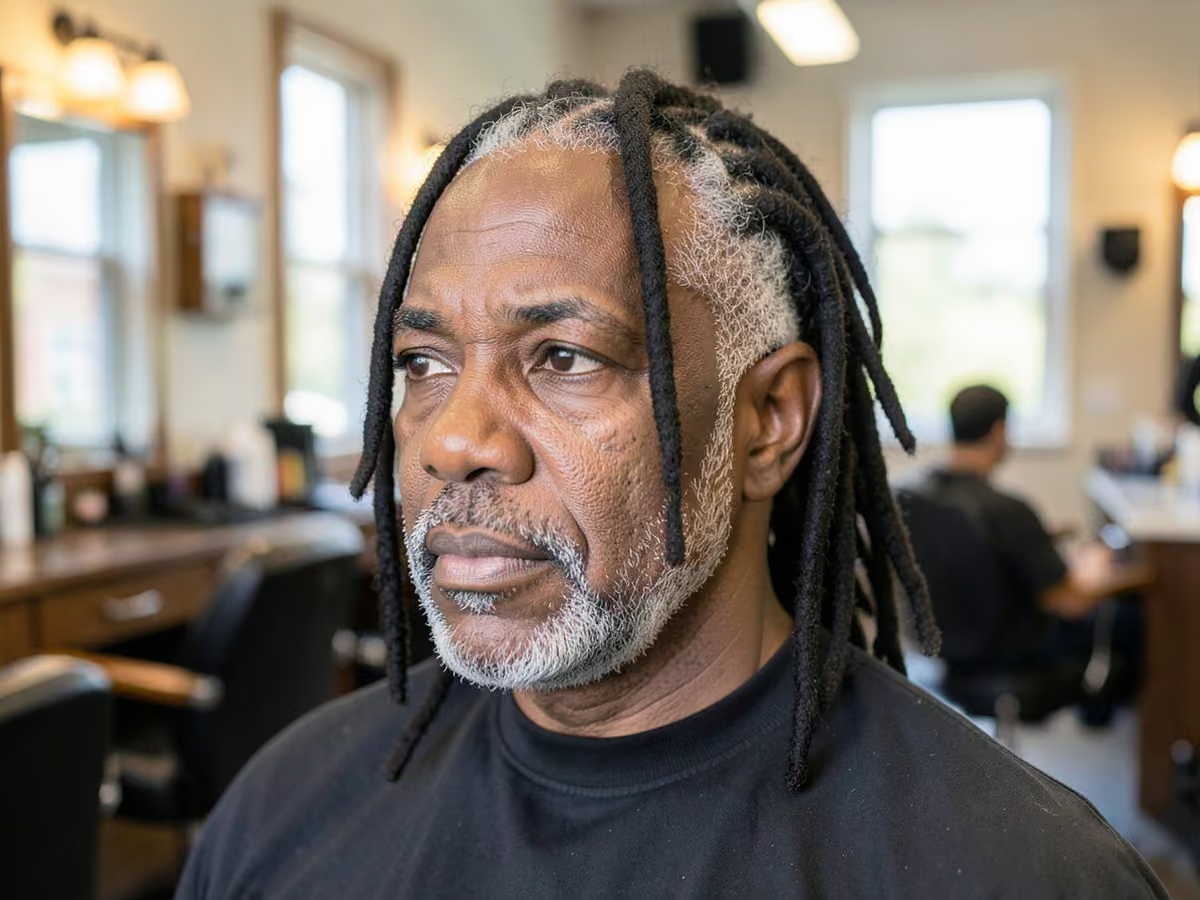
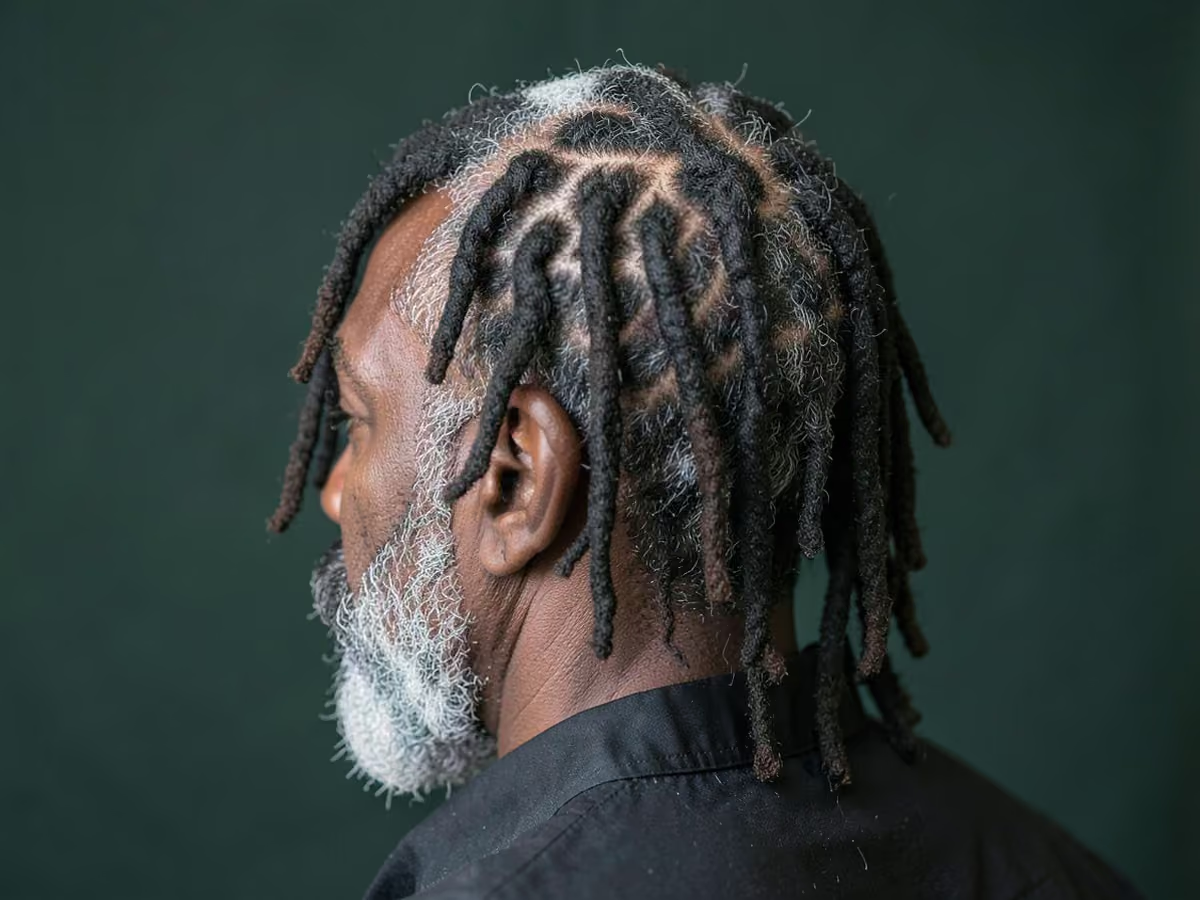
Trim:Every 6–8 weeks. Gray roots are wiry and need gentle retwisting.
Best For:Oval, long faces + gray or salt and pepper coily hair.
About This Style
Locs often turn gray from the root downward, giving a salt and pepper rope that grows lighter over time. Gray hair is coarser and drier, so the locs need more moisture and gentler retwisting to avoid breakage at the base. Many older men keep them shoulder length or shorter to reduce weight. A purple shampoo now and then keeps the gray from yellowing.
How to Style at Home
Wash with a purple shampoo once a month to keep the gray bright.
Apply leave-in to the lengths after every wash.
Retwist gently, with less tension than on darker hair.
Ask Your Barber
"Gentle retwist on my gray locs, low tension at the roots, keep them at shoulder length and taper the nape."
Trim:Every 4–6 weeks. Loose hairs need crocheting back in.
Best For:Oval, square faces + straight or wavy hair at 6+ inches.
About This Style
Straight hair slides apart rather than coiling, so dreads on it are usually started by backcombing or crochet and need ongoing work to stay locked. They tend to be thicker and fuzzier than locs on coily hair and can take longer to tighten. Washing with a residue-free shampoo helps, since conditioner makes straight hair slippery. A loctician who works with straight textures gives the most even result.
How to Style at Home
Skip conditioner on the locs, since it makes straight hair slip apart.
Palm roll each dread daily for the first few months.
Crochet loose hairs back in every few weeks or at appointments.
Ask Your Barber
"Crochet maintenance on my backcombed dreads, tuck in loose hairs at the roots, and tidy the sideburns and nape with a taper."
Trim:Every 4–6 weeks. Red tones fade fast and roots show.
Best For:Oval, square faces + dark brown or black mature locs.
About This Style
Wine-red color works on dark locs without full bleaching, since a light lift and a semi-permanent red dye is often enough. The shade reads deep indoors and brighter in sunlight. Red pigment fades faster than most colors, so it needs a refresh every month or two. Sulfate-free shampoo helps hold it, and a strand test first shows how the dye will take inside a loc.
How to Style at Home
Wash with a sulfate-free shampoo in cool water to slow fading.
Apply leave-in along the colored lengths after each wash.
Keep the locs out of strong sun or chlorine where you can.
Ask Your Barber
"I am getting burgundy color on the lengths, so retwist the roots first and keep the line-up clean and soft around the dyed hair."
Trim:Every 3–4 weeks. Trim the stubble every few days.
Best For:Round, oval faces + short locs and patchy beards.
About This Style
Three to five millimetres of stubble adds shape to the jaw without the weight of a full beard, which keeps attention on the locs. Men whose beards grow unevenly do well with it, since short stubble hides gaps. The sideburns are usually tapered from the locs down into the stubble so there is no hard edge between hair and beard.
How to Style at Home
Run a beard trimmer at a 3 to 5 mm guard over the jaw every three days.
Clean the neckline one finger above the Adam's apple.
Retwist the locs monthly with a small amount of loc gel.
Ask Your Barber
"Taper the sideburns down into my stubble, set the beard at a #1 with the neckline cleaned up, and retwist the short locs."
Recommended Products
Loc Gel
Beard Oil
Loc Sizes and Parting Patterns
Loc size is set by the parting at the start and is hard to change later, so pick it with the final length in mind. These six cover the main sizes and the grid patterns locticians part them in.
Trim:Every 6–8 weeks. Fewer roots means faster retwists.
Best For:Oval, square faces + thick, dense coily hair.
About This Style
Jumbo locs are parted at roughly one and a half to two inches square, so a full head may have only twenty or thirty. That makes retwisting quick and gives a heavy, rope-like look once they hang. The trade-off is drying time and a visible scalp along wide parts, so they work best on dense hair. Thin hair tends to look sparse at this size.
How to Style at Home
Retwist each root with a dime-size dab of loc gel.
Dry with a hood dryer or long air-dry after every wash.
Oil the wide parts so the scalp does not look dry.
Ask Your Barber
"Start or keep my locs at jumbo size, about two-inch parts. Retwist the roots and give me a low taper at a #1 around the ears."
Trim:Every 4–6 weeks. A medium head of roots takes about two hours.
Best For:Most face shapes + 4A to 4C hair of any density.
About This Style
Most locticians default to medium locs, parted around one inch square, because they suit nearly every density and give fifty to eighty locs on an average head. They are thick enough to stay strong at long lengths but still fine enough to style into buns, ponytails and parts. Retwist sessions are moderate, and the locs dry in a few hours.
How to Style at Home
Palm-roll each loc after retwisting to round the shaft.
Clip the retwisted roots flat until the gel dries.
Wrap the locs in a satin scarf before sleeping.
Ask Your Barber
"Medium locs with one-inch box parts, please. Retwist the roots, palm-roll them, and keep the edges natural with a light line-up."
Trim:Every 4–6 weeks. Many small roots take several hours to retwist.
Best For:Oval, heart-shaped faces + fine or medium-density hair.
About This Style
Parted at around half an inch, small traditional locs are larger than microlocs but give far more pieces than a medium set, often over a hundred. They move freely and are easy to style into updos. Because each loc is thinner, it is weaker at the root, so tight retwisting or heavy jewelry can cause breakage. Light gel and gentle tension keep them healthy.
How to Style at Home
Use a pointed comb to keep parts clean when retwisting.
Retwist with a light gel so small roots do not build residue.
Avoid tight ponytails for a day after each retwist.
Ask Your Barber
"Small locs with about half-inch parts, retwisted gently with light gel and no heavy tension. Clean the neckline and keep my sideburns full."
Trim:Every 6–8 weeks. Interlocking hundreds of roots takes a full day.
Best For:Oval, long faces + coily hair, fine or dense.
About This Style
Grown past the shoulders, microlocs look almost like loose hair from a distance and can be braided, curled or styled in a part. Mature sets often number three hundred or more and are kept up by interlocking with a tool rather than palm-rolling. They hold water less than big locs, so they dry quickly. Expect long, costly maintenance sessions with a specialist.
How to Style at Home
Wash weekly with a residue-free shampoo to keep small locs clean.
Sleep with the locs braided loosely to prevent tangling.
Pick a loose loc up at the root and twist it back into its section.
Ask Your Barber
"Interlock my microlocs at the roots and trim any thin, split ends by a quarter inch. Keep the length and line my edges soft."
Trim:Every 4–6 weeks. Grid parts blur unless roots are kept separated.
Best For:Square, oval faces + coily hair with full density.
About This Style
Square, or box, parting lays out the head in a grid so each loc sits in its own neat square. The result looks very even, especially on short and medium locs where the scalp shows between them. Keeping the grid sharp means separating roots at every retwist, since new growth tends to bridge neighboring locs. It is a common parting for men starting cultivated locs.
How to Style at Home
Separate any roots that join across a part line after washing.
Retwist inside each square without pulling hair from neighbors.
Rub scalp oil along the grid lines once a week.
Ask Your Barber
"Square parts in an even grid, one inch boxes, and keep the lines clean when you retwist. Light taper at the temples and nape."
Trim:Every 4–6 weeks. Triangles need re-separating at each retwist.
Best For:Round, oval faces + medium to thick coily hair.
About This Style
Parting in triangles staggers the locs so no straight gaps run across the scalp. When the locs fall, they cover more of the head and look fuller than on a square grid, which helps with thinner patches. The pattern shows best on short locs and on the crown of longer ones. It takes a loctician more time to part, so the starting session runs longer.
How to Style at Home
Keep the triangle points clean by separating roots after washing.
Retwist each section toward its own point, not across lines.
Brush the edges down softly with an edge brush after retwisting.
Ask Your Barber
"Can you part my locs in triangles, staggered so no straight lines show, about one inch per section, and taper the nape at a #2."
Recommended Products
Loc Gel
Edge Brush
Locs with Fades, Parts and Beard Shapes
Pairing locs with a fade or beard shape changes the outline of the head without touching the locs themselves. These six cover fade finishes, a hard part, a V nape and two beard pairings; see the skin fade guide for blend details.
Trim:Every 2–3 weeks. A shadow fade grows out softly.
Best For:Oval, round faces + locs on sensitive or bumpy skin.
About This Style
Stopping the fade at a #0.5 or #1 instead of bare skin leaves a gray shadow on the sides, which hides razor bumps and is easier on skin that reacts to foil shavers. Under medium locs it gives a clean outline without the stark contrast of a bald fade. It also grows back gently, so a missed barber week is less obvious.
How to Style at Home
Run scalp oil over the faded sides after washing.
Retwist roots monthly with a light coat of loc gel.
Brush the shadow down so the blend lies flat.
Ask Your Barber
"Shadow fade on the sides, starting at a #0.5 and going up through a #1 and #2 into my locs. No razor or foil, please."
Trim:Every 1–2 weeks. Razor-bare skin loses its finish in days.
Best For:Oval, long faces + locs and a smooth, even scalp.
About This Style
With the sides razor shaved to smooth skin, the locs on top look thicker and darker by contrast. The bald section usually reaches about an inch above the ear before blending through a #1 into the locs. It needs a barber every week or two, and anyone prone to bumps should ask for a foil shaver instead of an open razor.
How to Style at Home
Moisturize the shaved skin with scalp oil after every shower.
Wear a satin-lined cap at night to protect the locs and the blend.
Book the fade weekly and retwist every month.
Ask Your Barber
"Bald fade razor shaved on the sides and back, blended with a #1 and #2 into the locs. Clean line-up at the front and temples."
Trim:Every 2 weeks. The shaved part line fills in within days.
Best For:Square, oval faces + medium locs tied back or to the side.
About This Style
Unlike the short-dread side part, this one is cut into a full fade under medium or long locs that are swept to one side or tied back. The razor line runs from the temple toward the crown along the part, giving the faded side a clear top edge. It suits men who wear their locs pulled over one shoulder.
How to Style at Home
Sweep the locs away from the part and tie them if needed.
Brush the faded side down so the line stays visible.
Get the part re-razored at each fade appointment.
Ask Your Barber
"Mid fade from a #1 on the right side, with a hard part razored where the locs start. Leave my locs at full length and sweep them left."
Trim:Every 2 weeks. Both the fade and beard edges need upkeep.
Best For:Round, square faces + short to medium locs and a full beard.
About This Style
Starting short at the sideburn and growing longer down the cheek, the beard fade reverses the hair fade above it, so locs, sides and beard read as one shape. The sideburn is usually taken to a #0.5 or #1 and the beard left fuller at the chin. Done well, it frames the face and keeps the gap between locs and beard from looking empty.
How to Style at Home
Comb beard oil through the lower beard daily.
Use a beard brush to blend the short cheek hair into the jaw.
Retwist the locs monthly and keep the sideburns clipped.
Ask Your Barber
"Low fade on the sides into a beard fade, #1 at the sideburn, longer at the jaw, about an inch at the chin. Retwist my locs too."
Trim:Every 3 weeks. The V point softens as the neck hair grows.
Best For:Oval, long faces + short or tied-up locs.
About This Style
Cutting the back neckline into a V gives a point at the nape that shows when locs are short or tied up. A low taper around it keeps the V sitting in clean skin. On long locs that hang down, the V is hidden, so men usually choose it for buns and high tops. The shape takes a steady hand and needs a touch-up every few weeks.
How to Style at Home
Tie the locs up and check the V in a hand mirror weekly.
Oil the clipped nape so it does not itch.
Brush the taper downward toward the point of the V.
Ask Your Barber
"Low taper at the back with a V-shaped nape, the point about an inch below where it is now. Retwist the locs and keep my length."
Trim:Every 2 weeks. The thin beard line loses shape fast.
Best For:Round, square faces + short locs and a dense jaw beard.
About This Style
A chin strap is a narrow line of beard, about a finger wide, running along the jawline from sideburn to sideburn. With locs it outlines the jaw and connects the hair to the face without the bulk of a full beard. The cheeks are shaved clean. Keeping both sides even takes a trimmer and a mirror every few days.
How to Style at Home
Shave the cheeks above the strap every two or three days.
Trim the strap with a 3 mm guard so it stays even.
Apply beard balm to keep the line neat.
Ask Your Barber
"Taper my sideburns into a chin strap about one finger wide along the jaw, shave the cheeks clean and line it up sharp. Retwist the locs."
Recommended Products
Beard Balm
Loc Gel
Locs for Work, Sport, Age and Hair Type
Some loc styles exist because of where they are worn or what hair they grow from. These six cover work, school, the gym, thinning hair and a starting method for straight or wavy hair, plus knots for longer locs.
Trim:Every 3–4 weeks. Neat roots and edges matter most at work.
Best For:Oval, square faces + uniform locs of 3 to 6 in.
About This Style
For an office or client-facing job, short locs look most groomed when every loc is the same size, the roots are freshly retwisted and the edges carry a soft taper. Length is kept between collar and ear so nothing touches a shirt. Many workplaces now protect locs under hair discrimination laws in parts of the US and UK, but checking your employer's grooming policy is still sensible.
How to Style at Home
Retwist the roots every four weeks so new growth stays tight.
Brush the taper and edges flat each morning before work.
Use a light leave-in so the locs look moisturized, not wet.
Ask Your Barber
"Retwist and palm-roll my locs, keep them above the collar, and give me a low taper at a #1 with a soft line-up."
Trim:Every 4–6 weeks. Fast-growing roots need regular retwists.
Best For:Ages 13–18 + 4A to 4C coily hair, 3 in or longer.
About This Style
Teens starting locs usually begin with two-strand twists or comb coils kept short, around three inches, with a taper on the sides for school dress codes. Young hair grows quickly, so roots loosen within a month. Parents should check school policies before starting, and encourage washing every week or two, since sports sweat builds up inside new locs.
How to Style at Home
Wash after heavy practice weeks with a residue-free shampoo.
Retwist the roots with a small amount of loc gel each month.
Wear a durag at night to keep the twists from unravelling.
Ask Your Barber
"My son wants short starter dreads, about three inches, with a low taper at a #1 on the sides so it meets the school rules."
Best For:Oval, long faces + fine or thinning coily hair.
About This Style
Locs pull on the scalp through their own weight, so men with thinning hair need small to medium sizes, loose retwists and short to medium length. Interlocking with low tension or freeform growth stresses the roots less than tight palm-rolling. Any widening part or thinning at the hairline is worth showing a dermatologist before starting, since traction can make some kinds of hair loss worse.
How to Style at Home
Ask for loose retwists and avoid tight buns or ponytails.
Keep the locs no longer than the shoulders to limit weight.
Massage the scalp gently with oil once or twice a week.
Ask Your Barber
"Keep my locs small and short, retwist with light tension, and do not pull the hairline. A soft taper at the sides is fine."
Trim:Every 4–6 weeks. The band hides root growth at the front.
Best For:Oval, long faces + locs past the chin.
About This Style
Pushing locs back with a sports headband or wide elastic band keeps them off the face during training, basketball or yard work. Worn just behind the hairline, it shows the edges, so a fresh line-up helps. A soft band is kinder to the hairline than a tight elastic, and moving its position each day avoids pressure on the same spot.
How to Style at Home
Slide the band on from the back of the neck and up over the locs.
Push the front locs back under it with flat hands.
Move the band slightly forward or back each day.
Ask Your Barber
"Give me a clean line-up at the front and a retwist, since I wear a headband most days and the hairline shows."
Trim:Every 4–6 weeks. Loose hairs need crocheting into the body.
Best For:Oval, square faces + wavy or loose curly hair.
About This Style
For wavy or loose curly hair, each section is twisted and then ripped apart and twisted again until the hair knots on itself. It gives messy, uneven dreads faster than waiting for straight hair to lock alone, and uses no wax. The early months look frizzy, and a crochet hook is often needed to tuck stray hairs in. Sizes vary more than with backcombing.
How to Style at Home
Wash with a residue-free soap so the knots tighten.
Tuck loose hairs back into each dread with a small crochet hook.
Separate roots so neighboring dreads do not merge.
Ask Your Barber
"Section my hair into one-inch parts and do twist and rip dreads, no wax. Taper the back at a #2 so the neckline stays clean."
Trim:Every 2–3 weeks. Knots loosen and should be redone weekly.
Best For:Round, oval faces + medium locs, 6 to 12 in.
About This Style
Medium locs are gathered into eight to twelve sections, twisted and coiled into small knots on the scalp. Worn up, the knots keep locs off the neck in heat; taken down, they leave a wavy, crinkled pattern. Neat parting between sections matters because the scalp shows. Each knot should sit loose enough that it does not pull at the root.
How to Style at Home
Part the locs into even sections with your fingers.
Twist each section and wrap it around its base into a knot.
Tuck the ends under and leave overnight for a wavy take-down.
Ask Your Barber
"Bantu knots after the retwist, about ten sections, loose at the root. Clean up my edges and nape as well."
Recommended Products
Loc Gel
Edge Brush
How Do You Ask a Loctician or Barber for Locs?
Book a consultation before the install. Say which method you want, how thick each loc should be (pencil, finger or thumb width), and what parting pattern you want: square grid, brick lay or freeform. A brick-lay pattern staggers the parts so the scalp shows less once the locs hang. Ask how long the session will take; microlocs and crochet installs can take a full day or more.
Locticians handle the locs, and barbers often handle the fade, taper or line-up around them. If you want faded sides, tell the barber how high the fade goes and that the loc sections must stay above that line. Our taper fades for coily hair guide explains the heights that sit best under locs. Bring photos of locs at the length you want, rather than just the starter stage.
Clipper Guards Used in Dreadlocks for Men Styles
A clipper guard is the plastic comb that clips onto the blade and sets how much hair is left: a #1 leaves 3 mm (1/8 inch), each step up adds about 3 mm. The right column lists the cards on this page that call for each guard. See the full clipper guard numbers guide for the complete chart.
Wash locs every one to two weeks with a residue-free shampoo, working it into the scalp and squeezing it through the lengths. Rinse longer than you would loose hair, because soap trapped inside a loc causes buildup. Dry them completely, by squeezing with a microfiber towel and then air drying or sitting under a hooded dryer, since locs that stay damp can develop a musty smell or mildew inside.
Maintenance at the roots depends on the method. Retwisted locs are palm rolled or twisted with a light loc gel every four to six weeks. Interlocked and crocheted locs are tightened every six to ten weeks. Keep the scalp moisturized with a light oil, as the scalp care basics guide describes, and sleep with a satin cap or durag to cut down on lint and frizz.
What Loc Mistakes Should You Avoid?
Over-retwisting is the most common mistake. Twisting the roots every week, or too tightly, thins the base of each loc and can lead to breakage or traction hair loss along the hairline. Give new growth at least four weeks. The second mistake is heavy wax or petroleum products, which do not wash out and build up as white residue inside the locs. Use a light gel or a water-based product instead.
Other problems come from skipping maintenance. Unseparated roots can merge into one large loc, which is fine if you want freeform but not if you planned even sizes. Tying heavy locs in the same tight ponytail every day pulls at the edges. Finally, avoid letting anyone without loc experience cut or retwist your locs, since repairs to thin or broken locs take time to fix.
Which Dreadlocks for Men Is Right for You?
Pick your hair type and how much upkeep you will put in. The matches below come from the Best For and Maintenance notes on each card. Upkeep follows the Maintenance badge: low means a cut every 3 to 6 weeks and almost no daily styling, high means weekly line-ups or daily product.
Q1: How long does it take for dreadlocks to lock?+
On coily hair, most locs look locked in roughly six months and are fully mature in one to two years. Straighter or finer hair often takes longer. Interlocked and crocheted locs look settled sooner because the hair is knotted from day one, though the inside still tightens over the first year.
Q2: How long does hair need to be to start locs?+
Comb coils can start on about one to three inches of coily hair. Two-strand twists need around three inches, and interlocking about two to three. Backcombed and crocheted locs usually need four inches or more. Freeform locs can start at any length, since you simply stop combing and let the hair clump.
Q3: How often should you retwist dreadlocks?+
Every four to six weeks suits most retwisted locs. Interlocked locs usually go six to ten weeks between sessions. Retwisting more often than that does not speed up locking and can thin the roots. Between appointments, keep edges tidy with a barber line-up or taper rather than twisting the roots yourself.
Q4: Can you wash dreadlocks?+
Yes, and you should. Clean locs lock faster than dirty ones. Wash every one to two weeks with a residue-free shampoo, rinse well and dry completely. In the first weeks of comb coils, some locticians suggest a stocking cap during washing so the coils do not unravel.
Q5: Can white guys or men with straight hair get dreadlocks?+
Yes. Straight and wavy hair can lock, but it usually needs backcombing or crochet to start and more upkeep, such as palm rolling and crocheting loose hairs back in. The locs may look frizzier and take longer to mature. A loctician experienced with straight textures will give the most even result.
Q6: How do you get rid of dreadlocks?+
Most people cut them off and start with a short cut. Younger locs can often be combed out by soaking them in conditioner and working from the tips up with a fine comb, which takes many hours and loses some hair. Mature locs are usually too dense to comb out without heavy breakage.