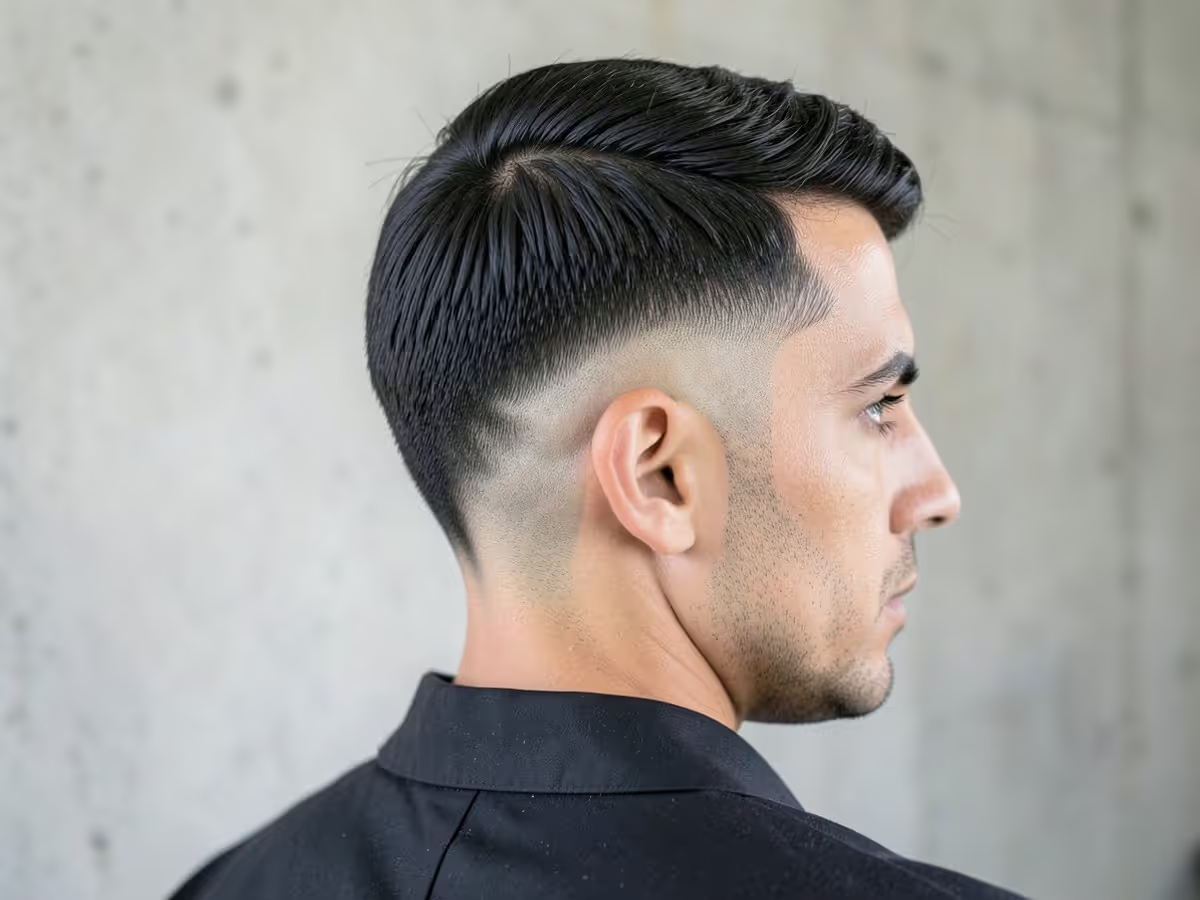
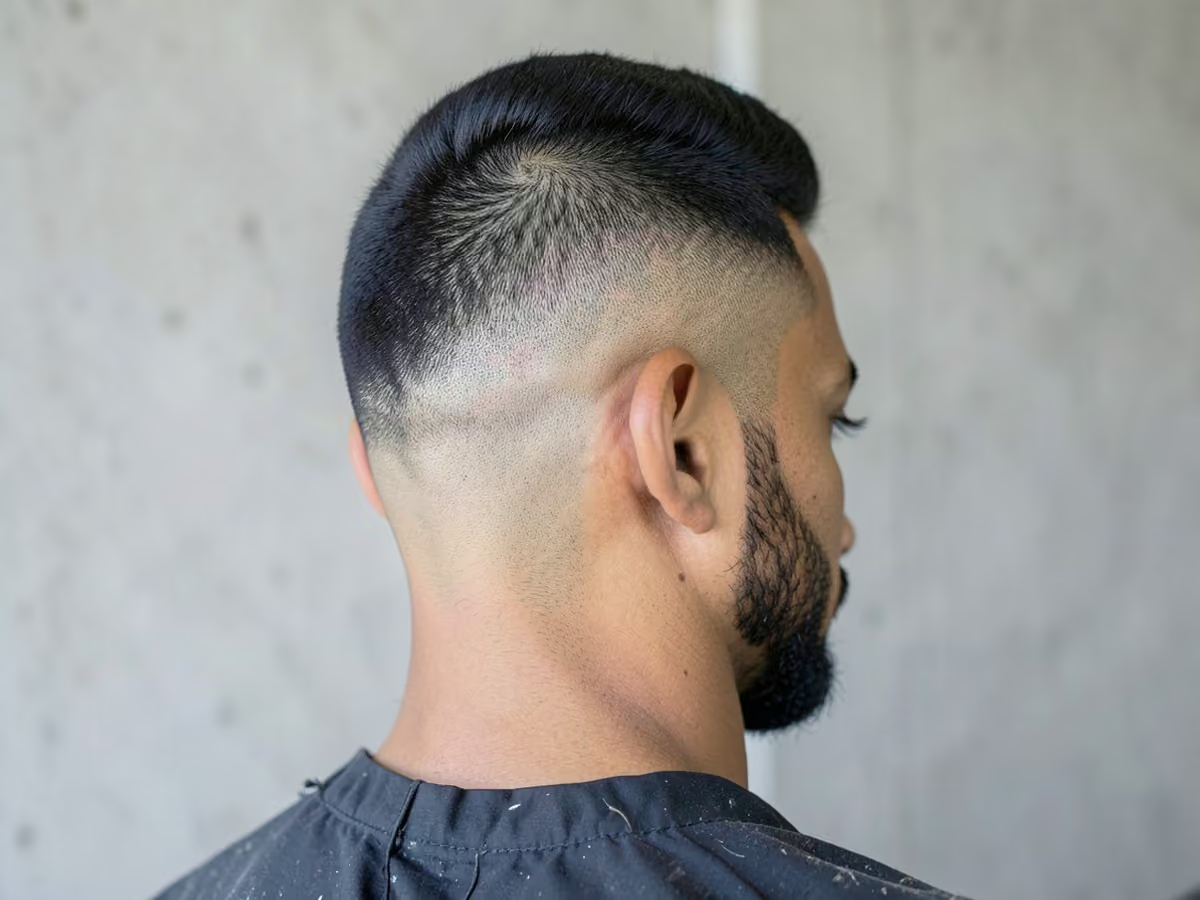
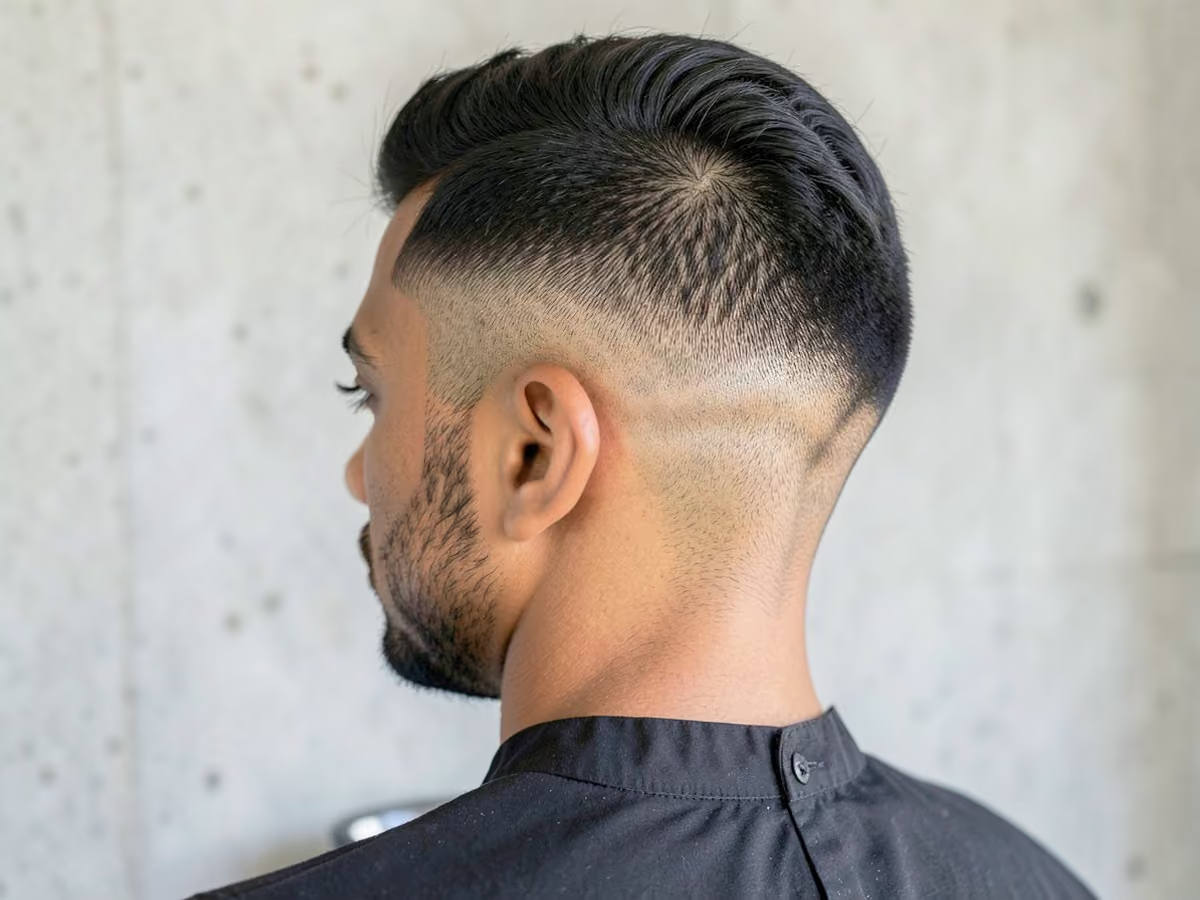
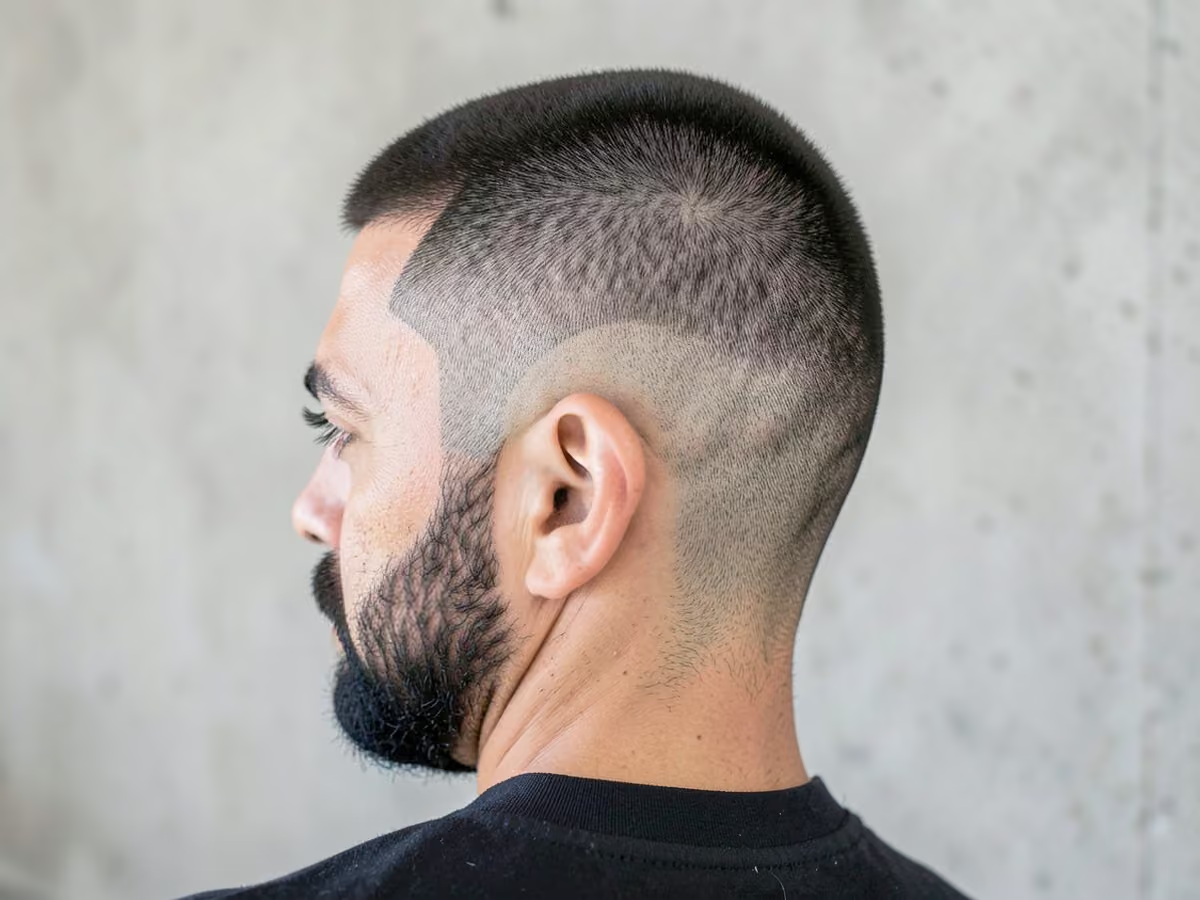
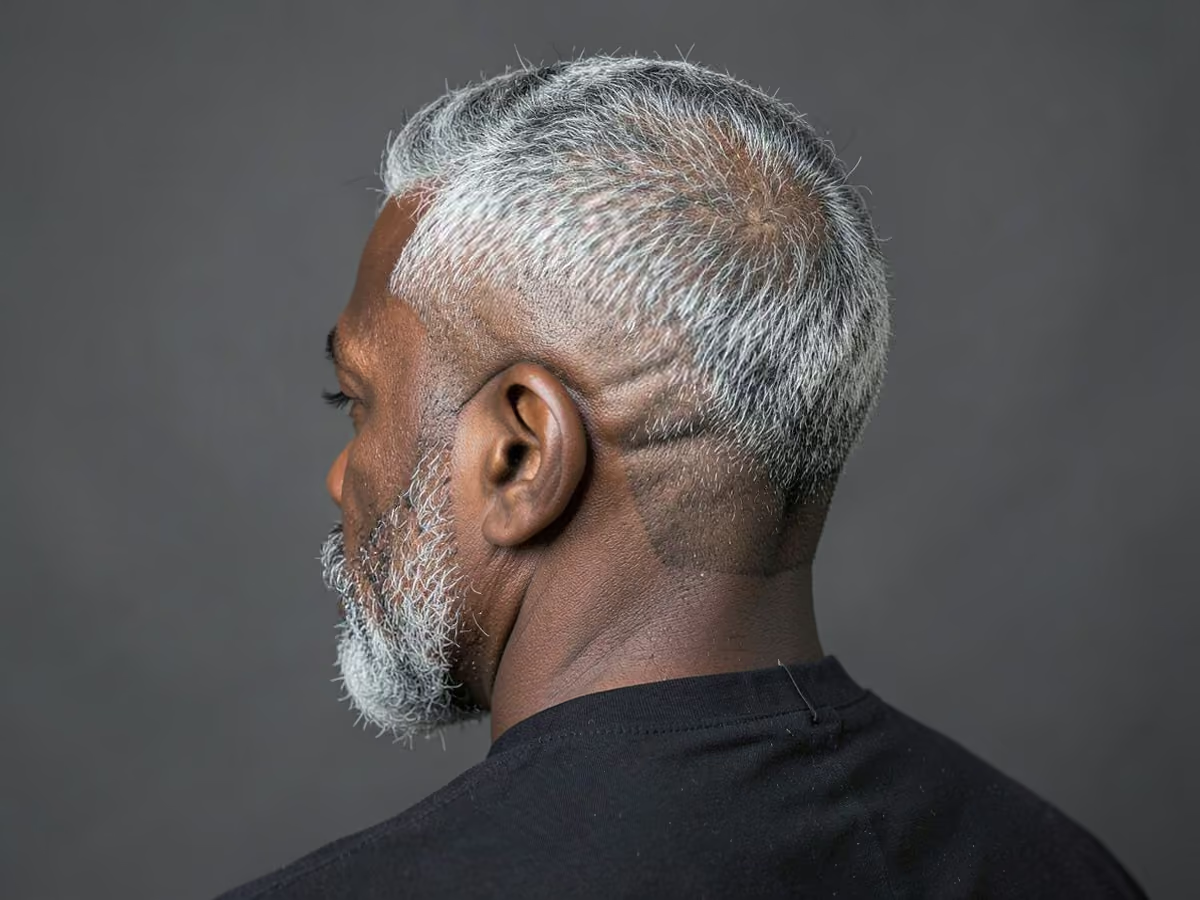
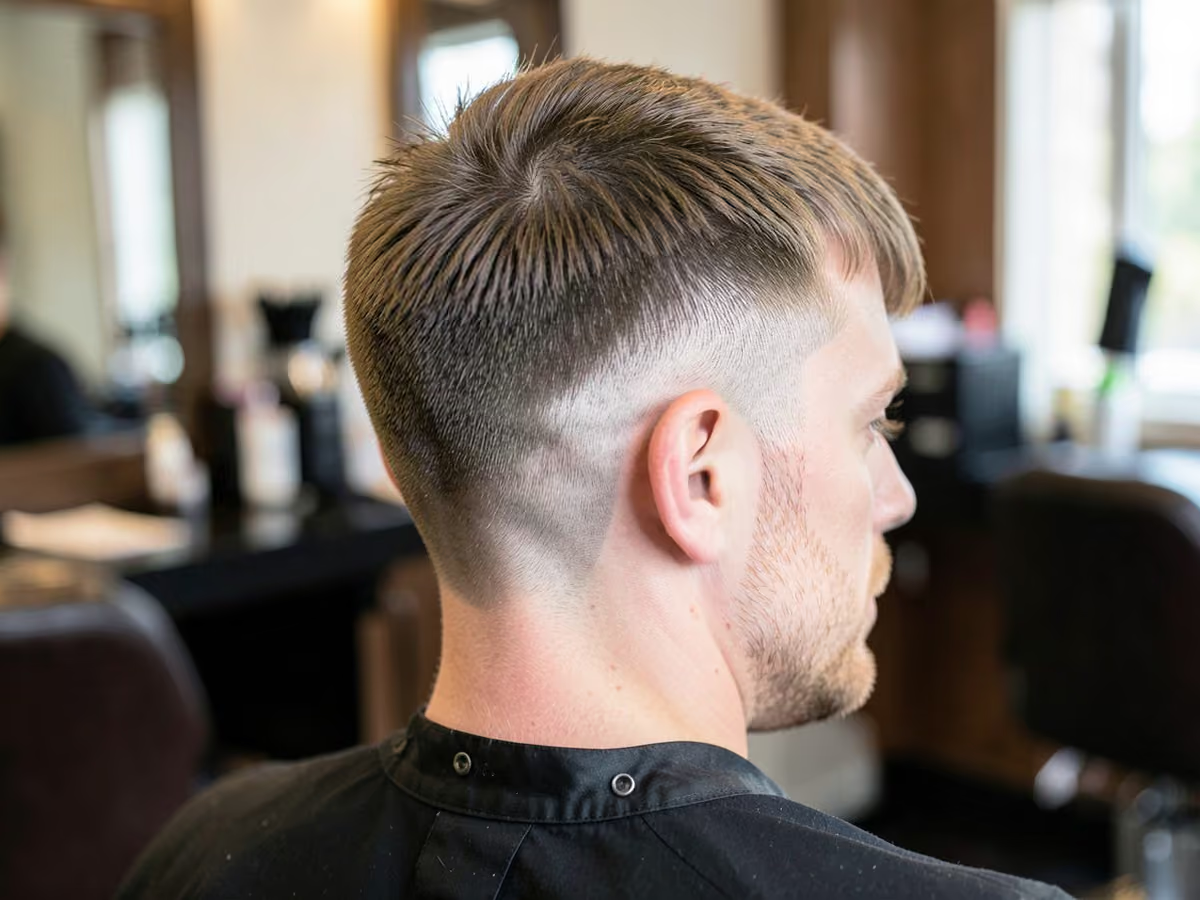
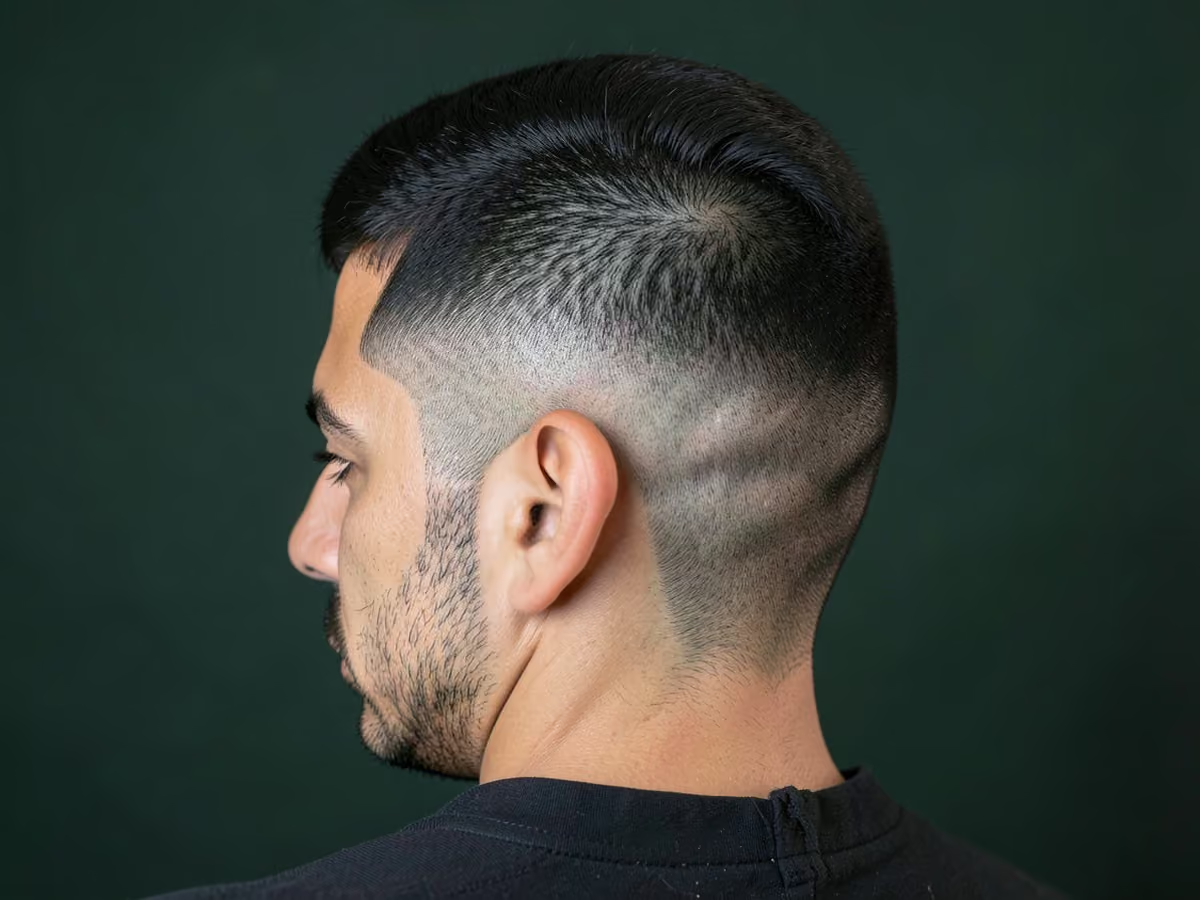
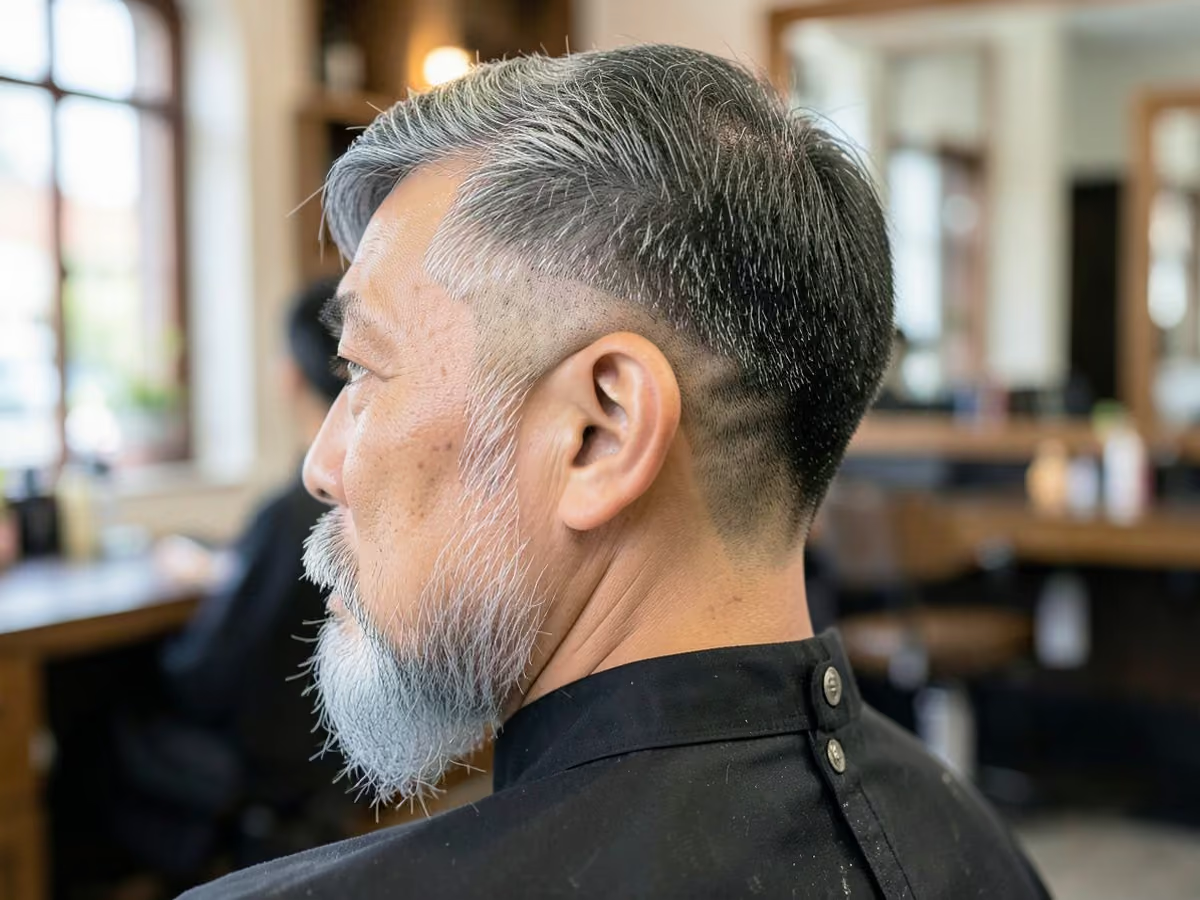
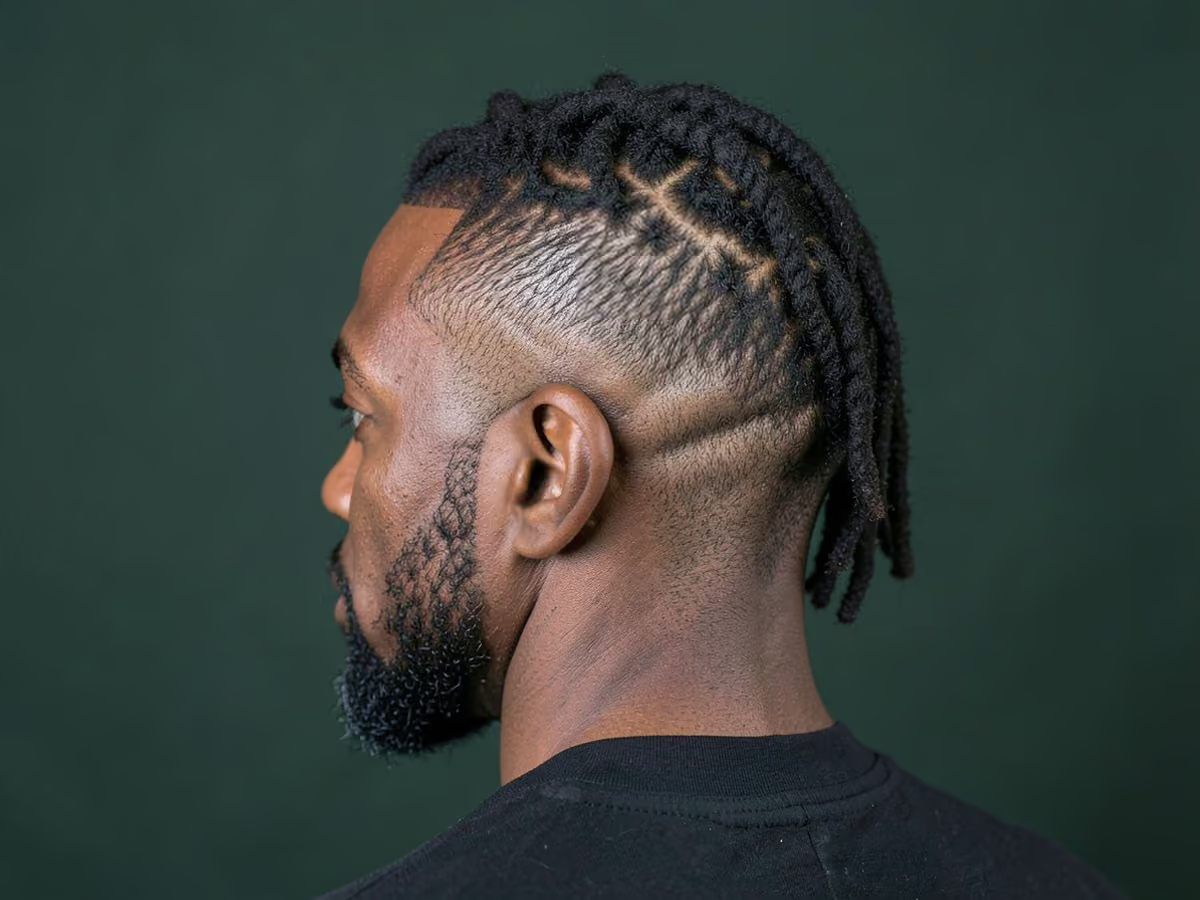
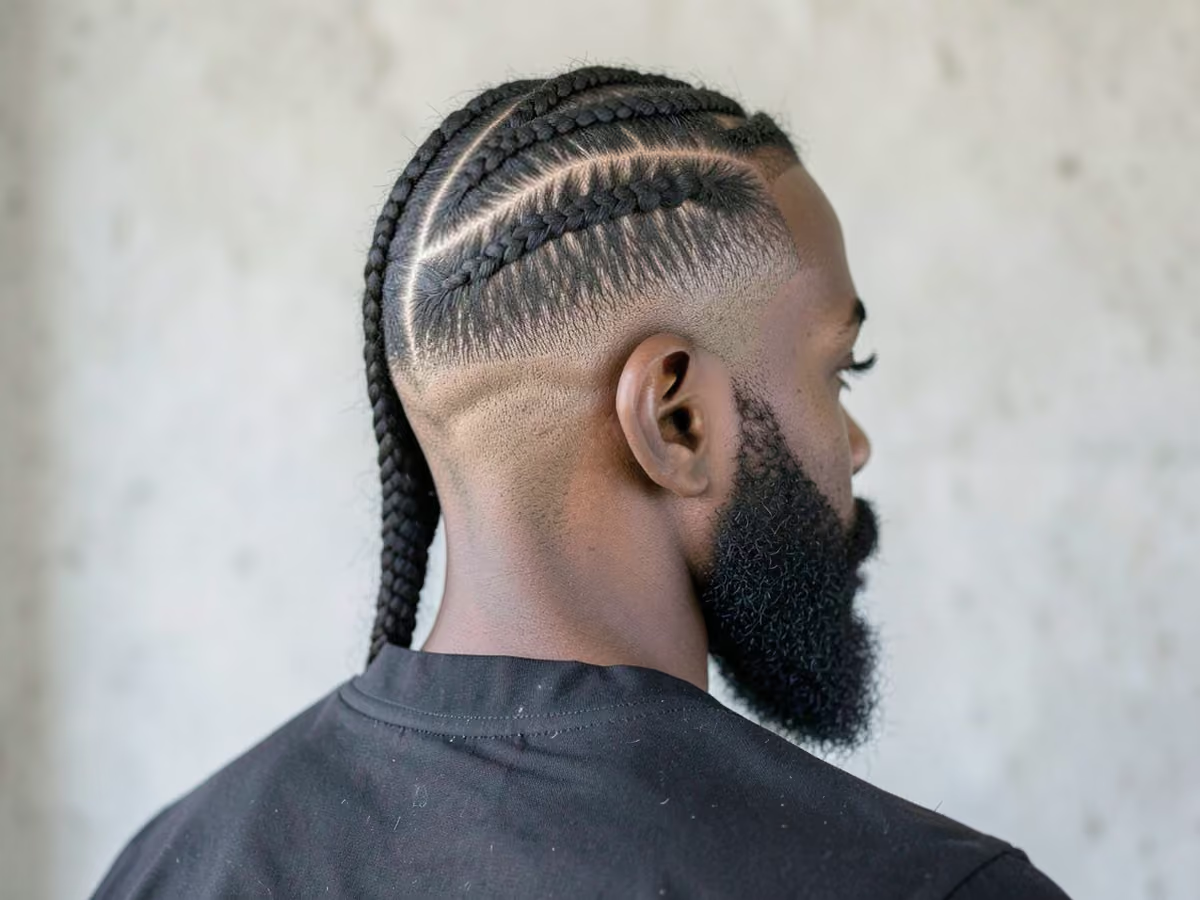
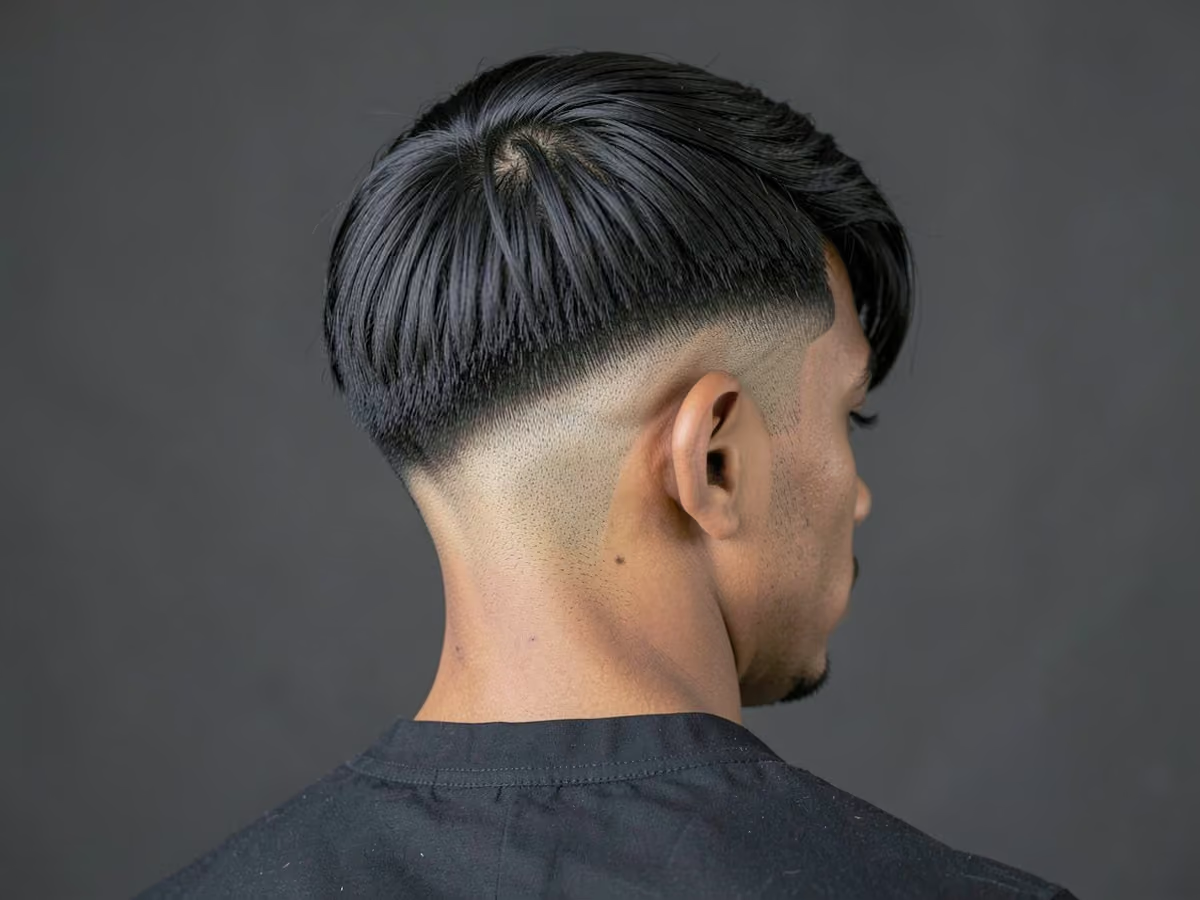
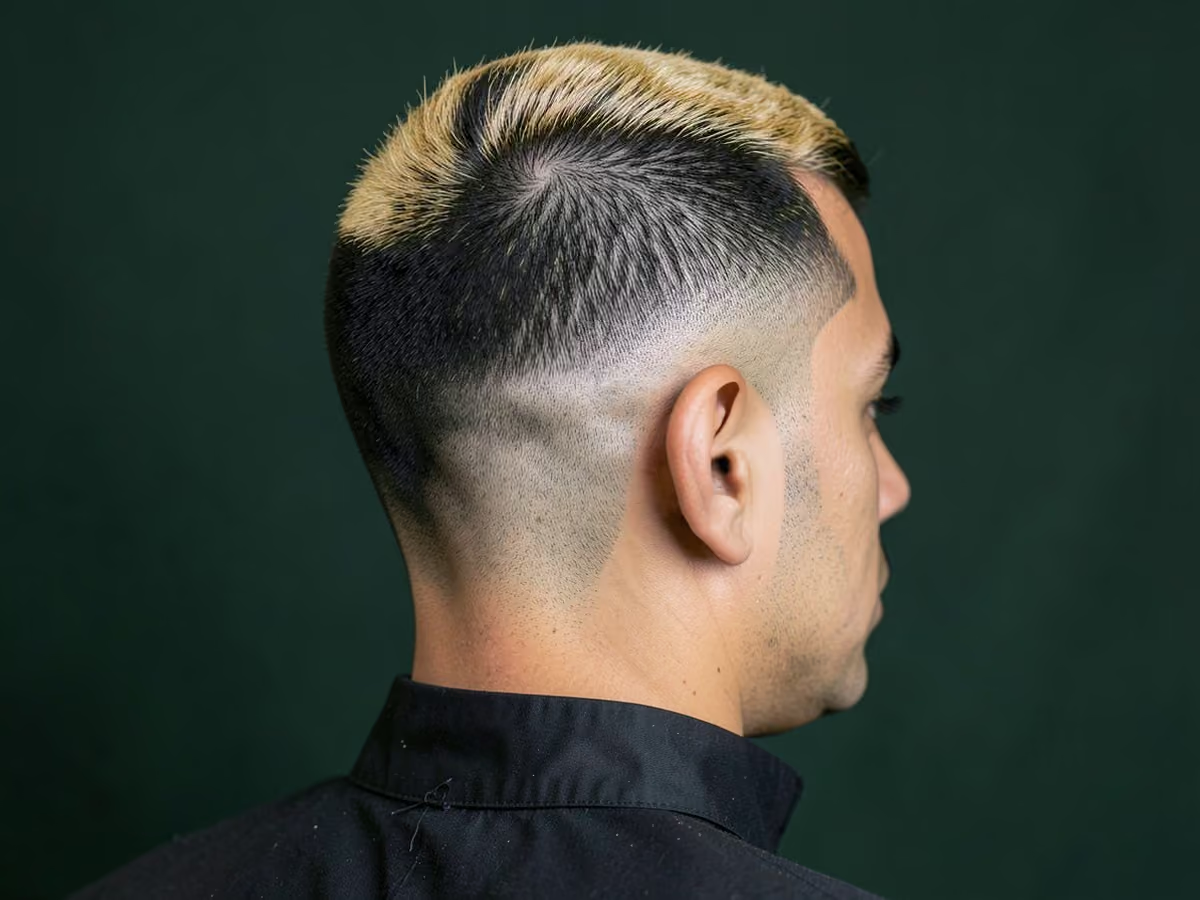
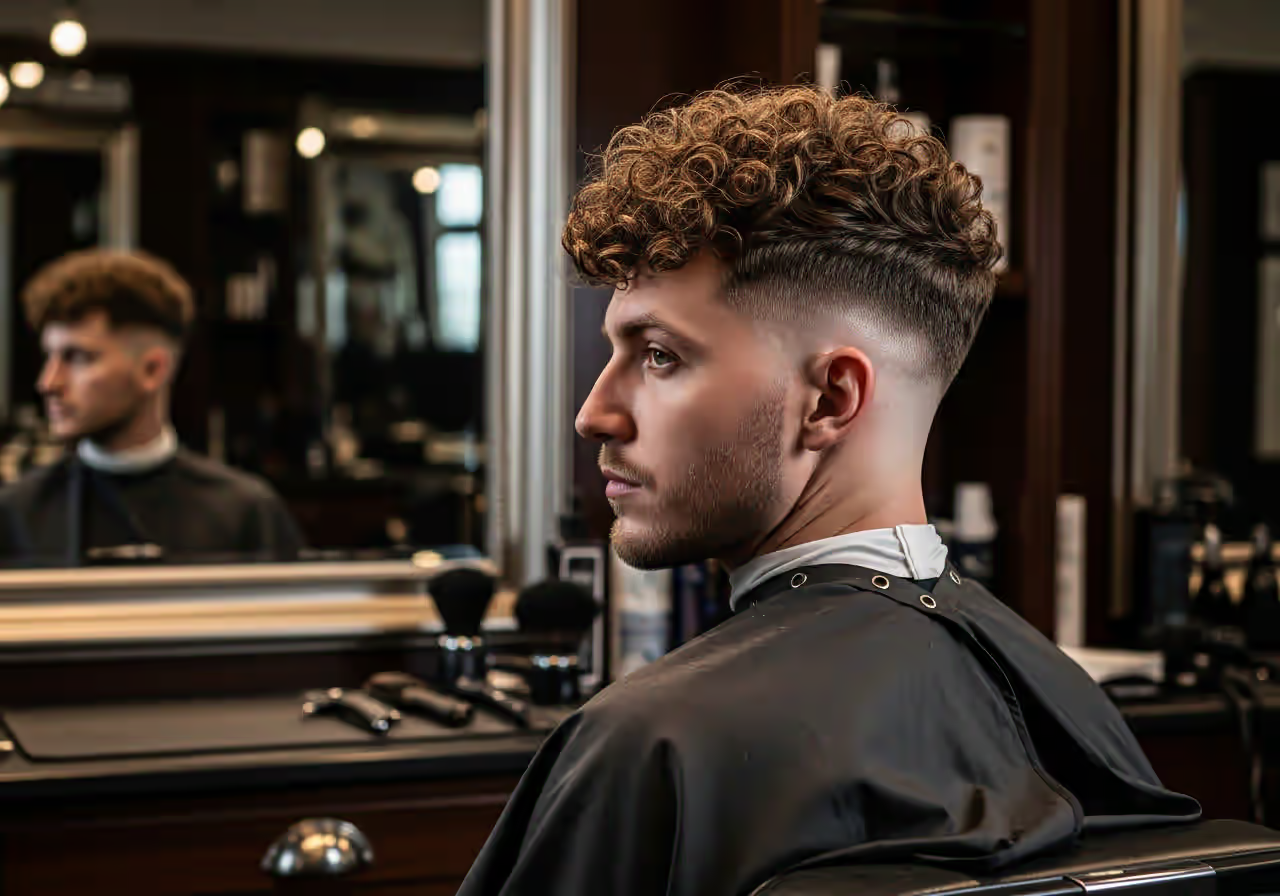
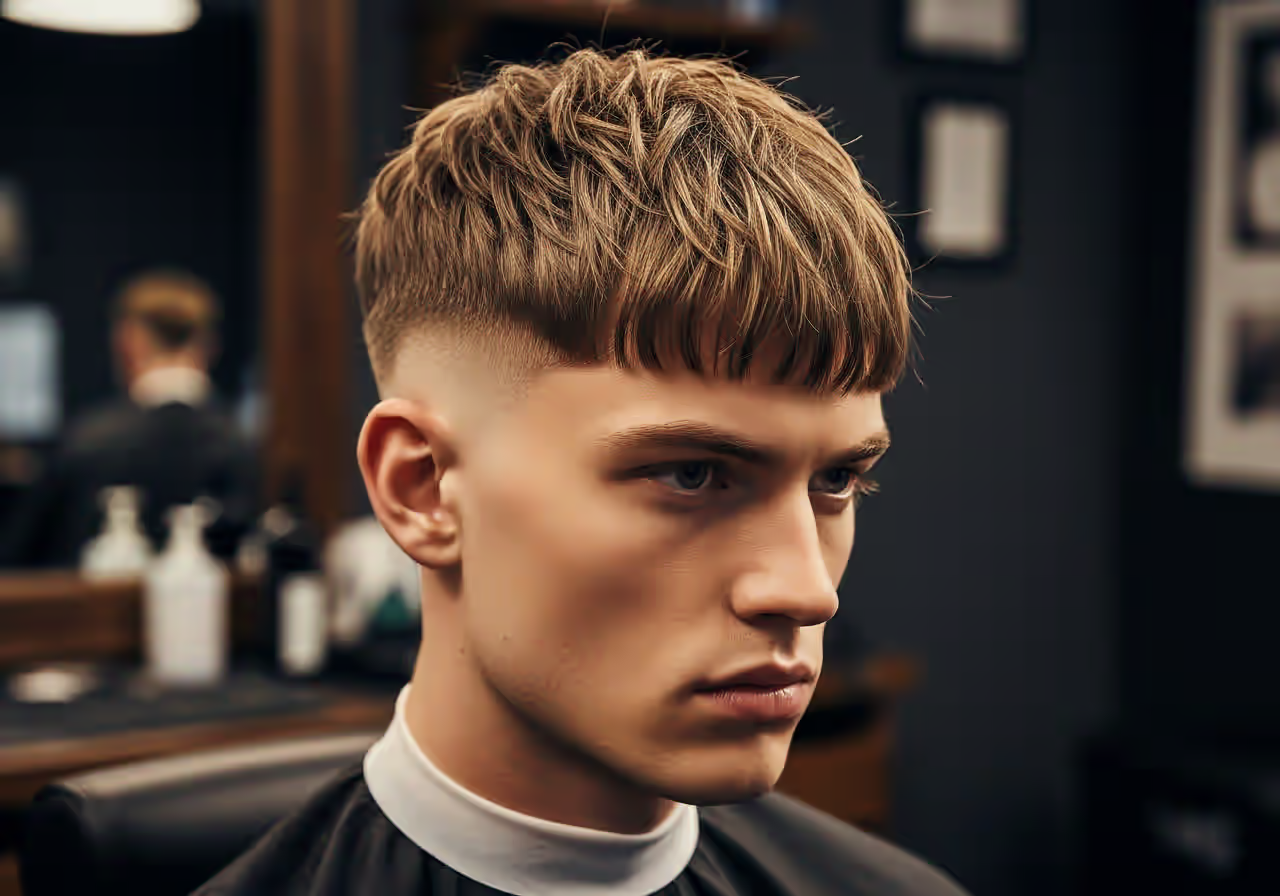
Quick answer: A burst fade curves in a semicircle around the ear instead of running straight across the side, and it suits curly tops, mohawks, mullets and longer textured styles that need a rounded frame. Expect a #0.5 to #3 on the sides, 2 to 3 inches on top and a trim every 2 weeks.
Burst Fade Styles at a Glance
Every style on this page with its clipper guard, top length and trim interval. Tap a name to jump to that card.
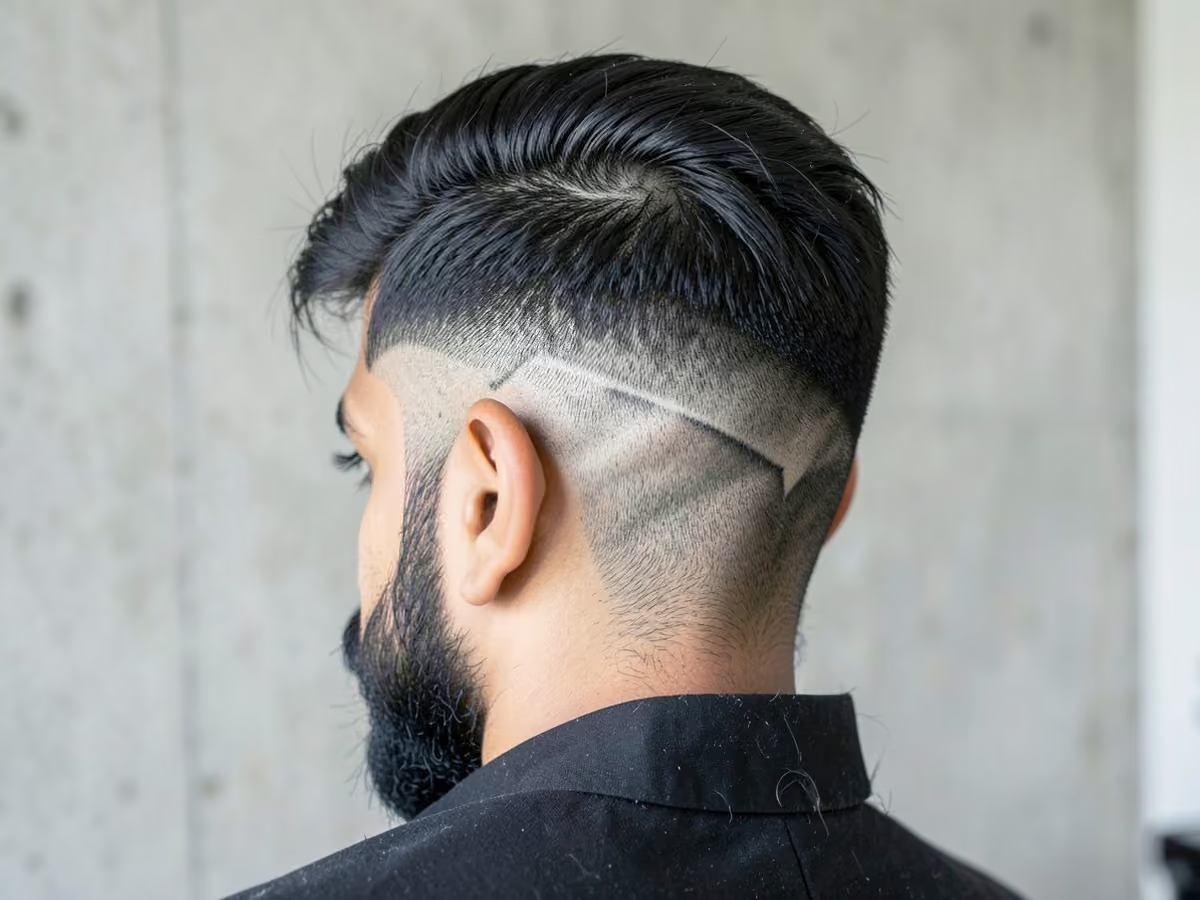
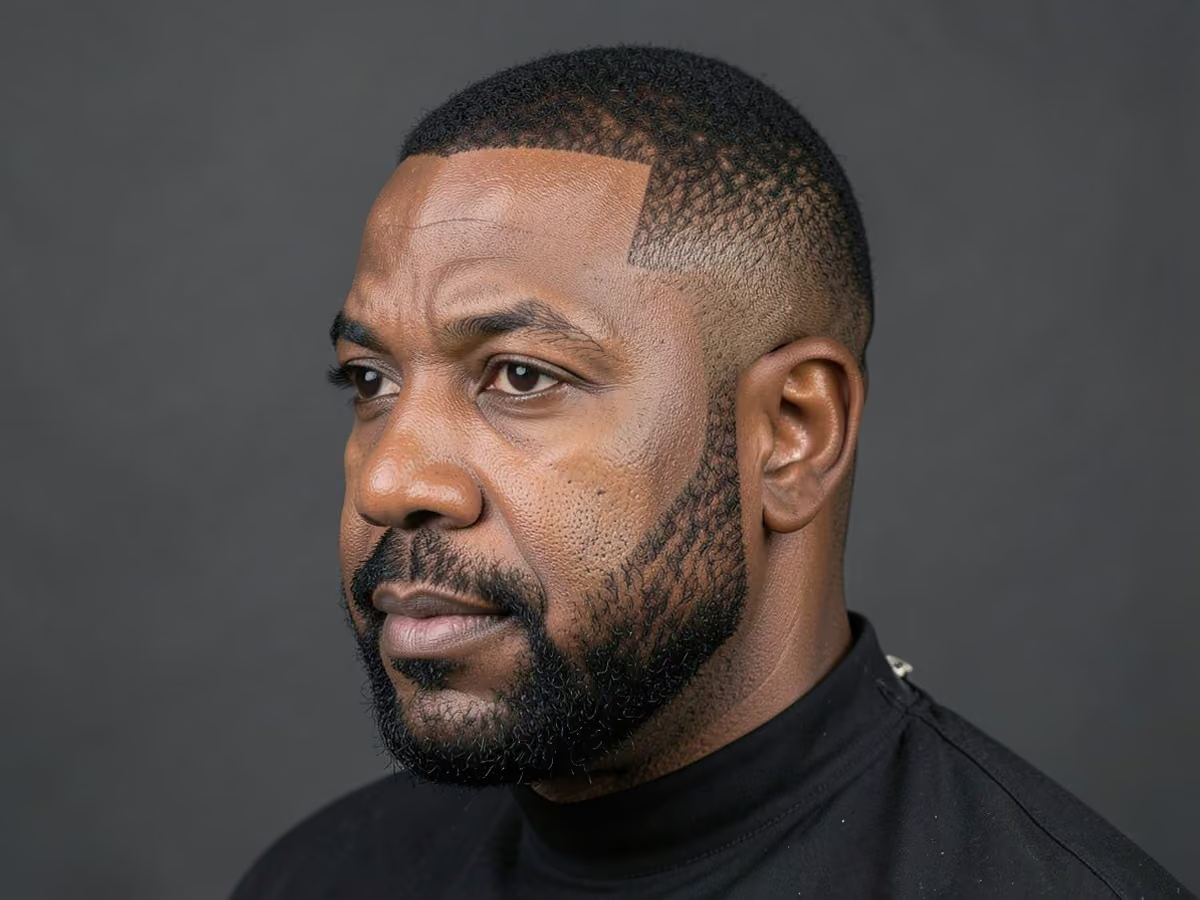
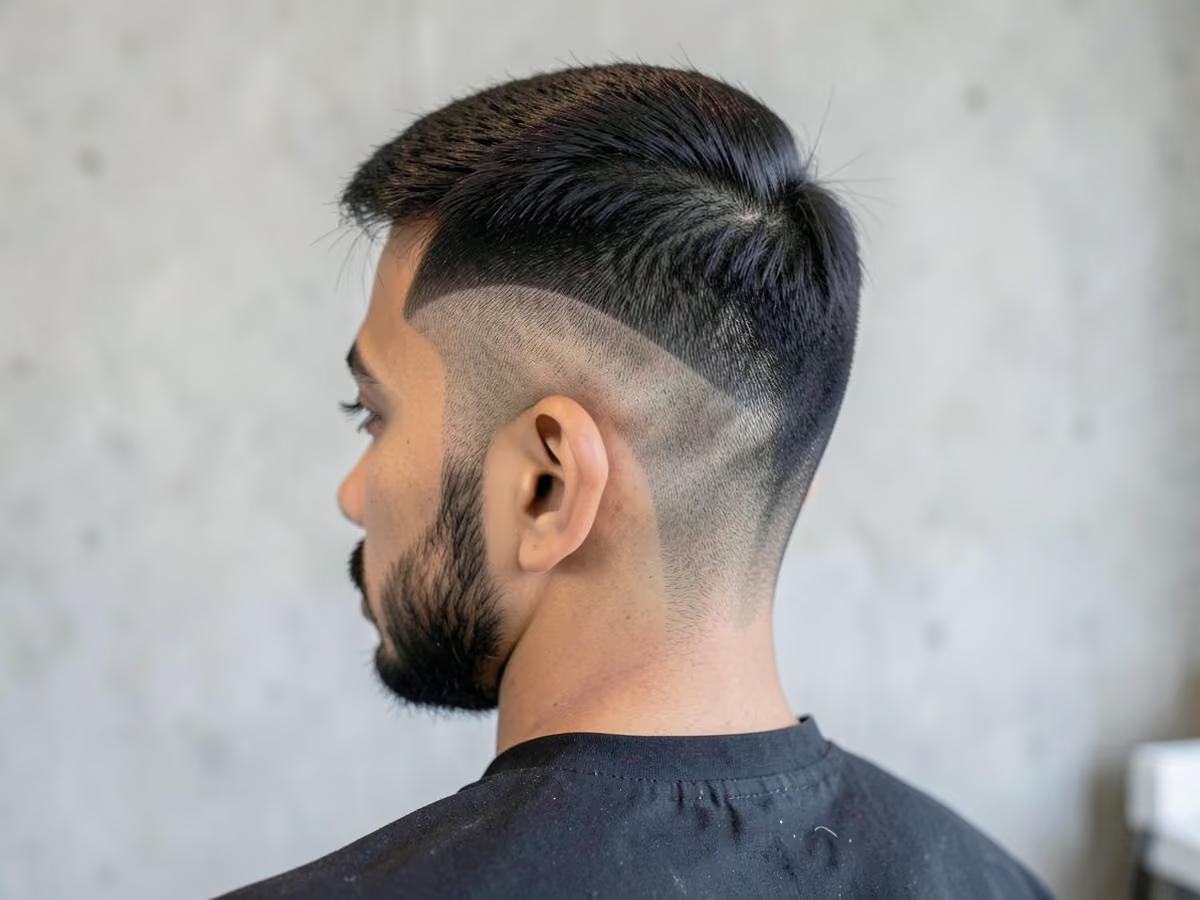
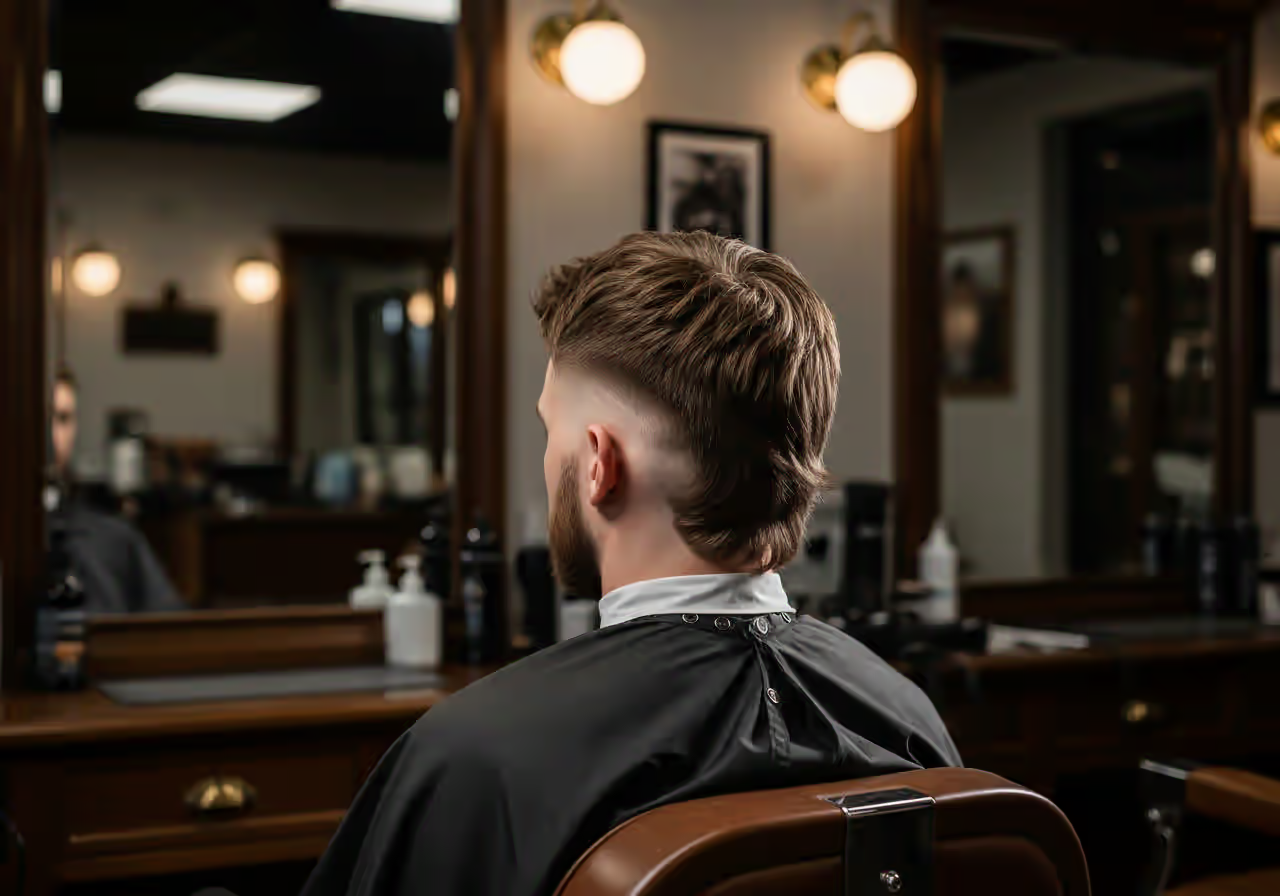
A burst fade is a fade that curves in a semicircle around the ear instead of running straight across the side, which gives a rounded, sculpted shape. The barber opens at skin or a #0 by the ear and blends outward in every direction, usually setting the arc with a #2 or #3 guard and fading it through a #1 and #0.5. It works at low, mid, high or skin placement and suits curly tops, mohawks, faux hawks, mullets and longer textured styles, where the arc makes heavy hair on top look intentional. A drop fade, by comparison, dips down behind the ear instead of circling it. To order one, say: burst fade, make the fade curve in a round burst around the ear, then give the placement and your top length and style. The arc starts to lose its shape after two to three weeks, so a cleanup every two keeps it round.
The burst fade is the usual base for a takuache haircut, where a fluffy top falls forward over the brow and the curve frames the ear.
If you want the back faded too rather than left long at the nape, ask for a Southside fade, which runs the line straight around the whole head.
A burst fade is the most common way to soften the sides of a mohawk haircut, since the curve around the ear frames the strip.
The burst fade is the most common base for a mohawk fade, where the curve around the ear frames a strip that runs to the nape.
Of the curved fades it is the most dramatic and the least forgiving: the arc has to match on both sides, and it loses its round shape sooner than a drop fade, which grows out more gracefully. If you want lower upkeep, a straight taper is the softer choice, so tell your barber how often you can come back before choosing.
A burst fade is usually cut low around the ear; compare it with a standard low fade or a taper fade if you want the sides cleaner all the way round.
Burst Fade vs Other Fades
BURSTSemi-circular arc radiating around ear: roundest, most sculpted, maximum drama.
DROPCurves and drops behind ear: smoother contour, graceful grow-out.
Show this to your barber or follow it yourself for the cleanest round fade possible.
1
Prep
Dampen hair or cut dry for precision. Section top hair away from sides.
2
Create the Burst Guideline
Use a #2 or #3 guard. Start at the temple and draw a semi-circular arc that bursts outward around the ear, this is the 'burst'.
3
Fade the Burst
Switch to open blade or lower guards (#1 → #0.5). Blend the arc smoothly so it disappears into skin in a perfect round shape.
4
Nape & Sideburns
Curve the neckline to match the burst radius for a smooth round silhouette.
5
Clean Finish
Use a foil shaver or straight razor for skin-smooth edges (optional skin burst for maximum contrast).
6
Symmetry Check
View from every angle. The burst must be identical on both sides.
7
Style the Top
Leave 2–6+ inches on top depending on the desired style.
Pro Tip: Always cut the burst dry and use a mirror to show the client the round shape before finishing.
Filter the styles
Showing all 56 styles
Fade
Hair
Length
Classic, Low, Mid and High Burst Fades
The Low Burst Fade and Burst Taper Fade are the easy keepers in this set, at about three weeks between visits; the High Burst Fade needs the barber every one to two.
Instead of running straight across the side of the head, the fade bends in a half circle around and behind each ear, dropping to a #0.5 at the center of the curve and growing back out toward the nape. Above it, the top is left full and natural, around three inches. Straight or thick hair holds that fullness without product and makes the curve easy to see. It suits most face shapes. The curve needs a barber comfortable working around the ear, and it softens after about two weeks.
How to Style at Home
Let the hair air-dry about halfway after a shower.
Blow-dry with a little light pomade worked in so the top falls naturally.
Finish with your fingers instead of a comb so the top stays loose.
Ask Your Barber
"Classic burst fade: a clean half circle around the ear, a half guard at the center, and keep the top full and natural, about three inches."
The burst starts right above the ear and stays low, so the curve is small and the sides keep most of their length. That makes it the calmest-looking version on the page. Keeping width off the temples suits oval and heart-shaped faces. Because so little skin is exposed, regrowth blends in quietly, and it goes three weeks between visits, longer than any other card in this group. A little texture clay on top is all the styling it needs.
How to Style at Home
Rub a small amount of texture clay between your palms.
Work it through the top, damp or dry, for easy movement.
Rake with your fingers instead of combing.
Ask Your Barber
"Low burst fade starting just above the ear, a soft, small curve, 1 at the center going out to a 3. Natural top. Use a #3 on the sides."
The burst is set at temple height, so the curve is larger and clearer than the low version without the drama of the high one. It hugs the head in a rounded line, which softens the angles of a square jaw or the sharp cheekbones of a diamond face. Wavy hair works well on top, around two to three inches, roughed up with matte clay so it doesn't sit flat. A curve at this height shows growth quickly, so keep to the two-week schedule.
How to Style at Home
Matte clay goes mostly on the top of a mid burst fade, worked into dry hair.
Finger-tousle the crown rather than combing it flat.
Check that the curve at the temple looks even on both sides.
Ask Your Barber
"Mid burst fade, round curve starting at temple height. Textured length on top, two to three inches, no product on the sides. Use a #1 to #2 following the curve."
Here the burst starts above the temple, so the half circle is at its largest and the sides are almost bare. It is the most dramatic curve in this set. Because the height pulls the eye upward, round and heart-shaped faces look longer and narrower. Thick hair on top holds the contrast; fine hair can look sparse next to that much skin. Mousse and a round brush give the top lift. Regrowth at this height is obvious within days, so the barber sees you every one to two weeks.
How to Style at Home
Work volumizing mousse through damp hair.
Dry the top over a round brush for lift.
Keep a standing barber appointment every one to two weeks.
Ask Your Barber
"High burst fade starting above the temple, sharp and dramatic. Keep volume on top. Use a #1 to #2 following the curve."
The top is cropped to about an inch, with a tight burst curve around each ear. There is almost nothing to style, which makes it the practical pick for busy weeks or sports. The tight curve holds its shape better than a loose one, and it works on any hair type because there's no length for texture to show. A dab of texture clay is optional. Short tops show growth fast, so trims come every two weeks.
How to Style at Home
Towel off and push the top forward with your palm.
If you want a little movement, press in a small dab of texture clay.
That's it; no comb, no dryer.
Ask Your Barber
"Short top, about an inch, nothing to style. Tight burst curve around the ear, a half guard to a 2. Use a #2 on the sides."
A moderate burst curve sits under a medium top, around three inches, that can be combed neatly for the office or pushed around loosely on weekends. Nothing about it is extreme, so it suits nearly any face shape and hair type. It's a good choice if you don't want to commit to one daily look. A light-hold product keeps it flexible. The curve and top both stay balanced for two to three weeks.
How to Style at Home
Decide the look for the day: combed for work, loose for weekends.
Work a light-hold cream through the top.
Comb it for a neat finish or rake with your fingers for a relaxed one.
Ask Your Barber
"Wearable burst fade, round curve around the ear, with about three inches on top I can style a few ways. Use a #1 to #2 following the curve."
This is the softest burst on the page. The barber blends the curve so gradually, working up from a #1 through several guards, that there is no visible line anywhere around the ear. The top is left natural at two to three inches. You get the rounded shape of a burst without looking like you were in the chair yesterday. Minimal product is needed, and the soft blend hides regrowth, so it comfortably lasts three weeks. It is a forgiving choice for nearly any hair type.
How to Style at Home
Skip product, or use the smallest amount of cream on dry ends.
Let it air dry.
Push the top into place with your fingers and leave it.
Ask Your Barber
"The most natural burst fade you can do: a soft curve starting at a 1, no harsh lines anywhere, and barely any product on top."
Trim:Every 3–4 weeks. No bare skin means regrowth hides well.
Best For:Oval, square faces + straight or wavy hair.
About This Style
A shadow burst stops short of skin. The bottom of the half circle around the ear is cut with a #1, then blends up through a #2 and #3 into whatever length sits on top. You get the curved outline without the bright scalp contrast, so it reads softer at work and grows out without an obvious line. Men with lighter skin and dark hair often prefer it because a skin burst can look patchy on them after a week.
How to Style at Home
Towel-dry hair and rub a pea-sized amount of cream between your palms.
Push the top in its usual direction with your fingers.
Smooth any fluff above the curve so the shadow stays even.
Ask Your Barber
"Burst fade around the ear starting at a #1, no skin, blended to a #3 at the top of the curve. Leave the nape longer and two inches on top."
Trim:Every 2–3 weeks. The broad curve blurs quickly behind the ear.
Best For:Long, oval faces + thick or coarse hair.
About This Style
Here the half circle is cut larger than usual, running from the front of the sideburn to a point well behind the ear before curving back down. Because more of the side is faded, the head looks narrower at the ears, which helps a long face look more balanced. Expect a #0 or #0.5 at the center of the curve and three to four inches of length left at the back and on top.
How to Style at Home
Rough-dry the top with a blow-dryer on medium heat.
Work matte clay through the top from back to front.
Leave the back hair falling naturally over the curve.
Ask Your Barber
"Wide burst fade, start at the sideburn and finish an inch behind the ear, #0.5 in the middle. Keep three inches at the nape and on top."
Trim:Every 2 weeks. The buzz and curve both lose shape together.
Best For:Round, square faces + any hair type.
About This Style
The whole top is clipped with a #2 or #3, and the only detail is a short half circle around each ear taken down to a #0. With so little hair overall, the burst becomes the main design feature, and the nape stays at buzz length instead of growing into a tail. It takes no styling at all, dries in minutes after a workout and is a common summer request. Patchy beards and buzz cuts pair well with it.
How to Style at Home
Wash with shampoo and towel-dry; nothing else is needed.
Rub a drop of scalp oil over the faded areas if the skin feels dry.
Ask Your Barber
"Number two buzz on top and back, then a burst fade around each ear down to a zero. Keep the nape at the buzz length."
Recommended Products
Scalp Oil
Volume & Flow Burst Fades
Most of the lifted tops here, such as the pompadour, quiff, blowout and slick back, need a cleanup every two weeks. The Burst Fade Long Hair is the exception at three.
A high-volume pompadour, about four inches at the front, is swept up and back off the forehead, with a dramatic burst curve underneath. The rounded curve gives the retro pompadour a current edge. The added height lengthens round and oval faces. Thick hair holds the volume through the day without collapsing. Blow-dry with pomade first, then set with a firmer hold. The burst softens in about two weeks, and the pompadour starts looking top-heavy once it does.
How to Style at Home
Work pomade into damp hair before blow-drying.
Round-brush the front up and back for height.
Once cool, set the shape with a little more pomade and a comb.
Ask Your Barber
"Burst fade pompadour: about four inches at the front swept back, a dramatic round curve under it, firm hold. Use a #1 to #2 following the curve."
A soft, airy top of two to three inches is cut with lots of texture, so fine or thin hair looks like more hair than it really is. The burst curve is kept gentle, so it doesn't overwhelm the lighter density on top. It suits men whose hair looks flat in a shorter cut. Texturizing powder at the roots gives lift, while heavy products would flatten it. The soft curve and fluffy top both hold two to three weeks.
How to Style at Home
Shake texturizing powder into dry roots.
Blow-dry lightly while lifting with your fingers.
Avoid heavy products, which flatten fine hair.
Ask Your Barber
"My hair is fine, so keep the top soft and fluffy, two to three inches with lots of texture, and a gentle burst curve. Use a #1 to #2 following the curve."
Enough length is left on top, usually six inches or more, to gather into a small bun or top knot, while the burst curve keeps the sides clean. When the hair is tied back, the curve shows clearly around the ears. It works on straight, wavy or curly hair, though curly hair needs a bit more cream to smooth it before tying. It's a practical way to wear longer hair without losing sharp sides, and the curve needs reshaping every two to three weeks.
How to Style at Home
Smooth styling cream through damp hair on top.
Gather the top at the crown with your fingers.
Tie a loose bun with a soft elastic.
Ask Your Barber
"Leave enough on top to tie into a small bun, and give me a clean round burst curve on the sides. Use a #1 to #2 following the curve."
This keeps noticeably more length through the crown than any other burst here, around five inches, so the top falls in natural layers instead of a styled shape. The burst curve provides contrast so the length doesn't look shapeless. It suits oval and heart faces and works on wavy or straight hair. Texture spray on damp hair and a little styling cream once it's mostly dry let the length move freely. Because the top is meant to look grown, the cut holds three weeks.
How to Style at Home
Mist texture spray onto damp hair.
Once mostly dry, work a little styling cream through for control.
Let the length fall naturally instead of combing it one way.
Ask Your Barber
"Keep more length on top than usual, about five inches with natural layers, and a smooth round burst curve around the ear. Use a #1 to #2 following the curve."
The front, about three to four inches, is lifted into a swept-up quiff, giving the burst more height and a more structured finish than a plain textured top. The height adds length to the face, which suits oval faces. Medium-thick hair holds the lift through the day without falling flat. A matte pomade sets the shape once the hair cools. The burst needs a refresh every two weeks to keep the quiff looking sharp.
How to Style at Home
Round-brush the front while blow-drying for lift.
Once cool, work matte pomade through to set the shape.
Comb the quiff into its final direction.
Ask Your Barber
"Burst fade quiff: three to four inches at the front swept up, round burst curve on the sides, matte finish. Use a #1 to #2 following the curve."
Height and volume are built across the whole top, about four inches, by blow-drying, rather than only at the front like a quiff. Paired with a dramatic burst curve, it creates an airy, full outline that suits oval and round faces. It takes more daily styling than most versions here, because the volume needs rebuilding every morning. Mousse before drying gives extra hold. The curve needs a cleanup every two weeks.
How to Style at Home
Work volumizing mousse through damp hair.
Round-brush the top section by section while blow-drying.
Leave the crown alone once it has cooled.
Ask Your Barber
"Airy blowout on top, about four inches, with a dramatic round burst curve around the ear and lift through the crown. Use a #1 to #2 following the curve."
Medium-length hair, about four inches, is combed straight back off the forehead for a glossy, formal finish, while the burst curve on the sides gives strong contrast against the smooth top. It suits heart and oval faces and works best with straight hair, which holds the slick more easily than wavy or curly hair. A wet-look pomade gives the shine. The curve softens in about two weeks.
How to Style at Home
Work wet-look pomade into damp hair.
Comb the top straight back from the hairline in one motion.
Smooth down lifted strands with your fingers during the day.
Ask Your Barber
"Slick the top straight back, about four inches, bold round burst curve on the sides, wet-look finish. Use a #1 to #2 following the curve."
Trim:Every 5–6 weeks. Only the curve needs cleaning between growth.
Best For:Oval, long faces + wavy or thick hair.
About This Style
Five to seven inches of hair are pushed back off the forehead and allowed to fall behind the ears and onto the collar, with only a small curved patch beside each ear clipped short. That small faded patch stops the sides from bunching over the ears, which is a common complaint while growing out a flow. Hockey players and surfers ask for it often. A barber can clean the curve every few weeks without touching the length.
How to Style at Home
Apply sea salt spray to damp hair from mid-length to ends.
Rake hair back with your fingers and let it air-dry.
Tuck the side pieces behind the ear above the faded curve.
Ask Your Barber
"Keep all my length for a flow. Just cut a small burst fade around each ear at a #1 so the sides sit flat."
Recommended Products
Sea Salt Spray
Styling Cream
Textured, Crop & Fringe Burst Fades
The Burst Fade Edgar and French crop lead this set, alongside spiky hair, a comb over and a mid-length textured top for wavy or straight hair.
A short, choppy crop of about two inches is point-cut so the pieces separate, and it sits above a clean burst curve. The finish looks relaxed rather than heavily styled. The soft, broken texture balances the angles of square and diamond faces. Wavy hair adds to the undone look on its own, so it needs little effort. Matte clay on dry hair keeps the pieces apart. The crop and curve both need tidying every two weeks.
How to Style at Home
For the textured crop, rub matte clay through dry hair until it looks lived-in.
Tousle the top with your fingers instead of a comb.
Leave pieces separated rather than smoothing them into one shape.
Ask Your Barber
"Choppy textured crop on top, about two inches, with a clean round burst curve around the ear. Leave the pieces separated. Use a #1 to #2 following the curve."
The Edgar's blunt, thick fringe sits straight across the forehead above a crisp burst curve, which looks more current than a plain burst. The top is about an inch and a half. It suits round and oval faces. The fringe grows faster than you'd expect and needs trimming on its own schedule, separate from the fade. Matte clay keeps the fringe flat and dry-looking. Plan on two-week visits for both.
How to Style at Home
Keep the clay to the Edgar's fringe: a little matte clay through that blunt front line on dry hair.
Push the fringe forward with your fingers so it lies flat.
Keep product off the burst curve on the sides.
Ask Your Barber
"Burst fade Edgar: thick blunt fringe at the front, about an inch and a half on top, round burst curve around the ear. Use a #1 to #2 following the curve."
Best For:Square, diamond faces + straight/wavy hair.
About This Style
The top is short and choppy, about an inch, with a forward fringe slightly longer at the front, paired with a clean burst curve. It looks young and needs little effort. It suits square and diamond faces and works on straight or wavy hair, since the short crop leaves little room for texture problems. Texture clay on damp hair before drying gives grip. It needs a trim every two weeks.
How to Style at Home
Before reaching for the dryer, press texture clay into the damp French crop.
Blow-dry the fringe forward.
Leave the rest of the crop textured.
Ask Your Barber
"French crop on top, about an inch, with a forward fringe and a clean round burst curve on the sides. Use a #1 to #2 following the curve."
Defined 360 waves on top, with a glossy finish, sit above the smooth curve of the burst. It suits oval and square faces. The waves depend on daily brushing and a durag overnight to stay defined, which is more upkeep than most versions here. The top is kept short and even so the pattern isn't cut out. The barber adds a clean edge at the hairline. It holds two to three weeks.
How to Style at Home
Work a light styling cream into damp hair.
Brush the top in the direction of the wave pattern.
Wear a durag overnight.
Ask Your Barber
"Defined waves on top, short and even, with a round burst curve around the ear and a clean edge at the hairline. Use a #1 to #2 following the curve."
Matte, textured spikes on top, about an inch and a half long, give an energetic look that contrasts with the rounded burst curve. Round and oval faces benefit from the added height. Straight hair holds spikes most reliably; wavy or curly strands tend to bend over. Matte paste builds the points and sea salt spray adds grip. Short spikes and a tight curve both lose shape quickly, so visits come every one to two weeks.
How to Style at Home
Work matte paste through dry hair in sections.
Pinch small sections upward into spikes.
Mist sea salt spray for extra grip.
Ask Your Barber
"Textured spikes on top, about an inch and a half, with a dramatic round burst curve and firm hold. Use a #1 to #2 following the curve."
A neat, side-swept comb over, about three inches, is combed into structure rather than left loose, and the burst curve beneath gives it a slightly more formal edge than a plain comb over. It suits oval and square faces. Straight hair holds the swept direction most cleanly through the day. Pomade on damp hair gives structured hold. The curve softens in two to three weeks.
How to Style at Home
Comb pomade through damp hair from the roots.
Comb the top across from a side part.
Soften the part slightly with your fingers.
Ask Your Barber
"Side-swept comb over on top, about three inches, structured, with a round burst curve on the sides. Use a #1 to #2 following the curve."
The top sits between a short crop and a long layered style, about three inches, just enough length to show texture without heavy styling. The burst curve stays moderate rather than dramatic, making it a practical everyday cut for most face shapes, with wavy or straight hair. Texture clay on damp hair gives natural separation. Combing it flat removes the texture the length is meant to show. It holds two to three weeks.
How to Style at Home
Mid-length hair above the burst takes texture clay best before it fully dries.
Finger-style the top for loose, separated movement.
Don't comb it flat.
Ask Your Barber
"Medium-length textured top, about three inches, with a moderate round burst curve around the ear. Use a #1 to #2 following the curve."
Trim:Every 3 weeks. The fringe reaches the eyebrows fast.
Best For:Oval, heart faces + straight or wavy hair.
About This Style
Three to four inches on top are combed forward and cut so the fringe sits just above the brows, slightly longer at the center than the corners. The burst around the ear keeps the sides tight while the back stays at a #3 or longer. A fringe hides a high forehead, so this works for men with a tall face or a receding front who still have density at the crown.
How to Style at Home
Blow-dry the top forward with your fingers, not a brush.
Twist small pieces of the fringe with texture paste.
Pinch the ends apart so the fringe looks separated.
Ask Your Barber
"I'd like a Burst fade around the ear at a #1, back at a #3, three to four inches on top pushed forward into a choppy fringe above the eyebrows."
Trim:Every 2–3 weeks. The short fringe line softens quickly.
Best For:Round, square faces + coarse or curly hair.
About This Style
An inch of hair on top is cut to one even length and brushed forward to a straight, short fringe, the classic Caesar shape. The burst adds a curve around each ear that a standard Caesar does not have. Coarse and curly textures hold the flat front without product. A line-up at the forehead keeps the fringe edge crisp, and the back can be faded or left at a #2.
How to Style at Home
Brush the top forward with a soft brush while hair is damp.
Press a little styling cream onto the fringe to keep it flat.
Ask Your Barber
"Caesar on top at about an inch, straight fringe, line-up at the front. Burst fade around the ears down to skin, #2 at the back."
Trim:Every 3 weeks. Straight thick hair sticks out above the curve.
Best For:Oval, round faces + thick straight hair.
About This Style
Thick, straight Asian hair tends to stand off the head at the sides, so the barber takes the burst a little higher than usual and thins the area above it with texturizing shears. The top is often left four inches long for a two-block style, comma bangs or a center part. Because this hair grows fast and straight, the half circle loses its shape sooner than it does on curly hair.
How to Style at Home
Blow-dry the top down and forward, then lift the roots at the front.
Shape a comma or part with light pomade on your fingertips.
Mist sea salt spray at the roots for hold through the day.
Ask Your Barber
"Burst fade a little higher than normal with the area above it thinned out. Four inches on top for comma bangs, back at a #3."
Recommended Products
Light Pomade
Sea Salt Spray
Curly, Coily & Natural Burst Fades
Every card in this group is for curly or coily hair, from the afro and broccoli style to sponge twists, and all six are booked every two weeks.
Best For:Oval, round, diamond faces + curly/coily hair.
About This Style
Full, natural curls on top, about three inches, are framed by a clean burst curve, so the curls provide the volume instead of being cut down. It suits oval, round and diamond faces. Curly hair needs more moisture than straight hair to stay defined, so weekly deep conditioning is part of the routine. Curl cream and a diffuser keep frizz down. The curve needs reshaping every two weeks.
How to Style at Home
Section damp curls and give each part its own curl cream, rather than one big handful.
Diffuse on low heat.
Deep condition once a week.
Ask Your Barber
"Keep my curls full on top, about three inches, with a clean round burst curve. Don't straighten the curl pattern. Use a #1 to #2 following the curve."
A rounded natural afro on top is shaped so its curve echoes the semicircle of the burst underneath, so the two shapes work together instead of competing. It suits round and oval faces. The afro needs regular moisture and a pick or curl sponge to keep its round outline between visits. The barber shapes it with the hair picked out. Both the afro outline and the curve need a tidy every two weeks.
How to Style at Home
Work a moisturizing cream through the afro.
Run a curl sponge over the surface to define the round shape.
Pick the afro into shape rather than combing it flat.
Ask Your Barber
"Full, rounded afro on top, shaped picked out, with a round burst curve around the ear to match. Use a #1 to #2 following the curve."
Dense, tightly curled hair on top is styled into a rounded, textured cluster known as a broccoli cut, against a sharp burst curve for a playful, high-contrast finish. It suits round and diamond faces. It works specifically with coily or tight curls; looser curls won't hold the same rounded density. Curl cream and scrunching build the shape. It needs a trim every two weeks.
How to Style at Home
The broccoli top relies on curl cream, so coat the damp curls fully before they start to dry.
Scrunch the curls upward to build density.
Air dry without brushing.
Ask Your Barber
"Dense rounded curly top in a broccoli shape, with a sharp round burst curve on the sides. Use a #1 to #2 following the curve."
A crisp burst curve blends into thick, natural coily or curly hair on top, keeping the density and shape of the hair instead of forcing it into a style that fights the pattern. It suits oval and square faces. At this length, coily hair dries out, so moisture between cuts matters. The skin around the curve needs moisturizing too, since dryness shows through short hair. It needs reshaping every two weeks.
How to Style at Home
Massage a hydrating oil into the scalp and hair between washes.
Diffuse the top on low heat for lift without frizz.
Moisturize the skin around the burst curve too.
Ask Your Barber
"Blend the burst curve cleanly into my natural texture on top, and keep the full density. Use a #1 to #2 following the curve."
Thick, full curls on top, three to four inches, are balanced by a smooth burst curve, so the curls look styled rather than simply grown. It suits diamond and heart faces. Thick curls are heavier than fine ones and lose shape without a curl cream with real hold. Once they're dry, touching them causes frizz. The curve needs a refresh every two weeks.
How to Style at Home
Divide thick, damp curls into sections and be generous with curl cream in each.
Diffuse on low heat, lifting at the roots.
Don't touch the curls once dry.
Ask Your Barber
"Keep my thick curls full on top, three to four inches, with a smooth round burst curve underneath. Use a #1 to #2 following the curve."
A curl sponge rubbed in small circles over the top creates rows of small, defined twists, a much quicker alternative to twisting by hand. The top needs about an inch and a half of coily or curly hair for the twists to form. Paired with a smooth burst curve, it looks fresh and takes little upkeep. It suits any face shape. A light-hold cream helps the twists set. The curve and twists both need refreshing every two weeks.
How to Style at Home
Work a light-hold cream through damp coily hair.
Rub the sponge in small circles over the top, section by section.
Let the twists air dry fully before you touch them.
Ask Your Barber
"About an inch and a half on top for sponge twists, with a clean round burst curve around the ear. Use a #1 to #2 following the curve."
Trim:Every 2–3 weeks. Retwist the locs every 4–6 weeks.
Best For:Oval, long faces + coily or 4C hair.
About This Style
Starter or mature locs stay on top and at the back, while a burst around each ear clears hair from the sides. That keeps the locs falling in a column and shows the ear, which reads cleaner than locs with full sides. The fade needs touching up far more often than the locs need retwisting, so many men book separate appointments. Short locs of two to four inches work as well as long ones tied up.
How to Style at Home
Rinse the scalp and squeeze locs dry with a microfiber towel.
Palm-roll the roots with a small amount of loc gel.
Rub a few drops of scalp oil into the faded skin around the ears.
Ask Your Barber
"Give me a Burst fade around both ears down to skin, keep the locs at the back and top untouched, and line up the front and temples."
Trim:Every 2 weeks. Rebraid every 2–3 weeks as the curve grows.
Best For:Oval, square faces + coily or long curly hair.
About This Style
Cornrows run straight back from the hairline, and the burst clears hair only in a curve behind and above each ear, so the outer braids sit just above the curve. You need at least three inches of hair to braid, and braids last two to three weeks. Ask the braider to plan the outer parting after the fade is cut, otherwise the last row can sit on faded hair and pull.
How to Style at Home
Get the fade cut first, then book the braids.
Spray a light leave-in along the parts every few days.
Sleep on a satin pillowcase or in a durag.
Ask Your Barber
"Burst fade around the ears down to a #0, leave everything above the curve for straight-back cornrows, and keep the nape long enough to braid."
Recommended Products
Leave-In
Scalp Oil
Skin Burst Fade with Mohawk, Hard Part and Designs
The loudest versions: skin bursts, a mohawk, a faux hawk and shaved line designs. Six of the seven need the barber every one to two weeks.
The burst is taken all the way to bare skin at the center of the curve, with a foil shaver, rather than leaving a short guard. That gives the deepest, sharpest version of the half circle and the most contrast on the page. It suits men who want a bold look and don't mind frequent visits, since bare skin shows regrowth faster than a short guard. Keep product on top minimal so the contrast stays clean. Plan on every one to two weeks.
How to Style at Home
Let the hair air-dry halfway.
Use as little product on top as possible so the bare curve stays the focus.
Rake the top with your fingers so it stays textured.
Ask Your Barber
"Burst fade taken to bare skin with a foil shaver at the center of the curve. Deepest curve you can do. Use a #1 to #2 following the curve."
A raised strip of hair, about two inches wide and three inches long, runs down the center for height, while the burst curve wraps dramatically around both sides. It is a bold, sculpted outline rather than an everyday cut. It suits oval and round faces and works best with thick or straight hair, which holds the strip upright without heavy product. Keep the sides bare and product-free. It needs reshaping every one to two weeks.
How to Style at Home
Only the central strip of the mohawk gets texture clay, applied while damp.
Blow-dry the strip straight up for a defined lift.
Keep product off the sides so the curve stays visible.
Ask Your Barber
"Mohawk strip down the center, about two inches wide, with a dramatic round burst curve on both sides. Use a #1 to #2 following the curve."
A razor-shaved part line on top adds a sharp geometric detail that contrasts with the rounded curve below. It works in professional settings that still allow a bit of edge. The top is about three inches, combed away from the line. Matte clay keeps it dry-looking. Straight hair shows the line most cleanly. The line blurs faster than the fade, so it needs re-shaving every couple of weeks.
How to Style at Home
With a comb, draw matte clay through damp hair moving away from the hard part line.
Keep product off the shaved line.
Rake the rest of the top with your fingers for texture.
Ask Your Barber
"Sharp shaved part line on top, about three inches of length, and a precise round burst curve around the ear. Use a #1 to #2 following the curve."
A clean burst curve is the base, and then the barber shaves a custom pattern into the faded area, such as a star, a zigzag or initials. Because the design is the focal point, the top is kept simple, about two inches, so it doesn't compete. It suits creative types with any face shape. Designs only look sharp against fresh skin, so plan on re-shaving every week or two.
How to Style at Home
Wash the design area gently and pat dry.
Keep the top simple with a little product.
Leave the design alone while styling so you don't smudge any lines with product.
Ask Your Barber
"Custom design shaved into the burst fade, above the ear. Simple top so the design catches the eye. Use a #1 to #2 following the curve."
Instead of blending, the barber leaves a clear gap between the length on top, about four inches, and the burst on the sides. It's a bold, high-contrast finish for creative and edgy styling. Thick hair on top holds enough shape to make the disconnection look intentional rather than unfinished. Matte clay gives strong definition. The sides need cleaning every one to two weeks.
How to Style at Home
The top of the disconnected burst gets matte clay, combed through while damp.
Push the top back or to one side so it overhangs the gap.
Keep the sides product-free.
Ask Your Barber
"Disconnected look: about four inches on top, a clear gap, and a round burst curve on the sides. Use a #1 to #2 following the curve."
Instead of a broad design, this uses thin shaved lines, one or two arcs that follow the burst curve, for a cleaner, more graphic look. It suits men who want a personal detail without anything large. Lines grow out more evenly than full designs, but they still blur, so touch-ups come every one to two weeks. Keep the top tidy and short so the lines are the focal point.
How to Style at Home
Clean the lined area gently in the shower.
Moisturize the shaved skin lightly.
Style the top minimally.
Ask Your Barber
"Two thin shaved lines following the burst curve, round burst around the ear, short top. Use a #1 to #2 following the curve."
A softer, more wearable take on the mohawk: the center section is raised into a ridge, but the sides aren't shaved as narrow, and the burst curve wraps around the ears. The ridge needs about three inches. It suits oval and round faces and works best with thick hair that holds the center up through the day. Texture clay and a blow-dryer build the height. It needs a refresh every one to two weeks.
How to Style at Home
Pull texture clay toward the center of the damp top, where the faux hawk peaks.
Blow-dry the top upward and toward the middle.
Pinch the ridge into shape with your fingers.
Ask Your Barber
"Faux hawk, about three inches through the center, raised but not a full mohawk, with a round burst curve on the sides. Use a #1 to #2 following the curve."
Trim:Every 1–2 weeks. Both bursts and the back strip need edging.
Best For:Oval, long faces + coily or tight curly hair.
About This Style
Popular with Black men and on social media, this cut combines two deep burst fades with a band of curls or sponge twists that runs from the forehead over the crown and down to the nape. The hair at the back is left long, so the strip continues past the curve rather than stopping at the crown like a frohawk. Most barbers line the front and take the bursts to skin.
How to Style at Home
Spray curls with water and work in curl cream.
Twist the top with a curl sponge in small circles.
Shape the strip with a pick so it stays narrow.
Ask Your Barber
"South of France: skin burst fades on both sides, two-inch strip of curls from front to nape, long at the back, line-up at the front."
Trim:Every 2–3 weeks. The faded curve under the top needs edging.
Best For:Oval, square faces + straight or thick hair.
About This Style
The top is left four to six inches long and falls over a faded half circle cut underneath, so when your hair is down the burst hides, and when it is slicked back it shows. There is no blend between the long top and the faded area. Thick straight hair hangs well over the disconnection. It is a good option for workplaces that frown on visible fades but tolerate long hair.
How to Style at Home
Comb pomade through damp hair from front to back.
Push the top back or to the side to reveal the curve.
Let it fall forward when you want the burst hidden.
Ask Your Barber
"Undercut style: leave five inches on top, no blending, and fade a burst underneath around each ear down to a #0."
Trim:Every 2–3 weeks. Recolor roots every 6–8 weeks.
Best For:Oval, heart faces + wavy or curly hair.
About This Style
Blonde or caramel highlights are painted only on the top two to three inches, while the burst stays the natural dark color. That contrast makes the curved outline sharper than it is on all-dark hair. Ask for highlights on curly hair to be painted on the curl ends, since that grows out more gently than foils at the root. Bleach dries out curls, so moisture matters more after coloring.
How to Style at Home
Use a color-safe shampoo and follow with leave-in conditioner.
Scrunch curl cream into the highlighted top while it is still damp.
Air-dry, or diffuse on low heat to protect the bleached ends.
Ask Your Barber
"Let's go with a Burst fade to skin around the ears, three inches on top, and blonde highlights painted on the curl ends only."
Trim:Every 1–2 weeks. The bolt fades out in about ten days.
Best For:Teens, young men + any short hair type.
About This Style
A zigzag bolt is cut with a trimmer into the faded area, usually starting at the top of the burst and pointing down toward the ear or back toward the nape. The design needs a short base, so the curve is taken to a #0 or #1 around it. Expect the edges to blur within two weeks. It is a popular request for game days, birthdays and back-to-school cuts.
How to Style at Home
Keep the design area clean and moisturized with a light oil.
Avoid scratching or rubbing the faded patch with a towel.
Ask Your Barber
"Burst fade to a #0 on the left side with a lightning bolt cut through it from the top of the curve toward the nape."
Recommended Products
Scalp Oil
Beard, Mullet & Long Styles
Three pairings: a burst under a mullet, a burst that runs into a beard, and a burst fade crew cut for oval and square faces.
The burst and the mullet share a shape: the burst curves around the ear and leaves length at the nape, which is exactly where a mullet grows. Here the back is kept noticeably longer, past the collar, while the top is about two inches of texture. It suits round and oval faces, and wavy or curly hair adds natural movement to the back. The sides soften in about two weeks, which sets the schedule.
How to Style at Home
Work texture clay through the back for movement.
Shape the top with your fingers.
Let the back air dry so the wave shows.
Ask Your Barber
"Burst fade mullet: back long past the collar, about two inches textured on top, and a bold round burst curve on the sides. Use a #1 to #2 following the curve."
The burst curve blends into a full beard at the cheekbones, so instead of the fade stopping at the jaw, head and face read as one connected shape. It suits any face shape and hair type. Ask the barber to line up the beard and fade in the same visit for the cleanest transition. The top stays natural, about two inches. Both need a tidy every two weeks.
How to Style at Home
Massage a few drops of beard oil into the beard.
Brush the beard down and check the line where it meets the fade.
Push the top into place with your fingers.
Ask Your Barber
"Blend the burst curve into my beard at the cheekbones, no visible break. Line up the beard and fade together. Use a #1 to #2 following the curve."
Best For:Oval, square faces + straight/thick hair.
About This Style
A short, classic crew cut, about an inch on top and slightly longer at the front, sits above a tight burst curve, giving a clean, minimal look that suits square and oval faces. Straight or thick hair holds the crew shape without daily product. It grows out cleanly because there's so little length to manage. A light cream gives a soft sheen. The burst needs a refresh every two weeks.
How to Style at Home
A crew cut over a burst needs only a little styling cream, rubbed through damp hair.
Push the front slightly up with your fingers.
Leave the rest as it falls.
Ask Your Barber
"Short classic crew cut on top, about an inch, slightly longer at the front, with a tight round burst curve. Use a #1 to #2 following the curve."
Trim:Every 2 weeks. Shave the cheeks every two or three days.
Best For:Round, oval faces + any hair type or texture.
About This Style
A goatee adds length at the chin, and the burst keeps width off the sides of the head, so a round face looks longer from both ends. The cheeks and sideburns are shaved clean, which means the burst does not need to connect to any beard. A short top of one to two inches keeps the focus on the chin. Trim the goatee to about half an inch so it stays tidy.
How to Style at Home
Trim the goatee with a #2 guard and shave the cheeks.
Brush two drops of beard oil through the goatee toward the chin.
Rub a small amount of matte paste into the top.
Ask Your Barber
"Skin burst fade around the ears, sideburns taken clean, inch and a half on top. Please tidy my goatee at half an inch."
Trim:Every 3 weeks. Trim stubble with a #1 every few days.
Best For:Square, oval faces + straight or wavy hair.
About This Style
Stubble of three to five days pairs with a shadow or low burst so the beard and the fade read at a similar length near the ear. The sideburn is faded down into the stubble line, joining the two. Light beard growth is enough for this look, which makes it a choice for men whose beards come in patchy when they go longer.
How to Style at Home
Run a trimmer with a #1 guard over the whole beard.
Clean the neckline one finger above the Adam's apple.
Style the top with a small amount of light cream, pushed forward.
Ask Your Barber
"Low burst fade at a #1 blended into my stubble at the sideburn, two inches on top, neckline cleaned up."
Recommended Products
Styling Cream
Burst Fade for Boys, Curtains and Side Part
For school and the office. The Burst Fade for Boys goes three weeks between cuts, the curtains version two to three, and the Executive needs a cleanup every two.
Best For:Boys/teens + all faces + fine/straight hair.
About This Style
A softer, lower-maintenance version for younger wearers: a fluffy, relaxed top of about two inches and a gentle burst curve rather than a dramatic one. It looks neat for school photos without looking severe. It suits most face shapes and fine or straight hair, which is common in kids. A little texturizing powder gives lift without the heavy products children don't need. Because the curve is gentle, it grows in quietly and goes three weeks between trims, longer than the bolder adult versions.
How to Style at Home
Shake a little texturizing powder into dry hair.
Tousle the top with your fingers.
Skip heavy products.
Ask Your Barber
"Age-appropriate, low effort: soft round burst curve, fluffy relaxed top about two inches. Use a #1 to #2 following the curve."
The top, about four inches, is parted down the middle so it falls forward on both sides of the face like curtain bangs, with a clean burst curve below for contrast. It suits most face shapes and works with straight or wavy hair, though wavy hair gives the curtains a softer fall. Rough-drying forward rather than upward helps the curtains hang. The curtains reach the eyes within a few weeks, so trims come every two to three.
How to Style at Home
Rough-dry the top forward on medium heat rather than upward.
Rub a pea of styling cream between your palms and work it through from back to front.
Set the two sides with your fingers rather than a comb.
Ask Your Barber
"Middle part with about four inches falling forward on both sides, and a clean round burst curve around the ear. Use a #1 to #2 following the curve."
Best For:Professional men + all faces + straight hair.
About This Style
A dressy, professional burst: the top, about three inches, is kept neat and combed to the side, and the curve is clean and low rather than dramatic, so it suits corporate or client-facing jobs. Straight hair holds the tidy shape with two minutes of light pomade each morning, and a touch of regular pomade adds a little shine for formal days. Even a subtle burst loses its edge as it grows, so to look sharp it needs a visit every two weeks.
How to Style at Home
Comb a little light pomade through damp hair.
Comb the top into a neat side sweep.
Smooth the surface with your palm.
Ask Your Barber
"Professional burst fade: clean, not dramatic, with a neat top about three inches that holds through a workday. Use a #1 to #2 following the curve."
Trim:Every 2–3 weeks. Straight hair shows the curve's regrowth first.
Best For:Oval, square faces + fine or straight hair.
About This Style
Fine straight hair lies flat, so the burst shows clearly from a distance, but the regrowth does too. Barbers often keep the curve smaller on straight hair and leave the back at a #4 so it blends into the neck. The top works well at three inches pushed up into texture or swept to one side. Searches for a burst fade on white guys usually mean this version.
How to Style at Home
Blow-dry the top upward to add lift at the roots.
Rub texture powder into the roots for grip.
Finish with a small amount of matte clay.
Ask Your Barber
"Small burst fade around the ear at a #1, back at a #4, three inches on top with texture so it stands up."
Recommended Products
Texture Powder
Matte Clay
How Do You Ask for a Burst Fade?
"Give me a burst fade: make the fade curve in a perfect round burst around the ear. [Low / Mid / High / Skin] placement. Top [length / texture / style]."
Clipper Guards Used in Burst Fade Styles
A clipper guard is the plastic comb that clips onto the blade and sets how much hair is left: a #1 leaves 3 mm (1/8 inch), each step up adds about 3 mm. The right column lists the cards on this page that call for each guard. See the full clipper guard numbers guide for the complete chart.
→Trim every 2 weeks: the round burst loses its perfect shape faster than straight fades.
→Wash 2–3 times per week with a gentle sulfate-free shampoo.
→Moisturize scalp daily with light oil or SPF scalp spray to prevent dryness and irritation.
→Use clarifying shampoo monthly to remove product buildup.
→The burst fade grows out gracefully, and still looks intentional up to 3 weeks.
Best Products for Burst Fade Styles
→
Texture Clay / Matte Clay
Best for textured crops, fringes, broccoli, disconnected, and edgy burst fades.
→
Pomade
Ideal for pompadour, slick back, quiff, comb over, and executive burst fades.
→
Curl Cream + Argan Oil
Must-have for curly, coily, afro, waves, and sponge twist styles.
→
Sea Salt Spray
Best for mullet, curtains, long hair, and wavy burst fades.
→
Thickening Powder
Essential for fluffy, blowout, and fine hair burst fade styles.
→
Light Hold Cream
Best for medium-top, natural, crew cut, and low-maintenance burst fades.
Which Burst Fade Is Right for You?
Pick your hair type and how much upkeep you will put in. The matches below come from the Best For and Maintenance notes on each card. Upkeep follows the Maintenance badge: low means a cut every 3 to 6 weeks and almost no daily styling, high means weekly line-ups or daily product.
1. What is a burst fade haircut and how is it different from a regular fade?+
A burst fade creates a dramatic semi-circular 'burst' that curves and radiates outward around the ear, giving a rounded, sculpted head shape. A regular (straight) fade goes in a straight horizontal line across the side. The burst fade is the most contoured and sculpted option in 2026.
2. Burst fade vs drop fade: which should I choose?+
Choose burst fade for maximum drama and the roundest silhouette: the semi-circular arc radiates outward around the ear. Choose drop fade for a smoother contour that drops behind the ear. Both are extremely popular in 2026; burst fade is bolder while drop fade is more subtle.
3. Burst fade vs taper fade: what's the difference?+
Burst fade gives sharp round contrast with a dramatic semi-circular shape. Taper fade is a gradual straight blend that's softer and lower maintenance. In 2026, burst fade is chosen for maximum visual impact while taper works better for conservative looks.
4. Which burst fade works best for round, square, or oval face?+
Round face: High Burst Fade, Burst Fade Pompadour, or Burst Fade Blowout: adds height to elongate. Square face: Burst Fade Textured Crop, Burst Fade Mullet, or Burst Fade French Crop: softens jawline with texture. Oval face: Classic Burst Fade or Burst Fade with a Medium Top: flattering on almost any style.
5. What is the best burst fade for curly, wavy, or thin hair?+
Curly/Coily: Burst Fade Curly Hair, Broccoli Style, or Thick Curls. Wavy: Burst Fade Mullet, Waves, or Textured Crop. Thin/Fine: Burst Fade Fluffy Hair or Burst Fade with a Medium Top: both create strong volume illusion framed by the round burst shape.
6. How often should you get a burst fade in 2026?+
Every 2 weeks is ideal for most men. The round burst curve loses its crisp perfect shape after 2–3 weeks. The good news: it grows out gracefully and still looks intentional up to week 3–4.
7. How do you cut a burst fade: what is the pro technique?+
Start dry or damp. Use a #2–#3 guard to draw a semi-circular arc starting at the temple and bursting outward around the ear. Blend with #1 → #0.5 guards until the arc disappears into skin. Curve the neckline to match the burst radius. Check symmetry from all angles. Pro tip: always cut the burst dry for maximum precision.
8. Can you get a burst fade with a beard?+
Yes, Burst Fade with Beard is one of the top 2026 combinations. Ask for a smooth blend where the beard connects naturally with the round burst curve around the ear. It frames every face shape perfectly.
9. Is the burst fade mullet still popular in 2026?+
Yes, the Burst Fade Mullet is extremely strong in 2026, especially with wavy or curly hair. The round burst gives the mullet a more sculpted, modern shape compared to a straight-fade mullet.
10. How long does a burst fade take to grow out?+
A burst fade grows out very gracefully. It still looks good at 3 weeks and transitions into a natural curved taper by week 4–5. This is one of the reasons it's preferred over straight skin fades.
11. Low, mid, or high burst fade: what is the difference?+
It is all about where the curved blend sits around the ear. A low burst hugs tight to the ear for a subtle arc: clean and work-friendly. A mid burst opens the curve up for more contrast, a common middle ground. A high burst pushes the fade well above the ear for a bold, eye-catching sweep. The shape stays the same; you are choosing how dramatic the radius is.
12. Does a burst fade work with a mullet or mohawk?+
That is its home turf. The burst fade was built for styles with a centre line: it curves around the ear and leaves weight at the back, exactly what a mullet or faux hawk needs. For a mullet the burst keeps the sides clean while the tail flows; for a mohawk it frames the strip without hard shaved panels. Ask for the burst to wrap the ear and leave the nape untouched.
13. How do I ask my barber for a burst fade?+
Say: burst fade around the ears, curving up behind them, and leave the back and nape with some length. Specify how high you want the burst to climb (low, mid, or high) and bring a photo, because the burst is easy to confuse with a drop or taper. Tell them what is going on top too (mullet, fringe, textured crop) so they set the contrast to match.
As editor, Jessica Hamilton checks every guide against barber, stylist and dermatology sources. Guides are drafted with AI assistance; gallery images are AI-generated illustrations.
The 56 Burst Fade styles above run from the Classic Burst Fade to the Burst Fade Side Part, each with its own barber script and upkeep notes. Most of them run a #0.5 to #3 on the sides and need a trim every 2 weeks, so pick the card closest to your hair type and show your barber its script.
You've explored all
56
Burst Fade Styles for Men 2026
Keep this guide handy for your next trip to the barber. Show the "Ask Your Barber" script from any style to get the exact round fade you want. Every time.