
Data report · Updated October 2026
Boys haircut statistics: 37.4 million US boys, and up to 12 million lice cases a year in young kids
Hair growth, head lice, cradle cap, school hair rules and back-to-school spending for boys from baby to teen, with every number sourced.
The US had about 37.4 million boys under 18 in July 2024[1]. The CDC estimates 6 to 12 million head lice infestations a year among children aged 3 to 11[2], and 10.4% of preschool boys in one large study had seborrheic dermatitis, the condition behind cradle cap[3].

37.4 million
US boys under 18 (July 2024 estimate)[1]
6–12 million
Head lice infestations a year in US children aged 3–11 (CDC estimate)[2]
10.4%
Preschool boys with seborrheic dermatitis (cradle cap) in an Australian study[3]
30
US states with a CROWN Act banning race-based hair discrimination[4]
$863.86
Average 2026 back-to-school budget per K-12 family[5]
By Jessica Hamilton, Editor · Published · Updated · Free to reuse with credit (CC BY 4.0)
Key findings
- About 37.4 million boys aged 0 to 17 lived in the US on July 1, 2024, including 9.5 million under age 5[1].
- The CDC estimates 6 to 12 million head lice infestations a year among US children aged 3 to 11, and says some studies suggest girls get lice more often than boys[2].
- In lice collected from 138 sites in 48 states between 2013 and 2015, the mean frequency of permethrin resistance mutations was 98.3%[6].
- The American Academy of Pediatrics said in its October 2022 report that head lice are no reason for a child to miss school[7][8].
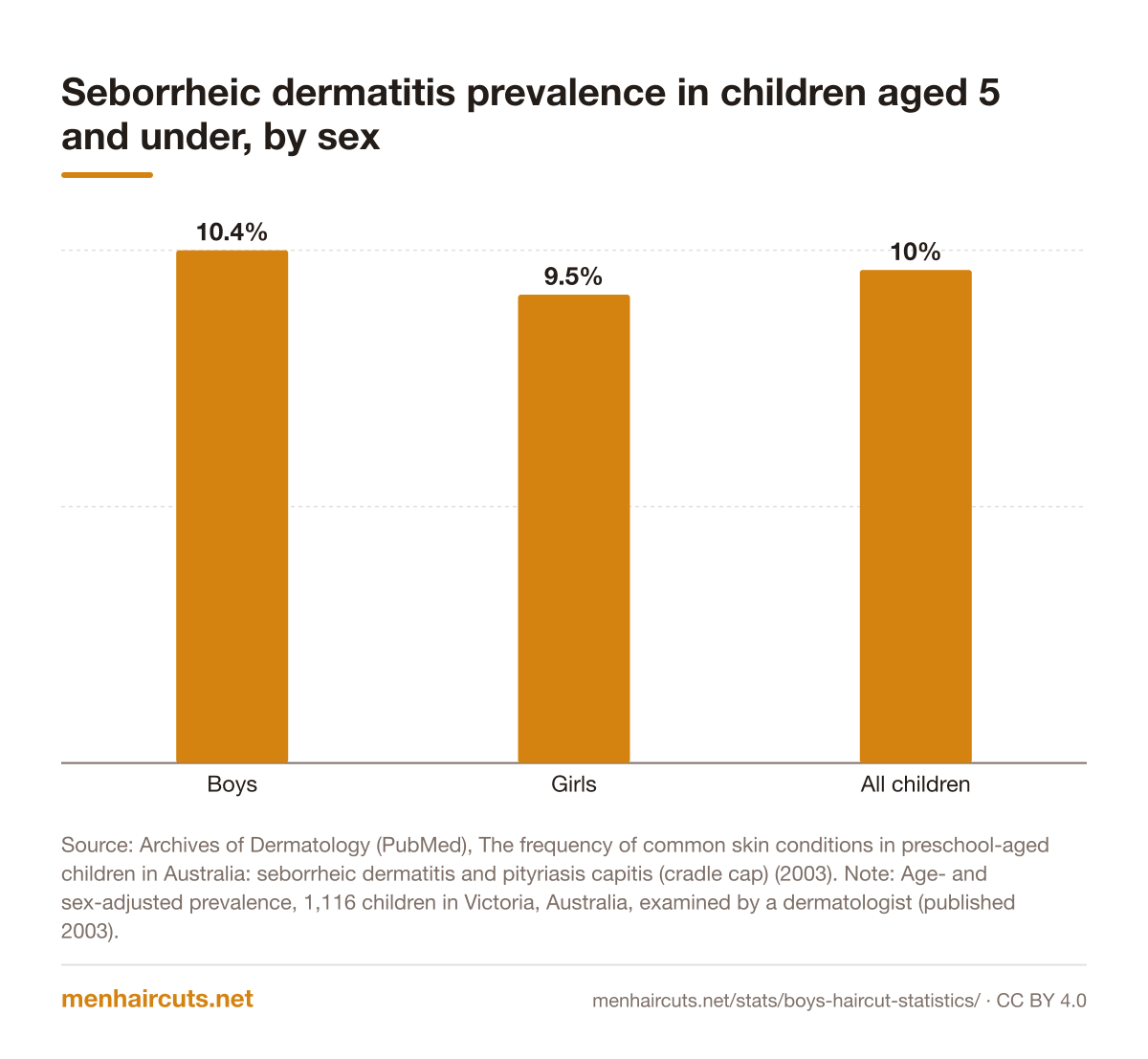
- A survey of 1,116 Australian children aged 5 and under found seborrheic dermatitis in 10.4% of boys and 9.5% of girls, with the highest rates in the first 3 months of life[3].
- Thirty US states have passed a CROWN Act; California was first, signing its law on July 3, 2019, with protection in K-12 public and charter schools[4].
- A Texas judge ruled on February 22, 2024, that Barbers Hill ISD did not break the state CROWN Act by suspending Darryl George over the length of his locs[9].
- K-12 families planned to spend an average of $863.86 on back-to-school items in 2026, a record $43.3 billion in total, including $250.29 on clothing and accessories[5].
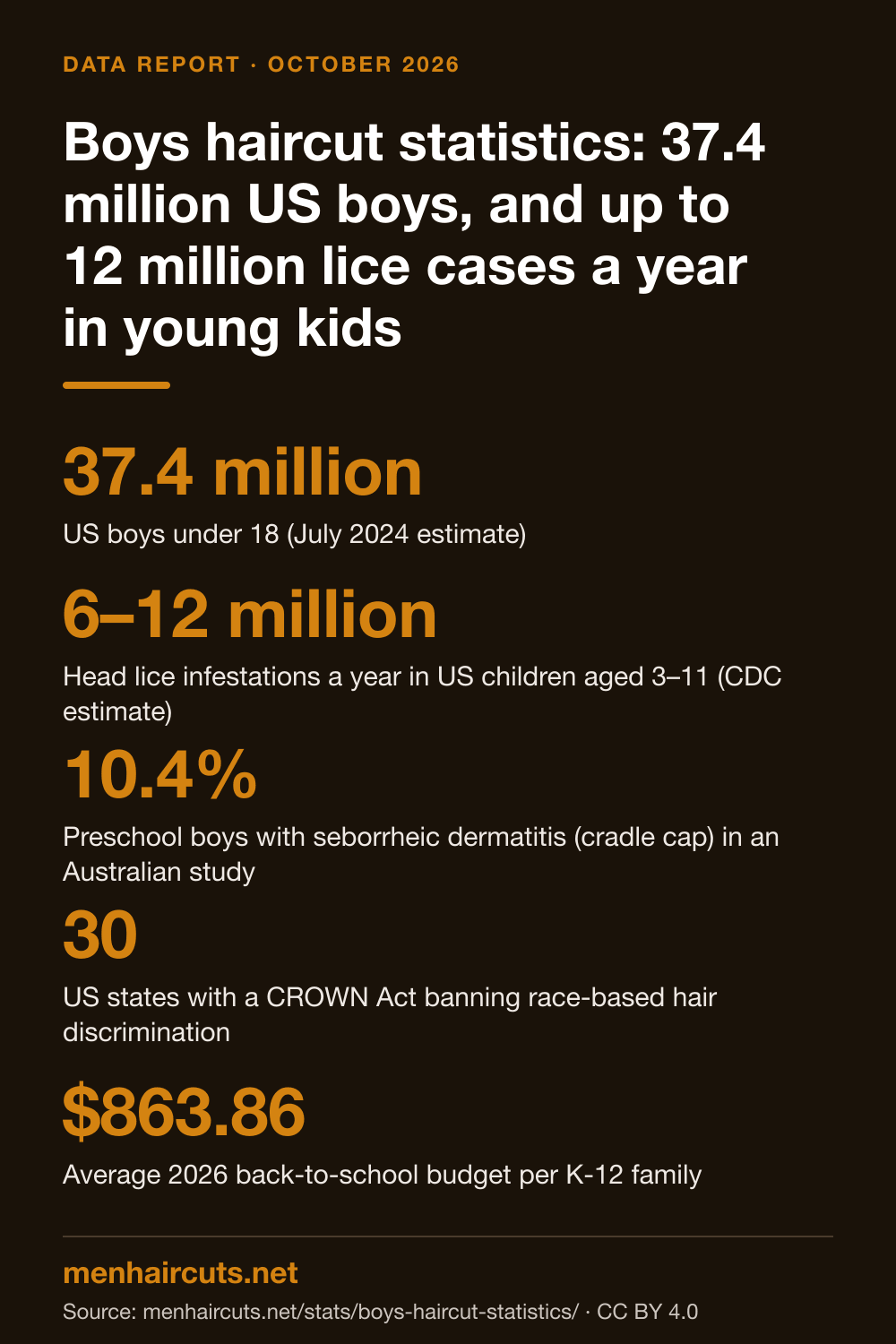
Download the infographic
The headline numbers from this report as one tall image (1000 x 1500 PNG), sized for Pinterest, slides and posts. Free to reuse with credit.
How many boys are there in the US?
Every kids' barbershop, lice clinic and school dress code serves a large group. The Census Bureau's population estimates count 37,405,255 boys aged 0 to 17 in the US on July 1, 2024, compared with 35,727,465 girls in the same age range[1].
The count splits fairly evenly across childhood. There were 9.5 million boys under 5, 10.3 million aged 5 to 9, 10.7 million aged 10 to 14 and 6.9 million aged 15 to 17, a band that covers only three years of age[1]. About 1.85 million boys were under their first birthday, the group heading toward a first haircut in the next year or two[1].
These are estimates for a single date, not a count of haircuts. No federal survey tracks how often boys get their hair cut or where, so the figures here set the size of the group rather than its habits.
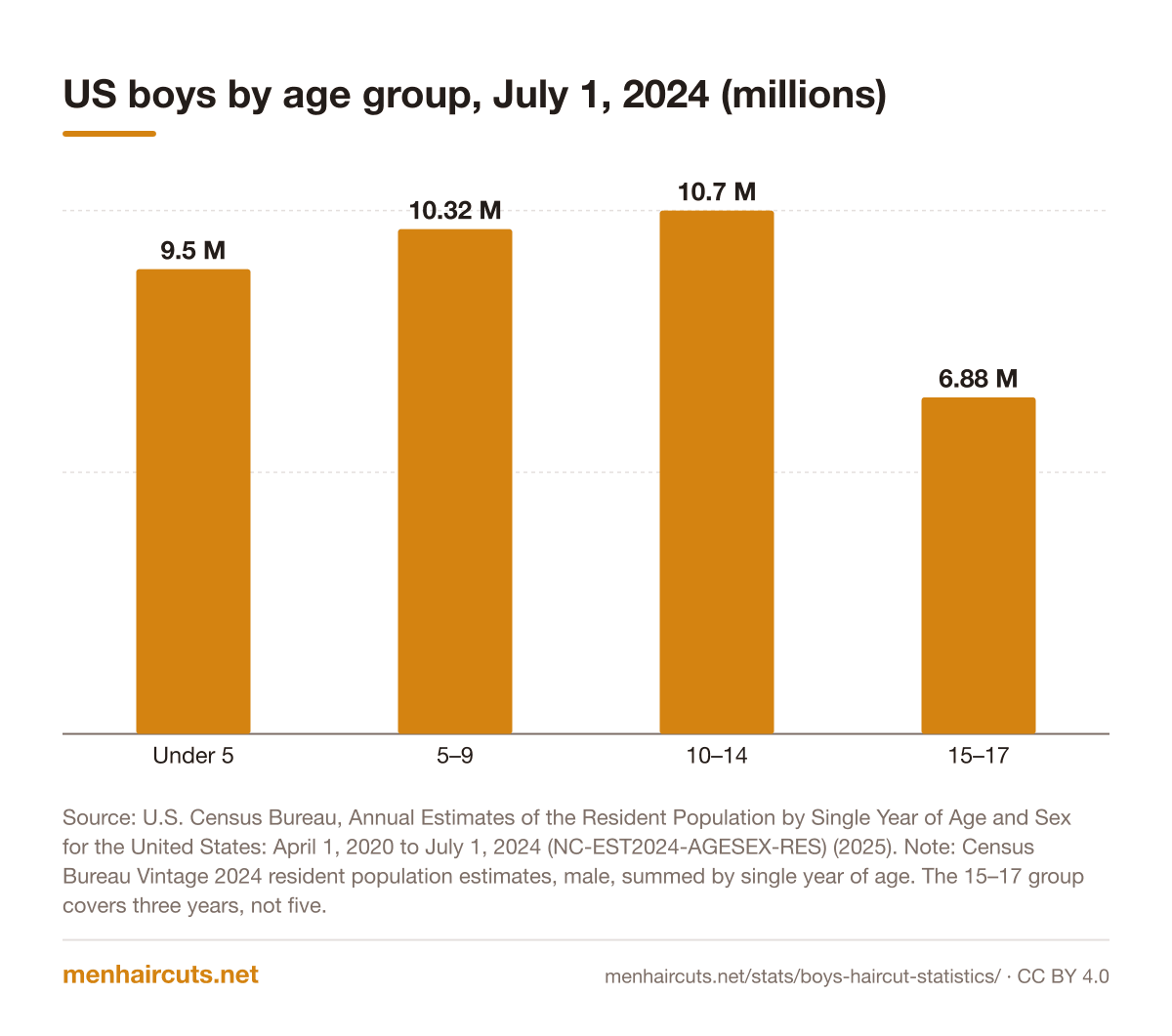
Show the numbers
| Category | Value |
|---|---|
| Under 5 | 9.5 M |
| 5–9 | 10.32 M |
| 10–14 | 10.7 M |
| 15–17 | 6.88 M |
How fast does a boy's hair grow between haircuts?
Growth speed decides how soon a short cut loses its shape. The best measured figures come from adults, not children, so treat them as a guide. In a phototrichogram study published in 2001, scalp hair of Caucasian adults grew at a mean of 396 micrometers a day, and hair of African-born adults grew at a mean of 256 micrometers a day[10]. Individual rates in the African group ranged from 150 to 363 micrometers a day[10].
Converted to familiar units, 396 micrometers a day is about 11.9 mm in 30 days, or roughly 0.47 inches a month, and about 5.7 inches over a year. The slower 256-micrometer rate works out to about 7.7 mm a month, or 3.7 inches a year (menhaircuts.net calculation: daily rate × 30 days or × 365 days; 25.4 mm = 1 inch).
On a short taper or fade, where the sides start at a few millimeters, half an inch of growth is enough to change the look, while a longer style hides the same growth far better. A study of 2,249 young adults from 24 ethnic groups also found that growth rate and density differ by scalp area, sex and origin, so a single average will not fit every child[11].
Normal shedding is part of the cycle. The American Academy of Dermatology says shedding between 50 and 100 hairs a day is normal[12].
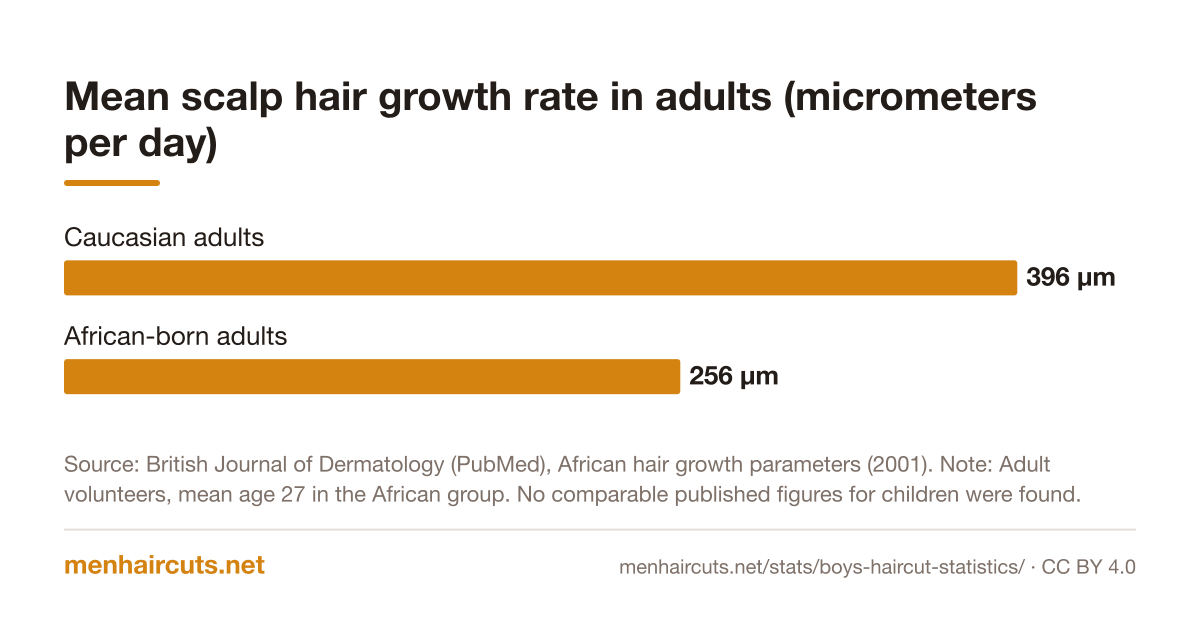
Show the numbers
| Category | Value |
|---|---|
| Caucasian adults | 396 µm |
| African-born adults | 256 µm |
How many kids get head lice each year?
Head lice are the hair problem most parents of school-age boys run into. The CDC says there is no reliable data on how many people get head lice each year in the United States, but it estimates 6 to 12 million infestations a year among children aged 3 to 11[2]. Infestation is most common among preschool and elementary school children and the people who live with or care for them[2].
To put that range in context, the Census Bureau estimates 36.0 million US children aged 3 to 11 in July 2024 (18.4 million boys and 17.6 million girls)[1]. Dividing gives roughly one infestation a year for every 3 to 6 children in that age band (menhaircuts.net calculation: 36.0 million ÷ 12 million = 3.0; 36.0 million ÷ 6 million = 6.0). Some children get lice more than once, so this is not the share of kids affected.
Boys may be at slightly lower risk. The CDC notes that some studies suggest girls get head lice more often than boys, probably because of more frequent head-to-head contact[2]. It also says infestation is much less common among African American people in the US, possibly because the common US louse grips some hair types better than others[2].
Lice spread mainly through direct head-to-head contact. Sharing hats, combs, brushes or sports uniforms is a less common route, and lice have nothing to do with how clean a child or home is[2].
| Measure | CDC figure |
|---|---|
| Adult louse length | About 2–3 mm (size of a sesame seed) |
| Eggs laid by an adult female | About six a day |
| Time for a nit to hatch | About a week |
| Time for a nymph to become an adult | About seven days |
| Adult life span on a head | About 30 days |
| Survival off the head without feeding | Dies within two days |
| Time before first itching | Four to six weeks |
| Hot water to clean combs and brushes | At least 130°F for 5–10 minutes |
Are head lice resistant to treatment, and should boys stay home from school?
Over-the-counter permethrin products have lost ground for a measurable reason. Researchers collected lice from 138 sites in 48 states between July 2013 and May 2015 and tested them for knockdown resistance (kdr) mutations, which protect lice from pyrethrins and pyrethroids such as permethrin[6]. The overall mean resistance allele frequency was 98.3%. At 132 of the 138 sites (95.6%) it was 100%, five sites had intermediate values, and one site had no mutations[6]. Forty-two states (88%) had a mean of 100%[6].
The American Academy of Pediatrics updated its head lice clinical report in the October 2022 issue of Pediatrics, the first revision since 2015, adding newly approved medications and a management algorithm[8]. Lead author Dawn Nolt said head lice are no reason for a child to miss school, and the AAP said school screening programs have not been shown to cut the number of cases over time[7].
Older research backs up the caution about quick diagnoses. A Harvard study of specimens sent in by health workers and lay screeners found that both groups often overdiagnosed lice and failed to tell active from old infestations, so children without lice were kept out of school at least as often as children with them[13]. The CDC adds that nits found more than a quarter inch from the scalp are almost always hatched or dead[2].
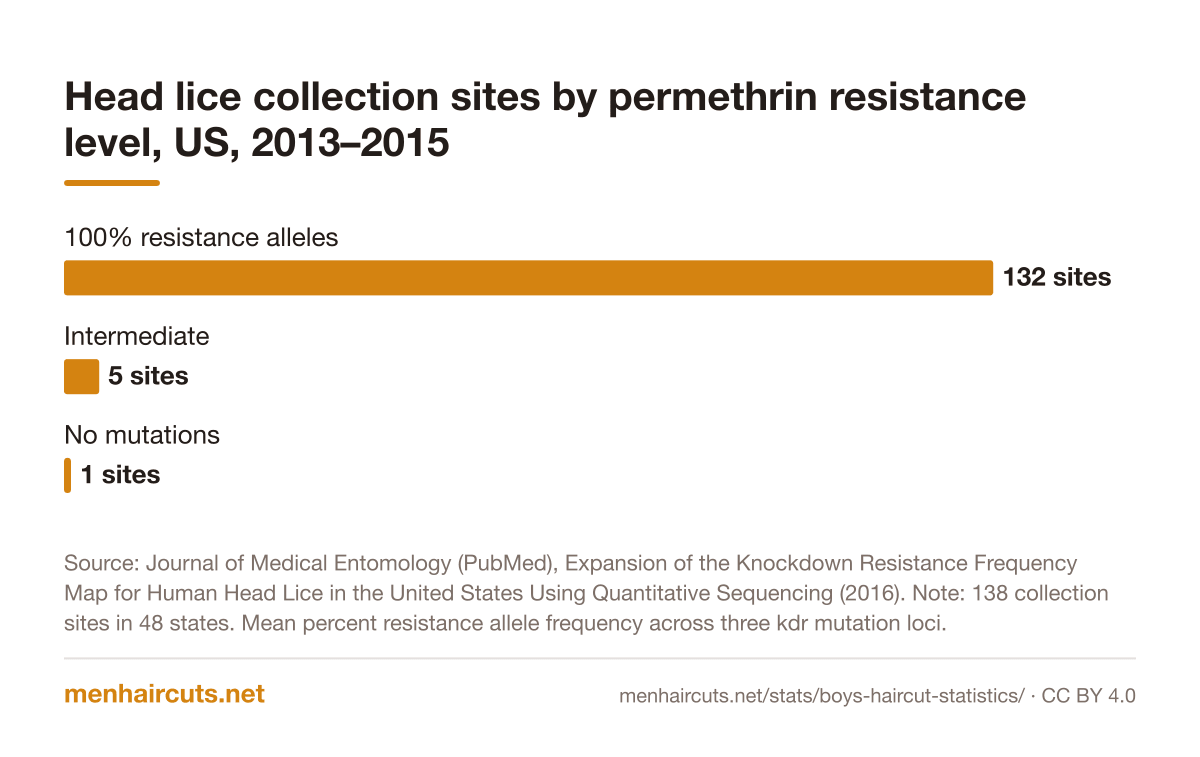
Show the numbers
| Category | Value |
|---|---|
| 100% resistance alleles | 132 sites |
| Intermediate | 5 sites |
| No mutations | 1 sites |
How common is cradle cap in baby boys?
Before the first haircut, the most common scalp issue in babies is cradle cap, the everyday name for seborrheic dermatitis of the infant scalp[14]. Nemours KidsHealth says babies can develop it between 2 weeks and 12 months of age and that it usually gets better by 12 months[14]. MedlinePlus lists cradle cap as another name for seborrheic dermatitis, a common inflammatory skin condition[15].
The best sex-specific numbers come from a skin survey of 1,116 children aged 11 days to just under 6 years in Victoria, Australia, published in 2003. A dermatologist examined every child. The age- and sex-adjusted prevalence of seborrheic dermatitis was 10.0% overall, 10.4% in boys and 9.5% in girls[3]. Rates were highest in the first 3 months of life and dropped quickly by age 1[3].
Most cases were mild. In that study, 71.9% of children with seborrheic dermatitis had minimal to mild disease. Pityriasis capitis, a flaky scalp similar to dandruff, was far more common, at 41.7% of all children examined, and 85.8% of those cases were minimal to mild[3].
Show the numbers
| Category | Value |
|---|---|
| Boys | 10.4% |
| Girls | 9.5% |
| All children | 10% |
How common is hair pulling in kids and teens?
Patchy hair loss in a school-age boy is sometimes caused by hair pulling rather than a scalp disease. A 2022 Yale-led meta-analysis pooled 30 studies with 38,526 participants. It estimated the prevalence of trichotillomania, hair-pulling disorder, at 1.14%, and any hair-pulling behavior at 8.84%[16].
The disorder is often assumed to affect mostly girls, but the pooled data did not show a significant female preponderance for trichotillomania itself (odds ratio 1.29, with a confidence interval that crossed 1)[16]. Females were at higher risk of hair pulling only when noticeable hair loss was part of the definition[16]. The authors called the condition understudied and said more research is needed on how it splits by sex[16].
How many states ban hair discrimination in schools?
School dress codes that limit hair length for boys have been a recurring legal fight. The CROWN Act (Creating a Respectful and Open World for Natural Hair) began in California, which signed the first version into law on July 3, 2019. It expanded the definition of race in state employment law and the state Education Code to protect students in K-12 public and charter schools[4]. The CROWN Coalition now reports that 30 states have passed a version of the law[4].
Texas shows how the law can fall short for boys. Barbers Hill ISD told cousins De'Andre Arnold and Kaden Bradford to cut their locs in 2020; their families sued in May 2020, and a federal judge later ruled the district's hair policy discriminatory[9]. In 2023 the same district disciplined Darryl George, a junior, because his locs fell below his eyebrows and ear lobes, which school officials said broke the dress code for male students[17]. He was removed from regular classes on August 31, 2023, a day before the Texas CROWN Act took effect[9], and spent much of his junior year in in-school suspension[17].
A state judge ruled on February 22, 2024, that the suspension over hair length did not violate the Texas CROWN Act[9]. In August 2024 a federal judge dismissed most of George's civil rights claims but let his sex discrimination claim stand[17]. The ruling turned on length, which the Texas law does not mention, a gap that matters for any policy setting different hair rules for boys and girls.
| Date | Event | Source |
|---|---|---|
| July 3, 2019 | California signs the first CROWN Act, covering K-12 public and charter schools | CROWN Coalition |
| May 2020 | Families of De'Andre Arnold and Kaden Bradford sue Barbers Hill ISD over a rule to cut their locs | CBS News Texas |
| August 31, 2023 | Barbers Hill ISD removes Darryl George from regular classes over loc length | CBS News Texas |
| September 1, 2023 | Texas CROWN Act takes effect | CBS News Texas |
| February 22, 2024 | Texas state judge rules the suspension did not violate the CROWN Act | CBS News Texas |
| August 2024 | Federal judge dismisses most of George's claims; sex discrimination claim stands | OPB / NPR |
| 2026 | 30 states have passed a CROWN Act | CROWN Coalition |
Do Black children face hair discrimination at school?
The most cited survey on children and hair bias is the 2021 Dove CROWN Research Study for Girls, which covered girls only. No comparable survey of boys was found. Its numbers still give a sense of how early hair bias starts in school.
Among Black girls in majority-white schools, 66% reported experiencing hair discrimination, compared with 45% of Black girls across all school settings[18]. All Black elementary school girls in majority-white schools who reported hair discrimination said it began by age 10, and 81% of Black girls in majority-white schools said they sometimes wish their hair were straight[18]. The study was commissioned by Dove, which campaigns for the CROWN Act, so read it as advocacy research.
| Finding | Share |
|---|---|
| Black girls in majority-white schools reporting hair discrimination | 66% |
| Black girls in all school environments reporting hair discrimination | 45% |
| Black girls in majority-white schools who sometimes wish their hair was straight | 81% |
| Black mothers who have experienced hair discrimination themselves | 47% |
| Black girls who believe their hair is beautiful | 90% |
How much do families spend on back-to-school in 2026?
The school year sets the calendar for many boys' haircuts, and it lands in the same weeks as other big bills. The National Retail Federation's 2026 survey found that families with students in elementary through high school planned to spend an average of $863.86, up from $858.07 in 2025[5]. Total K-12 spending was expected to reach a record $43.3 billion, up from $39.4 billion in 2025 and above the previous high of $41.5 billion set in 2023[5].
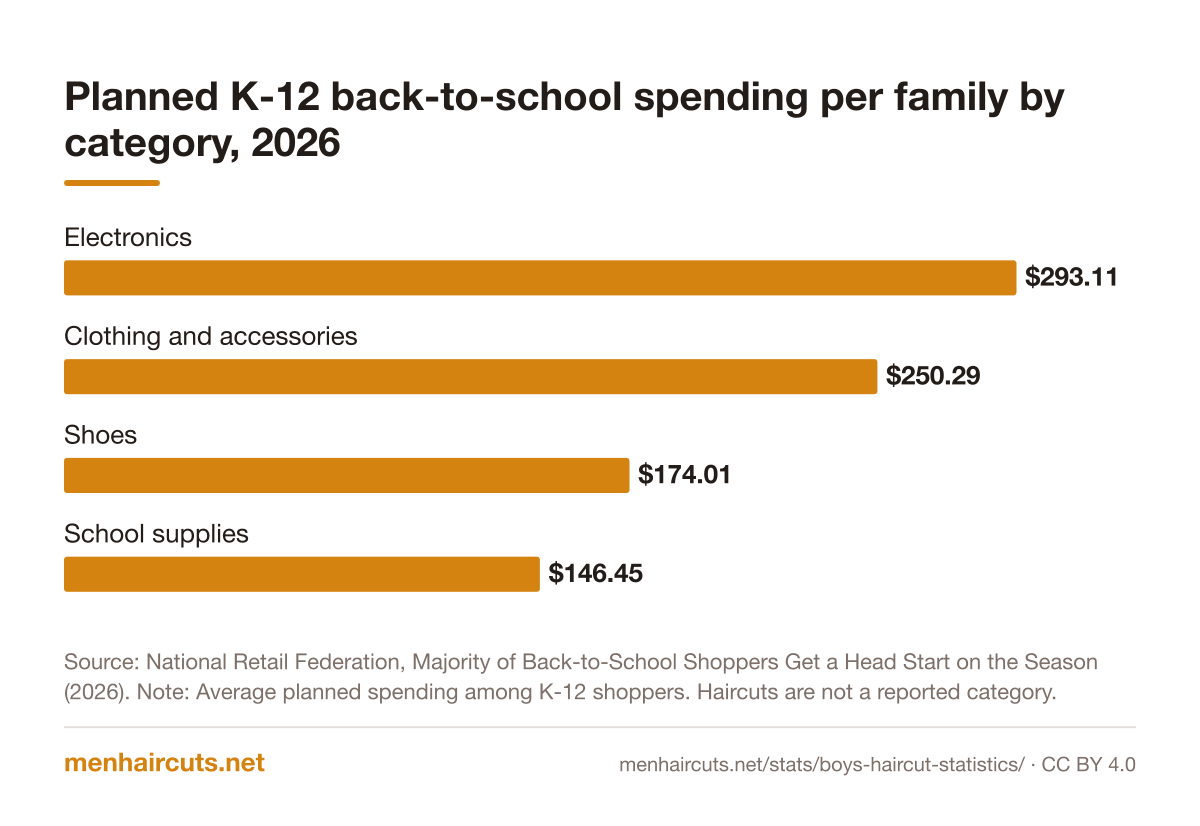
Electronics led the K-12 list at $293.11 per family, followed by clothing and accessories at $250.29, shoes at $174.01 and school supplies at $146.45[5]. NRF does not report a separate haircut or grooming line for K-12 families; its personal care figure ($133.34) applies to college shoppers only[5].
The survey covered 7,677 consumers, fielded July 1 to 8, with a margin of error of plus or minus 1.1 percentage points[5].
Show the numbers
| Category | Value |
|---|---|
| Electronics | $293.11 |
| Clothing and accessories | $250.29 |
| Shoes | $174.01 |
| School supplies | $146.45 |
Frequently asked questions
How many boys are there in the United States?
How many kids get head lice each year?
Do boys get head lice less often than girls?
Should a boy with head lice stay home from school?
How common is cradle cap in baby boys?
How fast does hair grow between haircuts?
How many states have a CROWN Act?
How much do parents spend on back-to-school in 2026?
Methodology and limitations
This page was compiled in October 2026 from government data, peer-reviewed studies and named organizational reports. Population counts come from the Census Bureau's Vintage 2024 national estimates by single year of age and sex, summed into age bands by menhaircuts.net. Head lice figures come from the CDC, the American Academy of Pediatrics (2022 clinical report and its HealthyChildren.org summary) and a 2016 study in the Journal of Medical Entomology. Cradle cap and hair-pulling figures come from PubMed-indexed studies, read in abstract form. Hair growth rates are adult data from a 2001 British Journal of Dermatology study. School policy dates come from the CROWN Coalition and news reports by CBS News Texas and NPR (via OPB). Spending comes from NRF's 2026 back-to-school release. Two menhaircuts.net calculations are shown with formulas: monthly and yearly hair growth from daily rates, and the ratio of children aged 3 to 11 to CDC's infestation estimate.
Limitations
There is no national survey of how often US boys get haircuts, where they go or what they pay, so this page does not give a kids' haircut price or frequency. Kids' salon chains do not publish national average prices. The CDC lice range is an estimate, not a count, and infestations are not the same as children affected. The cradle cap study was done in Australia in the early 2000s, and the hair growth rates come from adults, not children. The Dove CROWN study surveyed girls only and was commissioned by a brand that campaigns on the issue. CROWN Act state counts change as legislatures act; the figure here is the CROWN Coalition's count as accessed in October 2026.
Every figure on this page links to its source. Numbers are reported as published; any menhaircuts.net calculation is labelled and shows its inputs. Spotted an error? Tell us and we will check it.
Sources
- Annual Estimates of the Resident Population by Single Year of Age and Sex for the United States: April 1, 2020 to July 1, 2024 (NC-EST2024-AGESEX-RES), U.S. Census Bureau (2025). Accessed October 15, 2026.
- About Head Lice, Centers for Disease Control and Prevention (2024). Accessed October 15, 2026.
- The frequency of common skin conditions in preschool-aged children in Australia: seborrheic dermatitis and pityriasis capitis (cradle cap), Archives of Dermatology (PubMed) (2003). Accessed October 15, 2026.
- About the CROWN Act, The CROWN Coalition (2026). Accessed October 15, 2026.
- Majority of Back-to-School Shoppers Get a Head Start on the Season, National Retail Federation (2026). Accessed October 15, 2026.
- Expansion of the Knockdown Resistance Frequency Map for Human Head Lice in the United States Using Quantitative Sequencing, Journal of Medical Entomology (PubMed) (2016). Accessed October 15, 2026.
- Controlling Head Lice & Reducing Stigma, HealthyChildren.org (American Academy of Pediatrics) (2022). Accessed October 15, 2026.
- Head Lice (clinical report), Pediatrics 150(4):e2022059282, American Academy of Pediatrics (PubMed record) (2022). Accessed October 15, 2026.
- Texas school did not violate CROWN Act by suspending Darryl George for hairstyle, judge rules, CBS News Texas (2024). Accessed October 15, 2026.
- African hair growth parameters, British Journal of Dermatology (PubMed) (2001). Accessed October 15, 2026.
- Diversity in human hair growth, diameter, colour and shape. An in vivo study on young adults from 24 different ethnic groups, European Journal of Dermatology (PubMed) (2016). Accessed October 15, 2026.
- Do you have hair loss or hair shedding?, American Academy of Dermatology (2026). Accessed October 15, 2026.
- Overdiagnosis and consequent mismanagement of head louse infestations in North America, Pediatric Infectious Disease Journal (PubMed) (2000). Accessed October 15, 2026.
- Cradle Cap (Seborrheic Dermatitis) in Infants, Nemours KidsHealth (2026). Accessed October 15, 2026.
- Seborrheic dermatitis, MedlinePlus, U.S. National Library of Medicine (2025). Accessed October 15, 2026.
- Prevalence and gender distribution of trichotillomania: A systematic review and meta-analysis, Journal of Psychiatric Research (PubMed) (2022). Accessed October 15, 2026.
- Judge rules against majority of claims in Black student's hair discrimination case, NPR via OPB (2024). Accessed October 15, 2026.
- Hair discrimination: The facts (2021 Dove CROWN Research Study for Girls), Dove (Unilever) (2021). Accessed October 15, 2026.
Cite, embed and download
This report, its charts and its infographic are free to reuse under a Creative Commons Attribution 4.0 license. Credit menhaircuts.net with a link to this page.
Cite this report (APA)
Hamilton, J. (2026, October 15). Boys Haircut Statistics 2026: Lice, Hair and School Data. menhaircuts.net. https://menhaircuts.net/stats/boys-haircut-statistics/
Link to this report
<a href="https://menhaircuts.net/stats/boys-haircut-statistics/">Boys Haircut Statistics 2026: Lice, Hair and School Data</a> (menhaircuts.net, CC BY 4.0)Share the headline number
37.4 million: US boys under 18 (July 2024 estimate) (U.S. Census Bureau, via menhaircuts.net/stats/boys-haircut-statistics/)
Download the charts and infographic
- US boys by age group, July 1, 2024 (millions) (PNG)
- Mean scalp hair growth rate in adults (micrometers per day) (PNG)
- Head lice collection sites by permethrin resistance level, US, 2013–2015 (PNG)
- Seborrheic dermatitis prevalence in children aged 5 and under, by sex (PNG)
- Planned K-12 back-to-school spending per family by category, 2026 (PNG)
- Infographic: Boys Haircut Statistics 2026 (PNG, 1000 x 1500)
Related data
- 1.0–1.3 cmTypical scalp hair growth per monthHair Growth Statistics 2026
- 29.0%Share of US barbers who are Black (2025 annual average)Black Men's Haircut Statistics 2026
- 36%US men who always or usually get their hair cut at home (2024)DIY Haircut Statistics 2026
- 50%Adults worldwide affected by dandruffDandruff Statistics 2026
Related guides
Make us a Preferred Source on Google
See our latest articles first in your Google Search & AI Overviews.