
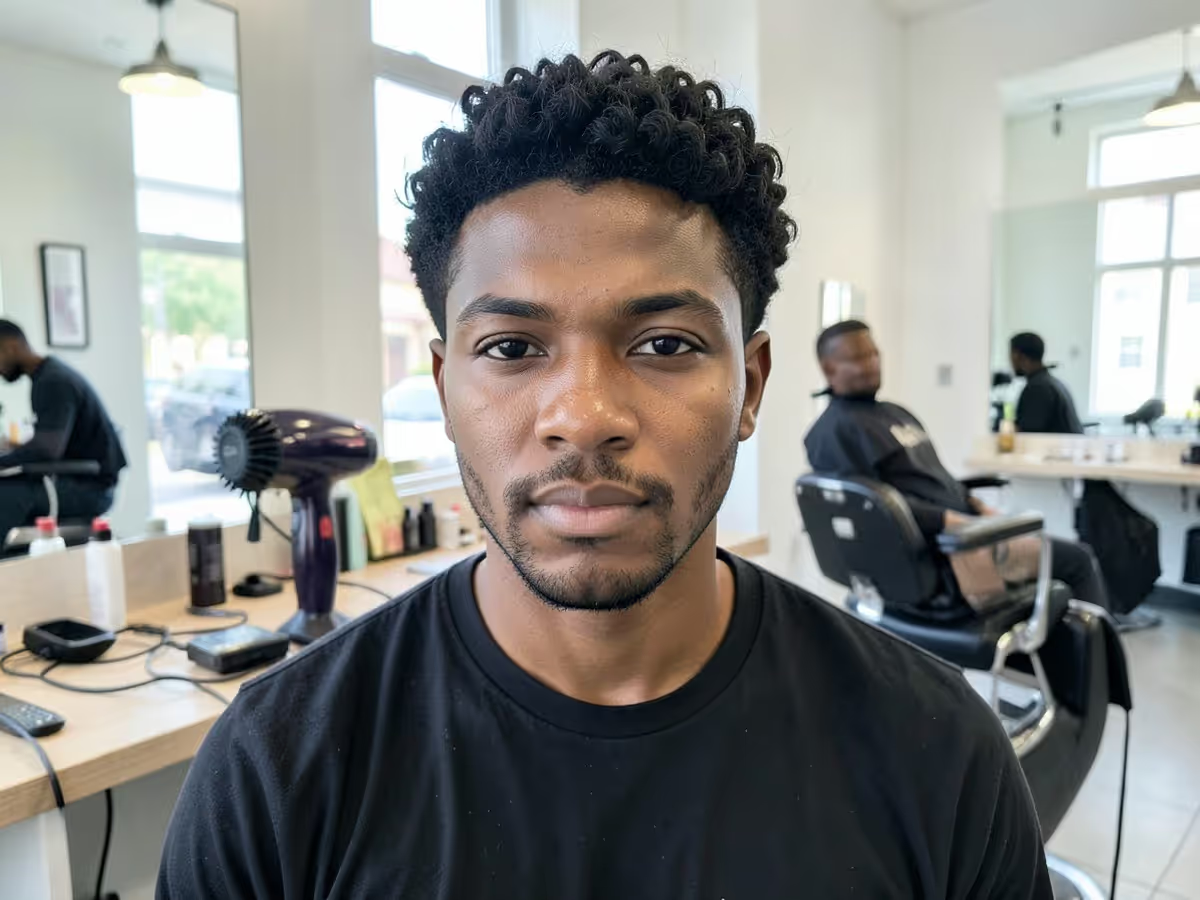
How to Get Curly Hair:
A Men's Routine That Works
Most men with a hint of wave have more curl than they think. Length, gentler washing and product bring it out.
By Jessica Hamilton · Updated
Quick answer: How to get curly hair as a man: grow the top to at least three inches, wash with a gentle shampoo two or three times a week, condition every wash, apply curl cream to soaking wet hair, scrunch and leave it alone while it dries. This brings out curl you already have. Straight hair needs a perm to curl.
Style images are AI-generated illustrations.
📚 Part of our Hair Type & Texture guide hub; start there for the rest of the topic.
How to get curly hair is mostly a question of uncovering curl that short cuts, rough towelling and harsh shampoo have been hiding. Many men with wavy or frizzy hair find defined curls within a few weeks of changing their routine. This guide covers how to check for natural curl, the routine and haircut that help it form, and what a perm can and cannot do.
Can Men Actually Get Curly Hair?
Curl pattern comes mainly from genetics and the shape of each hair follicle. Oval or flattened follicles tend to grow curly hair, round ones grow straight hair, and no shampoo or diet changes that shape. So a routine cannot turn genuinely straight hair curly. What it can do is reveal curl that is already there. Wavy hair, frizzy hair and hair that kinks at the nape when it gets long often has a real wave or curl pattern that has never had the chance to form.
Curl pattern can also shift over a lifetime. Some men notice more wave after their teens, or less as they get older, and hormonal changes, medication and illness can all play a part. If your hair changes texture suddenly, especially alongside shedding, it is worth mentioning to a doctor or dermatologist rather than treating it only as a styling problem. For everyone else, the steps below are low risk and cost little to try.
How Do You Know If Your Hair Has Natural Curl?
You can test this in a weekend. The signs are usually visible once there is enough length and nothing is weighing the hair down. Try two or three of the checks below; if any of them show a bend, an S shape or a loop, your hair has curl worth working with. If none do, your hair may be straight, and the perm section further down is the realistic option.
The air-dry test
Wash, condition, squeeze out water with a T-shirt, and let the hair dry without touching it at all. Bends or clumps that form on their own are your natural pattern.
The long-section test
Look at the longest part of your hair, often the nape or the crown. If it flicks, kinks or waves while the shorter areas look straight, length is what is missing.
The frizz clue
Hair that puffs up in humid weather often has a wave that is being disrupted. Our guide to humidity and frizz control explains why.
The single-strand test
Pull one wet strand straight and let go. If it springs back into a bend, the curl is there but needs support to clump.
How Do You Bring Out Natural Curls Step by Step?
A curl routine is short once it is set up. The goal is to keep moisture in, help strands clump together into curls, and avoid breaking those clumps apart while they dry. Expect two to four weeks before the results are consistent, because hair that has been washed daily with strong shampoo takes time to settle. Follow the steps in order and change one thing at a time so you know what is working.
1. Grow the top to at least three inches
Curls need length to complete a loop. Under about two inches, most wavy hair simply looks fluffy. Our guide on growing your hair out helps through the in-between stage.
2. Wash less, condition every time
Use a gentle, sulfate-free shampoo two or three times a week and conditioner every time you wet your hair. On non-shampoo days, rinse and condition only.
3. Detangle in the shower
Comb conditioner through with your fingers or a wide-tooth comb while the hair is soaking wet. Never brush curly hair dry.
4. Apply product to soaking wet hair
Rake a leave-in conditioner through, then a curl cream. Applying to dripping wet hair helps strands group into clumps.
5. Scrunch, then leave it alone
Cup the hair and squeeze upward toward the scalp a few times. Blot excess water with a cotton T-shirt, not a rough towel.
6. Dry without touching
Air dry or use a diffuser on low heat and low speed. The diffuser guide covers the technique. Touching curls while wet causes frizz.
7. Refresh instead of rewashing
On day two, mist with water, scrunch in a little more cream and let it dry again.
Which Haircut Helps Curls Form?
The wrong cut can undo a good routine. Thinning shears and heavy texturizing shred the ends, so they cannot clump, and a top cut too short never has room to curl. Ask for the top to be cut dry or with scissors, leaving at least three inches, and for weight to be removed with point cutting rather than thinning shears. The guide on asking for texture without thinning shears has the wording.
Keep the sides shorter than the top, but not so short that the contrast looks harsh as the curls grow. A taper or low fade stops the shape from widening into a triangle as the curls grow, and it keeps the cut tidy between visits. Plan a trim every six to eight weeks to remove dry ends while the top grows. Our curly hairstyles gallery shows which tops and side lengths work for each curl type, and wavy hair styles covers looser patterns that are still forming.
Which Products Help Curls?
You do not need a shelf of products. A gentle shampoo, a conditioner and one styler is enough to start, and many men stay with that. Add a second product only if the first does not give enough hold or moisture. Heavy waxes and clays usually work against curls because they weigh the hair down and break up clumps, so save them for straight styles.
| Product | What it does | When to use it |
|---|---|---|
| Sulfate-free shampoo | Cleans without stripping natural oils | Two or three times a week |
| Conditioner | Adds slip and moisture, helps detangling | Every time hair gets wet |
| Leave-in conditioner | Keeps moisture in through the day | On soaking wet hair, before styler |
| Curl cream | Defines clumps with a soft hold | Main styler for most men |
| Light gel | Firmer hold that lasts in humidity | Over cream, scrunch out once dry |
| Sea salt spray | Adds grip and wave to looser patterns | Wavy hair that will not curl fully |
What Does a Weekly Curl Routine Look Like?
A routine only works if it fits into your week, so keep it simple at first. The plan below suits short to medium curly or wavy hair and takes about five minutes on wash days and two on others. Adjust the number of shampoo days to your scalp: oily scalps and heavy exercise need more, dry scalps fewer. Once you know how your hair responds, you can drop steps that make no difference. Men with very short sides can still follow it; just keep the product on the top.
Wash days, two or three a week
Shampoo the scalp only, condition the lengths, detangle with fingers, apply leave-in and curl cream to soaking wet hair, scrunch, then air dry or diffuse.
Rinse days
Wet the hair, apply conditioner, rinse lightly, then style as on wash days. This keeps moisture up without stripping oils.
Day-two mornings
Mist with water, scrunch in a small amount of cream, and leave it to dry for ten minutes before going out.
Every two to four weeks
Use a clarifying shampoo once to clear build-up, then follow with a longer conditioning step.
Should You Get a Perm for Curly Hair?
If your hair is truly straight, a perm is the only way to get lasting curl. A stylist wraps the hair around rods and applies a chemical solution that breaks and resets the bonds inside each strand, then a neutraliser fixes the new shape. Men's perms range from loose body waves to tight spiral curls, and they usually last around three to six months as the hair grows and is cut. Results vary a lot by hair type and the stylist's skill.
Perms carry real risks. The chemicals can dry and weaken hair, irritate the scalp, and cause breakage if the hair is already bleached or damaged. Book a consultation with an experienced stylist, ask for a strand test and a patch test, and say if you have a sensitive scalp or any skin condition. Avoid perming and bleaching at the same time. Afterwards, wait the time your stylist advises before washing, and follow the same gentle curl routine described above.
What Mistakes Stop Curls From Forming?
Most curl problems come from habits rather than hair type. If you have followed the routine for three weeks and still see frizz or flat hair, check this list before changing products. Fixing one or two of these is often enough to see clearer curls, and none of them cost anything to change. Hard water and very hot showers can also dry the hair, so finish with a cooler rinse if your curls feel rough.
Rubbing with a towel
Breaks clumps apart and roughens the cuticle. Blot or squeeze with a T-shirt.
Styling damp instead of wet hair
Product spread on half-dry hair separates strands. Apply in the shower if you can.
Touching while drying
Every touch before the hair is fully dry adds frizz. Hands off until it is dry.
Too much product
Heavy layers weigh curls down and flatten the root. Start small and add more only if needed.
Product build-up
Creams can build up over weeks. A clarifying wash every two to four weeks resets it; see product build-up.
Heat on high
A diffuser on full heat dries curls into frizz and dries out the hair. Low heat, low speed.
Frequently Asked Questions
Q1: Can a straight-haired man get curly hair naturally?+
Q2: How long does it take to get curly hair?+
Q3: Does cutting your hair make it curlier?+
Q4: Is a perm bad for men's hair?+
Q5: Should men with curly hair use shampoo every day?+
Q6: Why does my hair curl when it is long but not short?+
Related Haircut Guides
Make us a Preferred Source on Google
See our latest articles first in your Google Search & AI Overviews.