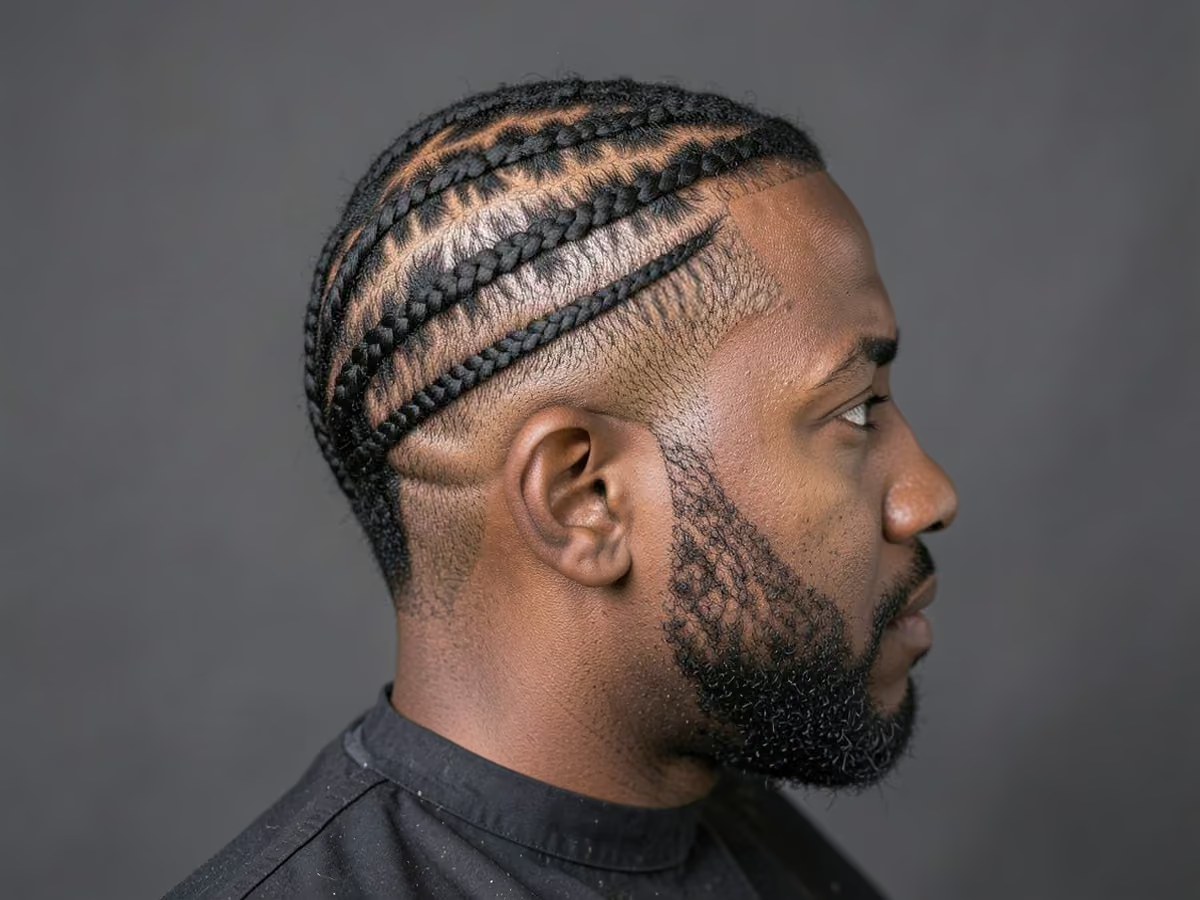
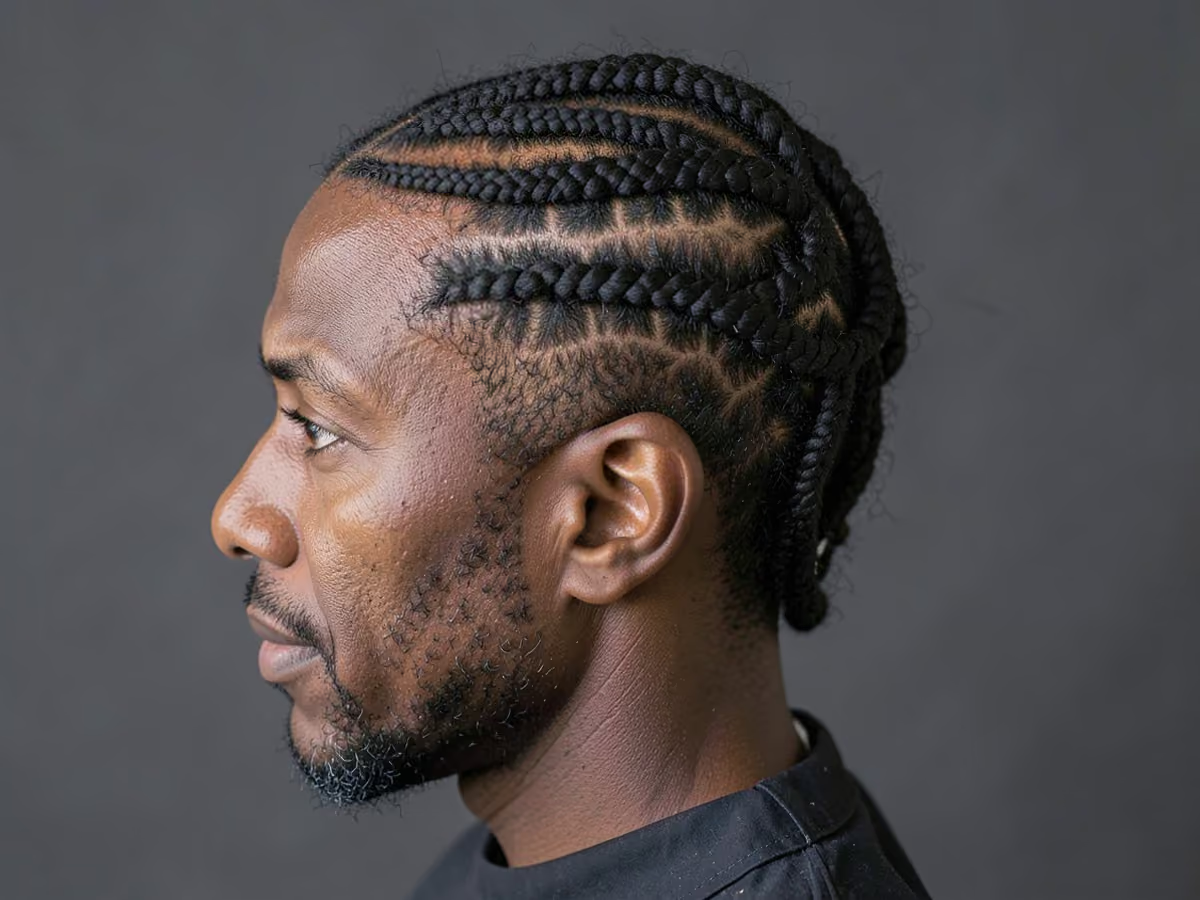
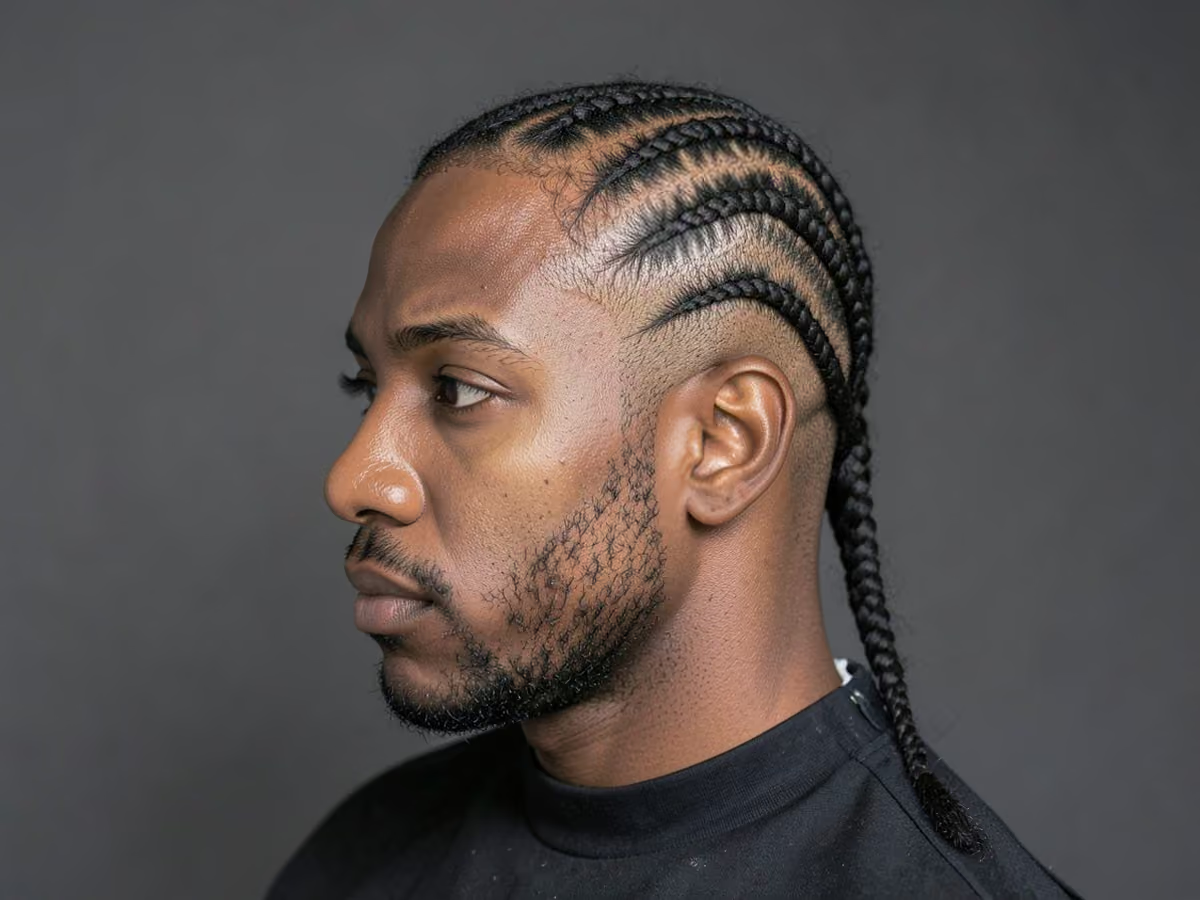
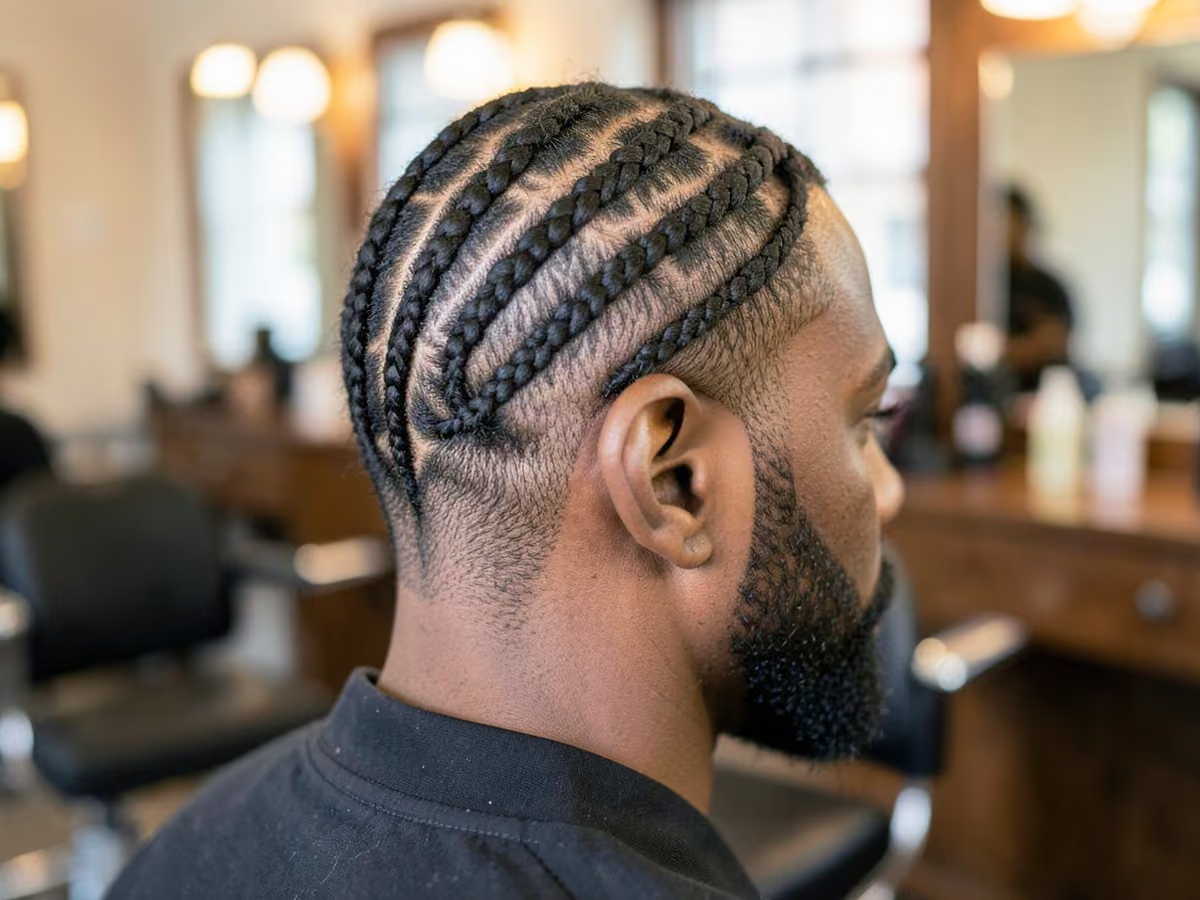
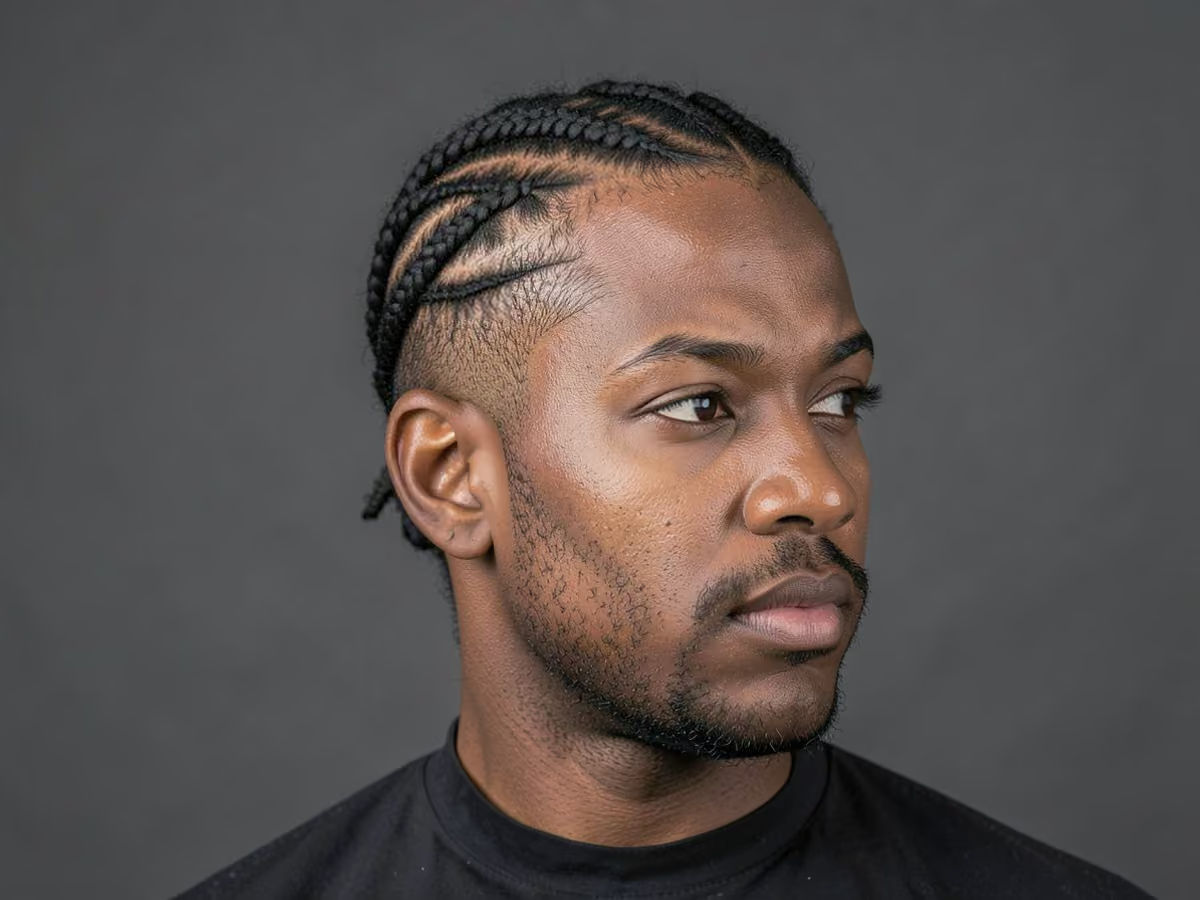
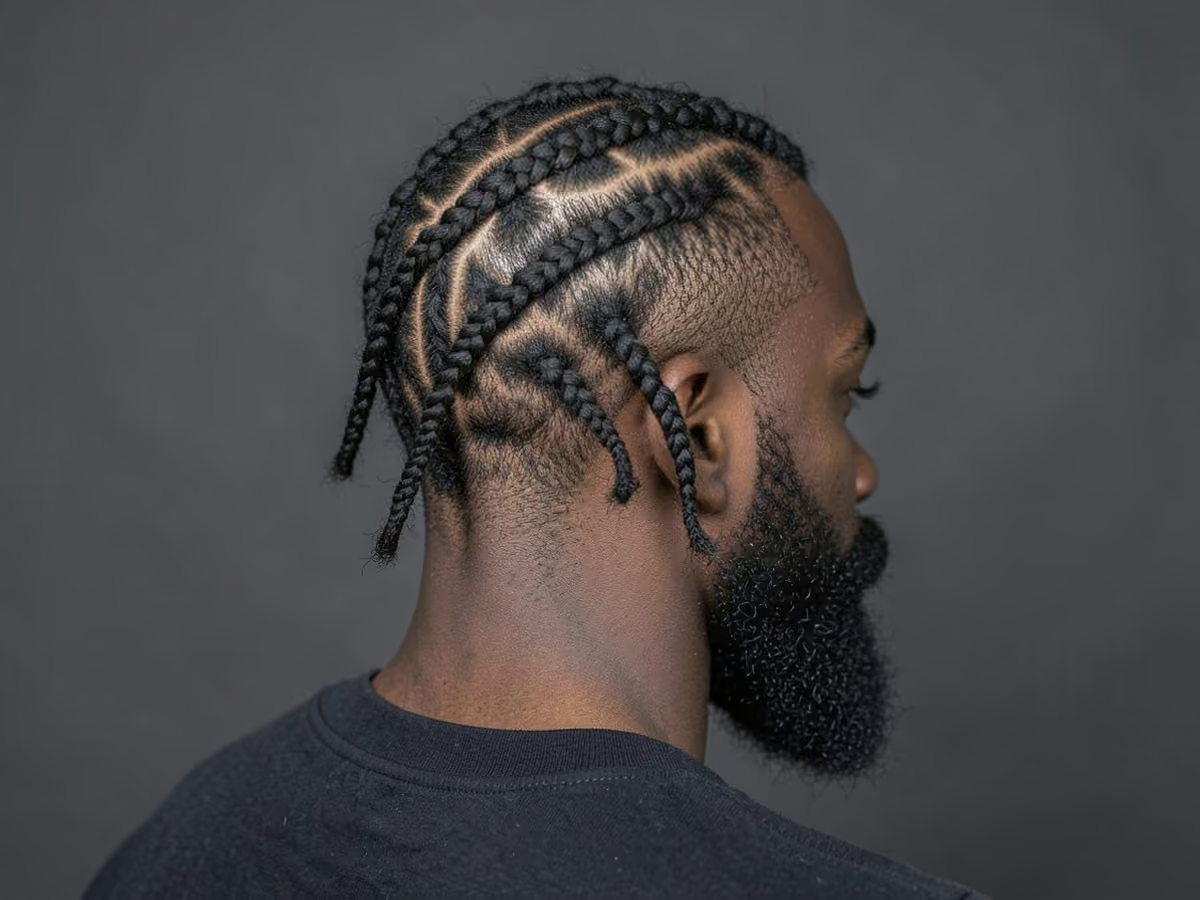
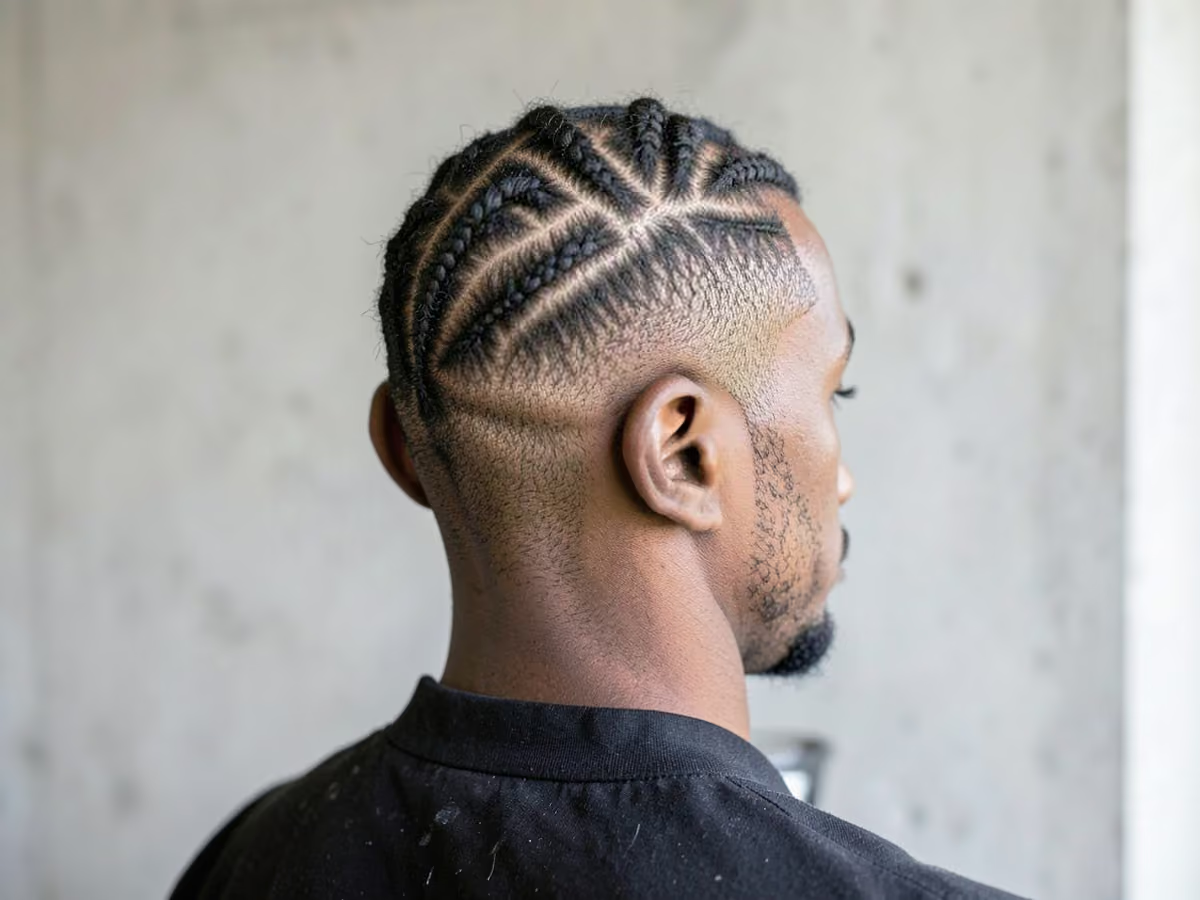
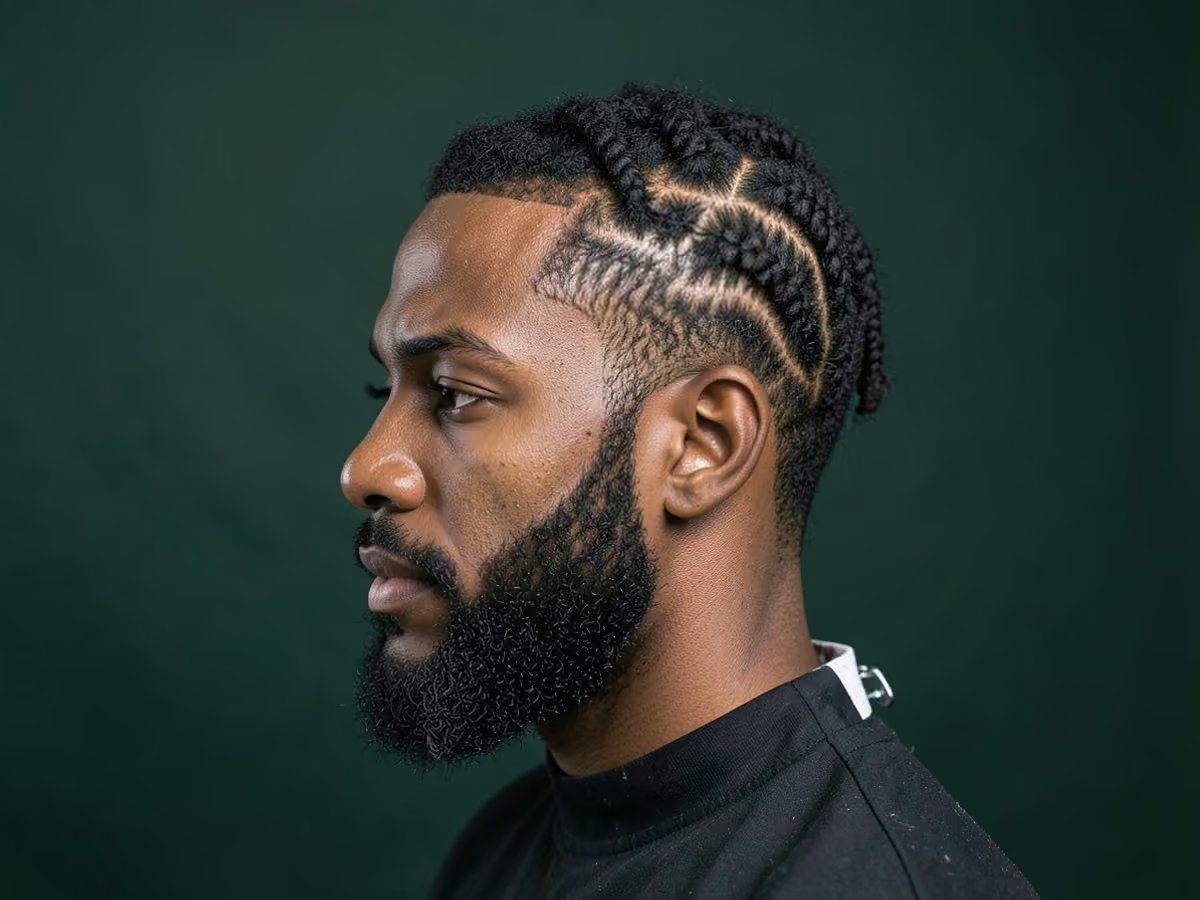
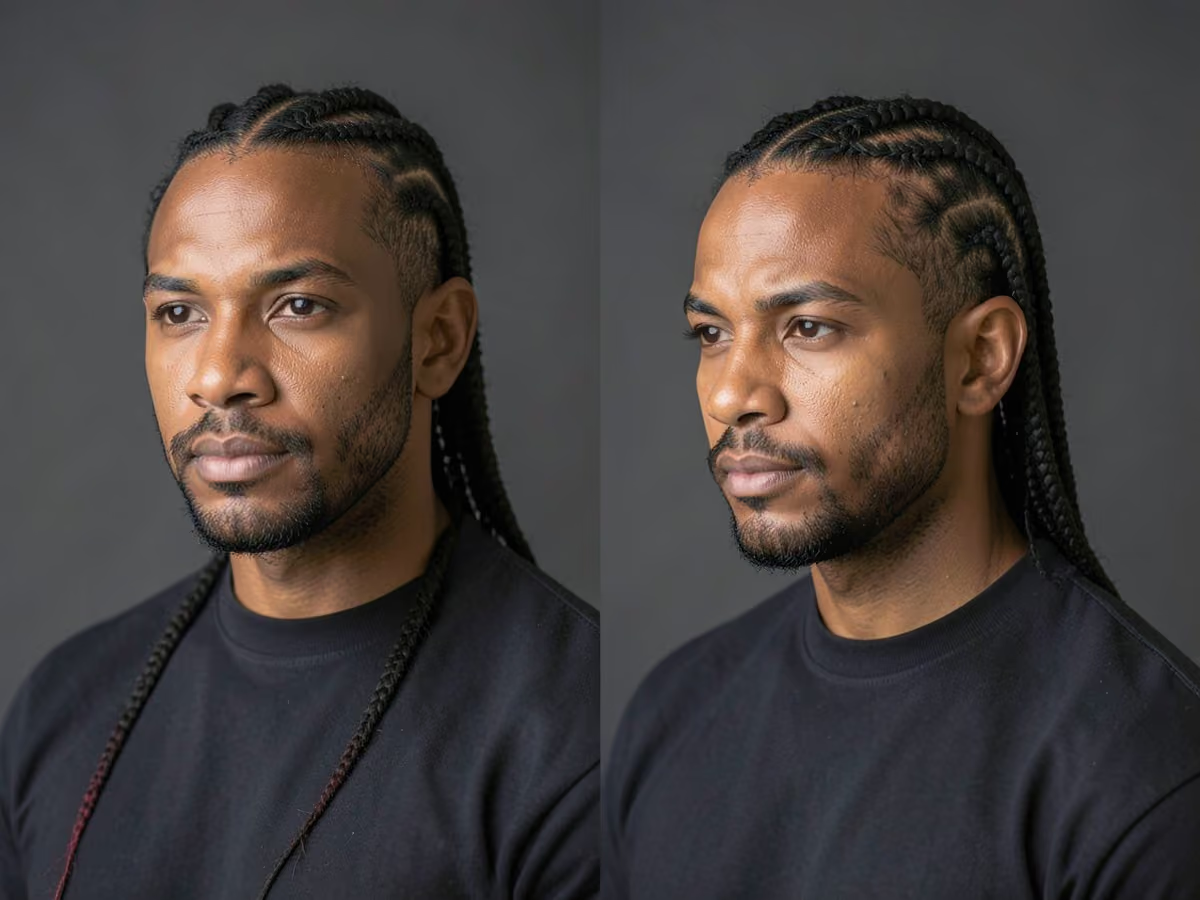
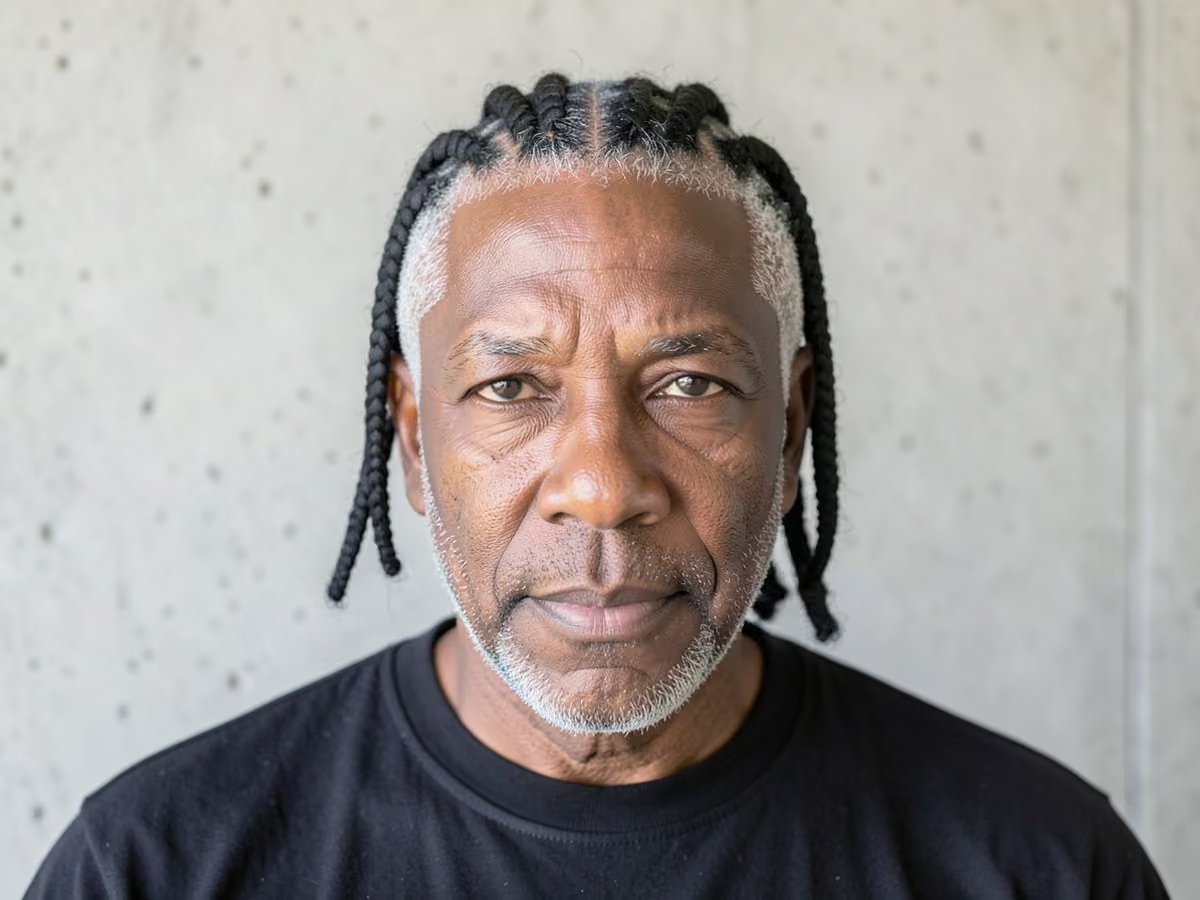
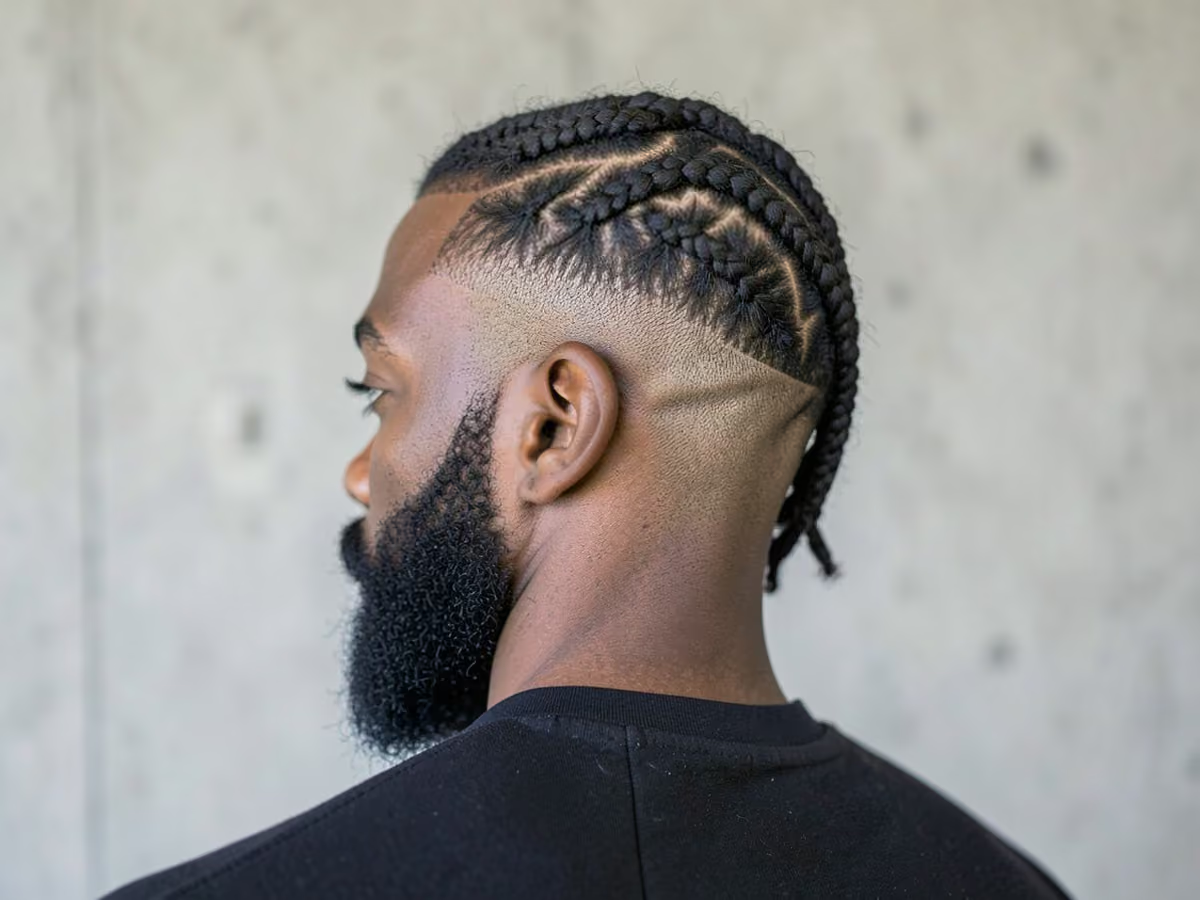
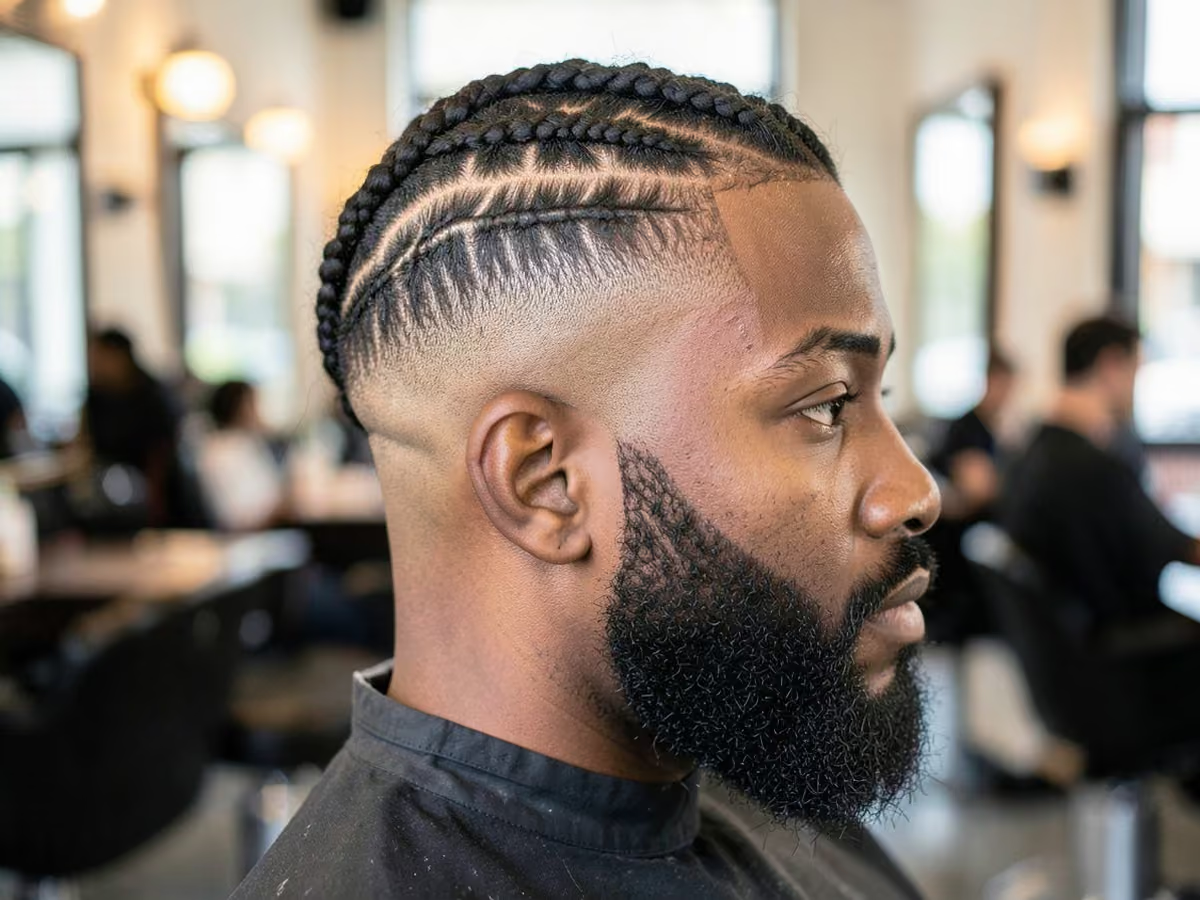
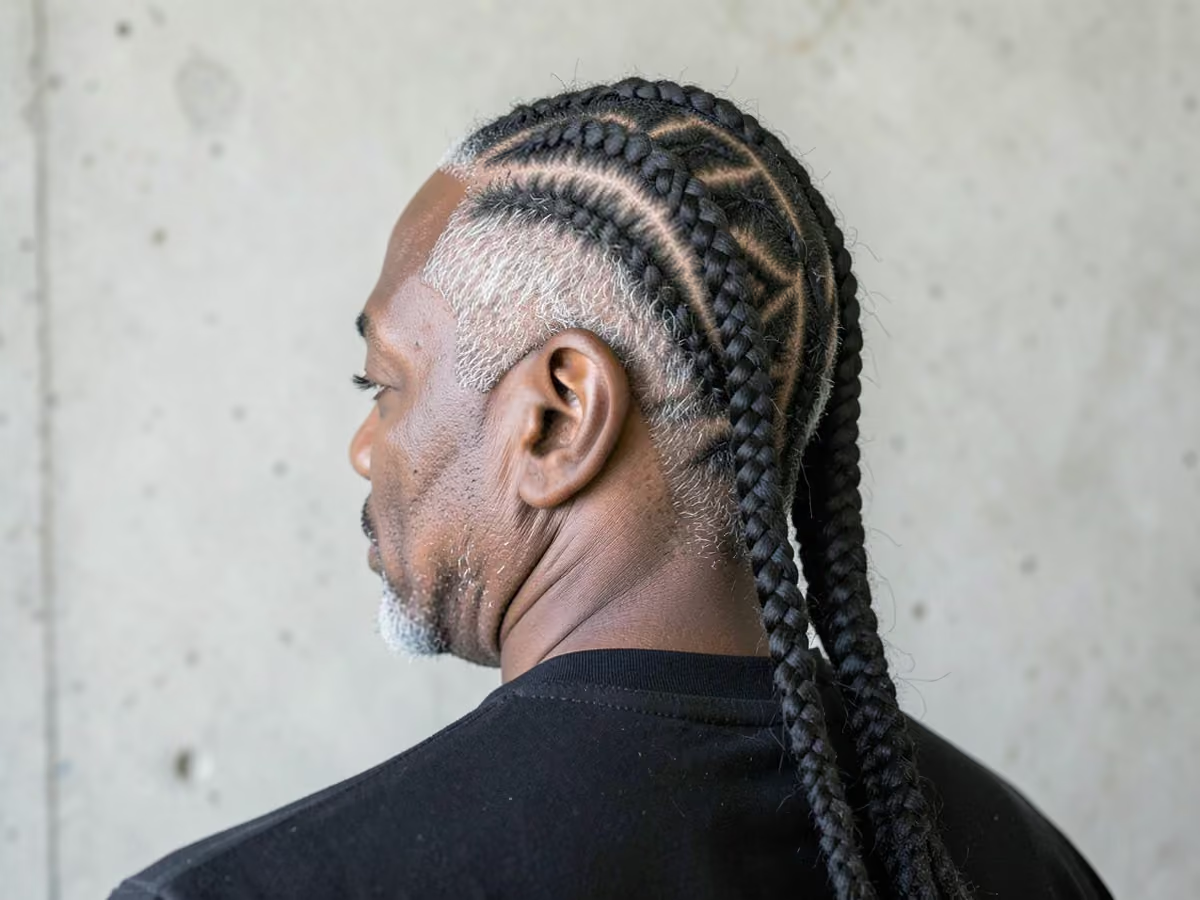
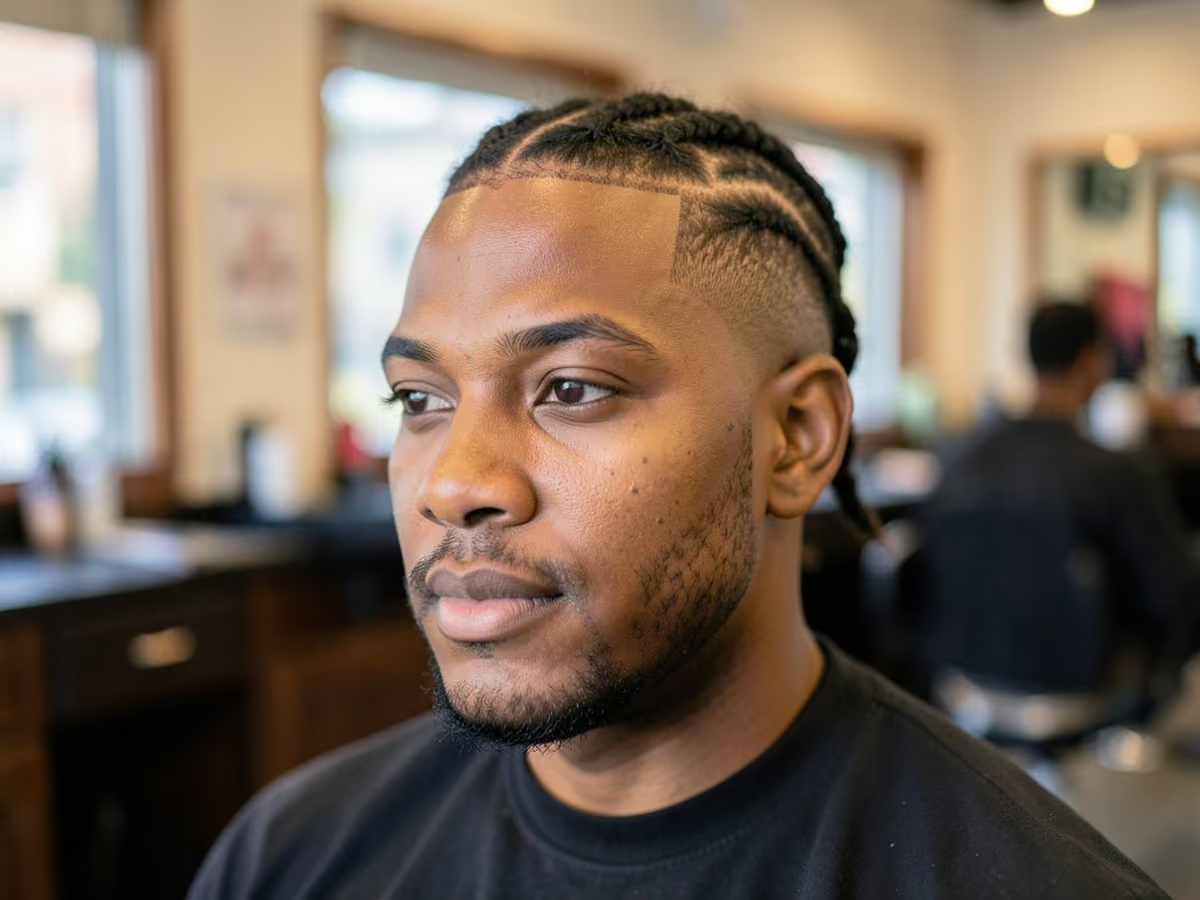
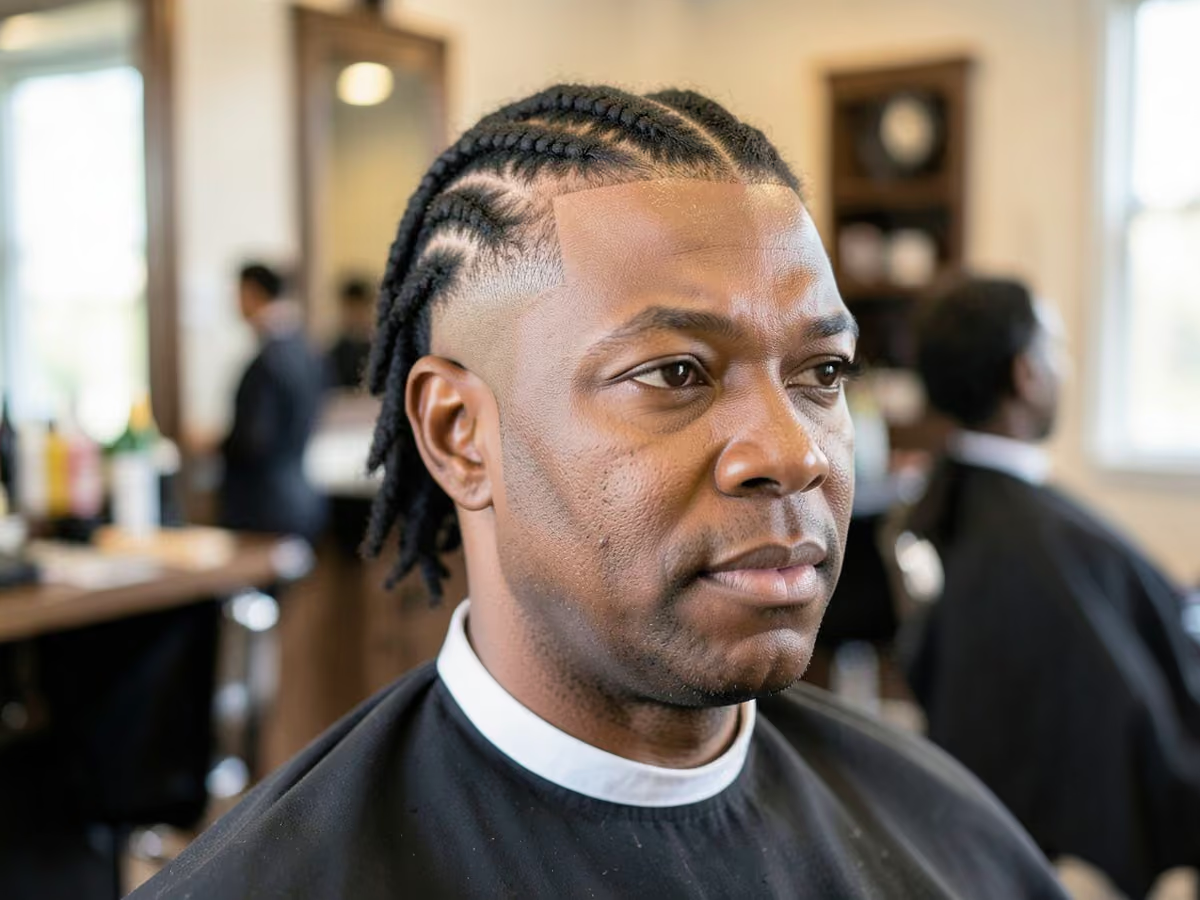
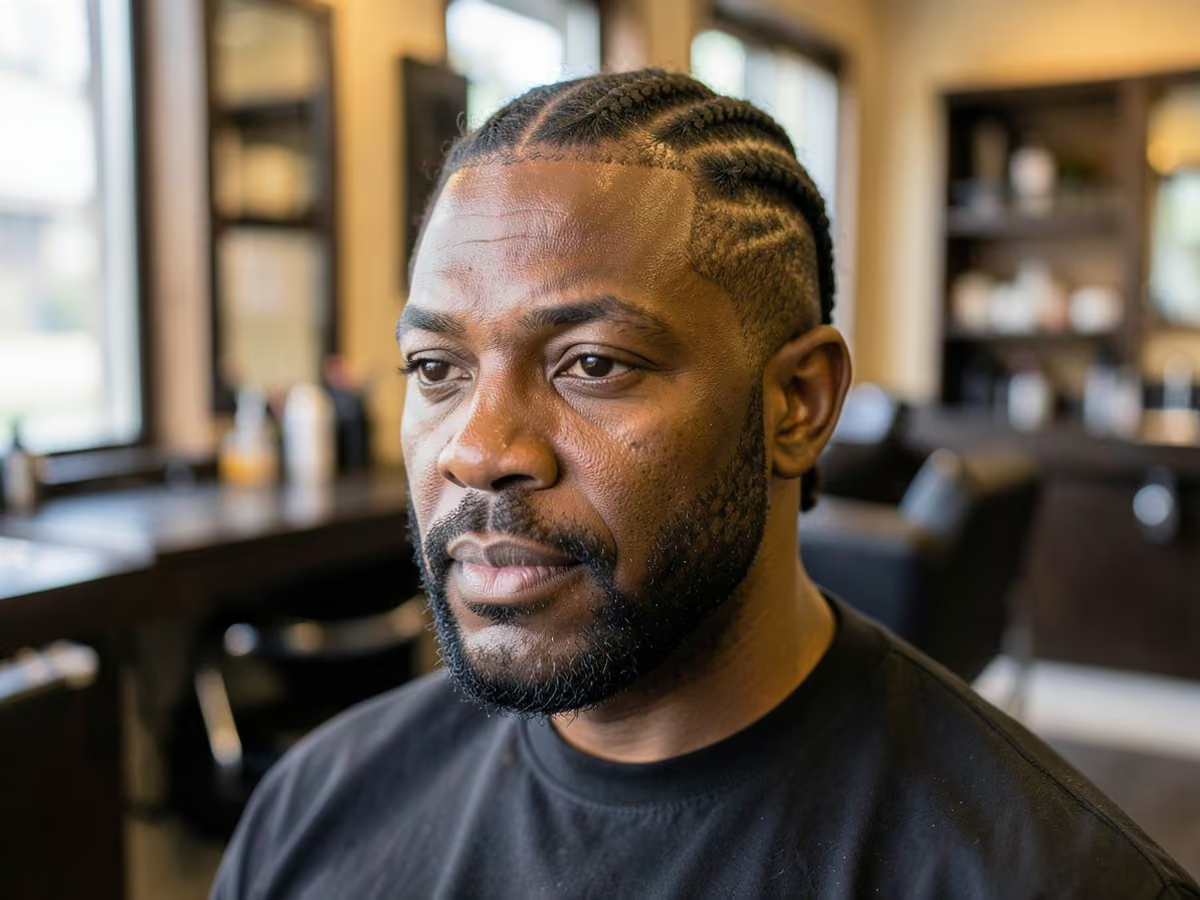
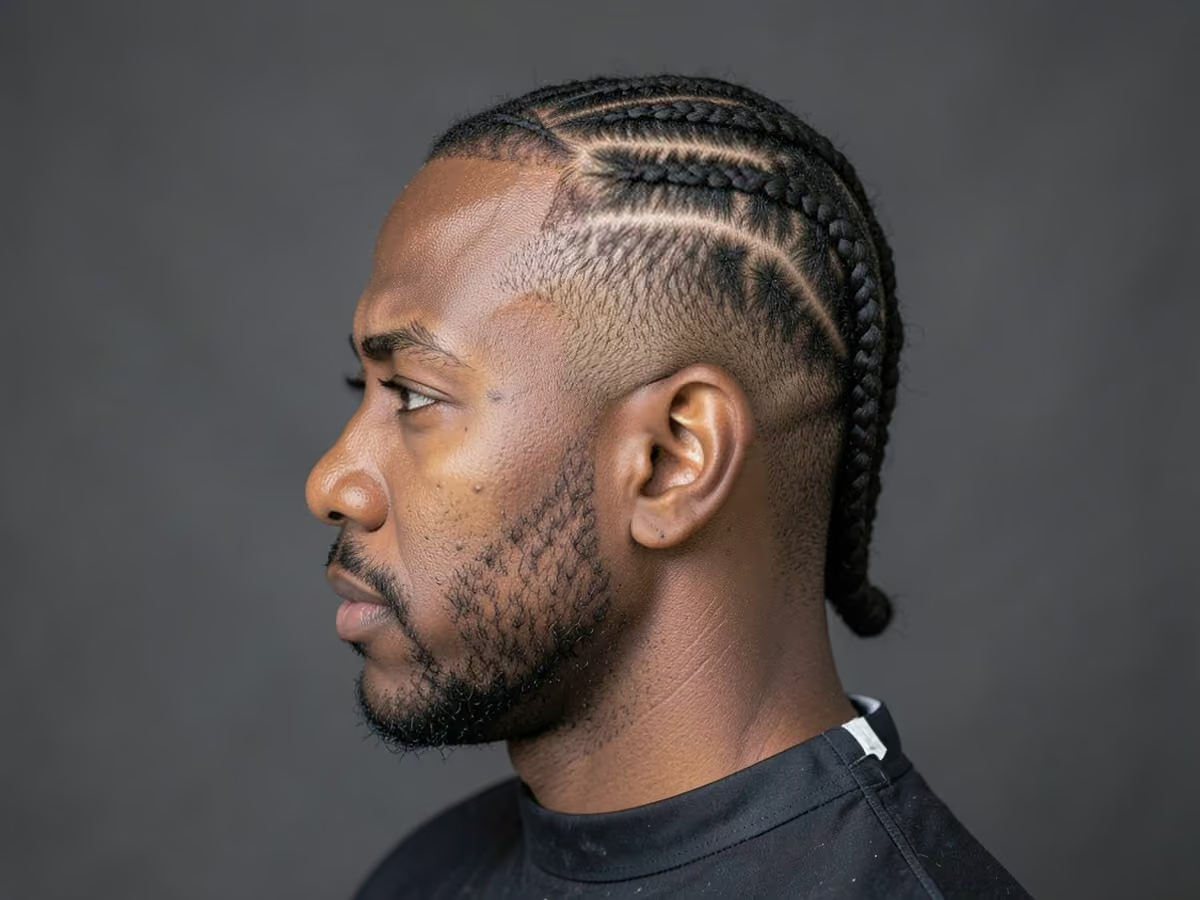
Quick answer: Cornrows for men are flat braids worked close to the scalp in rows, usually straight back, curved or in a spiral. Coily hair needs about two inches to braid, straight hair about five. They last two to four weeks. Ask for light tension at the hairline, since tight braids can cause traction alopecia.
Cornrows for Men Styles at a Glance
Every style on this page with its clipper guard, top length and trim interval. Tap a name to jump to that card.
Cornrows for men range from six simple straight back rows to spirals and criss-cross lattices that take a braider hours. Below are 30 styles grouped by pattern, row size, fade, beard, updo and hair type, each with how long it lasts, what to ask for and how to keep the braids from pulling on your edges.
What Are Cornrows?
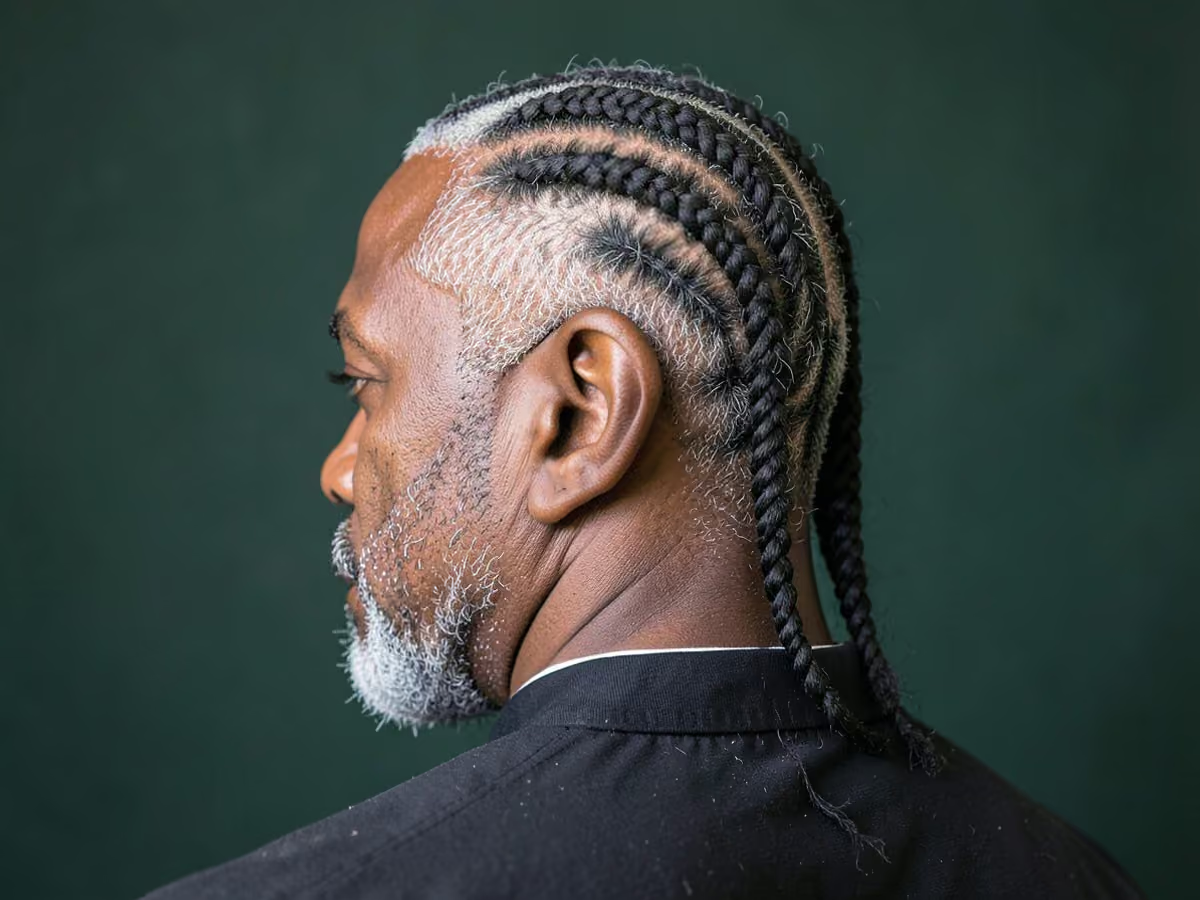
Cornrows are braids worked close to the scalp in raised rows, made with an underhand stitch that picks up new hair along a parted section as the braid travels back. The parts can run straight, curve, cross or spiral, and the braids can stop at the crown, run to the nape or end in loose tails. The style has a long history in African and African diaspora cultures, and for men it works both as a protective style and as a way to keep longer coily hair neat between cuts.
Most men's cornrows use only their own hair, which keeps installs shorter and lighter on the scalp, though extensions can be fed in for length. A typical install takes one to three hours depending on row size, and the braids look neat for about two to four weeks before new growth loosens them. The braids for men guide covers box braids and other loose braid styles.
How Are Cornrows Different From Box Braids and Twists?
The main difference is attachment. Cornrows are braided flat onto the scalp along a part, so they cannot move once installed. Box braids hang free from square sections and swing with the head. Two-strand twists wrap two pieces of hair around each other; they go in faster but unravel sooner. Each style also puts tension in a different place, which matters for the health of your hairline. The table gives typical ranges; your braider's advice for your hair comes first.
How Are Cornrows Different From Box Braids and Twists?
Cornrows suit most face shapes, and row direction changes the effect. Straight back rows open the forehead and lengthen a round face. Curved or side swept rows soften a square jaw, and a center part frames a narrow face. Hair type matters more than face shape: coily and kinky hair two inches or longer grips best, looser curls need a little product, and straight hair needs roughly five inches plus braiding gel to hold a row.
Cornrows are a poor fit if your edges are already sore, broken or thinning, unless the braider adapts the pattern by starting the rows further back and keeping the front loose. Men with a sensitive scalp or a history of folliculitis should ask for larger rows and shorter wear. School, workplace and service rules on braids differ and change, so check the current policy before an install rather than relying on what was allowed last year.
Filter the styles
Showing all 30 styles
Fade
Hair
Length
Cornrow Patterns
The part lines decide the pattern. Straight lines take the least time in the chair, while curves, crosses and spirals need a braider with a steady hand who maps the whole scalp before the first stitch.
Trim:Every 2–4 weeks. Roots loosen and frizz as new growth comes in.
Best For:Oval, long faces + coily hair two inches or longer.
About This Style
Six to ten parallel rows run from the front hairline straight to the nape, each braided flat against the scalp with an underhand stitch. It is the first pattern most braiders learn and the quickest to install, often under an hour on short coily hair. The rows look clean from the front and sit flat under a cap. Ask the braider to leave fine baby hairs at the edges loose if they break easily.
How to Style at Home
Wrap the rows in a satin durag every night to keep the braids flat.
Spray a light leave-in along the parts every two or three days.
Dab scalp oil only on itchy spots instead of coating the whole head.
Ask Your Barber
"Eight straight back cornrows from the hairline to the nape, medium width, snug but not tight at the edges, and a clean taper at the neckline."
Trim:Every 2–3 weeks. Curved rows show fuzz sooner than straight ones.
Best For:Round, oval faces + thick coily hair two to four inches.
About This Style
Rows start at a center point on the crown and curve outward in a coil, so the whole head reads as one swirl from above. The braider maps every part with a rat-tail comb before braiding, and an install on medium-length hair can take two to three hours. Spirals need even growth across the head, since a thin patch breaks the curve. Book with a braider who posts spiral work, not a general barber.
How to Style at Home
Sleep on a satin pillowcase as well as a durag so the curved rows keep their shape.
Mist the parts with water mixed with leave-in when the scalp feels dry.
Avoid tight hats that press on the crown center for the first two days.
Ask Your Barber
"Spiral cornrows starting from a center point on the crown, about twelve rows of medium width, parts mapped clean, light tension at the hairline and temples."
Trim:Every 2–3 weeks. Rebraid when the curves start lifting at the roots.
Best For:Square, oval faces + coily or kinky hair two inches plus.
About This Style
Each row bends in a gentle S or C as it travels back, which softens a square jaw and hides a part that would look stiff in a straight line. Curved rows sit between straight backs and full designs in difficulty, and most braiders charge a little more for them. Four to eight rows is common for men, and the curve usually sweeps toward one ear before finishing at the nape.
How to Style at Home
Press the rows flat with your palms after removing the durag each morning.
Use a soft edge brush only on loose hairline frizz, not on the braids.
Rinse the scalp with diluted shampoo through the parts once a week.
Ask Your Barber
"Six curved cornrows sweeping from the hairline toward my left ear and finishing at the nape, medium width, snug tension, soft natural edge at the front."
Trim:Every 2–3 weeks. Crossed sections loosen first where rows meet.
Best For:Oval, long faces + thick coily hair three inches or longer.
About This Style
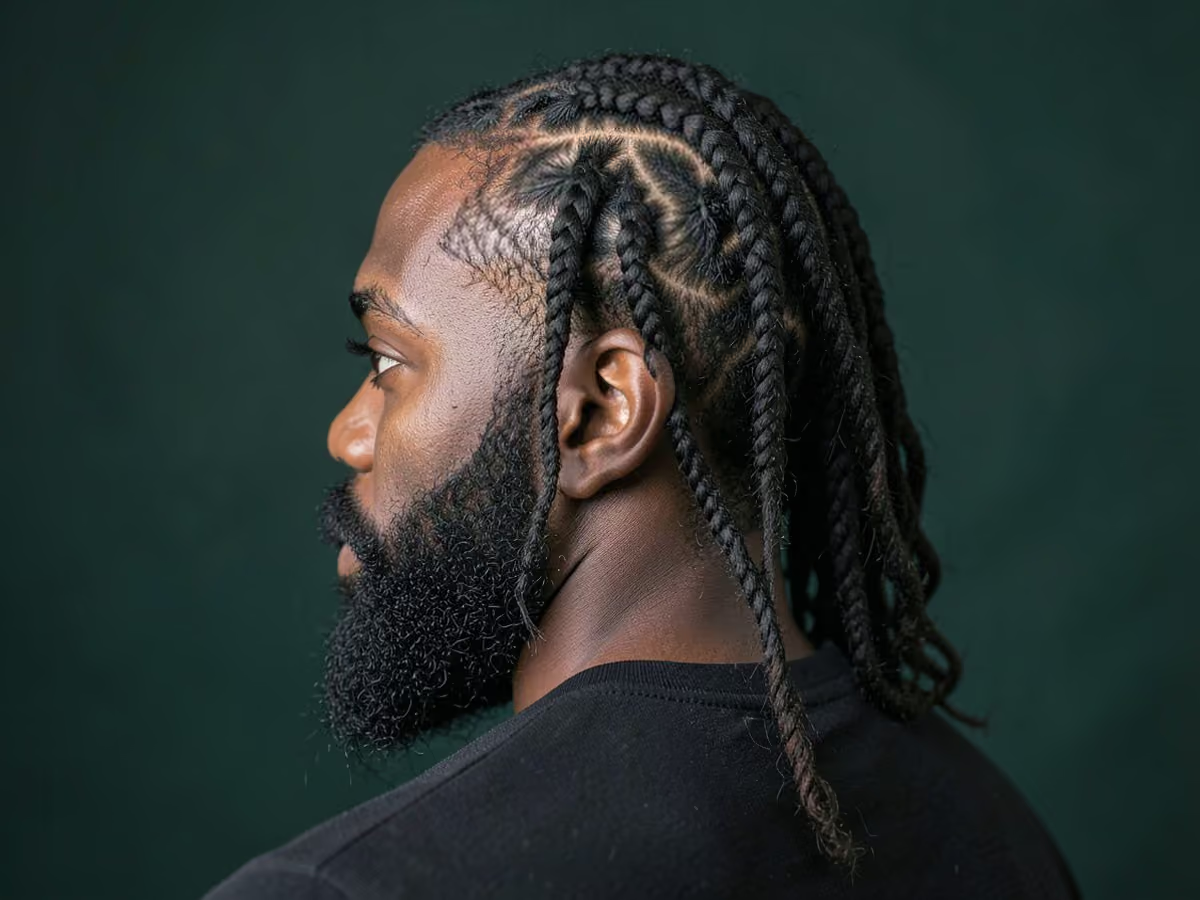
Rows angle diagonally from both sides and cross over each other, so the parts form a lattice of diamonds on top. One row is braided first and the next passes over or under it, which takes skill and more chair time than any straight pattern. It needs enough length to carry the crossing braid, roughly three inches on coily hair. Frizz appears first at the crossing points as the hair grows.
How to Style at Home
Tie a satin scarf under the durag to protect the crossing points overnight.
Smooth flyaways at the crossings with a pea-size amount of light gel.
Skip heavy oils, which collect where the rows overlap and attract lint.
Ask Your Barber
"Criss-cross cornrows in a diamond lattice on top, rows angled from both sides, firm but painless at the edges, ends tucked at the nape."
Trim:Every 2–4 weeks. Angled rows drift as new growth comes in.
Best For:Round, heart faces + coily hair two to three inches.
About This Style
Rows run on a diagonal from the front hairline toward one side of the nape instead of straight back. The angle breaks up the width of a round face and gives an asymmetric shape without curves, so it braids almost as fast as a straight pattern. It pairs well with a low fade on the side the rows sweep toward. On short hair the rows can stop at the occipital bone with the ends tucked.
How to Style at Home
Brush loose edge hair in the same direction the rows travel.
Tie the durag with the knot on the side where the rows finish.
Moisturize the ends at the nape, where the braids dry out first.
Ask Your Barber
"Six side swept cornrows angled from the front toward the right side of the nape, medium width, low fade on the right side, soft edge up."
Trim:Every 2–3 weeks. The ring braid frizzes along the hairline first.
Best For:Oval, long faces + coily hair four inches or longer.
About This Style
One cornrow circles the whole head like a crown, starting at the nape and running around the hairline, and the hair inside the ring is braided in smaller rows or left as a short puff. Because the outer braid follows the hairline, it pulls on the edges more than most patterns. Ask for low tension and take it down early if the temples feel sore. It also needs real length to reach all the way around.
How to Style at Home
Ask for the ring braid to be redone if it pulls at the temples on day one.
Moisturize the center hair with curl cream if it is left out as a puff.
Cover the ring with a satin scarf at night rather than a tight band.
Ask Your Barber
"Halo cornrow around the head along the hairline with light tension at the temples, four straight back rows inside the ring, nape cleaned up with a taper."
Recommended Products
Curl Cream
Leave-In
Cornrows by Size and Length
Row width changes both the finish and the time in the chair. Small rows last longer but take hours, while jumbo rows go in fast. Short hair can be braided too, as long as the braider can grip about two inches.
Trim:Every 3–4 weeks. Small rows keep their shape longer than wide ones.
Best For:Oval, square faces + thick coily hair three inches or more.
About This Style
Rows a quarter inch wide or less, often twelve to twenty across the head, give a fine, detailed finish and stay neat longer because each row holds less hair. The trade-off is time: three to five hours is normal, and many small rows braided hard can stress the scalp. Ask for light tension at the front and slightly wider rows along the hairline if your edges are fragile.
How to Style at Home
Clean the parts with a cotton pad and diluted shampoo instead of scrubbing.
Apply leave-in through a nozzle bottle along each part every few days.
Sleep in a durag and avoid lying directly on the back rows for long stretches.
Ask Your Barber
"Small straight back cornrows about a quarter inch wide, roughly sixteen rows, wider rows along the hairline with light tension, ends tucked at the nape."
Trim:Every 2–3 weeks. Wide rows loosen faster as the roots grow.
Best For:Round, oval faces + thick coily hair four inches or longer.
About This Style
Two to four wide rows, each an inch or more across, are braided straight back or on a slight curve. They go in fast, often in under an hour, and the larger sections spread tension across more hair, which is gentler on the scalp than many small rows. They frizz sooner and look relaxed by week two. Jumbo rows need length, so they suit grown-out coily hair more than short cuts.
How to Style at Home
Seal the ends with a little curl cream so the tails do not unravel.
Retie the durag each night so the wide rows stay flat instead of puffing.
Smooth new growth at the roots with a damp edge brush midweek.
Ask Your Barber
"Four jumbo cornrows straight back, about an inch wide each, even gentle tension, tails left loose past the nape, low taper around the ears."
Trim:Every 2–4 weeks. The center part blurs first as hair grows.
Best For:Oval, long faces + coily hair three inches or more.
About This Style
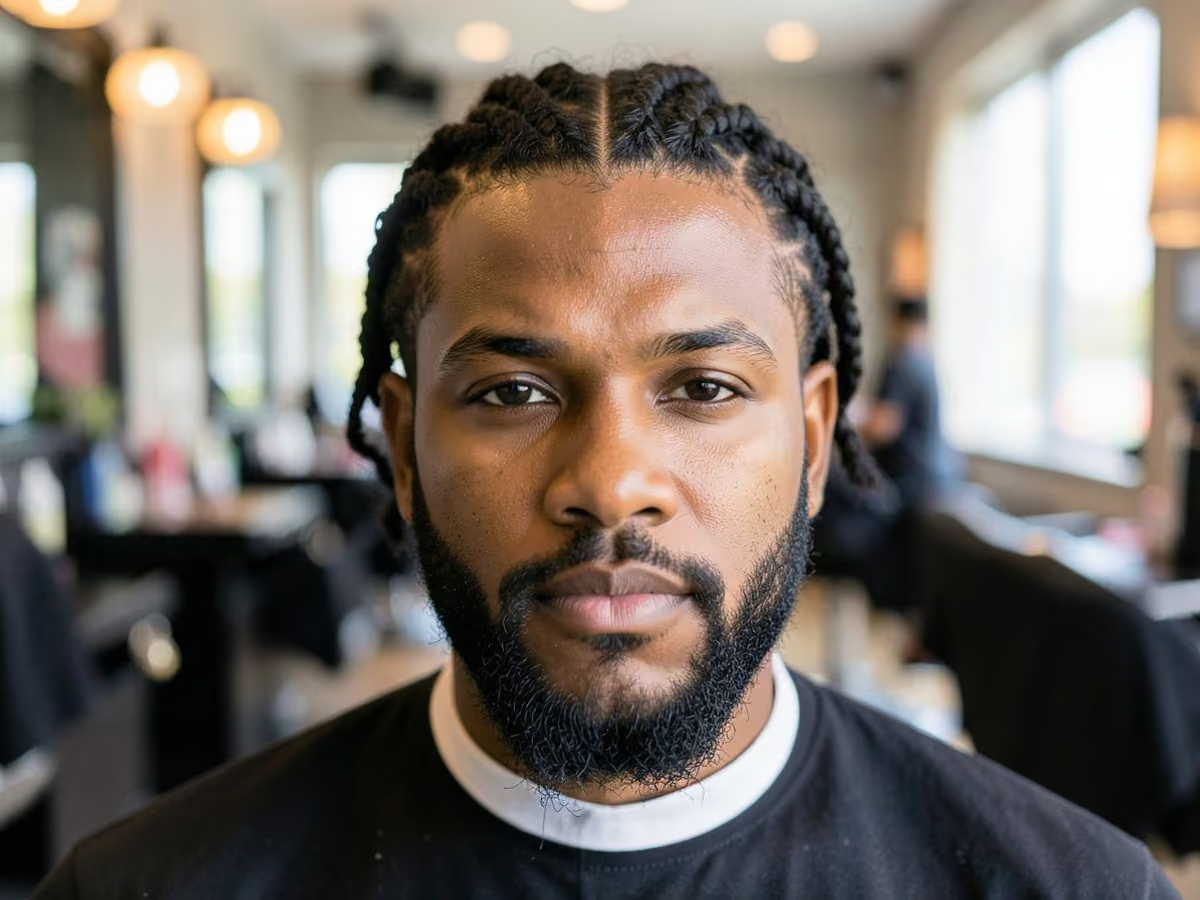
A single clean part runs from the forehead to the crown, and rows on each side angle back and slightly outward, mirroring each other. The center line gives the braids a symmetric frame that suits an even hairline and a narrow face. Four to six rows per side is typical. Since the part is the focal point, the braider sets it first with the comb tail and checks that both halves match.
How to Style at Home
Check the center part in a mirror and calm frizz there with a little light gel.
Line the durag seam up with the part so it does not drift overnight.
Spray leave-in on both halves evenly so one side does not dry out first.
Ask Your Barber
"Cornrows with a center part from forehead to crown, five rows on each side angled back, both halves mirrored, medium width, gentle at the temples."
Trim:Every 1–2 weeks. Short braids loosen fast once growth comes in.
Best For:Oval, round faces + coily or kinky hair about two inches.
About This Style
Coily hair around two inches long can usually be cornrowed in small or medium rows, since the tight texture grips well. The braids are short, often ending at the crown or occipital bone with the tails tucked, and the style stays close to the head. Each stitch holds less hair, so the rows tend to last only one to two weeks. A light pomade helps the braider grip slippery short ends.
How to Style at Home
Flatten the tucked ends with a damp palm after showering.
Wear a durag every night, since short rows unravel with pillow friction.
Wash only the scalp and blot it dry so the short braids do not swell.
Ask Your Barber
"Small cornrows on my short hair, about two inches, straight back to the occipital bone, ends tucked, firm grip but no pulling at the edges, low taper underneath."
Trim:Every 3–5 weeks. Added hair holds the pattern longer between installs.
Best For:Oval, long faces + short coily hair under three inches.
About This Style
Synthetic or human braiding hair is fed into each row so the cornrows run longer and fuller than your own length allows. Adding small amounts at a time keeps the start of each row light. Extra hair also adds weight, and weight on the hairline is a main driver of traction damage, so men with thin edges should keep extensions to the back rows or skip them. Ask about pre-rinsed braiding hair if synthetic fiber makes your scalp itch.
How to Style at Home
Rinse the scalp with a nozzle bottle and diluted shampoo about once a week.
Dry the braids fully after washing so the added hair does not stay damp.
Take them down within the time your braider recommends, not later.
Ask Your Barber
"Cornrows with extensions, six straight back rows, braiding hair fed in gradually so the front stays light, no added hair along the edges, ends sealed past the shoulders."
Recommended Products
Scalp Oil
Leave-In
Cornrows with a Fade
A fade under cornrows keeps the sides clean while the braids grow out. Most men get the braids first and the fade right after, so the barber can follow the line of the bottom row.
Trim:Every 2–3 weeks. The fade grows out before the braids do.
Best For:Oval, square faces + coily hair three inches or more on top.
About This Style
The braids cover most of the head, and the bottom inch or two above the ears and at the nape is faded from a #0.5 up to a #2. Since the fade sits low, the outermost row can run close to the ear without exposing much scalp. It is the easiest fade to wear at an office or school, and a quick neckline touch-up at the shop lets the braids last a little longer.
How to Style at Home
Book a neckline clean-up between braid installs to keep the fade sharp.
Rub a little scalp oil on the faded area if it feels dry after clipping.
Keep the durag edge above the fade line so it does not leave a mark.
Ask Your Barber
"Low fade under my cornrows, #0.5 at the bottom blending to a #2 just above the ears, follow the bottom braid line, nape tapered, no hard part."
Trim:Every 3–4 weeks. Only the sideburns and nape need cleaning up.
Best For:Oval, long faces + coily or kinky hair two inches plus.
About This Style
Only the sideburns and nape are tapered, usually from a #1 to a #3, so the braids keep their full width around the head. It is the most conservative way to add clippers to cornrows and reads tidy where grooming rules are strict. The taper takes about ten minutes and can be refreshed on its own while the braids stay in, which stretches each install toward its full life.
How to Style at Home
Smooth the sideburn hair down with an edge brush after removing the durag.
Spray leave-in on the braids, keeping it off the freshly tapered skin.
Get a taper-only touch-up at week two if the nape looks fuzzy.
Ask Your Barber
"Taper fade at the sideburns and nape only, #1 blending into a #3, leave the rest of the sides full for the cornrows, rounded neckline."
Trim:Every 1–2 weeks. Bare skin beside braids shows stubble within days.
Best For:Round, square faces + thick coily hair on top.
About This Style
The sides and back are shaved to skin with a foil shaver up to the temple, and the cornrows sit only on the top section, often four to six rows. The contrast between bare sides and braided top shows the pattern clearly from every angle. Men prone to razor bumps should ask for a #0.5 instead of skin. The skin needs a touch-up within a week, while the braids last two to three.
How to Style at Home
Moisturize the shaved sides daily with a light scalp oil.
Apply sunscreen to the bare skin before long stretches outdoors.
Keep product on the braided strip so it does not clog pores on the sides.
Ask Your Barber
"Mid skin fade to the temples with a foil shaver, cornrows on top only, five straight back rows ending at the crown, clean line between fade and braids."
Trim:Every 2–3 weeks. The curve around the ear blurs quickly.
Best For:Oval, heart faces + coily hair three inches or longer.
About This Style
The fade curves in a half circle around each ear and leaves the nape longer, so braids can run all the way down the back while the sides look sharp. It pairs well with rows that end in loose tails or a short ponytail. Most barbers burst from a #0 or skin behind the ear to a #2 at the edge of the curve, and the arc is shaped to follow the bottom row.
How to Style at Home
Keep the loose tails moisturized with a small amount of curl cream.
Tie the durag low enough to cover the tails without pressing on the burst.
Ask for the burst to be refreshed at week two while the braids stay in.
Ask Your Barber
"Burst fade around both ears from skin to a #2, nape left full, cornrows straight back with the tails hanging past the neckline."
Trim:Every 2–3 weeks. Temple hair grows back and softens the corners.
Best For:Oval, square faces + coily hair two to four inches.
About This Style
Also called a temp fade, it removes hair only at the temples and blends into the sideburn, leaving a crisp corner at the front of the braids. The rest of the sides stay at guard length or are braided. Because the focus is at the front, the rows frame the face more sharply. Ask for the temples at a #0.5 rather than skin if the hairline there is thin, since bare temples make thinning more visible.
How to Style at Home
Brush the front edges softly toward the temple corners each morning.
Avoid pulling the durag band tight across the faded temples.
Book a temple clean-up alone if the braids still look fresh.
Ask Your Barber
"Temple fade at both temples from a #0.5 into the sideburn, keep the braid line crisp at the front corners, rest of the sides at a #2, cornrows straight back."
Trim:Every 1–2 weeks. High contrast shows regrowth in the first week.
Best For:Round, oval faces + thick coily hair on top.
About This Style
Here the fade climbs to the parietal ridge, leaving only a strip of hair on top for three to five rows running front to back. The narrow braided band looks like a mohawk from the front and keeps the head cool in summer. Because only the top is braided, installs are short. The top rows carry all the tension, so ask for them snug but not tight to protect the front hairline.
How to Style at Home
Moisturize the braided strip every few days with a leave-in spray.
Use a light gel on loose hairs where the braids meet the fade.
Cover the bare sides with sunscreen when you are out for hours.
Ask Your Barber
"High fade to the parietal ridge, #0 at the bottom up to a #2, four cornrows on the top strip from forehead to crown, gentle tension at the hairline."
Recommended Products
Light Gel
Leave-In
Cornrows with Beards and Designs
A beard balances the long lines of cornrows, and a razor line along a part adds detail without more braiding time. Match the beard edge to the fade so the face and the rows connect.
Trim:Every 2–3 weeks. Rebraid and trim the beard on the same visit.
Best For:Round, square faces + coily hair and a full beard.
About This Style
Straight back or curved cornrows on top meet a full beard shaped at the cheek line and neck, with the sideburns faded into the beard so there is no break. The beard adds weight to the lower face, which balances the narrow outline of rows pulled back from the forehead. Keep the beard an inch or longer and brush it daily so its texture matches the neat braids.
How to Style at Home
Work a few drops of beard oil into the beard down to the skin after washing.
Brush the beard downward with a boar bristle brush to lay the coils flat.
Keep beard oil away from the braids so it does not collect lint.
Ask Your Barber
"Taper my sideburns into a full beard about an inch long, line up the cheek line, neckline one finger above the Adam's apple, cornrows straight back on top."
Trim:Every 2–4 weeks. Goatee edges need a trim each week or two.
Best For:Round, oval faces + coily hair and patchy cheek growth.
About This Style
A goatee covers the chin and mouth area while the cheeks stay clean, which works for men whose cheek beard grows in patchy. Paired with cornrows, it keeps the face open and draws attention to the rows and the jaw. The chin hair can be short and squared or rounded. A low taper on the sides keeps the overall look simple between braid installs.
How to Style at Home
Shape the goatee edges with a trimmer twice a week.
Work a little beard balm into the chin hair to keep it soft.
Shave the cheeks with the grain to limit bumps.
Ask Your Barber
"Low taper on the sides under my cornrows, shave the cheeks clean, line up a rounded goatee about half an inch long."
Trim:Every 2–3 weeks. Boxed lines on the cheeks fade within two weeks.
Best For:Oval, long faces + coily hair with dense beard growth.
About This Style
A short boxed beard keeps sharp cheek and neck lines with the length around a quarter to half inch, echoing the crisp parts between rows. The sideburn fades from a #1 into the beard so hair and beard read as one frame. It suits offices where a longer beard would look heavy. Shaving below the neckline can trigger razor bumps, so use a trimmer guard there instead of a blade.
How to Style at Home
Trim the beard with a #4 guard each week to hold the boxed length.
Edge the cheek line with a trimmer, not a razor, to avoid irritation.
Rub beard oil in after trimming to soften coarse hairs.
Ask Your Barber
"Short boxed beard at about a #4 length, sharp cheek line, neckline above the Adam's apple, sideburns faded from a #1, six straight back cornrows."
Trim:Every 3–4 weeks. Stubble only needs a trimmer pass twice a week.
Best For:Square, diamond faces + coily hair and light beard growth.
About This Style
Several days of stubble kept even with a #1 trimmer guard sits under cornrows without competing with them. It shadows the jaw and adds some ruggedness to a clean braided style. This is the lowest effort beard pairing, since there are no lines to keep sharp. Men with ingrown hairs along the neck often prefer stubble to a close shave, because the hair is never cut below the skin.
How to Style at Home
Run a #1 trimmer guard over the beard every three or four days.
Rub a drop of beard oil into the stubble to keep the skin calm.
Leave the cheek line natural rather than shaving a hard edge.
Ask Your Barber
"Keep my stubble at a #1 guard all over, no line up on the cheeks, light taper at the sideburns, medium cornrows straight back."
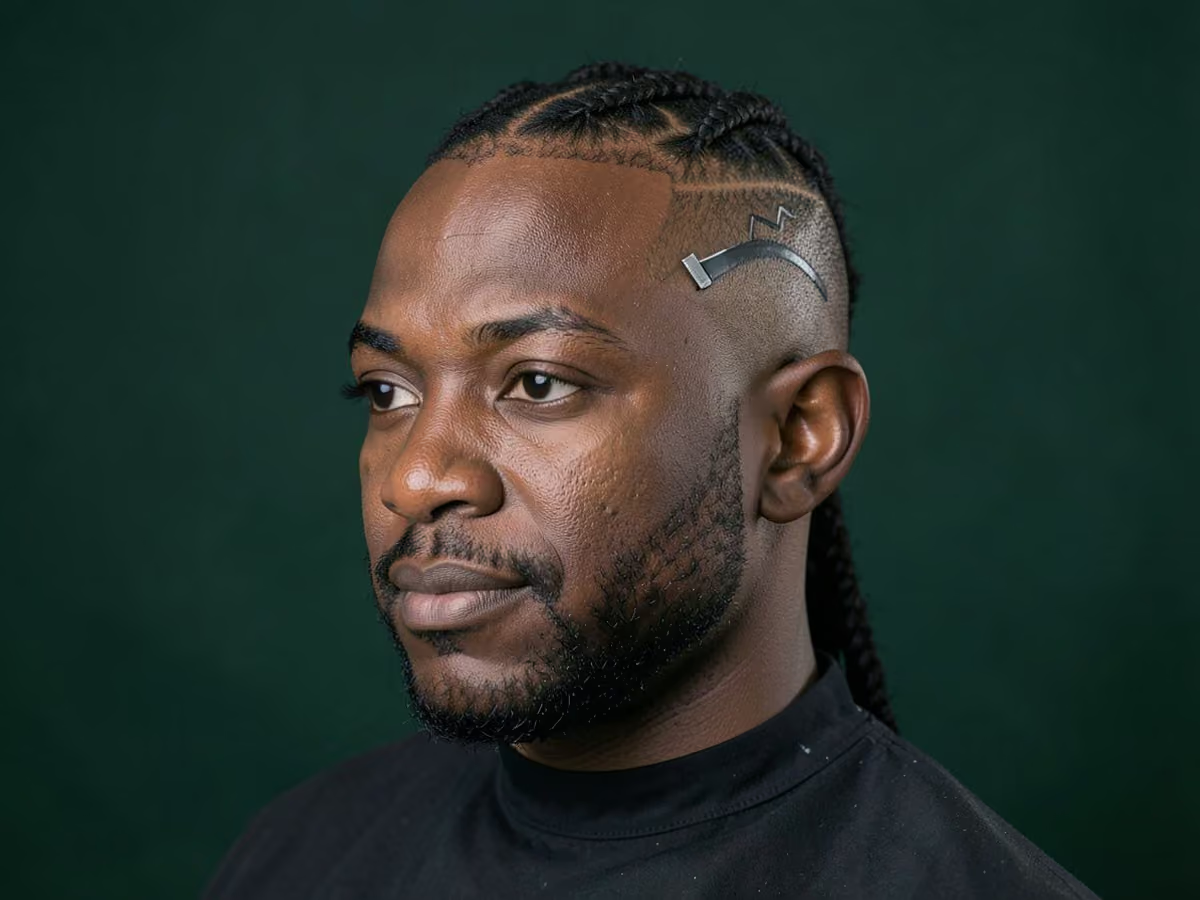
Trim:Every 2–3 weeks. The razor line fills in within a week or two.
Best For:Oval, round faces + coily hair with a low fade.
About This Style
A thin line is shaved with a trimmer along one part or on the faded side, so the braids gain a graphic detail. Common choices are a single curved line along the side or a small zigzag above the ear. The design is cut after braiding, so the barber can follow the actual row edges. Lines inside the parts disappear quickly as hair grows, so expect it to look clean for about a week.
How to Style at Home
Keep heavy product off the shaved line so it stays visible.
Rub a drop of scalp oil on the line if the skin looks dry.
Ask for a trimmer-only touch-up of the line at week one.
Ask Your Barber
"After my cornrows go in, shave a thin curved line along the side part above the left ear, about an eighth inch wide, low fade from a #0.5."
Recommended Products
Scalp Oil
Light Gel
Cornrow Updos and Mixed Styles
Cornrows can lead into a top knot, a puff of loose hair or twists at the back. These hybrids need more length, usually four inches or more, and they add weight to the rows that hold the gathered hair.
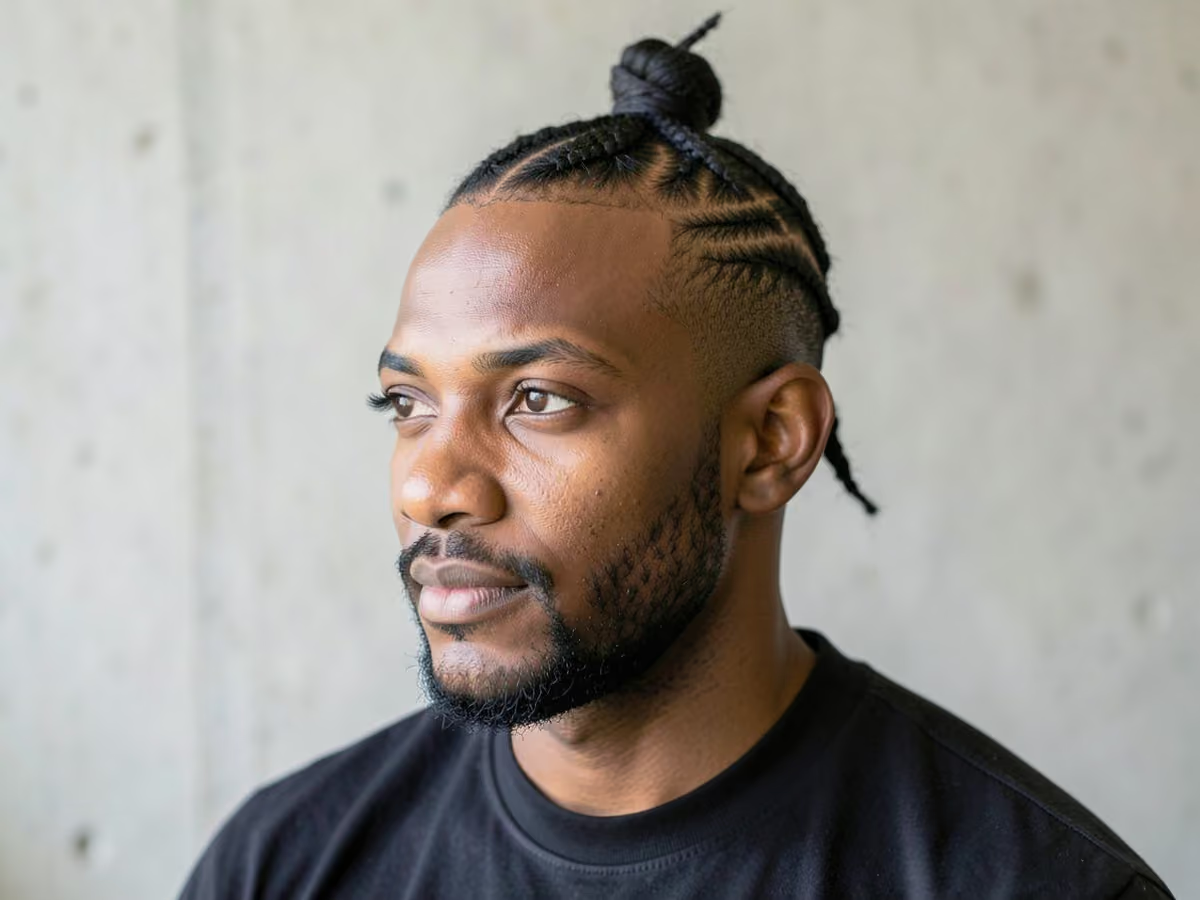
Trim:Every 2–3 weeks. Gathered tails pull on the front rows as they loosen.
Best For:Oval, long faces + coily hair five inches or longer.
About This Style
Rows braid upward from the hairline, sides and nape toward the crown, where the tails gather into a small knot. The upward angle lifts the face and shows off the taper underneath. Because the knot holds weight at the crown, the front rows take steady pull, so ask for a loose wrap on the knot and let it down at night. It needs more length than a straight back pattern to reach the top.
How to Style at Home
Release the knot before bed and cover the rows with a satin scarf.
Retie the knot loosely each morning with a soft cloth band.
Moisturize the gathered tails with curl cream twice a week.
Ask Your Barber
"Cornrows braided up toward the crown into a small top knot, medium rows, low taper at the nape and sides, light tension at the forehead, knot tied loosely."
Trim:Every 2–3 weeks. Loose hair needs shaping as the braids frizz.
Best For:Round, oval faces + coily hair four inches or more.
About This Style
Braids cover the front half of the head up to the crown, and the back half is left as a picked-out afro or set of coils. The face stays clear while natural texture shows behind. The split usually sits at the crown so the shape looks deliberate from the side. Wash day is easier because only half the head is braided, and the loose section can be picked or retwisted between installs.
How to Style at Home
Pick the loose back section from the roots to keep it round.
Spray water and a little curl cream on the afro each morning.
Use a satin bonnet at night so the loose hair does not flatten.
Ask Your Barber
"Cornrows from the hairline to the crown, about five rows, leave the back loose for a picked afro, round the back shape, low taper at the nape."
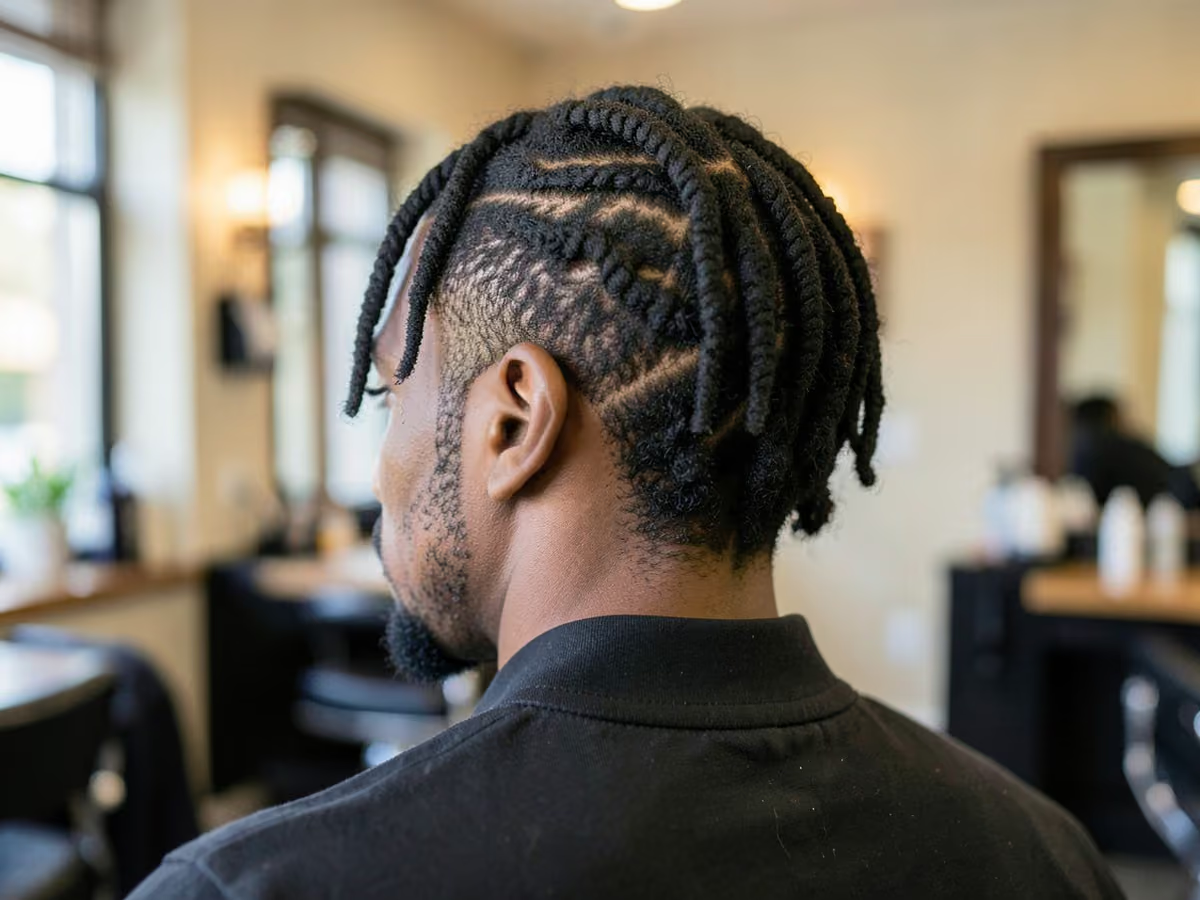
Trim:Every 3–4 weeks. Twisted ends hold longer than loose braid tails.
Best For:Oval, long faces + coily hair four inches or longer.
About This Style
Every row starts as a cornrow at the hairline and finishes as a two-strand twist at the crown or nape, so the ends hang loose and move. The mix gives the neat front of cornrows with softer texture behind. Twisted ends dry faster than braids after washing. Some men use it as a step toward starter locs, since the twisted sections can be left to mature.
How to Style at Home
Coat the twisted ends with curl cream so they do not unravel.
Rinse the scalp along the cornrow section with a nozzle bottle.
Gently roll any loosening twists between your palms.
Ask Your Barber
"Cornrows from the hairline that turn into two-strand twists at the crown, medium rows, twists about four inches long, taper at the nape, gentle tension at the front."
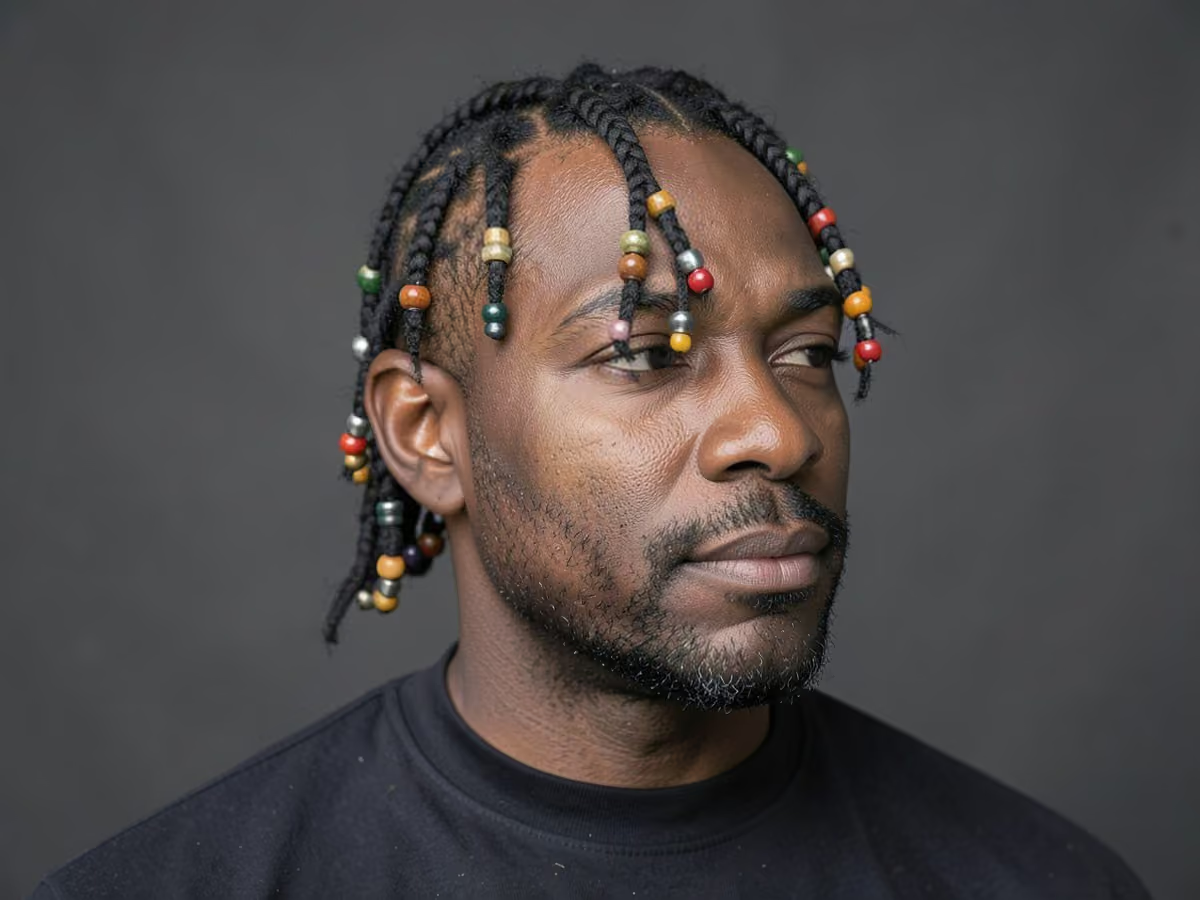
Trim:Every 2–3 weeks. Beads add weight, so rebraid before the ends sag.
Best For:Oval, heart faces + coily hair with braided tails.
About This Style
Wooden, metal or plastic beads slide onto the loose tails of each row and sit above a small band or knot. They add color and a light click when the head moves. Each bead adds weight to the end of the braid, which pulls on the root, so keep them light and few, and leave them off the front rows. Take metal beads out before contact sports.
How to Style at Home
Check that each bead band is secure but not cutting into the braid.
Wrap the tails in a satin scarf at night so the beads do not tangle.
Remove the heaviest beads first if your scalp feels sore.
Ask Your Barber
"Straight back cornrows with tails about three inches long, light wooden beads on the back rows only, none on the front rows, low taper at the nape."
Recommended Products
Leave-In
Scalp Oil
Cornrows by Hair Type and Age
Coily hair grips a braid best, but straight hair, looser curls, receding edges and kids can wear cornrows with changes to row size and tension. Each card notes what the braider should adjust.
Trim:Every 2–3 weeks. Kids' braids frizz faster from play and sweat.
Best For:Ages 6–12 + coily hair two inches or longer.
About This Style
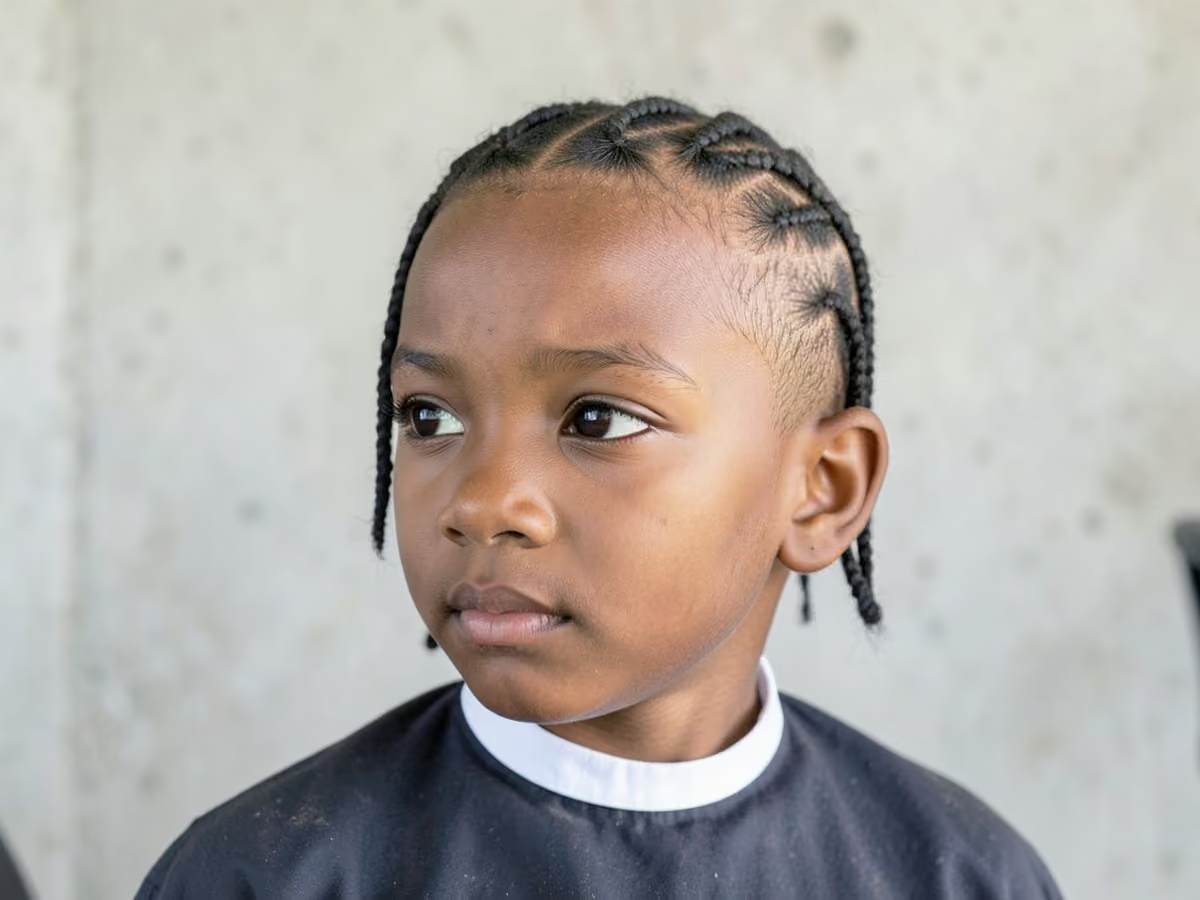
For boys, straight back rows of medium width keep the install to about an hour, which matters for a child who cannot sit still longer. Young scalps can be tender, so ask the braider to use light tension and to stop if your son says it hurts; pain means the braids are too tight. Keep beads and extensions off young heads, and take the braids down after two to three weeks.
How to Style at Home
Cover his braids with a satin durag or bonnet at bedtime.
Wash his scalp gently with a kids' shampoo diluted in a nozzle bottle.
Check the hairline each week for bumps or redness.
Ask Your Barber
"Medium straight back cornrows for my son, about six rows, light tension, no extensions or beads, soft taper at the nape and around the ears."
Trim:Every 1–2 weeks. Straight hair slips out of the braid quickly.
Best For:Oval, long faces + straight or wavy hair five inches plus.
About This Style
Straight and wavy hair is slippery, so cornrows need more length to hold, roughly five inches or more, and a braiding gel or pomade for grip. Rows come out softer and looser than on coily hair and usually last one to two weeks. Fewer, wider rows hold better than small ones. Fine straight hair can show scalp between rows, so a scissor taper rather than a fade keeps the sides full.
How to Style at Home
Smooth stray hairs back into the rows with a little light gel each morning.
Sleep in a snug durag, since straight hair slides out overnight.
Skip washing for the first few days so the braids settle.
Ask Your Barber
"Four wide cornrows straight back on my straight hair, braiding gel for grip, snug but not tight, scissor taper on the sides instead of a fade."
Trim:Every 2–3 weeks. Looser curls frizz out of the rows sooner.
Best For:Oval, round faces + 3a to 3c curly hair three inches plus.
About This Style
Looser curl patterns, common in mixed-race and Latino hair, hold a cornrow better than straight hair but slip more than 4c coils. Braiders usually work the hair slightly damp with a curl cream for grip and choose medium rows. Expect a softer, fuzzier finish within days. Detangle fully before braiding, since knots trapped inside a row break off when the braids come out.
How to Style at Home
Detangle the hair fully with detangling spray before the appointment.
Smooth frizz along the rows with a dab of curl cream midweek.
Retie the durag nightly so curls do not spring out of the rows.
Ask Your Barber
"Medium cornrows straight back on my curly hair, braided slightly damp with curl cream, six rows, firm grip but no pain at the edges, low fade on the sides."
Trim:Every 3–4 weeks. Longer breaks between installs rest the edges.
Best For:Oval, square faces + coily hair with thinning edges.
About This Style
If the temples or front line are already thinning, cornrows can still work with changes: start the rows a little behind the weakest area, leave fine edge hairs out, use wider rows that spread the pull, and skip extensions at the front. Ongoing tension on a thinning line can speed loss, so watch for soreness, bumps or broken hairs and take the braids out early if they appear. A dermatologist can check whether the loss is traction related.
How to Style at Home
Leave the front edges loose and smooth them with a soft brush only.
Massage a little scalp oil into the temples with light fingertip pressure.
Wait at least a couple of weeks between installs.
Ask Your Barber
"Cornrows starting about half an inch behind my temples, leave the fine edge hair out, wide rows with light tension at the front, no extensions, low taper on the sides."
Recommended Products
Scalp Oil
Leave-In
How Do You Ask for Cornrows?
Book a braider for anything beyond straight back rows. Spirals, criss-cross lattices, halos and designs need someone who maps parts every day, and many barbers can do simple straight backs but not complex patterns. Look at recent photos for clean parts and even row size. Arrive with clean, detangled, dry hair unless the braider says otherwise, since washing and blow-drying in the chair usually costs extra and adds time.
Give four details: the pattern, the number and width of rows, where the braids end, and if you want extensions. Then say how the sides should be handled, such as a low fade, a taper fade or no clippers at all; most men get the braids first and the fade right after, so the barber can follow the bottom row. Say up front that you want light tension at the hairline and that you will speak up if it hurts.
Clipper Guards Used in Cornrows for Men Styles
A clipper guard is the plastic comb that clips onto the blade and sets how much hair is left: a #1 leaves 3 mm (1/8 inch), each step up adds about 3 mm. The right column lists the cards on this page that call for each guard. See the full clipper guard numbers guide for the complete chart.
Cornrows are low effort day to day, but the scalp underneath still needs cleaning and moisture, and the hair inside the rows still needs some water to stay flexible. A few simple habits keep the rows neat for longer, cut down on frizz at the roots and protect your own hair when the braids finally come out.
Cover them at night
Sleep in a satin or silk durag or scarf, tied snug but not tight. Cotton pillowcases cause friction that frizzes the roots and pulls hair out of the rows.
Wash the scalp, not the braids
Every week or so, use diluted shampoo in a nozzle bottle along the parts, rinse well and let the braids dry fully. Damp braids left under a durag can smell and irritate the scalp.
Moisturize lightly
A water-based leave-in spray every few days keeps coily hair from drying out. Put oil on the scalp only where it itches; heavy oil collects lint in the parts.
Take them down gently
Unbraid from the ends with some conditioner or detangling spray, then comb out shed hair from tips to roots. Leave a few days or longer of loose hair before the next install.
How Do You Avoid Traction Alopecia With Cornrows?
Traction alopecia is hair loss caused by repeated pulling on the follicles, and tight braids are one of its best-known causes. Dermatology groups, including the American Academy of Dermatology, list warning signs such as pain or stinging after styling, small bumps at the base of braids and broken hairs around the hairline and temples. Caught early, the loss can often reverse once the pulling stops. After years of tension, the follicles can scar and stop growing hair for good.
Braids should not hurt. Headaches, tight shiny skin at the temples or trouble moving your eyebrows after an install all mean the rows are too tight, so ask for them redone. Change the pattern between installs so the same parts do not take the strain every time, keep extensions and beads off the front rows, and take the braids out on schedule. If your edges keep thinning, see a dermatologist rather than braiding over it.
Which Cornrows for Men Is Right for You?
Pick your hair type and how much upkeep you will put in. The matches below come from the Best For and Maintenance notes on each card. Upkeep follows the Maintenance badge: low means a cut every 3 to 6 weeks and almost no daily styling, high means weekly line-ups or daily product.
On natural hair, most men's cornrows look neat for two to three weeks and start to look fuzzy by week four as new growth loosens the roots. Small rows and extensions can hold a little longer. Leaving them in for months raises the risk of buildup, matting at the roots and breakage, so follow your braider's timeline.
Q2: How long does hair need to be for cornrows?+
Coily hair can usually be cornrowed at about two inches, though the rows will be short and may only reach the crown. Three to four inches gives more pattern choices. Looser curls need a little more, and straight hair needs roughly five inches plus braiding gel to grip. Extensions can add length to short hair.
Q3: Do cornrows cause hair loss?+
They can if they are braided too tight, worn too long or repeated on the same hairline without breaks. That type of loss is called traction alopecia. Light tension, wider rows at the edges, breaks between installs and no heavy extensions at the front lower the risk. Early traction loss often recovers, while long-term loss can be permanent.
Q4: Can men with straight hair get cornrows?+
Yes, with enough length, roughly five inches or more, and a braiding gel or light pomade for grip. Wider rows hold better than small ones, and the braids usually loosen within one to two weeks. Fine straight hair may show scalp between rows, so keeping the sides fuller helps the style look balanced.
Q5: Should you see a barber or a braider for cornrows?+
Many barbers can do simple straight back cornrows, but spirals, criss-cross lattices, halos and curved designs are a braider's work. Check recent photos for clean, even parts and ask how they handle tension at the hairline. A common setup is braids from a braider and the fade or taper from your barber right after.
Q6: How do you sleep with cornrows?+
Wear a satin or silk durag or scarf, tied snug but not tight, and add a satin pillowcase if you move a lot at night. Cotton causes friction that frizzes the roots and pulls hair out of the rows. Retie the durag each night so it lies flat and does not press a crease into the braids.