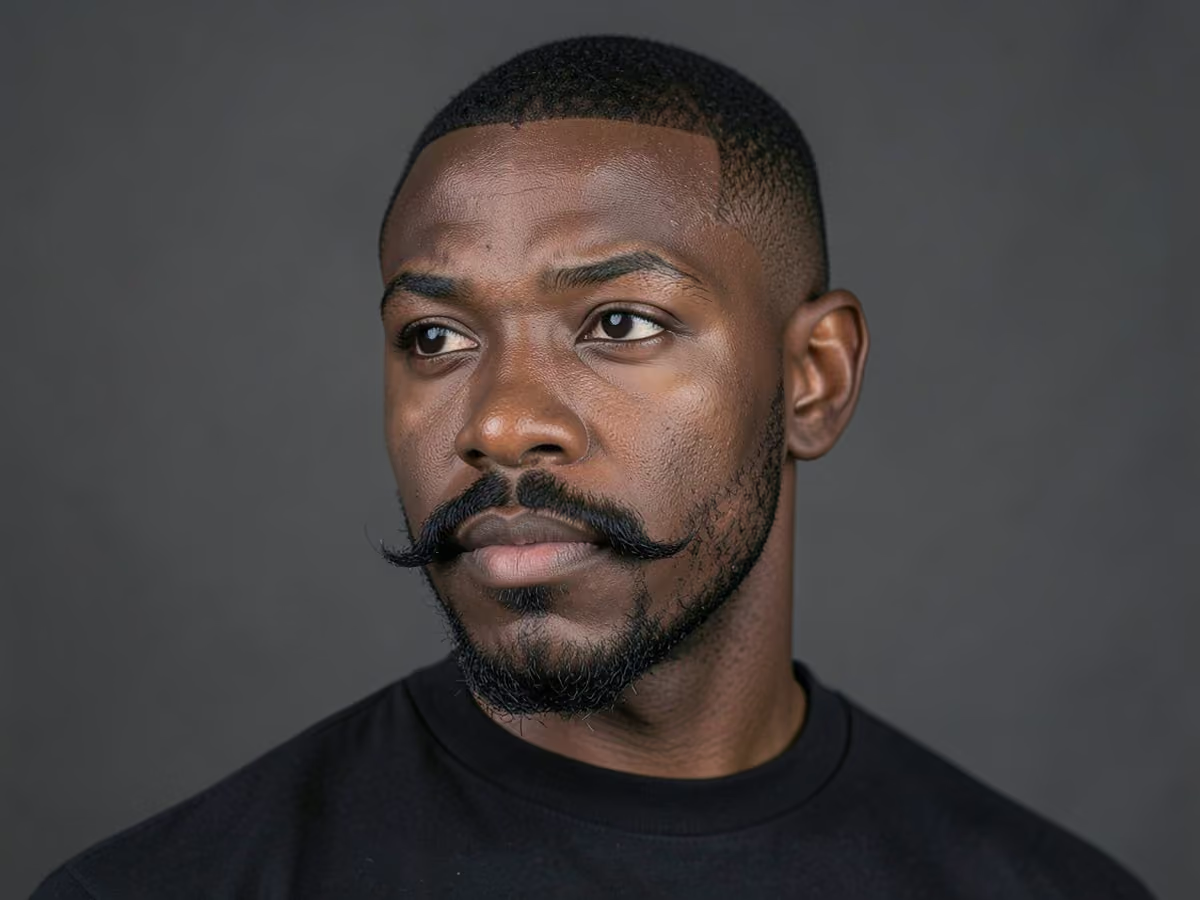
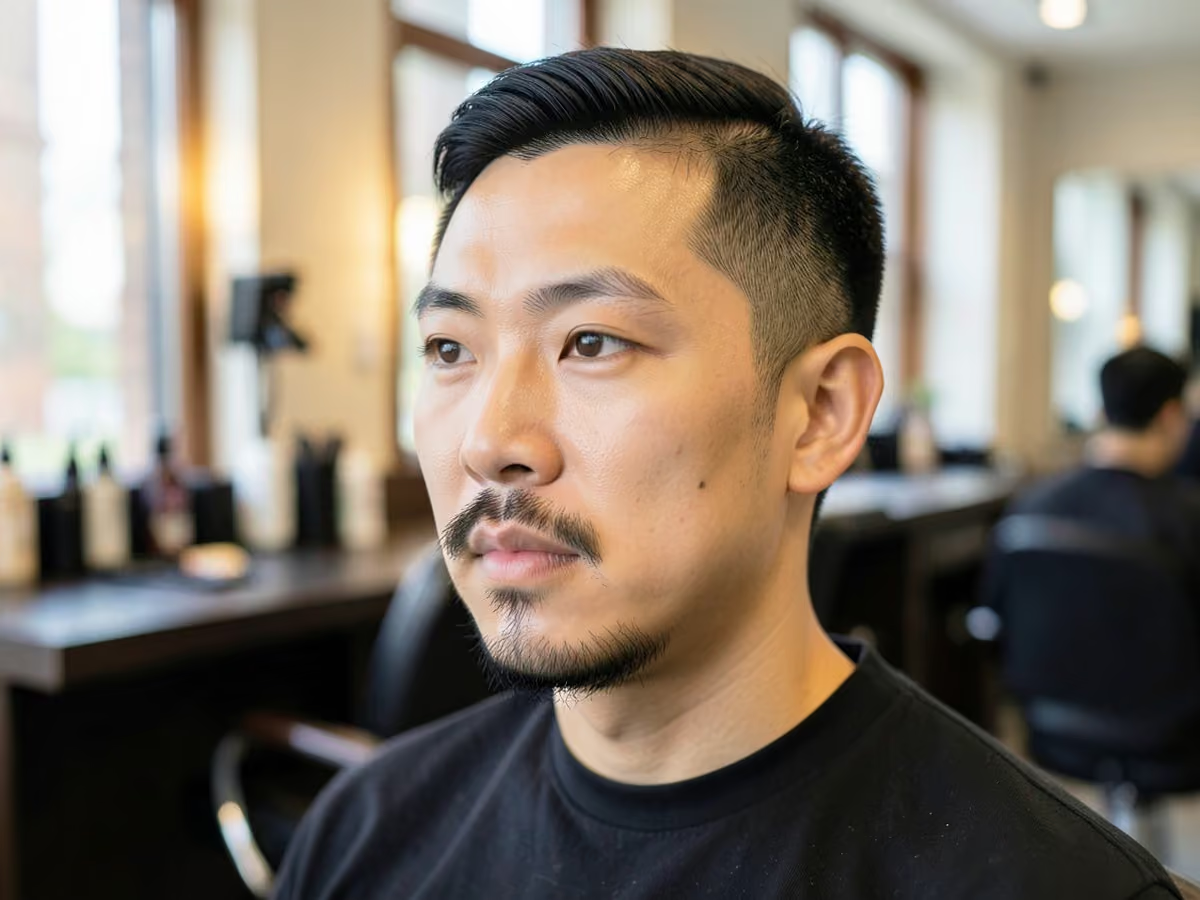
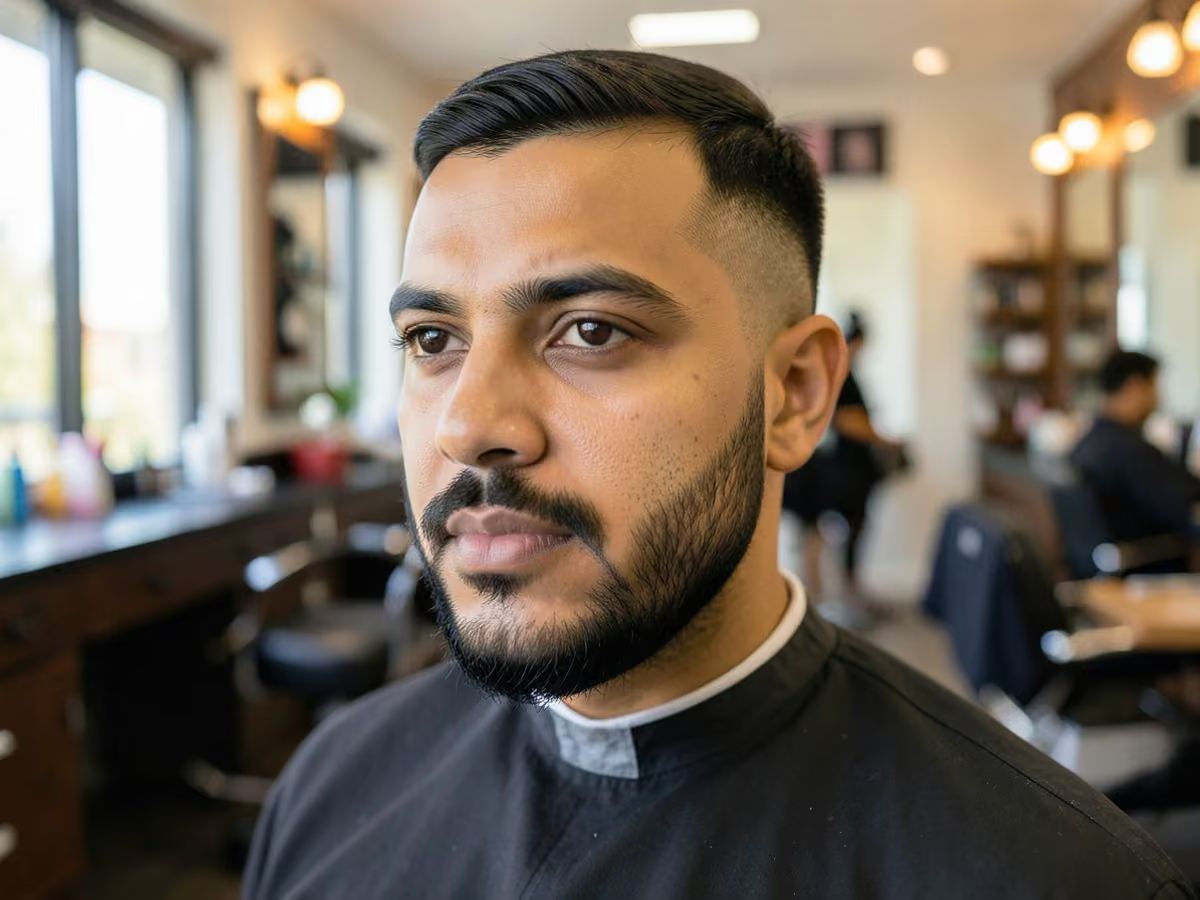
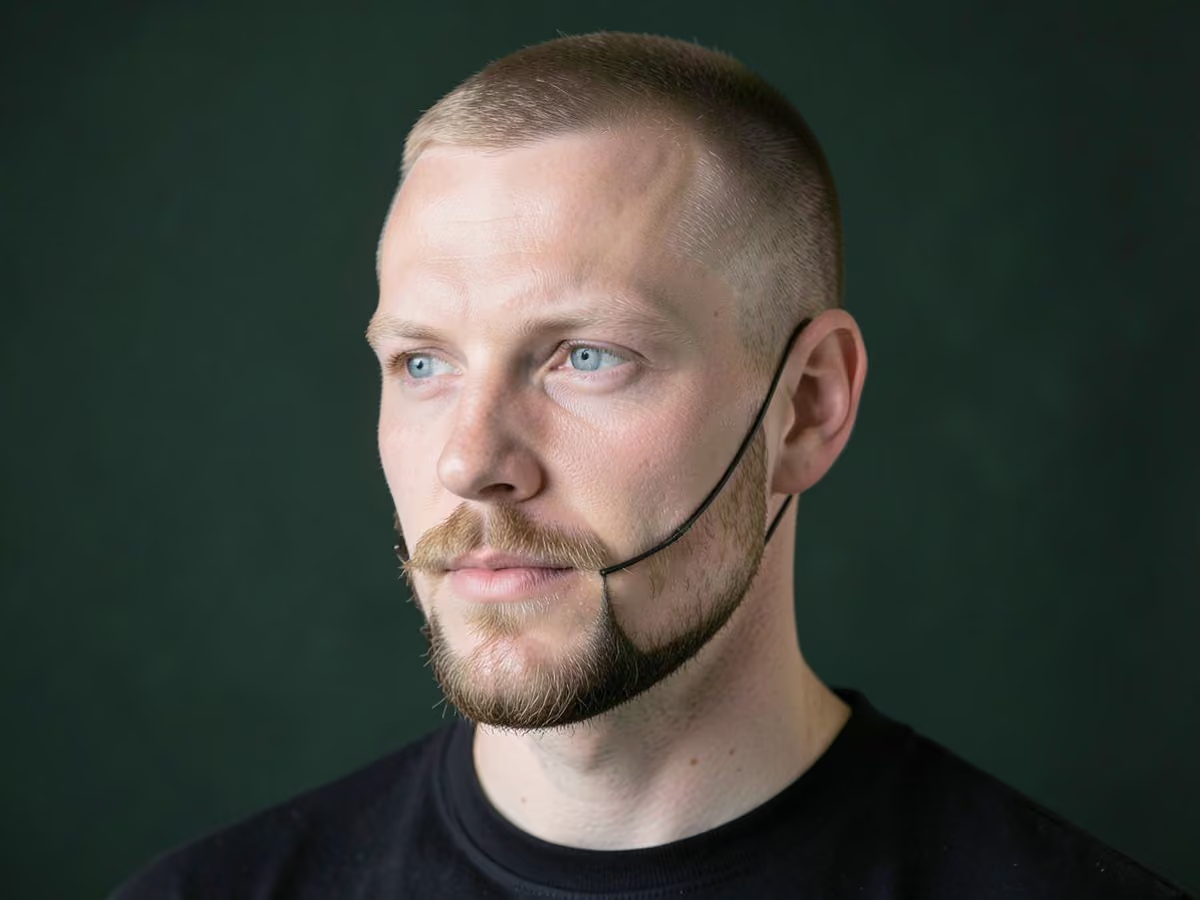
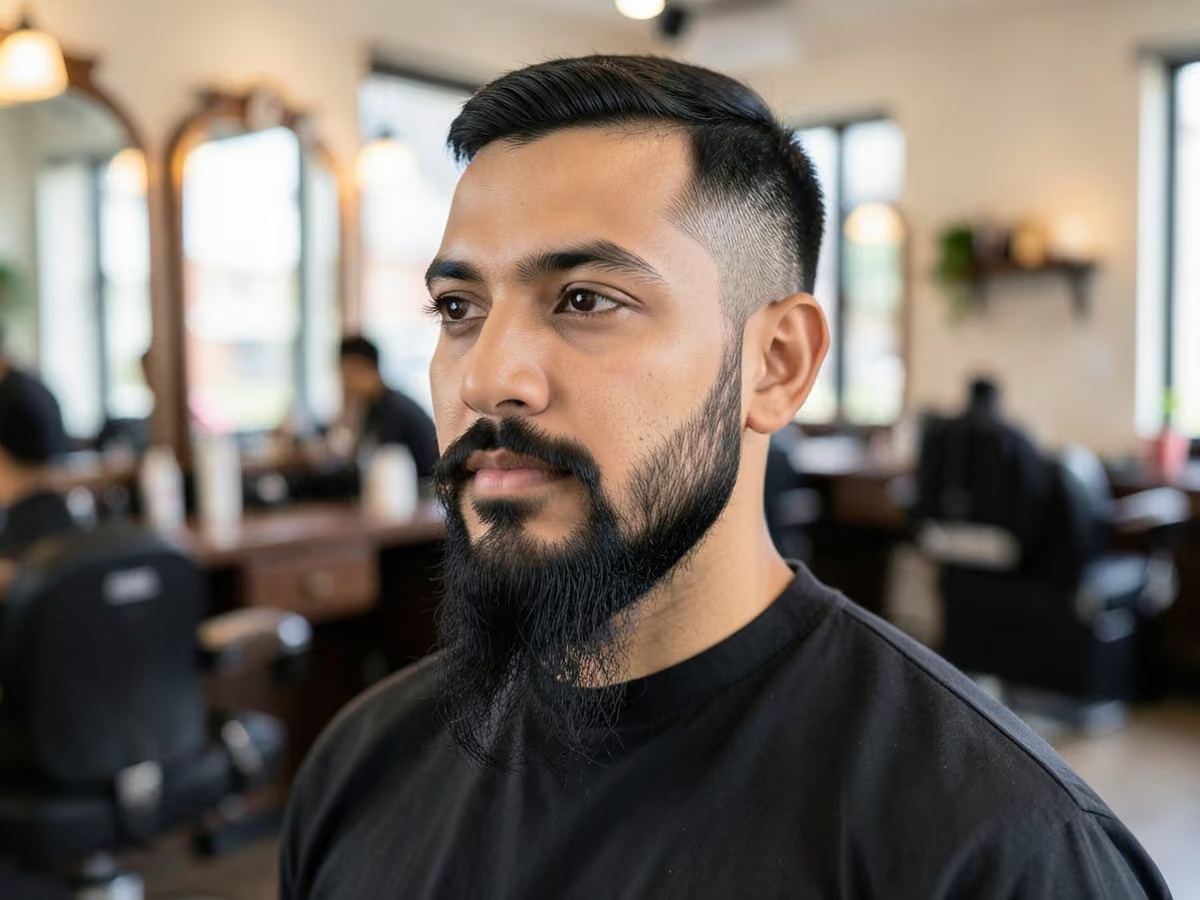
Quick answer: Goatee styles are beards kept on the chin with the cheeks shaved. A true goatee is chin hair only, while most people use the word for a chin beard joined to a mustache, called a full goatee or circle beard. Common types include the short goatee, extended goatee, Van Dyke, soul patch and chin puff.
Goatee Styles at a Glance
Every style on this page with its clipper guard, top length and trim interval. Tap a name to jump to that card.
Goatee styles keep the hair on and around the chin and shave the rest, which makes them one of the easiest beards to wear with patchy cheeks. The 25 types below differ by width, length, point or square bottom and whether the mustache connects, and each one lists the guard, trim schedule and words to use with your barber.
What Counts as a Goatee?
Strictly, a goatee is a tuft of hair on the chin only, like the beard on a billy goat, with the upper lip and cheeks shaved. In everyday use the word covers almost any chin beard with shaved cheeks, including ones joined to a mustache. Barbers usually call that joined version a full goatee or circle beard, and the version with a separate mustache a Van Dyke. Knowing which one you mean saves confusion in the chair.
What every goatee shares is the shaved cheek and jaw side. The width is set by the corners of the mouth, and the bottom can be rounded, squared or pointed. Length runs from stubble to several inches, and long goatees can be braided. Since cheek growth does not matter, the goatee is a common choice for men whose beard grows strongest around the mouth.
How Does a Goatee Differ From a Van Dyke, Balbo and Circle Beard?
These four shapes all keep hair on the chin and shave the cheeks, so they are easy to mix up. The difference is the mustache and how far the chin hair spreads along the jaw. The table compares them. If you want the full detail on the separated styles, our Van Dyke and Balbo guides cover cutting and upkeep step by step.
How Does a Goatee Differ From a Van Dyke, Balbo and Circle Beard?
Goatees add length and shape to the chin, so they work best on round, square and heart-shaped faces. A pointed or extended goatee lengthens a round face; a squared goatee gives a weak chin a firmer outline; a full goatee softens a wide, heavy jaw by drawing the eye inward. Long faces should keep the goatee short and wide rather than long and pointed, which only adds more length.
Growth pattern decides as much as face shape. If your cheeks are sparse but the chin and lip fill in, almost any goatee will look fuller than a full beard. If the chin is patchy but the lip is strong, a mustache style may suit better. The jawline guide matches beard outlines to bone structure if you want more detail before choosing.
Filter the styles
Showing all 25 styles
Fade
Hair
Length
Classic Goatee Styles
These are the core goatee shapes, set by width, length and bottom edge. All of them shave the cheeks and jaw sides, so they suit men whose growth is strongest around the mouth.
Trim:Every 2 weeks. The shaved lip and cheeks regrow first.
Best For:Round, oval faces + strong chin growth, weak lip.
About This Style
The original goatee is hair on the chin only, with the upper lip, cheeks and jaw sides shaved. It is usually no wider than the mouth and kept at a #3 to about an inch. Because there is no mustache, the eye goes straight to the chin, which adds length to a round face. It is a good choice when the mustache grows patchy or itchy.
How to Style at Home
Shave the upper lip and cheeks with the grain every one or two days.
Trim the chin hair with a #3 or #4 guard to keep it even.
Round the bottom edge with a detailer where it meets the neck.
Ask Your Barber
"Chin goatee only, no mustache, about as wide as my mouth and trimmed with a #4 guard, rounded at the bottom, everything else shaved clean."
Trim:Every 2 weeks. Cheek regrowth blurs the outline fast.
Best For:Square, oval faces + patchy cheeks, full lip and chin.
About This Style
What most people picture when they say goatee is this version: a mustache joined to a chin beard at the corners of the mouth, with the cheeks shaved. The outline is a little wider than the mouth and the bottom can be rounded or flat. Kept at a #3 to #5, it reads tidy enough for most workplaces and softens a heavy, square jaw by pulling focus inward.
How to Style at Home
Trim the whole goatee with a #4 guard once a week.
Shave the cheeks, leaving the corners of the mouth connected.
Brush the mustache down so it meets the chin hair evenly.
Ask Your Barber
"Full goatee at a #4, mustache connected at the mouth corners to the chin beard, slightly wider than my mouth, rounded bottom, cheeks and jaw sides shaved."
Trim:Every 1–2 weeks. Short hair shows uneven edges quickly.
Best For:Oval, heart faces + light or new facial hair.
About This Style
Trimmed close at a #1 to #2, the short goatee keeps the full goatee outline at stubble length. It looks clean in conservative workplaces and is an easy first step for men testing facial hair. The low length means edges must be sharp to read as a shape at all, so a detailer pass every few days helps. It also works on lighter or finer hair that looks thin when grown long.
How to Style at Home
Run a #1 or #2 guard over the goatee every three days.
Clean the outline with a detailer, moving away from the goatee.
Shave the surrounding skin and finish with a drop of oil.
Ask Your Barber
"Short goatee at a #2, mustache connected, sharp outline with the detailer, about as wide as my mouth, cheeks and neck shaved clean."
Trim:Every 2–3 weeks. Jaw edges need tidying between visits.
Best For:Round, square faces + full chin and jaw growth.
About This Style
Wider than a standard goatee, the extended version stretches along the jaw past the corners of the mouth, sometimes halfway to the ear, while the sideburns and upper cheeks stay shaved. It frames the lower face and gives a soft jaw more definition. Length is usually a #3 to 1/2 inch. It sits between a goatee and a full beard, so it suits men with good chin and jaw growth but thin upper cheeks.
How to Style at Home
Trim the goatee and jaw extensions with a #4 guard.
Shave a clean line where the extensions end on the jaw.
Brush the hair downward and finish with oil.
Ask Your Barber
"Extended goatee at a #4, mustache connected, chin beard running along my jaw about halfway to the ear, sideburns and upper cheeks shaved, clean neckline."
Trim:Every week. Tiny shapes need frequent edging.
Best For:Oval, long faces + any growth density.
About This Style
Just a small patch of hair below the lower lip, above the chin, makes up the soul patch. Everything else is shaved. It was linked with jazz musicians in the mid-20th century and turns up today with buzz cuts and fades. Keep it no wider than the gap between the lips' center and corners, about an inch, and short enough not to brush the lip when you talk.
How to Style at Home
Shave around the patch with a razor every day or two.
Trim the patch with a #2 guard or small scissors.
Square or round its outline with a detailer.
Ask Your Barber
"Soul patch only, about an inch wide under my lower lip, trimmed with a #2, squared at the bottom, everything else shaved clean."
Trim:Every 2 weeks. The rounded tuft needs regular shaping.
Best For:Long, oval faces + dense chin growth.
About This Style
Rounder and broader than a soul patch, the chin puff covers the chin itself without reaching the lower lip or connecting to a mustache. It is grown to about an inch and shaped into a small, rounded tuft. The puff adds a point of focus at the bottom of the face. Since it leaves the lip area clear, it suits men whose mustache grows unevenly but whose chin fills in well.
How to Style at Home
Shave the lip, cheeks and the area under the lower lip.
Brush the chin hair out slightly to build its rounded shape.
Snip stray hairs that break the curve with small scissors.
Ask Your Barber
"Chin puff, about an inch long and rounded on the chin only, not touching my lower lip, no mustache, cheeks and neck shaved clean."
Trim:Every 2–3 weeks. The point loses shape as it lengthens.
Best For:Round, square faces + full chin growth.
About This Style
Cut from the corners of the mouth down into a point one to two inches below the chin, this goatee adds length to a round or square face. The mustache can connect or float. Scissors over comb create the taper, and a small amount of balm holds the point through the day. It suits men with dense chin hair, since thin hair will not hold a defined tip.
How to Style at Home
Brush the chin hair straight down to find its center.
Twist a little balm into the hair to set the point.
Snip hairs on either side that widen the taper.
Ask Your Barber
"Pointed goatee, mustache connected, tapering from the corners of my mouth into a point about 1.5 inches below the chin, cheeks shaved clean."
Recommended Products
Beard Balm
Beard Brush
Goatee and Mustache Combinations
Change the mustache and the same goatee reads completely differently. These pairings keep the chin beard and vary the lip, from a thick chevron to a pencil line. The handlebar moustache guide covers growing longer mustache ends.
Trim:Every 2–3 weeks. Waxed tips need daily styling.
Best For:Oval, square faces + long, dense lip growth.
About This Style
Long mustache ends twisted and waxed out to the sides sit above a short chin goatee in this pairing. The mustache needs about two to three inches of length at the sides before the ends will curl. Keep the goatee short, a #3 to #4, so the eye goes to the handlebar. The horizontal line widens the face slightly, which suits oval and square shapes.
How to Style at Home
Comb the mustache out from the center to each side.
Twist stiff balm or wax into the ends and curl them upward.
Trim the goatee with a #3 guard so it stays below the curls.
Ask Your Barber
"Short goatee at a #3, separate from the mustache, and please leave the mustache ends long since I am growing a handlebar. Shave the cheeks clean."
Trim:Every 2 weeks. Keep the chevron off the top lip.
Best For:Square, round faces + thick, coarse lip growth.
About This Style
Thick, wide and angled down at the corners, a chevron mustache gives the goatee a heavier top half. The chin beard is kept at a #3 to #4 and often joins the mustache at the corners. Coarse, dense lip hair suits the chevron best. Trim it so it covers the top lip only slightly. The chevron moustache guide covers shaping the lip half.
How to Style at Home
Comb the mustache straight down over the lip.
Trim along the lip line with small scissors.
Brush the goatee down and shave the cheeks clean.
Ask Your Barber
"Full goatee at a #4 with a thick chevron mustache angled down at the corners and trimmed just over my top lip. Cheeks and neck shaved."
Trim:Every 2 weeks. The gaps at the mouth corners fill in fast.
Best For:Oval, round faces + gaps at the mouth corners.
About This Style
Separating the chin beard from the mustache with a small shaved gap at each corner of the mouth turns a full goatee into a disconnected one. Unlike a Van Dyke, the chin beard stays short and rounded instead of pointed. It suits men whose hair grows thin where mustache and chin would meet. The gaps need a razor every couple of days to look intentional.
How to Style at Home
Shave a small gap at each mouth corner with a detailer.
Trim the chin beard and mustache with the same guard.
Check in a mirror that both gaps match in width and height.
Ask Your Barber
"Disconnected goatee at a #3, rounded chin beard and mustache with a clean gap at each corner of my mouth, cheeks and neck shaved."
Trim:Every week. Pencil lines need detailing constantly.
Best For:Oval, long faces + fine, even lip growth.
About This Style
Narrowed to a thin line just above the lip, a pencil mustache gives the goatee below it a precise, old-Hollywood finish. The goatee can be a small chin goatee or a rounded full one at a #2 to #3. Fine, even lip hair shows the line best. Detailing the top edge of the mustache every two or three days keeps it from widening.
How to Style at Home
Shave the upper lip down to a thin line above the lip edge.
Trim the goatee with a #2 or #3 guard.
Detail the mustache edge and cheeks with a precision trimmer.
Ask Your Barber
"Small goatee at a #3 with a pencil mustache, a thin line right above my lip, separate from the goatee, everything else shaved clean."
Trim:Every 2 weeks. Thin curled tips need daily styling.
Best For:Long, oval faces + fine lip hair, long chin growth.
About This Style
Inspired by 17th-century French portraits, the Musketeer pairs a thin mustache with long, curled ends and a small pointed goatee that does not connect. The mustache is narrow over the lip but long at the sides, and the goatee is no wider than the soul patch area. It suits long and oval faces and works best with costume, theater or very groomed looks.
How to Style at Home
Comb the mustache ends outward and twist them with wax.
Brush the narrow goatee down and pinch it into a point.
Shave a clean gap between mustache and goatee.
Ask Your Barber
"Musketeer style, thin mustache with the ends left long for curling, a narrow pointed goatee under my lip, not connected, cheeks shaved clean."
Trim:Every 2 weeks. Squared edges need regular detailing.
Best For:Round, oval faces + strong chin, no soul patch growth.
About This Style
Squared and set on the chin with no soul patch beneath the lower lip, the Royale pairs that chin strip with a mustache whose ends are often lightly turned. The shaved gap under the lip gives it a cleaner, more formal look than a standard goatee. It is kept short, about a #3 to 1/2 inch. Round faces gain length from the vertical chin strip.
How to Style at Home
Shave the area under the lower lip clean.
Trim the chin strip into a square with a #3 guard.
Shape the mustache ends with a touch of balm.
Ask Your Barber
"Royale, a squared chin strip at a #3 with the soul patch area shaved, a separate mustache with the ends shaped, cheeks and neck shaved."
Recommended Products
Beard Balm
Goatee with Stubble, Fades and Edges
These versions add something around the goatee: stubble on the cheeks, a faded edge, a line up or a thin jaw strap. They suit men who want more coverage than a plain goatee but less than a full beard.
Trim:Every 1–2 weeks. Two lengths keep the shape visible.
Best For:Round, oval faces + medium growth, any texture.
About This Style
Rather than shaving the cheeks, this style trims them to 1 to 2 mm stubble while the goatee grows to a #3 or #4. The difference in length shows the goatee shape without bare skin around it, so it looks softer and needs less shaving. It also hides razor irritation. Round faces benefit, since the longer chin adds length while the shadow keeps the jaw defined.
How to Style at Home
Trim the cheeks and jaw at 1 to 2 mm with the trimmer comb.
Trim the goatee at a #3 or #4.
Shave only the neck below the neckline, leaving the cheek stubble alone.
Ask Your Barber
"Goatee at a #4, connected, with the cheeks and jaw cut to light stubble around it, about 1.5 mm, and the neck shaved one finger above my Adam's apple."
Trim:Every 2 weeks. The fade blurs as stubble grows.
Best For:Square, round faces + dense straight or coily growth.
About This Style
Barbers fade the cheek hair from bare skin near the ears up to the goatee's full length at the chin, so there is no hard edge. It is the facial hair version of a skin fade and pairs well with one. The gradient narrows a round or wide face. It needs a skilled barber and regular visits, since the fade turns into uneven stubble within two weeks.
How to Style at Home
Keep the goatee at a #4 with the trimmer between visits.
Shave only the neck at home and leave the fade to the barber.
Apply oil to the faded skin to calm it.
Ask Your Barber
"Goatee at a #4 with the cheeks faded from skin by the ear up into the goatee, no hard line, matched to the fade on my haircut."
Trim:Every 1–2 weeks. Crisp lines soften within a week.
Best For:Oval, round faces + coily or coarse, dark growth.
About This Style
Every edge of this goatee is cut into a crisp line with a trimmer, usually matched to a line up on the hairline. Dense, coily or coarse dark hair shows the contrast best. Length is often a #2 to #3 so the outline stays sharp. Outlining with a trimmer rather than a close blade reduces razor bumps, which are common where coily hair is shaved. See line-up vs edge-up for the hairline half.
How to Style at Home
Brush the goatee flat with a soft brush.
Outline the edges with a trimmer, keeping the angles matched on both sides.
Apply oil to the skin around the lines.
Ask Your Barber
"Goatee at a #3 with sharp lined edges done with the trimmer, not a close razor, connected mustache, and line up my hairline to match."
Trim:Every 1–2 weeks. Thin strap edges need constant upkeep.
Best For:Oval, long faces + even jaw growth.
About This Style
Linking a goatee to a thin strap that runs along the jaw to the sideburns gives this style its frame. The strap is usually 1/4 to 1/2 inch wide at a #1 or #2, while the goatee can be a little longer. It defines a soft jaw and suits oval faces. Keeping both sides of the strap level is the hard part, so trim in good light.
How to Style at Home
Trim the strap with a #1 and the goatee with a #3.
Shave above and below the strap so its width matches on both sides.
Check the line with your head tilted back.
Ask Your Barber
"Goatee at a #3 connected to a thin chin strap along my jaw up to the sideburns, strap about 1/2 inch wide at a #1, cheeks and neck shaved."
Trim:Every 2 weeks. Corners round off without detailing.
Best For:Round, heart faces + weak chin, good chin growth.
About This Style
Squaring the bottom of a full goatee into a flat edge with sharp corners gives a weak or narrow chin a firmer outline. The sides drop straight from the mouth corners and the bottom sits about half an inch below the chin. It suits round and heart-shaped faces that need structure at the base. A #4 or #5 guard gives enough length to hold the corners.
How to Style at Home
Trim the whole goatee with a #4 guard, working against the grain.
Cut the bottom straight across with a detailer.
Square each corner, then shave the cheeks clean.
Ask Your Barber
"Square goatee at a #4, mustache connected, sides straight down from my mouth corners, flat bottom with sharp corners about half an inch below my chin."
Trim:Every 2 weeks. Head and cheeks need shaving often.
Best For:Oval, round, square faces + bald or thinning hair.
About This Style
Shaving the head clean puts all the focus on the face, and a goatee gives that focus a shape. Most men pair a shaved head with a full goatee at a #3 to #5 or a pointed goatee for extra length. The facial hair helps balance a round head. Keep the goatee darker or thicker than the stubble on your head so it reads as a deliberate shape.
How to Style at Home
Shave the head and cheeks every one to two days.
Trim the goatee with a #4 guard once a week.
Moisturize the scalp and apply oil to the goatee.
Ask Your Barber
"Full goatee at a #4, rounded at the bottom, connected mustache, cheeks and neck shaved, and a clean head shave or a #0 all over."
Recommended Products
Beard Oil
Scalp Oil
Goatee Styles by Hair Type, Age and Face Shape
Texture, color and face shape change how a goatee should be cut. These versions adjust length, width and edges for coily hair, light growth, gray hair and round faces, plus two long options.
Trim:Every 2 weeks. Dense coily growth fills the edges quickly.
Best For:Round, oval, square faces + coily, dense growth.
About This Style
Coily facial hair grows dense and curls back toward the skin, so a goatee looks full even at a #2 to #3. Barbers usually outline it with a trimmer and avoid close shaving on the cheeks, since curly hair is prone to ingrown hairs and razor bumps. A full goatee with clean edges pairs well with a low fade or line up. Daily oil keeps the skin underneath calm.
How to Style at Home
Brush the goatee in one direction to lay curls flat.
Use a trimmer with no guard on the cheeks rather than a razor.
Massage oil into the skin under the goatee daily.
Ask Your Barber
"Full goatee at a #3, edges lined with the trimmer, cheeks taken down with the trimmer instead of a razor to avoid bumps, neckline above my Adam's apple."
Best For:Oval, round faces + fine, light or straight growth.
About This Style
Many men of East Asian descent grow straight, fine facial hair that is strongest on the chin and upper lip. A goatee suits that pattern well, since the cheeks are shaved anyway. Keep it short, around a #2 to #3, and slightly narrower than a full goatee so fine hair looks dense. A soft, rounded outline works better than sharp lines on lighter growth.
How to Style at Home
Trim with a #2 or #3 guard to keep the hair dense.
Round the outline lightly with small scissors rather than a hard line.
Shave the cheeks and finish with a little oil.
Ask Your Barber
"Short goatee at a #3, connected to the mustache, slightly narrower than a full goatee with a soft rounded outline, cheeks and neck shaved."
Trim:Every 2 weeks. Wiry gray hairs poke out of the outline.
Best For:Most face shapes + gray, white or mixed growth.
About This Style
Gray and white goatee hair is often coarser and grows at odd angles, so this style relies on frequent trims of stray hairs. A short to medium full goatee, a #3 to #5, with crisp edges shows the color well and adds definition to a softening jawline. It pairs with short gray haircuts; the silver fox guide has ideas.
How to Style at Home
Wash with a gentle cleanser to keep gray hair bright.
Brush and snip wiry hairs that stick out.
Apply a few drops of oil daily to soften the coarse texture.
Ask Your Barber
"Gray full goatee at a #4, clean defined edges, strays trimmed, slightly squared at the bottom to firm up my jaw, cheeks shaved."
Trim:Every 4–6 weeks. Only the ends and outline need cutting.
Best For:Round, square faces + dense chin growth.
About This Style
Reaching three inches or more below the chin, with bare cheeks, the long goatee hangs straight down and draws the face longer. It needs several months of growth and dense chin hair. A mustache is optional. Brush and balm keep it from fraying, and many men twist the end into a point. Long faces should skip it, since it adds more length.
How to Style at Home
Comb the goatee straight down from the chin.
Work balm through the length to stop frizz.
Trim split ends every few weeks with sharp beard scissors.
Ask Your Barber
"Long goatee, keep about 3 inches below my chin, just tidy the ends and outline, keep it as wide as my mouth and shave the cheeks clean."
Trim:Every 6 weeks. Even ends keep the braid neat.
Best For:Long, oval faces + long, thick chin growth.
About This Style
With four inches or more of chin hair, a goatee can be plaited into a single braid and tied at the end. The mustache is usually kept short so it does not compete. The braid keeps long chin hair tidy and suits Viking-style or rock looks. Braiding slightly damp hair with balm reduces frizz; undo it at night so the hair is not pulled constantly.
How to Style at Home
Brush the goatee out and work in a little balm so strands grip.
Split it into three sections and braid to the end.
Tie the end with a small band and trim any frayed hairs.
Ask Your Barber
"Keep the length on my goatee for braiding, just even out the ends, keep the mustache short and shave the cheeks and neck clean."
Trim:Every 2 weeks. The point and narrow sides need upkeep.
Best For:Round, wide faces + medium to dense chin growth.
About This Style
On a round face the goal is length, not width. That means a goatee no wider than the mouth, trimmed into a soft point about an inch below the chin, with the cheeks shaved clean. A neckline set below the jaw rather than on it keeps the chin from blending into the neck. Avoid circular outlines, which repeat the shape of the face.
How to Style at Home
Keep the sides of the goatee in line with your mouth corners.
Brush the chin hair down and shape a soft point with balm.
Shave the cheeks and keep the neck clean below the jaw.
Ask Your Barber
"Goatee no wider than my mouth, connected mustache, tapered into a soft point about an inch below the chin to lengthen my face, cheeks shaved."
Recommended Products
Beard Balm
Beard Brush
How Do You Ask Your Barber for a Goatee?
Give the barber four details: the width, the length, the bottom shape and the mustache. Width is easiest to describe against your mouth, for example lined straight down from the corners of the lips or slightly wider. Length can be a guard number for short goatees, where a #3 leaves 3/8 inch and a #4 leaves 1/2 inch, or inches below the chin for longer ones. Say if you want it rounded, squared or pointed, and whether the mustache connects.
Also mention the neckline under the chin and how clean you want the cheeks. Most goatees look best with the neck shaved to a line about one finger above the Adam's apple and the cheeks razor-clean. The neckline guide shows where that line sits. Bring a front photo, since goatee names change from shop to shop. If you are growing toward a longer shape, say so, and ask the barber to shape only the edges.
Clipper Guards Used in Goatee Styles
A clipper guard is the plastic comb that clips onto the blade and sets how much hair is left: a #1 leaves 3 mm (1/8 inch), each step up adds about 3 mm. The right column lists the cards on this page that call for each guard. See the full clipper guard numbers guide for the complete chart.
Shaving the cheeks and jaw is the daily job, since a goatee loses its shape as soon as stubble grows around it. Shave every one to two days, with the grain, and leave a small margin around the goatee rather than cutting into it. Once a week, run a trimmer with the right guard over the goatee itself to hold its length, and tidy the outline with a detailer. Trim when the hair is dry, since damp hair stretches and you will take off more than planned.
Goatee hair is often coarser than cheek hair, so a drop of beard oil each day keeps it soft and stops the skin underneath from itching. Longer goatees need a small amount of balm to hold a point or square bottom. The beard oil vs beard balm comparison explains which suits your length. A soft brush also trains the hair to lie in one direction.
What Goatee Mistakes Should You Avoid?
The most common mistake is making the goatee too narrow. Lines cut inside the corners of the mouth make the chin look small and the face look wider. Another is uneven sides: a goatee is small, so a difference of a few millimetres between the left and right edges shows at once. Check both sides in a mirror with your head straight before you finish.
Letting the cheeks grow in between shaves also blurs the shape, and a goatee that is far longer than the mustache can look unbalanced. Long faces should avoid long, pointed goatees. If your skin reacts to daily shaving, use a trimmer with no guard on the cheeks instead of a blade; how to prevent razor bumps has more tips. Finally, match the goatee to your haircut: sharp lines suit fades, softer outlines suit longer hair.
Which Goatee Style Is Right for You?
Pick your hair type and how much upkeep you will put in. The matches below come from the Best For and Maintenance notes on each card. Upkeep follows the Maintenance badge: low means a cut every 3 to 6 weeks and almost no daily styling, high means weekly line-ups or daily product.
Q1: What is the difference between a goatee and a Van Dyke?+
A goatee in the strict sense is hair on the chin only, while most people also use the word for a chin beard joined to a mustache. A Van Dyke has a pointed chin beard and a mustache that stays separate, with a clear gap at the corners of the mouth. Both shave the cheeks.
Q2: Which goatee style suits a round face?+
Pointed and extended goatees suit round faces best, because they add length below the chin and keep the sides narrow. A Van Dyke or a goatee trimmed to a point about an inch below the chin works well. Avoid wide, rounded goatees and circle beards, which repeat the curve of the face.
Q3: How long does it take to grow a goatee?+
A short goatee usually fills in within three to four weeks, since facial hair grows about half an inch a month. Longer pointed or braided goatees take two to six months. Grow the whole beard for the first few weeks before shaving the cheeks, so you can see where the chin hair grows thickest.
Q4: Should a goatee connect to the mustache?+
It depends on your growth and the look you want. A connected goatee, often called a full goatee or circle beard, looks fuller and works well in offices. A separate mustache, as in the Van Dyke or Balbo, looks more styled and helps when the hair at the corners of the mouth is thin.
Q5: How wide should a goatee be?+
Most goatees look best when the sides drop straight down from the corners of the mouth or sit a little wider. Narrower than the mouth makes the chin look small. Square or long faces can go slightly narrower, while round faces should avoid going much wider than the mouth.
Q6: How often should you trim a goatee?+
Shave the cheeks every one to two days to keep the outline, trim the goatee length with a guard about once a week, and see a barber every two to three weeks for a clean reshape. Long or braided goatees need a barber trim every four to six weeks.