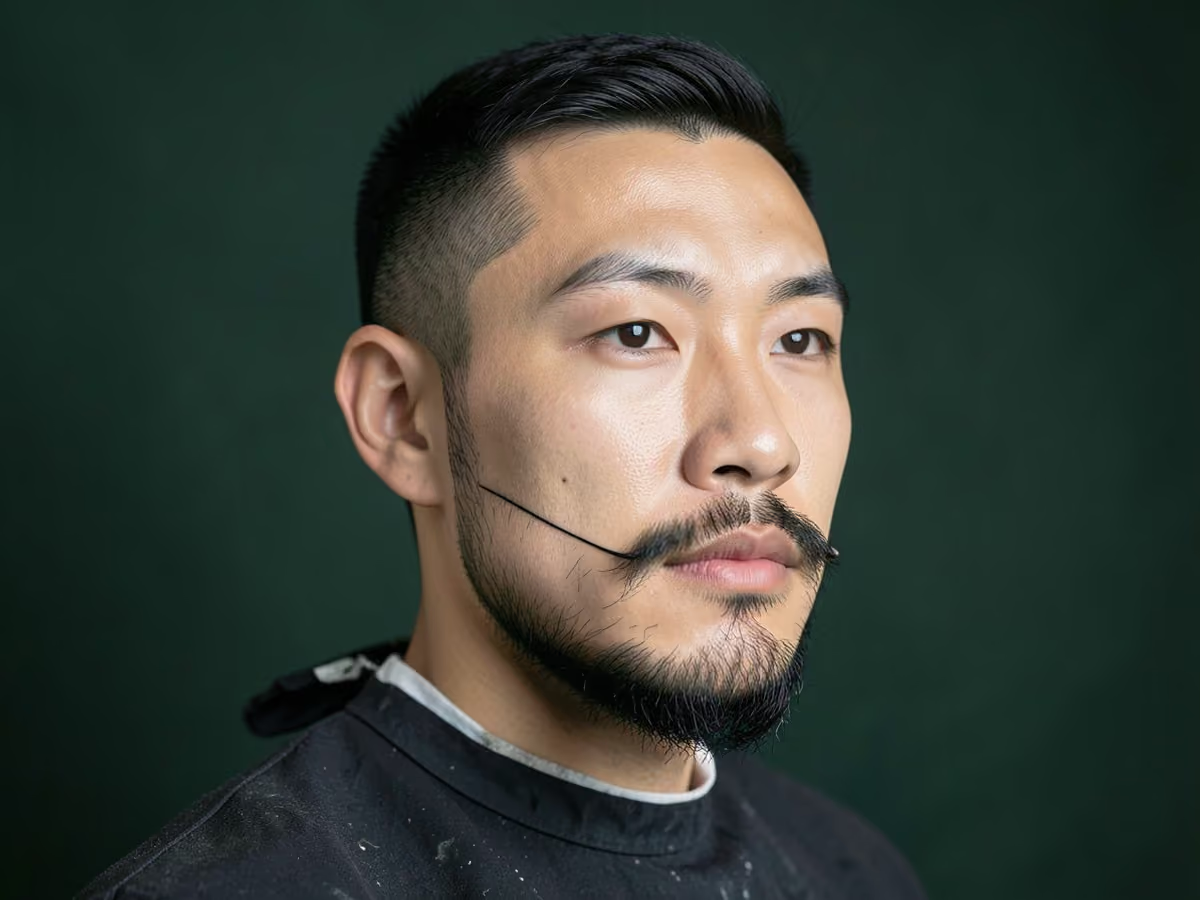
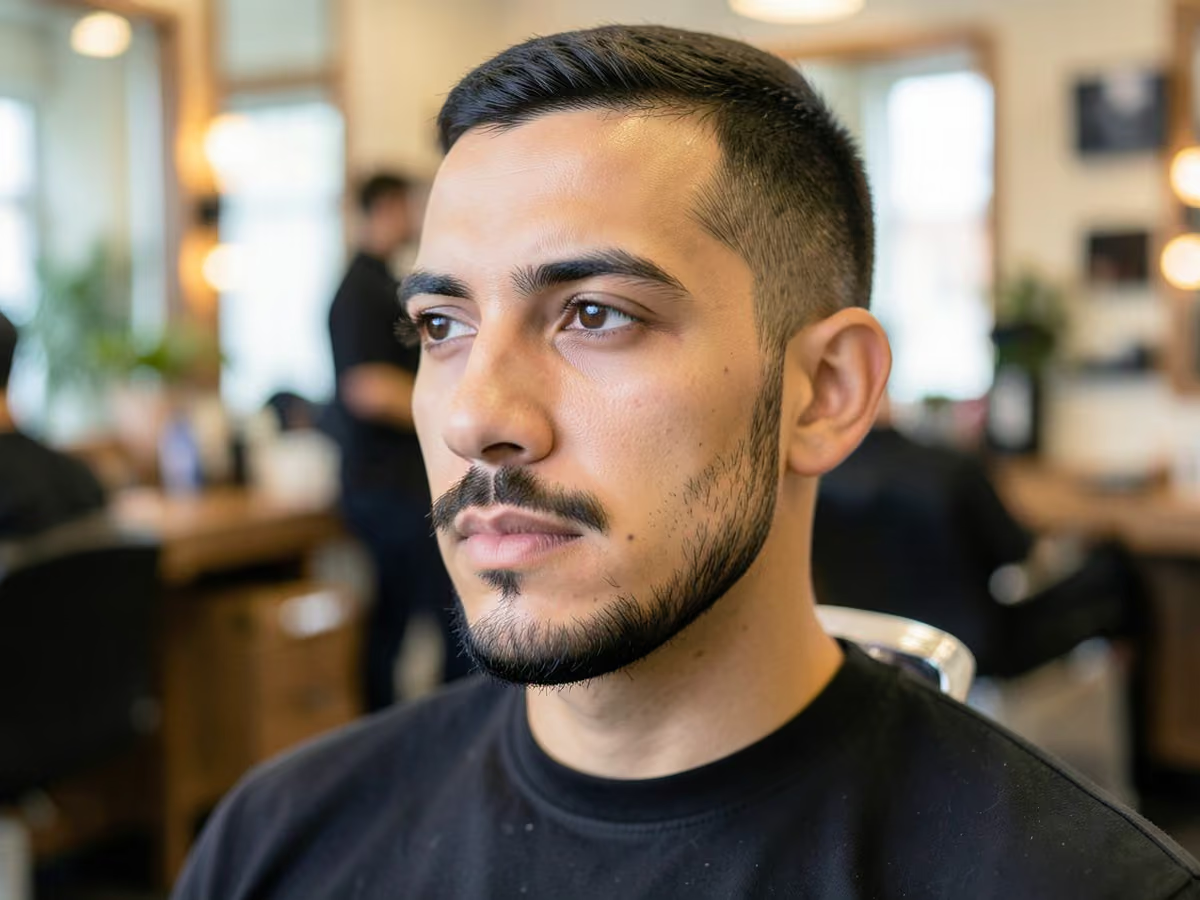
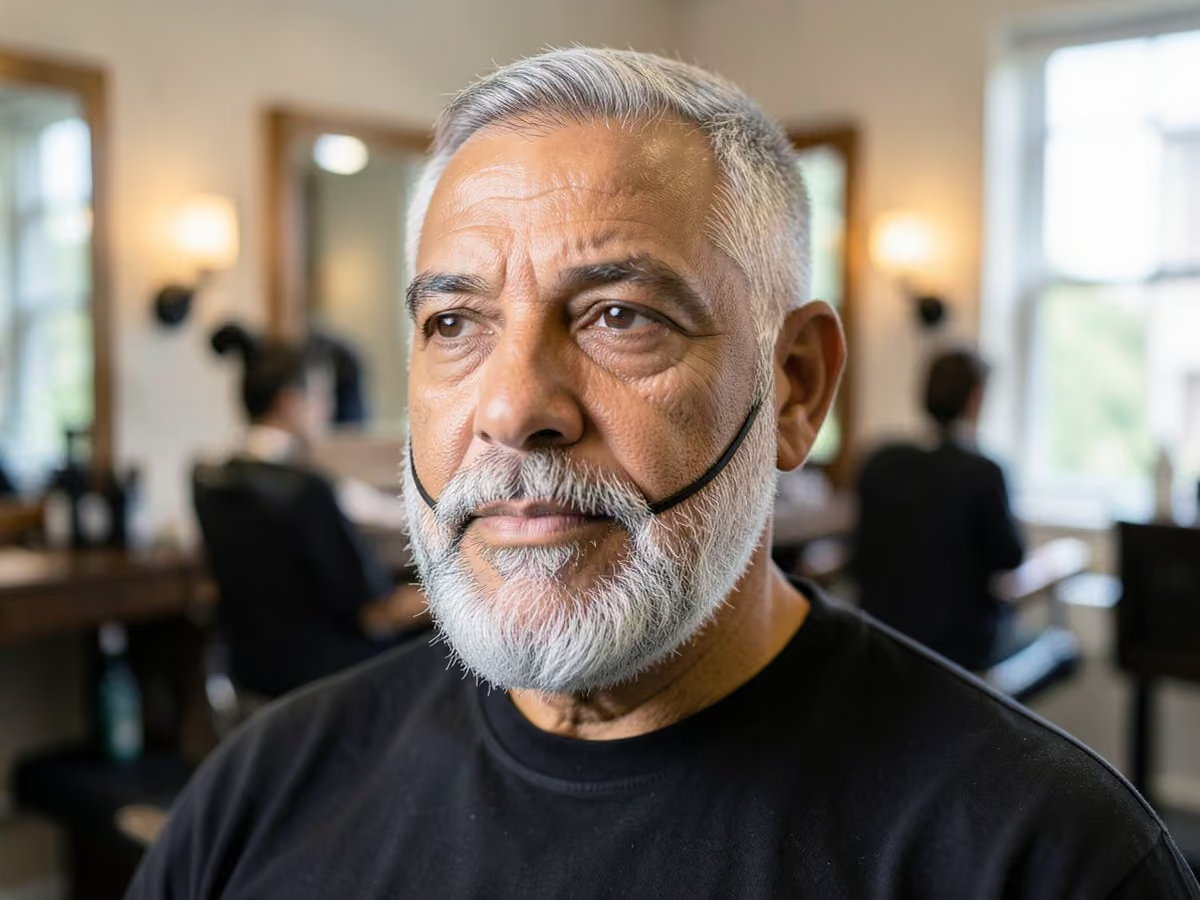
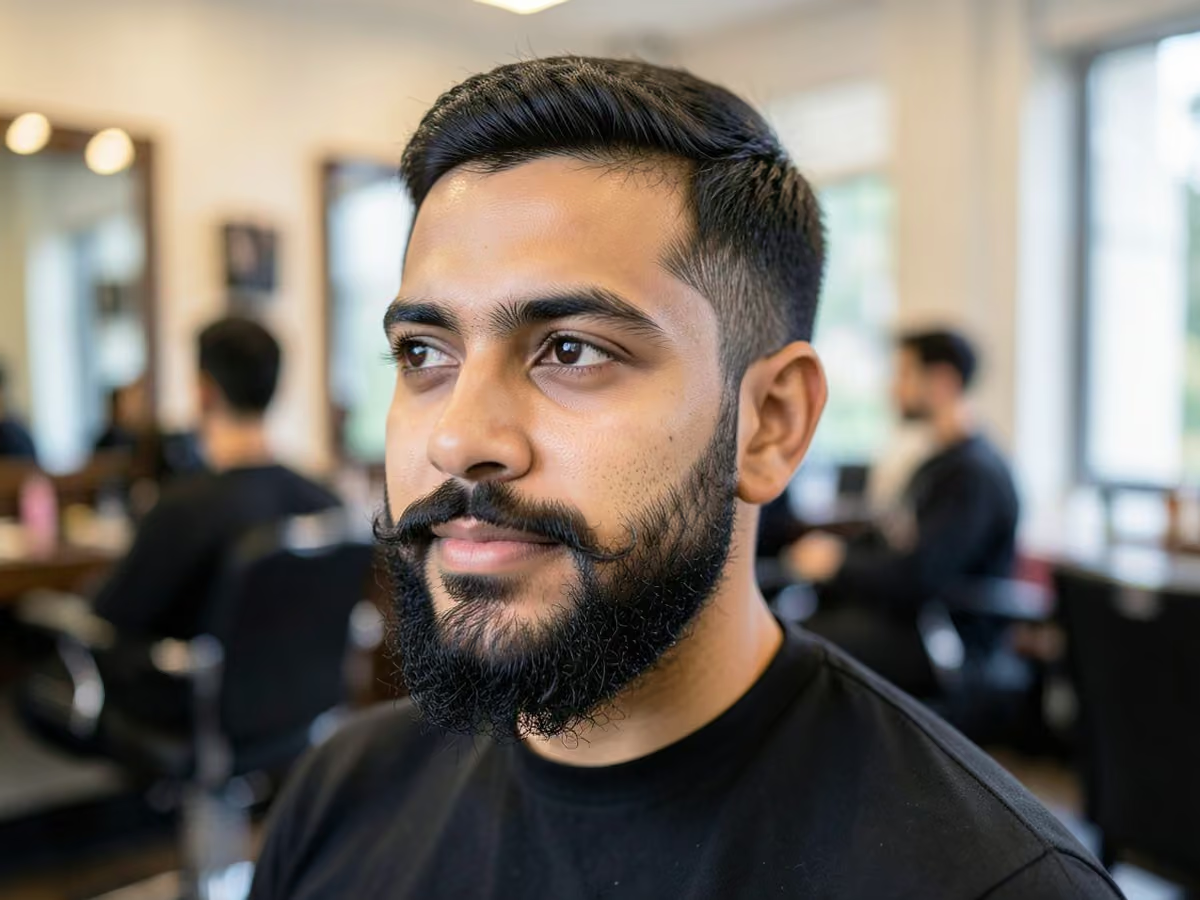
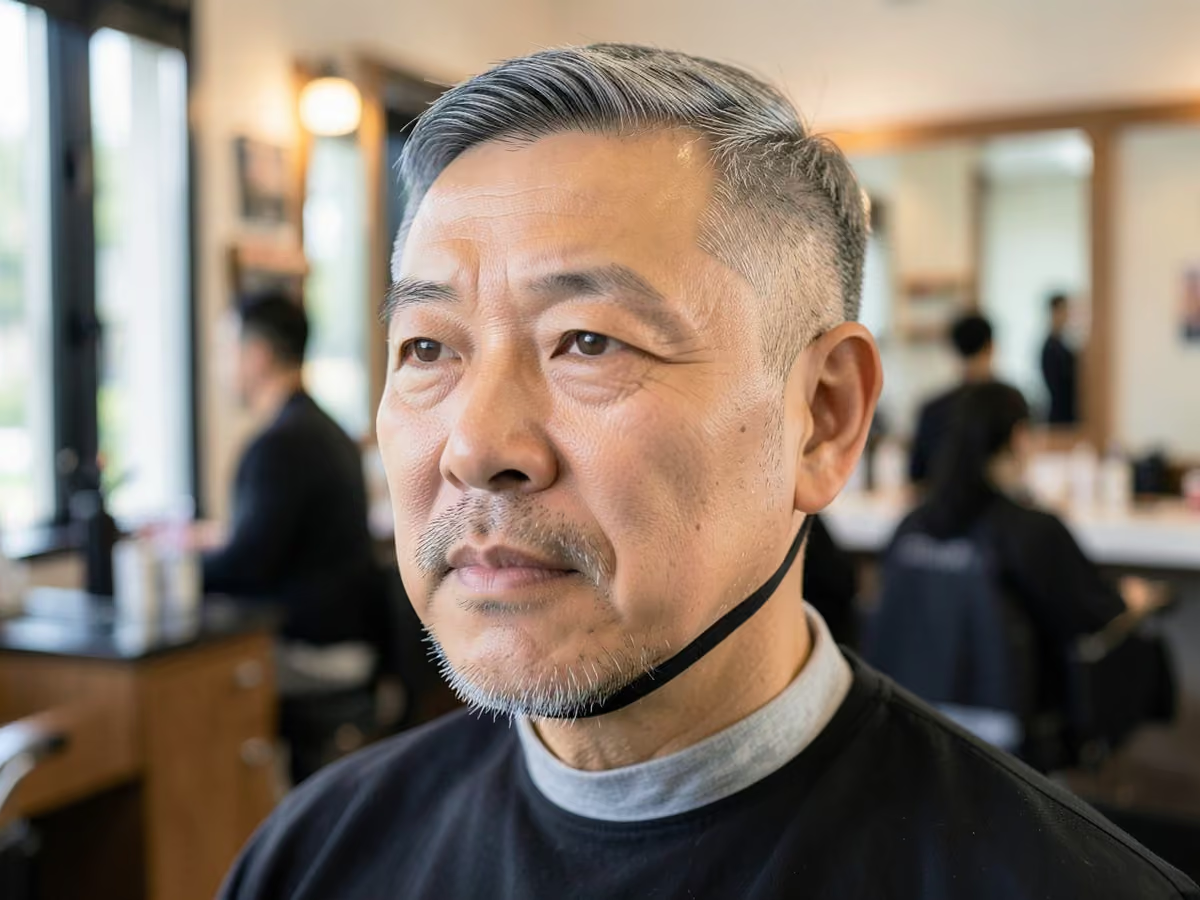
Quick answer: A chin strap beard is a narrow strip of facial hair that runs along the jawline from one sideburn, under the chin, to the other, with the cheeks and neck shaved clean. Most are 1 to 3 cm wide and trimmed to 3 to 6 mm long. Keeping the lines sharp means a touch-up every few days.
Chin Strap Beard Styles at a Glance
Every style on this page with its clipper guard, top length and trim interval. Tap a name to jump to that card.
A chin strap beard is all about lines. The hair itself stays short, but the edges above and below the band decide whether it looks precise or messy. The 15 styles below are grouped by width, by what you pair with it and by face, hair type and haircut, each with the band width, trim schedule and the request to make in the chair.
What Is a Chin Strap Beard?
A chin strap beard is a band of facial hair that follows the jawline from sideburn to sideburn and wraps under the chin, like the strap of a helmet. Everything above it on the cheeks and everything below it on the neck is shaved or trimmed close. The classic version has no mustache, though many men add one. The band is usually 1 to 3 cm wide and the hair inside it is kept short, between about 3 and 6 mm.
Because the area of hair is small, the whole style depends on two edges: the upper line across the cheek and the lower line under the jaw. Those lines need to be parallel, symmetrical on both sides and fresh. Even a few days of regrowth above or below the band blurs the shape, which is why the chin strap counts as a high-upkeep beard despite its short length.
How Does a Chin Strap Differ from a Chin Curtain or Pencil Beard?
The names overlap, and barbers use them loosely, so it helps to know the differences before you sit down. A chin curtain is the same jaw-following band without a mustache but usually grown longer, so it hangs below the chin like a fringe. A pencil line beard is a chin strap thinned to a few millimetres wide. A goatee, by contrast, keeps hair only around the mouth and chin and leaves the jaw bare.
When in doubt, describe the width in centimetres and the length in millimetres rather than relying on the name. That avoids ending up with a curtain when you wanted a strap. A phone photo taken from the side also helps, because the side view shows both the band width and where the lower line sits under the jaw, which is the part barbers most often place differently.
How Does a Chin Strap Differ from a Chin Curtain or Pencil Beard?
Style
Where the hair sits
Typical width
Hair length
Chin strap
Jawline, sideburn to sideburn
1 to 3 cm
3 to 6 mm
Pencil line beard
Jawline, sideburn to sideburn
Under 1 cm
1 to 3 mm
Chin curtain
Jawline and chin, often no mustache
2 to 4 cm
1 cm or more
Goatee
Chin and around the mouth only
Varies
3 mm to several cm
Who Suits a Chin Strap Beard?
A chin strap outlines the jaw, so it works best on faces where you want to add definition at the bottom. Round faces gain a visible edge, and oval faces can wear any width. Square faces with a strong jaw already have the line the strap draws, so a thin band works better than a heavy one. Long faces should keep the band narrow under the chin, since extra hair there lengthens the face. Our beard shapes by jawline guide goes deeper.
Growth pattern matters more than face shape. You need dense, even hair along the jaw and under the chin, because any gap in a narrow band is obvious. Men whose cheeks grow patchy often find a chin strap easier than a full beard, since the cheeks get shaved anyway. If your jawline growth is also thin, a stubble beard hides gaps more kindly.
Filter the styles
Showing all 15 styles
Fade
Hair
Length
Chin Strap Styles by Width and Line
Width and edge shape set the character of a chin strap. These five run from a narrow line to a heavy band, with curved, angular and faded variations of the outline.
Trim:Every week. A narrow band loses shape after two days.
Best For:Square, oval faces + dark, dense jaw growth.
About This Style
Kept about 1 cm wide, the thin chin strap traces the jaw with a single dark line. Hair inside the band sits at 3 mm so the edges stay crisp. It suits square and oval faces that already have a defined jaw, since the line follows rather than creates the angle. Dense growth is essential, because any gap in a strip this narrow shows from across a room. The cheek line and neckline both need cleaning every two to three days.
How to Style at Home
Trim the band to 3 mm with a short comb attachment.
Clean the cheek and neck edges with the bare trimmer blade, keeping 1 cm between.
Shave the bare skin with the grain and apply an alcohol-free balm.
Ask Your Barber
"Thin chin strap about 1 cm wide, hair at 3 mm, parallel lines from sideburn to sideburn following my jaw. Shave the cheeks and neck clean, no mustache."
Trim:Every 1–2 weeks. The wider band hides small edge regrowth.
Best For:Round, oval faces + medium or dense growth.
About This Style
At 2.5 to 3 cm wide with 5 to 6 mm of length, the thick chin strap carries more weight along the jaw and under the chin. It hides a soft jawline better than the thin version and tolerates small uneven patches at the edges. Round faces benefit, because the heavier band adds a clear frame at the bottom. Keep the cheek line straight rather than curving it up, or the band can start to look like a short boxed beard.
How to Style at Home
Trim inside the band with a 6 mm comb in the direction of growth.
Cut the upper line straight from sideburn to jaw corner at about 3 cm.
Brush a small amount of beard balm through to keep the hairs flat.
Ask Your Barber
"Thick chin strap around 3 cm wide, hair at 6 mm, straight upper line on the cheeks and a curved neckline two fingers above my Adam's apple."
Trim:Every week. Curves need recutting before they flatten out.
Best For:Square, diamond faces + straight or wavy growth.
About This Style
Instead of straight edges, both lines on this strap follow a gentle arc that swells slightly at the chin and narrows toward the ears. The curve softens strong angles, which is why square and diamond faces suit it. It is harder to cut than a straight band, so most men have a barber set the shape once and then follow the existing edge at home. Hair length stays at 3 to 4 mm to keep the arc readable.
How to Style at Home
Follow the existing curve with the trimmer edge, tilting it slightly.
Work from the chin outward on each side so both arcs match.
Apply beard oil and check the curve from both profiles.
Ask Your Barber
"Curved chin strap about 2 cm at the chin, narrowing to 1.5 cm at the sideburns, both edges softly arched. Hair at 4 mm, cheeks and neck shaved."
Trim:Every week. Sharp corners blur first at the jaw angle.
Best For:Round, oval faces + dark, coarse growth.
About This Style
Straight lines and a visible corner at each jaw angle give this strap a geometric outline. The band turns sharply where the jaw meets the neck rather than flowing in a curve, which gives round faces an angle they do not naturally have. Corners read most clearly in dark, coarse growth. Barbers usually cut it with a trimmer edge and finish with a razor. It looks best when matched with a sharp line-up on the hairline.
How to Style at Home
Set the band length at 4 mm with a comb attachment.
Cut straight segments along the cheek and jaw, meeting at a clear corner.
Brush the edges with an edge brush to see any stray hairs.
Ask Your Barber
"Angular chin strap, 2 cm wide, straight lines along the cheek and jaw with a sharp corner at each jaw angle. Razor finish on the edges, hair at 4 mm."
Trim:Every 1–2 weeks. The fade at the sideburns softens first.
Best For:Oval, round faces + any growth with a fade haircut.
About This Style
Here the band is longest under the chin, around 6 mm, and fades down to stubble length as it climbs toward the ears. The sideburns then blend into the shortest guard of the haircut. That gradient removes the hard break between hair and beard and makes the strap look part of the haircut. It is a common finish on a skin fade, where a solid band meeting bare skin can look abrupt.
How to Style at Home
Trim the chin section at 6 mm and the jaw corners at 4 mm.
Use 2 mm near the ears, flicking outward to blend each step.
Clean both edges and moisturize the faded skin.
Ask Your Barber
"Faded chin strap: 6 mm at the chin, 4 mm along the jaw and down to 2 mm at the sideburns, blended into my fade. Shave the cheeks and neck."
Recommended Products
Beard Oil
Chin Strap with Other Facial Hair
Adding or removing small pieces around the mouth changes the strap more than any width adjustment. These five pair the band with a mustache, soul patch, stubble or a break at the chin.
Trim:Every week. Mustache and band edges both need cleaning.
Best For:Long, narrow faces + full mustache growth.
About This Style
Adding a mustache puts weight in the middle of the face, which shortens long or narrow faces visually. The mustache can float on its own or connect to the strap with thin lines at the corners of the mouth. Keep both at the same length, about 4 mm, so they read as one style. This is the version most men wear day to day, since a shaved upper lip with a strap can look severe on some faces.
How to Style at Home
Trim the mustache and strap together at 4 mm.
Shave a clean gap between them or leave a thin connecting line.
Snip the mustache along the lip line with small scissors.
Ask Your Barber
"Chin strap 2 cm wide with a mustache at the same 4 mm length, connected at the mouth corners with a thin line. Cheeks and neck shaved clean."
Trim:Every week. The small patch needs edging on all sides.
Best For:Oval, long faces + dense chin growth.
About This Style
A small soul patch below the lower lip sits inside the strap's frame without touching it. The contrast of a bare chin area around a dot of hair adds detail without adding bulk. Keep the patch small, roughly the width of the lower lip, or it starts to read as a goatee. It suits oval and long faces. Expect extra work, since the skin around the patch and the strap both need shaving every few days.
How to Style at Home
Trim the strap and the soul patch to 3 or 4 mm.
Shave the skin around the patch with the grain, leaving a clear gap.
Square the patch edges with the trimmer corner.
Ask Your Barber
"Thin chin strap about 1.5 cm wide, hair at 3 mm, plus a small soul patch under my lower lip, not connected. Shave everything else clean."
Trim:Every week. The gaps fill in and close up quickly.
Best For:Square, oval faces + dense growth with strong lines.
About This Style
Two short breaks, usually where the sideburns meet the jaw or on either side of the chin, split the strap into segments. The gaps are a few millimetres wide and shaved clean. It is a more styled take on the strap and works best with sharp, dark growth. Men with a thin spot on one side of the jaw sometimes use the break to hide it on purpose. Keep the gaps symmetrical, or the break looks accidental.
How to Style at Home
Trim the full strap first at 3 to 4 mm.
Mark matching gaps on both sides with the trimmer corner.
Shave each gap with a razor and keep them equal in width.
Ask Your Barber
"Chin strap 2 cm wide with a clean gap on each side where the sideburns meet the jaw, about half a centimetre. Hair at 3 mm, sharp edges."
Trim:Every 1–2 weeks. The band outgrows the stubble around it.
Best For:Round faces + patchy cheeks with dense jaw growth.
About This Style
Rather than shaving the cheeks bare, this version leaves them at 1 mm stubble while the band along the jaw grows to 5 or 6 mm. The difference in length creates the strap outline without razor lines, so it is gentler on skin that bumps after shaving. The softer contrast suits men who want definition without the stark look of a classic strap. Patchy cheeks blend into the shadow, while the denser jaw growth stays visible.
How to Style at Home
Trim the cheeks and upper lip at 1 mm with a short comb.
Switch to a 6 mm comb and trim only the jaw band.
Clean the neck below the band with the trimmer, no razor.
Ask Your Barber
"Chin strap at 6 mm along the jaw with the cheeks and lip at 1 mm stubble instead of shaved. Neckline two fingers above the Adam's apple, trimmer only."
Trim:Every 1–2 weeks. Sideburn blend and fade regrow together.
Best For:Oval, round faces + any texture with a fade.
About This Style
The strap stays full along the jaw, but the sideburns above it are faded from the strap's length down to skin at the temple. The result connects the beard to a mid or high fade, with no solid patch left in front of the ear. It is popular in barbershops that cut a lot of fades, since the same clippers do both jobs. Book trims every week or two so the haircut and the sideburn fade grow out at the same pace.
How to Style at Home
Keep the strap at 4 mm with a comb attachment.
Fade the sideburns from 4 mm down to the bare blade near the temple.
Moisturize the faded skin and check both sides match.
Ask Your Barber
"Give me a chin strap at 4 mm, 2 cm wide, with the sideburns faded from beard length down to skin into a mid fade. Clean cheek line and neckline."
Recommended Products
Beard Oil
Scalp Oil
Chin Strap by Face Shape, Hair Type and Haircut
Face shape and hair texture change how wide the band should be and how it is cut. These five cover round faces, coily and curly growth, and two haircuts the strap pairs with often.
Trim:Every week. Chin length must stay ahead of the cheeks.
Best For:Round, full faces + medium or dense growth.
About This Style
To lengthen a round face, the band stays narrow along the cheeks, about 1.5 cm, and widens and lengthens at the chin to 6 or 7 mm. The extra length below the mouth pulls the eye downward. Angled lines along the jaw add the edge a round face lacks. Pair it with a haircut that has some height on top, such as a quiff or textured crop, as our round face haircuts guide suggests.
How to Style at Home
Trim the cheek sections at 4 mm and the chin at 7 mm.
Keep the band narrow along the cheeks and widen it slightly under the chin.
Brush the chin hair downward and apply a little beard balm.
Ask Your Barber
"Chin strap narrow on the cheeks, about 1.5 cm, widening at the chin. Cheeks at 4 mm and chin at 7 mm, angled lines along the jaw, neck shaved."
Trim:Every week. Coily regrowth softens the line-up fast.
Best For:Any face shape + coily or tightly curled growth.
About This Style
On coily facial hair, the strap usually gets a crisp line-up with clippers or a trimmer edge, then a light brush to lay the hair flat. Many barbers leave a slight guard length on the neck instead of shaving to skin, which lowers the chance of bumps. If bumps keep returning, a dermatologist can check for pseudofolliculitis barbae and advise on shaving. The band often connects to a line-up on the hairline for a matched finish.
How to Style at Home
Brush the band in one direction with a soft beard brush.
Edge the lines with the trimmer, avoiding razors on bump-prone skin.
Rub in beard oil and brush again to lay the coils flat.
Ask Your Barber
"Let's go with a chin strap at 4 mm, lined up with the trimmer, not a razor. Leave a short guard on the neck. Connect the sideburns to my line-up."
Trim:Every 1–2 weeks. Curls hide uneven length for a while.
Best For:Oval, round faces + wavy or curly growth.
About This Style
Curly beard hair shrinks as it dries, so the band is cut a little longer, 6 to 8 mm, to keep the same visible width. The edges are softer than on straight hair because curls fall over the line, which some men prefer. Trim dry and stretched with a comb, not wet. A leave-in or balm reduces frizz at the edges. This version grows out gracefully and suits men who cannot line it every few days.
How to Style at Home
Comb the curls straight before trimming at 7 mm.
Cut the edges with the hair dry and slightly stretched.
Work a small amount of beard balm through to set the curls.
Ask Your Barber
"Curly chin strap about 2.5 cm wide, hair at 7 mm cut dry. Soft edges rather than a razor line, neckline two fingers above my Adam's apple."
Trim:Every 2–3 weeks. The taper grows out softly with the strap.
Best For:Oval, square faces + straight or wavy hair.
About This Style
A taper fade only shortens the hair at the sideburns and nape, so it matches the clean outline of a strap without a high block of skin. The sideburn tapers down to the strap's length and the band continues along the jaw. It is a low-key pairing that suits offices and grows out evenly over two to three weeks. The top can be any length, from a short crop to a side part.
How to Style at Home
Trim the strap at 4 mm and the sideburns to match.
Clean the cheek and neck edges with the trimmer blade.
Style the top with a matte paste and leave the taper untouched.
Ask Your Barber
"Low taper at the sideburns and nape, sideburns blended into a 4 mm chin strap about 2 cm wide. Keep the top long enough for a side part."
Trim:Every 2–3 weeks. Both the strap and crew cut need edging.
Best For:Square, round faces + straight or thick hair.
About This Style
A crew cut keeps the top short and the sides shorter still, so a chin strap adds the only clear line on the face. Barbers usually leave a #2 or #3 on the sides with a #4 to #6 on top and match the sideburns to the strap. The whole look needs almost no styling. It suits square jaws, and on round faces the strap provides the edge the short haircut cannot.
How to Style at Home
Push the crew cut top forward with a little matte clay.
Trim the strap at 4 mm and clean the edges with the bare blade.
Moisturize the neck after shaving below the band.
Ask Your Barber
"Crew cut with a #3 on the sides and #5 on top, sideburns blended into a chin strap at 4 mm, 2 cm wide. Square the neckline at the back lightly."
Recommended Products
Matte Clay
Beard Oil
How Do You Ask Your Barber for a Chin Strap?
Give the band width, the hair length and how the edges should be finished. A clear request sounds like this: chin strap about 2 cm wide, hair inside trimmed to 4 mm, upper line straight from the sideburn to the corner of the jaw, lower line following the jaw two fingers above the Adam's apple, cheeks and neck shaved. Tell the barber if the mustache should be kept, removed or connected at the corners of the mouth.
If the strap should blend into a fade, ask for the sideburns to step down to match the shortest guard on the sides. Many barbers finish the edges with a straight razor; if your skin bumps after a close shave, ask for a trimmer finish instead. The line-up vs edge-up guide explains the edge options and which one grows out more cleanly on coarse hair.
Clipper Guards Used in Chin Strap Beard Styles
A clipper guard is the plastic comb that clips onto the blade and sets how much hair is left: a #1 leaves 3 mm (1/8 inch), each step up adds about 3 mm. The right column lists the cards on this page that call for each guard. See the full clipper guard numbers guide for the complete chart.
Grow a short beard for two to three weeks first, so you have enough hair to choose the band from. Then work in this order, in good light and in front of a mirror you can see both sides in. A trimmer with a narrow detail head makes the lines far easier to control than a wide clipper blade, and a hand mirror helps you check the band under the chin, which is the part most men miss.
Set the length
Trim the whole beard to the length you want inside the band, usually 3 to 6 mm, before cutting any lines. Short, even hair makes the edges easier to see.
Cut the lower line
Find the point two fingers above the Adam's apple and trace a curve back to just behind each earlobe, as in our neckline guide. Remove everything below it with the trimmer.
Cut the upper line
Measure the band width up from the lower line at the chin, then run the upper line parallel to it along the jaw toward the sideburn. Shave the cheek above it.
Check symmetry
Compare where each line meets the sideburn and the corner of the jaw on both sides. Fix the wider side, not the narrower one.
Finish and soothe
Shave the bare areas with the grain and apply an alcohol-free balm or beard oil. If you get bumps on the neck, our razor bump guide covers prevention.
What Chin Strap Mistakes Should You Avoid?
The biggest one is cutting the band too thin on the first attempt. A narrow strap can always be made thinner, but a gap in the line takes a week or more to fill in. Another is following the jawbone with the lower line, which places the band on the face instead of the neck and makes the chin look weak. Uneven lines are the third: the strap is so narrow that a few millimetres of difference between sides is easy to spot.
Skipping touch-ups is the last common error. Stubble above and below the band appears within two or three days, and once it does the strap loses its outline. Plan to clean both edges every three days and recut the lines properly once a week, either at home or with a quick barber visit. A five-minute edge-up between full trims is enough to keep the outline sharp.
Which Chin Strap Beard Is Right for You?
Pick your hair type and how much upkeep you will put in. The matches below come from the Best For and Maintenance notes on each card. Upkeep follows the Maintenance badge: low means a cut every 3 to 6 weeks and almost no daily styling, high means weekly line-ups or daily product.
Most chin straps are 1 to 3 cm wide. A band under 1 cm reads as a pencil line beard, while anything wider than about 3 cm starts to look like a short boxed beard with shaved cheeks. Start wider than you want and narrow it over a few trims until it suits your face.
Q2: Does a chin strap beard include a mustache?+
The classic chin strap has no mustache, so the upper lip is shaved and only the jaw band remains. Many men add one, either separate from the strap or connected at the corners of the mouth. A mustache adds weight to the middle of the face and suits long or narrow faces well.
Q3: How long does it take to grow a chin strap?+
Two to three weeks of growth is usually enough to shape one, since the hair inside the band is kept short. Growing a little longer gives you more choice about where to place the lines. Men with slow growth along the jaw may need four weeks for the band to look solid.
Q4: How often do you need to trim a chin strap?+
Clean the shaved areas above and below the band every two to three days, and recut the lines about once a week. The hair inside the band needs a trim with a comb attachment every week or two. The edges are what show regrowth first.
Q5: Is a chin strap good for a round face?+
Yes, if it is kept narrow on the cheeks and slightly longer at the chin. That combination adds a visible edge under the jaw and draws the eye downward, which makes a round face look longer. Avoid a wide band along the cheeks, which can add width.
Q6: What is the difference between a chin strap and a chin curtain?+
Both follow the jaw from sideburn to sideburn. A chin strap is kept short and narrow, usually under 6 mm long and about 1 to 3 cm wide. A chin curtain is grown longer, often an inch or more, so it hangs below the chin, and it is traditionally worn without a mustache.