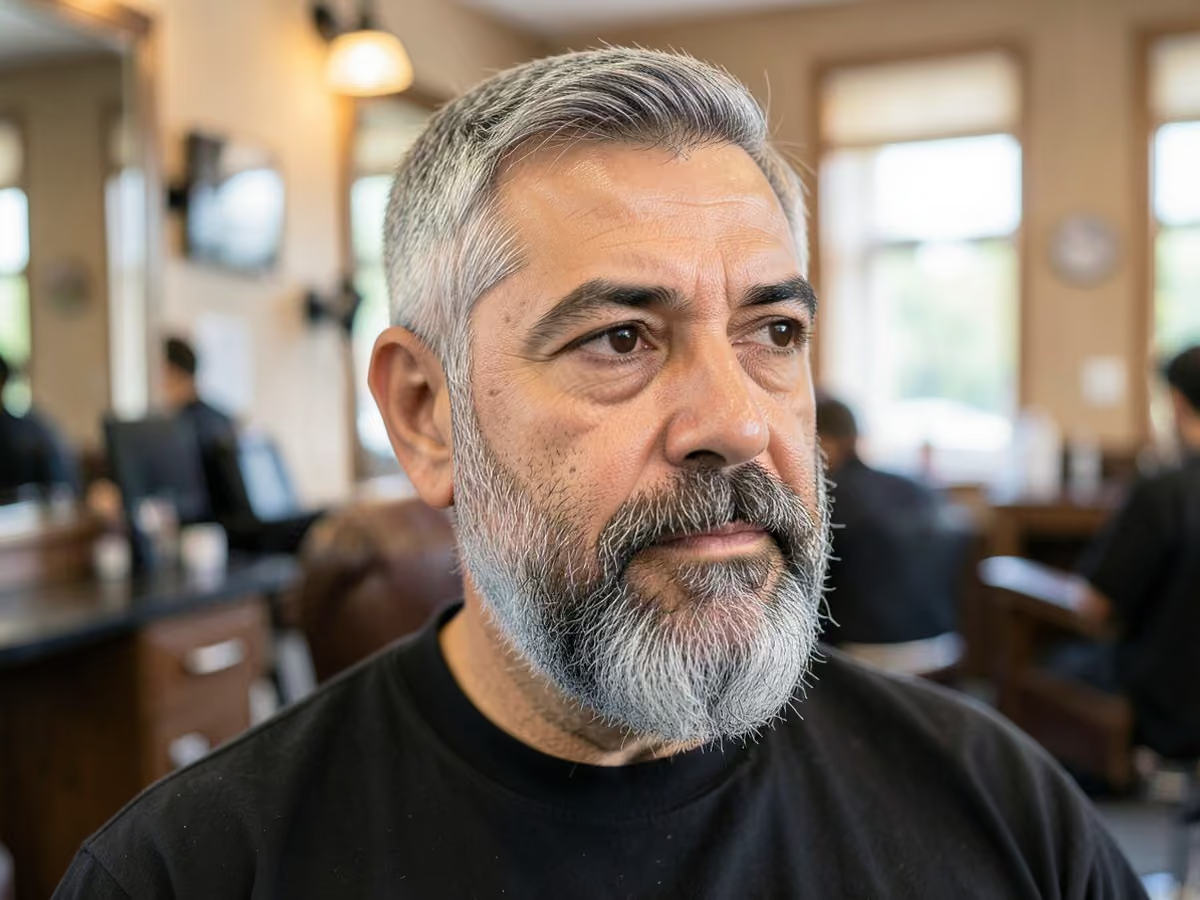
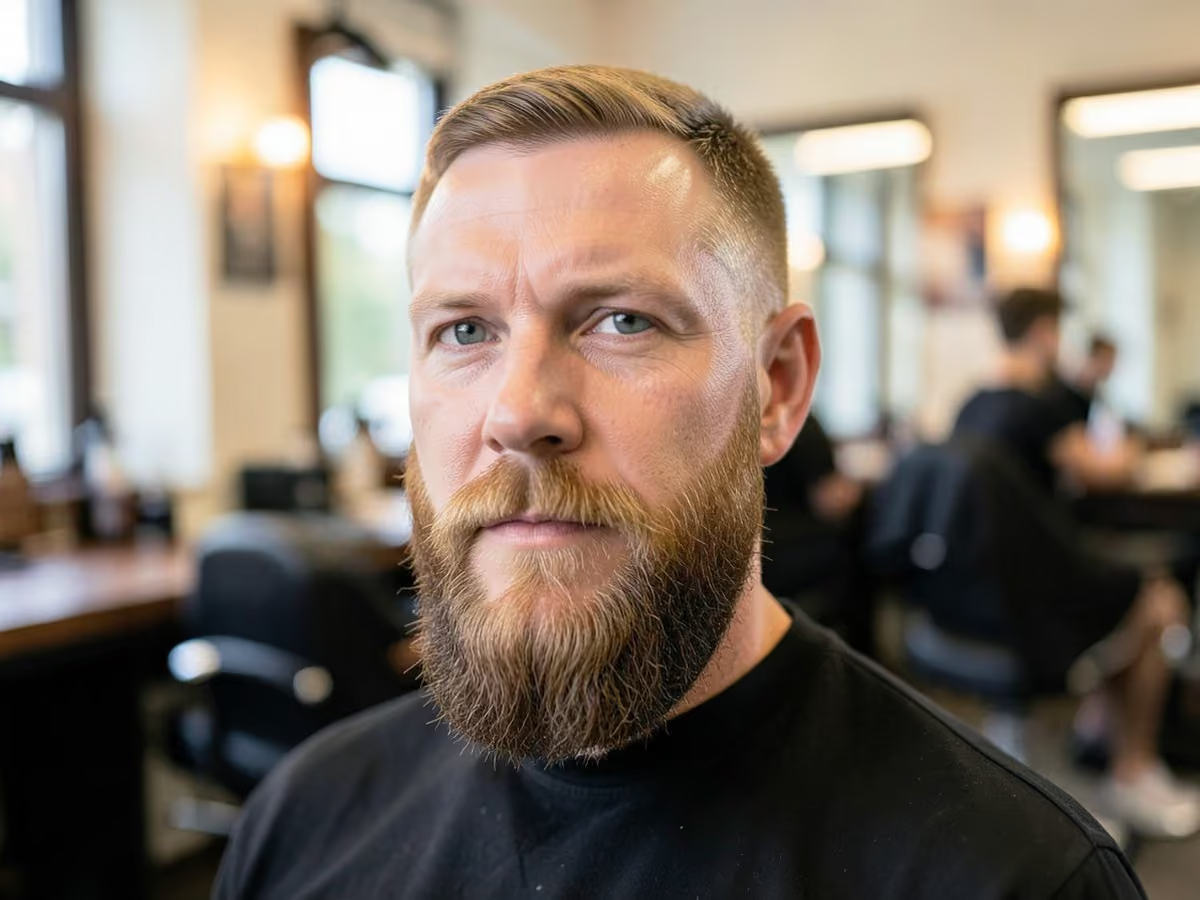
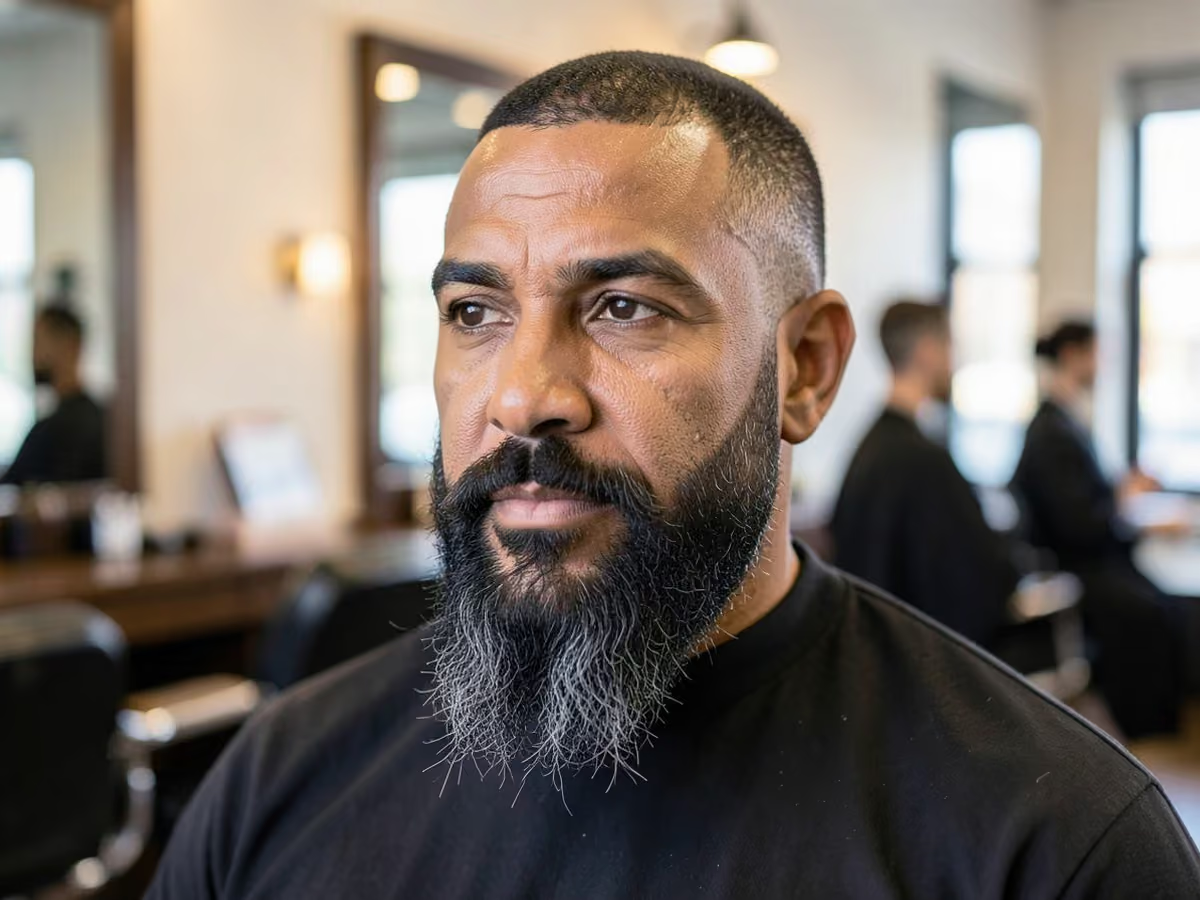
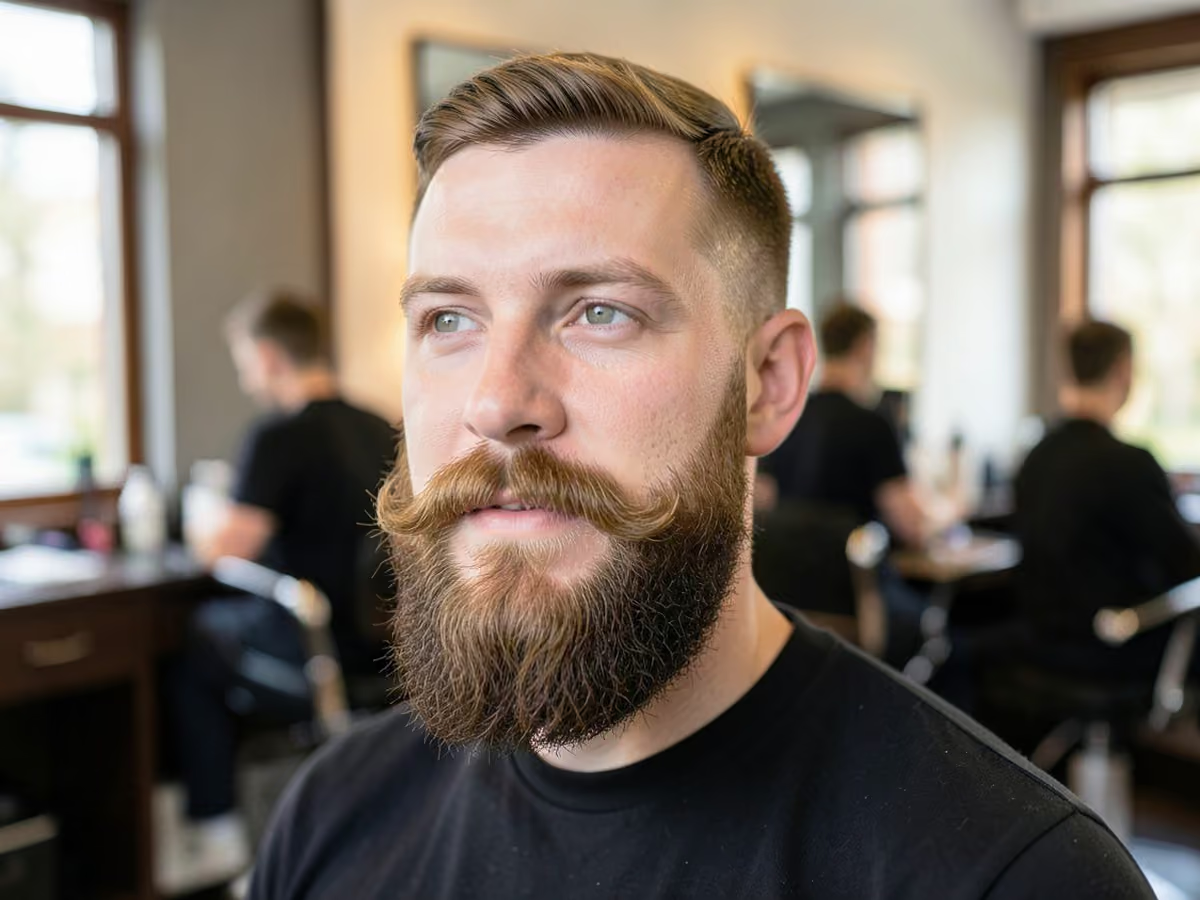
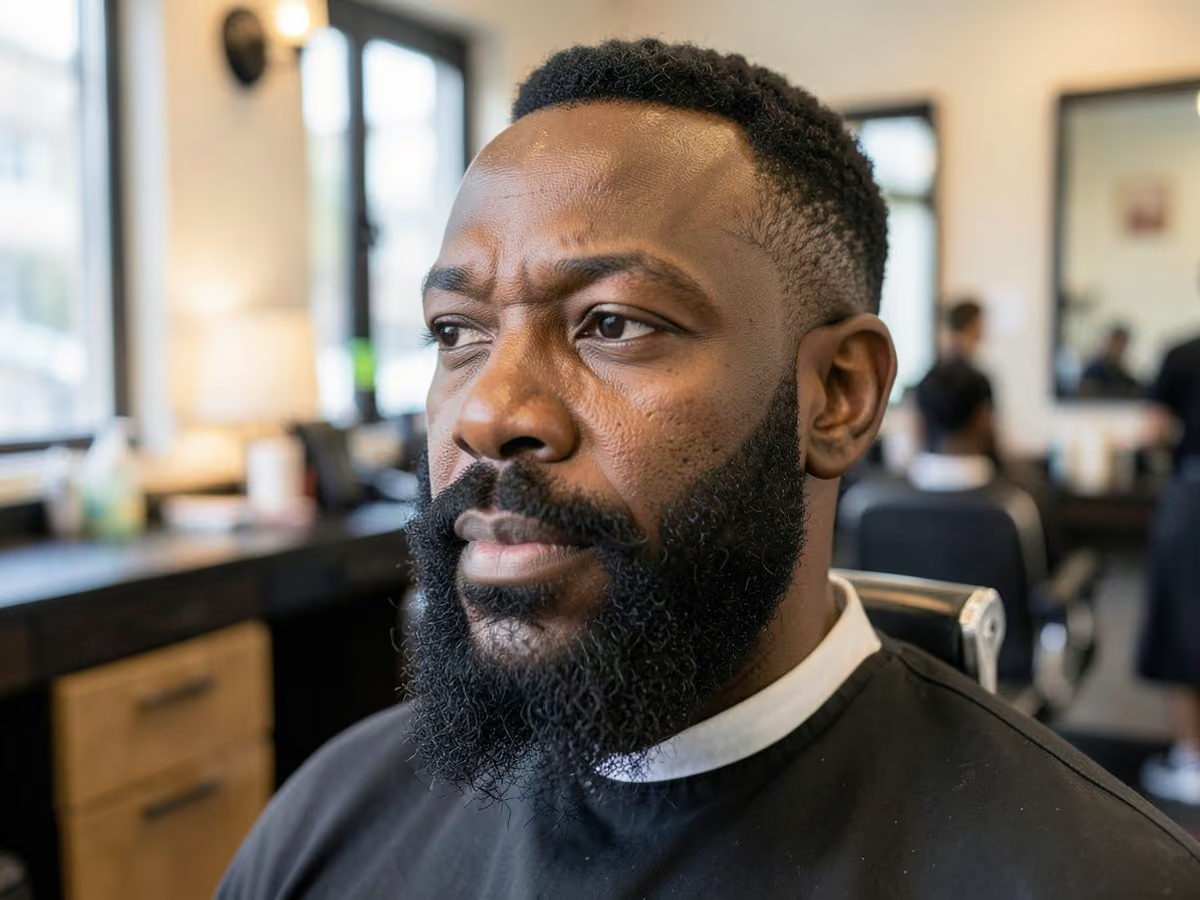
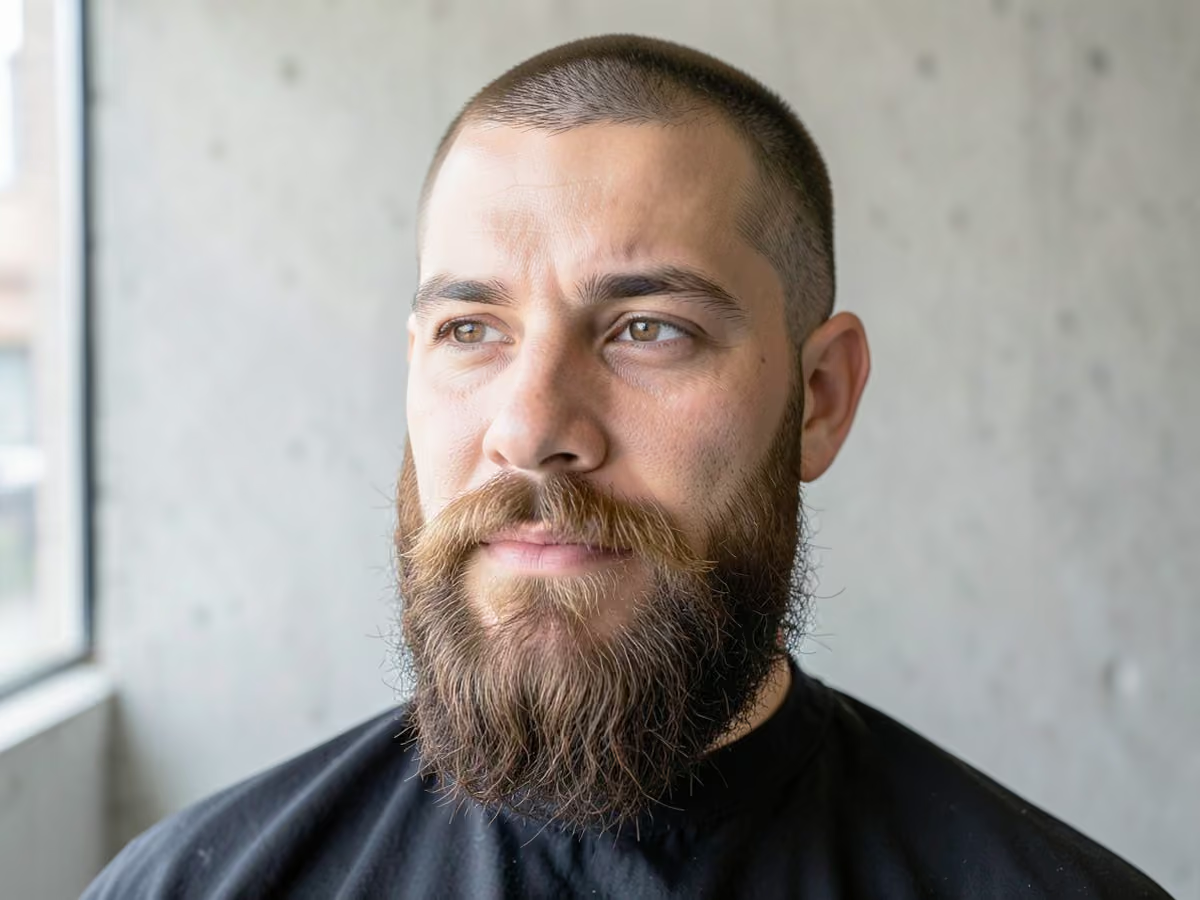
Quick answer: A full beard covers the cheeks, jaw, chin and upper lip with connected hair. Most men need three to four months of growth to reach an established full beard, at roughly half an inch a month. Shape it with a neckline two fingers above the Adam's apple, a clean cheek line, and a trim every two to four weeks.
Full Beard Styles at a Glance
Every style on this page with its clipper guard, top length and trim interval. Tap a name to jump to that card.
A full beard is the one style that uses all of your facial hair: cheeks, jaw, chin and mustache, joined into one shape. Growing it takes patience, and keeping it looking deliberate takes a few minutes a day. Below is how to get through the grow-in, where the lines go, the upkeep routine, and 15 full beard styles grouped by length, shape and face.
What Counts as a Full Beard?
A full beard is facial hair that covers the cheeks, the jawline, the chin and the upper lip, with the mustache connected to the rest. Length is not part of the definition: a full beard can be a tidy 1 cm or a foot long. What matters is coverage. Partial styles such as the goatee, the Balbo and the chin strap leave parts of the face bare on purpose, while a full beard keeps hair everywhere it grows and then shapes the outer edges.
Most full beards are shaped at three points. The neckline under the jaw sets the bottom edge, the cheek line sets the top edge and the overall outline sets the silhouette from the front. Change any one of those and you get a different named style, from the rounded beard to the boxed beard described in our boxed beard guide.
How Long Does It Take to Grow a Full Beard?
Beard hair grows about half an inch a month, but it does not grow at the same rate everywhere. The chin and mustache usually lead, and the cheeks lag, which is why the second month often looks uneven. Most men reach a beard that looks intentional at six to ten weeks and an established full beard at three to four months. Our beard growth timeline covers each stage in detail.
Genetics set the limit on density, and some men never fill in fully on the cheeks. That is common and does not mean the beard has failed. Leaving the cheeks a little longer, or choosing a shorter style, often hides the gaps. Brushing daily from the second month also trains hair to lie over thinner spots. The table below shows what to expect month by month.
How Long Does It Take to Grow a Full Beard?
Time
Typical length
What it looks like
What to do
Weeks 1 to 2
3 to 6 mm
Heavy stubble, often itchy
Moisturize, do not trim the shape yet
Weeks 3 to 6
About 1 to 2 cm
Uneven, patchy in places
Clean the neck only, keep growing
Weeks 6 to 10
2 to 3 cm
Filling in, shape appearing
First barber shape-up
Months 3 to 4
3 to 5 cm
Established full beard
Trim every two to four weeks
Month 6 and later
7 cm or more
Long full beard
Shape the bottom, keep the lines
Who Suits a Full Beard?
Most face shapes can wear a full beard if the outline is adjusted. Round faces suit a beard that is shorter on the cheeks and longer at the chin, which stretches the face downward. Long faces need the opposite: fuller cheeks and a shorter chin to add width. Square faces can wear a rounded bottom to soften a strong jaw, while oval faces can wear almost any shape. The beard shapes by jawline guide goes into each.
The bigger question is growth and lifestyle. A full beard needs reasonably even growth across the cheeks and daily care to stay clean and soft. Men who work in hot conditions or wear tight respirator masks may find a shorter style more practical, since many fitted masks require a clean seal against the skin. Check the rules for your job before you commit to a long grow.
Filter the styles
Showing all 15 styles
Fade
Hair
Length
Full Beard Styles by Length
Length changes upkeep more than any other choice. These five run from a short beard you can keep in a month to a long beard that needs half a year, plus a natural shape for the grow-in.
Trim:Every 2 weeks. Edges and neck lose shape quickly.
Best For:Oval, square faces + even, medium-density growth.
About This Style
At 1 to 2 cm, a short full beard covers every part of the face but keeps the jaw outline visible underneath. It is often the first shape men reach after six to eight weeks of growth. A trimmer with a 10 to 15 mm comb holds the length, and the edges stay clean with a weekly pass. It suits offices and warm climates and dries quickly after a wash. Thin spots show more at this length than in a longer beard.
How to Style at Home
Trim the cheeks at 12 mm and the chin at 15 mm with a trimmer comb.
Clean the neckline and cheek line with the bare blade.
Rub three drops of beard oil into the skin and brush through.
Ask Your Barber
"Short full beard, about 12 mm on the cheeks and 15 mm on the chin, neckline two fingers above my Adam's apple, cheek line cleaned up but not lowered."
Trim:Every 3–4 weeks. The bottom outline spreads as it grows.
Best For:Round, oval faces + dense or wavy growth.
About This Style
Between 3 and 5 cm, the beard has enough length to hold a real shape: rounded, squared or tapered at the bottom. Most men reach it after three to four months. This is the length where the cheeks can be cut a little shorter than the chin to slim the face. Balm becomes useful here, because longer hairs on the cheeks and jaw start to curl outward. Scissors or a long trimmer comb shape the bottom.
How to Style at Home
Brush the beard downward, then comb it out to see the outline.
Trim the sides with a 25 mm comb and shape the bottom with scissors.
Warm a small amount of beard balm and smooth it over the surface.
Ask Your Barber
"Medium full beard at about 4 cm, cheeks slightly shorter than the chin, rounded at the bottom. Clean neckline and cheek line, mustache trimmed off the lip."
Trim:Every 4–6 weeks. Split ends and stray hairs need snipping.
Best For:Long, oval faces + thick, dense growth.
About This Style
Past 7 cm the beard hangs below the chin and takes six months or more to grow. Shape now comes from scissors rather than a trimmer comb, and most men trim only the bottom edge and stray hairs. Washing, drying and detangling take real time, so a wide-tooth comb and a blow-dryer on low heat become part of the routine. Long faces should keep the sides full so the beard does not elongate the face further.
How to Style at Home
Detangle from the ends upward with a wide-tooth comb.
Blow-dry on low heat, brushing downward to straighten the hairs.
Seal with beard oil and a light layer of beard balm.
Ask Your Barber
"Long full beard, keep the length but tidy the bottom into a soft rounded shape and snip split ends. Leave the sides full and clean the neck below the jaw."
Trim:Every 4 weeks. Only the neck and lip need attention.
Best For:Square, oval faces + even growth during the grow-in.
About This Style
Some men prefer a beard with no visible shaping at all. The natural full beard leaves the cheek line where it grows and only cleans the neck and the lip. It is also the right approach during months one to three, when trimming the shape would slow progress. Even, dense growth makes it look intentional; patchy growth reads as unkempt. A weekly brush and daily oil keep it soft without making it look groomed.
How to Style at Home
Brush the beard in the direction of growth each morning.
Clean only the neck below a line two fingers above the Adam's apple.
Snip mustache hairs that fall over the lip.
Ask Your Barber
"Keep it natural: do not touch the cheek line or shape the bottom. Just clean the neck two fingers above the Adam's apple and trim the mustache off my lip."
Trim:Every 2–3 weeks. Bulk builds at the sides and widens the face.
Best For:Oval, long faces + very dense, coarse growth.
About This Style
Very dense growth can make a full beard look wider than the face it sits on. Barbers handle thick beards by taking bulk from the sides with a longer clipper guard or thinning scissors, while leaving the chin length. That keeps the shape narrow at the cheeks and full at the front. Coarse hair also benefits from daily oil and a firm boar bristle brush, which train the hairs to lie flat rather than spring outward.
How to Style at Home
Brush firmly downward with a boar bristle brush to flatten the sides.
Trim the cheek bulk with a 20 mm comb, keeping the chin longer.
Finish with beard oil, then a small amount of balm for control.
Ask Your Barber
"Thick full beard, take bulk out of the sides with a longer guard but leave the chin length. Keep the outline narrow on the cheeks and the neckline clean."
Recommended Products
Beard Brush
Beard Oil
Beard Balm
Full Beard Shapes and Outlines
The same amount of hair can be shaped several ways. These five outlines change where the beard is longest and how the edges are finished, from a tapered V to a squared bottom with a boxed beard finish.
Trim:Every 2–3 weeks. The cheek-to-chin gradient blurs as it grows.
Best For:Round, square faces + medium or dense growth.
About This Style
Short at the sideburns and progressively longer toward the chin, a tapered full beard forms a soft V from the front. The gradient narrows wide cheeks and adds length to the lower face. Barbers cut it with three or four trimmer comb sizes, blending each step. Its short sideburn end connects cleanly to a fade on the head. Keep the chin no more than twice the cheek length so it does not turn pointed.
How to Style at Home
Trim the sideburns at 6 mm and the upper cheeks at 12 mm.
Use 20 mm on the lower jaw and leave the chin at 30 mm.
Blend each step with short outward flicks of the trimmer.
Ask Your Barber
"Tapered full beard: 6 mm at the sideburns, building to 12 mm on the cheeks and 3 cm at the chin. Blend each step and keep the neckline two fingers up."
Trim:Every 3–4 weeks. The point loses definition as sides fill in.
Best For:Round, square faces + dense chin growth.
About This Style
The bottom of this beard narrows to a point below the chin, while the cheeks stay trimmed close. It is a stronger version of the tapered shape and needs at least 5 cm at the chin to work. The point draws a vertical line that lengthens round and square faces. Balm or a little wax holds the tip in place. On long or narrow faces it can look exaggerated, so those faces suit a rounded bottom better.
How to Style at Home
Comb the beard downward and find the center under the chin.
Trim the sides at an angle toward that center point with scissors.
Twist the tip lightly with a little beard balm to hold the point.
Ask Your Barber
"Pointed full beard, at least 5 cm at the chin narrowing to a point, cheeks trimmed close at about 15 mm. Clean cheek line and a standard neckline."
Trim:Every 2 weeks. Straight lines and corners need regular edging.
Best For:Round, oval faces + dense, dark growth.
About This Style
A boxed full beard keeps the length even along the jaw and finishes with a squared bottom and straight edges. Cheek lines are cut low and sharp, and the corners at the jaw are left visible. That geometry sharpens a round face. Of all full beards it looks the most groomed, which is why offices see it often, and needs dense growth because sharp lines expose any gap. Trims every two weeks keep the corners crisp.
How to Style at Home
Trim the whole beard at 20 to 25 mm with a trimmer comb.
Square the bottom edge with scissors along a straight comb.
Line the cheeks with the trimmer edge and brush the beard flat.
Ask Your Barber
"Boxed full beard, about 2.5 cm all over with a squared bottom, sharp low cheek line and clear corners at the jaw. Neck shaved two fingers above my Adam's apple."
Trim:Every 3–4 weeks. Only the neck and stray hairs need cutting.
Best For:Long, narrow faces + even, dense growth.
About This Style
Leaving the cheek line where hair naturally stops keeps the beard high on the face, which adds width to long or narrow faces. Only obvious stray hairs above the line are snipped. The approach grows out slowly, because regrowth has no razor line to blur. It works best with even cheek growth; if your cheeks thin out unevenly, a defined line hides it better. Pair it with a neat neckline so the beard still looks cared for.
How to Style at Home
Brush the cheeks upward to reveal strays above the natural line.
Snip only the hairs that sit well apart from the rest.
Trim the neckline and brush the beard back down.
Ask Your Barber
"Full beard at about 3 cm with the cheek line left natural, strays only. Clean the neck below a curved line two fingers above my Adam's apple."
Trim:Every 2–3 weeks. Mustache ends need shaping between visits.
Best For:Oval, long faces + full upper lip growth.
About This Style
Here the mustache is grown longer than the beard and its ends are twisted upward, like a light handlebar sitting on a full beard. The curl lifts the middle of the face and adds width to long faces. Mustache wax or a firm balm holds the shape; the beard itself can stay at 2 to 4 cm. Expect two to three months of mustache growth before the ends are long enough to curl, and train them daily.
How to Style at Home
Comb the mustache out from the center toward each side.
Twist a small amount of firm beard balm into each end and curl upward.
Brush the beard downward so it does not cover the curl.
Ask Your Barber
"I'd like a full beard at 3 cm, rounded bottom. Leave the mustache long and do not cut the ends, just trim the center off my lip so I can curl the sides."
Recommended Products
Beard Balm
Beard Brush
Full Beard by Face Shape and Hair Type
Face shape tells you where to keep length, and hair type tells you how to cut it. These five cover round and long faces, coily and gray growth, and men whose growth is light.
Trim:Every 2–3 weeks. Cheek bulk must stay shorter than the chin.
Best For:Round, full faces + medium or dense growth.
About This Style
The goal on a round face is to add length and remove width. Barbers keep the cheeks short, around 1 cm, and leave 3 to 5 cm at the chin, with a squared or slightly pointed bottom. Barbers also set the cheek line slightly higher here so the jaw does not widen. A haircut with height on top completes the effect; see our round face haircuts for options that match.
How to Style at Home
Trim the cheeks at 10 mm and blend into 25 mm along the lower jaw.
Leave the chin longer and square the bottom with scissors.
Apply balm and brush the sides flat so they stay narrow.
Ask Your Barber
"Full beard for a round face: cheeks short at about 1 cm, chin left at 4 cm with a squared bottom. Keep the cheek line slightly high and the neckline firm."
Trim:Every 2–3 weeks. The chin length creeps and lengthens the face.
Best For:Long, oblong faces + even cheek growth.
About This Style
Long faces benefit from the reverse of the round-face approach: fuller cheeks and a shorter chin. Keeping the sides at 2 to 3 cm and the chin roughly the same length widens the lower face and stops the beard from adding vertical length. A rounded bottom softens the shape further. The mustache can be kept full, which also breaks up the face horizontally. Avoid pointed or long beards, which make the face look longer still.
How to Style at Home
Trim the whole beard at 25 mm, including the chin.
Round the bottom with scissors, keeping the sides full.
Brush the cheeks outward slightly to keep their width.
Ask Your Barber
"Full beard for a long face: keep the sides full at about 2.5 cm and the chin no longer than the sides, rounded bottom, mustache full and off the lip."
Trim:Every 2–3 weeks. Shrinkage hides uneven length until it is combed out.
Best For:Any face shape + coily or tightly curled growth.
About This Style
Coily beard hair shrinks, so a beard that measures 5 cm stretched might look 2 cm on the face. Barbers usually pick it out or brush it before cutting so they can see the true shape, then line the cheeks and neck with clippers. Moisture is the main care need, because coils dry quickly; oil and a leave-in keep them soft. Line-ups on bump-prone skin are best done with a trimmer instead of a razor.
How to Style at Home
Spray the beard lightly with water and work in a leave-in.
Pick the hair out from the skin, then shape the outline.
Seal with beard oil and brush gently to define the surface.
Ask Your Barber
"Coily full beard, picked out and shaped round at about 3 cm, cheek line and neckline lined up with the trimmer, not a razor. Keep the mustache off the lip."
Trim:Every 2–3 weeks. Wiry gray hairs stray from the outline.
Best For:Older men + gray, white or salt and pepper growth.
About This Style
Gray beard hair is often coarser and drier than the color it replaces, and it tends to grow at odd angles. A clean outline matters even more here, because a shaggy gray beard can add years. A 2 to 3 cm length with a sharp neckline and a trimmed mustache is a common choice. Daily oil softens the texture, and a purple-tinted beard wash is an option if yellowing bothers you. Our silver fox styles pair well.
How to Style at Home
Brush the beard with a firm boar bristle brush to align wiry hairs.
Trim at 25 mm and snip strays that still stick out.
Massage argan oil or beard oil into the skin and hair.
Ask Your Barber
"Gray full beard at about 2.5 cm, tidy rounded outline, sharp neckline and cheek line, mustache trimmed off the lip. Snip any wiry hairs sticking out."
Trim:Every 3–4 weeks. Length helps cover thin areas, so trim lightly.
Best For:Oval, long faces + fine, fair or slow growth.
About This Style
Fine or slow growth can still make a full beard if you give it length to do the covering. Keeping the cheeks and jaw at 2 to 3 cm lets hair from denser areas fall over thin ones. The cheek line stays natural, since a low lined edge would expose gaps. Fair and red beards look fuller with a little balm, which groups hairs together. If you are still waiting for cheeks to fill, our patchy beard guide explains realistic options.
How to Style at Home
Brush the beard toward thin areas so longer hairs cover them.
Trim only stray hairs and the neckline, leaving the bulk.
Warm a little balm between your palms and press it in.
Ask Your Barber
"Full beard for light growth, leave the length at about 2.5 cm and keep the cheek line natural. Only clean the neckline and trim the mustache off my lip."
Recommended Products
Beard Balm
Beard Brush
How Do You Ask Your Barber to Shape a Full Beard?
Give three things: the length you want to keep, the shape of the outline and where the lines go. A clear request sounds like this: keep the length at about 3 cm, rounded at the bottom, cheeks trimmed a little shorter than the chin, neckline two fingers above the Adam's apple, cheek line cleaned up but not lowered. Say how you want the mustache finished, trimmed off the lip or left long to style.
If your haircut is a fade, ask for the sideburns to blend into the beard so there is no hard step between the two. The beard styles with skin fade guide shows the common blends. Ask the barber not to take length at the first shape-up if you are still growing; you only want the edges cleaned and the neck tidied, with the bulk left to keep growing.
A full beard holds food, oil and dead skin, so the routine is mostly about cleaning and softening. Five habits cover almost everything, and none of them takes more than a few minutes. The products you need change slightly as the beard gets longer: oil alone is enough for a short beard, while longer beards benefit from balm for hold.
Wash two to four times a week
Use a beard wash or mild cleanser rather than regular shampoo, which can dry the skin underneath. Rinse with lukewarm water.
Oil daily
Massage three to five drops of beard oil into the skin, not just the hair. It calms itch and softens coarse ends. See beard oil vs beard balm for when to add balm.
Brush or comb every morning
A boar bristle brush trains hairs to lie in one direction and spreads oil along each hair. Use a wide-tooth comb on beards longer than about 5 cm.
Keep the neckline weekly
Clean the neck below your line every week, as in our neckline guide. A neckline that drifts down is the fastest way for a beard to look neglected.
Trim the shape monthly
Every two to four weeks, trim the bottom and sides with scissors or a long trimmer comb, and snip stray hairs above the cheek line.
What Full Beard Mistakes Should You Avoid?
Trimming during the patchy weeks is the most common mistake. Cutting to even out slow areas only keeps the whole beard short, so let it grow for at least six weeks before shaping anything but the neck. The second mistake is setting the neckline at the jawbone, which removes the hair that gives the jaw its shape and makes the beard look pasted on.
Other problems are easier to fix. Using hair shampoo every day dries the skin and causes flakes. Ignoring the mustache lets it cover the lip and catch food. Cutting both sides without checking symmetry leaves one side longer. And skipping oil on coarse hair makes the beard feel wiry. If thin areas bother you, the patchy beard guide covers what helps and what does not.
Which Full Beard Is Right for You?
Pick your hair type and how much upkeep you will put in. The matches below come from the Best For and Maintenance notes on each card. Upkeep follows the Maintenance badge: low means a cut every 3 to 6 weeks and almost no daily styling, high means weekly line-ups or daily product.
Most men need three to four months for an established full beard. Beard hair grows about half an inch a month, and the cheeks usually fill in later than the chin and mustache. Many beards look patchy between weeks three and six, then fill in by week ten. Growth speed and density vary with genetics.
Q2: How often should you trim a full beard?+
Clean the neckline and cheek line every week, and trim the overall shape every two to four weeks. If you are growing for length, take only the stray hairs and the edges, and let the bulk grow. A barber shape-up every four to six weeks keeps the outline symmetrical.
Q3: What is the best length for a full beard?+
There is no single best length. Short full beards of 1 to 2 cm suit offices and warm climates, medium beards of 3 to 5 cm show the most shape, and long beards past 7 cm need the most care. Choose the length your growth fills evenly and your routine can maintain.
Q4: Where should a full beard neckline sit?+
About two fingers above the Adam's apple, curving up to just behind each earlobe. That keeps hair under the jaw, which gives the beard depth and defines the chin. Shaving the line up to the jawbone is a common mistake that makes the beard look thin from the side.
Q5: Can you grow a full beard if it is patchy?+
Often, yes. Many beards look patchy for the first six weeks and fill in later as slower areas catch up. Growing longer helps hair from dense areas cover thin spots. If gaps remain after three to four months, a shorter style or a doctor's advice on options may suit you better.
Q6: Should you use beard oil or balm on a full beard?+
Use oil daily at any length to moisturize the skin and soften hair. Add balm once the beard passes about 3 cm, when stray hairs start to stick out and need light hold. Many men use oil in the morning and a little balm on top for shape.