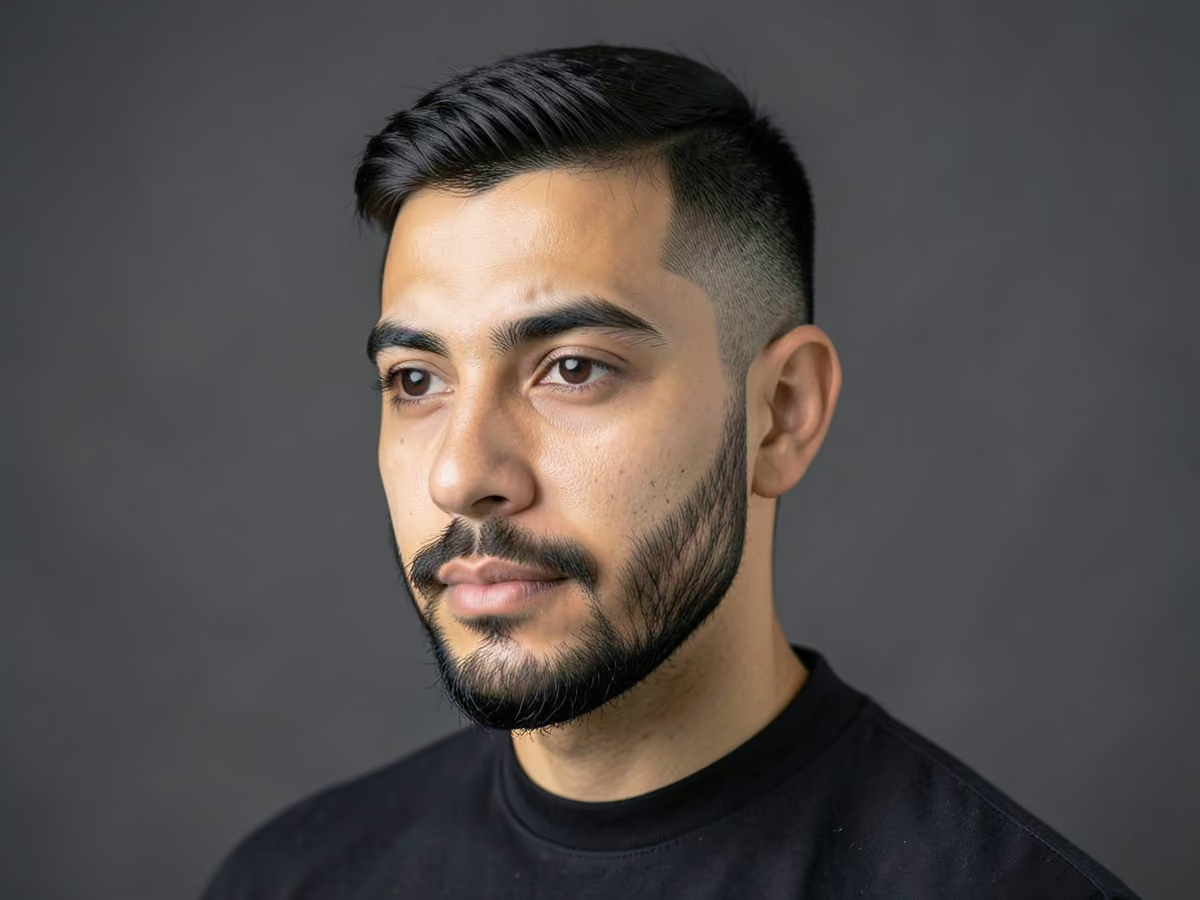
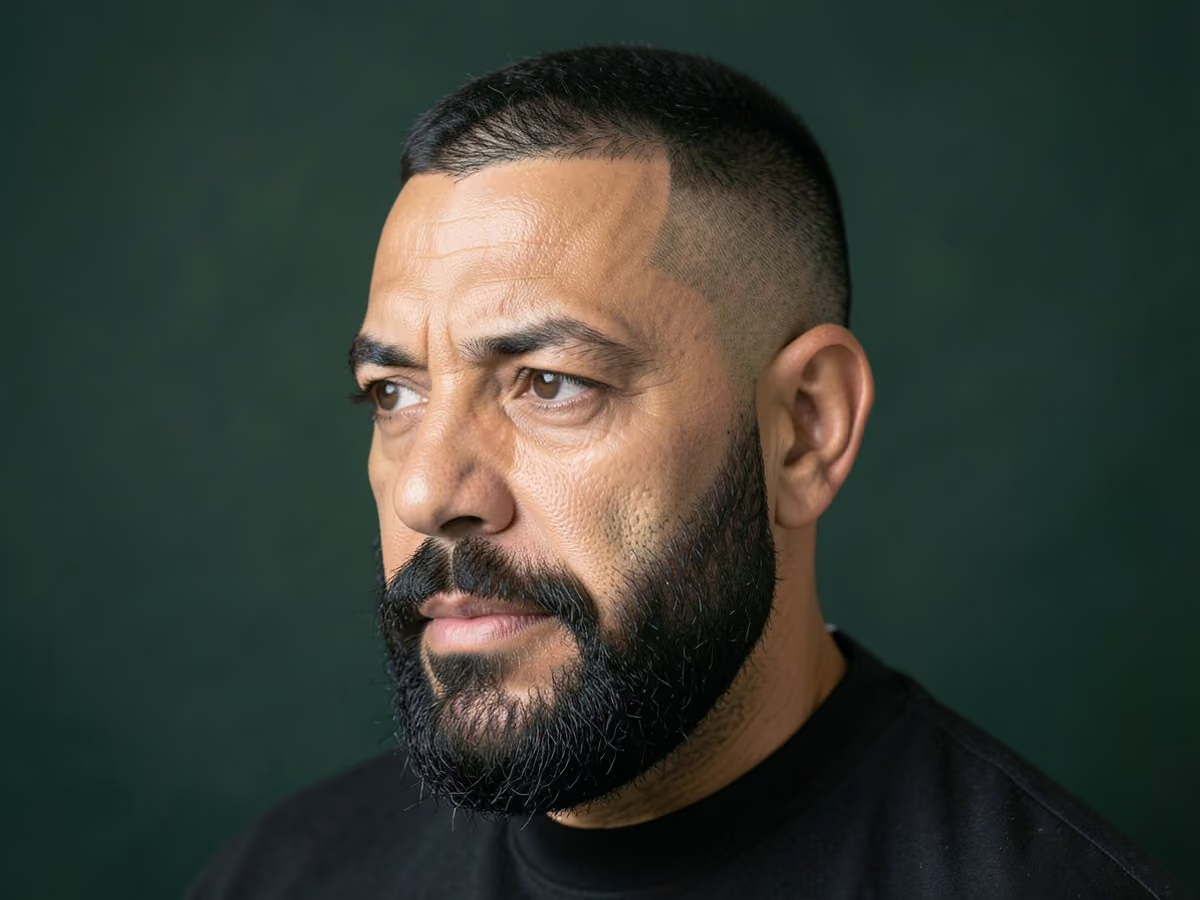
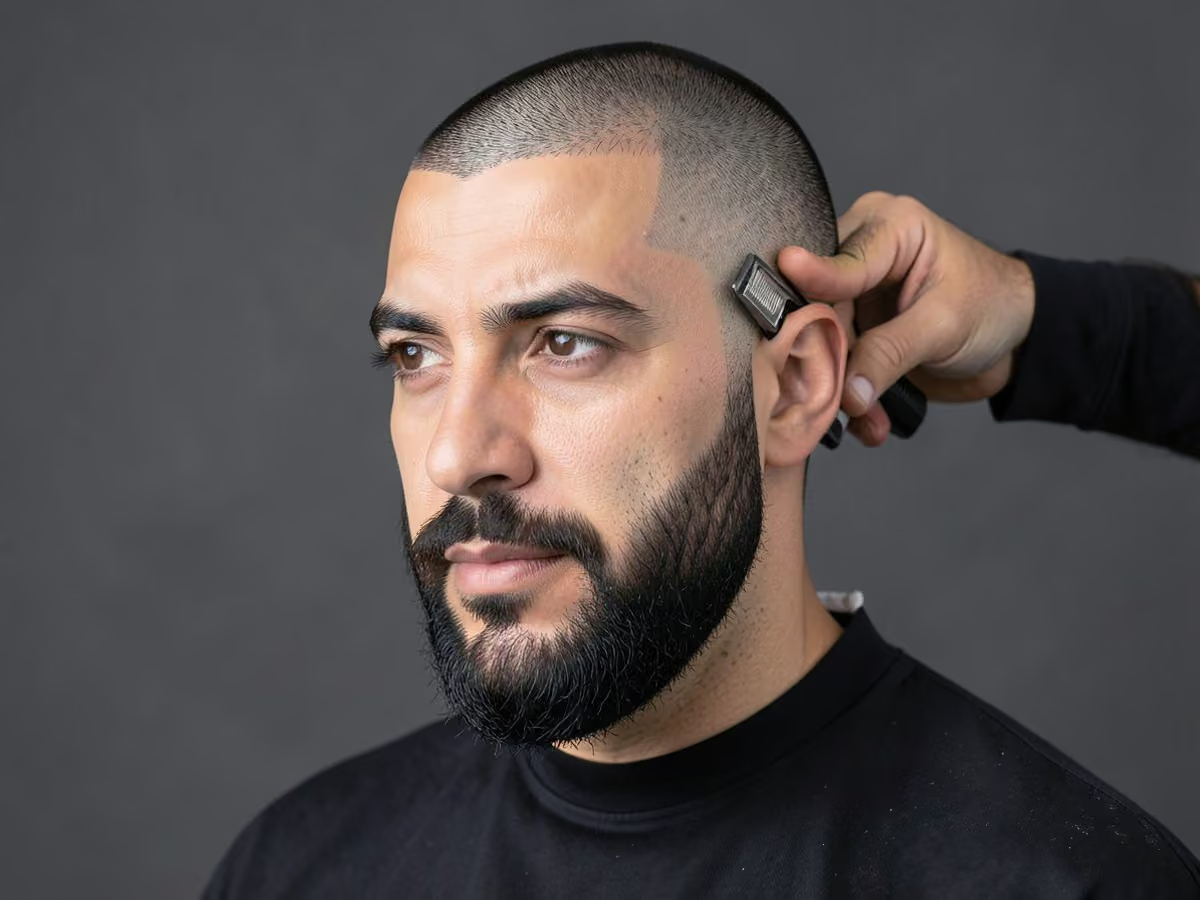
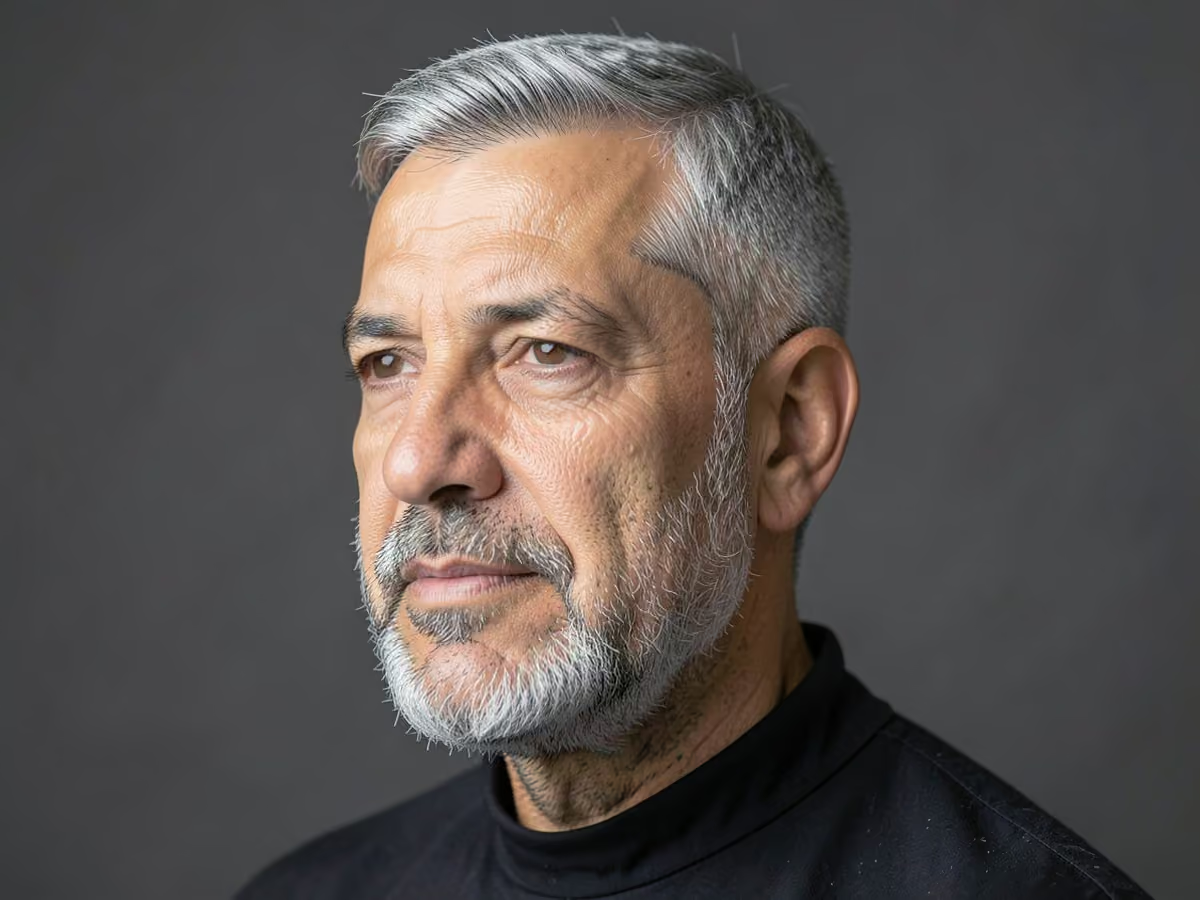
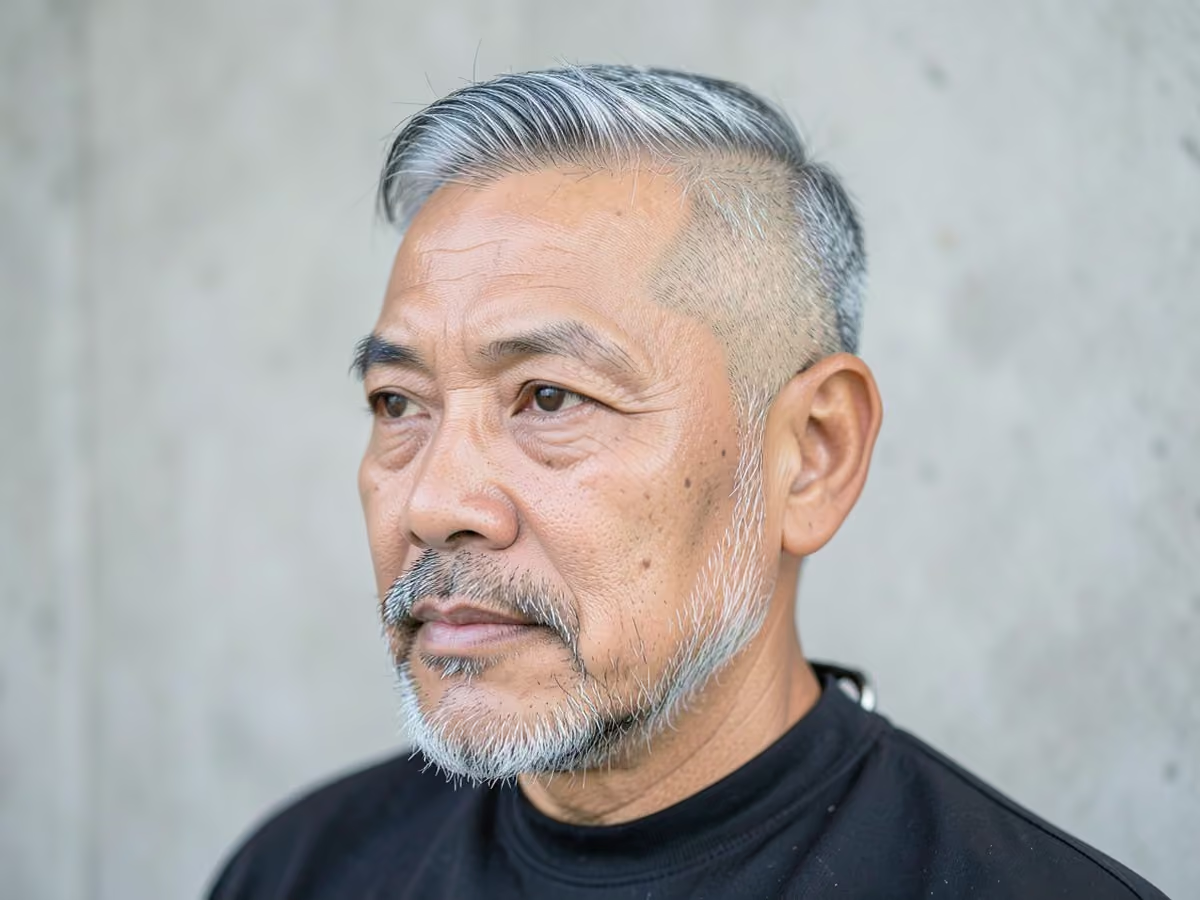
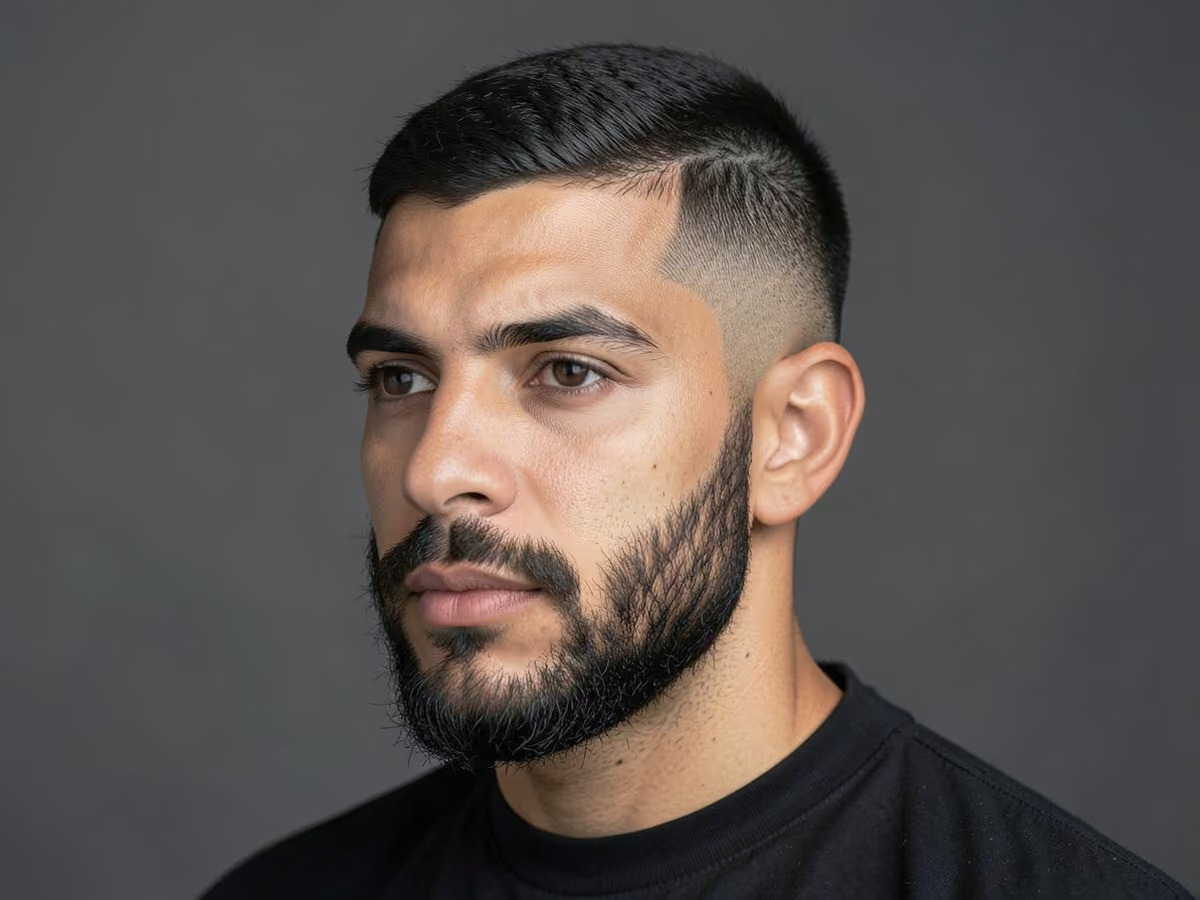
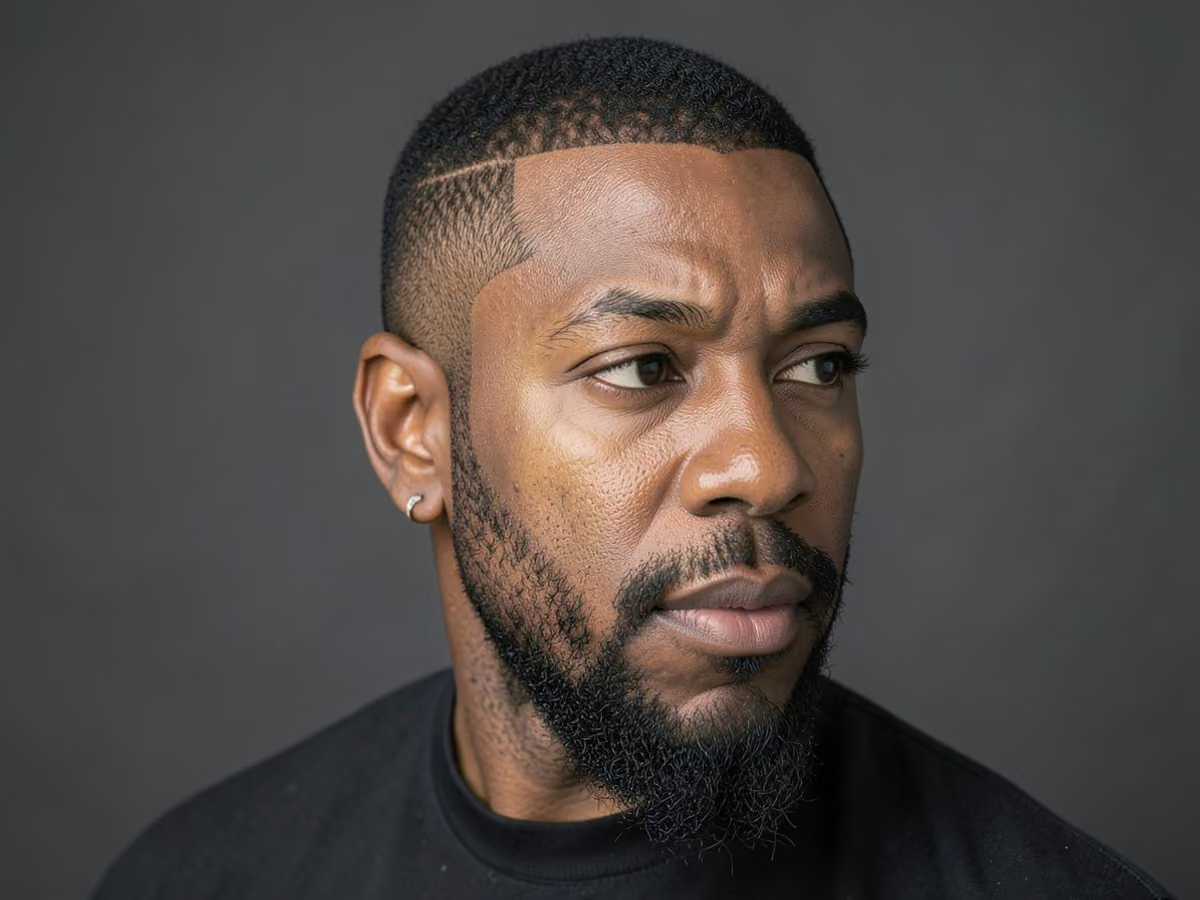
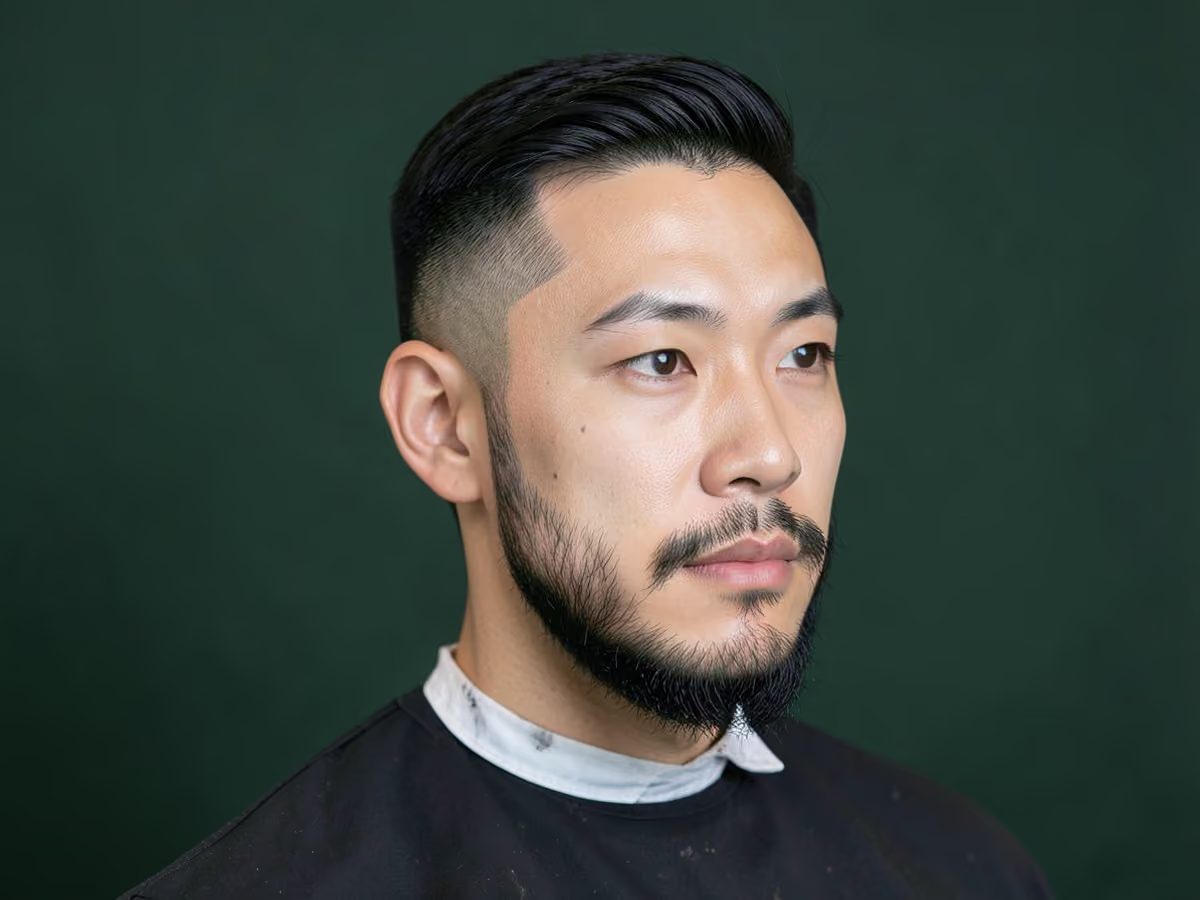
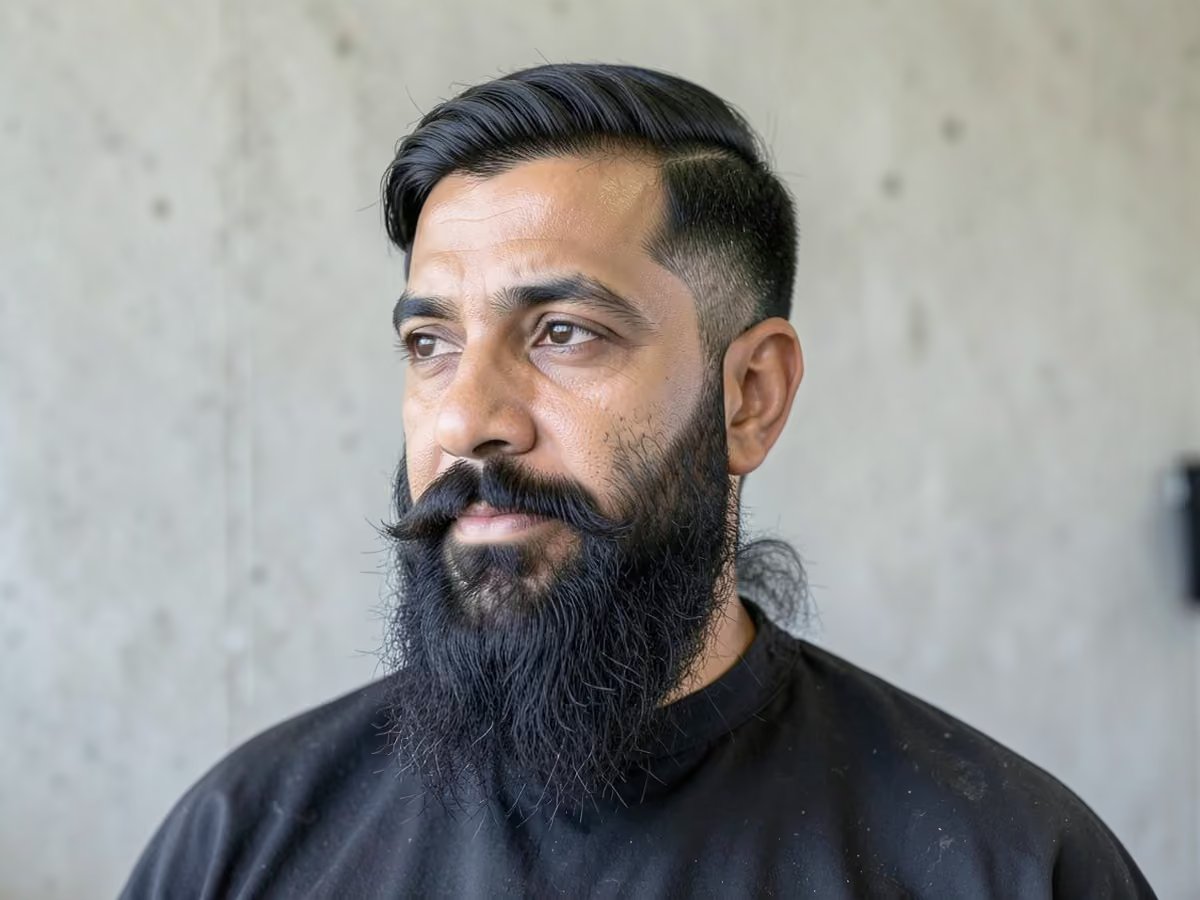
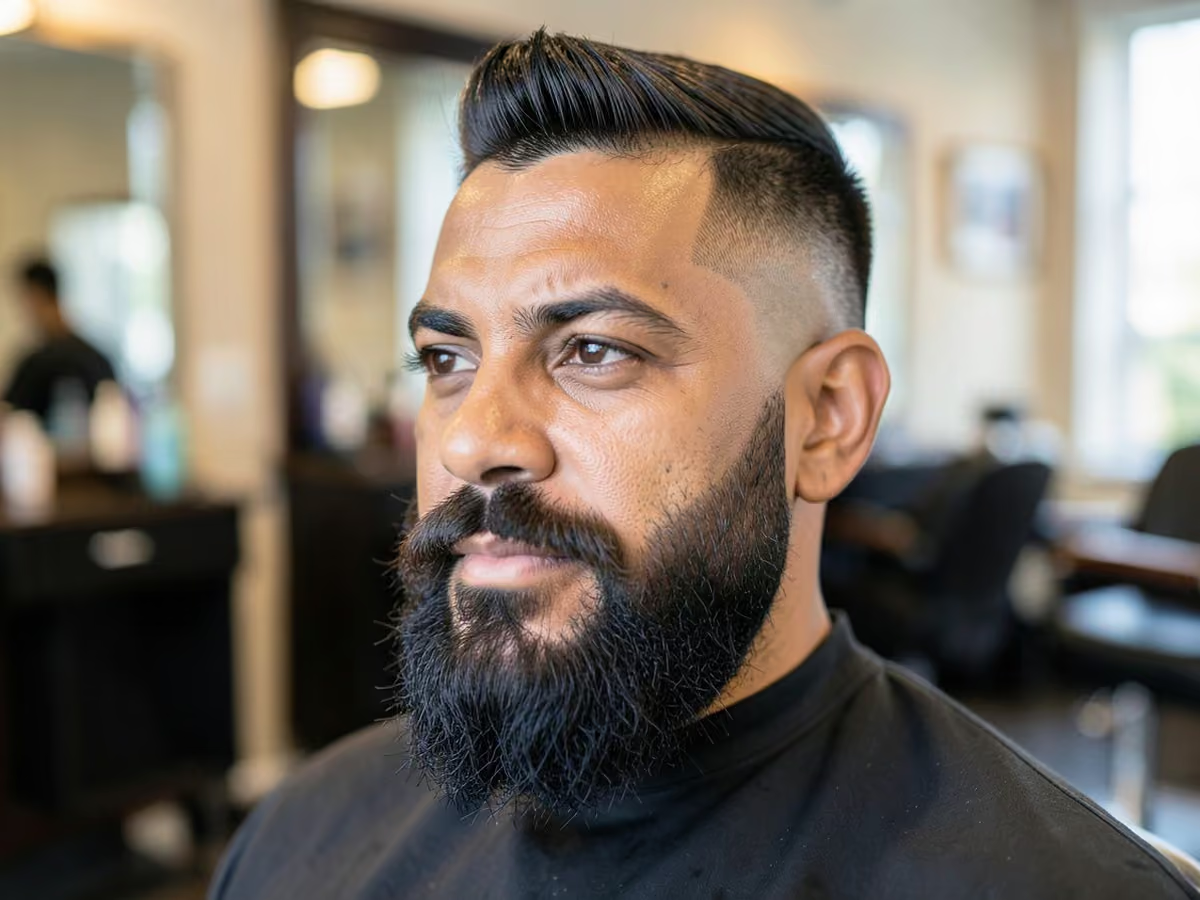
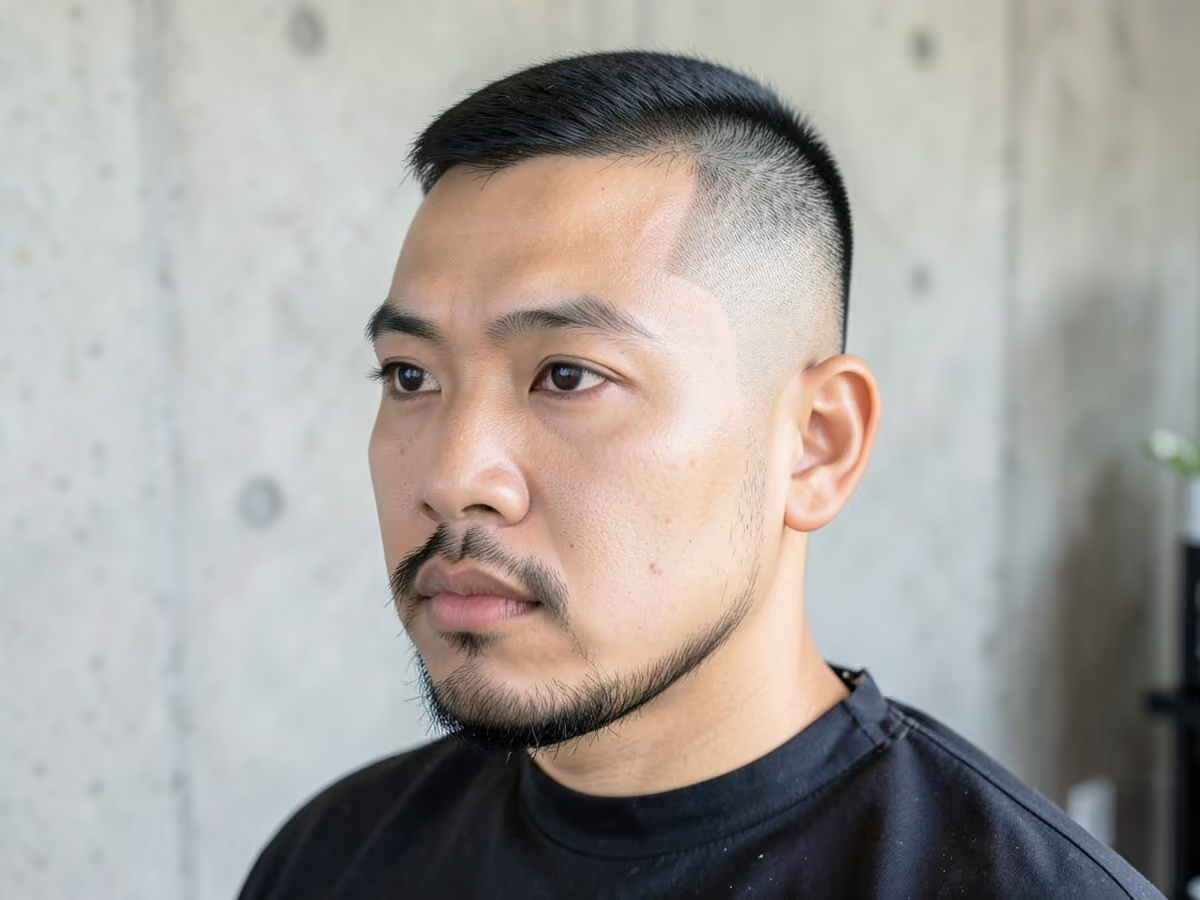
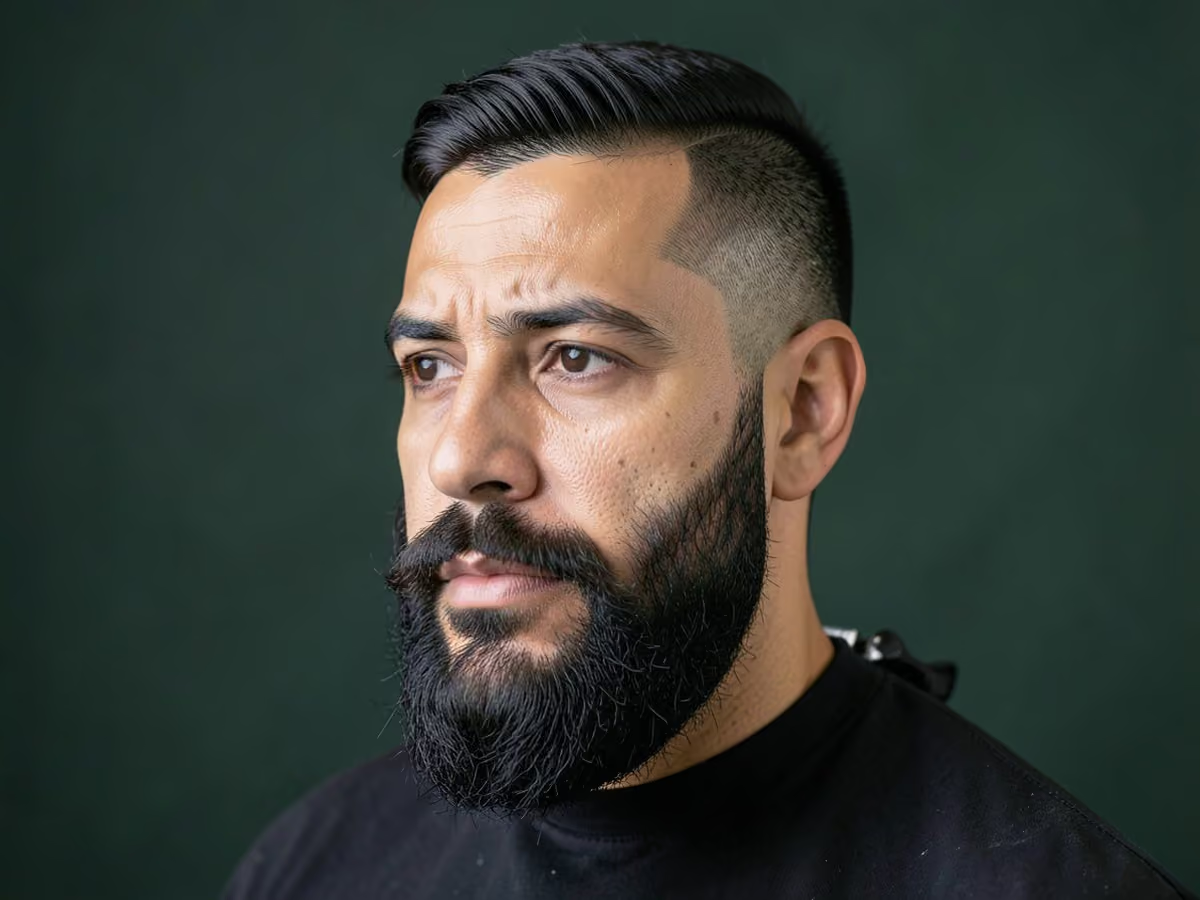
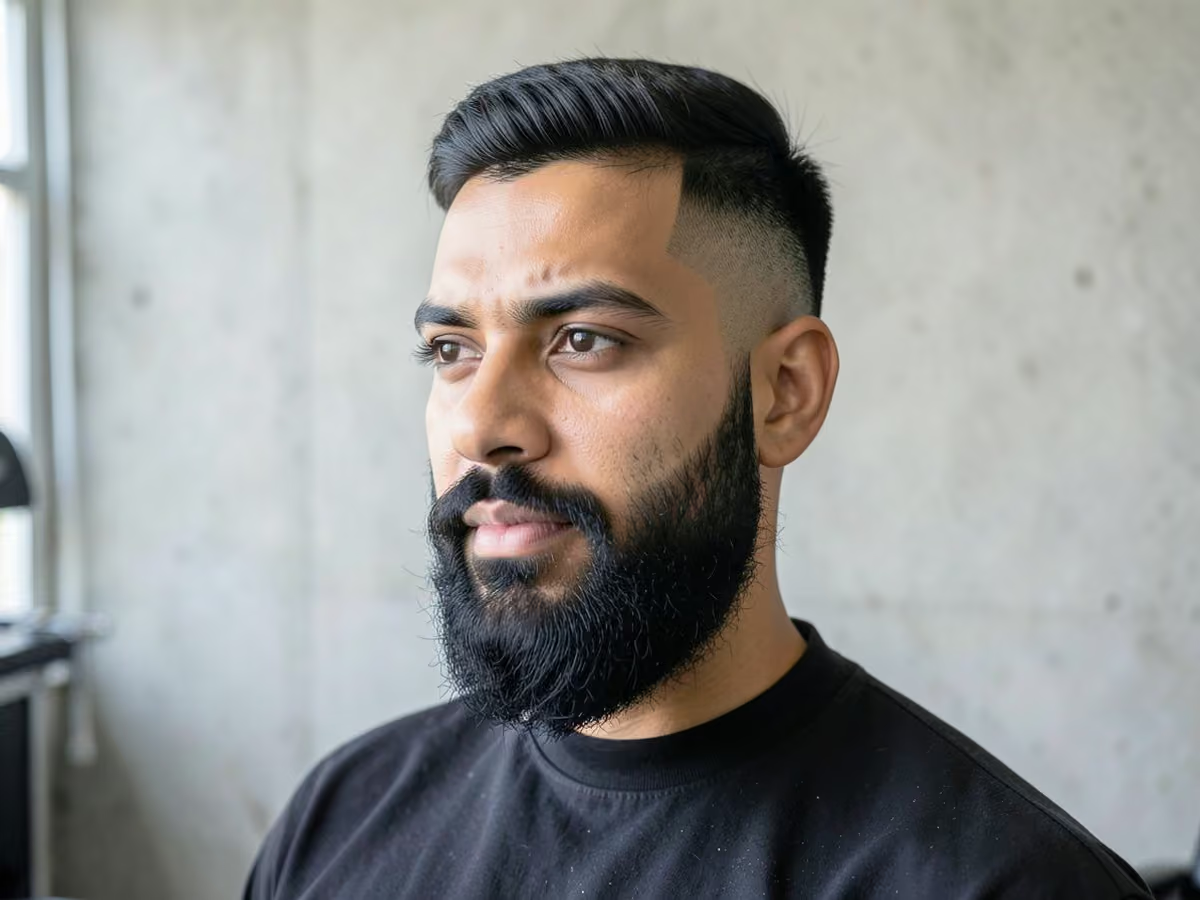
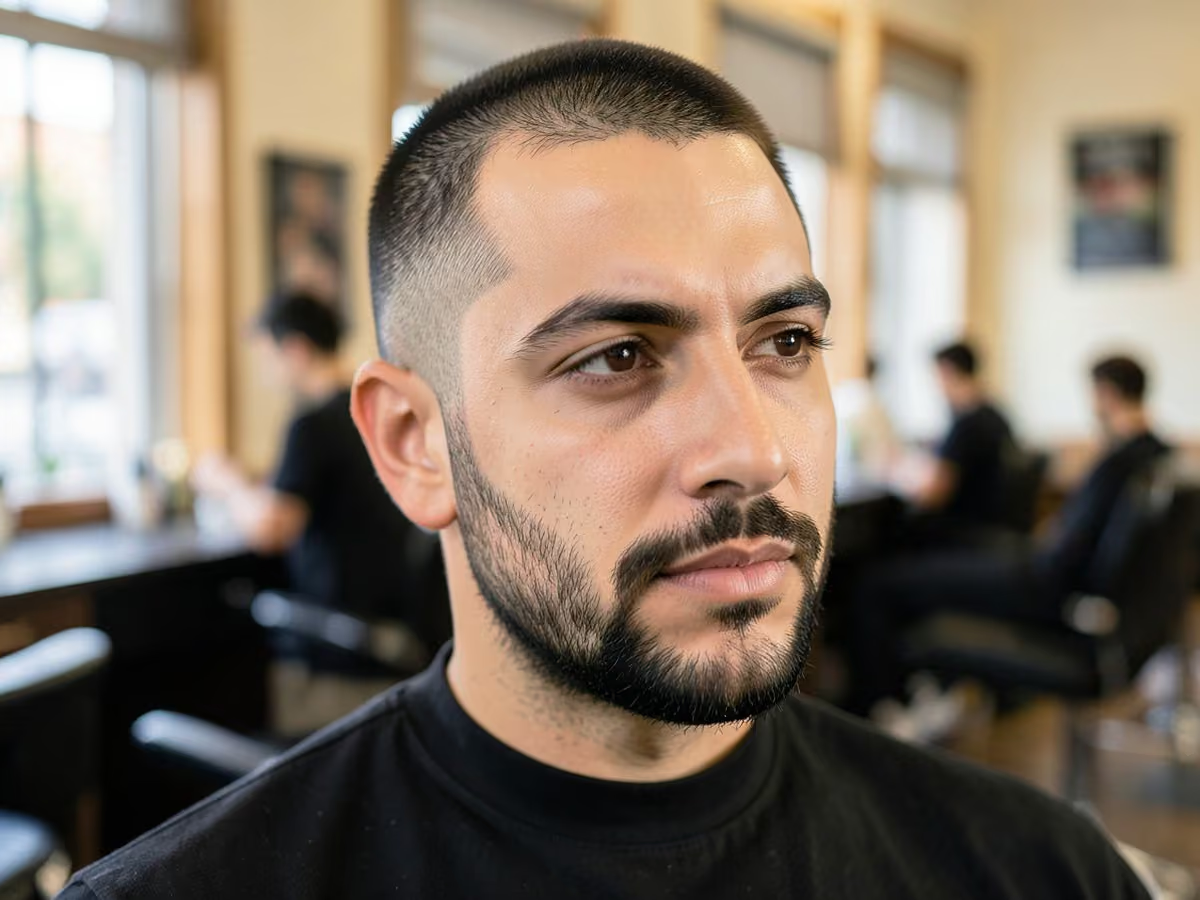
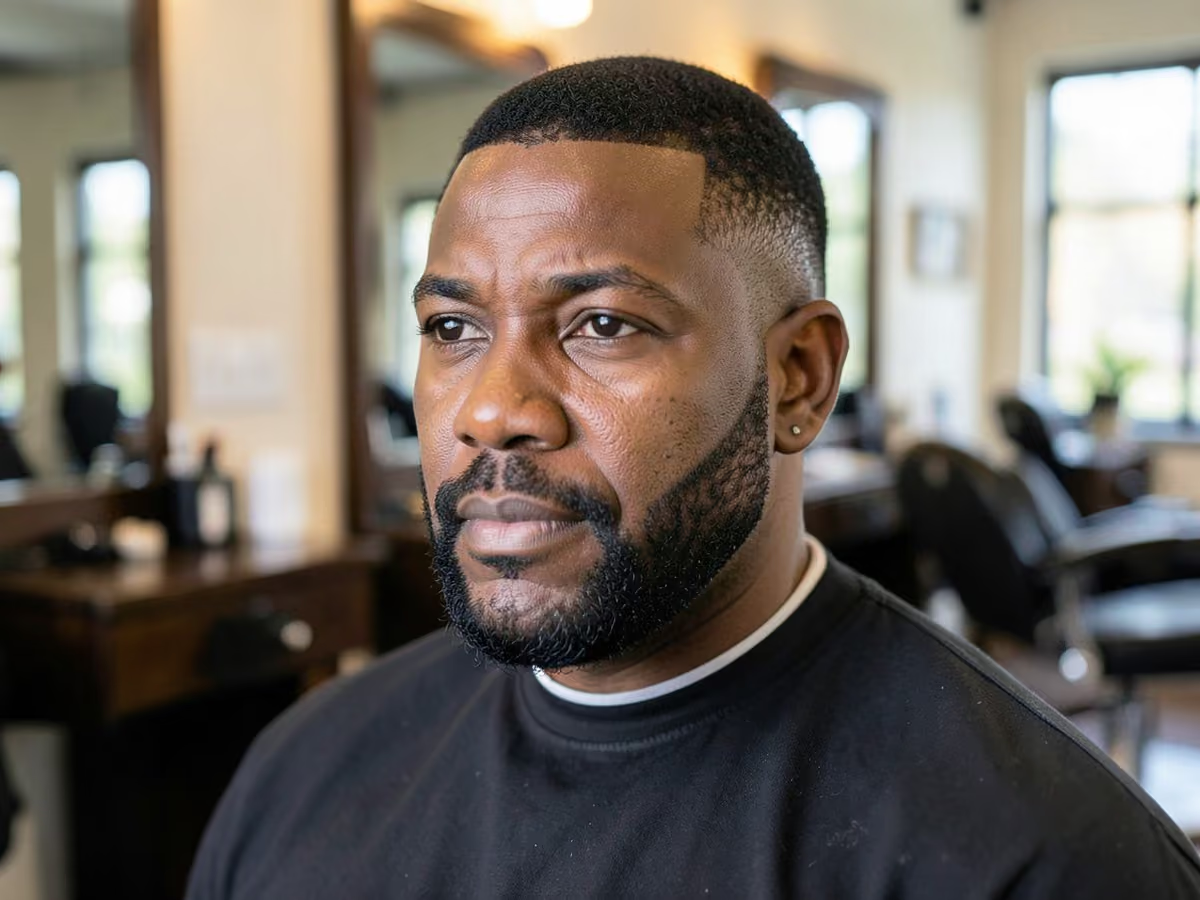
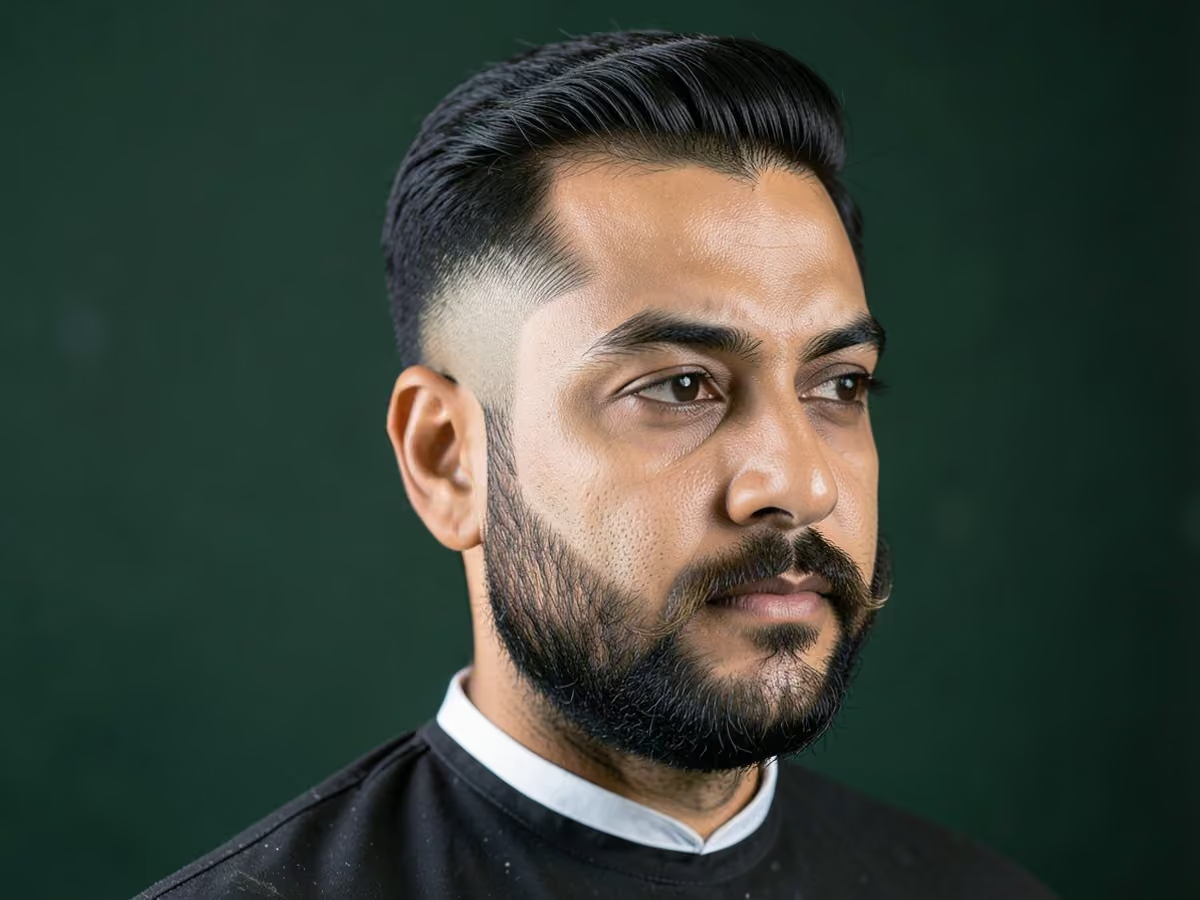
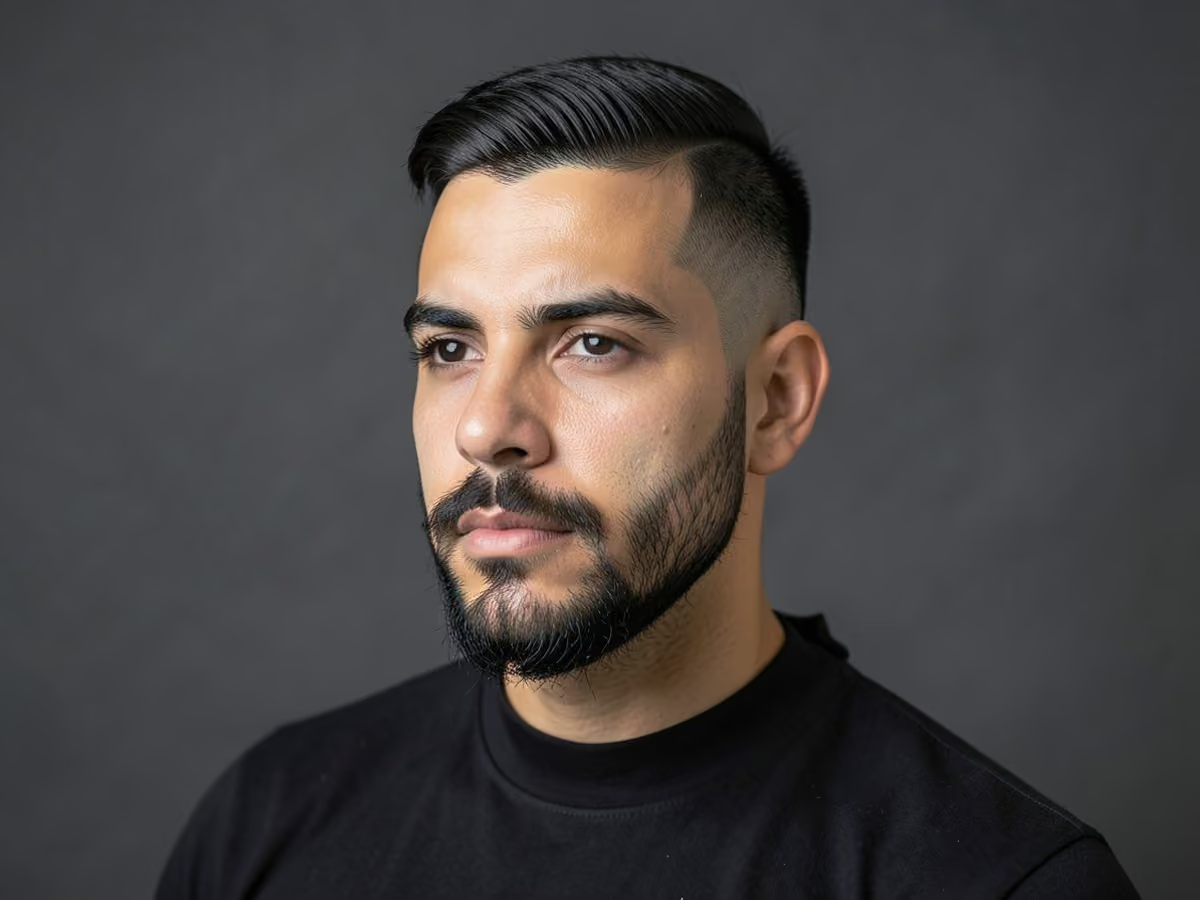
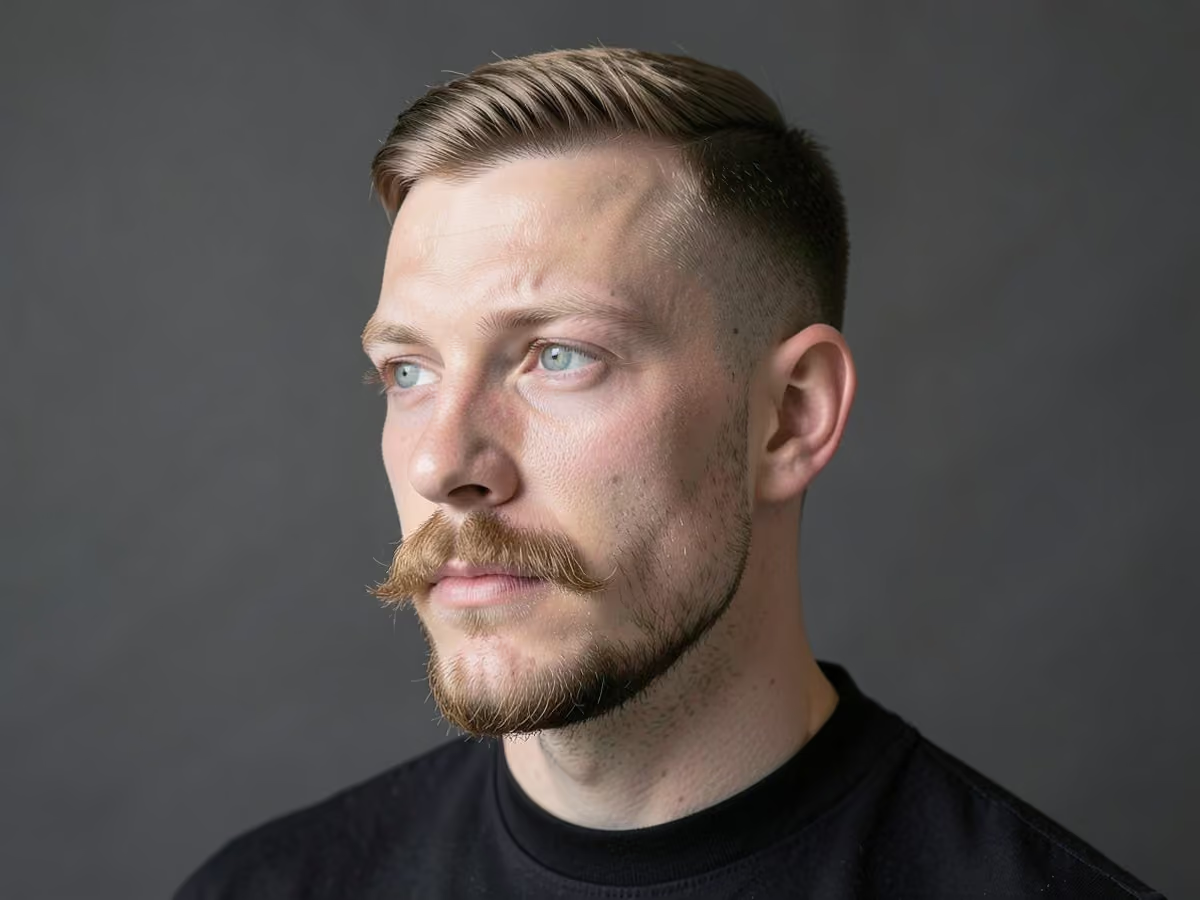
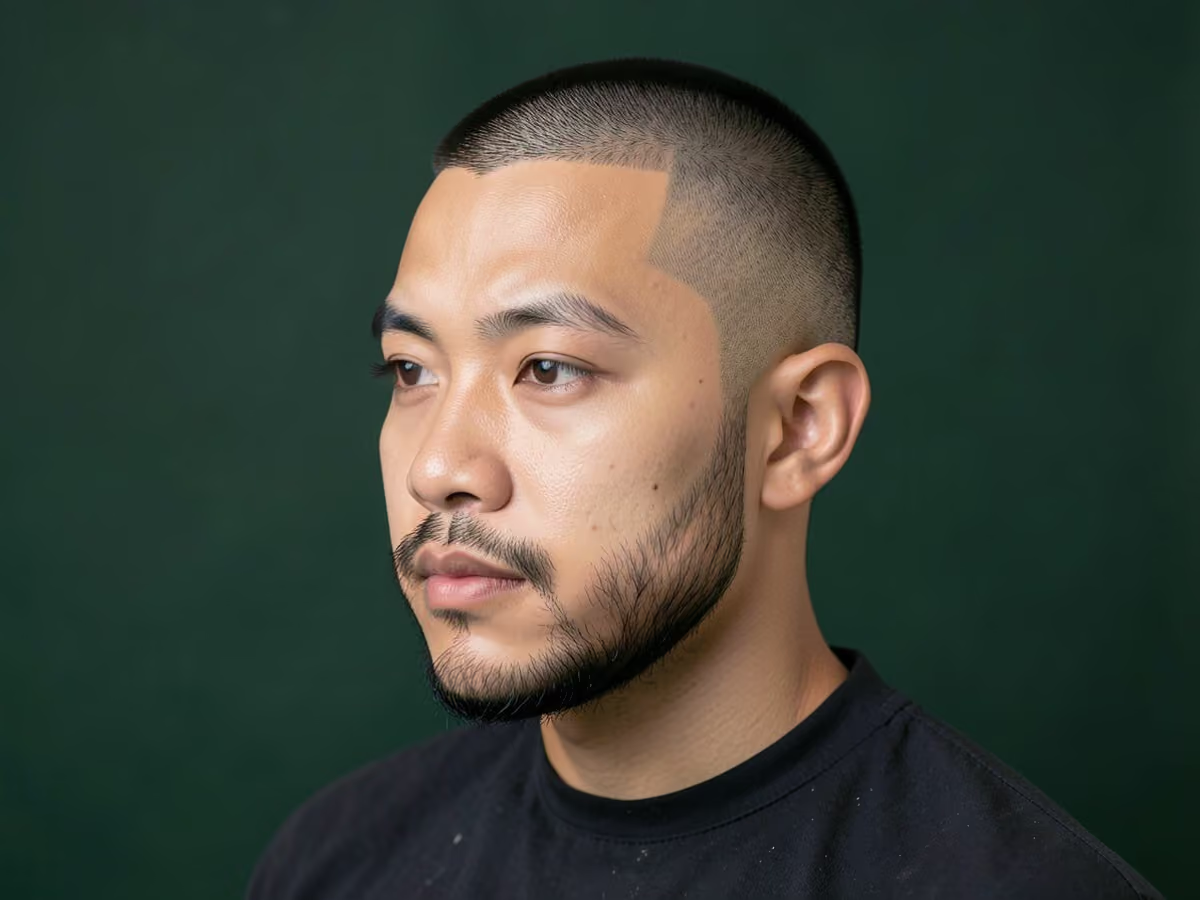
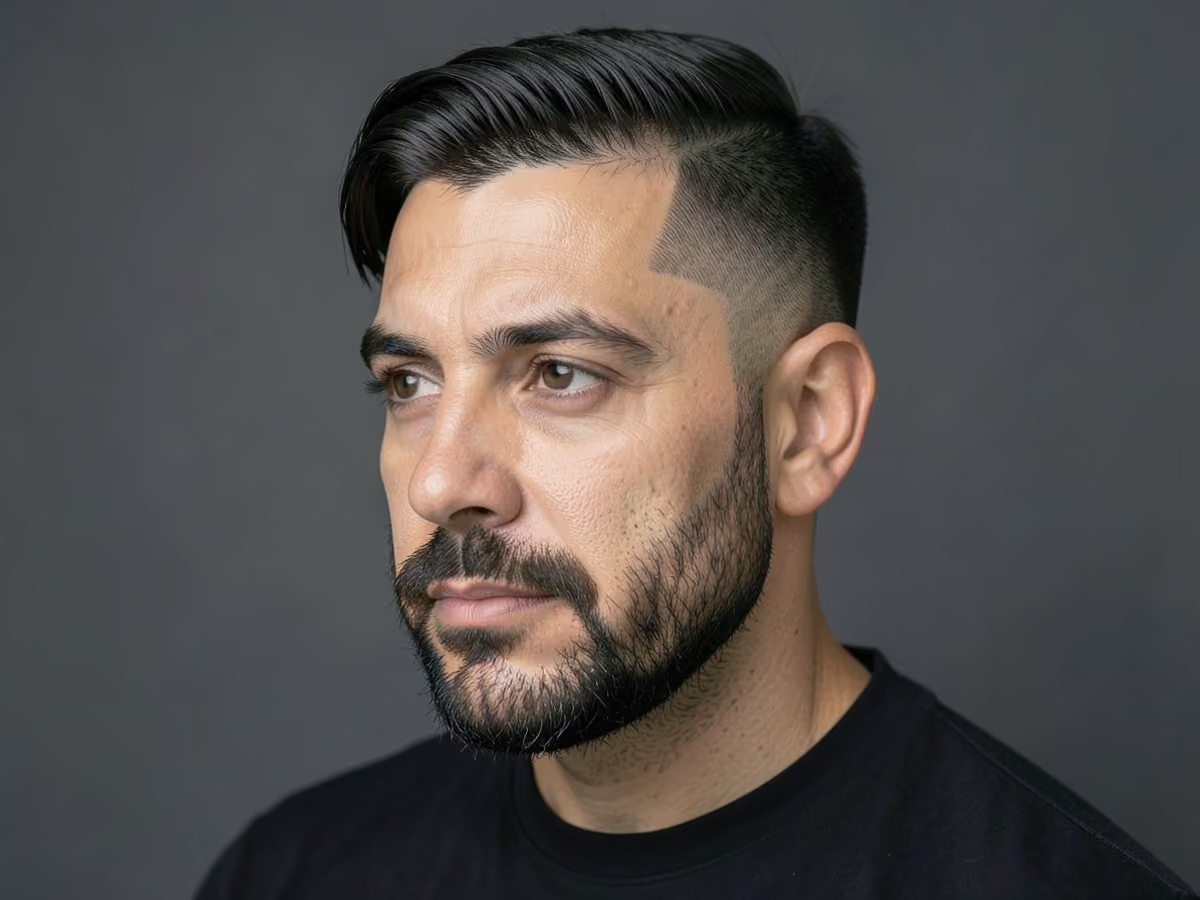
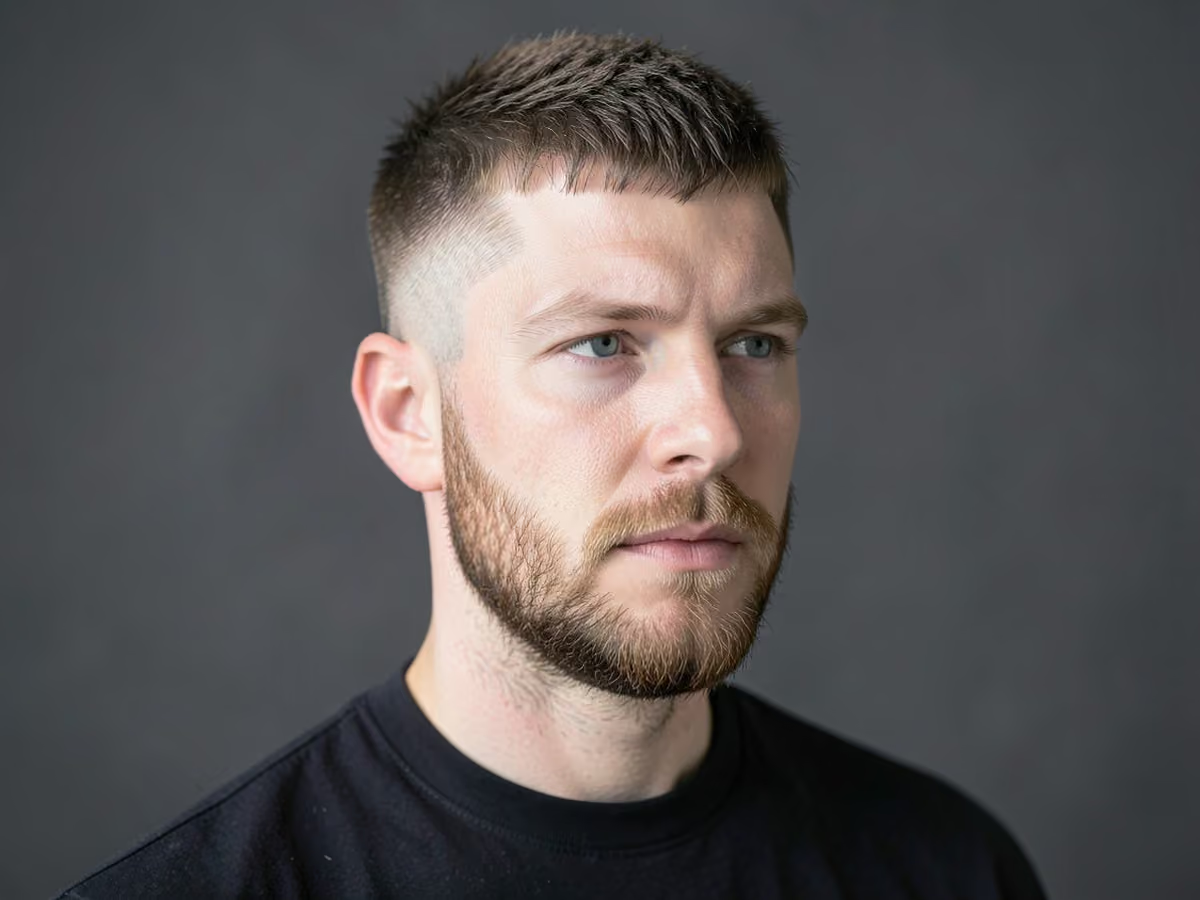
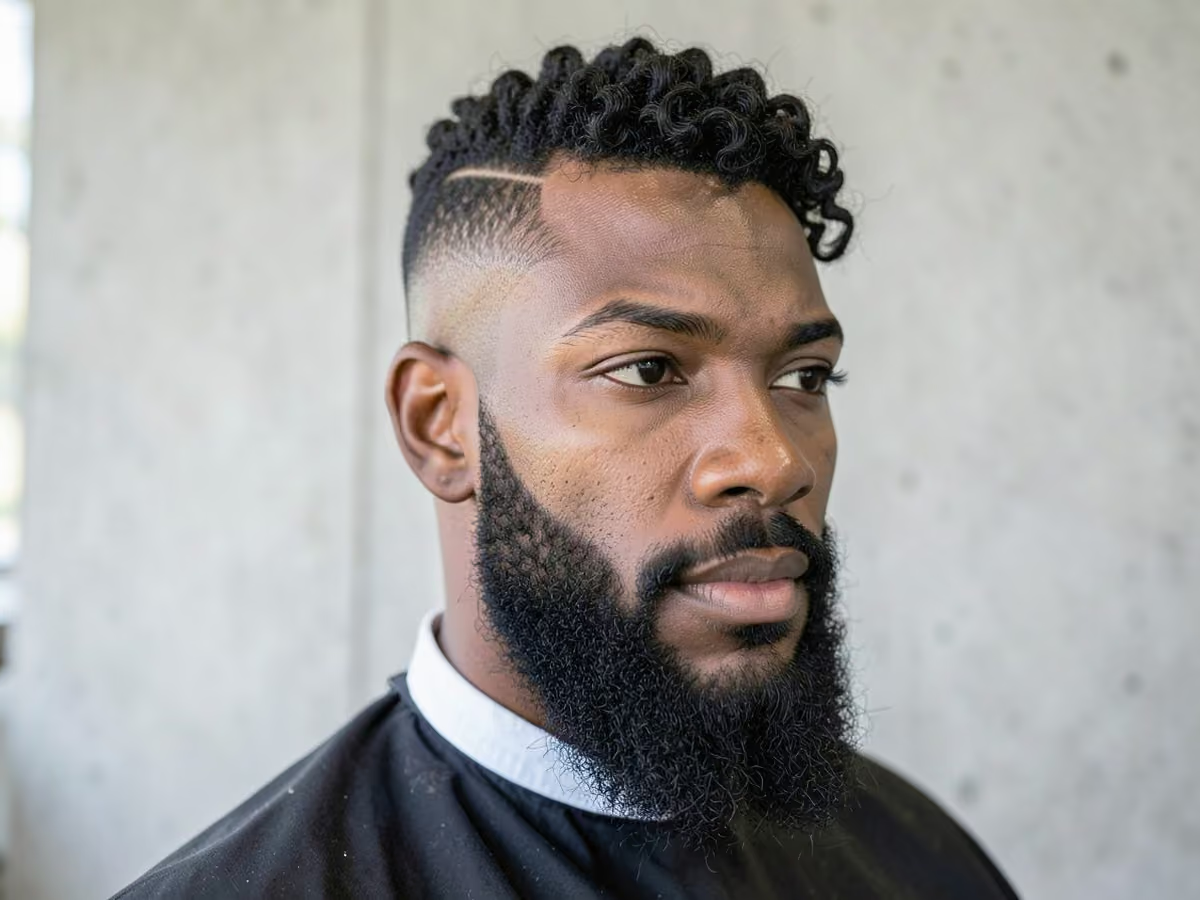
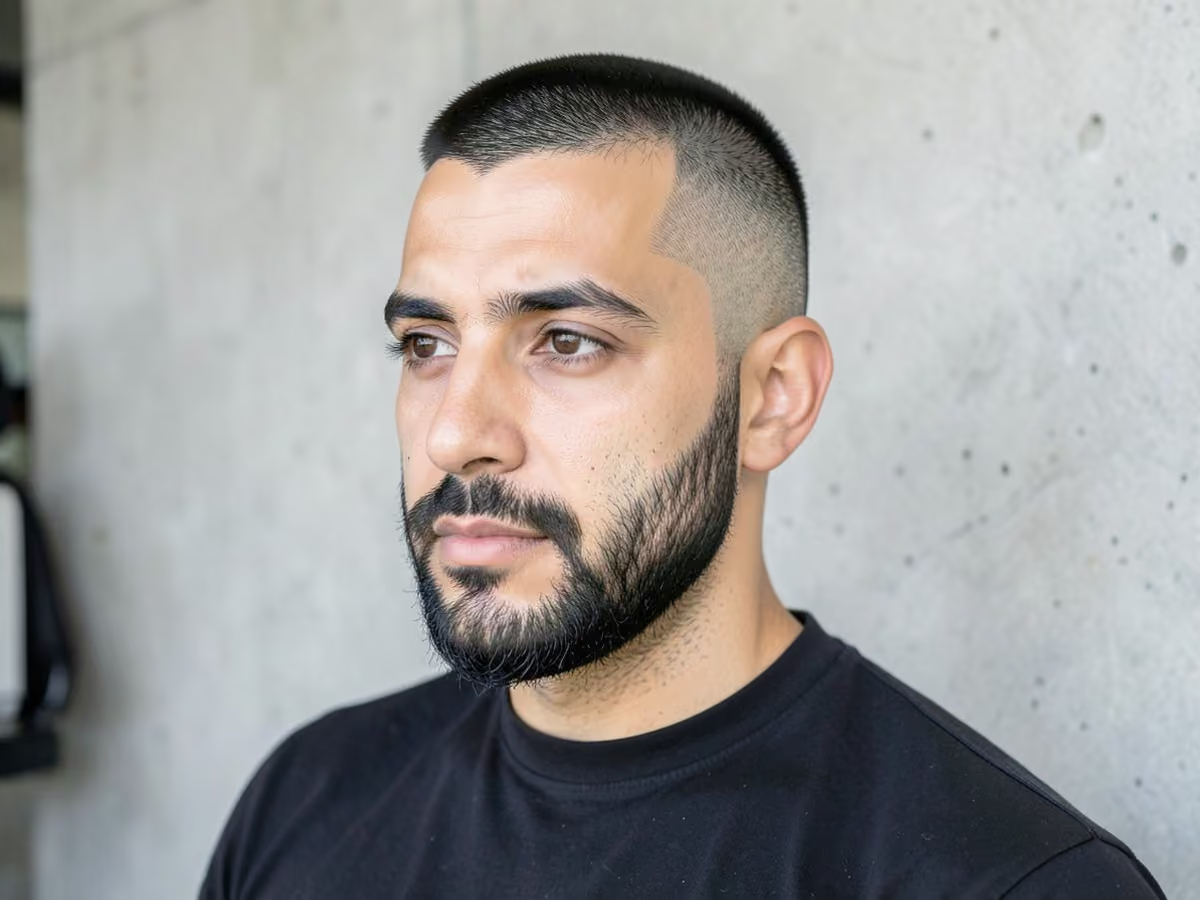
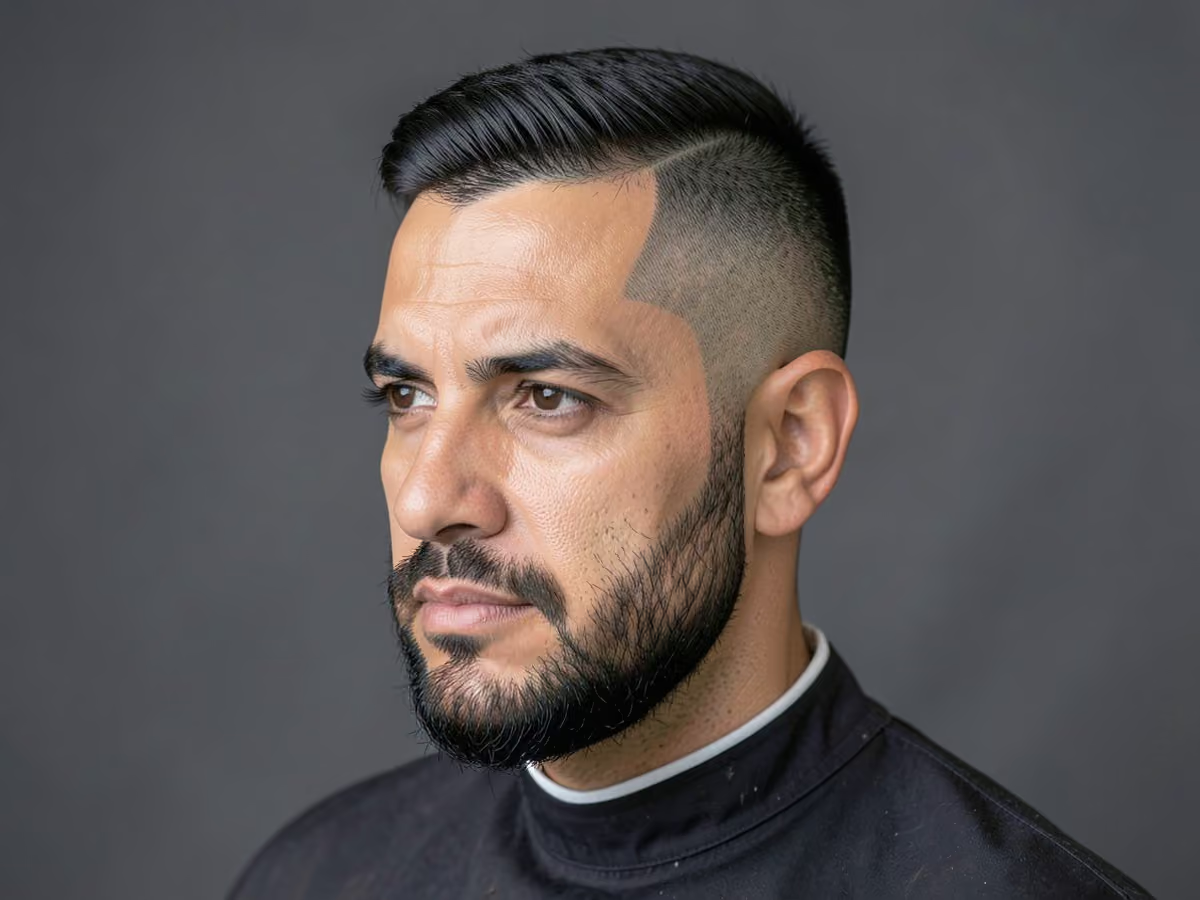
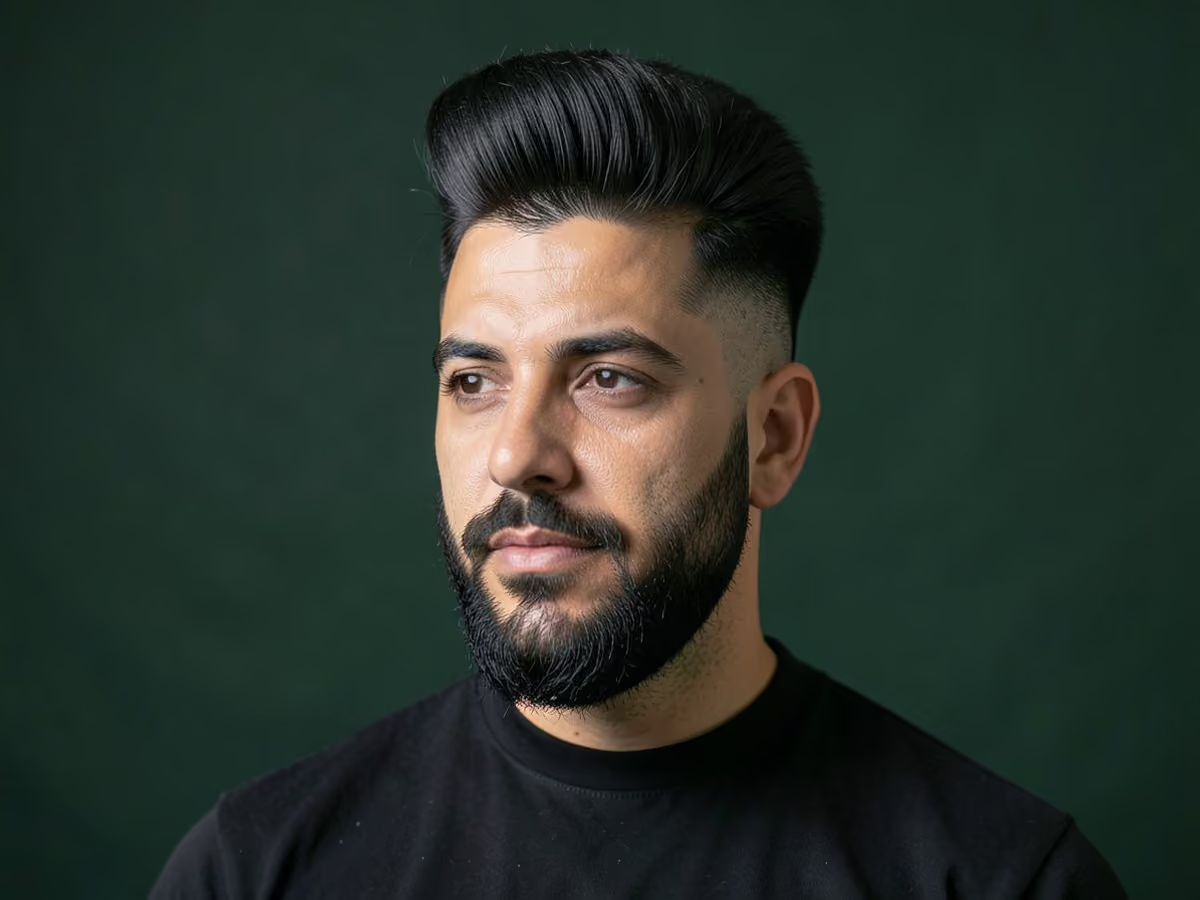
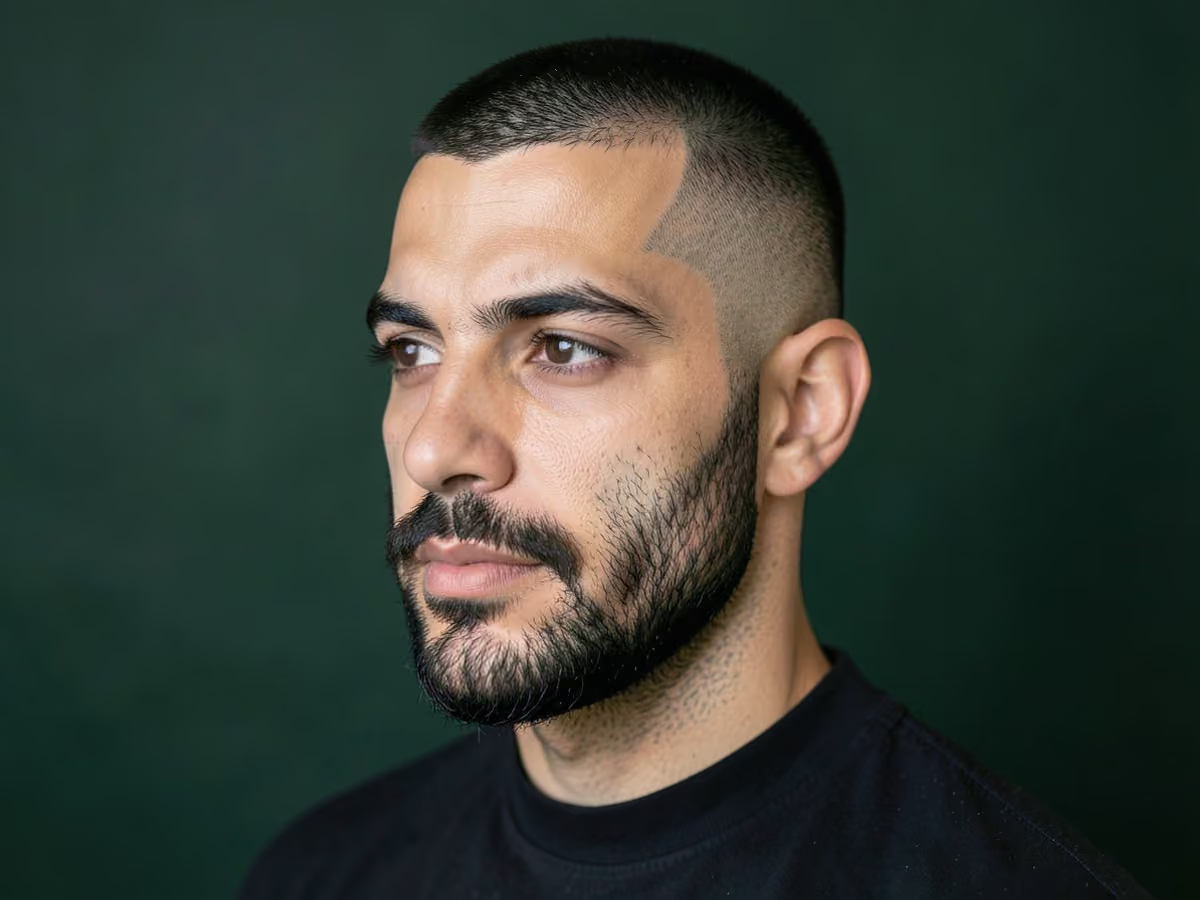
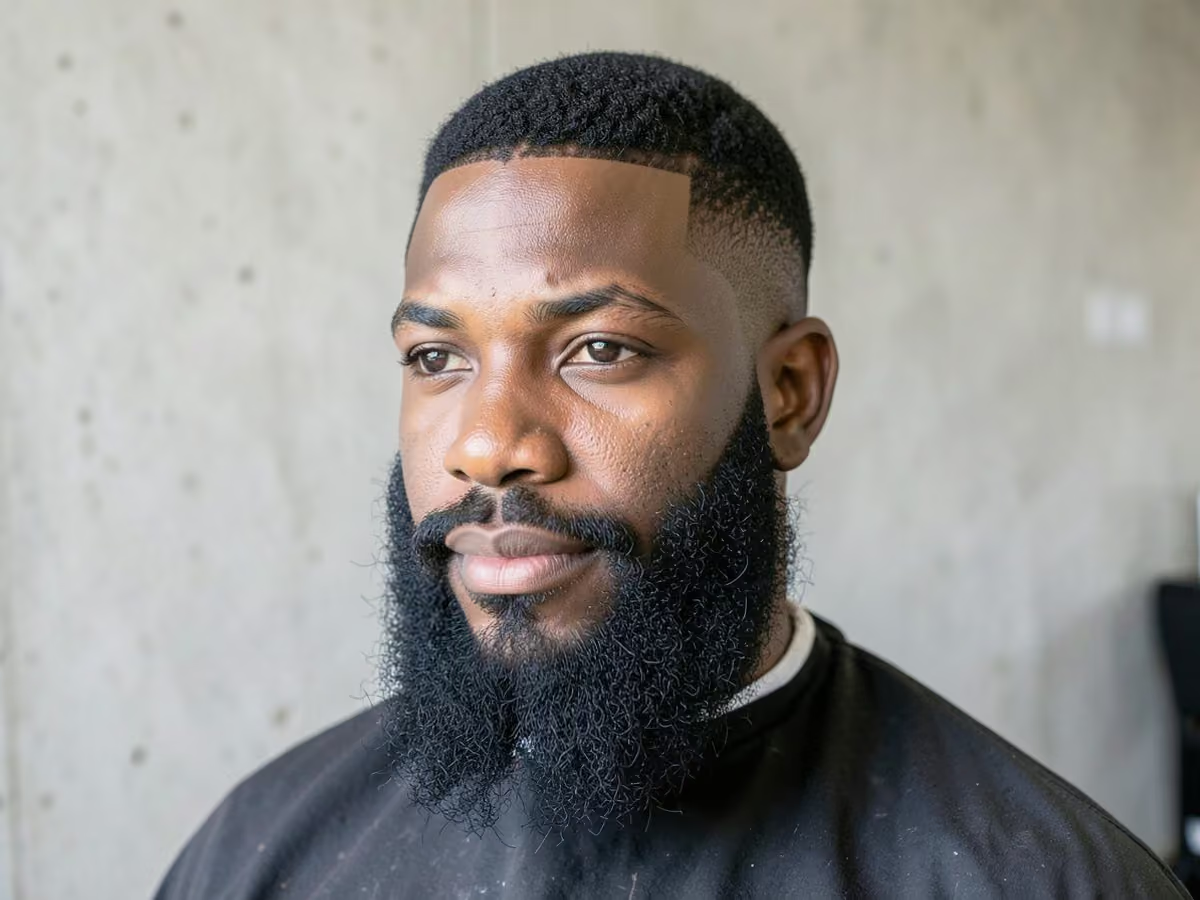
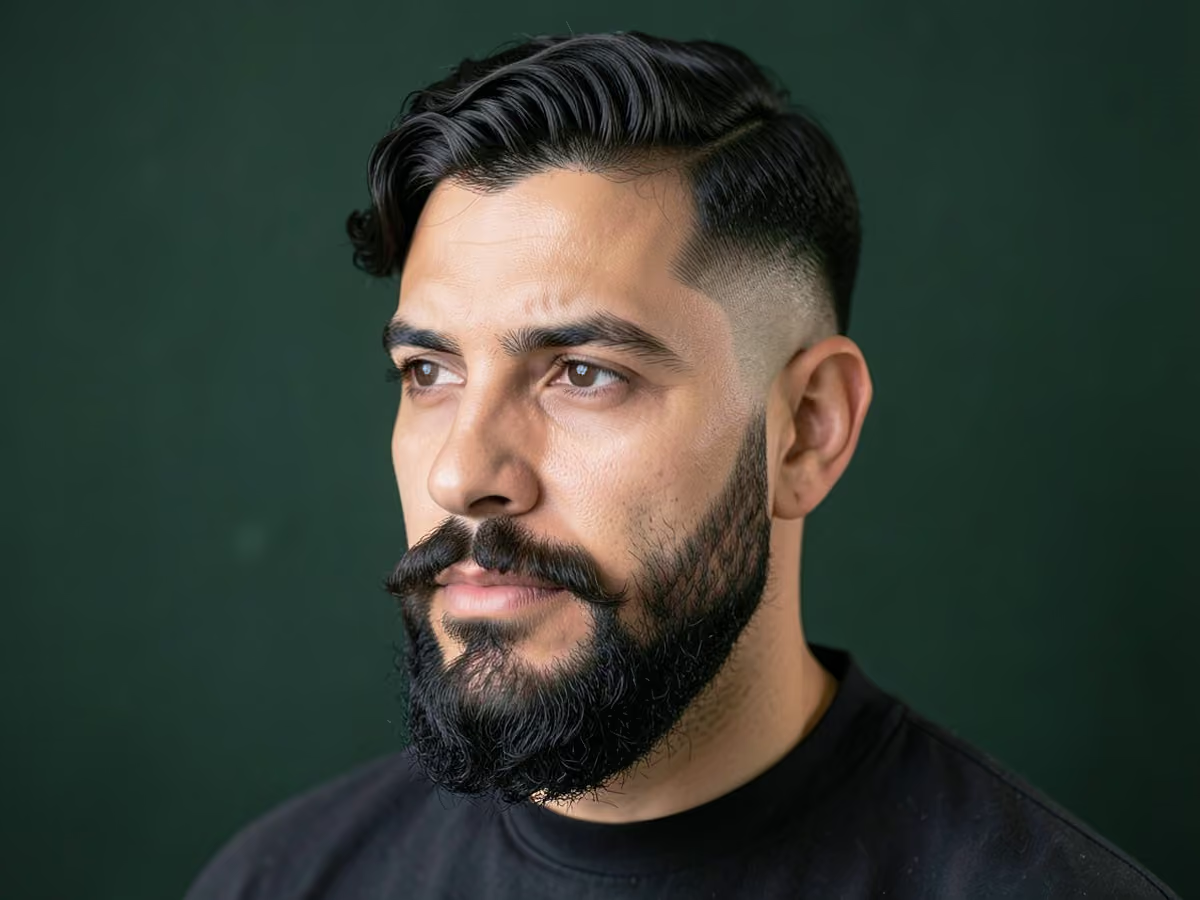
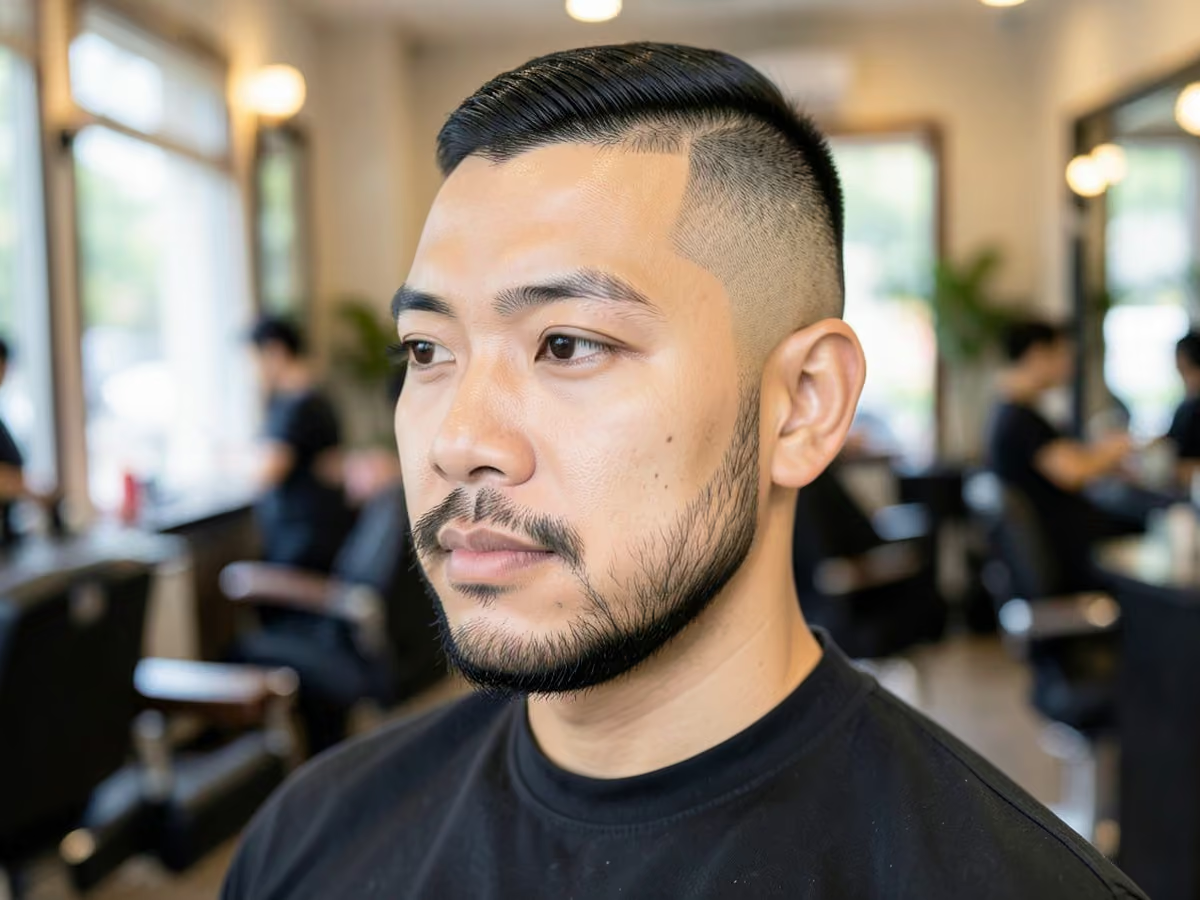
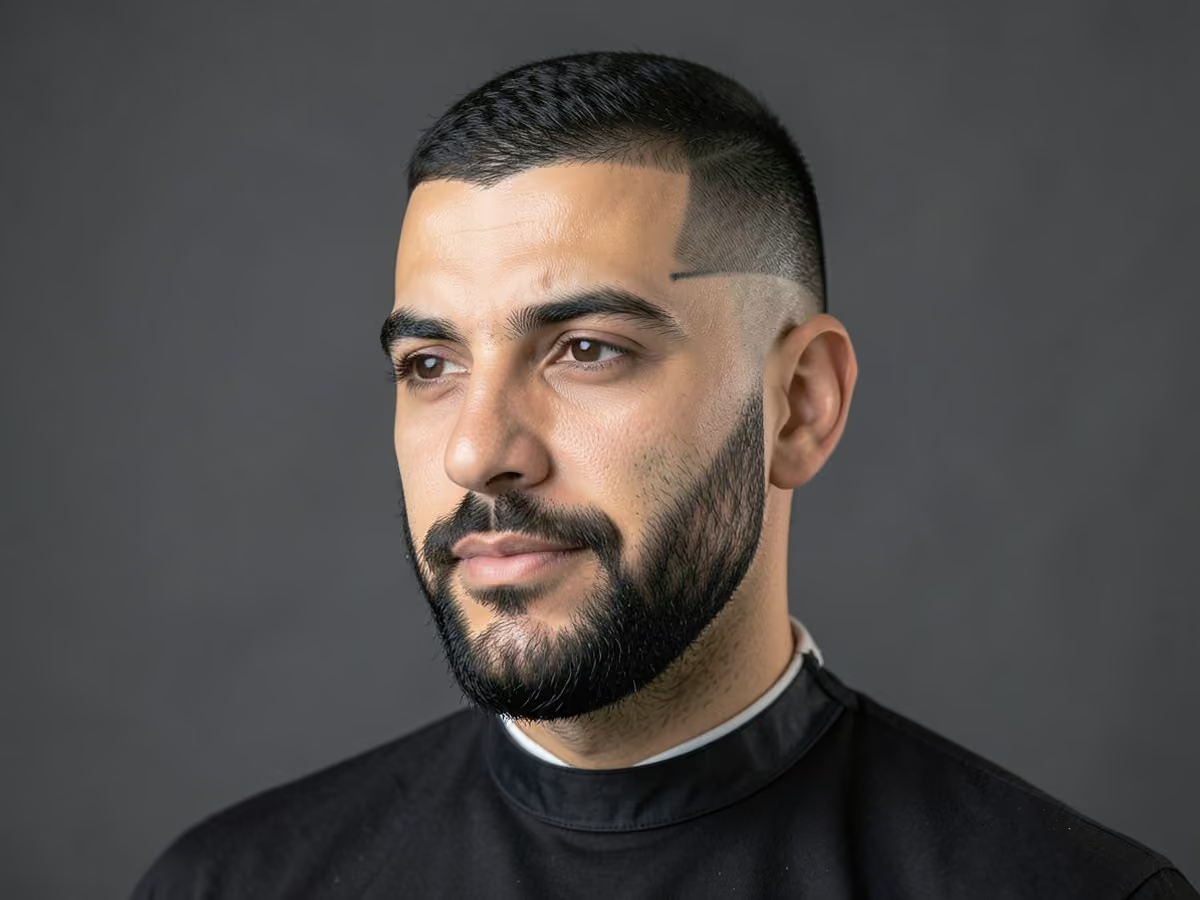
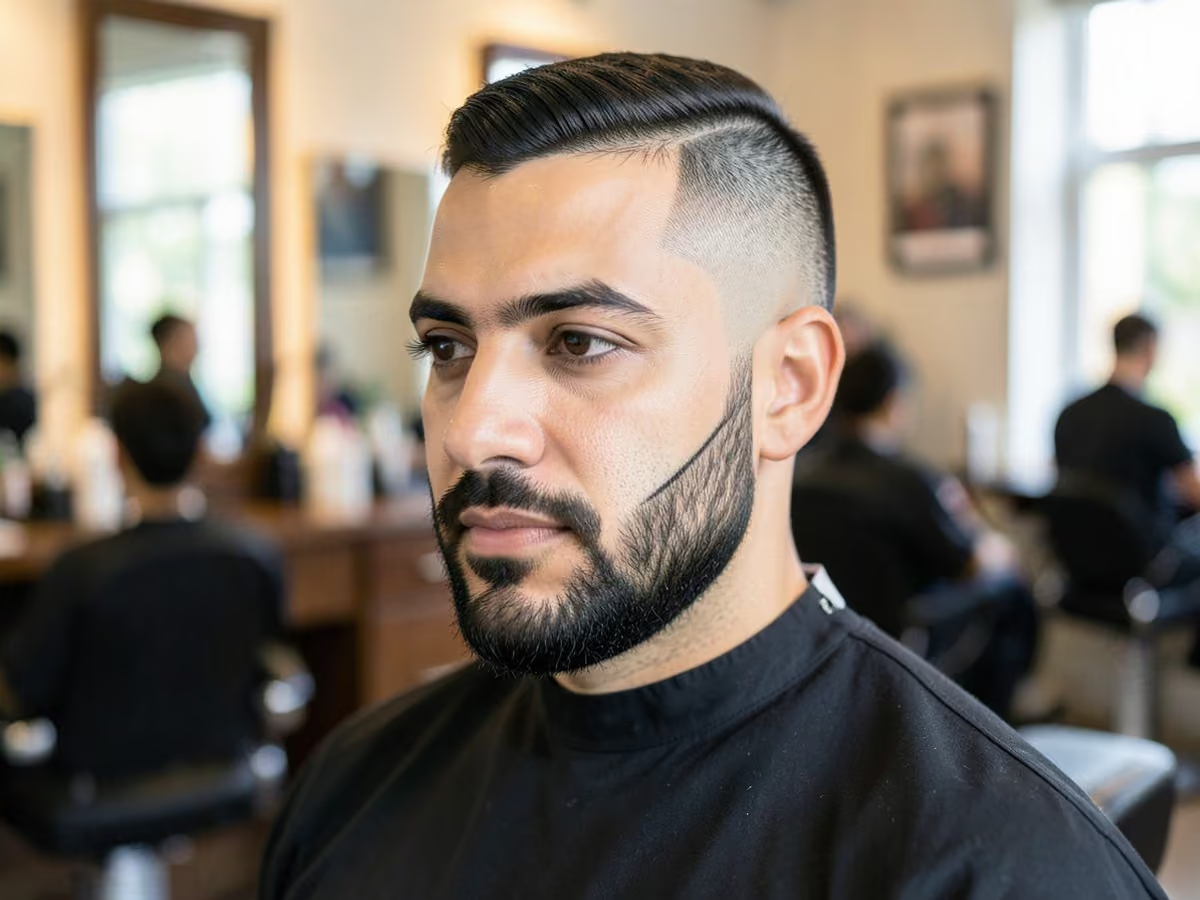
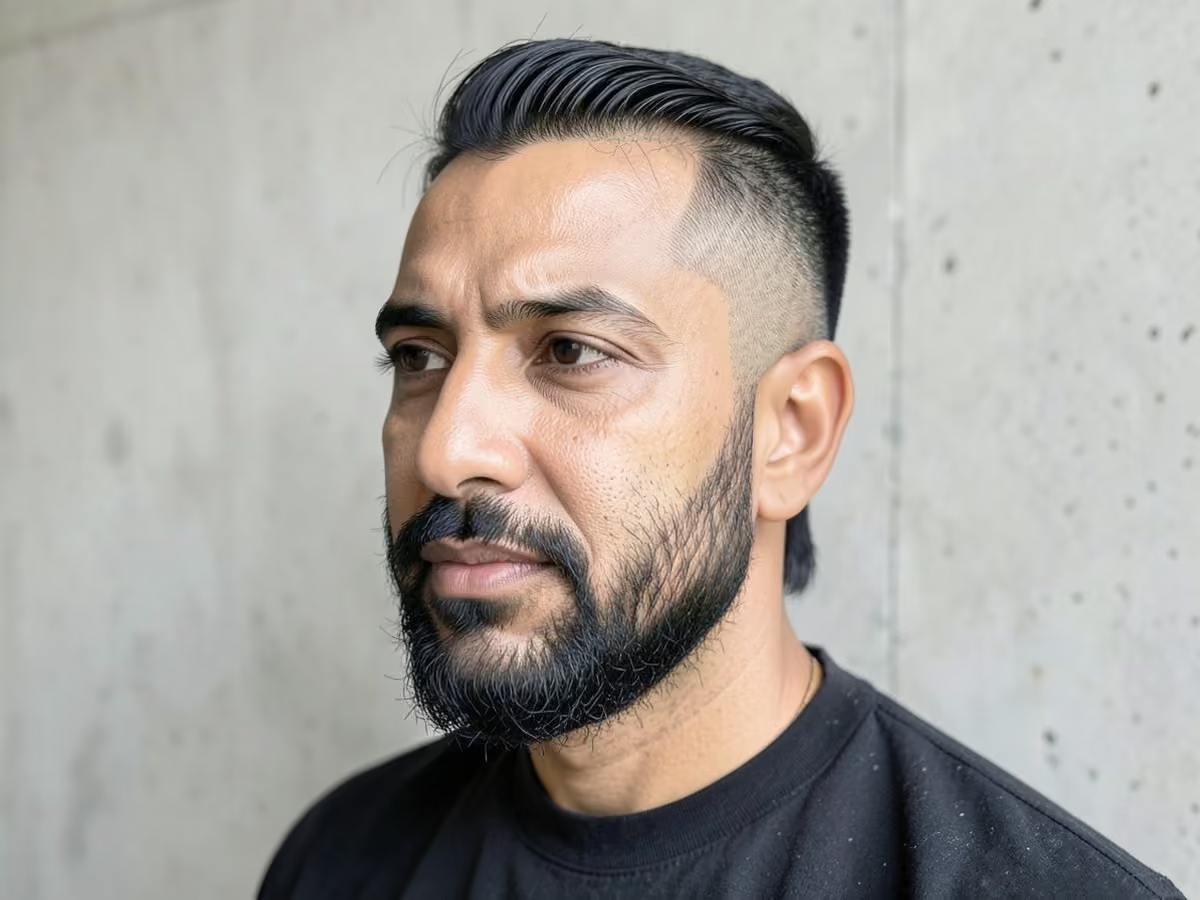
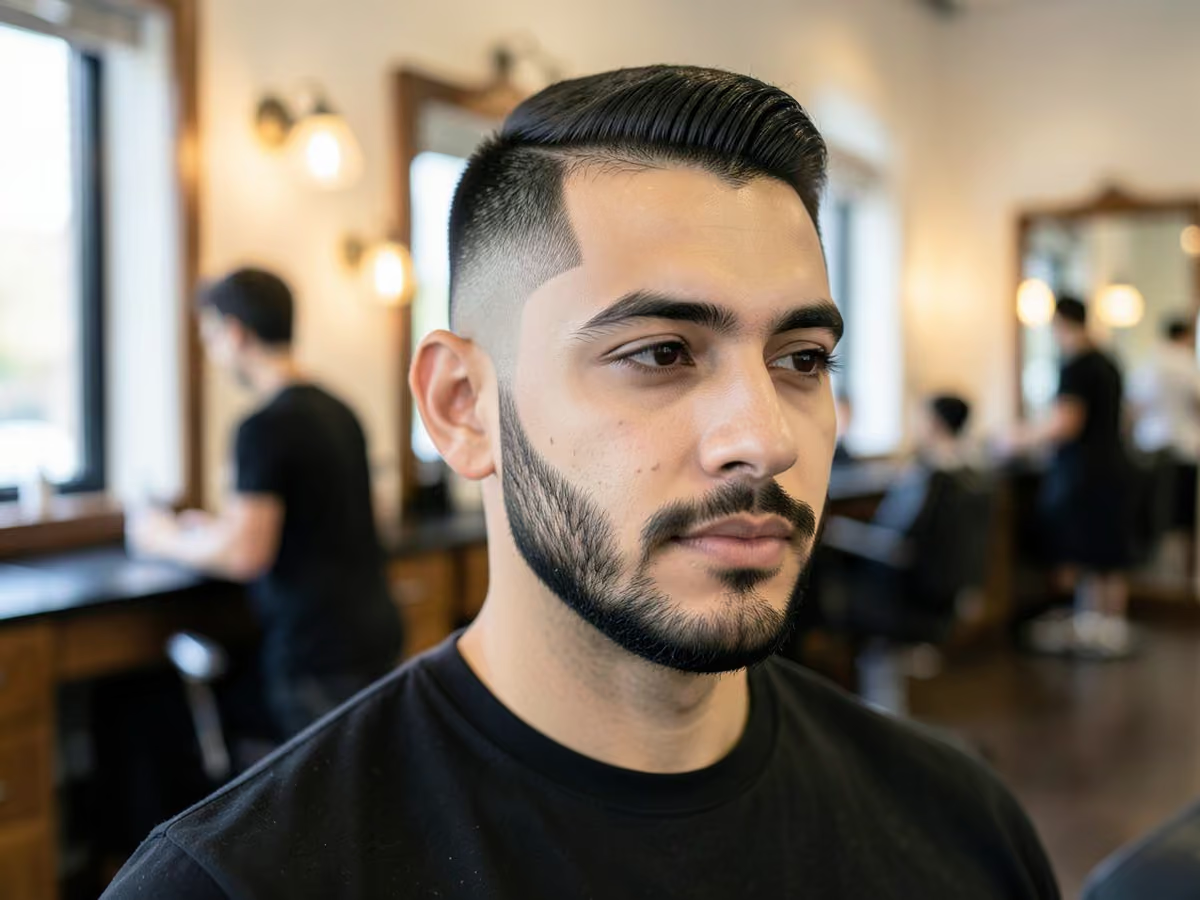
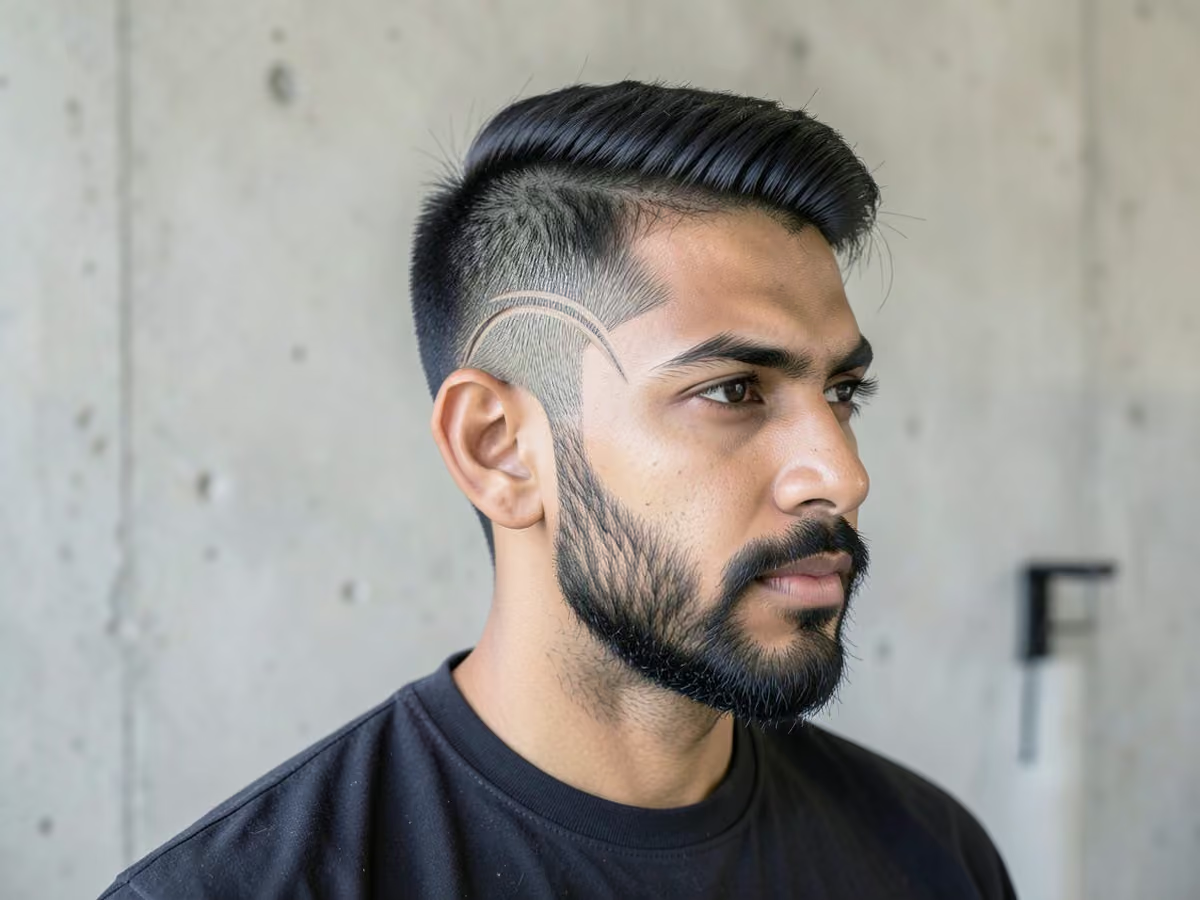
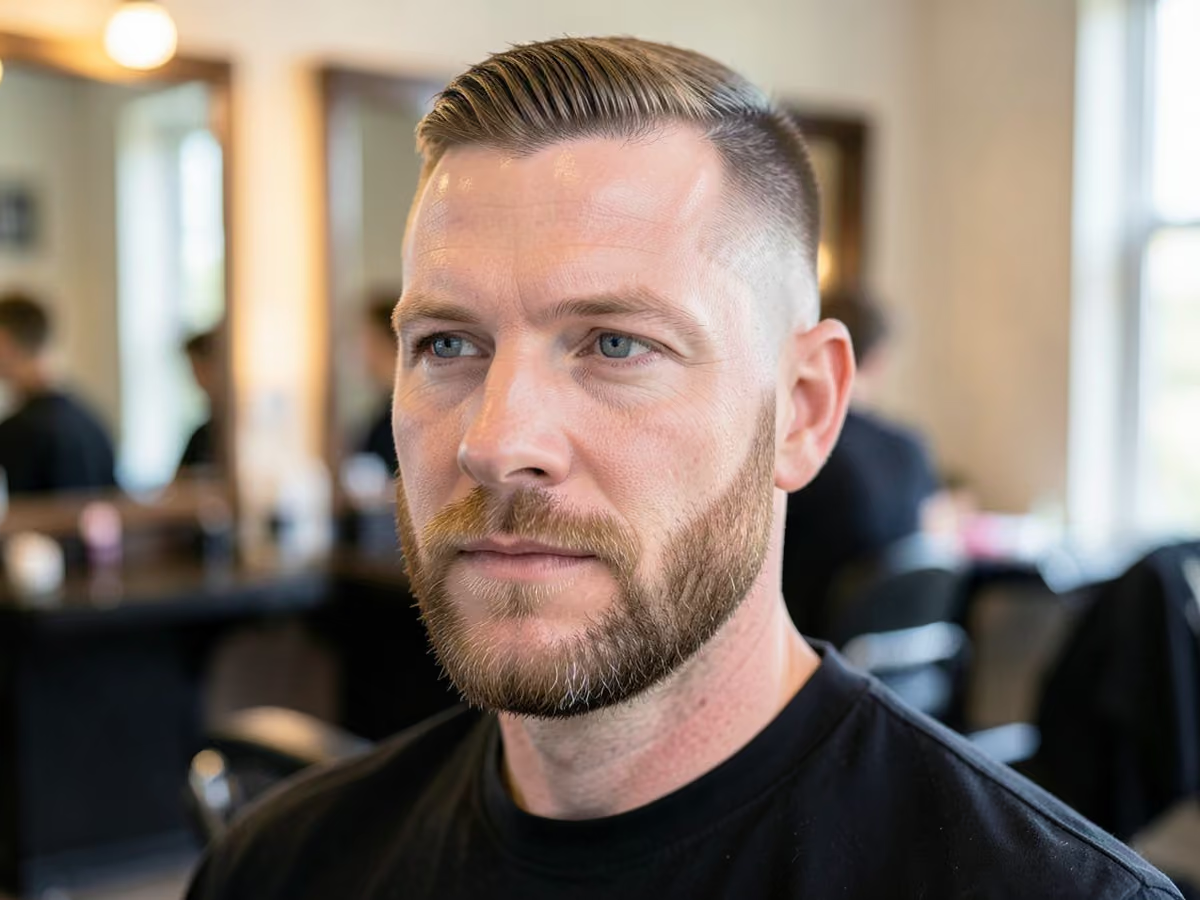
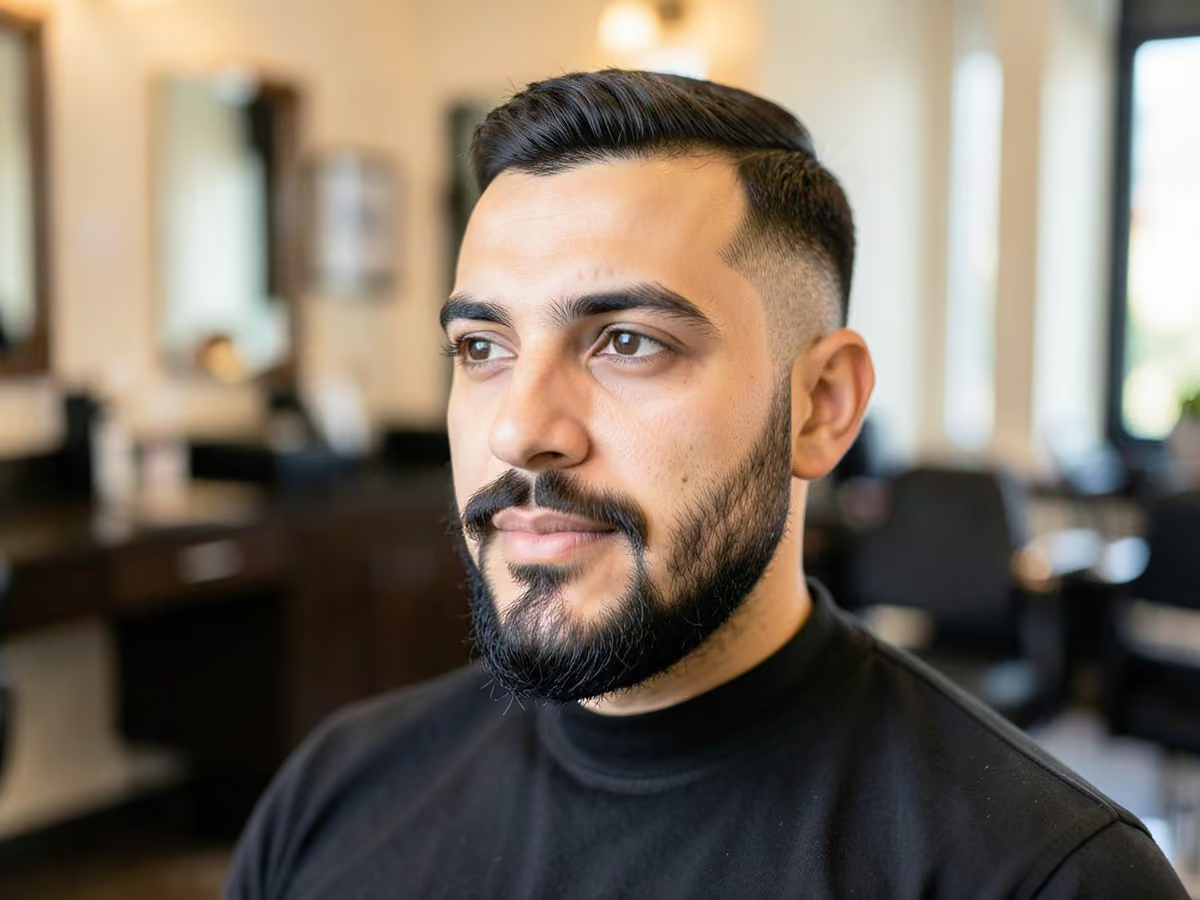
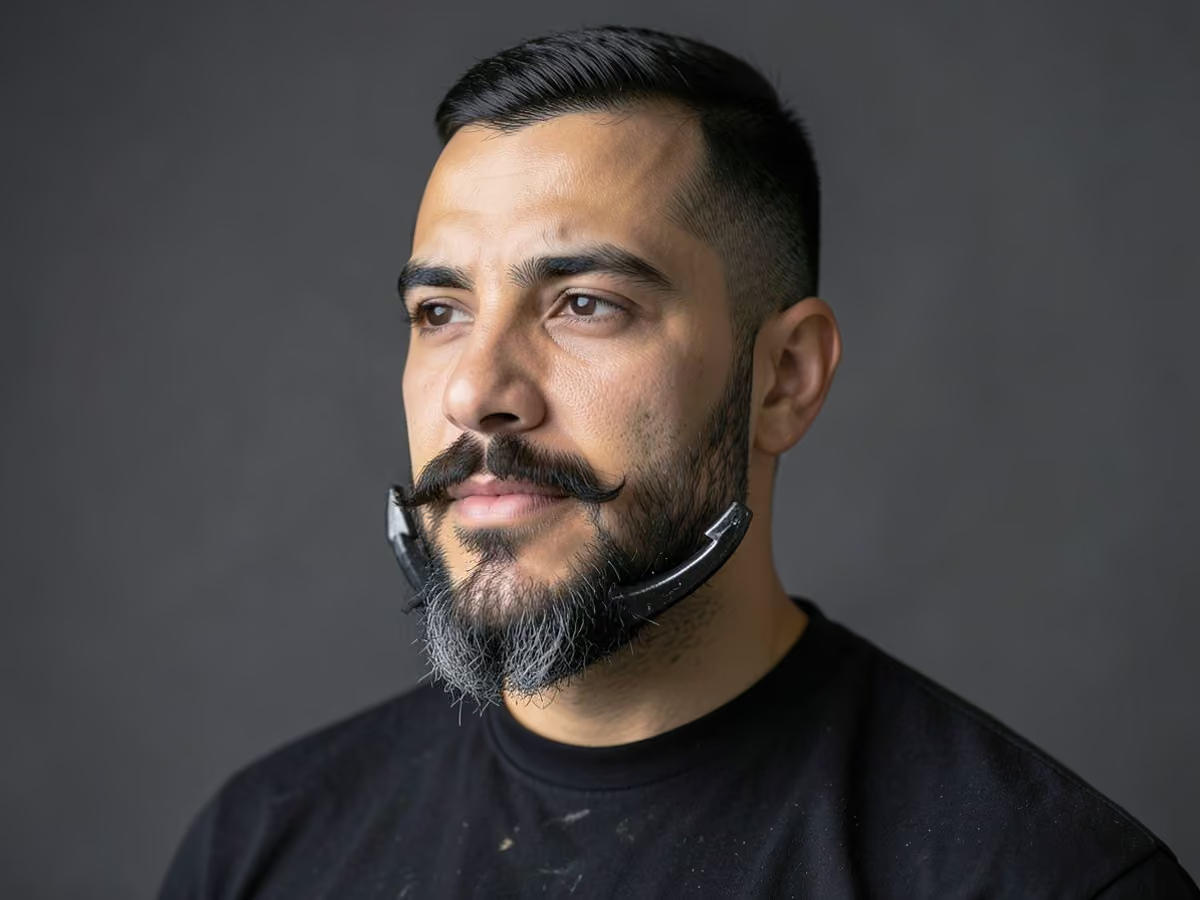
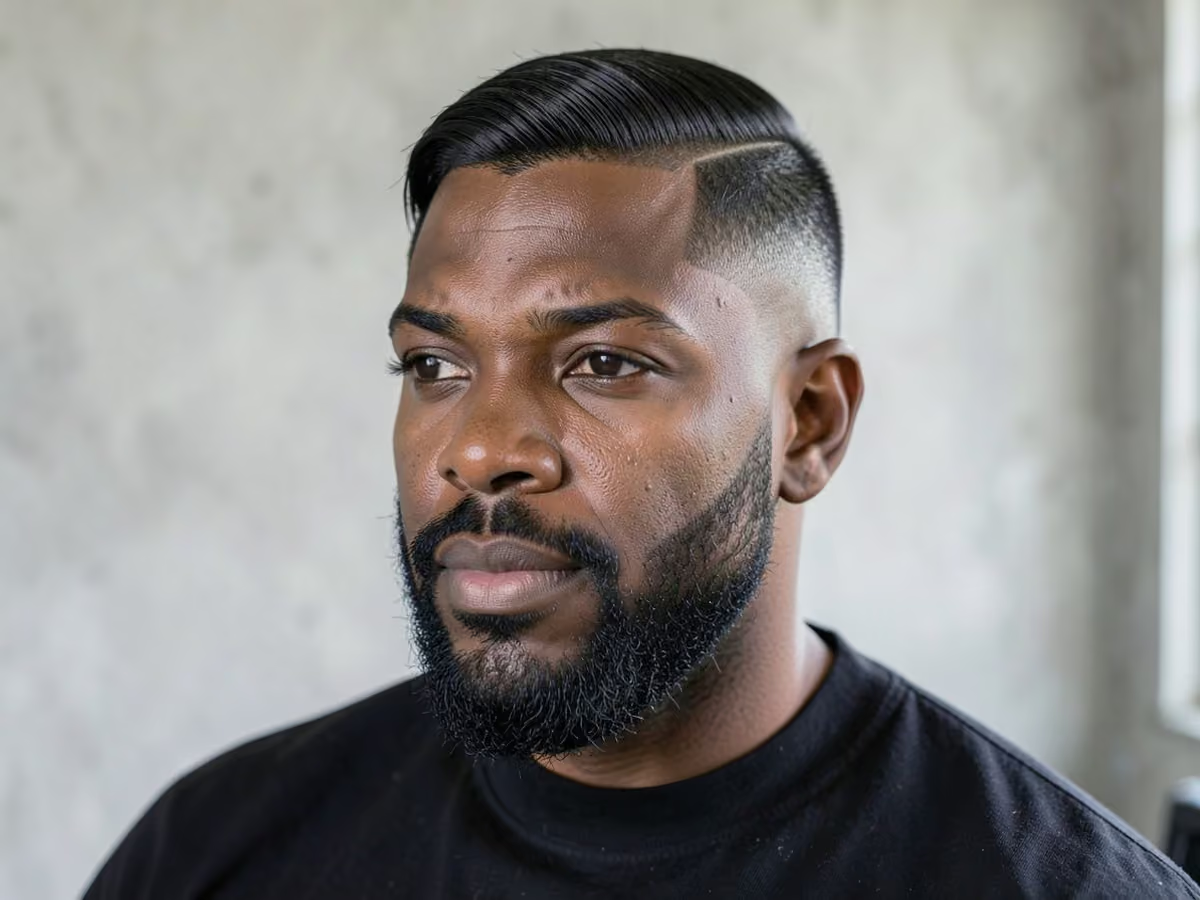
Quick answer: A beard fade is a gradual blend from the short hair of a fade haircut, through the sideburn, into the full length of the beard. The barber steps through clipper guards, often from skin or a #0 at the temple to a #1, #2 and #3, until the sideburn meets the beard length on the cheek.
Beard Fade Styles at a Glance
Every style on this page with its clipper guard, top length and trim interval. Tap a name to jump to that card.
A beard fade connects your haircut and beard so there is no hard step at the sideburn. Instead of the hair stopping at one length and the beard starting at another, the barber blends the two through a run of clipper guards. Below are 61 faded beard styles grouped by fade height, beard length, beard shape, haircut and beard texture, each with the guard numbers to ask for.
What Is a Beard Fade?
A beard fade is the part of a cut where the hair fade on the side of the head continues down through the sideburn and into the beard. Without it, a skin fade at the temple would sit right next to an inch of beard, leaving an abrupt jump in length. With it, the sideburn starts at the same short length as the bottom of the fade and lengthens one guard at a time until it matches the beard on the cheek. Barbers sometimes call it a beard taper or a sideburn fade.
The beard fade also works in the other direction on the neck, where some barbers fade the beard under the jaw from full length down to skin at the neckline. That neck fade gives a softer edge than a hard razor line. Both versions use the same tools: clippers with guards, a trimmer for the details and often a foil shaver or razor for the shortest part.
How Is a Beard Fade Different from a Disconnected Beard?
A disconnected beard leaves a visible break between hair and beard. The sideburn is shaved or cut to a different length, so the two read as separate shapes. Goatees, Van Dykes, Balbos and circle beards are naturally disconnected, because there is no cheek hair to blend. A beard fade only applies when the beard covers the cheeks and meets the sideburn. The table compares the two approaches and a hard-line version that sits between them.
Pick a beard fade when you want one shape from crown to chin, and a disconnected look when the beard style leaves the cheeks clean. The hard cheek line version keeps the blend at the sideburn but adds a sharp edge on the upper cheek, which suits dense beards that grow high on the face. Our guide to skin fade beard styles shows how each looks with bare sides, and the Van Dyke beard guide covers a classic disconnected shape.
How Is a Beard Fade Different from a Disconnected Beard?
Approach
Sideburn
Suits
Upkeep
Beard fade
Blended through #1 to #3
Full, boxed and short beards, stubble
Barber every 2 to 3 weeks
Beard fade with hard cheek line
Blended, plus razor line on the cheek
Coily and dense beards, line-ups
Edge every few days
Disconnected beard
Shaved or kept separate
Goatee, Van Dyke, Balbo, circle beard
Shave cheeks every 1 to 2 days
Who Should Get a Beard Fade?
Anyone with a fade haircut and a beard that covers the cheeks benefits, because the blend removes the step that would otherwise show at the ear. It suits square and round faces especially, since the shorter sideburn takes width away from the upper cheeks while the beard keeps mass at the jaw. Men with patchy cheeks also gain, because the fade shortens the thin upper cheek area where gaps show most, and leaves length lower down where the beard is denser.
A beard fade is less useful when the haircut has no fade at all, such as shoulder-length hair or a scissor cut with full sides. In that case the barber blends the sideburn with scissors instead. Men with very light or sparse beards may find the faded part almost invisible, so a short even length or low fade with stubble often looks better.
Filter the styles
Showing all 61 styles
Fade
Hair
Length
Beard Fade by Height
Height here means how far the blend reaches: only the top of the sideburn, the whole sideburn or down onto the cheek. Each card names the guards from the hair fade into the beard. See fade types for head heights.
Trim:Every 3 weeks. Only the upper sideburn changes length.
Best For:Oval, long faces + straight or wavy hair.
About This Style
Only the top inch of the sideburn is blended, from a #1 at the temple to the beard length by the middle of the ear. The cheek keeps its full length all the way up to the cheek line. Since it removes little beard, a long face keeps width at the cheeks. It pairs with a low fade or taper on the head and needs touch-ups less often than a higher blend.
How to Style at Home
Brush the beard downward after washing so the sideburn lies flat.
Trim the full beard with your usual guard once a week.
Leave the sideburn blend to the barber unless you can match both sides.
Ask Your Barber
"Low fade on the head. Blend only the top of the sideburn from a #1 into a #4 beard by the middle of the ear, cheeks left full."
Trim:Every 2–3 weeks. The sideburn blend softens after two weeks.
Best For:Oval, square faces + straight or thick hair.
About This Style
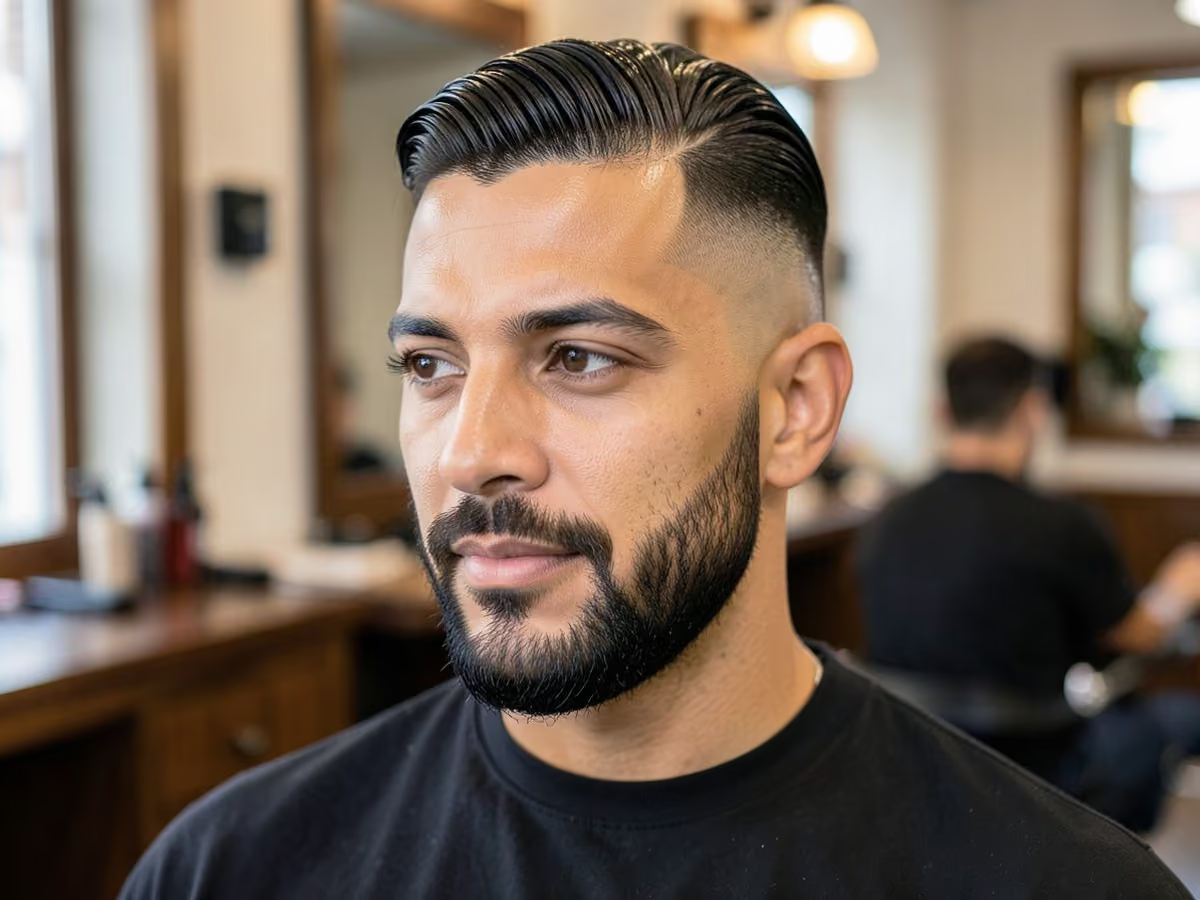
Covering the whole sideburn, the mid beard fade starts at a #0 or #1 at the temple and reaches the full beard length at the ear lobe. It is a common version and sits under a mid fade. The cheeks keep their length from the lobe down, so the jaw still looks full. Ask for steps of one guard at a time to avoid lines.
How to Style at Home
Apply beard oil to the skin at the sideburn, where the hair is shortest.
Trim the beard below the ear lobe with your regular guard.
Check both sideburns end at the same height in the mirror.
Ask Your Barber
"Mid fade on the head. Blend the sideburn from a #0 through a #1, #2 and #3 into a #5 beard by the ear lobe."
Trim:Every 2 weeks. The faded cheek shows growth quickly.
Best For:Round, wide faces + thick or coarse hair.
About This Style
In a high beard fade the blend continues past the sideburn onto the upper cheek, reaching the full beard length near the jaw. The upper cheek is short, around a #1 or #2, and the beard grows longer toward the chin. This slims a round or wide face by removing width at the cheekbones. It suits dense beards that can take a sharp gradient.
How to Style at Home
Brush the beard downward to show the gradient on the cheek.
Trim only the lower beard at home with a long guard.
Book regular visits so the cheek gradient does not grow into one length.
Ask Your Barber
"High skin fade on the head. Carry the beard fade down onto the cheek, from a #1 at the cheekbone to a #6 at the jaw."
Trim:Every 1–2 weeks. Shaved skin shows stubble within days.
Best For:Oval, square faces + coarse or coily hair.
About This Style
Starting with bare skin at the top of the sideburn, the barber uses a razor or foil shaver for the shortest section and then clippers up to the beard. It pairs with a skin or bald fade on the head, so the skin runs from the temple into the sideburn with no break. The contrast is sharp but grows out fast. Men with sensitive skin may get bumps from the razor section.
How to Style at Home
Apply a soothing scalp oil to the shaved area after cutting.
Avoid hot water on the fresh razor area for a day.
Book a sideburn clean-up after one week if you want the skin kept bare.
Ask Your Barber
"Skin fade on the head. Razor the top of the sideburn to skin, then blend through a #0.5, #1 and #2 into a #4 beard."
Trim:Every 3–4 weeks. No skin means a slower grow-out.
Best For:Oval, long faces + fine or light hair.
About This Style
No skin is shown in a shadow beard fade. The shortest point at the sideburn is a #1 or #1.5, so it leaves a gray shadow rather than bare scalp. It suits men who visit the barber monthly, because the blend stays readable longer. Fair skin and light hair benefit too, since a skin fade can make the sideburn look like it vanishes. Pair it with a shadow fade on the head.
How to Style at Home
Trim the beard with your regular guard every week.
Clean up only the neckline between visits with a trimmer.
Use beard balm to keep the sideburn hairs flat.
Ask Your Barber
"Shadow fade on the head with a #1 at the bottom. Blend the sideburn from a #1 to a #4 beard, no skin anywhere."
Trim:Every 2 weeks. The curve behind the ear loses shape fast.
Best For:Oval, square faces + coarse or coily hair.
About This Style
A drop fade curves down behind the ear toward the nape, so the lowest point is at the back rather than at the temple. The sideburn is blended from the top of the curve into the beard in front of the ear. With the fade lower behind the ear, the beard connection sits slightly higher than usual. Barbers often add a sharp line-up at the temple. See our drop fade guide.
How to Style at Home
Brush the beard forward and down after oiling it.
Keep the temple line-up crisp with an edge brush.
Clean the curve behind the ear with a trimmer if you can see it.
Ask Your Barber
"Drop fade curving behind the ear. Connect the sideburn from a #0 at the temple into a #4 beard by the ear lobe, with a line-up."
Trim:Every 2–3 weeks. Temple corners lose their shape quickly.
Best For:Oval, square faces + straight, wavy or coily hair.
About This Style
Also called a temp fade, this cut fades only the temple area and the hair just above the ear, leaving the back fuller. The sideburn then drops from a #0 at the temple to a #2 at the ear and joins a short beard at a #3. Because the work is concentrated at the front, the head keeps its rounded shape at the back. Barbers often finish it with a line-up.
How to Style at Home
Brush the hair at the temples flat toward the line each morning.
Trim the beard with a #3 guard about once a week.
Rub beard oil into the cheeks and the blended sideburn.
Ask Your Barber
"Temple fade from a #0, sideburn into a #2 at the ear, then my beard at a #3. Keep the back full."
Best For:Oval, round faces + straight or wavy hair.
About This Style
Instead of fading the whole side, a low taper touches only the sideburn and the nape, so the head keeps a #3 or scissor length above the ear. The sideburn runs from a #2 near the ear into the beard at a #3 or #4. It is the most conservative way to connect hair and beard, which suits offices and men who want the blend without visible skin.
How to Style at Home
Trim the beard with a #4 guard once a week.
Comb the sideburn downward in a mirror to check the blend.
Smooth a little beard balm over the cheeks to keep the hair flat.
Ask Your Barber
"Taper only the sideburns and nape, #3 above the ears. Run the sideburn from a #2 into my beard at a #4, no skin."
Recommended Products
Beard Balm
Styling Cream
Beard Fade by Beard Length
The longer the beard, the more guard steps the barber needs between the sideburn and cheek. These cards run from stubble to long beards, with the number of steps each length takes.
Trim:Every 2–3 weeks. Stubble needs a guard trim twice a week.
Best For:Oval, square faces + straight or wavy hair.
About This Style
Short stubble at a #1 or #2 needs only one or two steps from the fade. The barber takes the sideburn from skin or a #0 to the stubble length in less than an inch of space. Because the difference is small, a clean blend is quick, and the whole side of the face reads as one even shadow. It is a good first beard fade for men starting to grow facial hair.
How to Style at Home
Run a #2 guard over the stubble every three days.
Shave the neck below the jaw to keep the edge clean.
Rub a drop of beard oil in to stop itching.
Ask Your Barber
"Low skin fade on the head. Blend the sideburn from a #0 into #2 stubble in one short step, cheek line left natural."
Trim:Every 3 weeks. The blend and beard grow at the same pace.
Best For:Oval, round faces + thick or wavy hair.
About This Style
A medium beard, around 3/4 to 1 inch, needs three or four guard steps through the sideburn. The barber typically goes from a #0 to a #1, #2, #3 and #4, then blends into the beard with a longer guard or scissors. More steps mean the blend takes up more of the sideburn, so it often finishes at the ear lobe. The beard keeps full width along the jaw.
How to Style at Home
Brush the beard downward with a boar bristle brush.
Apply beard balm to shape the sides and control flyaways.
Trim the outline every week, not the bulk.
Ask Your Barber
"Mid fade on the head. Blend the sideburn from a #0 through a #4 into a beard of about an inch, finishing at the ear lobe."
Trim:Every 3–4 weeks. Long beards need shaping, not frequent cuts.
Best For:Oval, oblong faces + thick or coarse hair.
About This Style
Over three inches of beard cannot be matched by guards alone, so the barber blends from clipper length to scissor-over-comb on the cheek. The sideburn starts short and lengthens through the guards to a #8, then scissors take it to full length. The result is a gradual wedge of hair from temple to jaw. A long beard fade keeps the head from looking wide next to a large beard.
How to Style at Home
Comb the beard with a wide-tooth comb while it is damp.
Apply beard oil from the roots to the ends.
Trim only split ends at home and leave the blend to the barber.
Ask Your Barber
"High fade on the head. Blend the sideburn through to a #8, then scissor blend into a long beard of about four inches."
Trim:Every 3 weeks. Bulky beards outgrow their shape quickly.
Best For:Square, oblong faces + thick or curly hair.
About This Style
Bushy beards spread outward as they grow, which can make the face look wide at the cheek. A fade at the sideburn and upper cheek pulls that width in, while the beard stays full at the chin and jaw. The barber removes bulk at the sides with clippers and leaves volume below. It is a common fix for men whose beard grows out more than down.
How to Style at Home
Blow-dry the beard downward on low heat to reduce puffiness.
Use beard balm to hold the sides flatter.
Trim the sides shorter than the chin with two guard sizes.
Ask Your Barber
"Mid fade on the head. Fade the sideburn and upper cheek from a #1 to a #5, and keep the bushy beard full at the jaw and chin."
Trim:Every 2 weeks. Box lines and fade both need sharpening.
Best For:Round, oval faces + straight or coarse hair.
About This Style
Here a short boxed beard at a #3 or #4 has straight cheek lines and square corners at the jaw. The sideburn fades into it from skin, and the cheek line is cut straight with a trimmer. The squared base and straight edges add structure to a round face. Upkeep is high, because both the fade and the box lines show regrowth within a week.
How to Style at Home
Trim the cheek line with a detail trimmer every few days.
Keep the jaw corners square with a #4 guard.
Shave below the neckline every two days to keep it sharp.
Ask Your Barber
"Skin fade on the head. Fade the sideburn from skin into a short boxed beard at a #4 with straight cheek lines and square corners."
Trim:Every 4–6 weeks. Shaping is mostly done with scissors.
Best For:Square, oblong faces + thick or wavy hair.
About This Style
Rugged and full, a lumberjack beard is two inches or more, shaped loosely around the jaw. Paired with a low fade or a scissor cut, the beard fade is gentle, starting at a #2 at the temple and running through a #4 and #6 before the scissors take over. It keeps the beard looking natural while avoiding a sharp change at the sideburn. Good for men who prefer fewer barber visits.
How to Style at Home
Wash the beard with a beard shampoo two or three times a week.
Comb beard oil through from root to tip.
Brush the beard into shape each morning with a boar bristle brush.
Ask Your Barber
"Low fade on the head. Blend the sideburn from a #2 through a #6 into a lumberjack beard of about two inches, scissor shaped."
Trim:Every 3–4 weeks. Cheek bulk returns as the full beard grows.
Best For:Round, oval faces + thick straight or wavy hair.
About This Style
Grown for three months or more, a full beard covers the cheeks, chin and neck at an inch or two. The fade takes it from the hair through the sideburn and then shortens the upper cheek with smaller guards, so the beard looks fuller at the chin and slimmer at the sides. Barbers use this blend to make a heavy beard look shaped rather than wild.
How to Style at Home
Wash the beard with a gentle cleanser twice a week.
Brush the beard down and slightly forward while it is damp.
Use beard oil daily so the cheek hair stays soft.
Ask Your Barber
"Shape my full beard: mid skin fade, sideburn #1 to #3, then shorten the upper cheek a little so it is heavier at the chin."
Trim:Every 3–4 weeks. A short beard holds its outline for a month.
Best For:Oval, square faces + straight or wavy hair.
About This Style
Office dress codes rarely ban beards, but they favor tidy ones. This version keeps the beard at half an inch, with the sideburn stepping from a #2 through a #3 into it, a natural cheek line and a clean neck. Above it sits a low taper with a side part. Nothing goes to skin, so the cut looks much the same on day one and day twenty.
How to Style at Home
Trim the beard with a #4 guard every few days.
Shave the neck below the Adam's apple to keep the edge clean.
Comb the side part in place with a little light pomade.
Ask Your Barber
"No skin anywhere, just a low taper. Sideburn from a #2 into a #3, beard at half an inch, natural cheek line and a clean neck."
Recommended Products
Light Pomade
Beard Oil
Faded Beard Shapes
Some beard shapes take a fade at the sideburn, while others fade at their own edges. These cards cover where each shape is blended and where it stays sharp. Our Van Dyke beard guide covers one shape in depth.
Trim:Every 2 weeks. The soft edges need regular blending.
Best For:Round, oval faces + any hair type or texture.
About This Style
No sideburn connection here: the fade is around the edges of the goatee itself. The center of the chin is kept longest, around a #4, and the sides of the goatee are taken down to a #2 and #1 before reaching shaved skin. This softens the hard outline of a regular goatee. It pairs well with a skin fade on the head, which also runs to bare skin.
How to Style at Home
Trim the center of the goatee with a #4 guard.
Go one guard shorter around the outer edges.
Shave the cheeks and keep the outline soft, not lined.
Ask Your Barber
"Skin fade on the head. Goatee kept at a #4 in the center, faded at the edges through a #2 and #1 to skin."
Trim:Every 1–2 weeks. A thin strap shows uneven growth quickly.
Best For:Round, oval faces + coily or coarse hair.
About This Style
A thin strap of hair follows the jaw to the chin, and its top is blended into the sideburn and the hair fade. It starts at skin at the temple, builds to a #1 or #2 along the jawline and stays that length to the chin. Very little hair is needed to sharpen a soft jaw this way. The narrow band shows regrowth fast, so edges need frequent lining.
How to Style at Home
Edge the strap above and below with a detail trimmer.
Shave the cheeks every one or two days.
Use a mirror to check that both sides match in width.
Ask Your Barber
"Mid skin fade on the head. Fade the sideburn into a half-inch chin strap at a #2 along the jaw, cheeks and neck shaved."
Trim:Every 3 weeks. The chin shave is daily, the fade monthly.
Best For:Long, oval faces + thick or coarse hair.
About This Style
Mutton chops are wide sideburns that grow down the cheeks to the jaw, with the chin shaved. The fade blends the top of the chops into the haircut so the temple stays clean, and the chops widen below the ear to their full length. This adds width to a long face. It works best with a low fade, since a high fade leaves too much contrast above the chops.
How to Style at Home
Shave the chin and upper lip every one or two days.
Brush the chops downward and outward with a beard brush.
Use beard balm to keep the chops shaped.
Ask Your Barber
"Low fade on the head. Fade the top of the sideburn from a #1 into mutton chops at a #5, chin and lip shaved."
Trim:Every 3–4 weeks. The point at the chin needs scissor shaping.
Best For:Round, square faces + thick straight or wavy hair.
About This Style
Short at the sides and pointed at the chin, the ducktail is a natural fit for a beard fade. The sideburn fades from a #0 into a #3 on the cheeks, then the beard lengthens toward the chin where it ends in a point. The gradient from short to long makes the face look longer. Pair it with a mid fade and a textured top.
How to Style at Home
Brush the beard down and toward the chin point.
Trim the cheeks with a #3 guard and leave the chin longer.
Shape the point with scissors and a fine comb.
Ask Your Barber
"Mid fade on the head. Fade the sideburn from a #0 into a #3 on the cheeks and shape a ducktail point at the chin about two inches long."
Trim:Every 4–6 weeks. A large round beard changes slowly.
Best For:Oblong, square faces + thick or coarse hair.
About This Style
Wide, round and up to eight inches long, the Garibaldi carries a lot of hair. Shortening the hair near the ear narrows the top of the beard, so it looks round at the base rather than square from ear to ear. The barber blends from a #2 at the temple into scissor length on the cheek. Pair it with a low taper or a scissor cut on the head.
How to Style at Home
Brush the beard downward into a round base each morning.
Apply beard oil daily to the skin and lengths.
Trim the round bottom with scissors every few weeks.
Ask Your Barber
"Low taper on the head. Fade the sideburn from a #2 to scissor length and shape the Garibaldi round at the base."
Trim:Every 2–3 weeks. The stubble and mustache grow at different rates.
Best For:Oval, long faces + straight or wavy hair.
About This Style
A beardstache is a heavy mustache over short stubble. The fade runs from skin at the sideburn into stubble on the cheeks and jaw, while the mustache is left an inch or longer. Volume sits above the mouth, so a long face looks a little shorter. Keep the stubble trimmed twice a week to hold the contrast with the mustache, and comb the mustache flat.
How to Style at Home
Comb the mustache down and trim it along the lip line.
Run a #2 guard over the stubble every few days.
Use a little beard balm to shape the mustache.
Ask Your Barber
"Low skin fade on the head. Fade the sideburn into #2 stubble on the cheeks and leave a full mustache trimmed at the lip."
Trim:Every 2 weeks. Bare cheeks need shaving every day or two.
Best For:Round, oval faces + straight or wavy hair.
About This Style
Because a Van Dyke has no sideburns or cheek hair, the fade works differently: the barber takes the temple to skin, leaves the cheeks shaved, and grades the goatee from shorter at its edges to longer at the chin point. The mustache is trimmed separately. The result is sharp and narrow, which lengthens round faces. Hair and beard do not connect.
How to Style at Home
Shave the cheeks and sideburn area smooth every other day.
Trim the chin beard into a point with small scissors.
Shape the mustache with a small amount of beard balm.
Ask Your Barber
"High skin fade, no sideburns. Faded Van Dyke, shorter at the sides of the chin, pointed at the bottom, mustache kept separate."
Trim:Every 2–3 weeks. The floating mustache edges blur fast.
Best For:Square, oval faces + straight or coarse hair.
About This Style
Made of three pieces, a Balbo pairs a floating mustache with a chin beard and a soul patch, with bare cheeks and no sideburns. Fading the outside edges of the chin piece from a #1 up to a #3 at the center softens its borders. Bare sideburns call for a mid skin fade above them. Square jaws suit it because the shape sits in the middle of the face.
How to Style at Home
Trim the chin piece with a #3 guard, then its edges with a #1.
Shave the small gap between the mustache and the chin beard.
Rub beard balm into the mustache to keep it tidy.
Ask Your Barber
"Balbo with the chin beard faded, #3 in the middle dropping to a #1 at the edges, mustache floating. Mid skin fade, no sideburns."
Recommended Products
Beard Balm
Beard Oil
Beard Fade with the Haircut It Joins
The haircut decides where the beard fade begins. These cards pair a top style and head fade with the sideburn blend that suits it. See fades and tapers for the head side of the cut.
Trim:Every 2–3 weeks. Even short hair shows the fade line.
Best For:Square, oval faces + coarse or thick hair.
About This Style
One clipper length on top, often a #2 or #3, sits over a skin fade that blends through the sideburn into a short beard. The head and beard are close in length, so the beard fade continues the gradient down the face. Clean and simple. It suits men who want a short, low-effort cut and a defined jaw. See our buzz cut styles for more lengths.
How to Style at Home
Wash and towel dry the buzz, no product needed.
Run a #4 guard over the beard once a week.
Shave the neck below the jaw every two days.
Ask Your Barber
"Buzz cut with a #2 on top and a low skin fade. Fade the sideburn from skin into a #4 beard."
Trim:Every 3 weeks. Undercut sides and sideburn grow together.
Best For:Oval, square faces + straight or thick hair.
About This Style
An undercut clips the sides to a #1 or #2 with a disconnected long top. The beard fade starts at the undercut length and blends into the beard, so even though the top is disconnected, the sideburn is not. This gives a contrast on top and a smooth join below. It suits men who style the top back or to the side and keep a medium beard.
How to Style at Home
Comb pomade through the top and style it back.
Brush the beard downward after applying beard oil.
Trim the undercut sides at home with the same guard if needed.
Ask Your Barber
"Undercut with a #2 on the sides and four inches on top. Fade the sideburn from a #2 into a #5 beard."
Trim:Every 2–3 weeks. A short crop shows growth at the fringe.
Best For:Round, oval faces + thick straight or wavy hair.
About This Style
Choppy texture on a short top, cut with a short fringe, sits over a mid skin fade. The beard fade runs from skin at the temple into a short beard of around 3/8 inch, so the face is framed by short hair from fringe to jaw. It looks neat but relaxed. A good choice for men who want low styling time and a clean outline.
How to Style at Home
Rub texture powder into dry roots and tousle the top.
Push the fringe forward with your fingers and leave it slightly uneven.
Trim the beard with a #3 guard every week.
Ask Your Barber
"Textured crop with a short fringe and mid skin fade. Fade the sideburn from skin into a #3 beard with a clean neckline."
Trim:Every 3 weeks. Curls hide some growth on top.
Best For:Oval, round faces + curly or coily hair.
About This Style
Two to three inches of curls on top sit over a low or mid fade, with the beard fade blending the sideburn into a curly beard. Curly beards look denser than straight ones, so the blend shows clearly. The barber keeps the steps tight at the sideburn, since curls can make a jump look larger. Curl cream on top and beard oil below keep both soft.
How to Style at Home
Apply curl cream to wet hair and scrunch the curls.
Let the curls dry fully without touching them to avoid frizz.
Brush beard oil through the beard to soften the curl.
Ask Your Barber
"Curly top with three inches and a mid fade. Fade the sideburn from a #0 into a #4 curly beard."
Trim:Every 1–2 weeks. Waves and line-ups need regular sharpening.
Best For:Oval, square faces + coily or 4C hair.
About This Style
Waves are trained into short coily hair with a brush and durag, usually over a low taper. The beard fade blends from the taper at the temple into a full beard, and the barber adds a line-up at the forehead and cheek. Coily beards fade with clear contrast. Daily brushing keeps the wave pattern, and the beard needs oil to stay soft.
How to Style at Home
Brush the waves in one direction for several minutes daily.
Wear a durag overnight to keep the wave pattern flat.
Brush beard oil through the beard each morning.
Ask Your Barber
"Waves with a #1 on top and a low taper. Fade the sideburn into a #4 beard with a line-up at the forehead and cheek."
Trim:Every 3–4 weeks. A taper grows out more softly than a fade.
Best For:Oval, long faces + straight or wavy hair.
About This Style
Only the sideburns and nape are shortened in a taper, leaving the rest of the sides at guard length. That makes the beard fade short: the sideburn goes from a #1 at the bottom of the taper to the beard length in a small space. It suits men who want a conservative haircut and a beard that looks connected. See our taper fade guide for heights.
How to Style at Home
Style the top with styling cream, combed or tousled.
Trim the beard every week with your regular guard.
Clean the neckline with a trimmer every few days between visits.
Ask Your Barber
"I'm after a low taper at the sideburns and nape, sides left at a #3. Fade the sideburn from a #1 into a #4 beard."
Trim:Every 2 weeks. The curve around the ear loses shape fast.
Best For:Oval, round faces + curly or coily hair.
About This Style
Curving around the ear, the burst fade is shortest just above it and longer at the back. The beard fade picks up from the front of that curve, blending the sideburn into the beard. Since the burst leaves the nape longer, it often pairs with a mohawk or mullet on top. The beard fade keeps the front of the face clean. See the burst fade guide.
How to Style at Home
Style the top with texture clay or curl cream.
Brush the beard downward after oiling it so the sides lie flat.
Keep the ear curve clean with a trimmer if you can reach it.
Ask Your Barber
"Burst fade around the ear. Fade the sideburn from skin at the front of the burst into a #4 beard."
Trim:Every 2–3 weeks. Both the pomp and the fade need upkeep.
Best For:Oval, round faces + thick straight or wavy hair.
About This Style
Four inches of hair blown up and back into a high pompadour sit over a mid fade that carries on down into a medium beard. Height on top balances the beard at the bottom, so the head looks long rather than heavy. Barbers keep the beard rounder at the chin to mirror the curve of the pomp. Styling takes about ten minutes each morning.
How to Style at Home
Blow-dry the front up and back using a round brush.
Comb pomade through the top for shine and a firm shape.
Brush the beard downward and finish with a drop of oil.
Ask Your Barber
"Four inches on top for a pompadour over a mid fade into a medium beard, sideburn #1 to #3, with the beard rounded at the chin."
Recommended Products
Pomade
Round Brush
Beard Oil
Beard Fade by Beard Texture
Beard texture changes how the fade looks. Coarse and coily beards show a sharp gradient, while light or patchy beards need a softer blend. These cards cover each texture and color.
Trim:Every 2–3 weeks. Curls make uneven length easier to see.
Best For:Oval, square faces + curly or wavy hair.
About This Style
Curly beard hair grows in loops, so it looks shorter than its actual length. The barber leaves the beard a guard longer than for straight hair, often a #5 or #6, and blends through the sideburn in short steps. Curls can make the blend look patchy if steps are skipped. Beard oil and balm calm the curls so the faded part looks even.
How to Style at Home
Apply beard oil to damp beard hair to calm the curls.
Brush the beard in the direction of growth.
Trim with a #5 guard, never against the curl.
Ask Your Barber
"Mid fade on the head. Fade the sideburn in small steps from a #0 into a curly beard at a #5."
Trim:Every 1–2 weeks. Line-ups and fade need regular sharpening.
Best For:Oval, round faces + coily or 4C hair.
About This Style
Coily beards are dense and show a crisp fade from skin at the sideburn to full length. The barber often adds a razor line-up at the cheek and neck. Coily hair is prone to razor bumps, so ask for a clipper finish if you get irritation. A beard of a #4 to #6, lined up, is common. See haircuts for Black men for top options.
How to Style at Home
Wash with a gentle beard wash and apply beard oil daily.
Brush the beard with a soft brush to lay it flat.
Avoid shaving the neckline against the grain to prevent razor bumps.
Ask Your Barber
"Low skin fade with a line-up. Fade the sideburn from skin into a #5 beard and line up the cheek and neck with clippers."
Trim:Every 2–3 weeks. A short blend hides thin spots.
Best For:Oval, long faces + patchy or sparse beard.
About This Style
Thin cheeks and a gap between the sideburn and the jaw are the usual trouble spots. The fade shortens those exact areas, so the patchy part becomes stubble while the fuller chin and jaw keep length. The barber blends from a #1 at the sideburn to a #3 on the lower cheek. It makes a patchy beard look intentional rather than unfinished.
How to Style at Home
Keep the beard at a #3 or shorter so gaps stay small.
Apply beard oil daily to soften the hair.
Avoid lowering the cheek line, which can make gaps larger.
Ask Your Barber
"Low fade on the head. Fade the sideburn and upper cheek from a #1 to a #3 and keep the chin a little longer."
Trim:Every 3 weeks. Gray hair grows coarser and shows sooner.
Best For:Oval, square faces + gray or salt and pepper hair.
About This Style
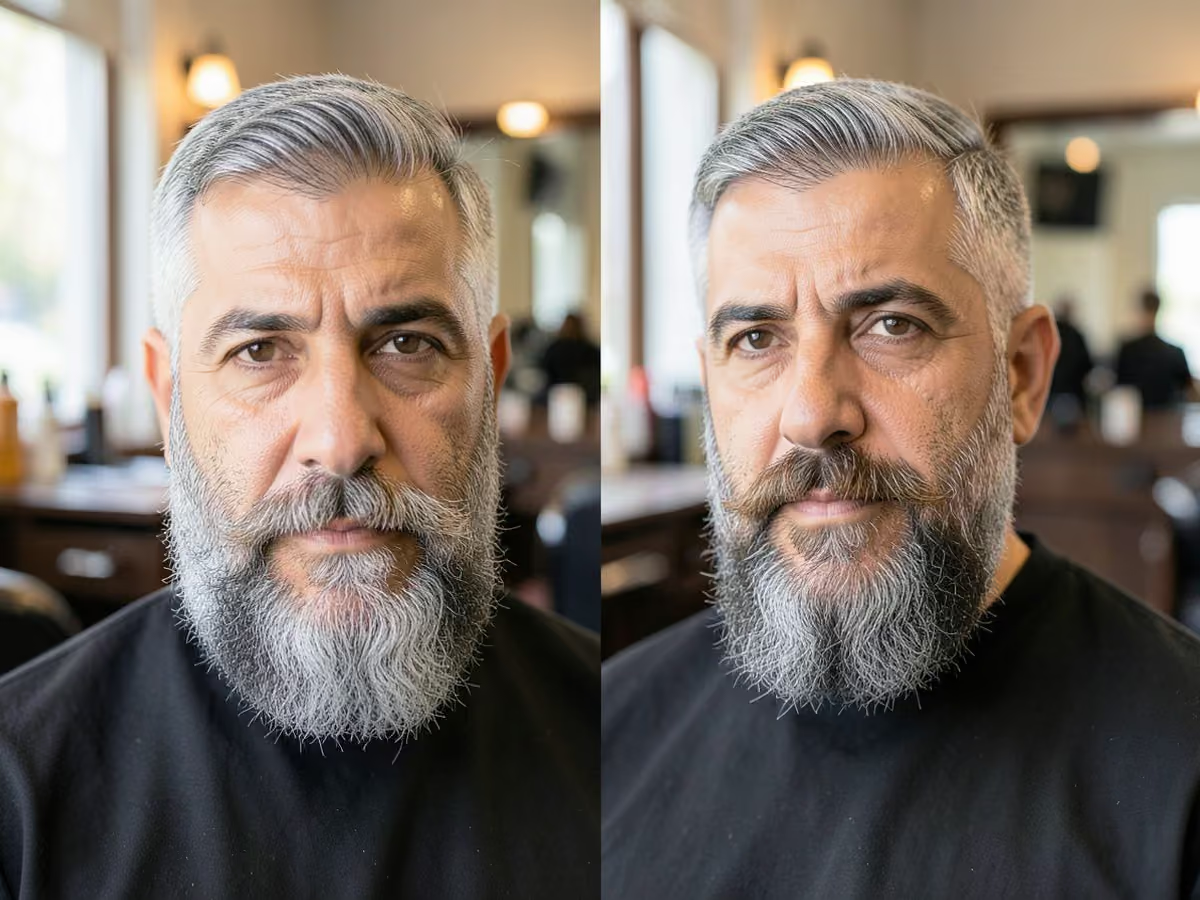
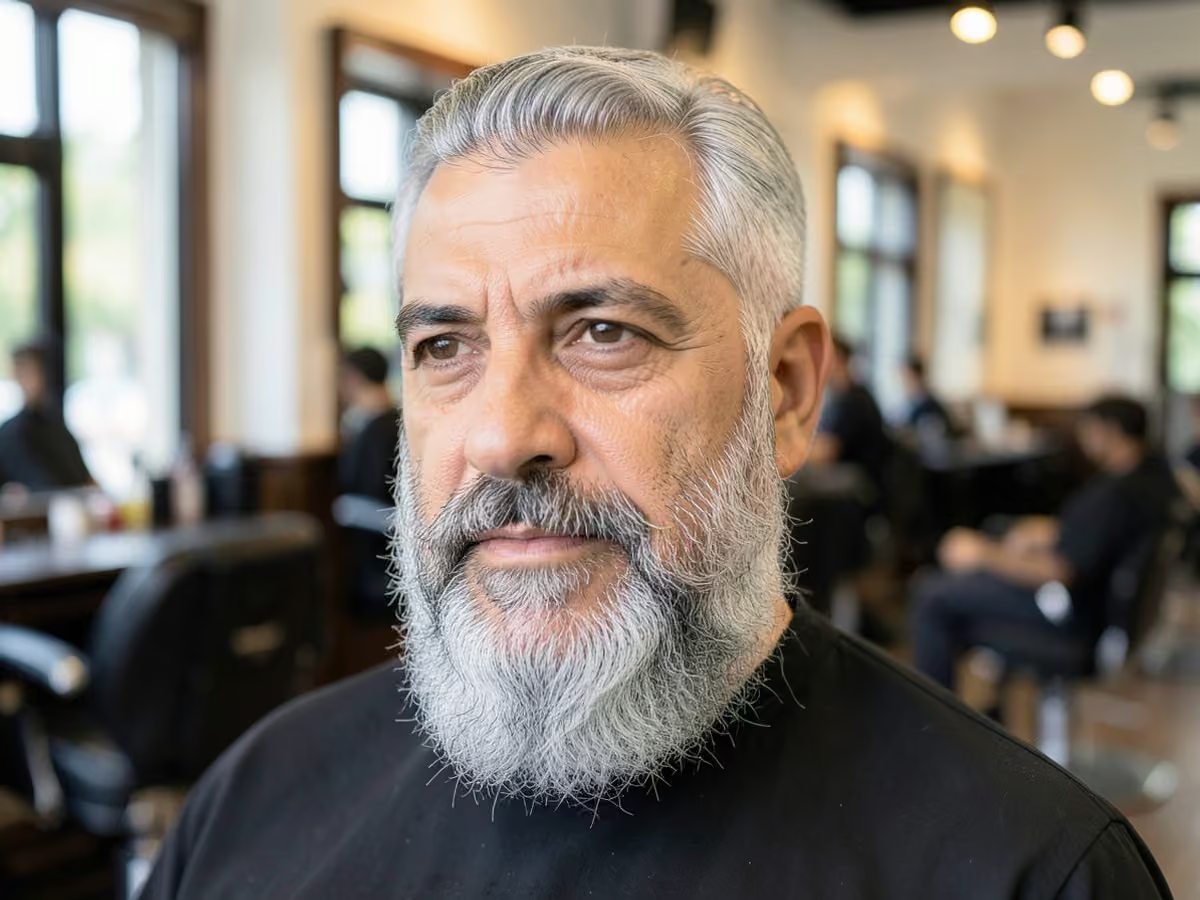
Gray or white beard hair is often coarser than the rest, and it can look lighter than the hair on the head. The barber keeps the beard fade gentle, finishing at a #1 rather than skin, so the sideburn does not disappear against light skin. A neat short beard at a #4 keeps the gray tidy. Older men often choose this with a low fade.
How to Style at Home
Use a purple beard wash once a week to remove yellow tones.
Apply beard oil to soften wiry gray hair.
Keep the beard at a #4 with a weekly pass of the trimmer.
Ask Your Barber
"Low fade on the head. Fade the sideburn from a #1 into a gray beard at a #4, no skin."
Trim:Every 2–3 weeks. Dense beards grow bulk at the sides.
Best For:Square, round faces + thick or coarse hair.
About This Style
Dense beard hair grows outward as well as down, which can make the face look wider than it is. Taking the sideburn and cheekbone area down through tight guard steps pulls that bulk in, so the beard hugs the face. Thick hair shows any jump in length, so the barber moves one guard at a time. The jaw and chin keep their full length for a strong lower face.
How to Style at Home
Brush the beard downward to keep the sides flat.
Use beard balm for hold on the sides.
Trim the sides with a shorter guard than the chin.
Ask Your Barber
"Mid fade on the head. Fade the sideburn from a #0 into a #5 thick beard, taking bulk out of the upper cheek."
Best For:Oval, round faces + straight or sparse facial hair.
About This Style
Many East Asian men grow denser hair on the chin and mustache than on the cheeks. A fade that keeps the cheek at a #1 and the chin at a #3 or #4 turns that pattern into a planned shape rather than a patchy one. The sideburn steps from a #0 to a #1. Thick, straight head hair usually sits on a two-block or textured crop above.
How to Style at Home
Trim the cheeks with a #1 guard and the chin with a #3.
Brush the chin hair downward to check the two sides match.
Massage a drop of beard oil into the cheeks after trimming.
Ask Your Barber
"Keep my cheeks at a #1 over a low skin fade, sideburn #0 to #1, with the chin and mustache at a #3."
Trim:Every 2–3 weeks. Waves curl outward as the beard grows.
Best For:Oval, square faces + wavy or loose curly hair.
About This Style
S-shaped beard hair bends back on itself, so the same guard leaves it looking shorter than straight hair would. Barbers add half a guard size to the beard and check the sideburn blend with the wave relaxed, not pulled straight. Balm keeps the waves defined rather than frizzy. On the head, a mid fade under a wavy fringe or quiff repeats the texture.
How to Style at Home
Work beard balm into the damp beard and scrunch it lightly.
Comb the sideburn down with a wide-tooth comb.
Let the beard air-dry so it keeps its natural wave.
Ask Your Barber
"Trim my beard dry at a #4 over a mid fade, sideburn #1 to #3, so the waves stay soft. Natural cheek line please."
Best For:Oval, square faces + red, coarse or wavy hair.
About This Style
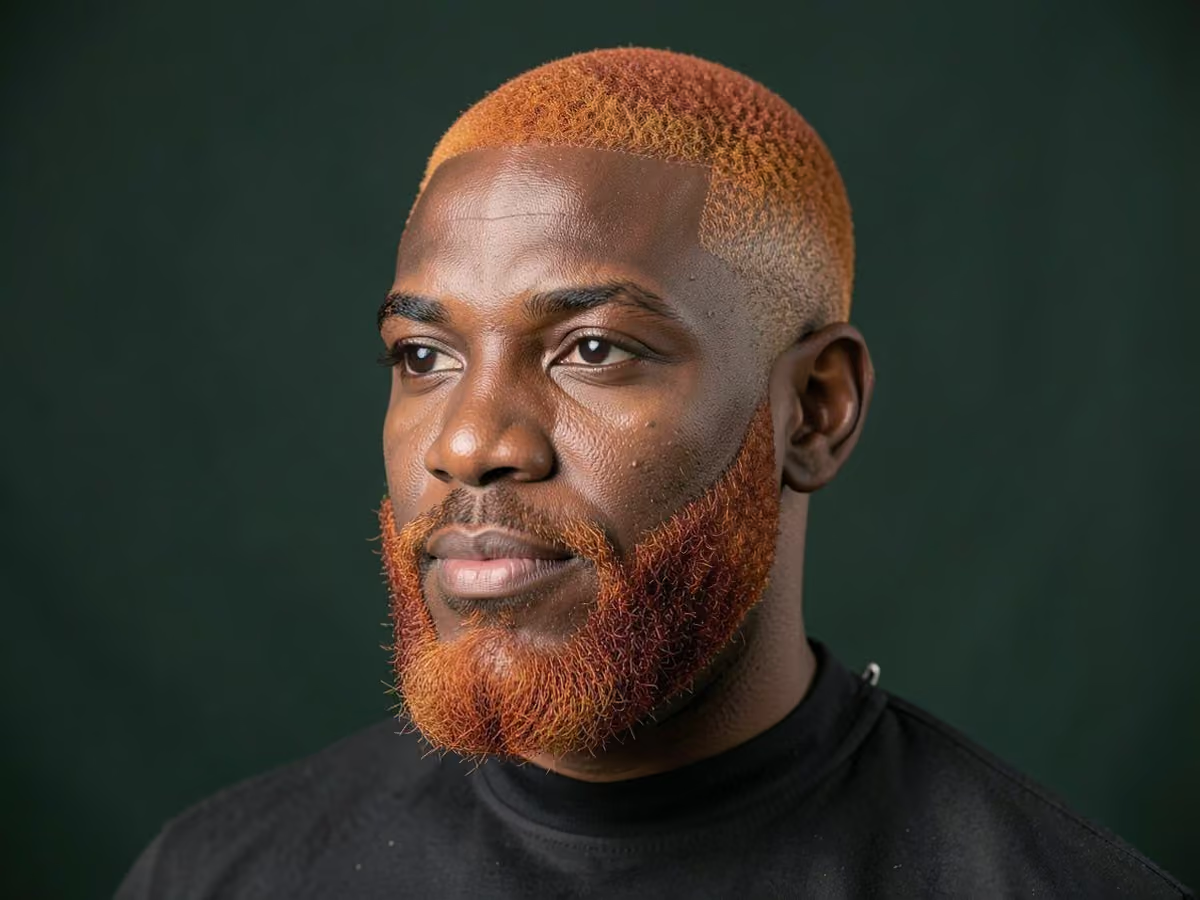
Red beards are often a different shade from the head, sometimes brighter and sometimes more coppery. Fading the sideburn gradually from the head color through a #1 and #2 into the beard makes that shift look natural instead of abrupt. Ginger beard hair tends to be coarse, so the barber trims it dry. Pale skin shows less contrast at the short end of the fade.
How to Style at Home
Use beard oil daily to soften coarse red hair.
Brush the sideburn downward so the two shades blend.
Snip any stray light hairs that catch the sun.
Ask Your Barber
"Blend my hair color into the beard with a low fade, sideburn #1 to #2. Beard at a #4, trimmed dry."
Recommended Products
Beard Oil
Beard Brush
Beard Fade with Line-Ups and Edges
The fade handles the sideburn, but the cheek line and neckline set the outline. These cards cover the edge finishes that pair with a beard fade. See line-up vs edge-up for terms.
Trim:Every 1–2 weeks. Line-ups soften within a week.
Best For:Oval, square faces + coily or coarse hair.
About This Style
Sharp edges at the forehead, temple and beard come from the line-up. The beard fade blends the sideburn, then the barber outlines the beard at the cheek and neck with a trimmer or razor. The fade and the sharp line together give the cleanest finish. Coily and dense beards show it best, but it needs frequent touch-ups.
How to Style at Home
Keep the line-up clean with an edge brush and a little light gel.
Brush the beard down after applying beard oil.
Avoid trimming the line at home unless you can match it.
Ask Your Barber
"Skin fade with a forehead line-up. Fade the sideburn into a #4 beard and line up the cheek and neck sharply."
Trim:Every 1–2 weeks. The cheek line shows stubble fast.
Best For:Round, oval faces + thick straight or coarse hair.
About This Style
Cut from the sideburn to the corner of the mustache, a straight razor line on the upper cheek gives the beard a clean geometric edge. The beard fade keeps the sideburn smooth, and the hard line defines the top of the beard. It lifts the cheekbones visually and suits round faces. The line must be kept the same height on both sides.
How to Style at Home
Shave above the cheek line every two or three days.
Use a mirror to keep both cheek lines at the same angle.
Apply beard oil to calm the shaved skin.
Ask Your Barber
"Mid fade on the head. Fade the sideburn into a #4 beard and razor a straight cheek line from the sideburn to the mustache."
Trim:Every 1–2 weeks. Thin shaved lines fill in quickly.
Best For:Oval, square faces + coily or coarse hair.
About This Style
Cut through the faded part of the sideburn or along the cheek, a thin shaved line adds a design detail. Some barbers continue a hair design from the side of the head down into the beard. The line is cut with a trimmer at the beard fade, where the hair is shortest and the line shows best. It grows out within a week. See hair designs for more ideas.
How to Style at Home
Brush the beard flat so the line stays visible.
Keep the area around the line clean with a detail trimmer.
Book a touch-up after one week to sharpen the line.
Ask Your Barber
"Skin fade on the head. Fade the sideburn into a #4 beard and cut a thin shaved line through the faded part."
Trim:Every 3–4 weeks. A natural edge needs only stray hairs removed.
Best For:Oval, long faces + straight or wavy hair.
About This Style
No sharp outline is cut at the cheek; the beard keeps the line it grows with, and only stray hairs above it are removed. The beard fade at the sideburn gives a neat join with the haircut, while the cheek looks soft. Low upkeep and natural looking, this suits men who dislike shaving lines and want the beard to grow in without a visible edge.
How to Style at Home
Pluck or trim stray hairs above the cheek line.
Brush the beard with a boar bristle brush.
Trim the beard with your regular guard every week.
Ask Your Barber
"Low fade on the head. Fade the sideburn into a #4 beard and leave the cheek line natural, only stray hairs removed."
Trim:Every 2–3 weeks. The neck fade softens with regrowth.
Best For:Round, oval faces + any beard type.
About This Style
Under the jaw, the beard is faded from its full length down to skin at the neckline. Instead of a hard razor line, the barber steps through a #3, #2 and #1 to skin. The softer edge looks natural and avoids the razor bumps that a sharp neckline can cause. Set the start of the neck fade about one finger above the Adam's apple.
How to Style at Home
Trim the beard at its full length with your regular guard.
Go one guard shorter just above the neckline.
Shave only below the neckline, flicking the trimmer outward.
Ask Your Barber
"Fade the beard under the jaw from a #4 to skin at the neckline, one finger above the Adam's apple. No hard line."
Trim:Every 2 weeks. The curve blurs after about ten days.
Best For:Round, oval faces + straight or coily hair.
About This Style
Rather than a straight diagonal, the cheek line here is cut in a gentle downward arc that ends near the mouth. The curve follows the cheekbone and makes a round face look leaner. The barber joins the sideburn to the beard first, then shapes the arc with a trimmer and razor. It looks softer than an angled line but still clean.
How to Style at Home
Trace the arc with a trimmer held flat, working on the top edge only.
Shave the skin above the line with a safety razor.
Brush the beard down and check that both curves match.
Ask Your Barber
"Curve my cheek line along the cheekbone over a mid fade into the beard. Make it a curve, not straight, both sides matched."
Trim:Every 1–2 weeks. The design fades as stubble returns.
Best For:Oval, square faces + straight, wavy or coily hair.
About This Style
One or two thin lines cut into the faded area above the ear, sometimes running down toward the sideburn, add detail to a beard fade without changing the beard. The lines need at least a #1 around them to show. Common choices are a single curved part line or a lightning bolt. Like any design, it needs redoing every week or two.
How to Style at Home
Keep the design area clean with a soft brush after washing.
Moisturize the lines with scalp oil so the skin does not flake.
Avoid running clippers over the design at home.
Ask Your Barber
"Skin fade into my beard, sideburn #0 to #2. Cut two thin curved lines above the right ear down toward the sideburn."
Trim:Every 3–4 weeks. A low line takes longer to look grown out.
Best For:Long, oval faces + straight or wavy hair.
About This Style
Dropping the cheek line halfway down the cheek, closer to the jaw, shows more skin and trims the beard from above. Long faces benefit because the beard looks wider at the jaw and shorter overall. The sideburn is faded from a #1 to a #3 and the beard sits below the line at a #4. Patchy beards should skip it, since it removes the densest coverage.
How to Style at Home
Retrace the cheek line with a trimmer every five days.
Comb the beard down so the edge stays visible.
Rub beard oil over the cheek skin after shaving.
Ask Your Barber
"Drop my cheek line lower, about halfway down the cheek. Low fade, sideburn #1 to #3, beard at a #4."
Recommended Products
Beard Oil
Faded Circle, Anchor and Spade Beards
These shapes leave more of the cheek bare or change the chin outline, so the fade has less length to work with. Several of them do not connect to the haircut at all; see beard styles for the unfaded versions.
Trim:Every 2 weeks. The rounded outline needs weekly trimming.
Best For:Square, oblong faces + straight or coarse hair.
About This Style
Joining a mustache to a goatee in one ring around the mouth, the circle beard leaves the cheeks and sideburns shaved. Fading the outside of the ring from a #3 near the lips to a #1 at the edge softens the circle so it melts into the bare skin. Keeping the head at a low skin fade holds the two areas in proportion. It suits men whose cheek growth is weak.
How to Style at Home
Trim the ring with a #3 guard, then go round the outer edge with a #1.
Shave the cheeks and neck around the ring every two days.
Use a little beard balm to keep the mustache neat.
Ask Your Barber
"Circle beard faded from a #3 near the mouth to a #1 at the outer edge. Low skin fade on the head, no sideburns."
Trim:Every 2 weeks. The anchor point loses shape fast.
Best For:Round, square faces + straight or wavy hair.
About This Style
Shaped like a ship's anchor, this beard runs along the jaw for a short distance, points down at the chin and pairs with a separate mustache. Grading the anchor's arms from a #1 where they end on the jaw to a #3 at the point keeps the shape crisp. Shaved sideburns and a mid fade on the head match the bare cheeks. It adds length to round faces.
How to Style at Home
Draw the anchor outline with a trimmer once a week.
Shave the cheeks and the gap under the mustache.
Comb the point downward with a small amount of balm.
Ask Your Barber
"Anchor beard faded along the jaw, #1 at the ends up to a #3 at the chin point, mid skin fade and shaved sideburns."
Trim:Every 3–4 weeks. The spade outline holds for a few weeks.
Best For:Round, oval faces + thick straight or wavy hair.
About This Style
Tapering to a broad point at the chin, the spade beard is a full beard shaped like a garden spade. The fade starts at the hair, runs through a #1 and #2 at the sideburn and keeps the cheeks at a #3, so the width builds toward the chin. Expect to grow two or three inches below the jaw first. Round faces look longer with it.
How to Style at Home
Brush the beard straight down before trimming the outline.
Cut the bottom into a broad point with scissors.
Work beard oil through the length after washing.
Ask Your Barber
"Spade shape on the beard with a broad point, low fade, sideburn #1 to #2, cheeks at a #3. Keep the length at the chin."
Trim:Every 3–4 weeks. The mustache needs a weekly comb and trim.
Best For:Oval, oblong faces + straight or wavy hair.
About This Style
Named after the composer Giuseppe Verdi, this beard is rounded at the bottom, no more than four inches long, with a mustache kept separate and styled. The fade blends the sideburn from a #1 to the cheek length at a #3. A rounded bottom and styled mustache read as formal, so a side part or slick back on top suits it.
How to Style at Home
Comb the mustache out toward the sides with balm.
Brush the beard down and round off the bottom with scissors.
Apply beard oil to the length after every wash.
Ask Your Barber
"Rounded Verdi beard about three inches long, mustache kept separate and shaped. Low fade with the sideburn going from a #1 into #3 cheeks."
Trim:Every 4–6 weeks. A long beard only needs its shape tidied.
Best For:Square, oblong faces + thick, coarse or wavy hair.
About This Style
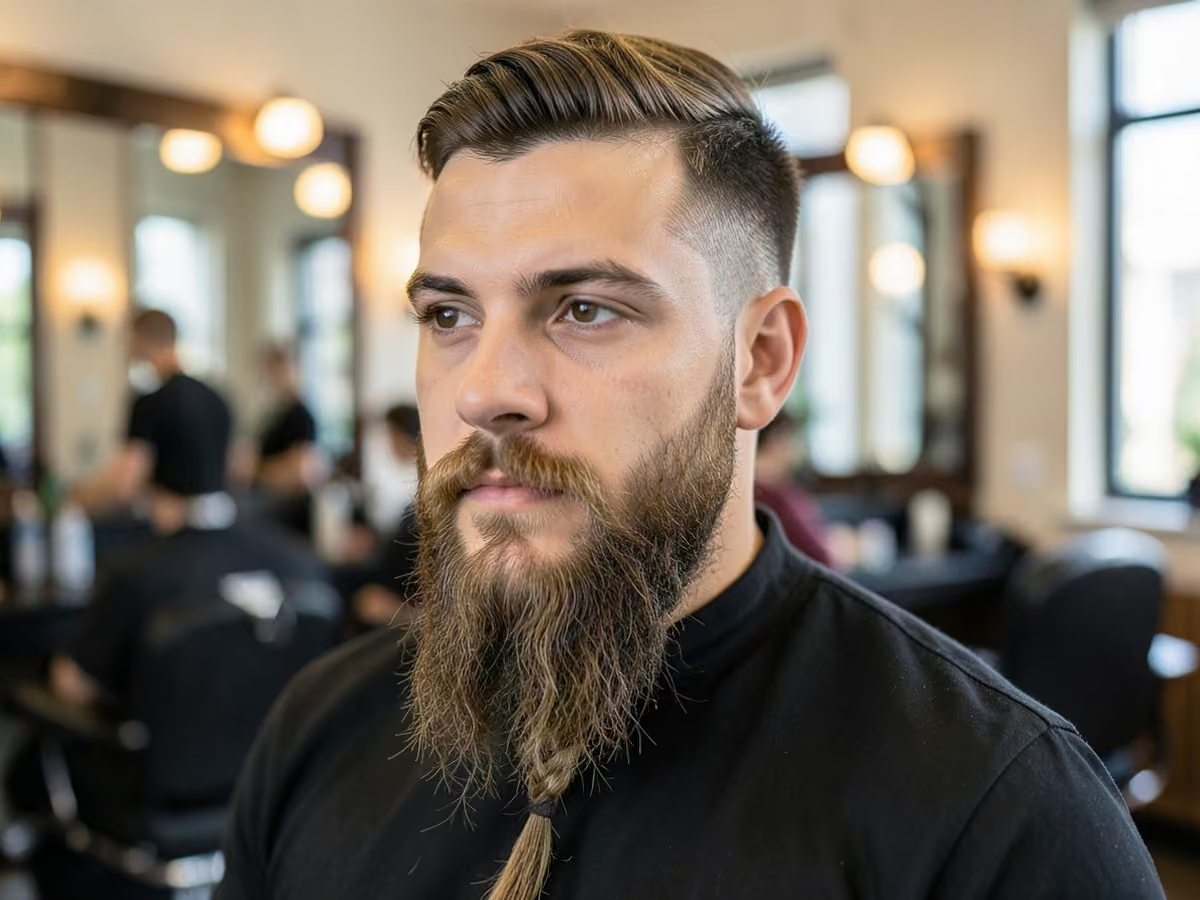
Dense, long and often braided at the chin, a Viking beard is grown for six months or more. Fading it means keeping the sideburn short, a #1 into a #3, while the cheeks stay at about an inch and the chin runs four inches or longer. Tighter cheeks stop it looking wide. A shaved or undercut head usually goes with it.
How to Style at Home
Brush the beard every day from the cheek down to the chin.
Braid the chin length loosely for events or work.
Oil the length daily to stop the ends breaking.
Ask Your Barber
"Undercut with skin on the sides. Sideburn #1 into #3, cheeks at an inch, leave the chin long for braiding."
Trim:Every 2–3 weeks. The upper lip needs shaving every day or two.
Best For:Square, oval faces + straight or coarse hair.
About This Style
Sometimes called a chin curtain or Amish beard when grown long, this version covers the cheeks, jaw and chin while the upper lip stays shaved. A fade from the haircut through the sideburn makes the jaw beard look intentional. Kept short at a #3, it reads modern rather than traditional. It suits men with weak mustache growth or those who find a mustache uncomfortable.
How to Style at Home
Shave the upper lip every one or two days.
Trim the whole beard with a #3 guard once a week.
Rub beard oil along the jawline after trimming.
Ask Your Barber
"No mustache, upper lip clean. Low fade, sideburn #1 into a #3 beard. Keep the beard along the jaw and chin."
Recommended Products
Beard Oil
Beard Fade with Long, Styled and Textured Hair
These haircuts add length or a strong shape on top, so the beard fade has to balance them. The blend works the same way, in steps of guards through the sideburn. Compare slick back styles for more top options.
Trim:Every 3–4 weeks. Only the faded sides and beard need regular work.
Best For:Oval, long faces + straight, wavy or curly hair.
About This Style
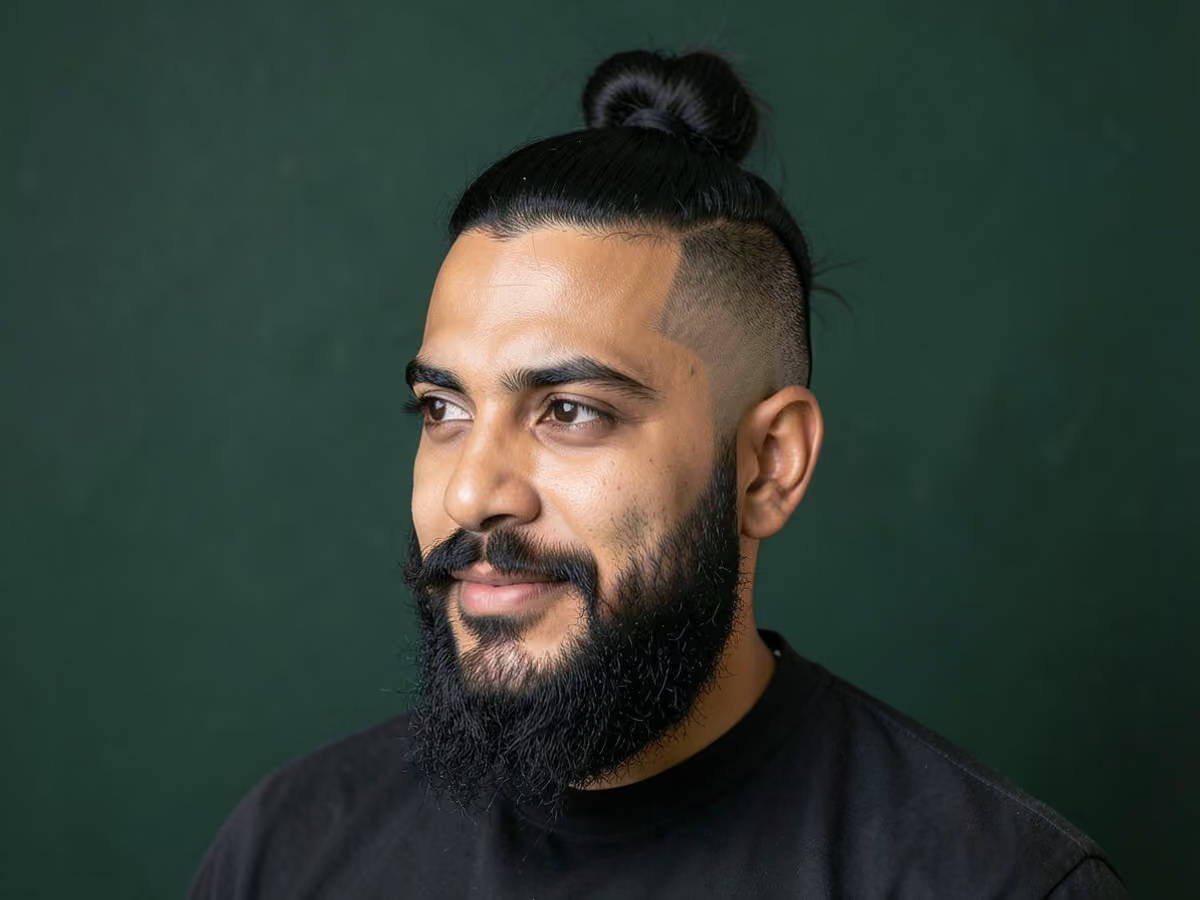
Tied into a bun at the crown, long hair sits over faded sides that run down into a full beard. Faded sides stop the head looking top-heavy when the hair is up. Barbers usually choose a mid fade so the bun has a clear base. A beard of an inch or more balances the volume on top.
How to Style at Home
Gather the hair at the crown and twist it into a bun.
Smooth the faded sides with a few drops of scalp oil.
Brush the beard into shape and finish with beard oil.
Ask Your Barber
"Keep the top long for a bun and give me a mid fade on the sides. Sideburn #1 to #3 into my full beard."
Trim:Every 2–3 weeks. The fade softens before the slick back changes.
Best For:Oval, square faces + straight or wavy hair.
About This Style
Three to five inches on top combed back with pomade create a glossy surface that pairs well with a short, shaped beard. Under it, the fade drops past the ear into a #3 or #4 beard. Shine on the hair contrasts with the matte beard. It is a common choice for weddings and formal events where the look has to hold all day.
How to Style at Home
Comb pomade through damp hair from the front to the back.
Blow-dry on low heat while combing everything back.
Brush the beard and smooth a little balm over it.
Ask Your Barber
"Slick back with four inches on top, no part. Mid fade into a #3 beard, with the sideburn running #0 to #2."
Trim:Every 3–4 weeks. Short hair and short beard grow out together.
Best For:Square, oval faces + straight or thick hair.
About This Style
Half an inch to an inch at the front, shorter at the crown, the crew cut needs almost no styling. Pairing it with a beard fade creates one continuous short line from the crown down to a #3 or #4 beard. Everything stays short, so it is easy to keep at home with a trimmer between visits. Square jaws carry it well.
How to Style at Home
Run a #3 guard over the beard twice a week.
Push the front up with a small amount of matte cream.
Shave the neckline every few days to keep it clean.
Ask Your Barber
"Crew cut, an inch at the front, low fade on the sides. Sideburn #1 into #2 and a #3 beard."
Trim:Every 2–3 weeks. Fade and line-up need regular sharpening.
Best For:Oval, long faces + coily or tight curly hair.
About This Style
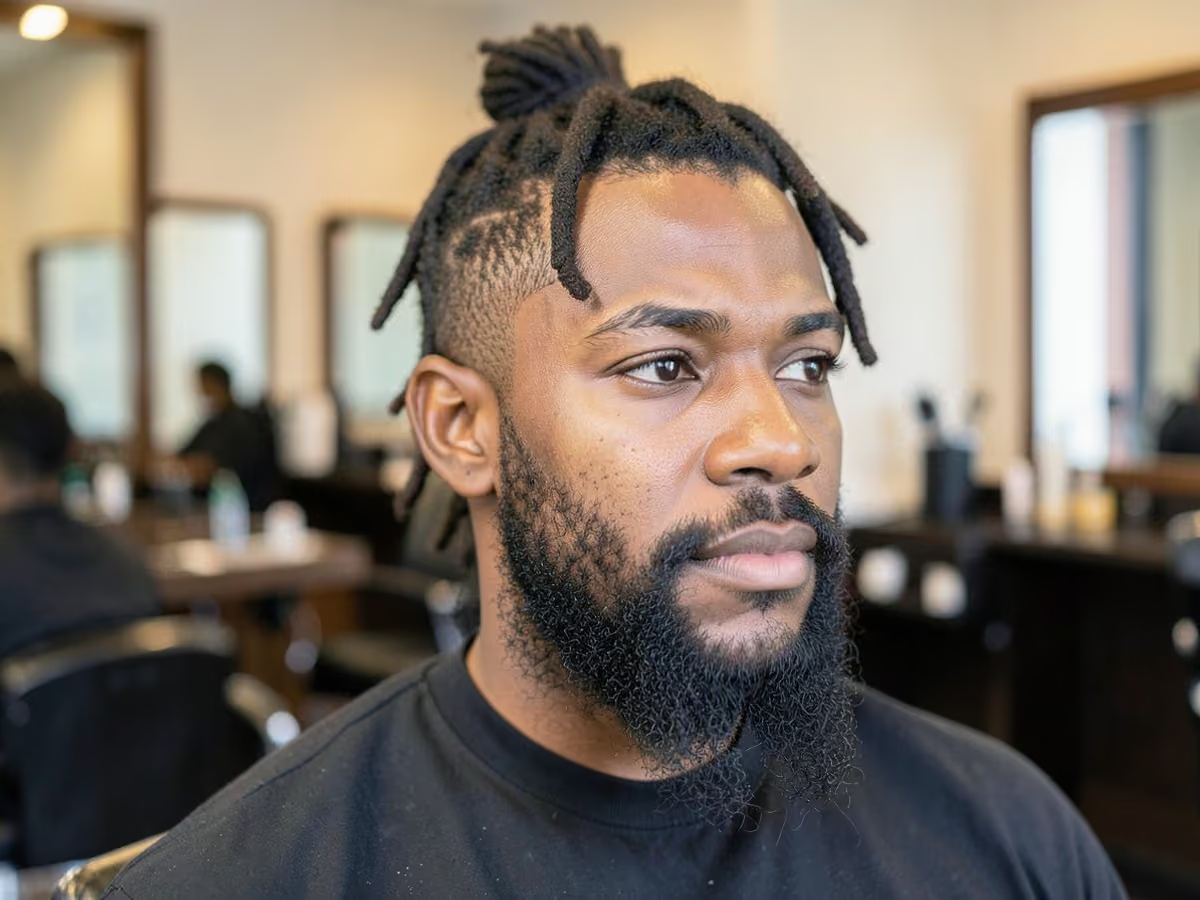
Locs on top, either shoulder-length or tied up, sit above faded sides that drop into a coily beard. A forehead line-up and a defined cheek line are common additions, since coily beard hair holds sharp edges well. Faded sides keep the locs off the face. Retwisting the roots every four to six weeks keeps the top neat.
How to Style at Home
Moisturize the locs and the scalp with a little scalp oil.
Brush the beard with a soft brush so it lies down.
Tie the locs up when you want the fade to show.
Ask Your Barber
"Under my locs, a low skin fade with the sideburn going #0 to #2 into the beard. Line up the forehead and the cheek line."
Trim:Every 2–3 weeks. Bare sides and the strip both need upkeep.
Best For:Oval, long faces + thick straight or curly hair.
About This Style
Shaved or faded sides leave a central strip two to three inches wide, and the beard steps up from the sideburn to a short or medium length. The vertical strip and the beard line up to make the face look longer. Barbers keep the beard narrow at the cheeks so it echoes the strip. Spiking the strip needs a firm-hold product.
How to Style at Home
Blow-dry the center strip upward on medium heat.
Twist the strip into spikes with a firm texture clay.
Trim the beard narrow at the cheeks with a #3 guard.
Ask Your Barber
"Mohawk strip three inches wide, skin fade on the sides. Sideburn #0 to #2 into a #4 beard, narrow at the cheeks."
Trim:Every 2–3 weeks. Twists loosen as the fade grows in.
Best For:Oval, square faces + coily or 4C hair.
About This Style
Two-strand or sponge twists, one to three inches long, rest on a fade that carries down into a coily beard. The fade is usually low or mid, so there is enough hair at the sides to frame the twists. A clean line-up at the hairline and beard makes it look finished. Twists need redoing every one to two weeks.
How to Style at Home
Apply leave-in to damp hair and twist with a curl sponge.
Brush the beard down and line it up with a trimmer.
Oil the beard and the faded sides before bed.
Ask Your Barber
"Two inches on top for twists. Mid fade, sideburn #0 to #2 into my beard, line up the front and the cheek."
Trim:Every 3–4 weeks. A side part holds its shape for weeks.
Best For:Oval, oblong faces + straight or wavy hair.
About This Style
Classic and conservative, a side part with a few inches of length combs neatly to one side over a low fade, which then drops into a short beard. A hard part can be added, but most men leave it natural. The tidy part balances the texture of the beard. It suits job interviews, weddings and older men who want a groomed look.
How to Style at Home
Comb the part into damp hair with a fine comb.
Smooth the top with a little light pomade.
Trim the beard with a #3 guard every week.
Ask Your Barber
"Side part on the left with three inches on top over a low fade. Sideburn #1 into a #3 beard with a natural cheek line."
Recommended Products
Light Pomade
Beard Oil
How Do You Ask Your Barber for a Beard Fade?
Give the barber three facts: the haircut fade height and shortest guard, the beard length and where the blend should finish. A clear request sounds like this: mid skin fade, fade the sideburn from a #0 to a #3 and blend it into the beard by the middle of the ear, beard at a #5. If you want the fade to continue on the cheek, say how far down. Our clipper guard numbers chart helps if the numbers are new.
Point to where the blend should end, because barbers place it differently. Some finish the fade at the top of the ear, others at the ear lobe. Mention the cheek line too: natural, rounded or a sharp razor line. If you have a sensitive neck, ask for a clipper neck fade rather than a razor line, which can cause bumps.
Clipper Guards Used in Beard Fade Styles
A clipper guard is the plastic comb that clips onto the blade and sets how much hair is left: a #1 leaves 3 mm (1/8 inch), each step up adds about 3 mm. The right column lists the cards on this page that call for each guard. See the full clipper guard numbers guide for the complete chart.
Yes, with a trimmer that has several guards and a good mirror setup. Start with the beard length guard and trim the whole beard. Then switch one guard shorter and cut only the sideburn from the top of the ear upward, flicking the trimmer out as you go. Repeat with the next shorter guard, starting a little higher each time. The key is to lift away at the end of each pass, so the lengths blend instead of leaving lines.
Work on both sides at the same height, using the top of the ear and the corner of the eye as markers. Keep the cheek line where your barber set it. If you also cut your own hair, our how to fade your own hair guide covers the clipper technique, and the same lever and guard steps apply to the sideburn.
What Beard Fade Mistakes Should You Avoid?
The most common error is fading too high on the cheek, which removes too much beard and makes the face look narrow at the top and heavy at the jaw. Another is a blend that jumps two guard sizes, leaving a visible line at the sideburn. Uneven heights between the left and right sides show quickly, because the eye compares them straight on. Taking the neckline too high is the other big mistake; how to shape a beard neckline explains where it belongs.
Leaving the beard fade until the haircut grows out also spoils the join. The sideburn grows at the same rate as the fade, so if you stretch haircuts, at least clean up the sideburn and neckline at home to keep the blend readable. Patchy blends are often caused by skipped guards or by cutting dry, tangled beard hair; see why a fade looks patchy. Finally, do not shave the sideburn to skin at home between visits, since one slip removes the blend entirely.
Which Beard Fade Is Right for You?
Pick your hair type and how much upkeep you will put in. The matches below come from the Best For and Maintenance notes on each card. Upkeep follows the Maintenance badge: low means a cut every 3 to 6 weeks and almost no daily styling, high means weekly line-ups or daily product.
Barbers call it a beard fade, faded beard, beard taper or sideburn fade. All describe the same idea: the short hair of a fade haircut blends through the sideburn into the longer beard. When the fade continues under the jaw toward the neck, it is often called a neck fade.
Q2: What guard numbers are used for a beard fade?+
Most beard fades start at skin, a #0 or a #1 at the top of the sideburn, where it meets the hair fade. They step through a #2 and #3 and finish at the beard length, often a #4 to #8. Longer beards are blended into scissor length on the cheek.
Q3: How long does a beard fade last?+
About two weeks before the blend softens. The sideburn grows roughly 1/8 inch a week, so a skin fade into the beard shows stubble within a few days. Men who want it sharp book every two to three weeks and clean the neckline at home between visits.
Q4: Can you get a beard fade without a fade haircut?+
Yes, but it looks different. With a taper or scissor cut, the barber blends the sideburn from the side length into the beard with fewer steps. The result is a soft connection rather than a fade. A beard fade shows best with a low, mid or high fade on the head.
Q5: Does a beard fade work on a patchy beard?+
Often it helps. Patchy beards are usually thinnest on the upper cheek and near the sideburn, which is exactly where the fade shortens the hair. Shorter hair there makes gaps less noticeable, while the denser beard at the jaw and chin keeps its length.
Q6: Should the beard fade start at the ear or the cheek?+
Most start at the top of the ear and finish by the ear lobe, so the cheek keeps full length. A high beard fade carries the blend down onto the cheek, which slims a wide face. Ask your barber to show you the start point before cutting.