
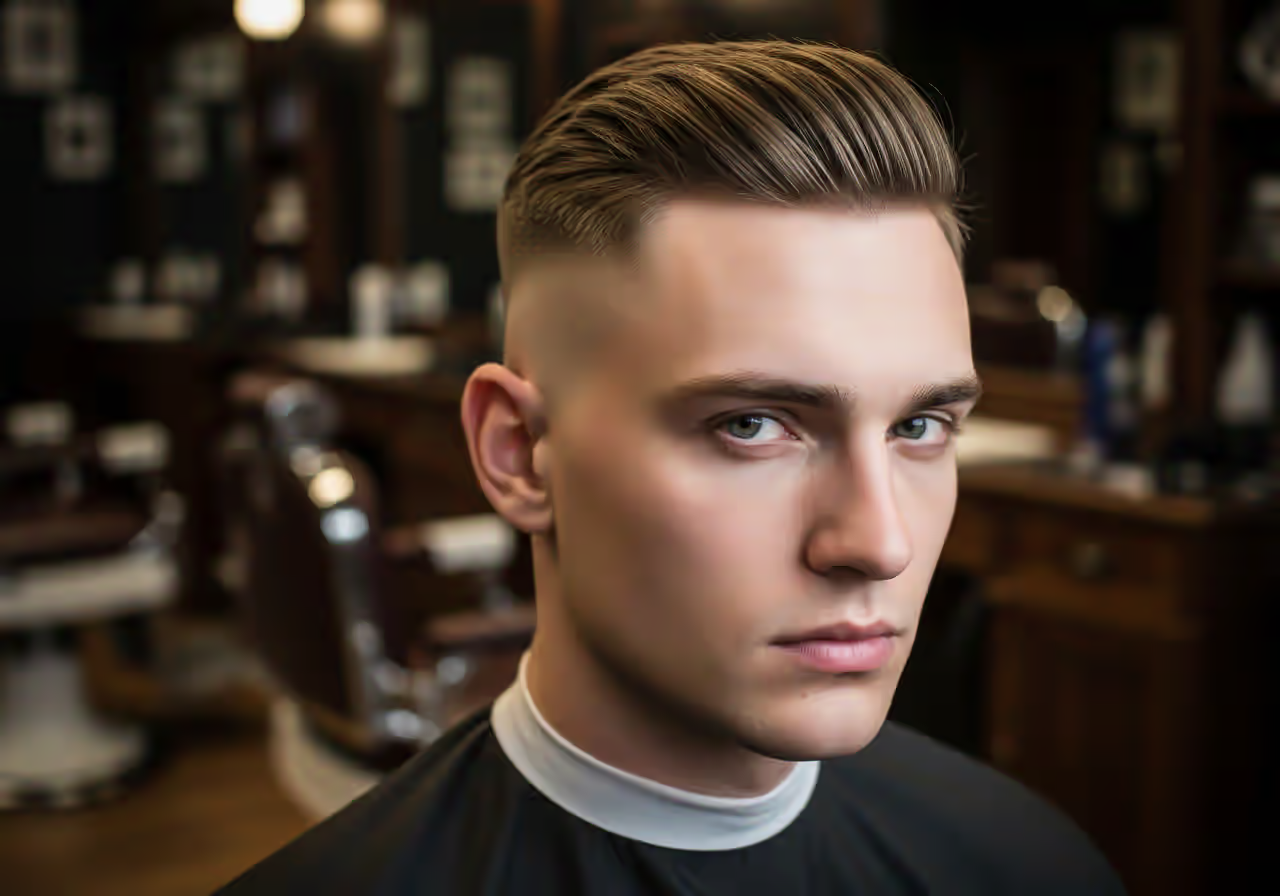
Fade Types Explained:
Low vs Mid vs High vs Skin
Fade types explained in one line: every fade is a gradient, and the difference is where it starts and how short it goes. Here's the whole family, decoded, so you order the right one.
By Jessica Hamilton, Editor · Updated
Quick answer: Fade types explained in one line: a fade's name tells you where the short-to-long blend starts and how short it goes at the bottom. Low, mid and high name the starting point; a skin fade takes the bottom to bare skin. Learning a handful of terms lets you order the same fade every visit.
Style images are AI-generated illustrations.
📚 Part of our Fades & Tapers guide hub, where the related guides are listed together.
"Fade" isn't one haircut: it's a family, and the names describe two things: how high up the head the fade starts, and how short it goes at the bottom. Once you understand those two variables, every fade name makes sense and you can pick exactly the one you want.
What Makes Fade Types Different From Each Other?
A fade is a haircut where the sides and back get gradually shorter toward the bottom. Fade types differ in two ways: where the blend starts (low just above the ear, mid at the temple, high near the top of the sides) and how short the bottom goes, from a short guard down to bare skin.
The fade height also decides how much sideburn is left, and our sideburn styles guide shows each option with how to trim it evenly.
A shadow fade stops at a short guard instead of skin, so it can be worn at any height with softer contrast and slower regrowth.
When the shortest band is shaved with a straight razor instead of a foil shaver, barbers call it a razor fade; it lasts a few days less before stubble shows.
Any fade height can sit under a center strip, and our mohawk fade gallery shows 55 versions from low to burst.
On coily hair the same fade heights look a little different, and our guide to fade haircuts for Black men shows 72 examples.
Curly and coily hair changes how every fade height looks, so see our curly hair fade guide before choosing one for textured hair.
Parents choosing a fade for a child can compare gentler heights and kid-friendly guard numbers in our guide to boys fade haircuts.
The same guard steps used on the head also apply to facial hair, as our guide to the faded beard shows.
A low fade is the subtle, office-friendly choice, a mid fade is the everyday default, and a high fade gives bold contrast. Add "skin" to any of them and the bottom is blended down to bare skin. Two variations change the shape of the line: a drop fade curves down behind the ear and suits curly tops, and a burst fade fans around the ear only, often with a mohawk.
A taper is the gentler version, kept to the sideburns and neckline. To order, stack the terms, such as "mid skin fade" or "low drop fade," and bring a reference photo.
Most mix-ups happen at the bottom of the blend. "Low fade" on its own does not say if you want skin showing or a short guard left, so add "skin" or name the guard every time.
What Are the Main Types of Fade Haircuts?
| Fade | Where it starts | Best for |
|---|---|---|
| Low fade | Just above the ear | Subtle, conservative, office-friendly |
| Mid fade | Around the temple | The balanced all-rounder |
| High fade | High on the sides | Bold, high-contrast, modern |
| Skin fade | Any height, down to bare skin | Sharpest contrast; pairs with any of the above |
| Drop fade | Curves down behind the ear | Following the head shape; suits curly tops |
| Burst fade | Fans around the ear only | Mohawks, curly tops, a semicircle look |
Which Type of Fade Should You Get?
- Want subtle and professional? Low fade.
- Want a safe, everyday default? Mid fade.
- Want bold contrast? High fade, or add "skin" to any of them.
- Curly or textured top? Drop or burst fade follows the shape beautifully.
- Combine the terms when you order: "mid skin fade," "low drop fade". Barbers understand these stacked.
How Fast Does a Fade Grow Out?
A fade needs more frequent trims than almost any other haircut because the whole point is a sharp gradient, and gradients blur first as hair grows. A high or skin fade shows growth within a week or two, since the shortest section grows past bare skin quickly and the line where it meets longer hair starts to soften.
A low fade hides growth longer because the blend sits closer to the ear, where a little extra length is less noticeable. Most men keep a fade sharp with a trim every two to three weeks, though high and skin fades often need closer to two. If you are stretching time between barber visits, a mid or low fade holds its shape noticeably longer than a high or skin fade will.
How Long Does Each Fade Type Stay Sharp?
Hair grows about half an inch a month, roughly 1/8 inch a week, and the shortest part of a fade shows that growth first. Our fade haircut statistics report covers how popular each height is.
| Time | Skin or high fade | Low or mid fade |
|---|---|---|
| Week 1 | Sharp; bare skin turns to light stubble | Sharp |
| Week 2 | Blend softening; time for a touch-up | Still clean |
| Week 3 | Reads as a short taper | Edges and neckline fuzzy |
| Week 4 | Grown out; fade line gone | Needs a recut |
| Week 6 | Sides about 3/4 inch, no fade left | Sides bulky over the ears |
A skin fade typically costs $30 to $60 depending on the shop, as our skin fade cost guide explains, so the short cycle adds up. The haircut cost guide and how often you should get a haircut show what a year of visits looks like.
Which Fade Type Suits Your Hair Type?
Straight, fine hair shows the transition line of a fade very clearly, which is part of why high and skin fades look so sharp on that hair type right after a cut. Thick or curly hair behaves differently: the blend still needs to be cut correctly underneath, but the visible line often looks softer because the hair has more natural volume sitting on top of it.
This is why drop and burst fades are recommended so often for curly or textured hair, since they follow the natural curve of the head and the hairline instead of fighting the shape the hair already wants to fall into. Wavy hair sits somewhere between the two, and usually reads well with a mid fade that gives the blend enough room without needing perfectly straight hair to look clean.
What Should You Say to Get the Right Fade Type?
Name three things: the height, how short the bottom goes, and what happens on top. A guard is the plastic comb on the clipper that sets the length, so a number is the clearest way to say it; our clipper guard numbers chart lists them.
What to say in the chair
“Mid skin fade starting at the temple, down to bare skin at the bottom, blended into a #3 and then scissor length on top.”
Mistakes to avoid when you choose a fade:
- Asking for "a fade" with no height. Two barbers will give you two different cuts.
- Choosing a high skin fade when you can only book every four weeks. It will look grown out for half that time.
- Forgetting the top. A fade frames whatever is above it, so decide on the top length first.
- Skipping the photo. A picture settles the line between a mid and a high fade faster than words.
If you do not know the terms yet, start with how to ask for a fade without knowing terminology and how to talk to your barber.
Frequently Asked Questions
Q1: What's the difference between a low, mid, and high fade?+
Q2: What is a skin fade?+
Q3: Which fade is best for me?+
Q4: What is the difference between a fade and a taper?+
Q5: How do I ask for a specific fade?+
Q6: Does a fade work with longer hair on top?+
For a closer look at each height, see our guides to the low fade, the mid fade and the taper fade, and the men's haircut names chart for the rest of the barbershop vocabulary.
Make us a Preferred Source on Google
See our latest articles first in your Google Search & AI Overviews.