
What Haircut Should I Get:
Decide in Five Steps
Start with your hair, then your face, then how much time and money you want to spend on it.
By Jessica Hamilton · Updated
Quick answer: What haircut should I get depends on five things, in this order: your hair type and density, your face shape, how often you will see a barber, what your job allows, and how you spend your days. Hair type sets what is possible, face shape fine-tunes proportions, and upkeep decides between a fade and a softer taper.
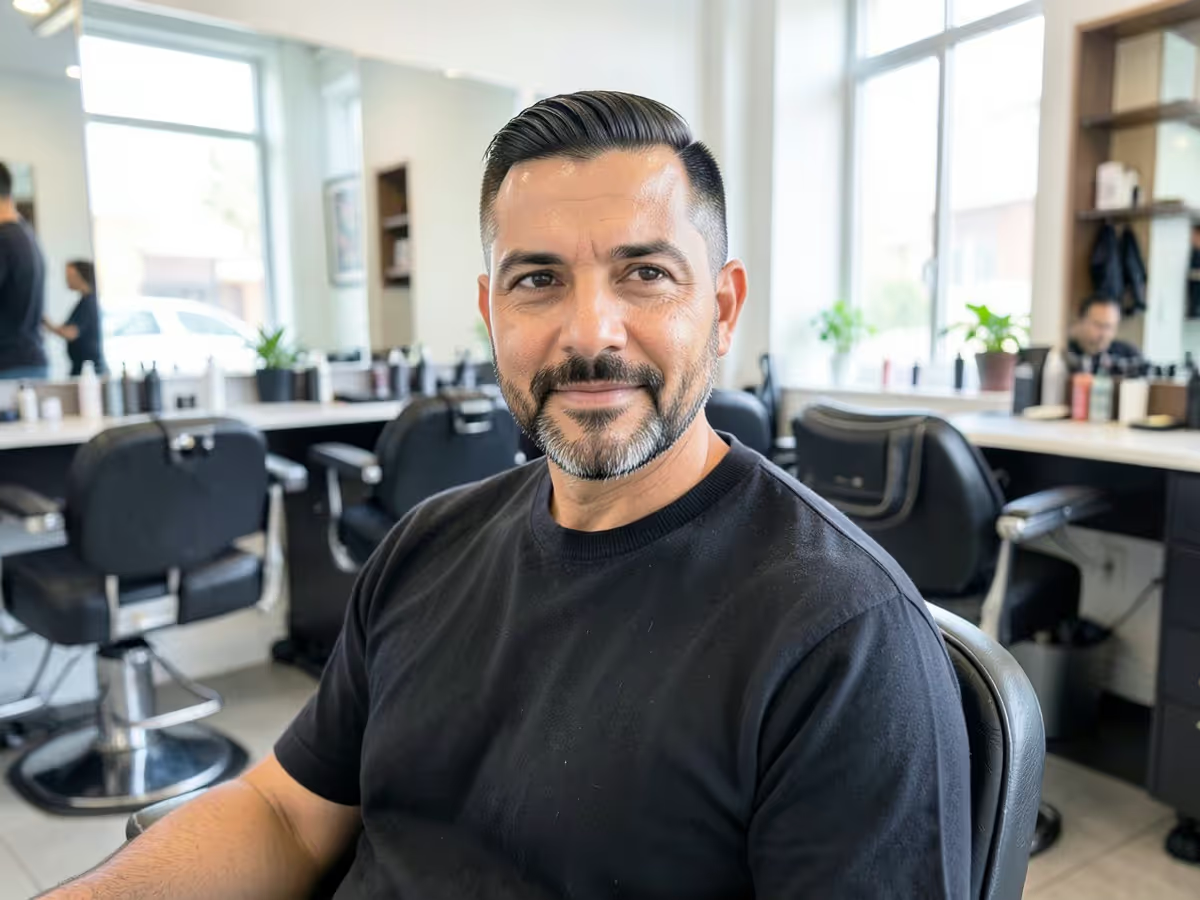
Style images are AI-generated illustrations.
📚 Part of our Barbering Basics guide hub; start there for the rest of the topic.
What haircut should I get comes down to five checks, in order: your hair type, face shape, upkeep, job and lifestyle. Start with what your hair can do, then narrow the list with the other four. Work through the steps below, check the situation table, and you will arrive at the shop with one or two cuts that suit you.
How Do You Decide What Haircut to Get?
Most men pick a haircut backwards: they see a style they like, ask for it, and then discover their hair will not do it. Thin straight hair will not hold a tall quiff, tight curls will not lie flat in a slick back, and a receding hairline changes how any fringe sits. Working from the hair outward avoids that. Each step below removes options until a short list of two or three cuts is left, and that short list is what you bring to the barber.
Give each step a minute of honest thought, and write the answers down if it helps. The order matters because the early steps are fixed and the later ones are choices. You cannot change your hair texture or your skull shape, but you can choose to visit the barber every two weeks instead of every six, and that choice opens or closes a whole group of cuts.
Step 1: Read your hair type and density
Note whether your hair is straight, wavy, curly or coily, and whether it is fine, medium or thick. Look at the temples and crown for thinning. This sets what the top can do.
Step 2: Find your face shape
Pull your hair back and compare forehead, cheekbone and jaw widths against face length. Our face shape guide walks through the measurements.
Step 3: Set your upkeep budget
Decide how often you will actually book a cut and how many minutes you will spend styling each morning. Be realistic, not hopeful.
Step 4: Check what your job allows
Uniform rules, client-facing roles and safety gear all limit length and contrast.
Step 5: Factor in your lifestyle
Helmets, hats, swimming, sport and glasses each favor certain lengths and shapes.
Which Haircut Fits Your Situation?
If you already know your main constraint, start here. Each row pairs a common situation with two or three cuts that handle it well and a link to a gallery with dozens of examples. Treat the suggestions as a starting point; the steps further down explain why each one works, so you can adjust if two rows apply at once.
| Your situation | Cuts to consider | See examples |
|---|---|---|
| Never had a style, want something safe | Crew cut, short textured crop, low taper | Short haircuts |
| Barber visit only every 6 to 8 weeks | Medium textured cut, scissor cut, longer crew cut | Crew cuts |
| Conservative office or client meetings | Side part, low taper, Ivy League | Office haircuts |
| Job interview next week | Short side part, neat crew cut | Interview haircuts |
| Thinning on top | Short textured crop, buzz cut, French crop | Thinning hair cuts |
| Receding at the temples | Textured crop with fringe, short crew cut | Receding hairline cuts |
| Very thick hair that puffs out | Undercut, mid fade with texture, two-block | Thick hair cuts |
| Fine, flat straight hair | Textured crop, short quiff, comb over | Straight hair cuts |
| Natural curls you want to keep | Curly top with taper, medium curly cut | Curly hairstyles |
| Coily or 4C hair | Short afro with taper, waves, twists | Black men haircuts |
| Wear a helmet or hard hat daily | Buzz cut, crew cut, short crop | Helmet-friendly haircuts |
| Play sport or train most days | Buzz cut, high and tight, short crop | Athlete haircuts |
| Growing hair out | Longer layered cut, flow, curtains | Medium-length styles |
| Over 50 with gray or silver hair | Short side part, textured crop, crew cut | Older men haircuts |
Which Haircut Suits Your Hair Type?
Hair type is the strongest filter because it decides how the top behaves every single day. A cut that fights your texture will look right only when a barber has just styled it. A cut that works with your texture looks close to right after a towel dry. If your hair is a mix, such as wavy on top and straight at the sides, choose for the top, because that is where the style lives.
Straight hair
Lies flat and shows every scissor line, so it needs texture cut into it or enough length to fall well. Crops, comb overs and side parts suit it. Fine straight hair looks fuller with a shorter, choppier top.
Wavy hair
The easiest type to work with. Medium lengths, quiffs, flows and textured crops all suit it, and a little sea salt spray brings the wave out. See our wavy hair styles.
Curly hair
Shrinks as it dries and needs to be cut with that in mind. Keep enough length on top for the curl to form, usually two inches or more, and keep the sides shorter so the shape does not widen.
Coily or 4C hair
Holds shape very well, which makes short afros, high tops, waves, twists and sharp line-ups possible. Moisture matters more than hold. Our afro guide covers the longer options.
Thick hair
Needs weight removed, or it grows outward. Shorter sides, a fade or an undercut, and texturizing on top keep it under control.
Thinning hair
Looks fuller cut shorter. Long strands separate and show scalp. A short crop or buzz cut usually looks denser than any attempt to cover.
Which Haircut Suits Your Face Shape?
Face shape fine-tunes the proportions once you know what your hair can do. The idea is balance: add height on a round face, keep width on a long one, soften a sharp jaw or let it show. You only need a rough idea of your shape, and most faces mix two shapes, so read both entries if you sit between them. Each link below opens a full gallery for that shape.
Oval
Balanced proportions, so most cuts work. Avoid a heavy fringe that hides the forehead. See oval face haircuts.
Round
Add height on top and keep the sides tight with a mid or high fade. A quiff or faux hawk lengthens the face. See round face haircuts.
Square
A strong jaw suits short, structured cuts such as a crew cut or side part. See square face haircuts.
Long or oblong
Avoid extra height. A fringe, a low taper and some fullness at the sides shorten the face. See long face haircuts.
Heart
A wider forehead and narrow chin suit medium-length tops with some side volume, and a beard can add width at the jaw.
Diamond
Wide cheekbones suit a fringe or textured crop and sides that are not taken to skin at the temple. See diamond face cuts.
How Much Upkeep Do You Want?
Upkeep is where a good choice on paper turns into a cut you are happy with in week three. Two numbers matter: weeks between barber visits and minutes of styling each morning. Fades and skin cuts look sharp for one to three weeks; tapers and scissor cuts hold for four to six. Styled tops such as a pompadour need product and a blow-dryer, while a crop or buzz needs almost nothing. Our guide on how often to get a haircut sets out typical schedules.
Minimal: under a minute a day, a cut every 4 to 8 weeks
Longer crew cut, longer scissor cut, natural curls with a low taper. A buzz cut needs no styling but looks best clipped every two to three weeks, which you can do at home.
Moderate: two to five minutes a day, a cut every 3 to 4 weeks
Textured crop, French crop, side part, short quiff, low fade.
High: five to ten minutes a day, a cut every 1 to 3 weeks
Pompadour, slick back with a skin fade, high fade with a designed line-up, waves that need brushing.
Which Haircuts Work for Your Job and Lifestyle?
Work and daily routine narrow the list further. A cut that suits your face but breaks a uniform rule or collapses under a hard hat is the wrong cut. Check any written grooming standard first: many military and police roles spell out length at the collar and ears, and food service jobs often require hair to be tied back or covered. Military rules change, so confirm the current version with your unit rather than relying on any website, including this one.
Office and client-facing roles
Low tapers, side parts and short textured cuts read as tidy without looking severe. The office haircuts gallery has options at every length.
Trades, cycling and motorbikes
Short cuts survive helmets. Anything longer than about three inches on top gets flattened, so a crop or crew cut is the practical choice.
Sport and swimming
Short hair dries fast and does not fall in the eyes. Chlorine is hard on longer hair, as our swimmers haircut guide explains.
Glasses wearers
Frames add a horizontal line, so the haircut should balance it. See choosing a haircut for glasses.
Students and creative jobs
More freedom means more choice: mullets, curtains, bleached crops and longer flows are all on the table.
How Do You Try a Haircut Before Committing?
The safest rule is to go longer first. A barber can always take more off at the next visit, but nothing puts hair back. If you are torn between a taper and a fade, ask for the taper; our taper vs fade comparison shows the difference. Bring two or three photos of the style on someone with your hair type, ideally from the side and back as well as the front. Our list of men's haircut names helps you put a name to the photo.
In the chair, describe three things: how short the sides go, how long the top stays, and how you plan to style it. If you are unsure of the words, the guide on talking to your barber has example scripts. Give a new cut two weeks before you judge it. Hair settles after a few washes, and most men need several mornings to learn how much product a new cut needs.
Frequently Asked Questions
Q1: What haircut should I get if I have no idea?+
Q2: What haircut suits every face shape?+
Q3: How do I find my face shape?+
Q4: What is the lowest maintenance haircut for men?+
Q5: Should I get a fade or a taper?+
Q6: How often should I change my haircut?+
Related Haircut Guides
Make us a Preferred Source on Google
See our latest articles first in your Google Search & AI Overviews.